Safety problems add to costs, overruns, in AREVA’s new nuclear plants
Areva, the state-controlled French nuclear engineering company, is already battling construction delays and cost overruns at both Flamanville and Olkiluoto, in Finland, where it is building the first of its EPR plants.
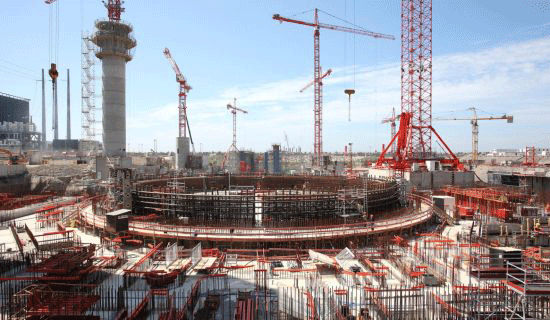
Safety Fears Raised at French Reactor, NYTimes.com, By PATRICIA BRETT July 26, 2010, PARIS — Anti-nuclear activists are seeking to halt construction of France’s latest-generation nuclear power plant at Flamanville, on the Normandy coast, arguing that changes introduced to solve problems with the reactor’s fuel pellet cladding have invalidated the plant’s original building permit.
Didier Anger, head of the anti-nuclear action committee Crilan, and a former member of the European Parliament, said the bid to block, or at least delay, construction of the EPR reactor had been made in a letter this month from the committee to the French nuclear safety authority, the A.S.N.
Changes to the initially proposed cladding design would affect the operating economics of the reactor and would present “a serious safety problem,” Mr. Anger said. The safety regulator had not yet responded, he added by telephone last week.
Areva, the state-controlled French nuclear engineering company, is already battling construction delays and cost overruns at both Flamanville and Olkiluoto, in Finland, where it is building the first of its EPR plants. EPR originally stood for European Pressurized Reactor, a name that Areva subsequently changed to Evolutionary Power Reactor when it sought U.S. certification………………
Spanning 10 years from 1999 to 2009, the documents, published by the coalition, Sortir du Nicleaire, referred to a major redesign of the core because original plans did not meet safety criteria, and indicated that despite the revamping, some issues remained unresolved. They also documented efforts by EDF to conceal unfavorable data from the A.S.N. while trying to persuade the regulator to relax safety requirements.
The documents referred specifically to Flamanville, but all EPR plants have the same basic design, according to national nuclear regulators in France, Finland and Britain, which is also considering EPR construction proposals.
Special Report – Energy – Safety Fears Raised at French Reactor – NYTimes.com
1 Comment »
Leave a comment
1 This Month
Chernobyl: The Lost Tapes – A good documentary on Chernobyl on SBS available On Demand for the next 3 weeks– https://www.sbs.com.au/ondemand/tv-program/chernobyl-the-lost-tapes/2352741955560

of the week–London Campaign for Nuclear Disarmament

Tell the Ukrainian Government to Drop Prosecution of Peace Activist Yurii Sheliazhenko
To see nuclear-related stories in greater depth and intensity – go to https://nuclearinformation.wordpress.com
-
Archives
- April 2026 (126)
- March 2026 (251)
- February 2026 (268)
- January 2026 (308)
- December 2025 (358)
- November 2025 (359)
- October 2025 (376)
- September 2025 (257)
- August 2025 (319)
- July 2025 (230)
- June 2025 (348)
- May 2025 (261)
-
Categories
- 1
- 1 NUCLEAR ISSUES
- business and costs
- climate change
- culture and arts
- ENERGY
- environment
- health
- history
- indigenous issues
- Legal
- marketing of nuclear
- media
- opposition to nuclear
- PERSONAL STORIES
- politics
- politics international
- Religion and ethics
- safety
- secrets,lies and civil liberties
- spinbuster
- technology
- Uranium
- wastes
- weapons and war
- Women
- 2 WORLD
- ACTION
- AFRICA
- Atrocities
- AUSTRALIA
- Christina's notes
- Christina's themes
- culture and arts
- Events
- Fuk 2022
- Fuk 2023
- Fukushima 2017
- Fukushima 2018
- fukushima 2019
- Fukushima 2020
- Fukushima 2021
- general
- global warming
- Humour (God we need it)
- Nuclear
- RARE EARTHS
- Reference
- resources – print
- Resources -audiovicual
- Weekly Newsletter
- World
- World Nuclear
- YouTube
-
RSS
Entries RSS
Comments RSS
 nuclear-news
While the cost overruns and delays are certainly worrisome, it is the failure of all 5 investment risk categories which should really slow down nuclear boosters, unless they are comfortable using non-market investment solutions. Here is what CitiBank has to say (plot spoiler, forget new reactors) tinyurl.com/citiseznonukes
For why nuclear fails as a climate solution as well see Amory Lovins excellent analysis at tinyurl.com/forgetnuclear