To Fukushima and Back with Hiro
To Fukushima and Back with Hiro
http://notesfromhadano.wordpress.com/2014/11/30/to-fukushima-and-back-with-hiro/
(This is Google’s cache of http://notesfromhadano.wordpress.com/2014/11/30/to-fukushima-and-back-with-hiro/. It is a snapshot of the page as it appeared on 30 Nov 2014 02:01:31 GMT. The current page could have changed in the meantime.)
http://notesfromhadano.wordpress.com/author/iidaruth/
A Japanese man sits on the floor of a 4-mat-sized room, staring at a TV set neatly fitted into a corner. There’s enough room for the man, the TV, and a low plastic coffee table. Clean clothes and hung on hooks along the wall, and laundry hangs from the curtain rail. What’s the story here?

I asked that question to photo journalist Hiro Ugaya as we pored over his photos from a recent trip to Fukushima. “He’s an old friend,” said Hiro, “whose wife and son have evacuated to Yamagata. He’s been looking for work for six months, but the only available jobs are related to decontamination or decommissioning of the crippled nuclear power plant, and he doesn’t want to resort to either of those options. Still, as bad as the situation is in Fukushima, the economy’s worse in Yamagata, so he stays where he is.”

Hiro, a native of Kyoto living and working in Tokyo, has made nearly 50 trips back and forth to Fukushima since the triple disaster of 3/11, capturing scenes of life near the evacuation zone with his trusty Canon Mark3 5D. Read more about him here. He travels alone, going as far north as possible by train and then renting a car in Fukushima to drive along the coast. This month, he visited his friend Watanabe-san (pictured above), and stayed at a local hotel filled with temporary workers hired from all parts of Japan to do decontamination work in the outer regions of the evacuation zone. “Business is booming,” said Hiro, “but only if you want to work in irradiated areas.”
Although Hiro took hundreds of photos from the various coastal towns near the disabled Daiichi power plant, I want to focus mainly on his photos from Iitate Village. They reflect the slow but steady progress of the Herculean task of decontamination and serve as a sobering reminder of the sheer ugliness and shame of what happened in Fukushima. All photos in this post are Hiro’s, and all but one are from his recent November trip.

Iitate Village (pronounced EE-ta-tay), a highland farming area northwest of the crippled nuclear power plant, lies outside of the designated 30 Kilometer radius of the government-determined evacuation zone. But those of you who have followed the story, know that on March 15th, a gusty winter wind blew particles of radiation straight toward the mountains of Iitate. The wind was accompanied by snow, which blanketed the entire area. Stores, schools, houses, trees, rice paddies, vegetable gardens, and grazing pastures were all heavily contaminated, though no-one guessed at first because of the village’s physical distance from the center of the nuclear disaster. Of course, the evacuation map was drawn as a perfect circle, with multiple rings indicating distance from the radius, and Iitate was far from that radius. If only radiation travelled so neatly, without regard to weather or topography, right?

The evacuation of Iitate did not begin until April 22nd (over a month after the meltdown and the explosions occurred) and was not finished until late August of 2011; residents were inadvertantly exposed to high levels of radiation as well as emotional stress and confusion. For many of the elderly people who evacuated from Iitate and are still in temporary housing, living with depression, disappointment, and lingering sadness has become the new normal. Worse yet, residents from towns near the epicenter of the accident were also exposed to excess radiation when they were initially relocated to Iitate, which was considered a safe refuge shortly after the meltdowns. This was a tragedy that could have been prevented if the central government (not wanting to “incite panic”) had released a map known as SPEEDI, containing specific data regarding the path of the plume of radioactivity. You can read about it here, in an early blog entry from 2012.
So what’s the story on Iitate now, more than three years down the road? Well, some readers may be surprised to learn that although the level of radiation in many areas of Iitate remains high, the village is no longer “off-limits”. Former residents can now come and go freely and decontamination work is progressing–slowly, painstakingly–in hopes that the village will be revitalized. The mayor is determined that it will be. The problem is that Iitate is bordered by forestland. Since the nuclear disaster, trees are now cesium repositories, and many traditional houses in the village are situated in close proximity to sheltering groves, which serve as windbreaks. The trees that once sheltered homes have now contaminated them, and they are uninhabitable.

The central government does not consider forestland “residential”, and does not place a high priority on decontamination of the trees that define residents’ backyards. The reality is that many local residents must either abandon their homes, or attempt to “clean” the forestland lying closest to their houses, essentially stripping the forest of its ecosystem. Think of Iitate as a mountainous forest which humans have made habitable by clearing and cultivating the land for generations. Now it is

impossible to guarantee the safety of the land for humans without destroying the ecosystem itself, which is steeped in cesium, from the shiitake mushrooms that flourish in the contaminated forest to the wild boars that feed on the mushrooms. Cesium from the forest is carried down to the village with each rain or snowfall, and previously cleared terrain is re-contaminated. On the flat areas below the forest, work progresses at a painfully slow rate, and deadlines that prove impossible to adhere to are continually being re-assessed and re-determined. Booming business for the decontamination workers means a longer exile for residents still hoping to return in the near future.
The above assessment sounds and is harsh, but there is another vision. Many residents of Iitate and of similar small villages and towns in Fukushima believe that the land can be rescued and revitalized without destroying the ecosystem. You can read more about them in this transcript of an NHK broadcast from December 2013. Although the English translation reads imperfectly, the photos, personal stories and quotes from local residents gathered by Swiss journalist Susan Boos are food for thought.

Unlike the land around the Chernobyl nuclear disaster site, which was left to revert to its natural state, Fukushima’s contaminated areas are being stripped, scrubbed, plowed, drained, and stirred up; Boos wanted to know why. The transcript describing her visit to Iitate Village is interesting because it makes no mention of the decontamination work being funded by the central government, focusing instead on the efforts of individual farmers who have lived and worked in Iitate for generations. Frustrated with the slow pace of the clean-up, Iitate residents have been doing things their own way, taking detailed measurements of radiation levels, creating radiation maps, and developing alternative methods for reducing the effects of cesium in the soil.
“From now on,” says Iitate farmer Muneo Kanno in the transcript, “we will need to coexist with nature in this contaminated area over many generations. In other words, I think it’s our job to collect all the data we can about contamination and pass it on to the future generations….I strongly believe that this is the first and foremost role both for me and all the other local people.”

Kanno and other volunteer farmers and researchers are committed to accurately evaluating the state of their land, recording their findings, and experimenting with solutions. For them, decontamination is “Not just to remove everything, to wash, to brush and to think now the problem is done.” Boos, who has travelled the world reporting on the conditions of nuclear disaster sites, was deeply impressed by the devotion of the Iitate farmers to their land and by their determination to preserve it for future generations. The transcript reads, “Susan has travelled to many parts of the word, but this is the first time for her to be exposed to such deep affection for someone’s home.”
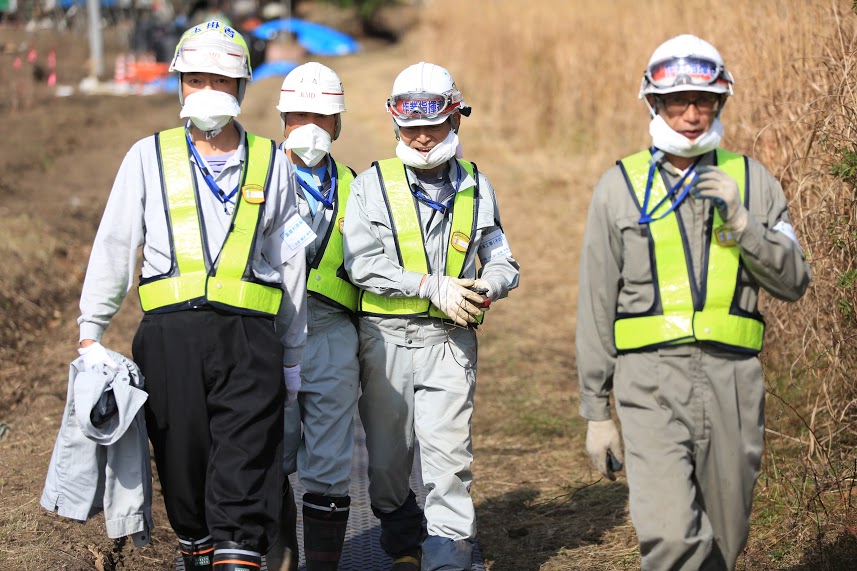
So who actually lives in Iitate Village right now? As of September 2014, a few hundred people have received permission to return home permanently, based on the location of their land. They are living in the zone that’s deemed “safe”, or at least”safe enough”. The area of Iitate still under decontamination and deemed “uninhabitable” is populated by day-trippers (former residents who commute into the village weekly–or even daily– to check on their houses, pets, or gardens), professional contamination workers, and the occasional journalist like Hiro, collecting stories, measuring radiation, and snapping pictures. It’s a ghost town at night.

On his most recent trip to Fukushima, Hiro, as I mentioned in the beginning of this post, stayed in a local hotel south of the Daiichi nuclear power plant. “I was lucky to get a room,” he said. “It’s always full these days. All guys, and all working in decontamination. ” Since there were no restaurants in town (read: nuclear zone, no tourists), Hiro and the other workers made a mad rush to the 7-11 , which closed at 8 p.m., to buy box lunches for their dinner every evening. According to Hiro, the going rate for a decontamination worker in Fukushima right now is around ¥16,000 a day–approximately $135 U.S. dollars– before money is taken out by contractors and sub-contractors. Is it worth the money? That’s something that every man ( I saw no women in any of the photos) must come to terms with on his own.
From here on in, I will let Hiro-san’s photos speak for themselves. You can read more about Iitate’s mountains of trash bags full of contaminated soil in this Japan Times article, which describes the current plan to build a 22 million cubic meter temporary waste storage facility in the Okuma/ Futaba area, home of the crippled power plant. That’s a space big enough to fill the Tokyo Dome Stadium 15 times. And you can read more about the plight of the old folks who have evacuated from Iitate and other neighboring towns in this article by The Guardian’s Justin McCurry. And you can support the excellent work of free lance journalists like Hiro Ugaya by passing on their words and images. Take a look at more of his stunning photos and read about his life here. I’ll post some of my favorites as well. Thank you for reading, and take care.


Fukushima radiation has killed two US sailors?
CBS: Now 2 US sailors dead after Fukushima radiation exposure — Doctor: Officials have to re-look at this entire situation — Reporter who served on USS Reagan: “We were done so wrong… Critical health risk to all of us onboard… People are not realizing how serious the issue is” (VIDEO) http://enenews.com/cbs-2-sailors-dead-after-fukushima-radiation-exposure-reporter-served-uss-reagan-feel-like-wrong-critical-health-risk-all-onboard-feel-people-realizing-serious-issue-video?utm_source=feedburner&utm_medium=email&utm_campaign=Feed%3A+ENENews+%28Energy+News%29
California State University, Northridge, Nov 12, 2014: Little did [U.S. Navy veteran Kelli Serio, 25] know her service would change the way she viewed the system she vowed her loyalty to… Serio may have been affected by radiation during what she calls her “final and most personally sacrificing deployment” in Japan… at 18, she enlisted in the U.S. Navy [and] was deployed off Japan’s coast… to assist with the cleanup of the Fukushima nuclear plant. While there, her carrier acted as a floating fuel station… Serio said she’ll never forget the day her captain said their water filtration system had been compromised… “I feel like we were done so wrong,” Serio said. “We were drinking the water.” Serio said she and the other 70,000 first responders have been dismissed by the government as if nothing happened out there. She wants justice…
Serio’s team-like mentality has also led to her modeling with organizations like Pin-Ups for Vets… to help bring up the morale of veterans and current soldiers [and] bring awareness to the men and women who’ve served their country through speaking engagements and visiting patients at veteran hospitals… [E]arlier this year… she met her friend and mentor, Fox News reporter Hollie McKay [who recommended] Serio for a reporter position at [breitbart.com]… Her first piece for the website was a first-hand account of and a look back at Operation Tomodachi.
Tahlequah Daily Press, Aug 7, 2014: USS Ronald Reagan… passed through radiation plumes and clouds… the ship and most of those onboard, tested positive for radiation exposure… Serio, now a broadcast journalism major at [CSUN], has recently written a column… on breitbart.com. “I feel as if people are not realizing how serious the issue is, and I would like to shed as much light on it as possible,” said Serio.
Breitbart, by Kelli Serio, Jul 23, 2014: I was onboard the USS Ronald Reagan [and went] directly through a radiation cloud. The commanding officer warned us that our water and ventilation systems had been contaminated, posing a critical health risk to all of us onboard. We were advised to refrain from showering or drinking water… Sailors worked tirelessly… while being left vulnerable to dangerous levels of radiation… most of us onboard the ship were tested for radiation exposure and many came back positive, resulting in full-body scrubdowns… [W]e were issued gas masks… myself and other junior sailors were asked to don protective garments in an effort to decontaminate the ship… Proper medical care for the victims of radiation exposure [is needed, it’s a] dire situation for many… Many of us are enduring the unfortunate consequences [and] hoping for care from the VA that appears to never arrive… we are reassured of our good health, despite the presence of mysterious and unexplained symptoms… A lack of coverage by the mainstream media has left victims without a voice… We do not want to be forgotten.
CBS San Francisco, Nov 21, 2014: Rare cancers, blindness, birth defects and now, two deaths. Hundreds of U.S. sailors… say they were exposed to dangerous levels of radiation… [Steve] Simmons… began feeling weak and sick with uncontrolled fevers… Soon he was in a wheelchair, unable to walk. He says military doctors would never tell him what was wrong. “Every one of them wanted to discredit radiation as a possible cause,” Simmons said… “[There’s] evidence that the doses that were assumed to be on board the USS Reagan may have been under-reported,” said Dr. Robert Gould, a former Kaiser pathologist… “Given that there is more information that has come out, I think you would have to re-look at the entire situation,” said Dr. Gould. >> Watch the CBS broadcast here
Nuclear power outdone by renewable energy in Scotland
 Renewable energy overtakes nuclear as Scotland’s top power source, Guardian, Jessica Shankleman 27 Nov 14 Clean energy produced more power in Scotland than nuclear, coal or gas for the first time, in first half of 2014 industry figures show, reports BusinessGreen
Renewable energy in Scotland from wind farms, hydro power plants and other clean technologies provided the single largest source of electricity to the country for the first time, in the first half of 2014, new industry figures will show on Thursday.
Analysis by the trade body Scottish Renewables shows that renewables produced nearly one third more power than nuclear, coal or gas in the first six months of the year, generating a record 10.4 terawatt hours (TWh) during the six-month period.
The analysis was compiled by comparing Energy Trends data produced by the Department of Energy and Climate Change (Decc) on renewable energy output with figures produced by National Grid on coal, gas and nuclear power.
Many renewable energy sources do not feed into the National Grid, and instead are part of a local distribution network, meaning it is difficult for National Grid to compare how renewables are fairing compared to traditional sources of energy.
Niall Stuart, chief executive of Scottish Renewables, said the record figures marked “an historic” moment for the renewable energy industry, as well as a major milestone for the Scottish government’s plans to generate 100% of its electricity from renewable sources by 2020…….
Scotland’s Business, energy and tourism minister, Fergus Ewing, said the figures highlight the potential that renewable energy has to replace nuclear power.
“The fact that energy from renewables has exceeded that from nuclear in the first half of 2014, highlights the vast potential of renewable generation to provide a safe, secure and cost-effective means of electricity generation for this country, together with appropriate levels of thermal generation,” he said. “It is vital that appropriate support for renewables in Scotland is maintained following the introduction of electricity market reform in the UK.”…….http://www.theguardian.com/environment/2014/nov/27/renewable-energy-overtakes-nuclear-as-scotlands-top-power-source
Indian Point nuclear complex should be closed, not re-licensed, as nuclear spent fuel problem increases
 No Yucca Mountain, and more Indian Point concerns http://www.lohud.com/story/opinion/contributors/2014/11/22/yucca-mountain-spent-nuclear-fuel-storage-stall-shut-indian-point/19288749/ Peter Schwartz November 22, 2014
Indian Point nuclear complex in Buchanan is safe, the Nuclear Regulatory Commission says. But with no long-term spent fuel storage on the horizon, safety mandates a closure of the facility’s reactors that are amid relicensing.
The Nuclear Regulatory Commission is sending mixed signals about nuclear waste from power plants. It recently issued new rules encouraging continued long-term storage of waste on site at the plants and denied environmentalists’ contention that waste buildup at Indian Point nuclear facility in Buchanan was a problem. On the other hand, NRC recently resumed safety evaluations of a proposed national nuclear waste repository at Nevada’s Yucca Mountain.
Whether that means the idea of transporting the waste to Yucca Mountain is alive again is unclear, though it’s quite clear that the NRC doesn’t consider spent fuel buildup any obstacle to continued operation of aging nuclear plants. Meanwhile, for New Yorkers and tri-state area residents, the spent fuel building up at Indian Point is a growing threat.
 “Spent” nuclear fuel is a misnomer. It’s much more dangerous than “unspent” fuel, since it’s many times “hotter” in terms of radioactivity and thermal heat when it comes out of a reactor than when it goes in. Spent fuel rods have high concentrations of lethal isotopes like strontium 90, iodine 131 and cesium 137. They emit 1 million rems of radiation an hour a foot away, enough to kill in seconds, and release part of their energy as heat. They can’t be handled or moved until they’ve cooled in special storage pools for at least five years (spent “High Burnup Fuel” has twice the radioactivity of other spent fuel, and can’t be moved from the pools for 20 years).
Lessons of Fukushima
Aerial photos of the Fukushima disaster illustrated the dangers of storing spent fuel at nuclear plants. Explosions tore the roofs off fuel pools, exposing shoddy construction and more spent fuel than the pools were ever designed to hold, leaving nothing but leaking water between concentrated, lethal radioactivity and the environment.
Our spent fuel situation isn’t like Japan’s. It’s worse. The U.S. has 30 million spent fuel rods, more than any other nation. They’re stored in pools housed in unfortified shed buildings one expert called “the kind you would find in big box stores and car dealerships.” Without a geologic repository like Yucca Mountain, the waste accumulated at nuclear plants, and these vulnerable buildings are now the largest concentrations of radioactivity on the planet.
As of 2011, Indian Point’s spent fuel pools, 25 miles north of Manhattan with 20 million people in a 50-mile radius, contained an estimated 234 million curies and counting. That’s three times the radioactivity of all the fuel pools in the Fukushima complex combined. The 40-year-old pools are deteriorating, leaking tritium- and strontium-laced water into groundwater and the Hudson.
To keep the reactors running until Yucca Mountain was supposed to open in 2010, Indian Point repeatedly “reracked” its pools, putting more spent fuel rods into them than they were designed to hold, packing them more closely together. That increases the risk of “criticality” – accidental nuclear reaction between the rods – that could boil the water, ignite the rods and release their radiation. Boron absorbers built into the racks to shield radiation are degrading, aggravating the risk.
Stop buildup, close plant
When Yucca Mountain failed to materialize, Indian Point began removing some of the fuel rods that had been in the pools the longest and cooled the most, and putting them into dry cask storage. But that only makes room for newer, “hotter” spent fuel, increasing net radioactivity in the pools, while yet more spent fuel accumulates in casks on the ground.
The faster we reverse this buildup and secure the waste, the better. Whether or not a geologic repository ever gets built, we can mitigate spent fuel danger now by shutting down Indian Point’s reactors. Every day they continue to run, they make more “hot” waste, concentrating yet more radioactivity on site. With Indian Point’s 40-year operating licenses expiring, its owner, Entergy, is seeking a 20-year extension, which would only compound the spent fuel problem.
As an engineer who built a business near Indian Point, I’m not especially skeptical of nuclear technology or the idea of a geologic repository. But as a lifelong local resident who developed thyroid cancer, which correlates with radiation exposure, I am highly skeptical of the way that keeping the plant’s reactors running and Entergy’s profits flowing seems to trump confronting safety problems at the plant. Indian Point’s spent fuel is a serious threat to the health, safety and economy of our region. To defuse it, we first need to stop making more waste, by closing the reactors as their licenses expire.
The writer, a Montebello resident, is a mechanical engineer who lives and owns a manufacturing business in Rockland County, within 10 miles from the Indian Point nuclear power plant.
Japanese nuclear power company aims to keep reactors going way beyond their present license limit
Kepco wants to extend lifespan of 40-year-old Takahama reactors to 60 years JAPAN TIMES BY ERIC JOHNSTON NOV 26, 2014 Kansai Electric Power Co. said Wednesday it hopes to apply for a 20-year extension for two aging reactors that are close to the end of their 40-year approved life cycle, and plans to soon begin inspections which are a prerequisite for the move…… (registered readers only) http://www.japantimes.co.jp/news/2014/11/26/national/kepco-wants-extend-lifespan-40-year-old-takahama-reactors-60-years/#.VHleldLF8nl
Deeper problems underlie the serious errors at America’s Waste Isolation Pilot Plant (WIPP)
New Mexico nuclear waste accident a ‘horrific comedy of errors’ that exposes deeper problems Jim Green, 27 Nov 2014, The Ecologist February’s explosion at the WIPP dump for long-lived intermediate-level nuclear waste from the US’s nuclear weapons program remains unexplained, writes Jim Green. But with the site’s history of ignored warnings, ‘missing’ safety culture, lack of supervision and dubious contractor appointments, it surely came as no surprise − and further accidents appear inevitable.
The precise cause of the February 14 accident involving a radioactive waste barrel at the world’s only deep geological radioactive waste repository has yet to be determined, but information about the accident continues to come to light.
The Waste Isolation Pilot Plant (WIPP) in New Mexico, USA, is a dump site for long-lived intermediate-level waste from the US nuclear weapons program. More than 171,000 waste containers are stored in salt caverns 2,100 feet (640 metres) underground.
On February 14, a heat-generating chemical reaction − the Department of Energy (DOE) calls it a ‘deflagration’ rather than an explosion − compromised the integrity of a barrel and spread contaminants through more than 3,000 feet of tunnels, up the exhaust shaft, into the environment, and to an air monitoring approximately 3,000 feet north-west of the exhaust shaft.[1] The accident resulted in 22 workers receiving low-level internal radiation exposure.
Investigators believe a chemical reaction between nitrate salts and organic ‘kitty litter’ used as an absorbent generated sufficient heat to melt seals on at least one barrel. But experiments have failed to reproduce the chemical reaction, and hundreds of drums of similarly packaged nuclear waste are still intact, said DOE spokesperson Lindsey Geisler. “There’s still a lot we don’t know”, she said.[2]……….
Compromised response to the accident
A degraded safety culture was responsible for the accident, and the same failings inevitably compromised the response to the accident. Among other problems:[4,6]
- The DOE contractor could not easily locate plutonium waste canisters because the DOE did not install an upgraded computer system to track the waste inside WIPP.
- The lack of an underground video surveillance system made it impossible to determine if a waste container had been breached until long after the accident. A worker inspection team did not enter the underground caverns until April 4− seven weeks after the accident.
- The WIPP computerised Central Monitoring System has not been updated to reflect the current underground configuration of underground vaults with waste containers.
- 12 out of 40 phones did not work so emergency communications could not reach all parts of WIPP in the immediate aftermath of the accident.
- WIPP’s ventilation and filtration system did not prevent radiation reaching the surface, due to neglect.
- The emergency response moved in slow motion. The first radiation alarm sounded at 11.14pm. Not until 9.34amdid managers order workers on the surface of the site to move to a safe location.
Everything that was supposed to happen, didn’t. Everything that wasn’t supposed to happen, did.
Jim Green is editor of Nuclear Monitor and national nuclear campaigner with Friends of the Earth, Australia. This article was originally published in Nuclear Monitor No. 794, November 2014. http://www.theecologist.org/News/news_analysis/2642182/new_mexico_nuclear_waste_accident_a_horrific_comedy_of_errors_that_exposes_deeper_problems.html
Drone photography shows the decayed Chernobyl area
 A drone’s-eye view of CHERNOBYL: Eerie footage reveals a city left to decay after devastating nuclear disaster, Daily Mail Australia 28 Nov 14 (Incl video and photos)
- Pripyat was just miles from the Chernobyl plant which exploded in 1986
- Drone footage was captured by Devon-based filmmaker, Danny Cooke
- He used a DJI Phantom 2 quadcopter, a Canon 7D camera and a GoPro3+
- It shows haunting views of abandoned fairground rides and buildings
- ‘There was something serene yet disturbing about this place,’ said Cooke
By ELLIE ZOLFAGHARIFARD FOR MAILONLINE, 28 November 2014 |
A frozen Ferris wheel, poisoned forests and paint sloughing off an empty swimming pool; these are the remains of a city devastated by a nuclear disaster nearly 30 years ago.
Pripyat in Ukraine, once home to a population of 50,000, was just a few miles from the Chernobyl power plant which exploded in 1986.
Now, a Devon-based documentary maker, Danny Cooke, has captured the area in decay by flying around the abandoned area using a camera attached to a drone
The footage shows Pripyat being taken over by nature. Eerie views of rusted bumper cars and scattered papers are placed alongside golden flowers and trees growing among buildings.
While many images have emerged of Pripyat since the disaster, this footage is the first to provide a drone’s-eye view of its abandoned remains……….http://www.dailymail.co.uk/sciencetech/article-2851
The UK follows Japan in determining extent of nuclear “Transparency” by extending secrecy and protecting corruption!
As the Japanese Secrets Act implementation looms on 10th December 2014, I thought it appropriate to remind our UK viewers that the new UK Secrets Act has already been Implemented from April 2nd 2014.. And as the nuclear Information will be retroactively applied, you can see, as why I had to leave the UK.
Will the Japanese who disseminates health and nuclear information have to do the same? Will the new Japanese Secrets Act apply retroactively too?” Documents created prior to this date will continue to carry their existing markings until such time as they are amended in the normal course of work when the new markings will be applied at the same time.”
Posted by Shaun McGee (aka Arclight2011)
And this link for info on the Japanese Secrets Act;
https://nuclear-news.net/2014/09/29/japans-secrecy-law-and-international-standards-%e7%89%b9%e5%ae%9a%e7%a7%98%e5%af%86%e4%bf%9d%e8%ad%b7%e6%b3%95%e3%81%a8%e5%9b%bd%e9%9a%9b%e5%9f%ba%e6%ba%96-japan-focus/

OFFICIAL
OFFICIAL-SENSITIVE
SECRET
TOP-SECRET

http://www.sellafieldsites.com/2014/03/new-government-security-classifications/
New Government Security Classifications
7 March 2014
In 2012 Francis Maude, Minister for the Cabinet Office, announced the intention to fundamentally overhaul and replace the existing information classification and marking scheme as part of the government’s Civil Service Reform programme.
Sellafield Ltd’s security regulator, ONR (Office for Nuclear Regulation), have instructed Sellafield Ltd and the wider civil nuclear industry to adopt the new GSC protective marking scheme known as Government Security Classifications (GSC).
Government Security Classifications
The new three tier system has three classifications: OFFICIAL, SECRET and TOP-SECRET.
Additionally ONR have mandated the use of an additional classification: OFFICIAL-SENSITIVE for Sensitive Nuclear Information which is classified below SECRET.
Implementing GSC
In line with the rest of UK government, the new GSC scheme is coming into operation on April 2nd 2014. All documents (including commercial correspondence, drawings, specifications, data sheets etc) created by…
View original post 538 more words
WHERE DOES FUKUSHIMA GO – Pacific and Atmosphere

By Marushka France
WHERE DOES FUKUSHIMA GO UPON ENTERING THE OCEAN?
September 25, 2013 [Last Update Feb 111,2014]
PREFACE
Radionuclides go everywhere. The first fallout did fall, first or highest to least amount (both ocean and landfall):
Coast of North America into north Pacific, Bering Strait, Alaska, Canada, Pacific Northwest of USA
(Washington and Oregon), California and Baja California/Mexico, and then EASTward around the globe. Back sweep also hit Japan hard, of course, far east Asian continent (Russia, Korea)… Initial fallout at least ast far as 1,700 km from Fukushima. (as reported in enews).
Pure Propaganda
As predicted, IAEA is about control of information – propaganda – and not transparency, not disclosure. IAEA is the pro-nuclear body for U.N., overrides anything and everything W.H.O. can say or do.
As an example, this recent ‘report’ (cough-cough) – this piece of propaganda issued by IAEA — expects us to believe that NO contamination from Fukushima will reach NorthAmerica! Absolutely preposterous!
http://www-pub.iaea.org/MTCD/Meetings/PDFplus/2013/cn207/Presentations/1028-Aoyama.pdf

Not Valid for Tracking Radionuclides – NOAA tsunami map
A) Often used, the NOAA TSUNAMI MAP IS NOT the same as radionuclides (aka radioistopes) making its way across the Pacific to other shores:
NOAA.org >> the initial Tsunami http://nctr.pmel.noaa.gov/honshu20110311/
One year later http://www.noaa.gov/features/03_protecting/japantsunami_oneyearlater.html
B) ‘Thumbs down’ on tracking plastics http://adrift.org.au/fukushima This one also ignores the far north, Bering Sea, and we know that got hit.
C, Certainly we do want to track the debris from Japan, it could be a mammoth problem, not sure how much radioactivirty might be involved: Washington blog article includes Japanese debris distribution of U of Hawaii – I would NOT assume debris of various sizes, weight, dimensions and type to behave the same as radioisotopes. Nor do we know if they got hit with radionuclide contamination. Plastics tracked across Pacific, again, not the same as radioisotopes, cannot expect the same behavior of unlike material.
11.11.2013 SYNOPSIS
There is a difference between radionuclides spreading across the Pacific and debris from the tsunami… How it travels, variable depths… Briefly: radionuclides’ fallout on to land and rivers and (both) travels to the ocean, radionuclides tend to coalesce and float together (referred to as pools, clouds or streams); settle in at about 1-100 meters depth, travel along ocean currents (varies by weight).
In the ocean, uranium buckyballs flew across the ocean’s surface in days after 311; radionuclides also biomagnify up the food chain; can be estimated by the degree of plankton uptake; concentrates in seawater, sea spray and is especially troublesome along coastlines – the entire Pacific rim.
Radionuclides also find their way back into the ATMOSPHERE via the natural water (hydrolic) cycle. Radionuclides traveling up with evaporation process is called ‘resuspension,’ thus finding its way to be redistributed on land wherever rain falls. The life-giving micronutrients from the ocean – the source of life and 50-85% of the oxygen in our world, is thus transformed into genomic instability, every possible breakdown of systems that sustain all life… e.g. death. Call it ecocide or omnicide, the more we pollute our environment, the more we pollute ourselves. The global growth of chronic disease is in step with the spread of man-made radioisotopes and man-made chemicals…. it destroys the ‘stuff of life’ as we know it.
WHERE DOES FUKUSHIMA GO UPON ENTERING THE OCEAN?
Tracking Radionuclides aka Radioisotopes
‘Plume’ is being used to address both Atmospheric (NOAA) and sometimes ‘into the ocean’ dispersal as well. Important to notice the distinction and be clear which one we mean when we post or write about Fukushima. Likewise, ‘cloud’ is being used to describe the coalescing of radioisotopes in pools that float and move together. Another study calls it ‘rivers’ or ‘streams’. Be very clear in disseminating information.
1. The first detection, of course, “The Comprehensive Nuclear-Test-Ban Treaty (CTBT) is meant to deter nuclear explosions by everyone, everywhere: on the Earth’s surface, in the atmosphere, underwater and underground. (All nukes have their own chemical ‘signature as well.)http://www.ctbto.org/verification-regime/the-11-march-japan-disaster/
2. Buckyballs Uranium UC Davis Study
http://www.enviroreporter.com/investigations/fukushima/a-radioactive-nightmare/
(this site mistakenly used tsunami map to represent the spread of radioisotopes across the Pacific)
http://www.pnas.org/content/109/6/1874.abstract?sid=ae203ffc-1b97-4e17-b87f-6114a5936f2
0riginal paper: Uranyl peroxide enhanced nuclear fuel corrosion in seawater
3. Multi-decadal projections of surface and interior pathways of the Fukushima Cesium-137 radioactive plume
http://www.sciencedirect.com/science/article/pii/S096706371300112X
4. [German] Model simulations on the long-term dispersal of 137Cs released into the Pacific Ocean off Fukushima
http://iopscience.iop.org/1748-9326/7/3/034004/article and with soundt he limitations of the study are well spelled out, read the whole thing, watch their video, it is very informative.
5. Various agencies have done plume modeling estimates. These take weather conditions and releases and estimate where the radioactive releases went or will go.
http://www.fukuleaks.org/web/?page_id=9971
6. NOAA and Navy dispersion model “”Science On a Sphere”
http://www.sos.noaa.gov/Datasets/dataset.php?id=332
The Hybrid Single-Particle Lagrangian Integrated Trajectory (HYSPLIT) model Same model used
http://www.fukuleaks.org/web/?page_id=9971
7. The U.S. Geological Survey (USGS) collaborated with the National Atmospheric Deposition
Program in an effort to monitor North American precipitation samples for the presence of nuclear fallout in response to the Japan Fukushima Dai-ichi Nuclear Power Station incident that occurred on March 11, 2011.
http://nadp.sws.uiuc.edu/fukushima/
8. Radionuclides (aka radioisotopes) like Strontium will collect in ‘rivers’ or ‘streams’ of
contamination… (SEE ALSO #10b and #11) will not ‘dilute’… Evidence of bioaccumulation in species, biomagnification- denser concentrations in the Pacific, as well as remaining in collective rivers and streams of its own making are derived from decades-long research chemical changes interacting with the salt… all speak to multiple, deadlier pathways
http://fukushima-diary.com/2012/05/strontium-90-spread-over-1000km-evenly-in-pacific-ocean/in this article of yours:>>>>>
1. Strontium 90 exists ~ 17-62 % cesium 134/137; Ministry of Education, Culture, Sports, Science & Technology assumed it would be 0.1 %.
2. Strontium90 evenly spreads from 170km offshore Chiba to 1000km southeast to Japan. spreads from 1m to 100m deep in the sea as well.
9. Cesium, iodine and tritium in NW Pacific waters
A comparison of the Fukushima impact with global fallout
http://www.biogeosciences.net/10/5481/2013/bg-10-5481-2013.html
10. Concentration & RESUSPENSION of Radionuclides from ocean back into atmosphere brings the fallout inland – AGAIN – and contaminates through rainfall & snowfall…
10a In the ocean, radionuclides become concentrated Marine plankton as an indicator of low-level radionuclide contamination in the Southern Ocean
[SciTech Connect] by Marsh, K.V.; Buddemeier, R.W. 1984
in the ocean STRATIFIED about 100m ~> into the atmosphere ~> into the rainfall everywhere…
globally(from the era of atomic bomb tests in the Pacific) [added 11.11.2013]
http://www.osti.gov/bridge/servlets/purl/6802363-hfGOhq/6802363.pdf
”On May 16, 1958, the Wahoo event was detonated underwater two miles south-west of Enewetak.
Plankton sampling was begun as soon as possible, and at H + 6 hours the major part of the total
radioactivity was found in the top 25 m and about one-eighth at the thermocline, 110 m. By H + 28 hoursthe activity was distributed through the upper half of the mixed layer to about 50 m, but by H +• 48 hours it was concentrated at 100 m, the upper edge of the thermocline. At no time was the activity uniformly mixed; it was always stratified”
[The thermocline is the transition layer between the mixed layer at the surface and the deep water
layer. The definitions of these layers are based on temperature.]
10b Through the water cycle
“National Weather Service; Jetstream-Online school for Weather; The Hydrologic Cycle” [water cycle] and returns inland in rainfall
http://www.srh.weather.gov/jetstream/atmos/hydro.htm
Some Radionuclides undergoes ‘RESUSPENSION‘
“The ocean is known to be a major source of atmospheric particulate [ matter]. There is considerable,evidence, however, that the chemical composition of the particles in the marine aerosol is often considerably different from that of seawater. Barker and Zeitlin found enrichment factors for transition metals in the aerosol approaching and exceeding three and four orders of magnitude relative to sodium. Cattell and Scott suggest that a biogenic agent may be responsible for the approximately 20,000-fold enrichment of copper during aerosol production in the ocean. The whole question of fractionation at the sea surface was the subject of a 1976 review article.^’
It seems possible, even likely, that the correlation we observe between radionuclides in plankton
and in the air samples is due, at least in part, to resuspension.”
Because of the ocean spray being concentrated, as well as fog, and the presence of uranium
buckyballs specific to Fukushima, (at least) and the higher likelihood of fish consumption in
coastal areas (internal contamination) — coastal areas might experience a higher likelihood of
internal, radionuclide contamination. [added 11.11.2013]
{this is also why Dr. Busby estimates coastal areas being more likely to have higher rates of cancer… both resuspension and higher likelihood of fish consumption… see his work relative to Sellafield, UK}
11. Further understanding of the damage of the atomic age on our environment, and climate
change
11a Dr. Rosalie Bertell talks about the 5 layers of atmosphere and the “Five Rivers or
Vapours” upon which the flow of air and water – sustains us all.
This entry is solely to support the ‘rivers’ and ‘streams’ metaphor as very real, not discovered until mid-Century [and a part was quickly destroyed by an atomic bomb] and how fast esp jetstream moves, hownthe planet has its own highways, byways, …. circuitous routes – types and pathways — in the atmosphere and in the oceans and seas.
Rosalie Bertell – Space Weapons of War – part 1 of 4 – PLANET EARTH
http://www.youtube.com/watch?v=qaSkCZ_Dcg0
11b blog by Jan Hemmer [update 11.11.2013]
“Nuclear Industry kills Ozone Layer and stops Oxygen production in Oceans”
July 21, 2013 by Mikkai
Source : Marushka France
BUY NOTHING DAY – 28 – 29 November
 Buy Nothing Day 28 Nov – North America 29 Nov International https://www.adbusters.org/campaigns/bnd
“Today, humanity faces a stark choice: save the planet and ditch capitalism, or save capitalism and ditch the planet.” – Fawzi Ibrahim
Until we challenge the entrenched values of capitalism – that the economy must always keep growing, that consumer wants must always be satisfied, that immediate gratification is imperative – we’re not going able to fix the gigantic psycho-financial-eco crisis of our times.
That challenge is a deeply personal one: in a world where every inch of the capitalist system is bullying you into submission, can you resist? When advertisers hound you day and night, can you escape? This Black Friday, a massive, absurd, and destructive consumerist machine will coordinate against you for one simple reason – to convince you to max out your credit card to buy shit you don’t need so that a broken system stays afloat. So when they say “BUY!”, will you say NOTHING!”?

Buy Nothing Day is legendary for instigating this type of personal transformation … as you suddenly remember what real living is all about … you sense an upsurge of radical empowerment and feel a strange magic creeping back into your life.
Join millions of us in over 60 countries on November 28/29 and see what it feels like. Then, after Buy Nothing Day, take the next step … for generations, Christmas has been hijacked by commercial forces … this year, let’s take it back.
And why not get playful while you’re at it!? … Put up posters, organize a credit card cut up, pull off a Whirl–mart, or a Christmas Zombie walk through your local mall.
British Politicians are Restless – Hinkley Point Nuclear Plant Might Not Go Ahead
 On the surface, all is well……..But leaks from civil servants in Whitehall suggest that the government may be getting cold feet about its open-ended guarantees…….With a general election in the UK looming in May next year, no decisions will be reached on any of these projects any time soon. And a new government might think renewables are a better bet.
 Renewables Help Push Nuclear Giants to Brink of Collapse, Eco Watch Paul Brown, Climate News Network | November 24, 2014 Plans to build two giant nuclear reactors in south-west England are being reviewed as French energy companies now seek financial backing from China and Saudi Arabia—while the British government considers whether it has offered vast subsidies for a white elephant.
Construction estimates have already escalated to £25 billion, which is £9 billion more than a year ago, and four times the cost of putting on the London Olympics last year.
Costs Escalate
Two prototypes being built in Olikuoto, Finland and Flamanville, France, were long ago expected to be finished and operational, but are years late and costs continue to escalate. Until at least one of these is shown to work as designed, it would seem a gamble to start building more, but neither of them is expected to produce power until 2017.
With Germany phasing nuclear power out altogether and France reducing its dependence on the technology, all the industry’s European hopes are on Britain’s plans to build 10 new reactors. But British experts, politicians and businessmen have begun to doubt that the new nuclear stations are a viable proposition.
Steve Thomas, professor of energy policy at the University of Greenwich, London, said: “The project is at very serious risk of collapse at the moment. Only four of those reactors have ever been ordered. Two of them are in Europe, and both of those are about three times over budget. One is about five or six years late and the other is nine years late. Two more are in China and are doing a bit better, but are also running late.”
Tom Greatrex, the British Labour party opposition’s energy spokesman, called on the National Audit Office to investigate whether the nuclear reactors were value for money for British consumers.
Peter Atherton, of financial experts Liberum Capital, believes the enormous cost and appalling track record in the nuclear industry of doing things on time mean that ministers should scrap the Hinkley plans……..
On the surface, all is well……..But leaks from civil servants in Whitehall suggest that the government may be getting cold feet about its open-ended guarantees. The industry has a long history of cost overruns and cancellations of projects when millions have already been spent—including an ill-fated plan to build a new nuclear station on the same site 20 years ago.
The Treasury is having a review because of fears that, once this project begins, so much money will have been invested that the government will have to bail it out with billions more of taxpayers’ money to finish it—or write off huge sums…….
Since the decision was made to build nuclear power stations, renewable energy has expanded dramatically across Europe and costs have dropped. Nuclear is now more costly than wind and solar power. In Britain alone, small-scale solar output has increased by 26 percent in the last year.
In theory, there are a number of other nuclear companies—from the U.S., China, Japan and Russia—keen to build stations of their own design in Britain, but they would want the same price guarantees as EDF for Hinkley Point.
With a general election in the UK looming in May next year, no decisions will be reached on any of these projects any time soon. And a new government might think renewables are a better bet. http://ecowatch.com/2014/11/24/renewables-push-nuclear-to-collapse/
Climate change brings threat of sea level rise to nuclear power facilities
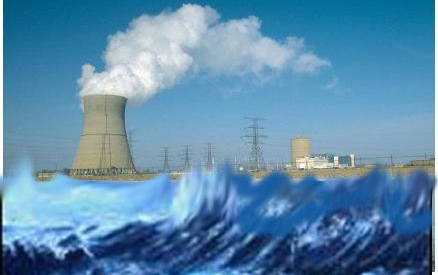 Nuclear power’s dark future Japan Times, 25 Nov 14 BY BRAHMA CHELLANEY “…….New nuclear plants in most countries are located in coastal regions so that these water-guzzling facilities can largely draw on seawater for their operations and not bring freshwater resources under strain.
But coastal areas are often not only heavily populated but also constitute prime real estate. Moreover, the projected greater frequency of natural disasters like storms, hurricanes, and tsunamis due to climate change, along with the rise of ocean levels, makes seaside reactors particularly vulnerable.
The risks that seaside reactors face from global-warming-induced natural disasters became evident more than six years before Fukushima, when the 2004 Indian Ocean tsunami inundated the Madras Atomic Power Station. But the reactor core could be kept in a safe shutdown mode because the electrical systems had been installed on higher ground than the plant level.
In 1992, Hurricane Andrew caused significant damage at the Turkey Point nuclear power plant in Florida, but fortunately not to any critical system. And in a 2012 incident, an alert was declared at the New Jersey Oyster Creek nuclear power plant — the oldest operating commercial reactor in the U.S. — after water rose in its water intake structure during Hurricane Sandy, potentially affecting the pumps that circulate cooling water through the plant.
All of Britain’s nuclear power plants are located along the coast, and a government assessment has identified as many as 12 of the country’s 19 civil nuclear sites as being at risk due to rising sea levels. Several nuclear plants in Britain, as in a number of other countries, are just a few meters above sea level……http://www.japantimes.co.jp/opinion/2014/11/25/commentary/world-commentary/nuclear-powers-dark-future/#.VHYvqNLF8nk
Utilities should avoid the high risk investments of new coal and nuclear power stations
 We Must Discourage Electric Utilities from Making High-Risk Investments Green Energy Institute, 24 Nov 14, By Amelia Schlusser, Staff Attorney
Ceres recently issued an update of its 2012 report, Practicing Risk-Aware Electricity Regulation. The updated report concludes that large fossil fuel and nuclear power plants are the riskiest investments for utilities, and that renewable energy, distributed generation, and energy efficiency are lower-risk investments with potentially lower price tags than baseload alternatives.
According to Ceres, these relative investment risks are driven in part by recent developments in the U.S. electricity sector. Notably, the EPA is poised to regulate carbon emissions from new and existing power plants in the near future. In addition, renewable energy costs have decreased significantly in recent years, and some renewable technologies are either approaching or have already become cost-competitive with fossil fuel resources. Impending carbon regulations and increased deployment of distributed generation and energy efficiency are placing added pressure on entrenched utility business models, and, as GEI’s Nate Larsen recently discussed, regulators are beginning to explore strategies to modernize the grid.
Renewable energy resources such as onshore wind and solar PV are insulated from risks associated with fuel price volatility and emissions regulations, and the levelized costs of these resources are on par or below the levelized costs of fossil fuel resources. Nevertheless, many utility integrated resource plans continue to identify renewables as higher cost, higher risk resource options……….
A carbon emissions allowance program that places a premium on renewable energy generation is one potential strategy to deter investments in high-risk fossil fuel resources, but it is by no means the only available strategy. State public utility commissions should consider revising their resource planning and procurement rules to send a clear message to utilities that investments in baseload fossil fuel plants are not prudent and that zero-emitting resources are in the public interest.
Ratepayer advocates should closely monitor levelized cost projections and oppose investments in resources that are vulnerable to long-term cost increases. And finally, policymakers should ensure that applicable legal and policy frameworks incentivize energy infrastructure development that mitigates ratepayer and taxpayer vulnerability to risk over extended timeframes. Infrastructure constructed today will likely operate for multiple decades, and it is imperative that we discourage investments that will lock-in exposure to rising costs and environmental degradation for years to come. http://greenenergyinstitute.blogspot.com.au/
Nuclear talks with Iran extended for another 7 months
U.S. and Allies Extend Iran Nuclear Talks by 7 Months, NYT, By DAVID E. SANGER and MICHAEL R. GORDONNOV. 24, 2014 “…..Secretary of State John Kerry, trying to put the best face on it, told reporters that a series of “new ideas surfaced” in the last several days of talks. He added that “we would be fools to walk away,” because a temporary agreement curbing Iran’s program would remain in place while negotiations continued. Late Monday night Mr. Kerry’s negotiating partner, Mohammad Javad Zarif, was equally upbeat in a session with the news media, saying with a broad smile that he was optimistic that in the next few months a solution would be found. “We don’t need seven months,” he said……..http://www.nytimes.com/2014/11/25/world/middleeast/iran-nuclear-talks.html?_r=0
Iran has made major concessions towards a nuclear deal with the West

 Failed Nuclear Talks Are Not Iran’s Fault, Iran News & Middle East ReportMuhammad Sahimi .25 Nov 14Nov. 24, the deadline for reaching a comprehensive agreement between Iran and P5+1 — the five permanent members of the United Nations Security Council plus Germany — came and went without the agreement.
What happened? Iran made major concessions. It was excessive demands by the U.S. and its allies that prevented the comprehensive agreement from materializing.
The original Geneva interim agreement expired last July, but both sides agreed to extend the deadline for reaching a comprehensive agreement to Nov. 24. Now, a new deadline of June 30, 2015 has been set. Both sides said that much progress was made, but some difficult issues have remained unresolved.
The agreement would have created an entirely new dynamic for the war-torn Middle East. It would have ushered in a new era of cooperation between two old nemeses, Iran and the United States, to defeat their common enemy, the Islamic State.
Given the historic significance of the agreement, why is it that a breakthrough was not achieved?
Iran’s Major Concessions
Several complex issues that had seemed unresolvable have actually been hammered out, but only because Iran was willing to negotiate with a spirit of compromise, of give and take.
Abbas Araghchi, Iran’s deputy foreign minister and a principal negotiator, has emphasized repeatedly and emphatically, “Iran would not agree to close any of its nuclear facility.” Iran has agreed to convert the site to a nuclear research facility, representing a major concession.
A second concession involved the IR-40 heavy water nuclear reactor, under construction in Arak, 155 miles southwest of Tehran. When completed, it will replace Tehran Research Reactor, an almost 50-year-old reactor that produces medical isotopes for close to 1 million Iranian patients every year.
The West had demanded that Iran convert the IR-40 to a light-water reactor, due to the concerns that if the reactor, when it comes online, will produce plutonium that can be used to make nuclear weapons. But, Iran refused to go along because, first and foremost, all the work on the reactor has been done by the Iranian experts and thus the reactor is a source of national pride. Iran has already spent billions of dollars to design and begin constructing the reactor, but the West was not willing to share the cost of the reactor conversion to a light-water one.
On its own initiative, Iran has agreed to modify the design of the reactor so that it will produce much smaller amounts of plutonium. Iran also agreed not to build any reprocessing facility for separating the plutonium from the rest of the nuclear waste. This was again a major concession.
The fourth major concession made by Iran is related to the issue of inspection of Iran’s nuclear facilities by the IAEA. Although Iran had lived up to its obligations under its original Safeguards Agreement with the agency signed in 1974, the IAEA under its Director-General Yukiya Amano, who has completely politicized the agency that has contributed to the complexities of reaching the comprehensive agreement, has been insisting that Iran implement the provisions of the Additional Protocol of the SG Agreement, which Iran signed in 2003 and, without ratification by its parliament, implemented voluntarily until February 2006.
Iran set aside the Additional Protocol after the European Union reneged on its promises made to Iran in the Sa’dabad Declaration of October 2003 and the Paris Agreement of November 2004. Iran and the IAEA reached an agreement in November 2013, according to which Iran allows much more frequent and intrusive inspection of its nuclear facilities, way beyond its legal obligations under its SG Agreement. Since then, the IAEA has repeatedly confirmed that Iran has lived up to its obligations.
The U.S. Excessive Demands
Three of the remaining issues concern the number of centrifuges that Iran gets to keep over the duration of the agreement, the duration of the comprehensive agreement and the mechanism by which the crippling economic sanctions imposed on Iran by the U.S. and its allies would be lifted.
In fact, agreeing to limit the number of its centrifuges for the duration of the agreement is yet another significant, but unacknowledged, concession by Iran, a signatory of the Nuclear Non-Proliferation Treaty. Iran’s SG Agreement with the IAEA
The issue of the number of centrifuges, NoC, is also mostly superficial. ………http://www.huffingtonpost.com/muhammad-sahimi/iran-nuclear-talks-fail_b_6219646.html?utm_hp_ref=worldPosted: 11/25/2014
-
Archives
- February 2026 (228)
- January 2026 (308)
- December 2025 (358)
- November 2025 (359)
- October 2025 (376)
- September 2025 (258)
- August 2025 (319)
- July 2025 (230)
- June 2025 (348)
- May 2025 (261)
- April 2025 (305)
- March 2025 (319)
-
Categories
- 1
- 1 NUCLEAR ISSUES
- business and costs
- climate change
- culture and arts
- ENERGY
- environment
- health
- history
- indigenous issues
- Legal
- marketing of nuclear
- media
- opposition to nuclear
- PERSONAL STORIES
- politics
- politics international
- Religion and ethics
- safety
- secrets,lies and civil liberties
- spinbuster
- technology
- Uranium
- wastes
- weapons and war
- Women
- 2 WORLD
- ACTION
- AFRICA
- Atrocities
- AUSTRALIA
- Christina's notes
- Christina's themes
- culture and arts
- Events
- Fuk 2022
- Fuk 2023
- Fukushima 2017
- Fukushima 2018
- fukushima 2019
- Fukushima 2020
- Fukushima 2021
- general
- global warming
- Humour (God we need it)
- Nuclear
- RARE EARTHS
- Reference
- resources – print
- Resources -audiovicual
- Weekly Newsletter
- World
- World Nuclear
- YouTube
-
RSS
Entries RSS
Comments RSS
 nuclear-news