Estimate of Consequences from the Fukushima Disaster
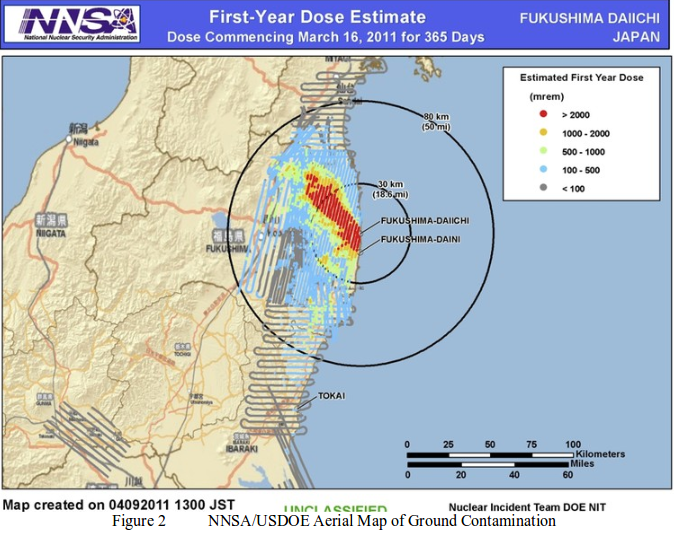
Estimate of Consequences from the Fukushima DisasterAbstractIn the immediate aftermath of the Fukushima disaster, the plants operator, the Japanese authority and the IAEA insisted for a month that the accident would pose no (immediate) health consequences. This work explores consequences that can be expected using the USNRC code MACCS2 in order to assess the validity of the statement.All the data and information used are from available sources published during the accident bythe Japanese authorities and internet sites.A range of possible atmospheric source terms is estimated, using three methods:dosimetric measurements at the plant, simplified accident progression, and aerial USDOE maps ofsurface contamination. Estimates from other sources are also included to arrive at the ranges.Detailed site population input for the code is constructed from current information on population around the plant, Japan, Korea, China and SiberiaEvacuation models are constructed to reflect the multi stage evacuation scheme adopted during the accident.Acute consequence models are then surrogated for in input to account for effects of Acute Radiation Syndrome, and chronic health effects are corrected for the lack of reciprocity at low and intermediate doses.For the range of source terms, acute consequences are calculated as best as the code allows, given the prolonged releases from the accident, together with chronic excess deaths and illnesses.Since much of the radioactive releases are deposited in the ocean some assessment is also given of the environmental damage to the sea life.Economic impact is assessed to some extent using simplified rough data just to show also this aspect of the accident.The authors thank Mr. Salih Güntay (Paul Scherrer Institut, Switzerland) for having reviewed this work and for his many useful suggestionsExtract
….It is obvious from all results that the IAEA, the Japanese authority and their experts were not telling the whole truth. The declarations, which, as noted, probably induced an unusually large part of the population (estimated 27%!) to remain in their homes, will probably result in an additional 200 cancer deaths or in a few months more than 20% of the total lifetime incurred dose for that population, even though they may have been forcibly removed at a later date.
The large number of cancer fatalities predicted for the City of Tokyo
results for a good part from ingestion of food and water contaminated up to the legal limits.
Individual lifetime (societal) risks of death are shown in Table 12.
Obviously the target of 1e4-year as “level of acceptable individual risk“
or “dose limited to 1 mSv per annum” regardless of frequency of occurrence [45] is well exceeded for an accident such as happened at Fukushima
for a very large number of people .Individual risk for the area almost promptly evacuated to 20 km is smaller because the 73% of the people who are removed disappear from the calculations for some time,
but they are still counted to arrive at the statistical averages….
Jiřina Vitázková, Errico Cazzoli
http://www.npsag.org/publications/download.aspx?id=1158&pid=89
| Report Title | Estimate of Consequences from the Fukushima Disaster |
|---|---|
| Reference NO | Cazzoli Consulting/Cazzoli paper 2011-09-05 |
| Project NO | 00-004 |
| Keywords | |
| Size | 1,23 MB |
| Publish Date | 2011-09-05 |
| Download |  click here to download click here to download |
No comments yet.
1 This Month
5 January -Webinar-What is Trump’s Golden Dome?
REGISTER AT Massachusetts Peace Action Education


New book – https://www.amazon.com/dp/1923372157?utm_source=substack&utm_medium=email
Now until to February 10, 2026 Radioactive waste storage in France: the debate is finally open! How to participate?
-
Archives
- January 2026 (52)
- December 2025 (358)
- November 2025 (359)
- October 2025 (377)
- September 2025 (258)
- August 2025 (319)
- July 2025 (230)
- June 2025 (348)
- May 2025 (261)
- April 2025 (305)
- March 2025 (319)
- February 2025 (234)
-
Categories
- 1
- 1 NUCLEAR ISSUES
- business and costs
- climate change
- culture and arts
- ENERGY
- environment
- health
- history
- indigenous issues
- Legal
- marketing of nuclear
- media
- opposition to nuclear
- PERSONAL STORIES
- politics
- politics international
- Religion and ethics
- safety
- secrets,lies and civil liberties
- spinbuster
- technology
- Uranium
- wastes
- weapons and war
- Women
- 2 WORLD
- ACTION
- AFRICA
- Atrocities
- AUSTRALIA
- Christina's notes
- Christina's themes
- culture and arts
- Events
- Fuk 2022
- Fuk 2023
- Fukushima 2017
- Fukushima 2018
- fukushima 2019
- Fukushima 2020
- Fukushima 2021
- general
- global warming
- Humour (God we need it)
- Nuclear
- RARE EARTHS
- Reference
- resources – print
- Resources -audiovicual
- Weekly Newsletter
- World
- World Nuclear
- YouTube
-
RSS
Entries RSS
Comments RSS
 nuclear-news
Leave a comment