Grapefruit-sized RadBall proposed for Fukushima clean-up
Transcript, Video on link;
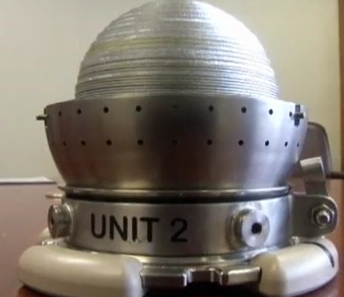
This is the RadBall – a radiation detecting device for disaster areas too dangerous for humans to enter. Devised by British engineer Steven Stanley, of the National Nuclear Laboratory, it requires no external power source and can be deployed in high radiation areas by robot.
SOUNDBITE (English) DR STEVEN STANLEY, INVENTOR OF RADBALL AND BUSINESS MANAGER FOR UK’S NATIONAL NUCLEAR LABORATORY, SAYING:
“The first part of the device is the radiation sensitive core and this is made up of layers of aluminium and radiation sensitive film….Now the core fits inside the second part of the Radball, which we call a collimation sheath, and this is actually a ten millimetre thick tungsten sphere that fits around the core….Rather like a colander there are a lot of holes in the colonator and that allows the radiation to preferentially pass through the holes into the radiation sensitive core.
” RadBall can identify radioactive contamination in confined spaces, producing a 3-D image to target clean-up operations. The radiation sensitive polymer film becomes permanently opaque within a minute of exposure to radiation, says RadBall technical lead Kat Lennox.
SOUNDBITE (English) KAT LENNOX, RADBALL TECHNICAL LEAD FOR UK’S NATIONAL NUCLEAR LABORATORY, SAYING:
“We make a 3D representation of the data, as you can see on the screen behind me. We will then use this data to track back along the straight lines that you can see, so from the Radball to where the source is coming from within the room.
After we’ve done that we’ll look at the amount of colour change within each of the films to work out the strength of each of those sources.”
Radball can be sent into tight spaces inaccessible to larger pieces of equipment. Weighing 12 kilograms, it’s smaller and lighter than other competing gamma imaging technologies. Stanley says electrical systems often fail when radiation interferes with electronics – not an issue for RadBall. The 2011 Fukushima Daiichi nuclear disaster in Japan spread radioactive material within the reactor systems of the plant and into the surrounding environment. Stanley says the RadBall could be deployed to scan the area, without putting humans with handheld detectors at risk.
SOUNDBITE) (English) DR STEVEN STANLEY, INVENTOR OF RADBALL AND BUSINESS MANAGER FOR UK’S NATIONAL NUCLEAR LABORATORY, SAYING:
“There’s some very specific challenges on Fukushima where they need to find the location of radioactive material. The main restrictions are that the radiation levels are quite high and also the actual penetration to get the measurement device in there is quite limited, so this device is very suitable.”
In UK trials the device successfully distinguished between various types of radioactive materials in a nuclear waste store. And now RadBall is under consideration by Fukushima officials to help clean-up the radioactive mess left by the worst nuclear disaster in 25 years.
No comments yet.
1 This Month.
5 January -Webinar-What is Trump’s Golden Dome?
REGISTER AT Massachusetts Peace Action Education


New book – https://www.amazon.com/dp/1923372157?utm_source=substack&utm_medium=email
Now until to February 10, 2026 Radioactive waste storage in France: the debate is finally open! How to participate?
-
Archives
- December 2025 (325)
- November 2025 (359)
- October 2025 (377)
- September 2025 (258)
- August 2025 (319)
- July 2025 (230)
- June 2025 (348)
- May 2025 (261)
- April 2025 (305)
- March 2025 (319)
- February 2025 (234)
- January 2025 (250)
-
Categories
- 1
- 1 NUCLEAR ISSUES
- business and costs
- climate change
- culture and arts
- ENERGY
- environment
- health
- history
- indigenous issues
- Legal
- marketing of nuclear
- media
- opposition to nuclear
- PERSONAL STORIES
- politics
- politics international
- Religion and ethics
- safety
- secrets,lies and civil liberties
- spinbuster
- technology
- Uranium
- wastes
- weapons and war
- Women
- 2 WORLD
- ACTION
- AFRICA
- Atrocities
- AUSTRALIA
- Christina's notes
- Christina's themes
- culture and arts
- Events
- Fuk 2022
- Fuk 2023
- Fukushima 2017
- Fukushima 2018
- fukushima 2019
- Fukushima 2020
- Fukushima 2021
- general
- global warming
- Humour (God we need it)
- Nuclear
- RARE EARTHS
- Reference
- resources – print
- Resources -audiovicual
- Weekly Newsletter
- World
- World Nuclear
- YouTube
-
RSS
Entries RSS
Comments RSS
 nuclear-news
Leave a comment