Future of nuclear power in limbo
Future of nuclear power in limboYuli Tri Suwarni , The Jakarta Post , Bandung | Thu, 29 may 2009 1:32 PM | The ArchipelagoState Minister of Research and Technology Kusmayanto Kadiman said on Thursday that tenders for nuclear power plants, which were initially targeted for completion by the end of this year, have been postponed indefinitely.The decision to postpone was made in light of an absence of political support since the legislative election in April, the minister said.
Nuclear reactor malfunctions, shuts down at Indian Point
Nuclear reactor malfunctions, shuts down at Indian Point.Breakdown is second problem in two weeks
BUCHANAN – A nuclear reactor at the Indian Point power plant in Buchanan automatically shut down this morning due to a malfunction. This is the site’s third unplanned break-down in three months.
According to officials with the Nuclear Regulatory Commission, the problem occurred around 5:30 a.m., when “a high vibration condition was detected on a main feedwater pump” in reactor Unit 3. The malfunction triggered a “high-level alarm,” then a turbine trip, then the reactor trip, said the NRC, in a statement.
This is the second time in two months that Unit 3 has malfunctioned. Plant operators manually tripped the reactor on May 15 after a main feedwater regulating valve in a steam generator failed, resulting in rising coolant levels that could not be controlled………………………….
These problems are occurring at a critical time for Entergy Nuclear, the New Orleans-based company that owns and operates Indian Point. Entergy is currently applying for a 20-year operating license renewal. It’s current licenses expire by 2015.
Indian Point’s critics, who include the state of New York and environmental groups, are formally petitioning the NRC to deny the license renewal. They’ve questioned the ability of the aging plant to operate safely and efficiently for another two decades.
Nuclear reactor malfunctions, shuts down at Indian Point. | recordonline.com
Niger Political Melee Could Affect Foreign Uranium Cos
Niger Political Melee Could Affect Foreign Uranium CosThursday Easy Bourse May 28th, 2009 / 20h15By Brian TruscottOf DOW JONES NEWSWIRESVANCOUVER -(Dow Jones)- As Kazakhstan investigates whether state officials sold uranium assets to foreign companies illegally, Niger – and its uranium market – is undergoing a small crisis of its own…………………..Political unrest, especially from opposing political parties, is spreading, with street demonstrations and the rise of anti-referendum coalitions.
On the face of it, this looks like political wrangling, but given the history of power grabs in African countries, this could be a precursor to economic instability in a region that often sees the military step in to resolve political upheavals, one uranium markets analyst said………………………..Niger Uranium Ltd. (URU.LN) has a number of potential prospects in development while Australia’s NGM Resources Ltd. (NGM.AU) has three uranium concessions.
What is ‘low-level’ waste, and is it good* for you?
 The nuclear-power lobby
San Antonio Current by Greg Harman 27 May 09
…………………………..What is ‘low-level’ waste, and is it good* for you?
So-called “low-level” radioactive waste is basically everything except the nuclear fuel, weapons waste, or uranium mill tailings from mining.
While “high-level” radioactive waste includes irradiated fuel, “low-level” waste includes everything from shoe covers, rags, and mops to irradiated nuke plant components and piping, control rods from reactor cores, and the poison curtains that soak up neutrons from reactor-core water.
Critics claims the term “low-level” is misleading, since these wastes can emit anywhere from one or two curies per cubic meter all the way to up to 5,000 curies per cubic meter.
Ultimately, entire nuclear power plants will be dismantled and buried as “low-level” nuclear waste.
Carcasses of animals “treated” with radioactive elements in pharmaceutical or medical research also need to be disposed of as low-level waste.
And scientific, medical, and some research waste also fall into this category. Most medical wastes decay within days or weeks, while wastes from nuclear power plants can remain deadly for hundreds, thousands, or even hundreds of thousands of years.
Sources: U.S. Nuclear Regulatory Commission, Nuclear Information Resource Service, Ohio State University
*Not on your irradiated life.
Sarkozy – nuclear salesman off to Pakistan?
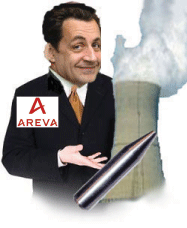 Sarkozy may visit Pakistan in autumn: official
ABU DHABI (AFP) 27 May 09 — French President Nicolas Sarkozy hopes to visit Pakistan this autumn……………………….Sarkozy’s visit would also be an opportunity to outline cooperation in civil nuclear energy that Sarkozy proposed to Zardari during his recent visit to Paris, the official said.
“France must invest diplomatically, politically and economically in Pakistan,” he stressed…………………….
http://www.google.com/hostednews/afp/article/ALeqM5jg2IU2J1lpF6y639I_bg8BSbt0VQ
Unlimited funding for nuclear power in the “Clean Energy Bank”?
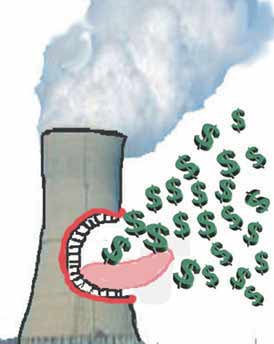 The nuclear-power lobby
San Antonio Current by Greg Harman 27 May 09 “………………………
……………….Although the would-be Nuclear Renaissance is a key element of more than a few lawmakers’ agendas, the federal government has failed to address the disposal of the plants’ high-level radioactive waste. The price tag on new nuclear plants has been rising by 15 percent a year — and the projects are already fantastically expensive.
Then you have upstarts like Jon Wellinghoff, head of the Federal Energy Regulatory Commission, who suggests the world doesn’t need any more nuclear power plants; that renewable energy and efficiency measures alone can provide for the future.
“There’s 500 to 700 gigawatts of developable wind throughout the Midwest,” Wellinghoff said last month, and “enough solar in the Southwest, as we all know, to power the entire country.”
It all boils down to terrible PR for the nuclear industry.
In addition to those immediate troubles, virtually all of the nation’s 104 nuclear plants are set to age themselves out of production by mid-century.
…………………..said Michael Marriott, director of the anti-nuke organization Nuclear Information Resource Service. “One hundred reactors at today’s prices is about a trillion dollars. Is that the best way to spend a trillion dollars, especially when the private sector has made it very clear they’re not going to put up the money?”
Still, nuclear has its boosters. And they’re stealthily creating the legislation now that will provide nuclear power with a raft of new federal subsidies.
………………As it turned out, the nuclear Trojan Horse was already in the bill.
It’s known as a “clean energy bank,” and it creates a new bureaucracy — the Clean Energy Deployment Administration — tasked with doling out federal energy dollars in the form of loans, loan guarantees, and letters of credit.
……………..So far, both the House and Senate Clean Energy Bank versions include nuclear power and “clean” coal — both extractive energy sources that rely on finite materials — among their list of truly renewable power sources like wind and solar. Thanks to a 30-percent cap on the amount any one of these technologies could receive, the House’s Clean Energy Bank language in ACES could allow up to 60 percent of the clean-energy spending to be made on coal and nuclear.
The Senate’s version currently doesn’t include limits on the funds any single power source could receive through the bank…………”
*Not on your irradiated life.
A first: Navajo’s recent court win over uranium miners
 Imperial nuclear power
Examiner.com Ann Garrison 27 May 09 Corporations mined uranium all over the Navajo Nation’s famously scenic mountains, mesas and canyons after World War II,
as the U.S. built its nuclear power, weapons, and war machine.
In “Uranium mining and weapons poisoning, on the Navajo Nation,” I told the story of eight Navajo veterans who died of uranium weapons poisoning within two years of returning from the Gulf War, and, of the toxic legacy of uranium mining on the Navajo Reservation. These histories inspired me, over the past five years, to study the uranium mining industry, most of all in indigenous country in the United States, Canada, Australia, and Africa.
Earlier this month the Navajo Nation won a victory in a U.S. federal appeals court, which supported the Diné Natural Resources and Protection Act of 2005, a ban on uranium mining, and, the only indigenous assertion of sovereignty over natural resources of its kind.
Anyone who might be persuaded by the argument that nuclear power is a clean, green “solution” to global warming , including California Governor Arnold Schwarzenegger, and San Francisco Mayor and gubernatorial candidate Gavin Newsom, should consider the devastating impact of uranium mining, the first step in the nuclear process, on indigenous peoples and environments all over the world.
http://www.examiner.com/x-8257-SF-Energy-Policy-Examiner~y2009m5d27-Imperial-nuclear-power?#comments
Uranium mining and weapons poisoning, on the Navajo Nation
Uranium mining and weapons poisoning, on the Navajo Nation – Examiner.com Ann Garrison 27 May 09 “………………
He had almost gone to Flagstaff to enlist just before the Gulf War, in 1991, but had gotten a job making better wages on the reservation instead. Eight of his friends had gone, and all eight had returned alive, but then, all eight had died of cancer, within two years. All eight had believed that uranium weapons poisoning caused their cancers; all eight had been on the deck of an aircraft carrier when a black cloud of munitions blowback descended upon them.
The Veterans Administration denied that their cancers had anything to do with uranium weapons, or, any sort of other toxic exposure in the Gulf,……………. I’m not going to name my friend, or the friends he lost, because the recruiting pressure in Native America is like nothing I’ve ever seen outside New Orleans.
I also learned about the horrific, ongoing post-World War II legacy of uranium mining contamination in Navajoland, which had killed many Navajo people and left many others suffering birth defects and illnesses, including cancer in numbers far disproportionate to the general population.
The uranium in the weapons that the Navajo vets had believed to be the reason they were dying might well have been mined, in their own poisoned homeland, as the U.S. built its post World War II nuclear power, weapons, and war machine.
SF Energy Policy Examiner: Uranium mining and weapons poisoning, on the Navajo Nation
Nuclear waste reprocessing plan melting down?
Nuclear waste reprocessing plan melting down? Examiner.com Robyn Monaghan May 25,
The Obama administration may be melting down a program that would have shipped deadly radioactive wastes from around the world to a reprocessing facility eyed for Chicago’s Southwest suburbs.“The program has been terminated,” Department of Energy spokesman Brian Quirke told Chicago Page One Examiner last week about the Global Nuclear Energy Partnership.That happened in late March, when GNEP was chopped from the new budget, he said.The controversial Global Nuclear Energy Partnership [GNEP] was a pet project of the DOE during the Bush years. It called for transporting radioactive waste from the nation’s 104 nuclear reactors and from 25 foreign countries signed on as “GNEP Partners.”…………………..
……………………Slicing GNEP from the budget doesn’t mean the DOE is completely abandoning the idea of nuclear waste re-processing. The budget funnels $145 million for the Advanced Fuel Cycle Initiative, for conducting research on “proliferation-resistant” recycling and nuclear waste reduction technologies. The 2009 budget also includes $143 million for “defense nuclear waste disposal” activities, which some sources say means to developing Yucca Mountain………………………….It may technically correct to say GNEP is terminated, said David Kraft, with the Chicago-based Nuclear Energy and information Service. In fact, the new administration has simply renamed and re-budgeted it.‘You can dress up a pig in silk and marry it and call it your wife, but it’s still going to be a pig,” Kraft said.
Opponents say nuclear reprocessing nuclear waste has devastated local and regional environments wherever it’s done – in the UK, France, and Russia. They say France’s decision to reprocess reactor fuel has contaminated seas as far as the Arctic Circle and point to studies that radioactive discharges from La Hague in France contributed to elevated rates of leukemia among young people close to the site…………………………..Obama’s Energy Secretary Steven Chu is Nuclear is promoting nuclear as “clean” in global warming terms, despite “huge issues associated with the waste, in its transport, reprocessing emissions, and storage,” Headington said.
Native rights declaration challenges ‘settler’ nations
Native rights declaration challenges ‘settler’ nations
By Haider Rizvi May 25, 2009 – UNITED NATIONS, May 6 (IPS) – The United States is considering whether to endorse a major U.N. General Assembly resolution calling for the recognition of the rights of the world’s 370 million indigenous peoples over their lands and resources………………………….
Approved by a vast majority of the U.N. member states in September 2007, the General Assembly resolution on the declaration was rejected by the George W. Bush administration over indigenous leaders’ argument that no economic or political power has the right to exploit their resources without seeking their “informed consent.”
Three other “settler nations” of European descent, namely Canada, New Zealand and Australia, also voted against the declaration, which states that indigenous peoples have the right to maintain their cultures and remain on their land…………………However, last month, the new left-leaning government in Canberra reversed its position, announcing support for the declaration.
Government Urged To Step Up Anti-nuke Campaign
Government Urged To Step Up Anti-nuke Campaign Voxy.co.nz 26 May, 2009 – 15:14
The Government should take the advice of former Australian Prime Minister Malcolm Fraser and launch a new anti-nuclear campaign, says Labour’s disarmament spokesperson Phil Twyford.
Mr Fraser met the Prime Minister yesterday and is advocating New Zealand and Australia form a ginger group of countries to push for the abolition of nuclear weapons in light of US President Obama’s strong support for the cause.
“After meeting Mr Fraser, Mr Key told Radio New Zealand he would consider ‘whether we may maybe take a bolder and… larger step forward’,” Phil Twyford said.
“Because of our anti-nuclear legislation and longstanding commitment to disarmament New Zealand is well placed to champion the cause of ridding the world of nuclear weapons.
Asse nuclear waste workers getting radiation scans
Asse nuclear waste workers getting radiation scans The Local : 22 May 09 12:31 CETOnline: http://www.thelocal.de/national/20090522-19443.htmlThe Federal Office for Radiation Protection (BfS) announced Friday they will take on a large operation to test radiation-exposure levels of both current and former workers at the atomic waste depot Asse near the town of Wolfenbüttel in Lower Saxony. With this health monitoring programme, we want to find out if the cases of cancer and leukaemia of former Asse workers had anything to do with the radiation exposure of their work,” BfS spokesman Werner Nording said in a statement on the authority’s website…………………….Officials are now trying to determine what to do about dangerous nuclear waste which has been stored at the increasingly unstable site since 1978.
Asse nuclear waste workers getting radiation scans – The Local
Will the Nuclear Power “Renaissance” Ever Reach Critical Mass?: Scientific American
Will the Nuclear Power “Renaissance” Ever Reach Critical Mass?
Scientific American May 21, 2009 Despite an abundance of plans and applications, new nuclear reactors outside of Asia are few and far between, which puts nuclear’s contribution to fighting greenhouse gas emissions at risk This month, Finland’s Olkiluoto 3 nuclear reactor was supposed to begin generating power, a tangible sign of the revival of the nuclear industry outside of Asia after nearly 30 years of no new construction because of accidents, cost-overruns and other issues. Instead, the reactor won’t be completed for more than three more years, its price is nearly 60 percent more than anticipated, and it is mired in costly legal squabbles between the builder, Areva, and the Finnish utility, Pohjolan Voima.In the U.S., since 2003, 17 applications for 26 new reactors have been filed with the U.S. Nuclear Regulatory Commission, but not one is yet under construction.
Despite dozens of new nuclear plants ordered or built in Asia in recent years, “increased deployment of nuclear power has been slow both in the United States and globally,” wrote the authors of a new Massachusetts Institute of Technology review of the state of nuclear power.Those figures, say the authors of the report, an update on a similar report in 2003, mean that “even if all the announced plans for new nuclear power plant construction are realized, the total will be well behind that needed for reaching a thousand gigawatts of new capacity worldwide by 2050.”
One thousand gigawatts is the number the M.I.T. professors estimated would be needed to ensure that nuclear power provided 20 percent of global electricity needs as well as cut emissions of greenhouse gases from power plants. …………………..(There are, of course, significant greenhouse gas emissions associated with building and fueling nuclear facilities).
But the price of new nuclear power has “escalated dramatically,” according to the report, jumping by 15 percent a year to reach as much as $4,000 per kilowatt compared with $2,300 for coal-fired generation and just $850 for natural gas. And the industry is asking for at least $100 billion in federal tax subsidies and loan guarantees for the 26 reactors currently planned.
The situation is no better in Europe, according to Steven Thomas, a professor of energy studies at the University of Greenwich in London: Finland cannot complete its new reactor; the U.K. has yet to get started on any projects; and a new nuclear reactor in France, after 18 months of construction, is 20 percent overbudget and requires complete subsidy by the French government………………….. Nor has there been a solution to the issue of nuclear waste……………………….. Adds Thomas: “It seems to me highly unlikely that [investing in nuclear power] is the most cost-effective way to reduce greenhouse gas emissions. Put that money in other sources, such as energy efficiency and renewables, and get a much better return on your money.”
Will the Nuclear Power “Renaissance” Ever Reach Critical Mass?: Scientific American
Soviet-Era Uranium Waste Sites Now Threaten Central Asia
Soviet-Era Uranium Waste Sites Now Threaten Central Asia Georgian Daily 19 may Paul goble Storage sites for uranium tailings that were built in Soviet times in Tajikistan are now leaking radiation into the surrounding atmosphere and ground water supplies, undermining the health and well-being of the people of a republic and a broader region that lack the resources to clean up a problem that it did nothing to create………………………..
The impact of the release of radioactive materials on the health of the population is already clear. Not only are the numbers of people suffering from cancer increasing, but the age of onset of cancers is falling, with many local people showing signs of cancer when they are only 15 or 16 years old, something almost unheard of earlier.
Moreover, medical officials from Dushanbe say that the overall health statistics for the areas around the uranium tailings sites are chilling: The number of stillborn children has increased as have the number of newborns with congenital defects. Some 85 percent of women in the region suffer from anemia, as do more than 64 percent of newborns…………………………..he amount of radioactive leavings is enormous, more than 450 million tons.
As a result, Ferghana.ru concludes sadly, the prospects are not good. “The elites have left the area forever because they know that the supplies of uranium are practically exhausted and that sooner or later all the factories and combines involved with the production of nuclear fuel will stop.”
In the end, the news service suggests, the local population will stand alon, facing “only the ruins of nuclear processing and mountains of ecological problems.”
georgiandaily.com – Soviet-Era Uranium Waste Sites Now Threaten Central Asia
Biased pro-nuclear report is challenged
 Full of problems or ripe with promise?
Meridian Booster By Graham Mason 14 May 09
With the Uranium Development Partnership report being presented to the public next month there is a question over how much the environment was taken into consideration in its glowing conclusions.
The report, titled Capturing the Full Potential of the Uranium Value Chain in Saskatchewan, was released March 31.
The nuclear and uranium industry were well represented on the 12-person panel with Duncan Hawthorne, president and CEO of Bruce Power, Armand Laferrere, president and CEO of Areva Canada, and Jerry Grandey, president and CEO of Cameco Corporation. ……………
……………Dr. Patrick Moore founding member of Greenpeace, was the only member to identify himself as an environmentalist.
In a statement before a U.S. congressional committee in Apr. 2005, he described his views on nuclear power generation where he described himself as an ‘environmental moderate.’
………………………………The Saskatchewan Environmental Society couldn’t disagree more in a recent nuclear pamphlet.
“The real solutions to climate change lie in the area of energy efficiency and renewable energy,” said the report. “If we were to provide the same level of support for these options as we have done for the nuclear industry, we could move much faster into the sustainable, low-carbon energy economy which is where the future lies.
The report argues nuclear is not an alternative to fossil-fuelled plants, rather they are both part of an environmentally unsustainable approach to the electricity system.
Coxworth questions whether Moore qualifies to be the environmental conscience of the report.
“Patrick Moore … is a paid consultant to the nuclear industry,” said Coxworth. “Labelling him by his past Greenpeace involvement would be somewhat analogous to identifying me solely by the fact that long ago I worked for the U.S. Atomic Energy Commission.”
“Doubtless some of the other partnership members have taken some environmental classes as part of their technical education.”
Local public consultations are at Lakeland College on June 10, the Don Ross Centre in North Battleford on June 11 http://www.meridianbooster.com/ArticleDisplay.aspx?e=1566432
-
Archives
- October 2026 (104)
- September 2026 (339)
- August 2026 (330)
- July 2026 (355)
- June 2026 (287)
- May 2026 (306)
- April 2026 (356)
- March 2026 (251)
- February 2026 (267)
- January 2026 (308)
- December 2025 (358)
- November 2025 (359)
-
Categories
- 1
- 1 NUCLEAR ISSUES
- business and costs
- climate change
- culture and arts
- ENERGY
- environment
- health
- history
- indigenous issues
- Legal
- marketing of nuclear
- media
- opposition to nuclear
- PERSONAL STORIES
- politics
- politics international
- Religion and ethics
- safety
- secrets,lies and civil liberties
- spinbuster
- technology
- Uranium
- wastes
- weapons and war
- Women
- 2 WORLD
- ACTION
- AFRICA
- Atrocities
- AUSTRALIA
- Christina's notes
- Christina's themes
- culture and arts
- Events
- Fuk 2022
- Fuk 2023
- Fukushima 2017
- Fukushima 2018
- fukushima 2019
- Fukushima 2020
- Fukushima 2021
- general
- global warming
- Humour (God we need it)
- Nuclear
- RARE EARTHS
- Reference
- resources – print
- Resources -audiovicual
- Weekly Newsletter
- World
- World Nuclear
- YouTube
-
RSS
Entries RSS
Comments RSS

