Paladin loss, as uranium price slips
Money Sept 2 09
…….- Paladin’s loss was greater than the broker expected, given greater ramp-up and exploration costs. With cashflow tight Paladin has been forced to draw down on its debt facility although first half FY10 inventory sales mean it’s just a bridging deal.Paladin’s realised uranium price was also lower than expected given a higher level of spot over contract sales. As the U price continues to drift and the Kayakelera ramp-up remains slow, the broker sees no positive catalysts. Hold retained on slightly lower earnings forecasts.
AREVA going to court over Finland nuclear reactor runaway costs
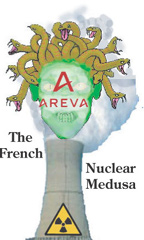 Areva’s half-year results yesterday night brought new information about the Olkiluoto-3 EPR nuclear fiasco:
South Africa’s nuclear company Eskom makes huge loss
Corporate Toughest of times for Eskom
World Nuclear News28 August 2009
Eskom, South Africa’s state-owned utility, has reported a record annual loss and has warned of a funding gap for an expansion program needed to prevent a repeat of the blackouts the country experienced in 2008.The company, which supplies about 95% of South Africa’s electricity and more than 60% of Africa’s, reported a loss of 9.7 billion rand ($1.25 billion) for the year ended 31 March. In the previous year, Eskom made a loss of 210 million rand ($27 million)………….
Indian government secretive about uranium pollution of Punjabi children
India’s generation of children crippled by uranium waste
Observer investigation uncovers link between dramatic rise in birth defects in Punjab and pollution from coal-fired power stations
Guardian.co.uk The Observer by Gethin Chamberlain 30 August 2009
Their heads are too large or too small, their limbs too short or too bent. For some, their brains never grew, speech never came and their lives are likely to be cut short: these are the children it appears that India would rather the world did not see, the victims of a scandal with potential implications far beyond the country’s borders………………………Health workers in the Punjabi cities of Bathinda and Faridkot knew something was terribly wrong when they saw a sharp increase in the number of birth defects, physical and mental abnormalities, and cancers. They suspected that children were being slowly poisoned.
But it was only when a visiting scientist arranged for tests to be carried out at a German laboratory that the true nature of their plight became clear. The results were unequivocal. The children had massive levels of uranium in their bodies, in one case more than 60 times the maximum safe limit.
The results were both momentous and mysterious………………..if a few hundred children – spread over a large area – were contaminated, how many thousands more might also be affected? Those are questions the Indian authorities appear determined not to answer. Staff at the clinics say they were visited and threatened with closure if they spoke out. The South African scientist whose curiosity exposed the scandal says she has been warned by the authorities that she may not be allowed back into the country.But an Observer investigation has now uncovered disturbing evidence to suggest a link between the contamination and the region’s coal-fired power stations………………………
India’s reluctance to acknowledge the problem is hardly unexpected: the country is heavily committed to an expansion of thermal plants in Punjab and other states. Neither was it any surprise when a team of scientists from the Department of Atomic Energy visited the area and concluded that while the concentration of uranium in drinking water was “slightly high”, there was “nothing to worry” about. Yet some tests recorded levels of uranium in the ground water as high as 224mcg/l (micrograms per litre) – 15 times higher than the safe level of 15mcg/l recommended by the WHO. (The US Environmental Protection Agency sets a maximum safe level of 20mcg/l.)…………………………
There have also been claims that the contamination may have been exacerbated by depleted uranium carried on the wind from the wars in Iraq and Afghanistan. At a seminar in Amritsar in April, Admiral Vishnu Bhagwat, a former chief of the naval staff, suggested that areas within a 1,000-mile radius of Kabul – including Punjab – may be affected by depleted uranium. Although the prevailing monsoon winds blow either from the north-east or the south-west, there are times when a depression originating in the Mediterranean can result in rainfall in Punjab.
India’s generation of children crippled by uranium waste | World news | The Observer
Nuclear energy on a downward trend: no renaissance in sight
Study shows: Nuclear energy on downward trend worldwide
Federal Ministry for Nuclear safety Germany,
28 August 09Minister Gabriel:
There is no renaissance of nuclear energyThe share of nuclear energy in worldwide energy consumption is marginal and has been declining for several years. This is revealed in a study by independent experts of the energy and nuclear sector which was published by the Federal Environment Ministry today. As Federal Environment Minister Sigmar Gabriel said:“The renaissance of nuclear energy, much trumpeted by its supporters, is not taking place. The only thing frequently revived is the announcement. The study shows: the number of old nuclear power plants which are decommissioned worldwide is greater than the number of new ones taking up operation. Available resources, engineering performance and funds are not even enough to stop the downward trend, let alone increase the number of reactors. All the facts are in favour of phasing out this technology while at the same time expanding the use of renewable energies and energy efficiency, as this is a promising option for the future.”
The authors of the study, headed by Mycle Schneider, Paris, collected crucial quantitative and qualitative facts on nuclear power plants which are in operation, being built or planned today and assess the economic viability of old and new nuclear power plants.
At the time of going to press, 1 August 2009, there were only 435 reactors in operation worldwide, which is nine less than in 2002. Nuclear energy accounts for only about 5.5 % of worldwide commercial primary energy consumption and only around 2 % of worldwide final energy consumption – and consumption has been steadily declining for years.
The authors also found out that the number of nuclear power plants will decrease worldwide over the next decades. Between 2015 and 2025 the capacity of nuclear power plants is expected to sink compared to today’s output……………….
Current and planned building projects of the nuclear industry are becoming increasingly expensive. The EPR, for example, the flagship of the world’s largest manufacturer of reactors, AREVA NP, which is currently in construction in Olkiluoto in Finland, has so far exceeded planned costs by at least 55 %.
Iran’s nuclear program continuing
Iran is continuing nuclear activity, says United Nations watchdog• Country ‘fails to co-operate with energy inspectors’• West may target foreign petroleum supplies
Guardian. uk by Julian Borger 28 August 09The UN’s nuclear watchdog reported today that Iran was continuing its uranium enrichment programme in defiance of UN security council resolutions, setting the stage for possible oil and gas sanctions by the west. Continue reading
Nuclear waste court case- a national test case
Appeal begins in high-profile fight over hot waste Court battle
Two more regions to weigh in on EnergySolutions case
By Judy Fahys The Salt Lake Tribune 08/28/2009
Utah’s court fight over who controls the flow of radioactive waste is turning into a national test case, as the state and its allies formally launched their appeal on Thursday and waste agencies representing eight more states prepared to join the fray. Continue reading
Nuclear industry declining world-wide
Nuclear decline set to continue, says report
Nuclear Engineering 27 August 2009
Nuclear will continue to decline according to a new report. At this point there is no obvious sign that the international nuclear industry could turn the decline into a promising future, it says. Continue reading
New Doubts Over Nuclear Plant Safety
Startling Revelations About Three Mile Island Raise New Doubts Over Nuclear Plant Safety
Fooling with Disaster?
CounterPunch By SUE STURGIS April 2009
“…………………It was the single worst disaster ever to befall the U.S. nuclear power industry, and Thompson was hired as a health physics technician to go inside the plant and find out how dangerous the situation was. He spent 28 days monitoring radiation releases.
Today, his story about what he witnessed at Three Mile Island is being brought to the public in detail for the first time — and his version of what happened during that time, supported by a growing body of other scientific evidence, contradicts the official U.S. government story that the Three Mile Island accident posed no threat to the public. Continue reading
Malaysia: where would we put nuclear waste?
Where do we store nuclear waste?
The Sun2 Surf , Malaysia 27 August 09
THE sun has been the main energy source for all life on the planet for billions of years. In Malaysia, we are blessed with sunlight. Yet, our government is pushing for nuclear energy as if it is a safe energy alternative to save our planet from the perils of climate change.
The government seems to be brushing aside the hazards related to nuclear power plants, as if they were issues that didn’t exist or could easily be remedied in the near future………………….
From what I have seen, there is no detailed information available to the public on Malaysia’s nuclear plans. Where will the reactors be located? What type of reactors will be used? Who will be selling us the uranium to run the reactors? How much will it all cost and who will pay for it?
What about the waste generated from the proposed nuclear power plants? Where and how will Malaysia dispose its nuclear waste which remains radioactive for thousands of years…………….
….we do know that nuclear energy will produce highly radioactive waste, even if it is in small amounts, every day a nuclear plant is running. We do know that this highly radioactive waste must be disposed of somewhere on our finite planet. We do know that we have no technology to make this waste safe.
And as more countries build nuclear power plants, more of this waste is dumped into our Earth, the planet that sustains our lives.
It is unforgivable that we, as governments and responsible adults, knowingly create such dangerous waste, so that we can have “modern conveniences” today, without a concern for tomorrow.
We are already leaving our children with our legacy of global warming, and choking pollution. And now we wish to leave this massive mess of nuclear waste and closed reactor sites to our grandchildren, leaving them with the burden of trying to figure out how to solve the problem that we ourselves had no idea how to solve.
Indigenous people fight uranium mining in the Grand Canyon
Havasupai Gather to Halt Uranium Mining in the Grand Canyon
Brenda Norrell | August 26, 2009
Indigenous Havasupai people held a gathering to stop uranium mining in the Grand Canyon and protect ancestral Havasupai Territory, at the south rim of the Grand Canyon, in July of 2009. Indigenous peoples and activists came from the four directions, from Arizona Hopi land and from as far away as Hawaii, to participate with sacred songs and ceremonies.
For four days, Havasupai elders gathered on sacred Red Butte and listened to the legacy of uranium mining on Indian lands. They heard directly from the victims of the trail of death and cancer left behind by uranium mining corporations that were never held responsible on Pueblo and Navajo lands in the Southwest United States. They also listened to the promise of solidarity from the hundreds who gathered here to stand with them: Navajos from Big Mountain, Hualapai, Hopi, Kaibab Paiute, Paiute, Aztecs, and other American Indians from throughout the Americas.
The Havasupai Nation, with the Sierra Club, Center for Biological Diversity, and Grand Canyon Trust, sponsored the gathering to halt uranium mining on Red Butte, July 23-26, 2009. Supai elders gave testimony for official U.S. records in their Havasupai (Pai) language and in English. Supai traditional singers sang as a camp was established on this mesa where Toronto-based Denison Mines is threatening to reopen a uranium mine.
Recent congressional legislation protects the Grand Canyon from new mining claims, but does not deter mining under existing claims held by Denison and others………………
………. “In Numbers, There is Strength”
During the panel, Larry King, Navajo from Church Rock, NM, told the gathering how he worked for the United Nuclear Corporation from 1975 to 1983 as an underground mine surveyor. King said he has lived all his life in Church Rock and still raises his cattle on the land where he grew up. Now, a community activist, he said Navajos in the communities of Church Rock, Pinedale, Coyote Canyon, and Iyanbito, NM, have suffered greatly from uranium mining.
…………… Speaking of the corporations who have contaminated this region for decades, Pino said, “Why would they want to mine uranium in one of the natural wonders of the world like the Grand Canyon? If they will mine uranium here, they will mine uranium anywhere. They have no heart, they have no soul.”
Uranium price “flat”
Flat outlook for uranium spot prices
Australian Mining 26 August 2009 | by Michael Mills
Equity research company Resource Capital Research (RCR) said it is not expecting any significant changes to uranium spot prices in the near term.
The uranium spot price is currently trading at US$47.50 per pound, down 8% from the US$52 three months ago.
At the end of December 2008, the prices were US$52.50 per pound.
…………. The long term contract uranium price is US$65.00 per pound, which is down from US$70 per pound price at December 2008.
http://www.miningaustralia.com.au/Article/Flat-outlook-for-uranium-spot-prices/495758.aspx
‘Fourth Generation’ Nuclear Power
ENERGY BULLETIN by Jim Green 25 August 09
‘Integral fast reactors’ and other ‘fourth generation’ nuclear power concepts have been gaining attention, in part because of comments by US climate scientist James Hansen.
…… There are two main problems……. nuclear power could at most make a modest contribution to climate change abatement, mainly because it is used almost exclusively for electricity generation which accounts for about one-quarter of global greenhouse emissions. Continue reading
The search for a nuclear graveyard
The search for a nuclear graveyard
40,000 metric tonnes of radioactive waste is stored at sites across Canada. Anna Mehler Paperny reports on the hunt for a permanent solution
Wanted: Friendly, open-minded community in need of jobs and a whack of infrastructure cash. Must be willing to play host to nuclear waste, perhaps until the end of time.More than six decades after joining the nuclear club, Canada is home to 22 nuclear reactors, 18 of them in operation, producing about 15 per cent of the country’s electricity. Canada also has 40,000 metric tonnes of radioactive waste – and counting.
For years, the issue of how to best dispose of this waste has plagued policy-makers, scientists and citizens. Suggestions have included shooting it into outer space or exporting it to the South Pole.
Now, Canada is preparing to get rid of its nuclear detritus once and for all – by burying it. Continue reading
America’s worst nuclear meltdown – cover-up revealed
Please go to the following link, to read this fine article.
50 Years After America’s Worst Nuclear Meltdown
Human error helped worsen a nuclear meltdown just outside Los Angeles, and now human inertia has stymied the radioactive cleanup for half a century.Miller McCune.com 25 August 09 By: Joan Trossman and Michael Collins | August 24, 2009
My apologies to Miller McCune for my use of the article.
It was not my intention to steal their material. Rather, I wish to lead people towards the source
Christina Macpherson
-
Archives
- October 2026 (91)
- September 2026 (339)
- August 2026 (330)
- July 2026 (355)
- June 2026 (287)
- May 2026 (306)
- April 2026 (356)
- March 2026 (251)
- February 2026 (267)
- January 2026 (308)
- December 2025 (358)
- November 2025 (359)
-
Categories
- 1
- 1 NUCLEAR ISSUES
- business and costs
- climate change
- culture and arts
- ENERGY
- environment
- health
- history
- indigenous issues
- Legal
- marketing of nuclear
- media
- opposition to nuclear
- PERSONAL STORIES
- politics
- politics international
- Religion and ethics
- safety
- secrets,lies and civil liberties
- spinbuster
- technology
- Uranium
- wastes
- weapons and war
- Women
- 2 WORLD
- ACTION
- AFRICA
- Atrocities
- AUSTRALIA
- Christina's notes
- Christina's themes
- culture and arts
- Events
- Fuk 2022
- Fuk 2023
- Fukushima 2017
- Fukushima 2018
- fukushima 2019
- Fukushima 2020
- Fukushima 2021
- general
- global warming
- Humour (God we need it)
- Nuclear
- RARE EARTHS
- Reference
- resources – print
- Resources -audiovicual
- Weekly Newsletter
- World
- World Nuclear
- YouTube
-
RSS
Entries RSS
Comments RSS

