TEPCO to Halt Most Work at Fukushima N-Plant for G-7 Summit
Tokyo, May 24 (Jiji Press)–Tokyo Electric Power Company Holdings Inc. will suspend most work at its stricken Fukushima No. 1 nuclear power plant for three days from Wednesday as Japan will host the Group of Seven summit this week.
During the three days, TEPCO will continue minimum necessary work, including operations for cooling the No. 1 to No. 3 reactors, which suffered meltdowns, and running a system to process radioactive water at the plant, which was damaged in the March 2011 earthquake and tsunami, according to the company.
But the company will halt the construction of tanks for storing radioactive water and preparations for removing nuclear fuel from the No. 3 reactor pool, along with other work.
TEPCO has been carrying out those operations as part of the decommissioning processes.
A TEPCO official said the company will suspend the work at the plant out of a sense of caution, while noting that the company is always ready to detect any problem at the plant quickly.
TEPCO official knew standard for meltdown at Fukushima
Yuichi Okamura, the senior director of nuclear power generation knew. In a recent press conference he said that it was his personal knowledge as to what was the meltdown standard. Mr. Okamura has worked in the industry for 20 years. He did not elaborate about TEPCO’s manuals or the knowledge of others. At the time of the disaster he was tasked with dealing with the spent fuel pool at unit 4.
A Tokyo Electric Power Co. senior official has admitted to knowing the criteria to assess reactor meltdowns during the onset of the 2011 Fukushima nuclear accident.
However, it took the company two months to make the declaration and another five years to “discover” its operational manual, which would have allowed it to declare a meltdown.
Until February this year, TEPCO had justified the delay in that it did not have the “basis to determine” such an occurrence. It announced Feb. 24 that it discovered a guideline in its operational manual.
TEPCO admitted that meltdowns had occurred in May 2011, two months after the disaster.
Yuichi Okamura, a senior director on nuclear power generation, said in a news conference on April 11 that he knew of the standard, although emphasizing it was only his “personal knowledge.” He did not elaborate on whether he knew the existence of the operational manual, or whether he shared his “personal knowledge” with other staff members.
“I, in fact, knew it (the criteria),” said Okamura. “I learned it while working in the field of nuclear technology with the company for over 20 years.”
According to Okamura, at the time of the accident at the Fukushima No. 1 nuclear power plant, he was directing the pumping of water into the cooling pool of spent nuclear fuel rods of the No. 4 reactor. He said he was not in a position to make a declaration whether a meltdown had occurred.
He made the admission in response to a question asking his personal understanding of the situation at the onset of the crisis.
Okamura declined to comment on whether he is being questioned by a third-party panel investigating the accident.
In February, TEPCO revealed that it did not realize for the past five years that there was a clear guideline in the operational manual to assess that a meltdown in a reactor had occurred. The standard requires the company to declare a meltdown when damage to a reactor core exceeds 5 percent.
TEPCO took two months to declare the triple meltdowns at the Fukushima plant, triggered by the Great East Japan Earthquake and tsunami on March 11, 2011. It had initially maintained that the reactors suffered “core damage” rather than meltdowns.
Despite all the misery, nuclear facility vital part of people’s lives Part 2

A former fisherman who ended up working full-time at the Fukushima No. 1 nuclear power plant harbors mixed feelings about his job choice.
Editor’s note: This is the second installment of a three-part series on conditions that contract workers face at the crippled Fukushima No. 1 nuclear power plant.
* * *
For those living in coastal areas of Fukushima Prefecture, the Fukushima No. 1 nuclear power plant is a bit like the proverbial elephant in the living room, in that it looms large in their lives.
Although the plant unleashed untold havoc five years ago, many people find it unsettling to badmouth the site to which they have owed their economic well-being–even after the disaster.
Tokyo Electric Power Co.’s sprawling nuclear complex provided them with coveted employment that made the difference between making do and doing without in an otherwise depressed local economy.
One local resident, a onetime fisherman, summed up the thoughts of people in the area by saying: “You cannot deny having a sense of gratitude if you have lived in this coastal region. It is not a question of like or dislike.”
Born in a community close to the crash of waves, the man aspired from an early age to become a fisherman.
He loved the sea so much that he even stopped attending high school for several months to work on a boat trawling for Pacific saury.
He eventually quit high school to make his living by fishing full-time.
Local fishermen can be away from home for months at a time, traveling to distant parts of the globe and danger. The longest time the man had been away was 10 months.
He recalled fishing for squid off Argentina shortly after the Falkland War ended in 1982 and witnessing a ship coming under fire and sinking because the vessel had intruded into the country’s territorial waters.
He began a stint at the Fukushima plant in around 1972, about a year after the plant opened. Although he was a full-time fisherman, the man sought to supplement his income when it was off-season for fishing.
As prices for fish continued to stagnate, he eventually quit fishing altogether in 1989 to become a full-time worker at the Fukushima plant.
Ever since, his life revolved around his work at the site–until the disaster triggered by the Great East Japan Earthquake and tsunami on March 11, 2011.
After a break of a couple of months in the aftermath of the triple meltdown, the man returned to the plant to work on ventilation equipment at a reactor building.
He was hired by a construction company based near the crippled facility.
Back in the 1970s, the man recalled that subcontractors were lax about the handling of radioactive materials.
“Workers did not follow the set rules as strictly as today,” he said.
They occasionally disposed of pipes and other radioactive waste generated at reactor buildings manually, although they were expected to use a machine for the task.
His responsibility also involved checking pipes for cracks.
To detect a flaw in piping, it was a standard procedure then, as it is now, to conduct a liquid penetrant test.
Workers paint pipes with a red solution and wipe them after a while.
The penetrant remains inside the damaged parts. Workers then coat the pipes with “developing fluid,” which is a mixture of highly volatile liquid such as thinner and some sort of white powder.
Red stains left in the flawed sections emerge in the process so that workers can identify parts that need to be repaired.
However, they would skip making needed repairs when they feared they would not be able to meet the deadline for the work they had been assigned to do.
“We deliberately did not paint red penetrant to the parts that we knew were damaged,” he recalled.
The man said his crew had no choice.
“The contractor told us to make out a report for all the mistakes we made, but we knew we would be better off not doing so because we would be certainly slapped with a penalty for the errors we would have reported,” he said. “As long as the nature of relations between a contractor and a subcontractor remained that of a higher and lower rung of a pyramid, attempts to cover up oversight were bound to continue.”
When the magnitude-9.0 earthquake struck, the man was in the basement of a reactor building.
An inspection was under way at the time to check whether the replacement of parts he had just finished was done properly.
The man heard metallic clanks from a floor above as if two huge objects had collided with each other.
He was desperate to flee right away, but could not. The stairs were shaking so violently that he was unable to climb them. The man was only able to climb ladders and reach safety after the vibrations had subsided.
Ensuing tsunami swept into the compound, but did not reach the office where he took refuge.
He managed to return home that night.
Later, he learned that the last people to leave the plant were engineers who handled valves.
These were the men who knew exactly which direction water will flow when a particular pipe valve was opened.
“All of us hired by a contractor and subcontractors remained on-site after the other workers had left,” a valve engineer told him.
The man returned to work at the plant around May 2011.
The company initially stated that the men would not have to work at the plant. But one day, the president of the company summoned them to a canteen and apologetically told them they had to.
“It is far from my intention to accept work at the Fukushima No. 1 nuclear plant, but I would be out of a job if we refused,” he said. “I am sorry to have to say this, but I registered you as reserve workers for the plant.”
The president said executives of a contractor had assembled the presidents of subcontractors to ask them to secure manpower for the plant.
One of the presidents demanded an extra allowance for the radiation risks in return.
“The current terms and conditions are unacceptable,” the president said. “We request you provide more hazard pay.”
Then one of the executives of the contractor declared: “We will not partner with a subcontractor that puts money first.”
Some subcontractors went along with the contractor, including the man’s company, while others refused.
When he was a full-time fisherman, the man and his peers were opposed to the plant.
“We believed that warm, discharged water from the plant would cause a change in the ecosystem in waters nearby,” he said.
Still, it was the nuclear power plant that provided him with a job to make a living over nearly four decades.
“Subcontractors have heavily relied on work at the plant as a source of their revenues before and even after the accident,” he said. “Thanks to the contracts with the plant, some companies grew into larger ones and others succeeded in improving their technological skills.”
Braving danger and radiation for chance to earn 11,000 yen a day Part 1

A one-year contract signed by a man from Nagano Prefecture and a subcontractor for the Fukushima No. 1 nuclear power plant. Part of the image was modified for privacy reasons.
Editor’s note: An army of workers, 6,000 or so, battles daily on the front line of the stricken Fukushima No. 1 nuclear power plant to get the site ready for the decades-long process of decommissioning the reactors.
An overwhelming majority of the men are hired by subcontractors and endure low pay, fragile job security and hazardous working conditions. Radiation exposure is a constant risk.
This three-part series is intended to shed light on conditions at the plant and how the people working there feel about their jobs.
***
It is winter and still dark when the man awakes at 3:30 a.m. to start his working day. He begins by putting on five layers of clothing under his protective gear, and dons two pairs of gloves and socks, the insides of which are stuffed with disposable hand warmers.
But even then, the 36-year-old native of Iwaki, Fukushima Prefecture, is cold.
Thirty minutes later, a cutting breeze blows from the ocean as the man climbs into a car ordered by his employer to take him to the J-Village facility, where the workers board buses to transport them to the crippled Fukushima No. 1 nuclear power plant 20 kilometers away. The man’s job is to lay pipes containing contaminated water at the complex. He works for a fourth-tier subcontractor with Tokyo Electric Power Co., operator of the plant.
Five years after the triple meltdown, the plant premises are much tidier than in the immediate aftermath of the disaster. Today, the ground is covered with steel sheets.
However, the steel frames of the reactor buildings still stand exposed because the concrete walls were blown out in hydrogen explosions triggered by the overheating of reactor cores.
Inevitably, jobs near the reactor buildings pose radiation risks.
“The closer you get to the reactor buildings, the higher the radiation readings,” the man said. He is required to carry a dosimeter whenever he is on-site.
Each time the man’s dose climbs by 0.16 millisievert, an alarm sounds. If the alarm goes off three times in a single shift, he must stop what he is doing, no matter what work remains to be done.
With a full-face mask and protective gear, working in summer months can be more grueling–and even life-threatening.
He packs ice cubes under his clothes to keep cool, but they melt within 30 minutes.
One summer day, he saw a middle-aged man lying on the floor of a lounge where the workers congregate during their break.
The man had collapsed after the end of his shift. Although the individual was airlifted to a hospital by helicopter, he apparently died of heatstroke.
When the magnitude-9.0 Great East Japan Earthquake struck, the Iwaki man was working inside the No. 1 reactor building. The power went out and in the darkness he heard a loud crashing noise, as if a piece of equipment had suddenly ground to a halt.
He fled the building as fast as he could.
Fissures dotted the concrete surface of the ground and shards of glass were everywhere.
The man took refuge in a structure in the compound known as the “company building.”
A roll call was taken to check that everybody was safe, and then he and his colleagues were dismissed in the evening.
The Iwaki man did not recall seeing the effects of the tsunami on his way home, which he reached at 8 p.m. By that time, he was running a fever and itched all over his body, probably the result of a stressful and nerve-racking day.
A hydrogen explosion rocked the No. 1 reactor building the following day, March 12.
Several days later, the man and his family evacuated to Nagoya, where he has relatives.
But around May, the president of the company he had worked for called and asked him to consider returning to the plant.
After giving the matter some thought, the Iwaki man accepted. His daughter had just turned 1 year old. He had a family to raise. Leaving his family behind, the man returned to Fukushima for a job that pays 11,000 yen ($97) a day.
ANOTHER MAN’S STORY
A 44-year-old man from Nagano Prefecture landed a short-term position at the plant in 2012 after scouring job ads online.
“I wanted to help contain the spread of radioactive contamination,” said the man, who previously worked in a local car dealership.
Shortly after replying to the ad, he was contacted by a subcontractor.
“We have a job to measure workers’ radiation levels,” the man was told. “It does not entail exposure to high levels of radiation.”
Relieved, the man headed to Iwaki and signed a one-year contract with a company that called itself a fourth-tier subcontractor.
But when he attended a briefing held by a first-tier subcontractor several days later, he learned that the initial job description was far different from what he had just been told.
“As you know, you will be working in an area where radiation levels are high. That’s because the mixers for contaminated water are there,” the official said. “You will be able to stay in the area for five to 10 minutes, no longer.”
The official added that the men would not be involved in replacing the mixers themselves as that is done by veteran workers.
What he and the others were required to do was lay rubber mats on the floor to lower those workers’ radiation exposure to enable them to stay longer.
He was also told that workers have to carry breathing apparatus on their backs.
The Nagano man, upset by what he had just learned about the job, protested to the president of the fourth-tier subcontractor afterward.
“It would be impossible for me to continue with this job as long as for a year if I had such a high level of radiation dose,” he said. “This is not what I signed up for.”
The president tried to appease him.
“Even if you had a reading of 1 millisievert a day, it would halve in a week,” the president said. “If you quit at this stage, the company’s reputation would be jeopardized.”
As it happened, the assignment involving high radiation risks was canceled at the last minute.
Instead, the workers were required to clear the glass shards in the compound.
During a break on the first day of his job, in June 2012, he struck up a conversation with a regular employee of a first-tier subcontractor.
“Would you allow your son to work in a job that gives out several millisieverts of exposure a day?” he asked the middle-aged man.
The employee replied: “It will not be a problem legally, but I would not (send my son to do that kind of work).”
On his way back to his lodgings, the president of the fourth-tier subcontractor called him. He was told to stop by at the office of a third-tier subcontractor.
When he showed up, he was met by someone he didn’t know.
“What you said at the work site gave us problems,” the stranger said. “You do not need to come to work anymore.”
After arguing with the official, the man returned to Nagano Prefecture three days later.
Later, he noticed his bank account had been credited to the tune of 24,000 yen, reflecting what was left over from several days of wages after accommodation costs had been deducted.
The man said he still has no idea at what point the original assignment to measure radiation doses was switched to one that was, without question, dangerous.
http://www.asahi.com/ajw/articles/AJ201604050034.html

Cheated every step of the way: a raw deal from subcontractors Part 3

Two types of monthly paychecks a man in Iwaki, Fukushima Prefecture, received. The payslip issued by a waterworks company in January 2015, right, stated the company paid him 236,828 yen. A cleaning company’s hand-written pay details mention the sum of 204,328 yen. Parts of the images were modified for privacy reasons.
Editor’s note: This is the last installment of a three-part series on conditions that contract workers face at the crippled Fukushima No. 1 nuclear power plant.
* * *
It’s a dirty job, but somebody’s gotta do it.
And that sums up what contract workers are facing, having signed up for jobs to clean up the wrecked Fukushima No. 1 nuclear power plant.
These men are positioned near the bottom of a pyramid of a multilayered hiring system, and get shunted off to dangerous work on the ground–often without due compensation.
One man who quit working at the plant last October was simply fed up with being shortchanged, especially as the work he did was potentially hazardous to his health.
“My pay was doubly skimmed off,” said the 27-year-old, who is from Iwaki in the prefecture.
The man’s case seems to be anything but exceptional because of a hiring system at the plant in which layers of subcontractors often skim off their shares as they assign work to companies below them.
The man signed on with a cleaning company in late 2012 to do decontamination work in Naraha, a stricken town near the plant. There was no written contract for his employment, just a verbal arrangement.
Then in March 2014, the cleaning company referred him to a “better-paying job” at the plant and asked him to sign a contract with a local waterworks company for the assignment.
His written contract with the waterworks company stated that his daily wage would be 15,500 yen ($137).
But the cleaning company, from which the man received his pay for work performed on behalf of the waterworks firm, told him that he would actually get 2,500 yen less than promised. It cited “miscellaneous expenses.”
“Our company cannot continue to operate without funds,” said an official with the cleaning company by way of explaining the discrepancy.
The cleaning company took possession of the man’s bank passbook and seal, and withdrew all the money the waterworks company paid into his bank account.
The cleaning company handed him a monthly salary in cash that was calculated on the basis of 13,000 yen per day.
He was also given two payslips: one stating a salary based on a daily wage of 15,500 yen and the other for 13,000 yen.
After working at the plant for 18 months or so, the man learned that he was being gypped more than he had realized. What the waterworks company actually paid to the cleaning company as his monthly salary was computed on the basis of a daily wage of 20,000 yen.
When he confronted the cleaning company, an official was evasive.
“It was a referral fee,” the official said of the gap. “We will raise your salary.”
Growing distrustful, the man quit the cleaning company in October.
In an interview with The Asahi Shimbun, a female representative at the cleaning company said it had never engaged in fraudulent activities.
“It is true that we kept his bank passbook,” she said. “We did it to withdraw money on his behalf since he could not go to the bank on pay day due to work.”
Plant operator Tokyo Electric Power Co. announced it was doubling hazard pay to 20,000 yen a day in November 2013 to help bolster morale among workers and secure manpower.
The problem is that TEPCO pays the contractors directly, so whether the money actually trickles down to subcontractors–and contract workers they employ–is a separate issue.
In the case of the Iwaki man, his payslip prepared by the waterworks company showed 7,000 yen in hazard pay out of the daily wage of 15,500 yen.
The hand-written slip created by the cleaning company, however, did not have an entry for danger allowance.
Still, the man was involved in work that carried radiation risks, and, in his opinion, with less than adequate protection.
His job at the plant was to install fire hydrants. Radiation readings on the dosimeters that workers were required to carry climbed as his work progressed because the water pipes for hydrants are extended toward the reactor buildings.
Although technicians working near the reactor buildings donned lead vests to shield themselves from radiation, the man had to make do with only protective suits.
On one occasion, his dosimeter started beeping loudly as he approached a reactor building. “Flee!” his boss shouted.
“My work was dangerous,” said the man. “I find it totally unacceptable that my pay was comparable to the money paid for a cleanup assignment.”
Tsuguo Hirota, a lawyer from Fukushima Prefecture who has been involved in lawsuits over back pay of hazard and other allowances for contract workers, said the multitiered hiring system at the plant is at the heart of the problem.
“If the system to repeatedly outsource work to subcontractors were not altered, the practice of skimming off (workers’ salaries) would still be continuing,” he said.
In one case, he said a leading construction company paid a daily wage of 43,000 yen per employee. But all a worker at a third-tier subcontractor ended up with was 11,500 yen.
On the other hand, the skimming of salaries is no longer a widespread practice in the cleanup operation commissioned by the Environment Ministry, although it was the case in the immediate aftermath of the 2011 triple meltdown.
When the ministry places an order with a contractor, its deal includes a clause requiring that designated hazard pay must be paid to workers hired by subcontractors.
But no similar arrangements have been made at the Fukushima No. 1 nuclear power plant.
Other problems inherent in a multilayered hiring system center on ultimate responsibility for ensuring the safety of contract workers at the plant and tracking their accumulative radiation exposure over a long period.
When the Iwaki man worked at the plant, he received instructions from the waterworks company, a third-tier subcontractor, on how to perform his tasks. But a second-tier subcontractor and the cleaning company also told him how to do his job, which could have been unlawful.
According to a TEPCO survey last autumn, 14.2 percent of respondents, or 465 workers, said the company that pays their wages is different from the one that gives direction on how to do the job.
Takeshi Katsura, a staff member of the Fukushima nuclear power plant workers’ consultation center, a private group in Iwaki, urged subcontractors to have a greater sense of responsibility for their workers.
“Even five years after the accident, some are working on a mere verbal arrangement,” he said. “A company that concluded a contract with workers should responsibly oversee their wages, safety, social security programs and other work-related matters.”
Fukushima Daiichi is not Tepco’s first accident
Fukushima is not Tepco’s first big accident. Fukushima was not their first Prom. They had practice only 4 years earlier. And guess what? Even back then Tepco misrepresented the amount that leaked into the ocean.
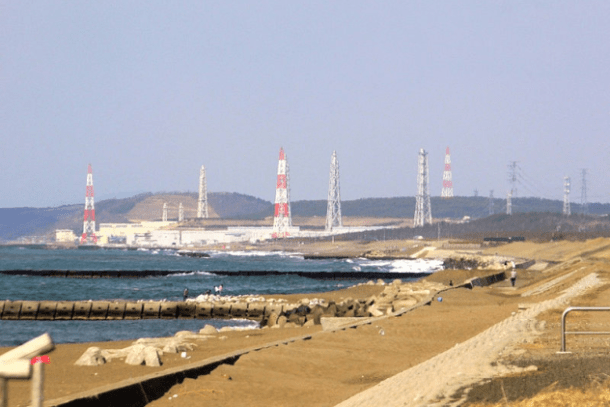
Chuetsu Earthquake
The Kashiwazaki-Kariwa Nuclear Power Plant (KKNPP) in Japan’s Niigata Prefecture can generate more power than any other power plant in the world—when it’s running. Since it became fully operational in 1997, one scandal after another has repeatedly forced it to shut down some or all of its seven reactors. Examples include concealing evidence of stress cracks and covering up the fact that the plant was built near fault lines.
That last bit came to light after the Chuetsu earthquake occurred on July 16, 2007. The magnitude 6.8 quake’s epicenter was only 24 kilometers (15 mi) offshore from the plant. The shaking was greater than the plant was designed to withstand; it was built before Japan updated their earthquake standards in 2006.
The ominous dry run for the later Fukushima Daiichi disaster damaged KKNPP and its reactors. The Tokyo Electric Power Company acknowledged that 1,200 liters of slightly radioactive water leaked into the sea and that dozens of barrels of low-level nuclear waste broke open during the quake. An exhaust pipe leaking radioactive iodine was also reported.
A report issued on July 19 by the Nuclear Information and Resource Service (NIRS) claimed the release of radioactive material to be much worse. According to NIRS, the water that leaked into the sea came from the irradiated fuel pool of one of the reactors. Another reactor had been releasing radioactive steam since the earthquake. The Associated Press also reported large amounts of damage to the plant’s infrastructure, with cracks and leaks seemingly everywhere. Liquefaction (formerly solid ground turning to mud) had occurred under parts of KKNPP.
Prosecutors innocent TEPCO over radioactive water leakage into the ocean
The court said there is no evidence that proves that radioactive water flew out of the Fukushima nuclear power plant to the ocean. I hope this would finally convince those who haven’t been convinced that the state of Japan denies truth and violates peoples lives. Its time to get rid of Abe et al.
Prosecutors drop TEPCO case over radioactive water leakage
FUKUSHIMA–The Fukushima District Public Prosecutor’s Office announced on March 29 that it will not prosecute Tokyo Electric Power Co. or its executives for violating an environmental pollution law.
The decision came two and a half years after a group of plaintiffs, including residents of Fukushima Prefecture, filed a criminal complaint against TEPCO, operator of the crippled Fukushima No. 1 nuclear power plant, and its 32 current and former executives.
The group sought to bring charges against the utility and its executives for allowing radioactive contaminated water to be discharged into the sea.
In its decision, the prosecutors said there was “insufficient” evidence to press charges against TEPCO and some of its executives, including Naomi Hirose, company president. The remaining executives, the prosecutors said, “had no authority or responsibility to set measures to avoid the leakage in the first place,” therefore, the accusation has “no grounds.”
“The Fukushima police investigated the case for almost two years. It is extremely disappointing,” said Ruiko Muto, 62, the head of the plaintiff’s group, at a news conference in Tokyo on March 29. “We wanted them to look into the case further. We can’t accept this decision.”
The group is planning to appeal to the Committee for the Inquest of Prosecution. The group will meet with its lawyers on March 30 and decide on whether it will pursue further action.
http://ajw.asahi.com/article/0311disaster/fukushima/AJ201603300068
Charges ruled out for Tepco figures over Fukushima No. 1 radioactive water spillage into sea
FUKUSHIMA – Public prosecutors decided on Tuesday not to indict Tokyo Electric Power Co. President Naomi Hirose and other current and former executives of the utility over radioactive water leaks from the crippled Fukushima No. 1 nuclear power plant into the ocean.
Sufficient evidence was not found, the Fukushima District Public Prosecutor’s Office said.
In September 2013, a civic group filed a criminal complaint against 32 current and former Tepco executives, including Hirose and Tsunehisa Katsumata, former chairman of the operator of the northeastern nuclear power plant, saying tainted water leaked from storage tanks into the ocean due to their failure to take preventive measures.
Through its investigation, the Fukushima Prefectural Police concluded that some 300 tons of stored radioactive water had flowed into the sea as of July 2013 because Tepco executives neglected to monitor the tanks or take leak-prevention measures, and sent the case to the prosecutors last October.
The prosecutors said there was no evidence supporting the allegation that the leaked tainted water was carried into the sea by groundwater at the plant, which suffered meltdowns following the massive earthquake and tsunami in March 2011.
The group said it will ask for a prosecution inquest panel’s investigation.
Tepco executives get a taste of citizens’ wrath

Three Tokyo Electric Power Co. executives are now facing criminal prosecution for negligence in failing to anticipate a monster tsunami that cut off electricity and inundated back-up emergency generators, causing a cessation of cooling in the Fukushima No. 1 nuclear plant reactors that precipitated three meltdowns in March 2011. How were they to know?
At the time, Tepco kept insisting that the 15-meter-high tsunami was sōteigai (inconceivable), an act of nature that absolved them of all responsibility. And, just in case the public was not buying this grand shirk, malicious rumors disingenuously scapegoated Prime Minister Naoto Kan, in a failed attempt to shift blame to him. Subsequently, Kan has been vindicated while Tepco remains guilty in the court of public opinion.
In mid-2012, Tepco released the results of its own investigation into the nuclear accident and, with unseemly chutzpah, absolved itself of all responsibility. It was so embarrassing in its exculpatory excesses, and thoroughly contradicted by all three of the other major investigations into the Fukushima debacle, that Tepco disavowed this whitewash in October 2012, conceding allegations of numerous failures; this mea culpa was at the insistence of a panel of international experts hired by the utility.
The court case will focus on what could have been done that Tepco knew about to better manage the risks inherent in the operation of nuclear reactors in a seismically active area with a history of devastating tsunami. As much as Tepco would like to paint this as a “black swan” once-in-a-thousand-year event — something of such low probability of occurrence that it would be a costly fool’s game to prepare for it — Tohoku’s tsunami coast was fairly recently battered in 1896 (8.5 magnitude with waves reaching 38.2 meters) and in 1933 (magnitude 8.4 with waves cresting at 28.7 meters). So it would seem that anyone operating a nuclear reactor on that coastline would have looked into the seismicity of the area and prepared accordingly.
In fact, Tepco did so in 2009 when it conducted in-house computer simulations suggesting the possibility of a 15.7-meter tsunami slamming the site of the Fukushima No. 1 nuclear plant. That information was actually provided to the Nuclear and Industrial Safety Agency (NISA) four days prior to the Great East Japan Earthquake, meaning that it was information considered vital enough to submit to the watchdog agency.
Interestingly, in February 2011 the Fukushima reactors were granted an extension to their 40-year operating license, passing a NISA safety review. But NISA was sharply critical of Tepco and called for the urgent replacement and relocation of backup diesel generators that had stress cracks and were located below, and between, the reactors and the ocean, leaving them vulnerable to inundation. In addition, NISA scolded Tepco for its lax safety practices, a clear reference to the 2002 scandal when a whistleblower revealed that the utility had falsified the repair and maintenance records for all of its nuclear reactors.
NISA, as part of the Ministry of Economy, Trade and Industry, was implicated in the attempted cover-up of that scandal and stands accused of regulatory capture, meaning it was co-opted by the utilities — a watchdog with neither bark nor bite. By not conducting rigorous oversight to ensure safety, NISA is thus also complicit in Tepco’s lack of a culture of safety, pinpointed by three major investigations as a cause of what they declared was a man-made nuclear accident.
Thus one wonders why no bureaucrats are being prosecuted. Haruki Madarame, then chairman of the Nuclear Safety Commission, testified in the Diet on Feb. 15, 2012: “Though global safety standards kept on improving, we wasted our time coming up with excuses for why Japan didn’t need to bother meeting them.” He also pointed out that back in the early 1990s, Tepco was told about the risk of a station blackout that might lead to reactor meltdowns and was urged to develop a defense in depth, meaning more backup electricity sources just in case. Tepco stonewalled safety regulators, asserting that the current systems were adequate.
So the nuclear accident at Fukushima was precipitated by natural disaster, but poor risk management and institutionalized complacency about risk were major factors increasing the likelihood of an accident and fumbling crisis response. The myth of 100-percent safety propagated by the “nuclear village” of atomic energy advocates made it taboo to question safety standards and militated against sober risk assessment and robust disaster emergency preparedness.
Not everyone was surprised by the nuclear disaster. In 1975, nuclear chemist Jinzaburo Takagi and others established the Citizens’ Nuclear Information Center (CNIC), which ever since has issued regular reports on power plant safety issues. Fukushima was the nightmare scenario that CNIC had long been predicting. In a 1995 interview, Takagi spoke about the risks of a meltdown in the event of multiple failures, as happened in Fukushima in March 2011. He correctly warned about the possibility of large radioactive releases from a meltdown resulting from a breakdown in the emergency core cooling system and the failure of back-up diesel generators.
“It’s inexcusable that a nuclear accident couldn’t be managed because a major event such as the tsunami exceeded expectations,” said Yotaro Hatamura, chariman of the government’s Third Party Panel Investigation Committee, blasting Tepco’s hubris in 2012. He added that risk management means anticipating worst-case scenarios — not wishing risk away.
Hatamura pointed out that the utility was ill-prepared for the crisis, dismissing the possibility of a total loss of power, and that its workers made critical errors in shutting off automated emergency cooling systems and wrongly assumed part of the cooling system was working when it was not. These workers and their managers were inadequately trained to cope with an emergency situation and according to the panel, lacked basic knowledge concerning the emergency reactor cooling system. Their mishandling of emergency procedures contributed to the crisis.
Tepco chose to ignore centuries of geological evidence and failed to act on fresh and compelling evidence about tsunami risk, a blind spot that left the plant needlessly vulnerable. It also successfully lobbied the government’s Earthquake Research Committee on March 3, 2011, to soften a public advisory warning that a massive tsunami could hit the Tohoku coast because it might cause misunderstanding. This PR approach to risk management promoted an unjustified insouciance that cost Japan dearly. Alas, Tepco was also cutting corners, balking at the $1 billion price tag of building a higher seawall to cope with the higher tsunami projections — a bargain in retrospect.
While it is unlikely that the Tepco Three (former chairman Tsunehisa Katsumata and two former vice presidents, Sakae Muto and Ichiro Takekuro) will be convicted for irresponsibly minimizing risk in ways that endangered local residents or for cutting costs that compromised public safety, the trial will make the nuclear village squirm as the public revisits the folly of wishing risk away — and understands it is happening all over again.
TEPCO draws fire after apologizing to Niigata panel
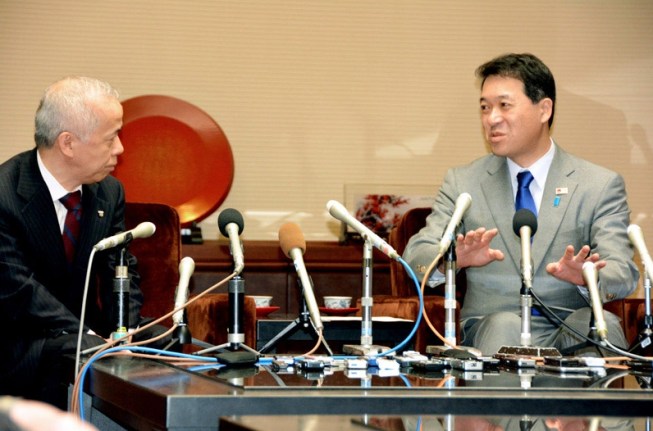
Niigata Governor Hirohiko Izumida, right, and Naomi Hirose, president of Tokyo Electric Power Co., hold a meeting at the Niigata prefectural government building in January.
NIIGATA–Even when they apologize, executives of Tokyo Electric Power Co. can still manage to draw additional criticism.
The executives, who hope to restart one of the largest nuclear power plants in the world in Niigata Prefecture, held talks here March 23 with a nuclear technology committee set up at the prefectural government.
Takafumi Anegawa, chief nuclear officer of TEPCO, offered an apology for the utility’s misleading responses to the committee’s repeated inquiries about the meltdowns at the Fukushima No. 1 nuclear power plant.
Specifically, Anegawa acknowledged that TEPCO could have declared the triple meltdown at the plant a few days after the crisis unfolded following the Great East Japan Earthquake and tsunami on March 11, 2011, instead of two months later.
TEPCO said late last month that it had found a passage detailing the criteria of a meltdown in its emergency response manual. Had the company known about that passage when the accident started, TEPCO said, it could have declared the meltdowns earlier.
When pressed by the Niigata committee on March 23 on why it took five years to find such an important passage in the emergency manual, the TEPCO executives did not give an explanation, saying the matter was still under investigation.
Committee members voiced their displeasure.
“Why did TEPCO turn it up now?” asked Masaaki Tateishi, professor emeritus of sedimentology at Niigata University. “It is out of the question for TEPCO to seek to restart its reactors, given its corporate culture.”
Mitsuhiko Tanaka, a journalist covering nuclear technology and a committee member, said TEPCO has again shown its slipshod approach toward dealing with an accident.
“TEPCO must have produced the manual but did not read it,” he said. “What it comes down to is that (its employees) had not been well trained.”
TEPCO plans to bring online two of the seven reactors at the Kashiwazaki-Kariwa nuclear plant in Niigata Prefecture and has submitted a safety screening application to the Nuclear Regulation Authority.
The Kashiwazaki-Kariwa plant has a capacity of 8.21 gigawatts.
However, Niigata Governor Hirohiko Izumida remains cautious toward restarting the nuclear plant, even if the reactors meet the NRA’s stricter safety regulations that were set following the Fukushima nuclear disaster.
The governor believes the full picture of the Fukushima disaster has not been unveiled.
The Niigata nuclear technology committee has been looking into what went wrong at the Fukushima plant, even after the Diet and the government wrapped up their investigations into the nation’s worst nuclear accident.
In autumn 2013, the committee set up an investigative panel to determine why TEPCO’s official acknowledgment of the meltdowns was delayed.
The panel demanded explanations from the company. TEPCO said in a reply in November 2015 that what constitutes a meltdown “had not been defined” within the company.
The panel kept pressing TEPCO, and in late February, TEPCO admitted that the manual used at the time of the Fukushima disaster had a passage defining a meltdown.
Anegawa told the committee on March 23 that the passage was uncovered during an investigation conducted “with the utmost care” to determine whether the delay in reporting to the government the meltdowns and other aspects of the Fukushima accident violated the law.
However, he declined to discuss details of how the company came across the passage, saying a third-party panel comprising lawyers and other experts were studying the issue.
After the meeting, Anegawa told reporters that he regretted the company’s probe “was not thorough.” He did not say when the third-party panel will release its findings.
Committee chief Ken Nakajima, professor of reactor safety at Kyoto University’s Research Reactor Institute, said the committee will continue to demand explanations from TEPCO.
“Humans are the ones who must ensure the safety (of nuclear facilities),” he told reporters. “Trust in TEPCO has been eroding. We cannot move ahead unless we are convinced of the veracity of what the company says.”
Governor Izumida, who has long questioned TEPCO’s credibility, declined an offer from TEPCO President Naomi Hirose in January to collaborate in drawing up an evacuation plan for a possible emergency at the Kashiwazaki-Kariwa plant.
“We cannot evacuate if you hide a meltdown,” the governor told Hirose during the meeting at the prefectural government building.
Izumida’s distrust of the utility runs deep.
After the Fukushima accident unfolded, Izumida confronted TEPCO officials over their previous denials over the phone that meltdowns had occurred at the plant.
The governor insisted that nuclear fuel rods must have melted, but the TEPCO officials repeated their denials by drawing a diagram of the reactors.
http://ajw.asahi.com/article/behind_news/social_affairs/AJ201603240072
TEPCO apologizes for meltdown announcement delay
Tokyo Electric Power Company has apologized to a Niigata Prefectural Government panel for not realizing sooner that 3 reactors at its Fukushima Daiichi plant had melted down in March 2011.
The panel is studying the safety of the Kashiwazaki-Kariwa nuclear plant in the prefecture. Niigata has made verification of the details of the Fukushima accident a prerequisite for the plant’s restart.
TEPCO waited 2 months after the Fukushima accident to announce the meltdowns. The panel had questioned the delay. But TEPCO insisted it had no basis for making the determination.
Last month, nearly 5 years after the disaster, the utility revealed it could have declared the reactors had melted down 3 days after the accident if it had adhered to an in-house manual.
On Wednesday, Managing Executive Officer Takafumi Anegawa apologized to the panel. He said the utility should have realized and reported the existence of the manual sooner.
Panel members asked the utility why the manual went unnoticed for 5 years. They said the utility’s longstanding and false claim that it had no standards for determining a meltdown makes it an untrustworthy nuclear plant operator.
The prefectural panel says it will resume discussions after a panel of outside experts set up by TEPCO submits a report on the cause of the delay.
http://www3.nhk.or.jp/nhkworld/en/news/20160323_30/
TEPCO Prosecution: A Sign That Japan’s Nuclear Industry Is in Free Fall
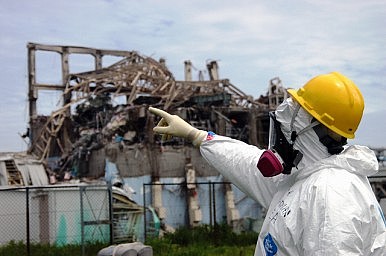
The criminal prosecution of TEPCO is another step in the process to end nuclear power in Japan.
By Shaun Burnie
The decision this week to indict executives of Japan’s largest energy utility, Tokyo Electric Power Company (TEPCO), for their failure to prevent the meltdown of three reactors at Fukushima Daiichi is a major step forward for the people of Japan.
The fact that this criminal prosecution is taking place at all is a vindication for the thousands of citizens and their dedicated lawyers who are challenging the nation’s largest power company and the establishment system. It is a devastating blow to the obsessively pro-nuclear Abe government, which is truly fearful of the effects the trial will have on nuclear policy and public opinion over the coming years.
For the eight other nuclear power companies in Japan, including their executives, the signal is clear – ignore nuclear safety and there is every prospect that when the next nuclear accident happens at your plant you will end up in court. For an industry that disregarded safety violations and falsified inspection results through its entire existence, the prosecution of TEPCO will be shocking.
But it would be naive to think that profound behavioral change will inevitably follow. In fact, in the five years after the accident, Japan’s nuclear industry has not just failed to learn the lessons of the accident, it is still actively ignoring them. In the three years since nuclear plant operators applied to restart their shutdown nuclear fleet, the evidence shows that when it comes to nuclear safety the bottom line is not safety, but money.
Leaving aside the inherent risks of another severe nuclear accident, the new safety agency in Japan, the Nuclear Regulation Authority (NRA) is overwhelmed, incapable and inadequate.
Back in 2008, TEPCO produced an internal report that predicted a maximum credible tsunami of 15.7 meters, but continued to insist that it would not reach the nuclear plant at Fukushima, which sits at a height of 10 meters. The cooling pumps for the reactor cores and spent fuel pools were located at just four metres above sea level.
Historical evidence that a major tsunami would impact the eastern Pacific coast of Ibaraki, Fukushima and Miyagi was well known. Modelling suggested that the next major tsunami was overdue and would inundate the coastal plain about 2.5 to 3 km inland. In 2009, Japanese nuclear regulators questioned the vulnerability of the Fukushima Daiichi reactors to a large-scale tsunami and asked TEPCO to “consider” concrete steps against tsunami waves at the plant. TEPCO responded: “Do you think you can stop the reactors?”
This relaxed attitude is not just limited to TEPCO. In recent weeks, Kyushu Electric informed the NRA that the emergency seismic proof isolation building that they committed to build by March of this year would not be built after all, despite being a condition to secure approval to restart the two Sendai reactors. The NRA expressed its disappointment, but the Sendai reactors restarted in August and continue to operate.
At the Takahama nuclear plant, owned by Kansai Electric the NRA admitted in the last month that they do not know if the reactors comply with fire safety regulations requiring essential electric safety cabling to be adequately separated and protected.
The loss of safety cable function sounds mundane, but the risks are considered more severe than all other failures at a nuclear plant combined. Without electricity, vital safety systems do not work and control of the reactor is lost. A severe accident at Takahama would threaten millions of residents of Kyoto, Osaka, Kobe and the wider Kansai region.
Nonetheless, the NRA granted Kansai Electric an exemption to avoid delaying restart. Takahama reactor-3 resumed operation in late January, while Reactor 4 at Takahama resumed operations for less than three days before shutting down again on 29 February due to an electrical failure.
These examples are the tip of the atomic iceberg that threatens the next nuclear disaster in Japan. With three reactors now operating, the industry remains in crisis. Having sat on idle assets for the last few years, the utilities are desperate to resume operations, while the nuclear obsessed Abe government is happy to support them. It’s time to put people first.
Nuclear power is a financial disaster which will only get worse as the electricity market opens to new suppliers and renewable energies out-price them. And the vast majority in Japan realize this: 60 percent of Japanese are opposed to the phase-in of nuclear, and there are more than 300 lawyers fighting reactor by reactor to prevent restart on behalf of citizens. At this rate, the Abe government and the nuclear industry will never see the target of 35 reactors restarted by 2030.
The criminal prosecution of TEPCO, long in coming, is another step in the process to end nuclear power in Japan and for a transformation of its energy system to renewables.
Shaun Burnie is a nuclear specialist at Greenpeace Germany, currently working as part of a Greenpeace radiation survey team in the Pacific Ocean off the coast of Fukushima
Fukushima towns grudgingly realize survival again depends on TEPCO

Workers dismantle a tank that once contained water contaminated with radiation in Okuma, Fukushima Prefecture.
Futaba Mayor Shiro Izawa was taken aback when the president of Tokyo Electric Power Co. paid a visit in early January.
Izawa has been working out of a temporary government office in the town of Iwaki, Fukushima Prefecture, since the disaster at TEPCO’s Fukushima No. 1 nuclear plant forced all residents to evacuate Futaba in 2011.
“Have you perhaps forgotten that TEPCO is the perpetrator that has driven Futaba into the situation it finds itself?” Izawa grumbled at TEPCO President Naomi Hirose. “I am beyond furious.”
But within minutes, Izawa was peppering Hirose with requests to rebuild life in his community.
Residents and government leaders around the still stricken nuclear plant continue to vilify the plant’s operator, but they are increasingly aware that economic survival depends largely on the very entity that turned their communities upside down.
Before the 2011 Great East Japan Earthquake and tsunami caused the meltdowns at the Fukushima No. 1 nuclear plant, the host and surrounding communities depended largely on nuclear power plants for government subsidies and employment.
They are resigned to having again depend on TEPCO for the billions of yen that will be sunk into the prefecture for work to decommission the reactors at the utility’s No. 1 plant as well as its No. 2 plant in Fukushima Prefecture.
Every day, about 7,000 workers pass through the gates of the Fukushima No. 1 plant for the decommissioning process that is expected to take decades to complete.
Some say the nuclear plant has been a source of income than crosses generations.
A 61-year-old man who was part of the team that constructed the No. 6 reactor at the plant now dismantles tanks that once contained radiation-contaminated water there.
“The nuclear plant remains unchanged as a stable workplace from before the accident,” he said.
His father was also involved in construction of the nuclear plant, which started operating in 1971.
After the 2011 disaster, relatives beseeched the man to cut all ties with the plant. But he has no intention of ending his work there.
The effects of the accident indeed sparked anger and distrust of TEPCO and nuclear power in general.
The Fukushima prefectural government decided to end its dependence on nuclear plants and supply all electricity through renewable energy sources. It has asked for the decommissioning of all reactors in the prefecture.
However, the prefectural government faces the difficult task of revitalizing the local economy because about 70,000 residents remain in evacuation close to five years after the accident.
Decommissioning work is now one of the only realistic large-scale options to support the local economy.
The central and prefectural governments are placing high hopes on research and development related to decommissioning the reactors.
In September 2015, after the evacuation order was lifted for the town of Naraha, the Japan Atomic Energy Agency built a facility in the municipality to conduct experiments on remote-control use of robots in the decommissioning work.
An international joint research center is planned for Tomioka, which lies immediately north of Naraha.
“Community development will not proceed unless there is a core structure,” a government source said. “It would be perfectly all right if money was injected through the decommissioning business.”
TEPCO has been constructing bases for decommissioning work in municipalities where evacuation orders are still in place.
In Okuma, a community that co-hosts the Fukushima No. 1 nuclear plant, TEPCO has built a facility to prepare 2,000 meals a day for workers at the plant. There are also plans to construct dormitories that can house 750 employees.
By the end of March, TEPCO’s Fukushima Revitalization Headquarters, now based at the J-Village training center about 20 kilometers from the Fukushima No. 1 plant, will move to Tomioka.
“It is the responsibility of the central and other governments as well as TEPCO to create a situation where those who want to return can do so,” said Yoshiyuki Ishizaki, chief of the headquarters.
Kazuyuki Shima, 37, who has lived in temporary housing in Iwaki since evacuating from Okuma, believes that creating jobs will lead to a revitalized local community.
He now works at the TEPCO facility that prepares meals for workers.
“If people gather for decommissioning, the restart of supermarkets and hospitals will also be accelerated,” Shima said. “That will make it easier for local residents to return. If that happens, I believe this community will not be forgotten.”
At the same time, the decommissioning plans have led to unusual demographics.
Often, the number of workers involved in decommissioning exceeds the number of residents who have returned to their homes.
That is the case in Hirono, a town within a 30-kilometer radius of the Fukushima No. 1 plant. The town also has nearly twice as many men as women.
To prevent housing facilities from sprouting up all over the town, the local government plans to adopt an ordinance requiring prior notification of construction plans of such buildings.
About 1,300 workers involved in decommissioning and decontamination work around the plant now reside in Naraha, about triple the number of residents who have returned home.
The Naraha town government is encouraging the construction of housing for the workers at a golf course away from the residential area.
“Residents might be concerned about the large number of strangers in their community and will be hesitant about returning home,” a high-ranking town official said.
In Mayor Izawa’s deserted town of Futaba, there are no signs of when residents can return home.
After lambasting the TEPCO president, Izawa asked for help in persuading companies involved in decommissioning R&D to build offices in Futaba.
“I do feel the contradiction, and I am in quite a dilemma,” Izawa said. “But without that, can a local government that never had any other major industry ever think of surviving?”
http://ajw.asahi.com/article/0311disaster/recovery/AJ201602260069
TEPCO gives unconvincing excuse for delay in meltdown declaration
Tokyo Electric Power Co., the operator of the stricken Fukushima No. 1 nuclear power plant, said Feb. 24 that it could have declared the reactor meltdowns at the plant much earlier than it did.
The utility said it discovered a guideline in its operational manual that would have allowed it to announce core meltdowns only three days after the plant was struck by the tsunami in 2011 instead of the two months it actually took.
In a Feb. 24 news conference, a TEPCO official said the manual had been discovered for the first time earlier in February.
But the company’s explanations about the delay in announcing the meltdowns, triggered by the Great East Japan Earthquake and tsunami on March 11, 2011, and the recent “discovery” of the document are by no means convincing.
TEPCO initially maintained that the reactors suffered “core damage,” a condition in which nuclear fuel inside a reactor core is damaged, rather than a “meltdown.” It did not admit that meltdowns had occurred in the three reactors until late May 2011, more than two months later.
The utility claimed it had taken so long to acknowledge the meltdowns because there was “no basis” for making the judgment.
But this claim has proved false. At that time, TEPCO was suspected of concealing facts to make the accident look less serious than it actually was. The latest revelations revive such suspicions.
In a statement on Feb. 24, Niigata Governor Hirohiko Izumida called on TEPCO to conduct a thorough internal investigation to uncover the “truth behind its concealment of meltdowns,” including determining who gave the instructions.
Niigata Prefecture is home to TEPCO’s Kashiwazaki-Kariwa nuclear power plant, which the company aims to restart. Izumida has every right to make the demand.
Even more baffling is the “discovery” of the manual nearly five years after the nuclear crisis broke out.
Back then, core meltdowns were clearly defined as nuclear emergencies under the nuclear disaster special measures law. Given that TEPCO has been very sensitive to the question of whether trouble at a nuclear power plant, no matter how minor, should be reported to the government, it is hard to believe that the company failed to remember the standard concerning meltdowns.
It is clearly impossible to directly confirm whether a core meltdown is taking place during a severe nuclear accident.
That’s apparently the reason why TEPCO established a clear criterion for a nuclear meltdown that required the company to declare a meltdown when damage to a reactor core exceeds 5 percent.
When a nuclear accident occurs, only the operator of the nuclear plant has access to detailed data about what is happening. Both the government and news media depend on information provided by the plant operator for related policy decisions and news coverage.
A utility’s failure to swiftly offer accurate information about the situation could cause the government to make misguided policy decisions and the media to distribute incorrect reports about the accident.
TEPCO’s report on its investigation into the nuclear disaster, released in 2012, defended the company’s use of the term “core damage.” The report argued that the company had tried to provide accurate information about the conditions of the reactors based on available data by avoiding the term “core meltdown” because there was no clear and widely shared definition of the term.
It cannot be said that TEPCO provided the entire picture of what happened based on exhaustive and effective efforts to identify all the factors involved.
The company’s guideline concerning core meltdowns was “discovered” during an in-house investigation into how the utility responded to the Fukushima nuclear crisis. That investigation was conducted at the request of a technical committee of the Niigata prefectural government.
The prefecture called for a fresh inquiry in connection with TEPCO’s plan to restart the Kashiwazaki-Kariwa nuclear power plant.
TEPCO has said it will look into how it failed to notice the existence of the guideline through a probe involving outsiders.
The utility should determine who should be held accountable for that failure.
The company also needs to offer convincing answers to such questions as how it will prevent a recurrence and whether problems with its corporate culture played a role. Otherwise, its efforts to regain public trust are destined to fail.
http://ajw.asahi.com/article/views/editorial/AJ201602260057
TEPCO ordered to pay couple who ‘voluntarily’ fled Fukushima after nuclear disaster

KYOTO–The Kyoto District Court ordered Tokyo Electric Power Co. to pay 30.46 million yen ($267,000) to a couple for mental illnesses the husband suffered following their “voluntary evacuation” from the Fukushima nuclear disaster.
The district court’s unprecedented ruling on Feb. 18 said the accident at TEPCO’s Fukushima No. 1 nuclear plant contributed to the insomnia and depression the husband developed after his family fled Fukushima Prefecture in 2011.
Although the plaintiffs did not live in a government-designated evacuation zone around the plant, the court said evacuating voluntarily is “appropriate when the hazard from the accident and conflicting information remained.”
The ruling was the first to award damages to voluntary evacuees, according to a private group of lawyers involved in lawsuits against TEPCO and the central government over the nuclear disaster.
The man, who is in his 40s, his wife and three children were seeking a total of 180 million yen against TEPCO.
According to the ruling, the husband and wife had managed a company that operated restaurants in Fukushima Prefecture. The family fled their home a few days after the nuclear accident started in March 2011 and moved to Kyoto in may that year.
The court acknowledged the man suffered severe mental stress because he had to leave his hometown and quit his position as representative of the company.
TEPCO had paid a total of 2.92 million yen to the family based on the central government’s compensation standards for residents who evacuated on their own.
The utility argued that its payments were appropriate because they were based on guidelines set by a central government panel addressing disputes over compensation for nuclear accidents. The guidelines dictate uniform and fixed payments for residents who left areas outside designated evacuation zones.
However, the district court said these guidelines “simply show a list of damages that can be broken down and the scope of damages.”
The court concluded that compensation amounts should instead reflect the personal circumstances of evacuees in nuclear accident-related cases.
It ordered TEPCO to compensate the couple for the period through August 2012, when radiation levels dropped to a certain level and information on the nuclear accident became more stable and accurate.
Specifically, the court said the husband and wife are entitled to part of the monthly remuneration of 400,000 yen to 760,000 yen they had received each for having to suspend their business following the nuclear accident.
But the court dismissed the damage claims of the couple’s three children, saying their compensation was already covered by TEPCO’s payments.
About 10,000 evacuees are involved in 21 damages suits filed in Fukushima Prefecture, Tokyo, Osaka and elsewhere.
An estimated 18,000 people from Fukushima Prefecture are still living in voluntary evacuation, according to the prefectural government.
http://ajw.asahi.com/article/0311disaster/fukushima/AJ201602190066
Tepco to compensate couple for damages from voluntary Fukushima evacuation
The Kyoto District Court has ordered the operator of the crippled Fukushima No. 1 nuclear power plant to pay about ¥30 million to a couple for economic and health damage caused by their decision to voluntarily flee the radiation in Fukushima Prefecture after the disaster.
The husband lost his job and developed a mental illness during the ordeal.
This is believed to be the first time a court has found Tokyo Electric Power Co. liable for damages stemming from a voluntary evacuation after the plant’s triple core meltdown, which was triggered by the Great East Japan Earthquake in March 2011.
The ruling is expected to affect similar lawsuits filed by voluntary evacuees across the country.
According to the Fukushima Prefectural Government, as of the end of October, some 18,000 people in 7,000 households who lived outside the designated evacuation zone remain evacuated outside Fukushima.
The sum awarded is also far more than the ¥11 million proposed by a government-established center that mediates out-of-court settlements for nuclear accident compensation cases. The settlement program is called ADR.
The center is for people who are not covered by Tepco’s direct compensation scheme. The ADR program is also aimed at reaching conclusions more quickly than through Tepco. Some 18,000 applications for settlement have been made, out of which 13,000 cases have been resolved. But the amount awarded through ADR tends to be small, experts say.
Hideaki Omori, the lead lawyer for the plaintiffs, said the ruling “set an example that there is no need to give up when evacuees do not feel satisfied with the sum” presented by the dispute resolution center.
The couple — who had moved twice before settling down in the city of Kyoto in May 2011 — had sought ¥180 million in damages.
The plaintiffs, who are in their 40s, expressed relief after the ruling.
“We are relieved that we will be financially alright for a while, but we still can’t imagine our future life,” they said in a statement released through their lawyers.
According to the written complaint, the husband became unable to work because he developed pleurisy (a respiratory disease) and depression after the evacuation. Their children also experienced emotional distress from being harshly treated by classmates because they came from Fukushima Prefecture.
The court also showed for the first time that such compensation should be extended for evacuation through the end of August 2012, rejecting claims for damages after that.
The court cited the gradual fall in radiation levels in the city of Koriyama, where the couple originally lived before the disaster, concluding that from September 2012 on, the levels were not serious enough to damage health.
After three reactors experienced meltdowns during the disaster, residents within 20 km of the nuclear plant and some areas beyond were ordered to evacuate. Many others also fled at their own discretion and remain in temporary housing.
http://www.japantimes.co.jp/news/2016/02/18/national/crime-legal/first-tepco-told-compensate-couple-damage-stemming-voluntary-fukushima-evacuation/#.VsbzN-bzN_l
Fukushima police to send toxic water case against TEPCO, execs to prosecutors
FUKUSHIMA — Police here will refer Tokyo Electric Power Co. (TEPCO) and 32 current and former TEPCO executives to prosecutors in connection with leaks of toxic water into the Pacific in the aftermath of the 2011 Fukushima nuclear disaster, investigative sources say.
The police will send papers on the case to the Fukushima District Public Prosecutors’ Office on suspicion TEPCO and the executives violated the environmental pollution offense law.
Among the 32 individuals are TEPCO President Naomi Hirose, former Chairman Tsunehisa Katsumata and former President Masataka Shimizu. They are suspected of being negligent in their duties and releasing radioactively contaminated water into the ocean from the crippled Fukushima No. 1 Nuclear Power Plant.
An initial criminal complaint accusing TEPCO executives of professional negligence resulting in injury or death was filed jointly by individuals and representatives of a citizens’ group. In September 2013, the same complainants filed with the Fukushima police against the TEPCO executives on suspicion of violating the environmental pollution offense law.
The complaint says the central government ordered TEPCO to build underground walls to prevent leaks of contaminated groundwater, but that TEPCO postponed taking the measure, citing costs and other reasons. Furthermore, the complaint accuses TEPCO of using weak water storage tanks resulting in the leak of some 300 metric tons of contaminated water, and of insufficient monitoring measures that led to the delayed discovery of the leak and increasing the volume of water that escaped.
Source: Mainichi
http://mainichi.jp/english/english/newsselect/news/20151002p2a00m0na016000c.html
TEPCO rejected requests for anti-tsunami steps before nuclear crisis
Tokyo Electric Power Co turned down requests in 2009 by the nuclear safety agency to consider concrete steps against tsunami waves at the Fukushima Daiichi nuclear plant, which suffered a tsunami-triggered disaster two years later, government documents showed Friday.
“Do you think you can stop the reactors?” a TEPCO official was quoted as telling Shigeki Nagura of the now-defunct Nuclear and Industrial Safety Agency, who was then assigned to review the plant’s safety, in response to one of his requests.
The detailed exchanges between the plant operator and regulator came to light through the latest disclosure of government records on its investigation into the nuclear crisis, adding to evidence that TEPCO failed to take proper safety steps ahead of the world’s worst nuclear accident since the 1986 Chernobyl disaster.
According to records of Nagura’s accounts, Nagura heard TEPCO’s explanations of its tsunami estimates at the agency office in Tokyo in August and September 2009 as it was becoming clear that the coastal areas of Fukushima and Miyagi prefectures were hit by massive tsunami in an 869 earthquake.
TEPCO said the height of waves was estimated to be around 8 meters above sea level and will not reach the plant site located at a height of 10 meters, they show.
But Nagura said he remembered thinking pumps with key cooling functions, which are located on the ground at a height of 4 meters, “will not make it” and told TEPCO, “If this is the outcome, you better consider concrete responses.”
In refusing to immediately act, TEPCO said it would wait for related studies to be carried out by the academic society of civil engineers, which it had requested to be done by March 2012.
Nagura also proposed placing the pumps inside buildings to protect them from being exposed to water, but a TEPCO official told him, “Our company cannot make a decision without seeing the results of the (studies by the) society of civil engineers.”
Then another TEPCO official told Nagura, “Do you think you can stop the reactors?” according to the government documents.
Nagura recalled in the documents, “I wondered why I had to be told such a thing.” But he also admitted that, after all, he only encouraged TEPCO to “consider” tsunami countermeasures and did not request that it “take” specific measures.
The Fukushima crisis has revealed how Japan, which had boasted of possessing the world’s safest nuclear power plants, was ill-prepared against a severe nuclear accident. Three reactors suffered core meltdowns after they lost their key cooling functions amid a loss of all electrical power following a huge earthquake and tsunami in March 2011.
The government-appointed nuclear accident investigation panel has already issued a final report, and the government is now gradually disclosing the records of hearings conducted to people involved.
Source: Japan Today
1 This Month

of the week – Shut Down Drone Warfare!


Tell the Ukrainian Government to Drop Prosecution of Peace Activist Yurii Sheliazhenko

Petition to revoke the licensing of the Near Surface Nuclear Disposal Facility (NSDF) at Chalk River. https://www.ourcommons.ca/petitions/en/Petition/Details?Petition=e-7247
To see nuclear-related stories in greater depth and intensity – go to https://nuclearinformation.wordpress.com
-
Archives
- April 2026 (19)
- March 2026 (251)
- February 2026 (268)
- January 2026 (308)
- December 2025 (358)
- November 2025 (359)
- October 2025 (376)
- September 2025 (257)
- August 2025 (319)
- July 2025 (230)
- June 2025 (348)
- May 2025 (261)
-
Categories
- 1
- 1 NUCLEAR ISSUES
- business and costs
- climate change
- culture and arts
- ENERGY
- environment
- health
- history
- indigenous issues
- Legal
- marketing of nuclear
- media
- opposition to nuclear
- PERSONAL STORIES
- politics
- politics international
- Religion and ethics
- safety
- secrets,lies and civil liberties
- spinbuster
- technology
- Uranium
- wastes
- weapons and war
- Women
- 2 WORLD
- ACTION
- AFRICA
- Atrocities
- AUSTRALIA
- Christina's notes
- Christina's themes
- culture and arts
- Events
- Fuk 2022
- Fuk 2023
- Fukushima 2017
- Fukushima 2018
- fukushima 2019
- Fukushima 2020
- Fukushima 2021
- general
- global warming
- Humour (God we need it)
- Nuclear
- RARE EARTHS
- Reference
- resources – print
- Resources -audiovicual
- Weekly Newsletter
- World
- World Nuclear
- YouTube
-
RSS
Entries RSS
Comments RSS
 nuclear-news