TEPCO to reuse tanks holding radioactively contaminated water at Fukushima plant

Tokyo Electric Power Co. (TEPCO) will reuse highly contaminated tanks at the crippled Fukushima No. 1 Nuclear Power Plant to store radioactively contaminated water after treatment, company sources said.
The company will return contaminated water to flange-type tanks that had held such water after removing radioactive materials from the water using the Advanced Liquid Processing System (ALPS). This is because TEPCO has failed to prevent contaminated water from being generated on the premises of the plant or to secure enough storage tanks to hold treated water.
TEPCO had submitted the reuse plan to the Nuclear Regulation Authority, which approved it on July 6 or earlier. TEPCO is set to begin reusing contaminated tanks as early as this month.
Flange-type tanks are assembled by tightening multiple steel plates with bolts. Since such tanks have higher risks of leaking contaminated water, TEPCO is gradually replacing them with tanks assembled by welding steel plates together.
TEPCO is trying to freeze underground soil to surround reactor buildings at the Fukushima power plant to prevent underground water from flowing beneath them and becoming contaminated with radioactive materials.
However, as the efforts have proven ineffective, the utility has decided to reuse flange-type tanks, which it had initially planned to dismantle.
Massive amounts of water are flowing onto the premises of reactor buildings at the atomic power station, generating some 400 tons of radioactively contaminated water a day. TEPCO uses ALPS to purify contaminated water, but the system cannot remove radioactive tritium.
The power company has stored the treated water mainly in welded-type tanks. There are already 1,000 water tanks on the premises of the power station.
http://mainichi.jp/english/articles/20160707/p2a/00m/0na/003000c
NRA casts doubt on TEPCO ice wall project at Fukushima nuke plant

In March this year, Tokyo Electric Power Co. (TEPCO) began work on a subterranean wall of frozen soil mainly on the seaward side of the disaster-stricken Fukushima No. 1 nuclear plant, with most of another wall on the landward side begun in June. The purpose of the barriers is to stop the flow of groundwater into the plant buildings — a problem that has resulted in enormous volumes of contaminated water. However, three months since the freezing process began, TEPCO is ominously silent on the ice wall’s effectiveness, and the plan is quickly approaching its do-or-die moment.
The problem itself is simply put. Every day, some 850 metric tons of groundwater flows down from the mountains and under the Fukushima No. 1 plant property. Some of the water collects in the shattered reactor buildings, coming into contact with melted nuclear fuel and other radioactive substances and becoming heavily contaminated. TEPCO needs to stop the groundwater from getting into these buildings.
In September 2015, the utility started digging a chain of wells called subdrains to catch and drain the groundwater. This is just one of many countermeasures tried so far, including the ice wall. Work on the latter began in June 2014, and eventually 1,568 pipes were sunk along a 1.5-kilometer perimeter around the No. 1-4 reactors and turbine buildings. The plan calls for coolant chilled to minus 30 degrees Celsius to be pumped into the pipes, freezing the soil around them to a depth of about 30 meters and creating a solid barrier.
“Ice walls are often used in public works projects, but the one at the Fukushima No. 1 nuclear plant is by far the largest ever tried,” says Mie University associate professor Kunio Watanabe. When building a tunnel, for example, ice walls are used to prevent groundwater from flowing into the construction area after the bedrock has been fractured. In Japan, the method has been used on some 600 such projects since 1962. The largest ice wall ever created was about 37,700 cubic meters, during construction of a subway line in Tokyo. The Fukushima plant ice wall is nearly double that, at about 70,000 cubic meters.
TEPCO tested the method in April 2015, freezing one section of the subterranean wall. To stop contaminated groundwater from flowing into the ocean, the utility started injecting coolant in the pipes on the seaward side and part of the landward wall in late March in an attempt to create about an 820-meter-long subterranean barrier — or 55 percent of the eventual total length. Saying that the temperatures were dropping according to plan, the utility started freezing operations on most of the remaining landward section at the beginning of June, and now only seven sections totaling 45 meters on the landward side are left.
TEPCO has stated that “the ice wall is going according to plan.” However, the Nuclear Regulation Authority (NRA) has pointed out that the volume of groundwater collecting in waterfront wells has not decreased, casting doubt on TEPCO’s claim.
At a meeting this month, NRA committee member Toyoshi Fuketa stated, “This is not a wall in a true sense. Perhaps it’s more akin to a bamboo screen, with groundwater trickling through the gaps.” TEPCO has responded that the quick flow of the groundwater likely makes it hard to freeze the soil in some places, and it is proceeding with work to create cement barriers to slow the water down.
There are also worries that the large volumes of highly contaminated water already collecting in the reactor and turbine buildings could leak into the environment if only the landward ice wall proves effective and the seaward wall has gaps. While TEPCO is looking to expand the ice wall, the NRA has not altered its stance that it must first confirm the effectiveness of the freezing operations already undertaken. The ice wall has already cost 34.5 billion yen in government funds.
http://mainichi.jp/english/articles/20160630/p2a/00m/0na/006000c
How far up the ladder did the #Fukushima cover up really go?
Tokyo – About the only country today where a public apology is still accepted is in Japan, and quite honestly, this writer has always thought life would be so much more simpler if that’s all it took to right a profound wrong.

That is what took place last week when CTV News reported Tokyo Electric Power Co. (TEPCO) President Naomi Hirose acknowledged in public the company had delayed its disclosure of the meltdowns of three reactors at the Fukushima Daiichi nuclear power plant.
Hirose’s apology on the cover-up was to be expected after the news came out that an investigation had found Hirose’s predecessor had instructed staff to avoid using the term, “meltdown” after the disaster in March 2011. “I would say it was a cover-up,” Hirose told a news conference. “It’s extremely regrettable.”
Hirose said he would take a 10 percent pay cut and another executive will take a 30 percent pay cut for one month each to show how sincere the apology really is. I hope all the children with thyroid abnormalities and all those displaced refugees from Fukushima Prefecture are willing to accept a one-month pay reduction by TEPCO executives as compensation for their troubles.
An investigative report submitted by three company-appointed lawyers on June 16, 2016, said TEPCO’s then-President Masataka Shimizu instructed officials to avoid using the specific description “meltdown” under alleged pressure from the Prime Minister’s Office, although the company’s attorneys say they have no direct evidence of this.
So TEPCO officials used the less damaging term “core damage” for two months, leaving the Japanese population and the rest of the world to think the disaster wasn’t that bad. Boy, was the world ever fooled? Of course, former officials at the Prime Minister’s Office have denied there was any pressure exerted on TEPCO, but what else would they be expected to say?
It wasn’t until May 2011 that TEPCO officials used the scary “M” word reports the Associated Press, and that was because computer simulations showed the fuel in one reactor had melted to the point it had fallen into the bottom of the primary containment chamber, and the other two reactor’s cores had melted far worse than previously thought.
It is interesting that every investigation so far had put the blame for the Fukushima disaster squarely on the shoulders of TEPCO. The first independent investigation authorized by the National Diet in its 66-year history was commissioned in 2011. That investigation reported: “It was a profoundly man-made disaster – that could and should have been foreseen and prevented. And its effects could have been mitigated by a more effective human response. “Governments, regulatory authorities and Tokyo Electric Power lacked a sense of responsibility to protect people’s lives and society.”
The big question for me is simple. Did Prime Minister Shinzo Abe put enough pressure on TEPCO officials that the disaster was downplayed to the world? Abe’s government has not been very forthcoming about anything to do with Fukushima over the past five years, as this writer has reported previously in Digital Journal.
And owing to the fact that Mr. Abe has been adamant in saying Japan needs its nuclear power plants, anything he says about Fukushima I would take with a grain of salt. Digital Journal reported that on March 6, this year at a press conference, Abe insisted that safety of nuclear plants was the government’s “top priority.” He also said the government would “not change its policy” in which reactors that meet the new standards can be restarted. So, yes, I think he probably did speak sternly with TEPCO officials in March 2011.
Fukushima nuclear meltdown was covered up, plant operator admits
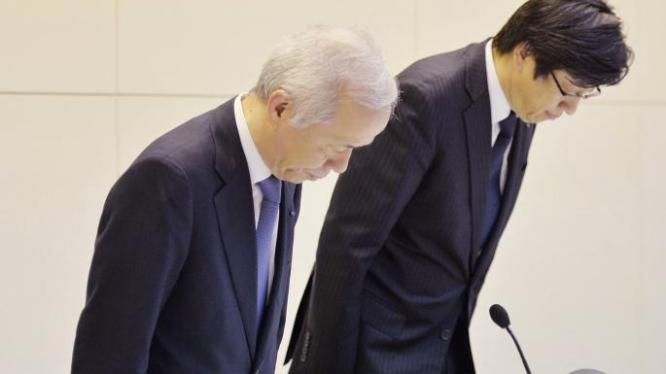
Naomi Hirose, left, TEPCO president, and Takafumi Anegawa, a director, apologise at press conference in Tokyo today
The company responsible for the Fukushima Dai-ichi nuclear power plant has admitted lying about the meltdown of its reactors five years ago, in a deliberate cover-up of the world’s second worst nuclear disaster.
It took two months for the Tokyo Electric Power Company (Tepco) to own up to the meltdown of three reactors after an earthquake and tsunami. A report commissioned by the company says that its president at the time ordered employees to speak of “damage” to the reactors and avoid the world, “meltdown”.
The company’s current president, Naomi Hirose, said: “It is extremely regrettable People are justified in…
Tepco’s “sincere”apology!!!
With Tepco it is always the same song, they apologize for a long ago previous lie and tell the whole world how very very sorry, repenting they are, while they daily continue lying and covering-up the true happenings at Fukushima Daiichi.
FUCK TEPCO!
Press Release (Jun 21,2016)TEPCO APOLOGIZES FOR PREVIOUS LEADERSHIP’S FAILURE TO ACKNOWLEDGE MELTDOWN DURING FUKUSHIMA ACCIDENT
Responding to recent report of an investigating committee, TEPCO restates its commitment to provide comprehensive, accurate and understandable information, while making safety the utmost priority to ensure a safe and secure society
TOKYO, June 21, 2016 In its first response to the June 16 report of the committee investigating the belated acknowledgment that a meltdown had taken place at Fukushima Daiichi NPS in March 2011, TEPCO said it is clear from the report that its previous leadership gave instructions not to use the word “meltdown” in public statements.
“We deeply regret that our previous leadership failed to live up to the standards of transparency and thoroughness that we strive to meet today,” said TEPCO President Naomi Hirose (who was not the company’s leader at the time of the accident). “We sincerely apologize for it,” he said.
In more recent years, through the creation of the Nuclear Reform Monitoring Committee and many other changes, TEPCO has worked to improve the timeliness, thoroughness, and clarity of its communication with the public, both inside Japan and internationally. President Hirose stressed that TEPCO has been learning this lesson and breaking from its past, as it works to build trust with the public and with government through the implantation of its Nuclear Safety Reform Plan. Improvements in communication represent an important element of that Plan, which is overseen both by the company’s Nuclear Safety Oversight Office and by an independent Nuclear Reform Monitoring Committee chaired by the former head of the U.S. Nuclear Regulatory Commission.
“We deeply regret the shortcomings of the past,” President Hirose said, “but it is important to recognize that they do not represent the TEPCO of today while making safety the utmost priority to ensure a safe and secure society.”
http://www.tepco.co.jp/en/press/corp-com/release/2016/1300509_7763.html
TEPCO admits meltdown cover-up

TEPCO admits meltdown cover-up
The president of Tokyo Electric Power Company has admitted the company concealed the reactor meltdowns at its Fukushima Daiichi nuclear plant immediately after the March 2011 earthquake and tsunami.
The utility did not officially admit the meltdowns until more than 2 months after the accident.
In February this year, it was revealed the utility could have ascertained a meltdown 3 days after its occurrence if workers had followed an in-house manual.
TEPCO asked a third-party panel to investigate the matter. Last Thursday, the panel released a report that said the company’s then-president, Masataka Shimizu, had instructed officials not to use the words “core meltdown.”
TEPCO President Naomi Hirose said at a news conference on Tuesday that the company’s concealment of the meltdowns at the order of its then-president is a grave issue. He said it is natural for the public to interpret the decision as a cover-up, and he apologized.
The panel report said TEPCO’s then-president received instructions on the matter from the prime minister’s office. But it’s not known what exactly he was told or who gave the orders.
Both then-Prime Minister Naoto Kan and then-Chief Cabinet Secretary Yukio Edano have denied giving such instructions.
http://www3.nhk.or.jp/nhkworld/en/news/20160621_35/
Fukushima meltdown apology: “It was a cover-up”
TOKYO — The utility that ran the Fukushima nuclear plant acknowledged Tuesday its delayed disclosure of the meltdowns at three reactorswas tantamount to a cover-up and apologized for it.
Tokyo Electric Power Co. President Naomi Hirose’s apology followed the revelation last week that an investigation had found Hirose’s predecessor instructed officials during the 2011 disaster to avoid using the word “meltdown.”
“I would say it was a cover-up,” Hirose told a news conference. “It’s extremely regrettable.”
TEPCO instead described the reactors’ condition as less serious “core damage” for two months after the earthquake and tsunami on March 11, 2011, wrecked the plant, even though utility officials knew and computer simulations suggested meltdowns had occurred.
An investigative report released last Thursday by three company-appointed lawyers said TEPCO’s then-President Masataka Shimizu instructed officials not to use the specific description under alleged pressure from the Prime Minister’s Office, though the investigators found no proof of such pressure.
The report said TEPCO officials, who had suggested possible meltdowns, stopped using the description after March 14, 2011, when Shimizu’s instruction was delivered to vice president at the time, Sakae Muto in a memo at a televised news conference. In a video from that day, a company official rushes over to Muto, showing the memo and telling him that the Prime Minister’s Office has banned the word.
Government officials also softened their language on the reactor conditions around the same time, the report said.
Former officials at the Prime Minister’s Office have denied the allegation. Then-top government spokesman Yukio Edano, now secretary general of the main opposition Democratic Party, criticized the report as “inadequate and unilateral,” raising suspicion over the report by the lawyers seen close to the ruling party ahead of an upcoming Upper House election.
TEPCO has been accused of a series of cover-ups in the disaster, though the report found TEPCO’s delayed meltdown acknowledgement wasn’t illegal.
Hirose said he will take a 10 percent pay cut, and another executive will take a 30 percent cut, for one month each to take responsibility.
The report said Shimizu’s instruction delayed full disclosure of the plant’s status to the public, even as people who lived near the plant were forced to leave their homes, some of them possibly unable to return permanently, due to the radiation leaks from the plant.
TEPCO reported to authorities three days after the tsunami that the damage, based on a computer simulation, involved 25 to 55 percent of the fuel but didn’t say it constituted a “meltdown,” even though the figures exceeded the 5 percent benchmark for one under the company manual.
TEPCO in May 2011 publicly acknowledged “meltdown” after another computer simulation showed significant meltdown in three reactors, including one with melted fuel almost entirely fallen to the bottom of the primary containment chamber.
The issue surfaced earlier this year in a separate investigation in which TEPCO reversed its earlier position that it had no internal criteria regarding a meltdown announcement, admitting the company manual was overlooked.
http://www.cbsnews.com/news/fukushima-tepco-power-japan-nuclear-meltdown-apologizes-cover-up/
Tepco head apologizes for 3/11 ban issued on ‘meltdown’
The head of Tokyo Electric Power Co. apologized Tuesday over his predecessor’s order to not use the term “core meltdown” to describe the situation at the Fukushima No. 1 nuclear plant in the early days of the March 2011 crisis.
“It is extremely regrettable. People are justified in thinking it as a coverup,” Tepco President Naomi Hirose said at a news conference in Tokyo.
The remarks came after a report published last Thursday said that then-President Masataka Shimizu instructed a vice president, who was taking part in a news conference on March 14, 2011, not to use “core meltdown” to describe the states of the reactors.
Tepco reported to authorities on March 14, based on a computer simulation, that the event damaged 25 to 55 percent of the fuel rods, but the utility did not say it constituted a meltdown, the report said.
The company’s internal manual defined a meltdown as damage to more than 5 percent of the fuel.
The utility used the less serious phrase “core damage” for two months after the disaster began. In May 2011, Tepco finally used “meltdown.”
The report suggested that efforts were made to make the nuclear crisis look less severe than it actually was at a time when attention was riveted on the condition of the six-reactor complex following a massive earthquake and tsunami that devastated northeastern Japan on March 11, 2011.
The utility said it will cut Hirose’s salary by 10 percent for a month.
Shimizu likely issued the instruction due to pressure from the office of then-Prime Minister Naoto Kan, according to the report, compiled by a third-party commission set up to investigate the utility’s handling of the disaster. But it did not explain how pressure was exerted by the prime minister’s office, citing fading memories of the people involved.
The commission said it had not interviewed Kan or Yukio Edano, who was then chief Cabinet secretary in the administration, in the course of compiling the report because it was not authorized to do so.
The two denied the allegation.
On Friday, Edano called a special news conference to refute the panel’s finding, saying that neither he nor Kan ordered or requested then-President Shimizu to avoid using the term “meltdown” under any circumstance.
He said the party will consider taking legal action against Tepco and a third-party panel that compiled the report. Edano criticized the report as “inadequate and unilateral.”
Edano also said the timing of the report was suspicious ahead of the Upper House election. Kan has suggested it might be some kind of bid by Tepco and the ruling parties to sling mud on the opposition Democratic Party.
The DP is the successor to the Democratic Party of Japan, to which Kan and Edano belonged, before it merged with Ishin no To (Japan Innovation Party) on March 27.
http://www.japantimes.co.jp/news/2016/06/21/national/tepco-head-apologizes-311-ban-issued-meltdown/
Edano may take legal action to challenge Fukushima crisis report
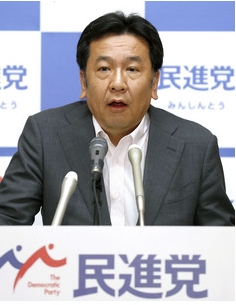
Democratic Party Secretary General Yukio Edano attends a press conference in Tokyo on June 17, 2016. Edano said a report on how Tokyo Electric Power Co. handled the Fukushima nuclear disaster is inappropriate as it notes the then TEPCO chief instructed staff not to use the term “core meltdown” in describing the situation in the early days of the crisis due to pressure from the prime minister’s office. Edano, then chief Cabinet secretary, said, “We may take legal action to challenge it.” (Kyodo)
Didn’t TEPCO betray Fukushima residents by not saying ‘meltdown’?
Was Tokyo Electric Power Co. (now Tokyo Electric Power Company Holdings, Inc.) putting top priority on ensuring the safety of residents around its Fukushima No. 1 nuclear power plant when the accident occurred? The findings of a recent probe have raised doubts even about this.
A third-party panel of lawyers set up by TEPCO released a report on why it took as long as two months after the crisis for the utility to acknowledge that the reactors had melted down.
On March 14, 2011, three days after the accident occurred following the massive earthquake and tsunami, then TEPCO President Masataka Shimizu instructed a then executive vice president during a press conference “not to use” the word “meltdown,” according to the report. The message was delivered via a public relations staffer, citing instructions from the Prime Minister’s Office, the report said.
Subsequently, TEPCO used the description “core damage” in connection with the accident. “The nuclear power plant and the head office shared a recognition that they should refrain from using ‘meltdown,’” the report pointed out.
Then Prime Minister Naoto Kan and then Chief Cabinet Secretary Yukio Edano have completely denied issuing such instructions on their own.
At the time of the accident, many politicians, bureaucrats and others concerned were working at the Prime Minister’s Office. The third-party probe failed to identify who gave the instructions to Shimizu.
This shows the limitations that the third-party panel faced as it probed the accident based only on interviews it conducted with TEPCO officials. Furthermore, Shimizu’s memories of those days were vague.
However, the probe revealed that TEPCO was paying too much attention to the Prime Minister’s Office’s intentions in responding to the accident.
Operator holds responsibility
When a nuclear power plant is hit by a serious accident, residents living around the facility face severe consequences. It is the primary responsibility of the plant operator to respond appropriately.
In such a situation, the highest priority should be placed on the safety of local residents. The operator must accurately provide local governments and residents with precise and necessary information regarding the situation the power plant is facing.
TEPCO chose to use “core damage,” an expression that made the status of the accident unclear, instead of “meltdown,” even though “meltdown” would have clearly shown the severity of the developments the Fukushima plant was dealing with. The operator cannot avoid criticism for having betrayed local residents with this decision. This kind of stance taken by the utility has caused increasing distrust of nuclear power plants.
At the time of the accident, TEPCO had internal manuals that described what constituted a meltdown. The operator must seriously reflect on why it failed to follow these guidelines.
When it came to public relations announcements at the time of the accident, the investigation committees set up by the government and the Diet both pointed out that the Prime Minister’s Office had some involvement.
An official at the then Nuclear and Industrial Safety Agency of the Economy, Trade and Industry Ministry was replaced after referring to a “meltdown” during a press conference. TEPCO was told by the Prime Minister’s Office to brief it in advance of any announcements made at press conferences, according to the latest report.
The Niigata prefectural government, whose administrative area is home to TEPCO’s Kashiwazaki-Kariwa nuclear power plant, has called for uncovering the whole process of how information was manipulated, saying this is a prerequisite for reactivating reactors at Kashiwazaki-Kariwa. The government cannot help but cooperate with the probe.
Extent of TEPCO cover-up over meltdown must be clarified
A panel investigating Tokyo Electric Power Co.’s response to the triple meltdown during the 2011 Fukushima nuclear disaster revealed an unpardonable breach of trust by the operator of the stricken Fukushima No. 1 nuclear power plant.
But there is still a lot more work to be done by the panel to uncover the full scope of the utility’s apparent meltdown cover-up.
Immediately after the catastrophic accident at the Fukushima nuclear plant, then TEPCO President Masataka Shimizu instructed employees not to use the term “meltdown,” leading to a delay in the official announcement, according to a report compiled by the investigation panel commissioned by the company.
A reactor meltdown, or the melting of nuclear fuel in the core of a reactor, is about as bad as it gets.
The panel’s report suggests that in the middle of this unprecedented nuclear disaster the top official of the plant operator was trying to conceal the severity of what was unfolding from the public, including people living in areas around the plant.
For four long years, TEPCO kept giving false explanations about the delay in the announcement of the reactor meltdowns to Niigata Prefecture, which was demanding the truth of what happened. The company claimed it did not have the criteria for defining and determining a meltdown. The firm also said no in-house instruction was given to employees telling them not to use the term.
In February this year, however, the company said it had “found” an in-house manual that spelled out such criteria and set up the third-party panel of legal experts to get to the truth about the delayed announcement of the meltdowns.
With the revelations made in its report, can the panel claim it has accomplished its mission?
We have to say the answer is “no,” although the disclosure of the former TEPCO president’s instruction concerning the meltdowns is definitely a step forward.
What is particularly baffling is the opinion about the president’s instruction voiced by Yasuhisa Tanaka, the former president of the Sendai High Court who headed the investigation. “We cannot say for certain that there was a deliberate cover-up by the company,” Tanaka said during a news conference.
At the time of the accident, a reactor meltdown was defined by the nuclear disaster special measures law as an emergency situation that must be reported. The conditions of the reactors at the Fukushima plant fulfilled TEPCO’s criteria, which say a meltdown means that 5 percent or more of the core of a reactor has been damaged.
But the utility initially denied that a meltdown was happening, while the president instructed employees not to use the term. If this was not a cover-up, what was it?
Also questionable is the panel’s suggestion that the TEPCO chief was probably acting on requests from the prime minister’s office in giving the instruction. The panel interviewed about 60 former and current TEPCO officials, but no government officials or bureaucrats who were involved in dealing with the crisis.
In explaining the panel’s failure to interview key government officials, Tanaka said, “Our authority to investigate is limited, and it is difficult (to uncover the entire truth) in such a short time.” But the panel didn’t even request interviews with them.
Both Naoto Kan, who was then prime minister, and Yukio Edano, who was chief Cabinet secretary, rejected the allegations that the government told TEPCO not to declare a meltdown.
As for the related requests made by Niigata Prefecture, TEPCO says it will continue its joint efforts with the prefectural government to uncover the facts.
The company has a responsibility to clarify the broad picture of the accident and publish the findings of its probe. But the Diet has its own role to play.
Whether the prime minister’s office actually asked TEPCO not to declare a reactor meltdown is not the only remaining mystery about the exchanges between the government and the company during the crisis. Only some fragments of information about the communications between the two sides have been revealed.
A Diet investigation committee has drawn up a report on its inquiry into the accident. But there are still many questions that the Diet should try to answer by using its right to investigate state affairs.
We need to learn all vital lessons from the devastating nuclear accident so as to avoid making the same mistakes.
That requires unearthing all the related facts first. It is our responsibility to tackle this challenge for future generations.
Japan Lawmaker Denies Pressuring TEPCO Not to Say ‘Meltdown’

Yasuhisa Tanaka, center, chairman of an outside investigation team appointed by the operator of Japan’s damaged Fukushima nuclear plant, speaks during a press conference in Tokyo Thursday. Two other lawyers of the team are: Zenzo Sasaki, left, and Toshiki Nagasaki.
A Japanese opposition leader who was a senior official during the 2011 Fukushima nuclear plant crisis denied Friday that he or the prime minister at the time pressured the president of Tokyo Electric Power Co. not to use the term “meltdown.”
Democratic Party Secretary-General Yukio Edano called a special news conference to refute a finding in a new report that then-TEPCO President Masataka Shimizu apparently came under political pressure not to use the word. The report did not find direct evidence of that.
“The fact that I or then-Prime Minister (Naoto) Kan ordered or requested then-President Shimizu to avoid using the term ‘meltdown’ under any circumstance does not exist,” Edano said. He said the timing of the report was suspicious ahead of an Upper House election next month.
The report released Thursday by a team of three lawyers appointed by TEPCO found that an instruction from Shimizu to avoid using the term “meltdown” delayed full public disclosure of the status of the nuclear plant, which suffered three reactor meltdowns after a major earthquake and tsunami hit the northeastern Japanese coast on March 11, 2011.
The utility used the less serious phrase “core damage” for two months after the disaster.
TEPCO reported to authorities three days after the tsunami that the damage, based on a computer simulation, involved 25 to 55 percent of the fuel but did not say it constituted a “meltdown,” the report said. Yet the company’s internal manual defined a meltdown as damage to more than 5 percent of the fuel.
In May 2011, TEPCO finally used “meltdown” after another computer simulation showed fuel in one reactor had almost entirely melted and fallen to the bottom of the primary containment chamber, and that the two other reactor cores had melted significantly.
TEPCO has been accused of softening its language to cover up the seriousness of the disaster, though the investigation found TEPCO’s delayed acknowledgement did not break any law.
In the 70-page report, the lawyers said Shimizu instructed his deputy not to use the word “meltdown” during news conferences immediately after the crisis. TEPCO’s vice president at the time, Sakae Muto, used the phrase “possibility of meltdown” until March 14, 2011.
Video of a news conference that day shows a company official rushing over to Muto when he was about to respond to a question, showing him a memo and hissing into his ear, “The prime minister’s office says never to use this word.”
Yasuhisa Tanaka, the lawyer who headed the investigation, said interviews of 70 former and current TEPCO officials, including Muto and Shimizu, showed that Muto had planned to use the word “meltdown” until he saw the memo, which has not been found.
“Mr. Shimizu’s understanding was the term ‘meltdown’ could not be used without permission from the prime minister’s office,” Tanaka said at a news conference at TEPCO headquarters. “The notion that the word should be avoided was shared company-wide. But we don’t believe it was a cover-up.”
Edano criticized the report as “inadequate and unilateral,” and said the team didn’t talk to him or Kan.
Tanaka said his investigation, which did not interview any government officials, could not track down what exactly happened between Shimizu and the prime minister’s office.
The Nuclear and Industrial Safety Agency, Japan’s nuclear regulatory unit at the time, was also reluctant to use the word. Two spokesmen were replaced between March 12 and 13, 2011, after suggesting meltdowns had occurred.
TEPCO has said the delay in confirming the meltdowns didn’t affect the company’s response to the emergency.
The issue surfaced earlier this year in a separate investigation in which TEPCO acknowledged that a company manual had been overlooked, reversing its earlier position that it had no internal criteria for a meltdown. TEPCO has eliminated the definition of a meltdown from the manual in revisions after the Fukushima disaster.
TEPCO’s nuclear commercials draw disgust from evacuees

A TV commercial about the Kashiwazaki-Kariwa nuclear power plant (Provided by Tokyo Electric Power Co.)
The narration over uplifting music boasts of repeated safety drills and enhanced capabilities to judge and act in nuclear plant emergencies.
Workers in blue uniforms and hard hats appear, declaring: “We will devote our entire energy to drills so that we can deal with any circumstance.”
This TV commercial in Niigata Prefecture never fails to draw a look of disgust from a 41-year-old woman.
The woman and her two children, then aged 1 and 3, were forced to flee their home in Fukushima Prefecture to Niigata Prefecture after the 2011 triple meltdown at the Fukushima No. 1 nuclear power plant.
The crippled plant is operated by Tokyo Electric Power Co., the producer of that commercial.
“The mess caused by the nuclear accident has yet to be cleaned up,” she said. “There are still evacuees facing hardships because they have no prospects for the future. If TEPCO has money to use for commercials, it should use it to support the evacuees.”
TEPCO, in fact, created six different commercials for an advertising campaign that started in June last year. The commercials have been aired a total of 320 times a month on four private broadcasting stations based in Niigata Prefecture, according to the utility.
By promoting the safety of nuclear power through the commercials, TEPCO hopes to gain support for its plan to resume operations at some of the seven reactors of its now-idle Kashiwazaki-Kariwa nuclear power plant in the prefecture.
The commercials have drawn the opposite reaction from many of about 3,000 evacuees from Fukushima Prefecture who currently live in Niigata Prefecture.
In April this year, residents and evacuees in Niigata Prefecture visited TEPCO’s head office in Tokyo and submitted a letter of protest along with about 1,900 signatures. They demanded the company suspend the commercials and disclose the costs for the campaign.
Complaints have also been directed at Chubu Electric Power Co.’s TV commercials for nuclear power generation in Shizuoka Prefecture.
The company’s first post-3/11 commercial started airing on four private broadcasting stations in 2012, mainly explaining the company’s safety measures.
In July 2015, the utility began to air an eight-part series of commercials, in which employees working at a nuclear power plant appear with the lovely voice of a female vocalist in the background.
“In order to protect this place even at midnight,” and “We will engage in a drill again today” are among the captions shown in one part titled, “Nighttime training.”
After the Fukushima nuclear disaster unfolded, Nagoya-based Chubu Electric Power suspended all reactors at its Hamaoka nuclear power plant in Omaezaki, Shizuoka Prefecture, under the request of the then Democratic Party of Japan-led government headed by Prime Minister Naoto Kan.
The utility is preparing to resume operations at some of the Hamaoka reactors, despite anxieties about the safety of the nuclear plant. The plant has been described as the most dangerous in Japan, given its proximity to a long-expected huge earthquake off the prefecture.
In 2012, a civic group made a request to Shizuoka Governor Heita Kawakatsu to hold a referendum on whether the Hamaoka plant should be restarted.
The group also presented about 165,000 signatures.
“The commercials on nuclear power plants are a unilateral strategy to improve image they project,” Shigeki Nishihara, mayor of Makinohara, located next to Omaezaki, said. “It is necessary for Chubu Electric Power to repeatedly hold dialogue and discussions with the people who have anxieties and doubts about nuclear power plants in order to educate itself.”
Tepco chief likely banned use of ‘meltdown’ under government pressure: report
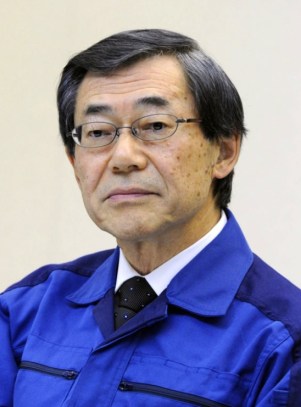
The president of Tokyo Electric Power Co. during the Fukushima nuclear crisis told employees not to publicly use the term “meltdown,” apparently in response to government pressure, a third party report released Thursday said.
The report, compiled by three lawyers, said it is highly likely the government at the time pressured Masataka Shimizu, then Tepco’s president when the monstrous earthquake and tsunami disabled the Fukushima No. 1 nuclear power plant on March 11, 2011, about the utility’s disclosures in the early stages of the crisis.
The report said someone in the government, then headed by Prime Minister Naoto Kan of the Democratic Party of Japan, was unhappy Tepco had revealed a photo of the blown-up building for reactor No. 1 on March 12 without telling the government in advance.
The Prime Minister’s Office then called Shimizu the same day. After Shimizu returned to Tepco’s Tokyo headquarters, he told his fellow executives that they needed to check with the Prime Minister’s Office whenever disclosing information to the public, according to the report.
The report also said Shimizu sent a note on March 14 to Vice President Sakae Muto, who was overseeing the plant and holding a news conference, to warn him not to say meltdown.
“Considering this fact, it is presumable that the Prime Minister’s Office requested Shimizu to be careful about admitting to a meltdown in public,” the report said.
The panel thought this was a critical point that required further investigation but was unable to track down a specific bureaucrat who made such a request. Yasuhisa Tanaka, who headed the panel, said it conducted hearings with 60 Tepco employees but did not talk to anyone from the government side.
Tepco did not acknowledge that a reactor meltdown had occurred until May 15, 2011 — two months after the fact.
Asked whether Tepco was intentionally covering up the meltdowns, Tanaka said that was probably not the utility’s intention at the time.
“Looking at the situation back then, we think it was difficult for Tepco to use the term meltdown because even the Nuclear and Industrial Safety Agency couldn’t use it” due to apparent government pressure, Tanaka said.
The Nuclear and Industrial Safety Agency was Japan’s nuclear watchdog at that time.
The panel spent about three months investigating why Tepco could not publicly reveal the meltdowns occurred earlier than it did.
In February, nearly five years after the crisis, Tepco announced it should have declared the meltdowns earlier, citing the existence of a company manual that listed what constitutes a meltdown. The manual says that meltdown is a state in which 5 percent or more of the fuel rods is damaged.
As of March 14, 2011, Tepco estimated that 55 percent of the fuel rod assemblies in reactor No. 1 and 25 percent of those in reactor No. 3 were damaged but did not declare that they had melted until May that year.
Niigata Prefecture has been pressuring Tepco to look into why it took about two months for the utility to admit to a meltdown.
Niigata hosts Tepco’s Kashiwazaki-Kariwa nuclear plant, which the firm desperately wants to restart, but Niigata Gov. Hirohiko Izumida has stressed that he won’t give the green light until the Fukushima crisis has been thoroughly investigated.
Tepco had explained to Niigata that it did not use the term meltdown because there was no clear definition of it. But it found the manual in February, which contradicted the explanation and led to the third-party investigation.
The report said that workers at the Fukushima plant were apparently following the manual but seemed to avoid using the term meltdown, presumably because there was a common understanding within the company not to use it.
Tokyo Electric changed its name in April to Tokyo Electric Power Company Holdings Inc.
Tepco admits they concealed the fact of meltdown

On 5/30/2016, a director of Tepco, Anegawa admitted that Tepco concealed the fact of meltdown in 311.
He stated that in the press conference of that day. He says it was obviously meltdown, but Tepco avoided mentioning the term of “meltdown”. He thinks that was concealment.
In Tepco’s internal manual, meltdown is defined to be when over 5% of reactor core is damaged. However Tepco did not mention meltdown even though they knew 55 ~ 70% of the core was damaged by 3/14/2011.
Anegawa commented ordinary engineer would call such a state meltdown even without a manual.
At this moment, third-party inspection committee is investigating Tepco for its arbitrariness.
http://www.tepco.co.jp/tepconews/library/archive-j.html?video_uuid=y3a6i6b2&catid=61697
http://fukushima-diary.com/2016/06/tepco-admits-they-concealed-the-fact-of-meltdown/
Tokyo Electric Power : Giant vacuum cleaner used to remove radioactive debris in Fukushima
Tokyo, Jun 1 (EFE).- The operator of the plagued Fukushima nuclear plant has deployed a large device similar to a vacuum cleaner to clean up radioactive debris scattered over the plant’s Reactor 1, the company explained to Efe.
Technicians of Tokyo Electric Power (TEPCO) on Monday started using the apparatus, 13 meters high and 5 meters wide, which is operated through a crane and is capable of safely absorbing objects of up to 20 kilograms.
The top floor was rocked by an explosion caused by hydrogen concentration one day after being hit by the earthquake and tsunami that devastated northeastern Japan on Mar. 11, 2011.
The blast destroyed the roof of the plant, which remains covered with highly contaminated pieces of debris – from cement to metal fragments – and this will hinder the complicated process of removing the molten fuel inside the reactor vessel.
TEPCO plans to finish this operation in July and then proceed to remove larger debris.
According to the company’s roadmap, the withdrawal of molten nuclear fuel inside Reactor 1 is to be done within about four years.
The accident at the Fukushima Daiichi plant was the worst nuclear accident since the Chernobyl disaster in Ukraine in 1986. Its resultant emissions and radioactive discharges still keep thousands of people who lived near the plant out of the area and have severely affected agriculture, livestock and local fishing.
“TEPCO reveals only handful knew meltdown manual existed”
Too Late…
Although a manual existed that outlined the criteria for a meltdown, Tokyo Electric Power Co. admitted that only five or so employees at its main office knew of it at the onset of the 2011 nuclear crisis.
Those employees belonged to a section that manages the manual at the company’s Tokyo headquarters, TEPCO said at a news conference on May 30.
The utility has been under fire for the delay in acknowledging in May 2011 that triple meltdowns took place at the Fukushima No. 1 nuclear power plant, two months after they actually occurred following the Great East Japan Earthquake and tsunami.
TEPCO had maintained that the reactors at the plant suffered “core damage,” rather than more serious meltdowns.
Explaining the delay, the company initially cited a lack of guidelines for determining a meltdown.
But TEPCO admitted in February this year that the company manual did contain entries defining a meltdown, although the company said it was unaware of the descriptions for the past five years. The criteria requires the company to declare a meltdown when damage to a reactor core passes 5 percent.
Takafumi Anegawa, chief nuclear officer with TEPCO, told the news conference that a third-party panel will investigate why it took the company five years to disclose the existence of the manual.
In April, a TEPCO senior official admitted that he knew of the criteria when the crisis was unfolding at the plant.
http://www.asahi.com/ajw/articles/AJ201605310068.html
1 This Month

of the week – Shut Down Drone Warfare!


Tell the Ukrainian Government to Drop Prosecution of Peace Activist Yurii Sheliazhenko

Petition to revoke the licensing of the Near Surface Nuclear Disposal Facility (NSDF) at Chalk River. https://www.ourcommons.ca/petitions/en/Petition/Details?Petition=e-7247
To see nuclear-related stories in greater depth and intensity – go to https://nuclearinformation.wordpress.com
-
Archives
- April 2026 (19)
- March 2026 (251)
- February 2026 (268)
- January 2026 (308)
- December 2025 (358)
- November 2025 (359)
- October 2025 (376)
- September 2025 (257)
- August 2025 (319)
- July 2025 (230)
- June 2025 (348)
- May 2025 (261)
-
Categories
- 1
- 1 NUCLEAR ISSUES
- business and costs
- climate change
- culture and arts
- ENERGY
- environment
- health
- history
- indigenous issues
- Legal
- marketing of nuclear
- media
- opposition to nuclear
- PERSONAL STORIES
- politics
- politics international
- Religion and ethics
- safety
- secrets,lies and civil liberties
- spinbuster
- technology
- Uranium
- wastes
- weapons and war
- Women
- 2 WORLD
- ACTION
- AFRICA
- Atrocities
- AUSTRALIA
- Christina's notes
- Christina's themes
- culture and arts
- Events
- Fuk 2022
- Fuk 2023
- Fukushima 2017
- Fukushima 2018
- fukushima 2019
- Fukushima 2020
- Fukushima 2021
- general
- global warming
- Humour (God we need it)
- Nuclear
- RARE EARTHS
- Reference
- resources – print
- Resources -audiovicual
- Weekly Newsletter
- World
- World Nuclear
- YouTube
-
RSS
Entries RSS
Comments RSS
 nuclear-news