TEPCO Employee Has Overwork Depression, Seeks Compensation

TEPCO employee says he has depression due to overwork, seeks compensation
A 35-year-old employee handling compensation claims relating to the Fukushima nuclear disaster for Tokyo Electric Power Co. (TEPCO) has filed an application with the Tokyo Central Labor Standards Inspection Office seeking workers’ compensation for depression.
Tadafumi Ichii filed the application on Oct. 31, arguing that he started suffering from depression as a result of being forced to work long hours illegally. According to his application and other information, in September 2011 — six months after the outbreak of the nuclear crisis — Ichii transferred to a division tasked with handling complaints from businesses that were not satisfied with the amounts of compensation they were offered for declining sales. In February 2013, he took over the role of giving advice to about 450 TEPCO employees on whether or not to pay damages.
The man clocked 89 hours overtime in March 2013, but he stated, “My overtime working hours, if combined with unpaid overtime and take-home work, stood at 169 hours (in March).” On the morning of June 20, 2013, he could not get out of bed, and failed to show up for work that day. He then transferred to TEPCO’s branch office in Tachikawa, western Tokyo, on July 1, 2013. He frequently started being absent from the office or leaving early, suffering symptoms such as vomiting in the office’s toilet. He was diagnosed on Sept. 3, 2013, as having tendency toward depression and he took a leave of absence from the following day. He was officially diagnosed with depression in April 2014.
The man received a notice from TEPCO in October this year stating that he would be dismissed on Nov. 5 when his recuperation period was due to expire. TEPCO demanded that Ichii submit documents including a doctor’s medical certificate, if he intended to return to work. Ichii says he still suffers symptoms such as insomnia. His doctor, therefore, has judged that he requires further medical treatment, he says.
“I worked hard until I was worn out,” Ichii said at a news conference.
An official with the public relations department at Tokyo Electric Power Company Holdings Inc. commented, “We understand that the labor standards inspection office concerned decides on individual claims for workers’ compensation. We decline to answer questions regarding individual cases.”
According to TEPCO, work to pay compensation to local residents whose livelihoods were lost and companies whose sales dropped due to the nuclear accident started in April 2011 and is ongoing.
As of Oct. 28, there were about 2,691,000 applications and about 6.479 trillion yen had been paid for a total of about 2,515,000 applications that TEPCO had finished screening.
http://mainichi.jp/english/articles/20161101/p2a/00m/0na/017000c
TEPCO worker seeks compensation over Fukushima job
A 35-year-old employee of Tokyo Electric Power Company is seeking insurance benefits, arguing that he developed depression due his work dealing with the aftermath of the Fukushima nuclear accident.
Tadafumi Ichii spoke to reporters on Monday after filing the request for workers’ accident compensation with labor authorities.
Ichii said that, in September of 2011, he was tasked with paying redress to businesses affected by the accident at the Fukushima Daiichi nuclear power plant six months earlier.
He said he was in charge of up to 180 companies and put in nearly 170 hours of overtime a month. He added that he was caught between his bosses and his clients, and mentally driven to the edge.
The utility reportedly plans to dismiss him when his sick leave ends in early November.
Ichii said he sacrificed his health to do the job and that he cannot accept the way his employers are treating him.
Tokyo Electric Power Company said in a statement that the utility will deal with the matter sincerely when it is contacted by labor authorities.
Industry ministry to create new fund to decommission Fukushima No. 1 plant reactors

The Ministry of Economy, Trade and Industry is poised to set up a system under which Tokyo Electric Power Co. (TEPCO) will accumulate the funds necessary to decommission reactors at its crippled Fukushima No. 1 nuclear plant with the help of a government-backed organization, sources close to the ministry said.
Under the system, money that TEPCO accumulates through cost-cutting and other measures will be provided to the Nuclear Damage Compensation and Decommissioning Facilitation Corp. (NDF), which will use the funds when necessary.
The move is aimed at strengthening the central government’s involvement in decommissioning the reactors at the tsunami-ravaged power station and securing as much money as possible to cover the costs.
TEPCO has so far raised a total of 2 trillion yen to decommission reactors at the Fukushima No. 1 complex. However, several trillion yen more is highly likely to be needed to decommission the reactors.
The planned scheme will allow the NDF to manage the decommissioning plan and funds to reduce the financial burden on consumers as much as possible, and stably secure funds for decommissioning the reactors at the plant. TEPCO and its subsidiaries will be required to raise as much money as possible to decommission the reactors.
The ministry is considering a plan to add the costs of dismantling reactors at the crippled Fukushima plant to the fees that new, smaller-scale power companies pay for using TEPCO’s power cables. However, consumers are critical of the plan, which would force them to shoulder an extra burden for the decommissioning of the reactors. As such, the ministry intends to secure as much money as possible for reactor decommissioning by strengthening the national government’s involvement and reforming TEPCO’s management.
Once the estimated costs of scrapping the Fukushima No. 1 plant reactors are finalized, TEPCO will be required to set aside a massive amount of funds for such work, possibly falling in a state of capital deficit in which its liabilities exceed its assets. The ministry will therefore take legal measures to allow TEPCO to post its liabilities in installments.
http://mainichi.jp/english/articles/20161101/p2a/00m/0na/018000c
Japan Nuclear Industry on the Defensive

METI proposed that TEPCO would start a subsidiary to manage all its nuclear plants. Saying it would facilitate restarting the reactors at the Kashiwazaki Kariwa NPP, as since the beginning of the Tepco-owned Fukushima Daiichi nuclear plant disaster the government planned to use profits from the Tepco-owned Kashiwazaki-Kariwa NPP to finance the Fukushima Daiichi disaster costs; and that it would also encourage collaboration among other utilities nuclear power plants, and make merger or sale easier. METI thinks such change would also encourage the public to support nuclear reactors restarting.
As the total decommissionning costs could double, Tepco would also like the rules to be changed so as not take an added large loss on their books.
One day later Hitachi announced that they consider merging their nuclear business with Toshiba and Mistubishi.
These recent new developments show Japan nuclear industry on the defensive, former PM Koizumi warned the Liberal Democratic Party could lose the next election if it focuses on the nuclear power issue.
Industry ministry unveils plan to split nuclear power division from TEPCO
Industry ministry unveils plan to split nuclear power division from TEPCO
The Economy, Trade and Industry Ministry is planning to spin off Tokyo Electric Power Co. (TEPCO) Holdings Inc.’s nuclear power generation division and aim for an alliance between the new subsidiary and another power company.
The ministry unveiled the plan at an Oct. 25 meeting of an expert panel on reform of TEPCO and issues related to the tsunami-hit Fukushima No. 1 nuclear plant. The possibility has emerged that realignment of the major utilities’ nuclear power divisions will be led by the government as the planned reactivation of idled nuclear reactors has stalled.
As part of TEPCO reforms this past April, the company’s thermal power, power retail and power transmission and distribution divisions were transformed into subsidiaries and placed under the umbrella of the newly established TEPCO Holdings.
However, TEPCO Holdings has retained its nuclear power division because the company needs to decommission the crippled Fukushima nuclear complex and pay compensation to victims of the nuclear disaster, which broke out in March 2011.
Under the ministry’s plan, a subsidiary would be set up to take over TEPCO’s nuclear power business, excluding the Fukushima No. 1 plant, with an eye to forming an alliance between the new firm and another major utility.
The costs of decommissioning the crippled power station’s reactors are likely to far surpass the initial estimate. The ministry released a revised projection at the Oct. 25 expert panel meeting stating that the annual decommissioning bill will likely balloon from the current 80 billion yen into the hundreds of billions, due to work to remove melted nuclear fuel from the reactors and other factors.
The panel discussed TEPCO reforms to raise funds to cover the massive expense of dealing with the accident, such as compensation payments and decontamination of areas tainted with radioactive substances emanating from the nuclear disaster, plus decommissioning.
The committee is aiming to increase TEPCO’s profitability by promoting the realignment of the firm’s nuclear power division and other cost-cutting efforts.
TEPCO set up a joint venture, JERA Co., with Chubu Electric Power Co. in April 2015 to gradually integrate their thermal power station fuel procurement and overseas power generation divisions. TEPCO has also formed a business tie-up with SoftBank Group Corp. to bundle electricity and communications device contracts.
The industry ministry furthermore proposed that TEPCO’s power transmission and distribution subsidiary, which is highly profitable thanks to a large number of customers in the Tokyo metropolitan area, strengthen its alliances with other utilities.
The expert committee is poised to work out the details of a plan to spin off TEPCO’s nuclear power division and how the subsidiary should join hands with other companies. The panel will draw up a draft of its proposals possibly by the end of this year, and incorporate the recommendations in TEPCO’s corporate rehabilitation plan to be released next year.
http://mainichi.jp/english/articles/20161026/p2a/00m/0na/004000c
Prospect of Niigata nuke plant delay threatens Tepco’s Fukushima plans
TOKYO — The election of an anti-nuclear candidate as governor of Japan’s Niigata Prefecture could hit the finances of not only Tokyo Electric Power Co. Holdings but the public as well, as the utility is relying on a reactor restart in Niigata to cover Fukushima cleanup costs.
The central government reached an arrangement in 2014 to extend up to 9 trillion yen ($86.6 billion currently) in interest-free loans to pay for dealing with the fallout of the 2011 Fukushima Daiichi nuclear plant disaster. Of this, 5.4 trillion yen is to go toward compensating those affected, with Tepco and other power companies, including Kansai Electric Power and Chubu Electric Power, to repay the loans. Another 2.5 trillion yen is earmarked for decontamination work, with the costs to be recouped through the sale of Tepco shares held by the government.
But more than 6 trillion yen in compensation has been paid out so far, and cost overruns on decontamination are seen as all but certain. Decommissioning work at Tepco’s Fukushima plant, such as extracting fuel, falls outside the 9 trillion yen framework.
The 2 trillion yen Tepco had aimed to secure on its own to pay for scrapping the plant will be nowhere near enough. The utility and Japan’s industry ministry had counted on bringing the Kashiwazaki-Kariwa nuclear plant in Niigata Prefecture back online, which would improve Tepco’s earnings by 240 billion yen a year. But Gov.-elect Ryuichi Yoneyama has indicated that he is not amenable to a quick restart.
An expert panel set up by the ministry started discussing how to handle the additional costs this month. It laid out a scenario in which improved profit margins at Tepco via restructuring, along with profits from the Kashiwazaki-Kariwa facility, would be used to minimize the amount shouldered by taxpayers.
The longer it takes to restart the plant in Niigata, the larger the hit will be to Tepco’s available funding for Fukushima costs. Though the utility will squeeze out some money via internal reforms, Tepco may use rate hikes to pass on to the public what it cannot cover itself. Tepco and other utilities already have raised rates to recoup part of the compensation costs. A top industry ministry official indicated that rate increases will also be on the table to pay for decommissioning.
Power companies besides Tepco could be affected as well. Since many nuclear plants in eastern Japan use boiling-water reactors like those at the Kashiwazaki-Kariwa plant, further delays could hold up other reactor restarts in the region.
New Niigata governor puts up additional hurdle for TEPCO
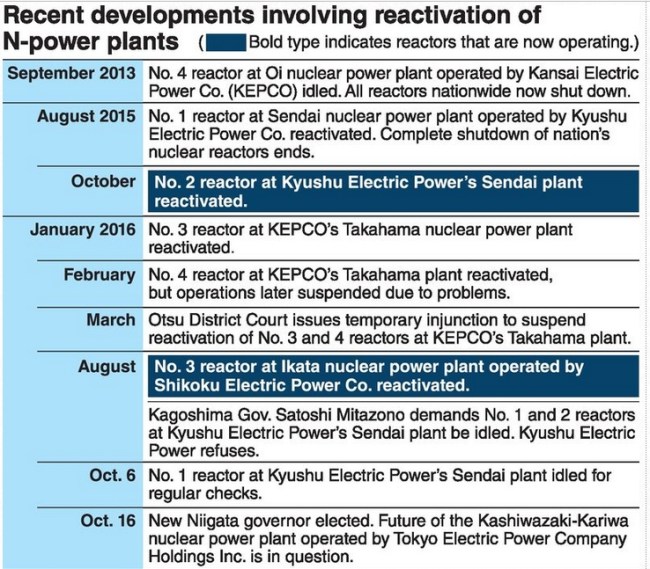
The election Sunday of Ryuichi Yoneyama as the new governor of Niigata Prefecture may make the financial situation at Tokyo Electric Power Company Holdings Inc. even more unstable, as Yoneyama is cautious about restarting reactors at the company’s Kashiwazaki-Kariwa nuclear power plant.
In the wake of the March 2011 accident at TEPCO’s Fukushima No. 1 nuclear plant, operations at all of the company’s 11 nuclear power reactors were suspended — excluding those at the Fukushima No. 1 plant, which are to be decommissioned.
The Kashiwazaki-Kariwa plant holds seven of the company’s reactors, all of which have been idle since March 2012.
TEPCO has applied for safety inspections to be carried out by the Nuclear Regulation Authority on two of the reactors at the plant.
TEPCO’s dependence on crude oil and liquefied natural gas has deepened because the company relies mainly on thermal power generation. As thermal power plants are affected by the import prices of the fuels, the situation is weighing on TEPCO’s financial situation.
If just one reactor at the Kashiwazaki-Kariwa plant can be reactivated, TEPCO’s annual profit is expected to rise by up to about ¥100 billion. The reactors can produce electric power at a lower cost than thermal power generation.
For now, TEPCO remains profitable, but this is largely because lower crude oil prices have lowered the company’s expenditures.
Though crude oil prices are currently low, prices are forecast to rise in mid- and long-term projections.
If the fuel costs of thermal power plants rise, electric power companies’ balance sheets will be adversely affected. This will make nuclear power plants increasingly important.
However, during the election campaign, Yoneyama said, “Unless examinations of the accident in Fukushima Prefecture are completed, it’s not possible to begin discussions about reactivation.”
The possibility he will tolerate swift reactivation of the reactors is very low, even if the Kashiwazaki-Kariwa plant passes the NRA’s safety inspections.
The total amount of compensation for those adversely affected by the accident at the Fukushima No. 1 nuclear power plant has surpassed ¥6 trillion, and the amount is likely to grow.
It is also assumed that work to decommission the reactors that caused the accident will cost trillions of yen. Thus TEPCO has asked for assistance from the government.
An expert panel of the Economy, Trade and Industry Ministry began discussions this month about TEPCO’s future direction, and how to share the financial burden of decommissioning nuclear reactors.
Reactivation of its nuclear reactors will be key to stabilizing TEPCO’s financial situation back on track, and enable the company to procure funds for compensation for damage and future decommissioning.
Anxiety will continue to mount over TEPCO’s financial situation the longer reactivation is delayed.
Electricity rates of major electric power companies in fiscal 2015 were about 20 percent higher on average for households, and about 30 percent higher on average for corporate users, compared to before the nuclear accident.
In TEPCO’s service area, the rates for households currently stand about 20 percent higher than before the nuclear accident.
An analyst estimated that if reactors Nos. 6 and 7 of the Kashiwazaki-Kariwa plant are reactivated, TEPCO will be able to lower the rates by 2 to 3 percent.
Gov’t, TEPCO should take Niigata gubernatorial election results seriously
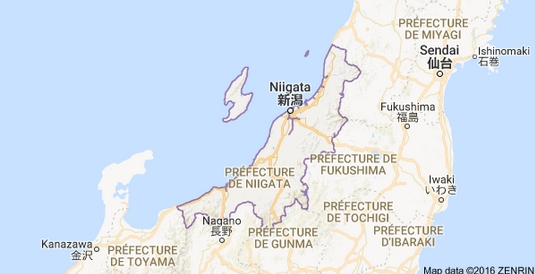
A candidate who is cautious about restarting idled nuclear power plants won the Oct. 16 Niigata gubernatorial election, defeating a rival backed by the ruling coalition. The government of Prime Minister Shinzo Abe and Tokyo Electric Power Co. (TEPCO) should take seriously the outcome of the election, in which the pros and cons of reactivating the utility’s atomic power station in the prefecture was a key point of contention.
Ryuichi Yoneyama, 49, supported by the opposition Japanese Communist Party, Liberal Party and Social Democratic Party, beat former Nagaoka Mayor Tamio Mori, 67, backed by the ruling Liberal Democratic Party (LDP) and its coalition partner Komeito.
Mori had been expected to score an easy victory as the approval rating of the Abe Cabinet has been high and both the ruling coalition parties enjoy support from the business community and related organizations. Therefore, the results highlight prefectural residents’ deep-rooted distrust in TEPCO, the operator of the tsunami-ravaged Fukushima No. 1 Nuclear Power Plant.
The governing bloc’s loss in the Niigata election follows its defeat in the July Kagoshima gubernatorial race, in which journalist Satoshi Mitazono, who called on Kyushu Electric Power Co. to stop operations at its Sendai Nuclear Power Plant in the prefecture during his campaigning, scored a victory.
The outcome of the Niigata race also apparently shows local residents’ displeasure toward Mori, who failed to clarify his stance toward whether the Kashiwazaki-Kariwa Nuclear Power Plant in the prefecture should be restarted, as well as their criticism of the Abe administration that is proactively trying to reactivate atomic power plants.
Close attention was focused on the latest election because incumbent Hirohiko Izumida abandoned seeking a fourth four-year term as governor.
The reason why Izumida gave up on running in the race remains unclear. However, Izumida has continued to demand TEPCO clarify the cause of the Fukushima nuclear crisis as a precondition for sitting at the negotiation table to discuss whether the Kashiwazaki-Kariwa plant should be reactivated. As such, TEPCO and the Abe government had expected that the retirement of Izumida would help facilitate the resumption of operations at nuclear plants.
As the election campaign went on, however, Yoneyama, who declared that he would take over Izumida’s policy line, garnered growing support from local voters. Alarmed by the situation, LDP heavyweights, including Secretary-General Toshihiro Nikai, delivered campaign speeches and urged the local business community and industry organizations to vote for Mori.
Numerous voters in Niigata, who saw the LDP’s desperate efforts to persuade local voters to vote for Mori, probably felt the old-fashioned culture of the LDP. During his campaigning, Mori emphasized his experience of serving as president of the Japan Association of City Mayors to demonstrate his close relations with the national government. However, he gave local voters the impression that he was hesitant to clarify his position on reactivation of atomic power plants.
Many challenges have been left unaddressed by Izumida, such as whether the evacuation plan for local residents in case of an accident at the Kashiwazaki-Kariwa plant is appropriate. Yoneyama must address these challenges as he pledged during his campaigning.
The manner in which the largest opposition Democratic Party (DP) approached the election was poor. The DP did not officially support Yoneyama although the party had initially planned to field him in the next House of Representatives election because the TEPCO union has strong influence within the Japanese Trade Union Confederation (Rengo), which is a major supporting organization for the party. However, DP leader Renho did an about-face and delivered campaign speeches for Yoneyama in the final phase of the campaign apparently after being convinced that he would win.
The DP cannot win support from voters unless the party discusses its nuclear power policy and clarifies its stance on the issue.
http://mainichi.jp/english/articles/20161017/p2a/00m/0na/009000c
Tepco Tumbles 7% After Anti-Nuclear Candidate’s Surprise Governor Election Win
Japan’s public is not ready to restart nuclear power generation.
Ryuichi Yoneyama, a doctor-lawyer who has never previously held office, won the race for governor of Niigata on Sunday. He ran on the platform that he would not allow the Kashiwazaki-Kariwa power station, owned by Tokyo Electric Power Company, or TEPCO (9501.Japan), to restart operations.
Yoneyama had more than 500,000 votes versus rival candidate’s 430,000 votes with 93% of the votes counted.
TEPCO was put under government control the year after the traumatic Fukushima catastrophe in March 2011 and is vital to Prime Minister Shinzo Abe‘s energy policy. Abe hopes to revive nuclear power generation to provide for 30% of Japan’s energy needs.
TEPCO tumbled 6.7% in Tokyo.
Judges may order gov’t to submit redacted report in lawsuit over Fukushima disaster

A judge presiding at a trial over the Fukushima nuclear crisis said the judges in charge will decide by the end of this year on whether to order the government to submit some of its investigation committee’s reports on the disaster that have been withheld.
Presiding Judge Akihiko Otake at the Tokyo District Court made the remark on Oct. 13 during an oral proceeding of the suit filed by shareholders of Tokyo Electric Power Co. (TEPCO), the operator of the crippled nuclear plant, to clarify the responsibility of former TEPCO board members over the disaster.
Otake also said the judges in charge will conduct an in camera review on other documents, part of which has been blacked out before they were disclosed, to deem whether the measure is appropriate.
Specifically, the judges will examine documents recording statements by the now deceased Masao Yoshida, who headed the Fukushima No. 1 Nuclear Power Plant at the time of the outbreak of the disaster in March 2011, and those by two officials of the then Nuclear and Industrial Safety Agency.
The documents were disclosed after the names of individuals and some other information were blacked out. The court said it has already ordered the Cabinet Office to submit the documents with the blacked-out parts unveiled. The Cabinet Office has reportedly responded that it intends to comply with the order by the end of this week.
http://mainichi.jp/english/articles/20161014/p2a/00m/0na/005000c
Where is the Responsibility of the Government and TEPCO?
It is up to each individuals to a carry glass badge to measure and avoid the irradiation. It is up to them to choose food. Now it is up to them to treat the nuclear waste.
Where is the responsibility of the government and TEPCO?

Special workshop to learn how to treat the waste resulting from the accident.
It takes only one day
No charge for the workshop and documents.
Open the black bags.
Separate the waste items.
Then break, burn or bury.
At Iwaki city: December 7th 2016
At Fukushima city: December 20th 2016
At Kôriyama city: January 24th 2017
Open to the people who:
Plan to return to the zone where the evacuation order has been or will be lifted or plan to get a job there;
Plan to get a job in 12 evacuated localities in the future ( Tamura city, Minamisoma city, Kawamata town, Hirono town , Naraha town, Tomioka town, Kawauchi village, Okuma town, Futaba town, Namie town, Katsurao village, Iitate village );
Plan to create firms in the 12 evacuated localities;
Are 18 years or older and;
Not belonging to a Yakuza organization
Fukushima Cleanup Talks Put Tepco Survival Risk in Focus
Tokyo Electric Power Co. is still struggling to put the Fukushima nuclear disaster behind it, admitting this week that paying for decommissioning the plant in one go risks leaving it insolvent.
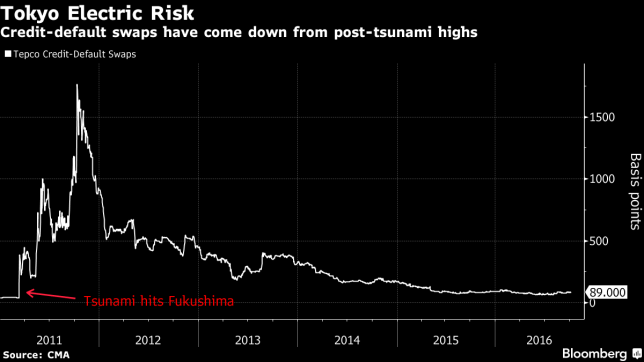
The cost to insure debt in Japan’s biggest utility climbed to a seven-month high of 89 basis points on Oct. 5 after President Naomi Hirose said after a meeting in Tokyo with a government commission that the company is asking for help in avoiding financial ruin. Tepco has already received state aid for compensation and decontamination.
The March 2011 nuclear accident and its fallout will ultimately cost more than 11 trillion yen ($106 billion), according to a study by academics including Kenichi Oshima, a professor of economics at Ritsumeikan University. Tepco has estimated that decommissioning alone will cost about 2 trillion yen. Investors should hold off buying bonds of other utilities until there is more clarity on how the government will close the Fukushima plant, according to BNP Paribas SA.
“Now is not the best time to be investing in electricity utility bonds, with discussions going on about nuclear plant decommissioning, and the potential for spreads to widen,” said Mana Nakazora, chief credit analyst at BNP Paribas in Tokyo. Even so, she added, “the government has little choice but to take measures to avoid a default by Tokyo Electric.”
While Prime Minister Shinzo Abe’s government has committed to provide up to 9 trillion yen for compensation to individuals and business hurt by the Fukushima disaster and for decontaminating areas affected, that figure doesn’t include decommissioning of the nuclear plant itself, according to a report by Moody’s Investors Service last month.
Scrapping the Fukushima reactors may take 30 years to 40 years, and Tokyo Electric will only start removing debris from the plant from in 2021, a decade after the incident, according to the utility’s road map for dealing with the remnants of the disaster.
In speaking to reporters, Tepco President Hirose was probably making a public case for more government support, according to Yutaka Ban, the chief credit analyst at SMBC Nikko Securities Inc. in Tokyo. Ban said he saw little probability that support will be withheld.
“Things will likely settle down” after the government adopts the new measures, said Ban. “Without government support, the costs would be extremely high.”
For a Bloomberg Intelligence report on Asia-Pacific utilities, click here.
Tepco’s credit-default swaps have come down from as high as 1,762 basis points in October 2011, according to data provider CMA. The utility has said it plans to return to the bond market by the end of the fiscal year to March 2017. Jun Oshima, a spokesman for Tokyo Electric, said that plan is still in place. It stopped issuing notes after the Fukushima disaster.
The extra yield on Tepco’s 1.155 percent bonds due in 2020 was 64 basis points more than sovereign debt, the lowest since before the Fukushima disaster, according to Bloomberg-compiled prices. The spread on Osaka-based Kansai Electric Power Co.’s 0.976 percent notes due in 2020 was 39 basis points.
Tokyo Electric has a Ba3 rating from Moody’s and BB- score from S&P Global Ratings, both three levels below investment grade.
“Decommissioning is currently the biggest unknown, and clarity matters in terms of credit,” said Mariko Semetko, a Moody’s analyst in Tokyo. “The lack of clarity there has been holding back the credit quality.”
Japan Grapples with Cost of Scrapping Fukushima Plant

Tepco’s Fukushima Daiichi nuclear plant, site of the 2011 meltdowns.
TOKYO — Tokyo Electric Power Co. Holdings promises to shoulder as much of the burden as possible in dealing with the aftermath of the nuclear meltdown in Fukushima, but additional outside assistance is deemed inevitable to cover the gargantuan cost of dismantling the facility.
An expert panel under the Ministry of Economy, Trade and Industry began deliberations over the additional costs of the 2011 disaster on Wednesday. Attendees included Yoshimitsu Kobayashi, chairman of the Japan Association of Corporate Executives, and Akio Mimura, chairman of the Japan Chamber of Commerce and Industry.
“We want to fully meet our responsibility for the Fukushima disaster without receiving government assistance,” said Tepco President Naomi Hirose, who attended as an observer.
Tepco has allocated 2 trillion yen ($19.3 billion) so far in preparation for the decades-long process to decommission its Fukushima Daiichi nuclear plant. But it is expected to need trillions more once it starts to remove melted nuclear nuclear fuel from the site.
The bulk of the cost will not hit until the 2020s, so the government has made little progress in creating a framework to provide assistance, unlike efforts in compensating victims and decontaminating the surrounding area.
Hirose explained that once Tepco can give a realistic estimate, it will be required to recognize the entire cost at once and could turn insolvent. “We’d like the government to come up with a framework to eliminate such risks,” he said.
The panel will project decommissioning costs in its future meetings, and will make recommendations to Tepco regarding necessary reforms and restructuring by the end of the year. The utility will aim to create a new management plan in January based on the panel’s proposals. The economy ministry will iron out details on how to assist Tepco based on the expense estimate, such as by creating a reserve fund where Tepco can put aside the necessary money.
The discussion will focus on how much of the cost Tepco can assume through internal reforms. In addition to dismantling the plant, total compensation to victims is already expected to top 6.4 trillion yen, while decontamination could cost about 4 trillion yen — both above projections from January 2014. It will take Tepco and other major utilities decades to pay that off under the current framework. An update is in order.
“I am not in favor of any rescue plan that involves the government shouldering what Tepco should be paying,” said Hitotsubashi University professor Kunio Ito, who heads the expert panel. But he said something like that could happen “as a last resort.” A ministry official also suggested there may be a debate on raising electricity prices to help fund the decommissioning.
If the plan is to hike rates on customers not served by Tepco, the utility needs to put forth a strategy for reform that can satisfy the entire Japanese public. The government’s program will depend on how far Tepco is willing to go.
Tepco Threatens To Declare Bankruptcy; Dismantling Unit 1
Calls grow to curb further govt. support to TEPCO
Members of a panel looking at how to cover costs from the 2011 Fukushima Daiichi accident say government support to the operator should be limited.
Economic leaders and academic experts attended the first meeting on Wednesday of a committee set up by the industry ministry to discuss decommissioning and compensation costs.
Officials said the government has earmarked about 87 billion dollars for compensation and decontamination work, and that operator Tokyo Electric Power Company has set aside about 19 billion dollars to scrap the crippled reactors.
But they said these funds could fall well short of the amount that will be needed.
Many participants said the utility must bear the increased financial burden through business restructuring and management reforms to curb additional government support.
TEPCO President Naomi Hirose, who took part in the meeting as an observer, warned that his company could become insolvent if it is forced to post the ballooning decommissioning costs as a debt.
He argued that a special accounting rule should be created to avoid a possible insolvency.
Before the next meeting is held, the government plans to show how much the cost of decommissioning the reactors is projected to grow.
Hirose told reporters after the meeting that his company should be the first to foot the bill, and that the firm will consider what should be done to absorb the cost.
Tepco Falls After President Highlights Fukushima Cost Risk
Japan utility declines 3.3% to settle at lowest in two weeks
Company seeks government help to eliminate insolvency risk
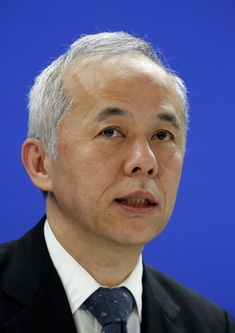
Tokyo Electric Power Co. Holdings Inc. closed at the lowest in more than two weeks after its president said it may face insolvency if it recognized at one time the cost of decommissioning the wrecked Fukushima nuclear plant and that it’s asked the government to help eliminate the risk.
Tepco, as the company is better known, fell as much as 7.9 percent during intraday trading and closed 3.3 percent lower at 414 yen a share in Tokyo, the lowest since Sept. 16. The benchmark Topix index rose 0.6 percent.
“As it becomes possible to estimate the Fukushima decommissioning cost, we will have the problem of recognizing the liability at once. That means there is a possibility Tepco becomes insolvent,” President Naomi Hirose told reporters in Tokyo Wednesday after meeting with a Ministry of Economy, Trade and Industry commission charged with reforming the company. “We are requesting institutional measures to remove such risk.”
As of June, nearly 1 trillion yen ($9.7 billion) has been allocated to decommissioning and water treatment at Fukushima, Tepco spokesman Tatsuhiro Yamagishi said last month.
The March 2011 nuclear accident and its fallout will ultimately cost more than 11 trillion yen, according to a study by Japanese college professors including Kenichi Oshima, a professor of economics at Ritsumeikan University.
Tepco calls for government help to curb impact of rising Fukushima costs
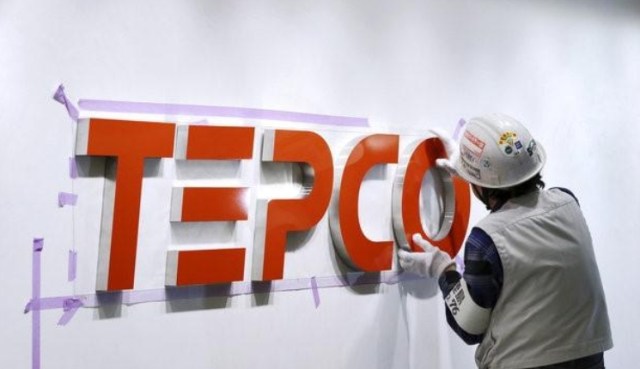
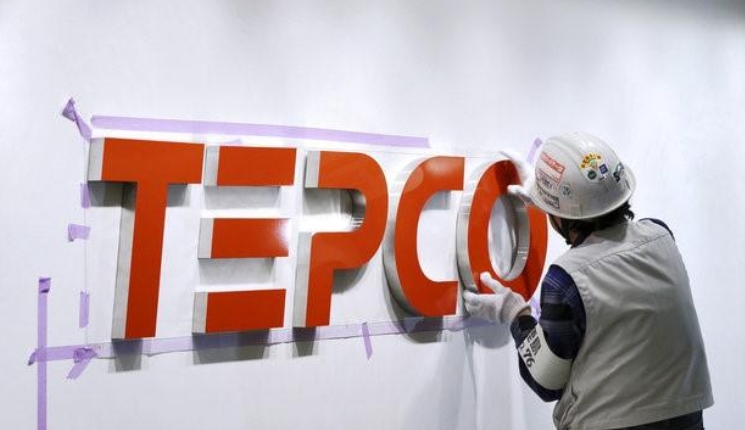
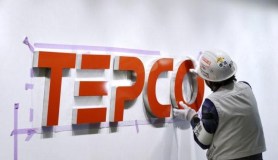
A worker puts up new logo of TEPCO Holdings and Tokyo Electric Power Company (TEPCO) Group on the wall ahead of the transition to a holding company system through a company split at the TEPCO headquarters in Tokyo, Japan, March 31, 2016.
The operator of the nuclear power plant destroyed in the Fukushima disaster five years ago has asked Japan’s government for help in avoiding the risk of the utility going bankrupt should there be a sharp rise in the full estimated clean-up costs.
Tokyo Electric Power Co Holdings Inc didn’t specify what kind of help it was seeking, but people familiar with the matter said Japan’s biggest utility is looking for new rules to avoid having to book a huge loss in its accounts if it is estimated that there will be big cost overruns for decommissioning the power station.
“We don’t want to receive national rescue measures but want to bear the Fukushima responsibility ourselves,” Tepco president Naomi Hirose told a government panel, according the panel chief, Kunio Ito, a professor at Hitotsubashi University.
“For that reason, we would like to undertake steps for a further overhaul than we have had so far,” Hirose was quoted as saying.
In March 2011, one of the worst earthquakes in history triggered a 10-metre high tsunami that crashed into the Fukushima Daiichi nuclear power station, causing the world’s worst nuclear accident since Chernobyl 30 years ago. Meltdowns in three reactors released radiation over a wide area, contaminating water, food and air, and forcing more than 160,000 people to evacuate.
Dismantling the reactors is expected to take about 40 years, but even five and a half years on, Tepco still struggles to contain radioactive water from the plant and has said it can’t predict the eventual total costs of the clean-up and decommissioning.
After the panel meeting on Tepco reform and the Fukushima Daiichi plant, Hirose told reporters that it was difficult to accurately predict the costs of even a gradual decommissioning of the crippled reactors, said a spokeswoman for the utility, which generates about a third of the country’s electricity.
“If the issue of recognising all the estimated losses at once were to emerge, our company would fail, so we would like some structural assistance from the government to be able to avoid that risk,” Hirose said.
Tepco wants the government to consider introducing rules to avoid having to book a single huge exceptional loss as soon as cost estimates for decommissioning become clearer, said a person familiar with the situation.
Cost estimates could shoot up when the company and the government, which owns 50.1 percent of Tepco, decide on how to extract fuel debris at the plant in 2018 or 2019, said a person with direct knowledge of discussions on restructuring Tepco.
A government official familiar with the deliberations said, “In the event that Tepco can’t shoulder the burden, it will mean changing the fiscal-support system.” As it’s hard to imagine the government letting the company go bust, “in the end it will have to be a matter of either shouldering the burden with public funds or responding by raising electricity prices.”
The Mainichi newspaper said on Wednesday that Japan’s utilities lobby expects clean-up and compensation costs from the Fukushima disaster to overshoot previous estimates by 8.1 trillion yen (£62 billion).
The Federation of Electric Power Companies of Japan has informally asked the government to shoulder the extra cost, the newspaper said.
However, a federation spokesman said the group has not asked the government to shoulder any extra costs and the Mainichi estimates were not correct.
The new government panel also agreed that management reform at Tepco was necessary at its first meeting earlier in the day, panel chief Ito said.
Shares in Tepco ended down 3.3 percent after falling as much as 7.9 percent on Hirose’s remarks, which were initially interpreted as a plea for additional financial aid.
“The stock market seems to have reacted to the headline that it could become insolvent,” said a credit analyst at a Japanese brokerage. “But in reality, the president has just said what’s been known, that they need an accounting system that allows them to write off the cost of decommissioning gradually because posting the cost all at once could make it insolvent.”
http://uk.reuters.com/article/uk-tepco-outlook-idUKKCN1250JT
1 This Month

of the week – Shut Down Drone Warfare!


Tell the Ukrainian Government to Drop Prosecution of Peace Activist Yurii Sheliazhenko

Petition to revoke the licensing of the Near Surface Nuclear Disposal Facility (NSDF) at Chalk River. https://www.ourcommons.ca/petitions/en/Petition/Details?Petition=e-7247
To see nuclear-related stories in greater depth and intensity – go to https://nuclearinformation.wordpress.com
-
Archives
- March 2026 (251)
- February 2026 (268)
- January 2026 (308)
- December 2025 (358)
- November 2025 (359)
- October 2025 (376)
- September 2025 (257)
- August 2025 (319)
- July 2025 (230)
- June 2025 (348)
- May 2025 (261)
- April 2025 (305)
-
Categories
- 1
- 1 NUCLEAR ISSUES
- business and costs
- climate change
- culture and arts
- ENERGY
- environment
- health
- history
- indigenous issues
- Legal
- marketing of nuclear
- media
- opposition to nuclear
- PERSONAL STORIES
- politics
- politics international
- Religion and ethics
- safety
- secrets,lies and civil liberties
- spinbuster
- technology
- Uranium
- wastes
- weapons and war
- Women
- 2 WORLD
- ACTION
- AFRICA
- Atrocities
- AUSTRALIA
- Christina's notes
- Christina's themes
- culture and arts
- Events
- Fuk 2022
- Fuk 2023
- Fukushima 2017
- Fukushima 2018
- fukushima 2019
- Fukushima 2020
- Fukushima 2021
- general
- global warming
- Humour (God we need it)
- Nuclear
- RARE EARTHS
- Reference
- resources – print
- Resources -audiovicual
- Weekly Newsletter
- World
- World Nuclear
- YouTube
-
RSS
Entries RSS
Comments RSS
 nuclear-news