Tepco customers have paid 20.5 billion U.S. dollars to cover nuclear power-related costs since 2012 rate hike
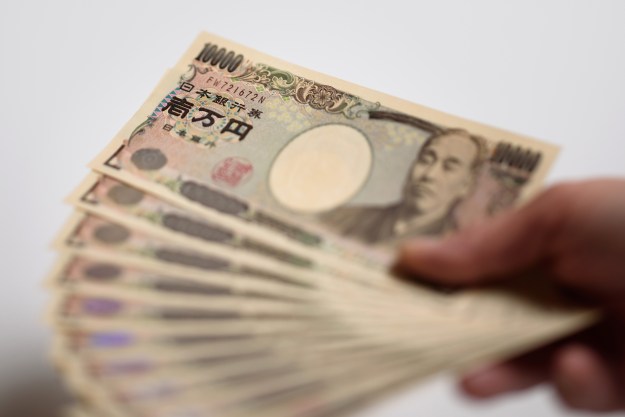
Customers of Tokyo Electric have paid over ¥2.4 trillion to cover nuclear-related costs since the beleaguered utility hiked electricity prices in September 2012, it has been learned.
The amount covers the costs of clerical work for processing applications for compensation related to the Fukushima disaster, totaling ¥25.9 billion, as well as ¥56.7 billion set aside as resources to repay the government for compensation paid on its behalf, and ¥41.4 billion in depreciation costs for two reactors at Fukushima No. 1 that were decommissioned, and for all four reactors at the Fukushima No. 2 plant, which Fukushima Prefecture and others want decommissioned.
The costs also include those to maintain its nuclear plants and to deal with the March 2011 triple meltdown at the Fukushima No. 1 plant.
According to materials held by Tokyo Electric Power Company Holdings Inc., the utility counted ¥601.4 billion in annual nuclear-related expenses as part of its overall costs when it raised electricity prices.
The expenses for nuclear power operations include ¥47.2 billion for measures related to Fukushima No. 1, including outsourcing radiation control-related work and inspecting and maintaining equipment to handle radioactive water.
The nuclear-related costs are expected to keep growing because Tokyo Electric has been unable to restart any reactors. When it raised prices in September 2012, the utility assumed that the ratio of nuclear power to its overall electricity supply would fall to 7 percent from 22 percent.
Tepco plans to restart two reactors at its Kashiwazaki-Kariwa nuclear plant in Niigata Prefecture, but this plan also may fail because Niigata’s new governor, elected in October, opposes restarts.
The Ministry of Economy Trade and Industry plans to have Tepco customers who have since switched to other utilities shoulder part of Tepco’s nuclear-related costs starting as early as fiscal 2020.
For 6,000, the daily bus ride takes them to Fukushima plant
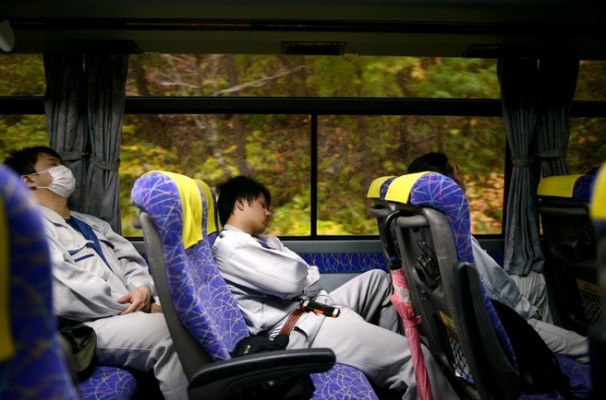
A shuttle bus takes workers in deep sleep from the Fukushima No. 1 nuclear plant to J-Village, where their temporary dormitories are located.
A shuttle bus takes workers in deep sleep from the Fukushima No. 1 nuclear plant to J-Village, where their temporary dormitories are located. (Shigeta Kodama)
NARAHA, Fukushima Prefecture–Despite the predawn hour, few people are sleeping on a bus that steadily makes its way north on National Route 6.
Some passengers are planning for the work ahead. One is looking forward to chatting with his colleagues. And a few wonder if today will be the day when their annual radiation doses reach the safety limit.
Every day, buses like this take 6,000 workers to the Fukushima No. 1 nuclear power plant. And every day, the same buses take the exhausted and mostly sleeping workers back to their base at the Japan Football Village (J-Village) in Naraha.
Although the Fukushima plant is still decades away from being decommissioned, without this daily routine of the workers who toil amid an invisible danger, the situation at the site would be much more difficult.
407 DAILY BUS RIDES
One of them, the 49-year-old leader of a group of metal workers from Iwaki, Fukushima Prefecture, has been working at nuclear plants, including the Kashiwazaki-Kariwa power station in Niigata Prefecture, for nearly 20 years.
He was at the Fukushima No. 1 nuclear plant when the Great East Japan Earthquake and tsunami triggered the triple meltdown there in March 2011.
“Nobody can get close to the area where the melted nuclear fuel remains due to high radiation doses,” the man said. “Even if we could approach the area, we would have no way out if something happens. The situation is harsh.”
Those metal workers install tanks for the contaminated water that keeps accumulating at the plant.
Although there are plenty of empty seats, the young workers sit in front and the older workers take the back seats.
Thousands of workers are staying at temporary dormitories set up in J-Village, a soccer training complex.
Tokyo Electric Power Company Holdings Inc., operator of the nuclear plant, hired a local bus company to transport the workers to the plant because securing parking areas near the site has been difficult since the 2011 disaster.
The company provides 407 services a day to and from the plant. Each trip takes about 30 minutes.
The first shuttle bus departs from J-Village at 3:30 a.m., while the last bus leaves the Fukushima plant at 9:45 p.m.
In mid-November amid torrential rain, one bus picked up a man taking shelter under the eaves of a bus stop.
He said he is in charge of managing data related to radiation doses of fittings and other equipment at the plant.
“We have many different types of work here,” the man proudly said.
Also on the way to the nuclear plant, a 53-year-old employee of a security company was thinking about personnel distribution.
Like other workers there, security guards must be replaced when their annual radiation doses reach a certain level set by the government.
He said he has difficulties making ends meet with a limited number of guards who have knowledge about radiation.
Suddenly, the man’s cellphone rings, and the caller orders the deployment of additional security guards to the plant.
A 52-year-old TEPCO employee was on the way to the nearby Fukushima No. 2 nuclear power plant to provide a safety training program for workers, many of whom are victims of the triple disaster.
“I want to convey to workers how precious their lives are and how important safety is in a way that doesn’t make me sound hypocritical,” the employee said.
The triple meltdown has been called a “man-made disaster” caused by the failure of both TEPCO’s management and the government’s regulatory authorities.
The TEPCO employee will use props, such as a ladder, and pretend to be a worker to explain dangerous cases at the No. 1 plant.
PREMIUM SEATS
On the trip back to J-Village, a different atmosphere exists on the bus.
Although dazzling sunlight shines through the windows and stunning views of the ocean are available, most of the workers are fast asleep in their wrinkled uniforms.
“Few people stay awake. I don’t even switch on the radio. They must be tired after their work,” said Nobuyuki Kimura, 52, who has driven the shuttle bus for one-and-a-half years.
In Kimura’s bus that departed the plant at 2:30 p.m., all 50 seats and some of the auxiliary seats were filled. The few passengers who stayed awake remained quiet.
By early evening, fewer workers boarded the bus at the plant.
Window seats at the back of the bus are desirable on all rides because they have an enough room for the seats to recline, allowing passengers to cross their legs.
A 21-year-old worker from Iwaki went for a window seat at the back after standing at the front of a line waiting for the bus.
“I can relax sitting here. This is the premium seat,” said the man who collects waste materials, such as boots and socks, at the site.
Although he works in protective gear in an area with high radiation levels, he said he has never thought about quitting his job.
He said he became fed up with school as a junior high school student, and did not bother going to senior high school.
At the age of 18, he joined his current company, and his first assignment was at the Fukushima No. 1 plant.
“I became acquaintances with more and more people. It’s fun to speak with people at work,” he said.
Through his work at the nuclear plant, his weight has dropped from 115 kilograms to 93 kg.
Thirty to 40 years are needed to decommission the Fukushima No. 1 plant, according to the mid- and-long-term roadmap compiled by the government and TEPCO.
To reduce the groundwater flowing into the buildings housing the No. 1 to No. 4 reactors, TEPCO installed coolant pipes this year to create an underground frozen soil wall to divert the water into the ocean.
TEPCO announced in October that the ice wall on the sea side was nearly frozen, but groundwater is believed to be seeping through it.
The utility plans to start removing spent fuel from the No. 3 reactor building in fiscal 2017. It also has plans to begin the daunting task of removing the melted fuel from the No. 1 to No. 3 reactor containment vessels in 2021.
However, extremely high radiation levels have prevented workers from approaching and understanding the condition of the melted fuel. The removal method has yet to be decided.
The estimated cost of work for decommissioning and dealing with the contaminated water has ballooned to 8 trillion yen ($68.1 billion).
Tepco worker’s thyroid cancer is recognized as a work-related
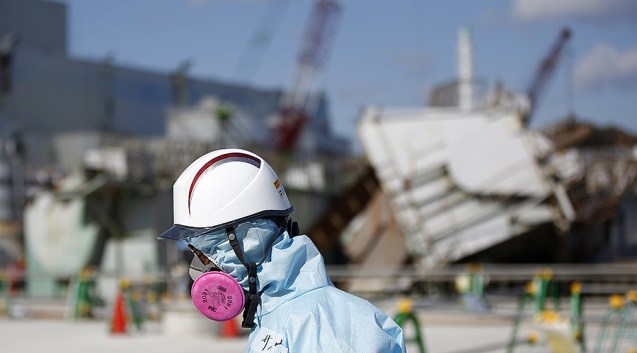
Tepco worker’s thyroid cancer is recognized as a work-related
Japanese labor authorities have recognized the thyroid cancer of a man who worked at Tepco’s stricken Fukushima No. 1 nuclear plant as a work-related, it was learned Friday.
It is the first time that thyroid cancer has been recognized as a work-related illness caused by radiation from the plant after it was damaged in the March 2011 earthquake and tsunami.
This is the third case labor authorities have linked to radiation exposure for workers at the Fukushima plant. The two previous cases involved leukemia.
At a meeting Friday, a Health, Labor and Welfare Ministry panel of experts presented for the first time criteria for recognizing thyroid cancer as a work-related disease from radiation, including doses of 100 millisieverts or more and a period of five years or more between exposure to radiation and the development of cancer.
Based on the criteria, a labor standards office in Fukushima Prefecture concluded that the cancer of the employee, who is in his 40s, was caused by radiation from the plant.
The man joined Tokyo Electric Power Company Holdings Inc. in 1992 and worked at several nuclear power plants for over 20 years.
After checking reactor instruments and carrying out other duties at the Fukushima No. 1 plant from March 2011 to April 2012, he was diagnosed with thyroid cancer in April 2014. His cumulative radiation dose after the accident stood at 139.12 millisieverts.
According to the International Commission on Radiological Protection, lifetime cancer mortality rises by about 0.5 percent for those exposed to a dose of 100 millisieverts.
Thyroid cancer compensation for Fukushima plant worker
A man who developed thyroid gland cancer after working at the stricken Fukushima No. 1 nuclear plant has for the first time won the right to work-related compensation.
While the case ranks as the third time a worker at the Fukushima plant has been recognized as eligible for work-related compensation because of cancer caused by radiation exposure, it is the first instance involving thyroid gland cancer.
The Ministry of Health, Labor and Welfare announced its decision Dec. 16.
The man in his 40s, an employee of plant operator Tokyo Electric Power Co., worked at the Fukushima plant after the triple meltdown triggered by the 2011 Great East Japan Earthquake and tsunami. He was diagnosed with thyroid gland cancer in April 2014.
The man worked at various nuclear plants, including the Fukushima facility, between 1992 and 2012. He was mainly involved in operating and overseeing reactor operations.
After the March 2011 nuclear accident, the man was in the plant complex when hydrogen explosions rocked the No. 1 and No. 3 reactor buildings. His duties included confirming water and pressure meter levels as well as providing fuel to water pumps.
The amount of his accumulated whole body radiation exposure was 150 millisieverts, with about 140 millisieverts resulting from the period after the nuclear accident. Of that amount, about 40 millisieverts was through internal exposure caused by inhaling or other ways of absorbing radioactive materials.
Along with recognizing the first work-related compensation involving thyroid gland cancer, the labor ministry also released for the first time its overall position on dealing with compensation issues for workers who were at the Fukushima plant after the accident.
The ministry said it would recognize compensation for workers whose accumulated whole body dose exceeded 100 millisieverts and for whom at least five years have passed since the start of work involving radiation exposure and the diagnosis of cancer.
Ministry officials said the dose level was not a strict standard but one yardstick for recognizing compensation.
According to a study by TEPCO and a U.N. scientific committee looking into the effects of radiation, 174 people who worked at the plant had accumulated whole body doses exceeding 100 millisieverts as of this past March.
There is also an estimate that more than 2,000 workers have radiation doses exceeding 100 millisieverts just in their thyroid gland.
http://www.asahi.com/ajw/articles/AJ201612170027.html
First thyroid cancer case in Japan recognized as Fukushima-related & compensated by govt
A man who worked at the Fukushima nuclear power plant in Japan during the disastrous 2011 meltdown has had his thyroid cancer recognized as work-related. The case prompted the government to finally determine its position on post-disaster compensation.
The unnamed man, said to be in his 40s, worked at several nuclear power plants between 1992 and 2012 as an employee of Tokyo Electric Power Company Holdings Inc. He was present at the Fukushima Daiichi nuclear power plant during the March 11, 2011 meltdown. Three years after the disaster, he was diagnosed with thyroid gland cancer, which the Japanese Ministry of Health, Labor and Welfare confirmed on Friday as stemming from exposure to radiation.
The man’s body radiation exposure was totaled at 150 millisieverts, almost 140 of which were a result of the accident. Although this is not the first time that health authorities have linked cancer to radiation exposure for workers at the Fukushima plant, it is the first time a patient with thyroid cancer has won the right to work-related compensation.
There have been two cases previously, both of them involving leukemia.
The recent case prompted Japan’s health and labor ministry to release for the first time its overall position on dealing with compensation issues for workers who were at the Fukushima plant at the time and after the accident. Workers who had been exposed to over 100 millisieverts and developed cancer five years or more after exposure were entitled to compensation, the ministry ruled this week. The dose level was not a strict standard but rather a yardstick, the officials added.
As of March, 174 people who worked at the plant had been exposed to over 100 millisieverts worth of radiation, according to a joint study by the UN and the Tokyo Electric Power Company. There is also an estimate that more than 2,000 workers have radiation doses exceeding 100 millisieverts just in their thyroid gland, Japanese newspaper the Asahi Shimbun reported.
The 2011 accident at the Fukushima nuclear power plant was the worst of its kind since the infamous 1986 catastrophe in Chernobyl, Ukraine. After the Tohoku earthquake in eastern Japan and the subsequent tsunami, the cooling system of one of the reactors stopped working, causing a meltdown. Nearly half a million people were evacuated and a 20-kilometer exclusion zone was set up.
https://www.rt.com/news/370650-thyroid-cancer-fukushima-plant-radiation/#.WFZfzwMDsFM.facebook
More Evacuees Sue Govt, TEPCO over Fukushima N-Accident
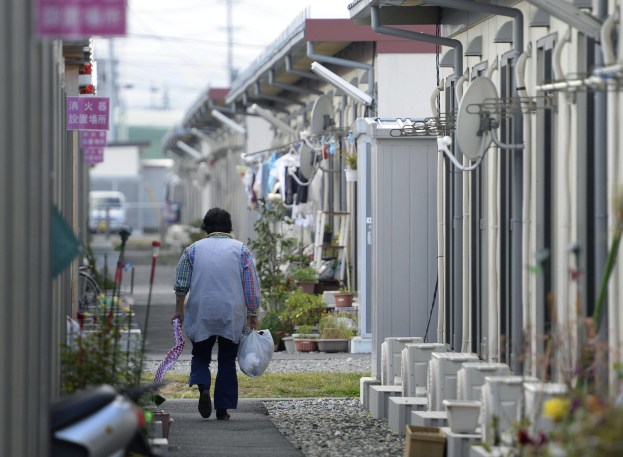
Fukushima, Dec. 12 (Jiji Press)–A group of 295 people, mainly nuclear disaster evacuees, on Monday joined lawsuits against the Japanese government and Tokyo Electric Power Company Holdings Inc. over the Mach 2011 meltdowns at TEPCO’s Fukushima No. 1 power plant.
Filing their suit with Fukushima District Court, the plaintiffs, many of whom were evacuees in and outside Fukushima Prefecture, demanded that the government and TEPCO pay compensation and restore conditions before the nuclear accident.
The group, made up of men and women from minors to 89 years old, said they were forced to evacuate and deprived of their peaceful lives because of the accident at the power plant in the northeastern Japan prefecture.
The team joined those who filed similar suits against the government and TEPCO in March 2013, raising the total number of plaintiffs to some 4,200.
At a news conference after the latest suit was filed, plaintiff Akemi Eda, who evacuated from the Fukushima Prefecture town of Namie, noted recent incidents in which children evacuated from the prefecture due to the accident have been bullied at schools.
Loan ceiling for TEPCO to be raised

Japan to increase loan to Fukushima operator Tepco to $123 billion
Question to ask: why call this a loan when the law, like USA Price Anderson Act, limits nuclear power co from liability and puts the govt on the hook for everything beyond that?
Answer: I’d say most likely simple propaganda. That’s the taxpayers TRILLIONS that’s going to a ‘forever’ nuclear power plant black hole. That money will never be paid back to govt. The only thing I can imagine is that the Govt reneges on the agreement and socializes utilities in Japan. Because either the corporation nor govt can survive unless they do that…. or they can play fictionalized accounting for public.
What do you think?
Japan will increase an interest-free loan to the operator of the wrecked Fukushima nuclear plant, Tokyo Electric Power, by more than a third to 14 trillion yen ($123 billion), a source familiar with the matter said on Thursday.
Spiraling costs from the world’s worst nuclear disaster since Chernobyl in 1986 are threatening the viability of the utility known as Tepco and hampering its ability to clean up its wrecked Fukushima Daiichi nuclear plant.
The increase in the loan from 9 trillion yen is to cover the costs for compensation and decontamination areas around the plant, according to the source, who is not authorized to speak to the media.
Three reactors melted down at the plant after a magnitude 9 earthquake in March 2011, which sparked a tsunami that devastated a large section of Japan’s northeastern coastline.
More than 15,000 people were killed in the natural disaster, which also caused a loss of power and cooling at the Fukushima station.
Explosions in the wake of the reactor meltdowns led to a massive release of radiation that prompted the evacuation of 160,000 people from areas around the plant, many of whom will never be able to return.
The disaster is likely to cost 22.6 trillion yen ($199 billion), more than double an earlier government estimate.
Costs for decommissioning the wrecked reactors will be covered by a separate arrangement from the loan, according to the Nikkei newspaper, which earlier reported the increase in the loan for Tepco.
http://www.reuters.com/article/us-japan-fukushima-support-idUSKBN13X00G?il=0
As Costs of Disaster Keep Rising, State Ownership of Tepco Continues
Tokyo says Tepco may stay nationalized to deal with massive cost of nuclear disaster
Faced with massive ongoing costs stemming from the 2011 nuclear crisis in Fukushima, Tokyo Electric Power Co. Holdings Inc. may remain under state control longer than initially planned, the government said Monday.
Under the current plan, the utility would gradually reduce government involvement in its management from April.
However, at a key panel meeting the government proposed a revised option in light of the huge compensation and decommissioning expenses that are involved.
The government leads the business operations of the utility, known as Tepco, acquiring 50.1 percent of its voting rights through the state-backed Nuclear Damage Compensation and Decommissioning Facilitation Corp.
Some ministry bureaucrats have also been dispatched to the utility.
It is understood the state-backed body will assess efforts to reform the company in late March and make a decision on whether to reduce state involvement.
“The direction of Tepco reform is coming into sight,” said Economy, Trade and Industry Minister Hiroshige Seko at the panel meeting. “We have to come up with a more detailed picture of the reform.”
The government is seeking to split the activities of the utility into “business operations,” including retail sales and power generation, and “Fukushima operations” related to decommissioning reactors at the disaster-hit Fukushima No. 1 nuclear plant and paying compensation, which would remain under public control.
As for Tepco’s business operations, the government plans to free them of state control at an early date, hoping to promote industry reorganization involving nuclear and energy distribution businesses.
The plan was revealed at the panel meeting at the trade ministry to study compensation and decommissioning issues facing the utility. The panel will compile proposals by the end of this year.
The government also seeks cooperation from other power companies in reactivating Tepco’s Kashiwazaki-Kariwa nuclear power plant in Niigata Prefecture, which would be the main source of its revenue.
With the involvement of other utilities, the government hopes to ease local distrust of Tepco’s nuclear plant operations. Two reactors at the Kashiwazaki-Kariwa plant are under prolonged safety examinations by nuclear regulators.
State ownership of TEPCO likely to continue as costs keep rising
The government will likely prolong its effective state ownership of Tokyo Electric Power Co. Holdings Inc. because the expected costs for decommissioning its ruined Fukushima No. 1 nuclear plant and paying compensation continue to soar.
The industry ministry mentioned the rising expenses at a meeting on Dec. 5 with scholars and others.
The ministry at the meeting showed a six-item report titled, “Tokyo Electric Power Co. and the state’s role.” One pillar of the report was that the state should urge TEPCO to perform its responsibilities.
However, one of the participants said, “The state should hold a certain ratio of (TEPCO) shares for a long period.”
The government-approved Nuclear Damage Compensation and Decommissioning Facilitation Corp. currently holds 50.1 percent of shares with voting rights of TEPCO.
The government planned to reduce the stake to less than 50 percent if it concluded at the end of this fiscal year that TEPCO could operate independently.
However, that scenario has collapsed.
Some sources now say total costs, including expenses for decommissioning and compensation, will probably exceed 20 trillion yen (about $176 billion).
TEPCO initially said that it would need a total of 11 trillion yen to resolve problems related to the plant that suffered a triple meltdown after being hit by the Great East Japan Earthquake and tsunami in March 2011.
That amount includes 2 trillion yen to decommission the reactors, 5.4 trillion yen to pay compensation to people affected by the disaster and 2.5 trillion yen to decontaminate areas polluted with nuclear substances.
However, an internal report worked out by the industry ministry in August showed that the costs for decommissioning would probably increase by 4 trillion yen and the compensation sum would likely rise by 3 trillion yen, making the total amount 18 trillion yen.
Fukushima Daiichi to cost TEPCO $170 billion
Japan’s government estimates the crippled Fukushima Daiichi nuclear plant will end up costing its operator more than 170 billion dollars. The figure includes the costs of decommissioning the facility, as well as compensation and decontamination work.
Tokyo Electric Power Company has said it will secure about 17 billion dollars to decommission the plant’s reactors.
However, government officials now say the total cost will be more than 4 times higher. They estimate about 70 billion dollars will be required for the work, which includes removing melted nuclear fuel and dealing with radioactive wastewater.
The costs of decontamination work and constructing intermediate storage facilities for contaminated soil and waste materials are also likely to increase.
An additional 70 billion dollars will be needed to compensate farmers seeking damages.
The government will temporarily shoulder some of the compensation costs, and seek repayment from TEPCO at a later date. Other power companies are sharing some of the burden, which means higher electricity bills for consumers.
Japan’s industry ministry is currently working on a plan to reform TEPCO’s management and divert its profits to decommissioning work. But the ballooning costs are threatening this plan. The government aims to decide by the year-end how to share the financial burden, and how the work will be done.
Crisis averted, but is N-plant operator Tepco prepared for a bigger quake?

An aerial view of the Fukushima Daiichi nuclear power plant after a strong earthquake hit off the coast of Fukushima on Tuesday. The operator of the plant said there were no abnormalities observed at the plant.
TOKYO — There was no avoiding fearful memories of the Japanese nuclear disaster of 2011 on Tuesday morning after a powerful earthquake off the coast of Fukushima caused a cooling system in a nuclear plant to stop, leaving more than 2,500 spent uranium fuel rods at risk of overheating.
But this time, the Tokyo Electric Power Company (Tepco), the utility that operates three nuclear plants, restored the cooling pump at the Fukushima Daini plant in about 90 minutes. The Daini plant is about 11km south of Fukushima Daiichi, the ruined plant where three reactors melted down five years ago after tsunami waves inundated the power station and knocked out backup generators.
Tepco reported that it never lost power at either the Daini plant or its neighbour to the north after the Tuesday quake, which had a magnitude of 7.4, according to the Japanese weather service.
“We took the regular actions that we should take when handling troubles,” Mr Yuichi Okamura, acting general manager of the nuclear power division at Tepco, said at a news conference on Tuesday.
The company was prepared for big tsunamis, having built sea walls rising to almost 15m at the Fukushima plants and enclosing backup generators in waterproof facilities, Mr Okamura said.
Critics of Tepco, which struggled to keep on top of a crisis that followed the 2011 calamity, said they were relieved that there had been no immediate damage. However, they remained sceptical that the company had done enough to prepare for a disaster on the scale of the earthquake five years ago.
That quake, which had a magnitude of 8.9, set off tsunami waves as high as 40m in some places. In contrast, the highest waves on Tuesday reached only about 1.4m.
“It looks like the right things have been done,” said Mr Azby Brown, director of the Future Design Institute at the Kanazawa Institute of Technology and a volunteer researcher with SafeCast, an independent radiation-monitoring group.
“But you never know until something happens. As far as this morning goes, they did a decent job, but mainly because it wasn’t that big of an earthquake or that big of a tsunami.”
Building higher sea walls, for example, “is all good, but that is like fighting the last war”, Mr Brown said.
“It remains to be seen how well prepared they would be for some other unusual combination of disasters.”
Compared to five years ago, Tepco has improved its communication with the public, reporting information about the cooling pump at Daini almost as it happened on Tuesday morning.
The company also quickly said that it had suspended the treatment and transfer of contaminated water from the Daiichi plant, where an extensive clean-up and decommissioning process is underway. By the evening, those operations had been restored.
“What I can say is today’s response was decent and they seemed to be confident,” said Mr Tatsujiro Suzuki, director of the Research Center for Nuclear Weapons Abolition at Nagasaki University. However, it would be difficult to independently verify Tepco’s claims because the Japanese Nuclear Regulation Authority depends on the company to release information.
He added that he was not convinced that Tepco was being fully transparent about its decisions, particularly about the clean-up at the Daiichi plant.
“We should be informed fully whether this operation is reasonably done with cost-effectiveness and safety and making sure that the best technology is being used,” Mr Suzuki said.
Mr Daisuke Maeda, a spokesman for the Nuclear Regulation Authority, said the agency had offices on the sites of the nuclear plants and worked with Tepco and other utility companies on Tuesday to confirm that the power stations were safe after the earthquake.
Regarding the longer-term situation, nuclear experts expressed concern about the safety of the clean-up operation at the Daiichi plant. The melted cores of three reactors have yet to be removed as they are still too radioactive for workers to approach.
Since the 2011 disaster, groundwater seeps into the reactors daily. The water, contaminated by the melted fuel rods, needs to be treated and stored on site. So far, Tepco has built more than 880 tanks of about 1,000 tonnes each.
The tanks are inspected four times a day to confirm that they do not leak, said Mr Okamura of Tepco.
And in an effort to halt the flood of groundwater into the damaged buildings, the company has built an underground wall of frozen dirt nearly 1.6km long encircling the reactors. The wall is not yet fully frozen, though, and groundwater continues to flow into the reactors.
Critics worry that the sea walls or storage tanks might not withstand a more powerful earthquake or tsunami. And Tuesday’s incident at the Daini reactor showed that quakes can set off problems even at plants that are not operating.
Most of the country’s 54 plants remain closed since the 2011 disaster, but the administration of Prime Minister Shinzo Abe wants to restart most of them.
A majority of the Japanese public is opposed to such a move. Candidates for governor who ran campaigns opposed to the revival have won elections in recent months in two prefectures that host nuclear plants.
According to Japanese daily Nikkei Shimbun, Mr Fumio Sudo, the chairman of Tepco, and Mr Naomi Hirose, the company’s president, were planning to meet on Tuesday with one of those governors, Ryuichi Yoneyama of Niigata, to try to persuade him to support a restart of the Kashiwazaki-Kariwa plant there.
Mr Sudo and Mr Hirose returned to Tokyo after the earthquake.
Mr Kiyoshi Kurokawa, who oversaw an independent investigation of the Fukushima nuclear accident for the Japanese Parliament, said that building walls and storage tanks failed to solve the underlying problem of an earthquake-prone country relying on nuclear power. Instead, he said, both the government and utility companies should invest in developing alternative sources of power like solar or wind technology.
“I think we expect more of such readjusting plate movements and that has been reasonably predicted, and many volcanic activity and earthquakes have been rampant over the last five years,” said Mr Kurokawa, an adjunct professor at the National Graduate Institute for Policy Studies. “So why are we continuing to restart nuclear plants?”
http://www.todayonline.com/world/asia/crisis-averted-n-plant-operator-tepco-prepared-bigger-quake
An aerial view of the Fukushima Daiichi nuclear power plant after a strong earthquake hit off the coast of Fukushima on Tuesday. The operator of the plant said there were no abnormalities observed at the plant.
Tepco’s Nov. 22 Post-Earthquake Information Release

Tepco released some post-earthquake informations about the situation of the Fukushima Daiichi Nuclear Power Station after the earthquake off the coast of Fukushima Prefecture that occurred around 5:59 am today, November 22.
“At Fukushima Daiichi Nuclear Power Station, at 6:06 am after the earthquake occurred. As a precaution, contaminated water transfer from the reactor building basements was stopped after the quake. It was restarted at 3:19pm.
Similarly, the Reverse Osmosis desalination system was stopped at 6:17 am, and restarted at 3:44 pm. The cesium adsorption system was stopped at 6:23 am, and restarted at 4:47 pm. Other water treatment systems were stopped at 6:12 am and restarted at 4:20 pm.
Since we confirmed that there was no abnormality after the earthquake, we resumed operation.
Also, we patrolled each Unit 1 to 6 equipments, our patrol was completed by 4:06 pm and we confirmed the following troubles:
– Damages to the south side silt fences of Units 1 to 4 and the north side silt fences of 5 and 6 units on the port, these are used to try to keep small radioactive debris from leaving the port.
– A puddle (about 2 m × 3 m) was found near the common spent fuel pool, thought to be caused by sloshing of the pool during the quake.
We will carry out the restoration work as soon as preparations are completed.”
Tepco did not mention anything about the storage tanks up on the hill. Those aging bolt together tanks, still partially in use, containing contaminated water, are a major concern, being the most vulnerable to be damaged by an earthquake.
According to JMA (Japan Meteorological Agency), they observed over 85 aftershocks by 11:00 AM (JST) of 11/23/2016, out of which 7 quakes of seismic intensity over 3. They warn the same level of the earthquake (M7.4) may happen again this week, with possible Tsunami.
Sources:
Tepco 2016年11月22日地震情報(福島第一・福島第二原子力発電所関連) (続報5)
http://www.jma.go.jp/en/quake/quake_local_index.html
http://2ch-news.co/newsplus/1479879660/
Cancer patient compensated for Fukushima work to sue TEPCO
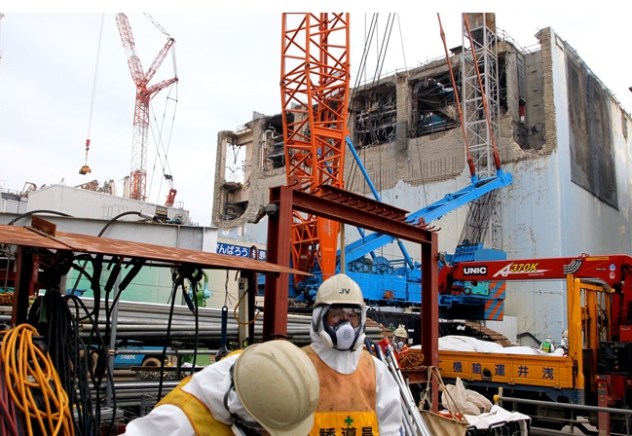
Damage from an explosion remains at the Fukushima No. 1 nuclear plant’s No. 4 reactor building in March 2013.
A 42-year-old man diagnosed with leukemia after working at the crippled Fukushima No. 1 nuclear plant plans to sue Tokyo Electric Power Co., saying the utility failed to take adequate precautions against radiation exposure.
He will also sue Kyushu Electric Power Co., operator of the Genkai nuclear plant in Saga Prefecture where he had also worked, in the lawsuit expected to be filed at the Tokyo District Court on Nov. 22.
The man, who is from Kita-Kyushu in Fukuoka Prefecture, will demand about 59 million yen ($541,000) in total compensation from the two utilities.
“TEPCO and Kyushu Electric, as the managers of the facilities, are responsible for the health of workers there, but they failed to take adequate measures to protect them from radiation exposure,” said one of the lawyers representing him.
“The man was forced to undergo unnecessary radiation exposure because of the utilities’ slipshod on-site radiation management, and as a result had to face danger to his life and fear of death,” the lawyer said.
The lawyers group said the man has a strong case, citing a ruling by labor authorities in October 2015 that recognized a correlation between his leukemia and his work in response to the 2011 Fukushima nuclear disaster.
It was the first time cancer was ruled work-related among people who developed the disease after working at the stricken Fukushima No. 1 nuclear plant.
The planned lawsuit will be the first legal action against TEPCO brought by an individual whose work-related compensation claim has already been granted.
Between October 2011 and December 2013, the man worked at the Fukushima No. 1 nuclear plant to set up a cover on the damaged No. 4 reactor building and perform other tasks.
The man also did regular maintenance jobs at the Genkai plant.
His accumulative radiation exposure at the two plants came to about 20 millisieverts.
http://www.asahi.com/ajw/articles/AJ201611180052.html
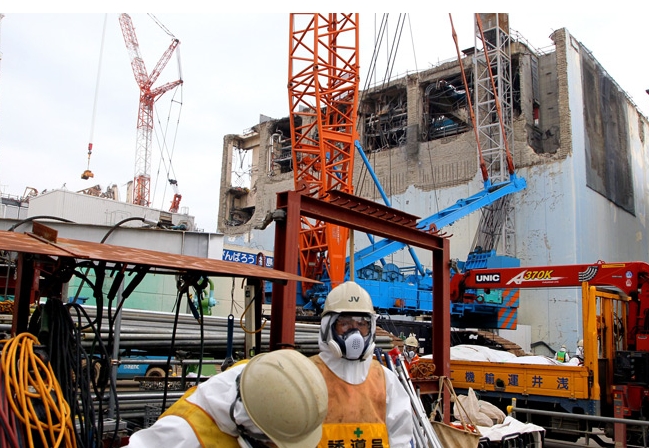
TEPCO may struggle to find partners due to Fukushima decommissioning costs
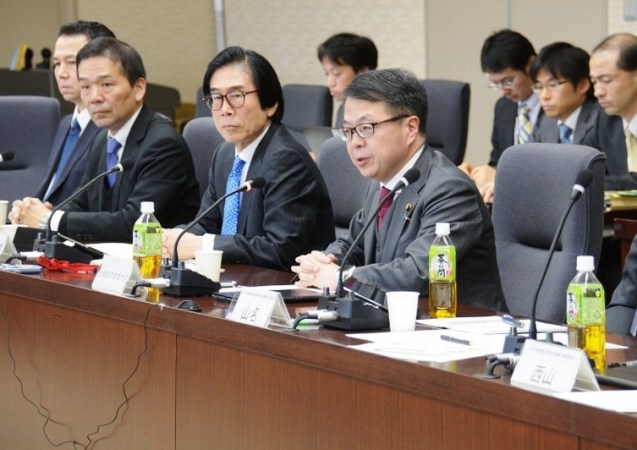
Economy, Trade and Industry Minister Hiroshige Seko, right front, speaks at a meeting of the ministry’s expert panel on reform of TEPCO and issues related to the crippled Fukushima No. 1 nuclear power plant on Nov. 15, 2016.
Naomi Hirose, president of Tokyo Electric Power Company Holdings Inc. (TEPCO), presented a proposal to reform the operator of the crippled Fukushima No. 1 Nuclear Power Plant to the Economy, Trade and Industry Ministry’s expert panel on Nov. 15.
Under the proposal submitted by Hirose on the reform of TEPCO and issues related to the crippled Fukushima nuclear power plant, TEPCO is to collaborate with other power companies in the areas of nuclear power generation and energy transmission and distribution in an effort to boost its earning power. But if other major utilities were to work with TEPCO on a nuclear power project, questions would be raised about how to split risks such as decommissioning costs for the crippled Fukushima plant among companies concerned. Such being the case, TEPCO will likely have difficulty finding partners.
Hirose attended the closed-door expert committee meeting as an observer. Committee chairman Kunio Ito (specially-appointed professor at Hitotsubashi University) and a senior industry ministry official revealed the details of Hirose’s reform proposal at a news conference after the panel meeting.
According to details revealed at the news conference, Hirose proposed to step up TEPCO’s cooperation with other power companies on its nuclear power business including the areas of safety measures, joint technological development and overseas business operations. The industry ministry had already proposed at an expert panel meeting that TEPCO spin off its nuclear business into a subsidiary and collaborate with other utilities, among other moves. TEPCO is expected to incorporate these plans into the “New Comprehensive Special Business Plan” that is set to be revised early next year in line with discussions at expert panel meetings.
Under the current New Comprehensive Special Business Plan, TEPCO assumes reactivation of its Kashiwazaki-Kariwa Nuclear Power Plant as a source of earnings to be used to rebuild itself. But there are no prospects of the power plant being reactivated as the governor of Niigata Prefecture, which hosts the nuclear facility, is taking a cautious stance toward reactivation. The industry ministry wants to secure understanding of a plan to reactivate the nuclear power plant by improving the creditworthiness of TEPCO’s nuclear business through collaboration with other utilities. But because there is a possibility of other power companies being forced to shoulder the costs of decommissioning the crippled Fukushima plant, it remains unclear whether TEPCO will be able to cooperate with those utilities as envisioned.
A member of the expert panel was quoted as saying at the meeting, “A proper alliance cannot be formed unless ways of shutting off the risks (for possible alliance partners) are considered. Hirose also proposed that TEPCO work with other firms in the area of power generation and transmission, as well as jointly procure materials with other firms.
As for the costs of decommissioning the Fukushima No. 1 nuclear plant, which are expected to exceed the initial estimate by several trillion yen, and expenses for paying compensation to nuclear disaster victims, the expert panel confirmed plans for TEPCO to minimize financial burdens on the public through management efforts. An expert panel member was quoted as saying at the Nov. 15 meeting, “If TEPCO’s liability is defined as limited, the general public will see the move as relief measures for TEPCO. We should carefully consider public opinion.”
http://mainichi.jp/english/articles/20161116/p2a/00m/0na/008000c
Japan’s government should stay out of U.S. sailors’ lawsuit against Tepco
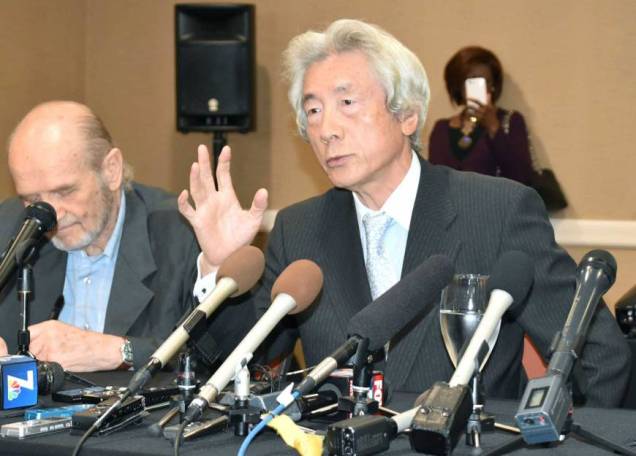
Anti-nuclear village voice: Former Prime Minister Junichiro Koizumi attends a press conference in Carlsbad, California, in May with former U.S. soldiers who have sued Tokyo Electric Power Co. for damage to their health they believe was caused by the Fukushima nuclear disaster. The author of this column, Brian Victoria, who acted as translator for Koizumi during the trip, is seated on the left.
Dear Prime Minister Shinzo Abe,
Let me first acknowledge that after four long years of silence, the Japanese government has finally taken a position regarding the lawsuit filed against Tokyo Electric Power Co. in the U.S. by more than 450 American sailors, marines and civilians who were on board the USS Reagan and accompanying military ships off the coast of Tohoku after 3/11.
These young people experienced serious health problems resulting from, they allege, radiation exposure while participating in Operation Tomodachi, the U.S. military’s humanitarian rescue mission launched in response to the Great East Japan Earthquake and tsunami of March 11, 2011, and subsequent multiple meltdowns at the Fukushima No. 1 nuclear plant.
While the Japanese government’s acknowledgement of the suit is welcome, the unconditional support it has given to Tepco is a matter of deep concern. Even now, U.S. service personnel find themselves prevented from seeking justice because Tepco, with the support of the Japanese government, is doing its utmost to ensure the case will never be heard in an American court.
The Japanese government submitted an amicus curiae brief to the Ninth Circuit Court of Appeals on Feb. 3. An amicus curiae (friend of the court) brief is one presented by a party not directly involved in the suit in the hope of influencing the outcome. The brief contains two points:
1. “The Government of Japan has developed a comprehensive system to ensure compensation for victims of the Fukushima Nuclear Accident.”
2. “Damage claims brought in tribunals outside of Japan threaten the continuing viability of the compensation system established by the Government of Japan.”
Examining the first point, if the Japanese government truly had “a comprehensive system to ensure compensation for victims,” there would be no need for the U.S. service members’ lawsuit. Yet, as you know, the Japanese government and its subsidiaries have, to date, not paid a single yen to any non-Tepco-related victim of radiation exposure from Fukushima No. 1. This includes, as of March this year, a total of 173 children from the prefecture who underwent surgery after being diagnosed with suspected thyroid cancer, 131 of whom were confirmed to have had cancer.
If the Japanese government will not admit that the suffering of its own children was caused by radiation exposure, how confident can young Americans be that the apparently radiation-induced injuries they experienced will be recognized as such, let alone compensated for, in Japan?
Further, at least seven of these previously healthy young Americans have already died and many others are too ill to travel to Japan even if they could afford to, let alone reside in this country during lengthy legal procedures, which typically take years to resolve. This is not to mention the prospect of expensive legal costs, including for court fees, hiring Japanese lawyers, translation of relevant documents, etc. And let us never forget, Prime Minister, it was the Japanese government that requested the assistance of these American military personnel.
As for the second point above, I agree the U.S. military personnel’s lawsuit threatens “the continuing viability of the compensation system established by the Government of Japan.” For example, if a U.S. court were to ascribe the plaintiffs’ illnesses to radiation exposure, how could the Japanese government continue to claim that none of the many illnesses the children and adults of Fukushima presently experience are radiation-related? The American service personnel truly serve as “the canary in the coal mine” when it comes to demonstrating the damaging effects of radiation exposure. Moreover, this canary is out of the Japanese government’s ability to control.
Let us further suppose that an American court were to award $3 million per person as compensation for the deaths, currently standing at seven, of the military personnel who were irradiated. By contrast, the Japanese government continues to deny compensation, for radiation-induced illnesses let alone deaths, to its own citizens. This would surely impact the “viability” (not to mention reputation) of the Japanese government in its ongoing denial of radiation-related injuries to non-Tepco employees.
Let me close by noting that there is one Japanese political leader who has accepted personal responsibility for the injuries inflicted on American service personnel. I refer to former Prime Minister Junichiro Koizumi who, after meeting with injured servicemen and women in San Diego in May, initiated a fund to meet as many of the medical needs of these sailors and marines as possible.
Fortunately, thanks to the support of thousands of ordinary Japanese, he has already raised $700,000 toward his $1 million goal. With tears in his eyes, Koizumi explained that he could not ignore the suffering of hundreds of formerly healthy young Americans who willingly put themselves at risk in order to render aid to the Japanese people.
Prime Minister Abe, I call on you to end the Japanese government’s unconditional legal support of Tepco. Further, if the Japanese government has a conscience, please immediately provide medical aid and compensation to the hundreds of American victims of Operation Tomodachi.
BRIAN VICTORIA
Kyoto
Fukushima Facility to Become Soccer Training Camp for 2020 Olympics
Tepco to end operations at the J-Village complex by March
Facility to be used as training camp for 2020 Tokyo Olympics
The base for the cleanup of the Fukushima nuclear plant will be returned by March to its original use: the training camp for the Japanese national soccer team.
In a symbolic step in the struggle to contain one of the worst nuclear disasters, Tokyo Electric Power Co. Holdings Inc. will return the J-Village facility — about 20 kilometers (12 miles) from the crippled Dai-Ichi plant and just 7 kilometers from the current exclusion zone — to the prefectural government during the current fiscal year, company spokesman Tatsuhiro Yamagishi said Tuesday. It’s also a boon for soccer players who will use the complex as their training base for the 2020 Tokyo Olympics.
The complex, opened in 1997 and shut down after March 2011 meltdown, will be fully reopened for players of “The Beautiful Game” in April 2019. It boasts 11 soccer pitches, a 1,200 square-meter gymnasium and a four-lane pool.
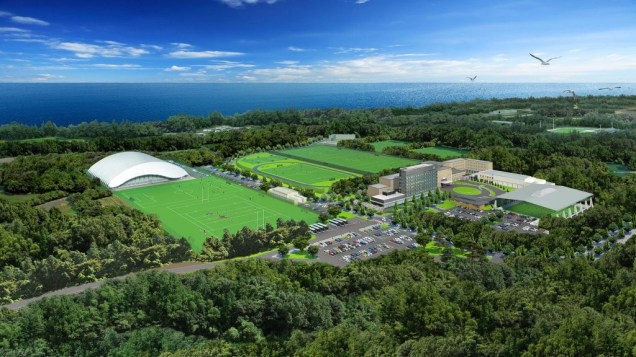
The hand-over is a shot in the arm for Prime Minister Shinzo Abe, who has vowed the nuclear disaster will not impede the nation’s plans to host the 2020 Games. In September, the premier said the situation at Fukushima is “under control” and that there doesn’t need to be a review of measures to prevent contamination.
“This promised handover of J-village would serve as a symbol of progress,” Daniel Aldrich, professor and director of the security and resilience studies program at Northeastern University in Boston, said by e-mail.
“Tepco clearly hopes that this will show the nation that it is on track in the Fukushima accident clean up process,” Aldrich said. “However, a number of obstacles, including expanding costs for decommissioning, a lack of physical control over the contaminated groundwater at the site, and complaints about the decontamination process nearby will no doubt hinder the process.”
As Tepco begins in coming years to remove melted fuel at Fukushima, clean-up costs may rise to several hundred billion yen annually from the current 80 billion yen ($763 million), Japan’s industry ministry said in October. About 300 metric tons of water — partly from the nearby hills — flow into the reactor building daily, mixing with melted fuel and becoming contaminated, according to the company.
The utility used the soccer facility as a make-shift base for tasks from corporate communications to measuring the radiation exposure of employees. It even built temporary dormitories there.
Gov’t to seek disaster compensation funds from consumers who used nuclear energy

The Ministry of Economy, Trade and Industry is considering making customers of new, smaller power companies who previously used nuclear energy from Tokyo Electric Power Co. (TEPCO) and other utilities shoulder part of the surging compensation costs for the Fukushima nuclear disaster.
Under the Act on Compensation for Nuclear Damage, nuclear power operators must each provide 120 billion yen to be used together with money paid by TEPCO and other major utilities to the Nuclear Damage Compensation and Decommissioning Facilitation Corporation to provide compensation. However, the compensation bill for the Fukushima No. 1 Nuclear Power Plant disaster continues to grow, and the compensation fund is expected to be left trillions of yen short.
The ministry takes the view that major utilities should have gathered more compensation funds from their customers, and it therefore plans to seek compensation funds from those who were previously in contracts with major power companies, using their nuclear energy.
A plan has surfaced to charge small-scale power companies more to deliver electricity through the power grids of major utilities, with the extra costs to be used for compensation. This and other plans will be debated on Nov. 2 at a working group of a ministry committee on energy reform. However, as some customers could face higher bills as a result, the move could trigger a public backlash.
http://mainichi.jp/english/articles/20161102/p2a/00m/0na/004000c
1 This Month
19 February – VIRTUAL EVENT-Decision Time: AI and Our Nuclear Arsenal
12:45 p.m. Central / 1:45 p.m. Eastern
To see nuclear-related stories in greater depth and intensity – go to https://nuclearinformation.wordpress.com
-
Archives
- February 2026 (181)
- January 2026 (308)
- December 2025 (358)
- November 2025 (359)
- October 2025 (376)
- September 2025 (258)
- August 2025 (319)
- July 2025 (230)
- June 2025 (348)
- May 2025 (261)
- April 2025 (305)
- March 2025 (319)
-
Categories
- 1
- 1 NUCLEAR ISSUES
- business and costs
- climate change
- culture and arts
- ENERGY
- environment
- health
- history
- indigenous issues
- Legal
- marketing of nuclear
- media
- opposition to nuclear
- PERSONAL STORIES
- politics
- politics international
- Religion and ethics
- safety
- secrets,lies and civil liberties
- spinbuster
- technology
- Uranium
- wastes
- weapons and war
- Women
- 2 WORLD
- ACTION
- AFRICA
- Atrocities
- AUSTRALIA
- Christina's notes
- Christina's themes
- culture and arts
- Events
- Fuk 2022
- Fuk 2023
- Fukushima 2017
- Fukushima 2018
- fukushima 2019
- Fukushima 2020
- Fukushima 2021
- general
- global warming
- Humour (God we need it)
- Nuclear
- RARE EARTHS
- Reference
- resources – print
- Resources -audiovicual
- Weekly Newsletter
- World
- World Nuclear
- YouTube
-
RSS
Entries RSS
Comments RSS
 nuclear-news