KEPCO has huge responsibility in restarting nuke plants

Utility seeks to restart two reactors in Fukui from mid-May

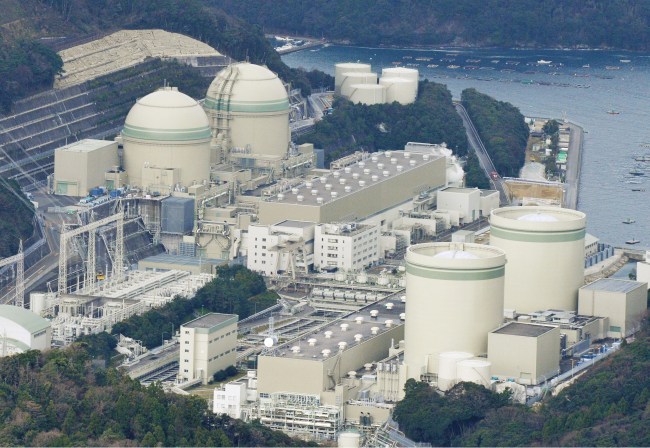
The Takahama Nuclear Power Plant’s No. 3 reactor, left, and No. 4 reactor are pictured in this file photo taken from a Mainichi Shimbun helicopter in Takahama, Fukui Prefecture, on June 15, 2016.
FUKUI, Japan (Kyodo) — Kansai Electric Power Co. said Tuesday it will seek to restart its two idled reactors in Fukui Prefecture, central Japan, in mid-May and early June, respectively.
Shigeki Iwane, the utility’s president, presented the plan to reboot the two units at the Takahama plant on the Sea of Japan coast when meeting with Fukui Gov. Issei Nishikawa.
“It is correct that (Kansai Electric Power) will take procedures to start operations,” Nishikawa told reporters after the meeting.
Kansai Electric Power will start to load nuclear fuel at the No. 4 unit later this month, eyeing the start of electricity generation in late May while aiming to reactivate the No. 3 reactor in early June after fueling the facility in mid-May, according to the schedule released by the Osaka-based company.
Although Prime Minister Shinzo Abe’s government has been promoting the restart of nuclear reactors across Japan, most of the reactors remain offline amid safety concerns among residents following the Fukushima Daiichi nuclear accident.
The two reactors in Takahama were brought back online in early 2016 after meeting the safety requirements introduced after the 2011 nuclear disaster.
While the No. 4 unit was shut down immediately after its restart in February last year due to a technical problem, the No. 3 reactor was forced to go offline the following month in the wake of an Otsu District Court order that resulted from a lawsuit filed by residents in neighboring Shiga Prefecture.
In March this year, the Osaka High Court struck down the lower court’s decision, making it possible for the two reactors to resume operation.
Among the four units at the Takahama plant, Japan’s nuclear regulators approved June last year the utility’s plan to extend the operation of the Nos. 1 and 2 reactors beyond the government-mandated 40-year service period.
https://mainichi.jp/english/articles/20170426/p2g/00m/0dm/001000c
Residents furious over high court decision to revoke Takahama nuclear plant injunction
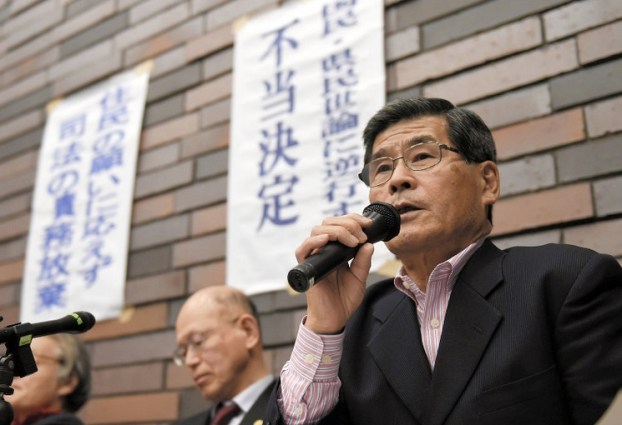
Yoshinori Tsuji, right, speaks during a news conference in Osaka’s Kita Ward on March 28, 2017, after the Osaka High Court handed down a decision on the injunction for reactors at Takahama Nuclear Power Plant
OSAKA — A March 28 Osaka High Court ruling that revoked a lower court decision to halt two nuclear reactors in Fukui Prefecture has angered plaintiffs and local residents as the high court effectively rubberstamped the state’s policy of restarting nuclear reactors.
Some 100 people demanding a halt to the reactors at Takahama Nuclear Power Plant gathered before the Osaka High Court on March 28. When they were informed of the ruling shortly after 3 p.m. with attorneys holding up banners that said, “Unjust ruling” and “The court fails to fulfill residents’ wishes,” the plaintiffs let out a sigh of disappointment.
“What are they thinking about?” “This is absurd,” they said, and shouted, “Resist the high court ruling that disregards Fukushima!” as they raised their fists.
Kenichi Ido, the head attorney for the plaintiffs, criticized the ruling during a news conference, with the over-400-page written court decision in his hand, saying, “While it’s this thick, its contents are just a copy of the views of (Takahama nuclear plant operator) Kansai Electric Power Co. and the Nuclear Regulation Authority.”
He added, “After the March 11 disaster, the judiciary is the only actor that can stop the administration that is railroading the resumption of nuclear power. But I sense that it has no self-awareness of its role or responsibility.”
Yoshinori Tsuji, the representative of the residents in the class action lawsuit, expressed frustration over the latest ruling, saying, “The decision was unjust as the high court took the policies of the central government and the utility into consideration.”
Tsuji also said the Otsu District Court’s injunction order handed down a year ago was a groundbreaking decision which reflected on the Fukushima nuclear disaster. “It further legitimized the authority of the judiciary,” he recalled.
Tsuji then slammed the Osaka High Court, saying, “The high court took a decidedly different stance from the district court with regard to listening to the people’s voices. Shame on them.”
http://mainichi.jp/english/articles/20170329/p2a/00m/0na/013000c
Osaka higher court backs restart of halted Takahama reactors
The Takahama reactors site is under 3 miles from Kyoto-fu, 36 miles (58K) from the cultural heritage sites in the ancient capital of Kyoto and closer to the region’s supply of fresh water, Lake Biwa.

Takahama reactors may soon restart after court overturns injunction

Plaintiffs hold banners in front of the Osaka High Court on Tuesday expressing disappointment after the court ruled in favor Kansai Electric over the restart of two Takahama reactors.
OSAKA – The Osaka High Court overturned Tuesday an injunction issued against the restart of Kansai Electric Power Co.’s No. 3 and No. 4 reactors at its Takahama facility in Fukui Prefecture, paving the way for them to be switched back on.
The landmark injunction issued by the Otsu District Court in Shiga Prefecture in March last year cited safety concerns for preventing the reactors from restarting even though they were judged to have met new safety regulations set after the Fukushima No. 1 nuclear crisis.
While the injunction had been a temporary victory for the plaintiffs in Shiga, some had predicted the Osaka High Court would adhere to a more narrow technical view of nuclear safety.
In his ruling, Judge Ikuo Yamashita said the plaintiffs had the responsibility to prove allegations of any specific dangers that would result in restarting the plant, which the judge ruled they had not.
Part of the plaintiffs’ claim relied on the alleged inadequacy of current evacuation plans in the event of an accident. Therefore, starting up the Takahama reactors, located about 60 km from the city of Kyoto, posed a significant risk, they argued.
Yamashita ruled that measures were being taken in Fukui and that official attitudes and efforts had been proactive, so he could not accept the plaintiffs’ claims.
“Kepco showed proof that they drew up emergency response measures based on the largest scale earthquake and tsunami,” the judge ruled. “The judge’s decision is extremely regrettable,”It’s clear with the decision that no progress has been made in terms of learning the lessons of March 11, 2011,” Kenichi Ido, a lawyer for the plaintiffs, said after the verdict was announced. “The attitude of the courts hasn’t changed at all since the Fukushima accident. In particular, the evacuation plans aren’t really being taken into consideration by the courts.”
Yoshinori Tsuji, one of the chief plaintiffs, said: “In America and South Korea, the courts are defying the presidents of both countries. But in Japan, the courts — which were ignoring the wishes of the people to stop nuclear power before March 11, 2011 — fail to reflect on what happened then. The courts follow the wishes of the nuclear power lobby and the government.”
Kansai electric officials welcomed the decision, saying at a Tuesday afternoon press conference in Osaka the utility would move towards preparing to restart, although they did not say when the reactors were expected to go back online.
“With safety as the top priority, the period for restarts is not yet set,” Kepco president Shigeki Iwane said. He added that once the restarts took place, the firm would move to reduce electricity prices.
In Kansai region, reaction to the court’s verdict was mixed. Fukui Gov. Issei Nishikawa, a strong supporter of nuclear power, was relieved with the decision, saying it was a return to a reasonable and correct decision by the court system.
But in neighboring Shiga prefecture, Gov. Taizo Mikazuki said that, given more immediate concerns Japan’s nuclear power industry faces, including spent fuel storage and decommissioning of old reactors, it was the wrong environment to approve reactor restarts. Kyoto Gov. Keiji Yamada emphasized that the utmost had to be done to ensure safety.
Higher court backs restart of halted Takahama reactors

The No. 3 and No. 4 reactors at the Takahama Nuclear Power Plant, from left to right, are pictured in this photo taken from a Mainichi helicopter in Takahama, Fukui Prefecture, on June 15, 2016.
OSAKA (Kyodo) — A Japanese high court on Tuesday revoked a lower court order to halt two nuclear reactors at the Takahama plant in central Japan, accepting an appeal by Kansai Electric Power Co. against the first injunction ever issued in the country to shut operating reactors.
But it is unlikely that the operation of other nuclear reactors in Japan will be resumed soon due to pending legal matters, analysts say.
The decision, made by the Osaka High Court, legally allows Kansai Electric to resume operating the Nos. 3 and 4 reactors at the nuclear power plant on the Sea of Japan coast in Fukui Prefecture. The two reactors have been idled for around a year.
The higher court said that quake-resistance standards were not overestimated under tougher regulations set following the 2011 Fukushima nuclear disaster and that necessary measures have been taken to prevent significant damage of the reactor core.
The latest decision bodes well for Prime Minister Shinzo Abe’s government, which has been promoting the restart of nuclear reactors in a bid to bolster the economy by cutting the cost of fossil fuels and exporting nuclear technology abroad.
Yoshihide Suga, the government’s top spokesman, said at a press conference in Tokyo, “We want Kansai Electric to put top priority on safety and make every effort to obtain understanding from the local government and others involved.”
Kansai Electric President Shigeki Iwane said at a news conference in Osaka that his company has yet to decide when to restart the operation of Takahama’s Nos. 3 and 4 reactors, pledging to “make safety our top priority.”
Iwane also expressed eagerness to push down electric charges as soon as possible after the resumption of the two reactors.
A group of residents in neighboring Shiga Prefecture who won the landmark injunction from the Otsu District Court in March last year are expected to consider countermeasures, including filing a special appeal with the Supreme Court.
Amid widespread concern about the safety of nuclear power following the 2011 Fukushima meltdowns, the residents in Shiga filed a request with the district court in January 2015, seeking an order halting the two reactors at the plant.
On March 9, 2016, the district court ordered operation of the two nuclear reactors to be halted, casting doubts about the utility’s safety measures and Japan’s post-Fukushima nuclear regulations set by the Nuclear Regulation Authority.
Last July, Kansai Electric filed an appeal against a district court decision rejecting its request to suspend the injunction order.
In Tuesday’s decision, the Osaka High Court determined that the post-Fukushima safety measures were “not unreasonable” because they were devised on the basis of the “latest scientific and technical knowledge” that reflects lessons learned from the nuclear disaster.
The utility has criticized the injunction, claiming it was not an objective judgment based on scientific knowledge. It also says the injunction is costing the utility 200 million to 300 million yen ($1.8 million to $2.7 million) more per day to generate power from other fuel.
Kansai Electric removed nuclear fuel from the Takahama reactors between August and September last year given the prolonged court battle.
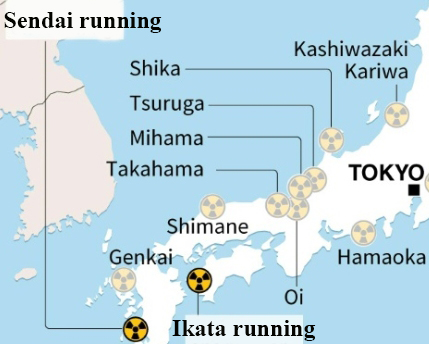
As of Tuesday, only three of Japan’s 42 commercial reactors nationwide are now operating — the Nos. 1 and 2 reactors at Kyushu Electric’s Sendai plant in Kagoshima Prefecture, southwestern Japan, and the No. 3 reactor at Shikoku Electric Power Co.’s Ikata plant in Ehime Prefecture, western Japan, according to the Agency for Natural Resources and Energy.
On Thursday, the Hiroshima District Court is set to rule on an appeal filed to halt the operation of the No.3 reactor at the Ikata power plant, the first ruling since it resumed operations in August last year.
http://mainichi.jp/english/articles/20170328/p2g/00m/0dm/063000c

The Nos. 3 and 4 reactors at the Takahama nuclear power plant
Japan court rules in favor of restart of Kansai Elec’s Takahama reactors
A Japanese high court on Tuesday overturned a lower court’s order to shut two reactors operated by Kansai Electric Power, a company spokesman said, potentially ending a drawn-out legal battle and helping the utility to cut fuel costs.
The decision, while positive for Kansai Electric, is not likely to speed the broader process of getting reactors back online nationally after the Fukushima nuclear disaster of six years ago, said a former advisor to the government and others.
“The future of nuclear power is still uncertain. The decision does not mean that the courts will give a ‘yes’ to other legal cases. Political uncertainty remains strong, too,” said Tatsujiro Suzuki, a former vice chairman of the Japan Atomic Energy Commission, a government body.
The Osaka High Court overturned the first court-ordered shutdown of an operating nuclear plant in Japan. The lower court had decided last year in favor of residents living near the Takahama atomic station west of Tokyo after they had petitioned for the reactors at the plant to be shut.
Kansai Electric, Japan’s most nuclear-reliant utility before the disaster, estimates it will save 7 billion yen ($63 million) per month in fuel once it restarts both reactors.
The restart schedule for the reactors, however, is still uncertain because the utility has been conducting safety checks requested by local authorities after a large crane toppled onto another reactor building at the site due to strong winds in January, a Kansai Electric spokesman said earlier.
There are four reactors at the Takahama plant, with the earlier court order covering the two newest ones.
The company released a profit forecast after the verdict on Tuesday saying it estimates net income of 133 billion yen ($1.2 billion) in the year through March 31, 2017.
The Kansai case was one of many going through the courts after the Japanese public turned away from nuclear power following the Fukushima meltdowns of 2011, the world’s worst nuclear calamity since Chernobyl in 1986.
Just three out of Japan’s 42 operable reactors are running and the pace of restarts has been protracted despite strong support from Prime Minister Shinzo Abe’s government, which is keen to restore a power source that provided about a third of electricity supply before the Fukushima disaster.
Residents have lodged injunctions against nuclear plants across Japan and lower courts have been increasingly siding with them on safety concerns.
Contentious verdicts are usually overturned by higher courts, where judges tend to be more attuned to government policy, judicial experts say.
“We are going to win some and we are going to lose some, but the political and social situation is such that unstable prospects for restarts are here to stay,” Aileen Mioko Smith, an advisor to the plaintiffs and a co-plaintiff in other lawsuits, told Reuters by phone from Osaka.
There are more than 30 cases going through Japan’s courts in which communities are seeking to stop reactors from operating, she said.
Kansai Electric shares had ended trading before the court decision was released. They closed 0.3 percent higher on Tuesday at 1,283 yen, while the broader market rose more than 1 percent.
http://www.reuters.com/article/uk-japan-nuclear-court-idUSKBN16Z0IP
Crane falls on building with spent nuclear fuel at Takahama plant
Large crane collapses at Takahama nuclear plant
A large crane has toppled onto a building storing nuclear fuel at the Takahama nuclear power plant in Fukui Prefecture, central Japan. Part of the building’s roof was damaged. There were no reported injuries.
Workers at the plant found on Friday night that the crane had half-collapsed onto the building next to the containment vessel of the No.2 reactor.
The crane is about 110 meters long. It buckled where it hit the edge of the roof and is lying across another building.
Officials at Kansai Electric Power Company say no one was injured. They confirmed damage to a facility collecting rainwater on the roof, but say they have detected no change to radiation levels in the surrounding area.
The Secretariat of the Nuclear Regulation Authority says its inspectors have confirmed the falling crane caused wall panels inside the building to move. Workers are checking the building’s functions to prevent radioactive materials from leaking.
Kansai Electric officials say they believe strong winds likely toppled the crane. They are investigating whether there was any problem in its installation.
Weather officials had warned of strong winds in the prefecture at the time.
The Takahama plant’s operational chief, Masakazu Takashima, has apologized for the accident.
The Nuclear Regulation Authority in June last year approved the operation of the plant’s No.1 and No.2 reactors beyond the basic limit of 40 years.
The crane was reportedly being used for construction work on the containment vessel as part of safety measures for the operation extension.
https://www3.nhk.or.jp/nhkworld/en/news/20170121_17/

A crane is seen collapsed over a reactor auxiliary building and another structure at the Takahama Nuclear Power Plant in Takahama, Fukui Prefecture, on Jan. 21, 2017. The No. 2 reactor is seen at top.
Crane falls on Takahama nuke plant buildings amid storm warning
TAKAHAMA, Fukui — A large crane fell on a reactor auxiliary building and a fuel handling building at the No. 2 reactor of the Takahama Nuclear Power Plant in Fukui Prefecture on the night of Jan. 20, damaging part of their roofs, Kansai Electric Power Co. said.
There were no injuries in the incident, nor were there any leakages of radiation to the outside environment, the power company said. A storm warning had been issued in the prefecture, with strong winds at a speed of about 15 meters per second (54 kilometers per hour) observed near the plant at the time of the incident, which occurred at around 9:50 p.m.
The 112.75-meter mobile crane, as well as three other similar cranes, was installed for work to refurbish plant facilities in accordance with the new safety standards introduced in the wake of the Fukushima No. 1 Nuclear Power Plant disaster. The collapsed crane was intended for work to install a new dome above the No. 2 reactor’s containment vessel. After the incident, the framework of the collapsed crane was seen bent along the buildings on which it fell, and the metal rails on the edges of the roofs of the two affected buildings were damaged.
According to Kansai Electric Power Co., a worker at the plant’s central control room heard a loud sound and checked to find one of the four cranes collapsed. When a Kansai Electric employee visually checked the inside of the fuel handling building, where 259 nuclear fuel rods are stored in a pool, there were no objects that had fallen upon them. The utility said there were no effects from the accident on the fuel pool or the fuel rods.
“We are sorry for causing concern,” said Masakazu Takashima, a senior official at the Takahama plant at a press conference, suggesting that work involving large cranes would be suspended at the plant for the time being. With regards to the strong winds in the area at the time, he said, “We thought it would be all right after calculating the effects from the wind. However, we hadn’t taken wind direction into consideration.” Takashima said the cause of the incident had yet to be identified.
The Nuclear Regulation Authority (NRA) in June last year granted permission to extend the operation of the plant’s No. 1 and No. 2 reactors, making them the country’s first reactors to be allowed to operate beyond 40 years.
According to the NRA, the management methods for protecting nuclear plant facilities are provided for by each plant’s safety code. Nuclear safety inspectors stationed at each plant monitor to see if work is in progress as specified by the safety code and conduct safety inspections four times a year. While no work was underway at the time of the crane collapse as it was during the night time, the NRA will investigate if work and equipment were properly managed in accordance with the rules as a storm warning had been issued in the prefecture at the time.
“We will check if the series of work involving the cranes had been properly managed to the effect that it wouldn’t affect nuclear reactor facilities,” said an NRA official.
http://mainichi.jp/english/articles/20170121/p2a/00m/0na/007000c

Workers on Saturday examine a crane that collapsed onto a building that houses spent nuclear fuel at the Takahama nuclear power plant in Fukui Prefecture
Crane falls on building with spent nuclear fuel at Takahama plant
FUKUI – A crane collapsed Friday night at the Takahama nuclear power station in Fukui Prefecture, damaging a building housing spent fuel, the plant operator said Saturday.
No one was injured in the accident at around 9:50 p.m. near the No. 2 reactor building and nothing fell into the spent fuel pool, according to the operator, Kansai Electric Power Co.
The crane also damaged the roof of an adjacent building.
A wind warning was in effect in the area, and strong winds were blowing at the time, according to the utility.
The 112-meter crane had been used to prepare for safety-enhancement work in which a concrete dome will be placed over the No. 2 reactor building. Work was not being undertaken at the time of accident.
An official apologized for the accident at a news conference at the plant, saying the utility would re-examine the risk of crane accidents amid strong winds and investigate the cause of the incident.
There are 59 fuel assemblies in the pool, including spent ones, according to Kansai Electric.
The No. 2 reactor is one of two aging reactors at the plant, in operation for over 40 years. Safety-enhancement work for the facility is expected for completion in 2020.
In June last year, nuclear regulators approved the utility’s plan to extend the operation of the Nos. 1 and 2 reactors beyond the government-mandated 40-year service period. It was the first such approval given under new safety regulation introduced following the 2011 Fukushima nuclear accident.
The plant has two newer reactors. All four reactors are currently offline.
100 Meters High Crane Collapsed at Takahama nuclear Plant
In Fukui Prefecture a 100 meters crane collapsed in a storm at Takahama nuclear Plant.


Community near nuke plant adopts statement against extending 40-year reactor rule
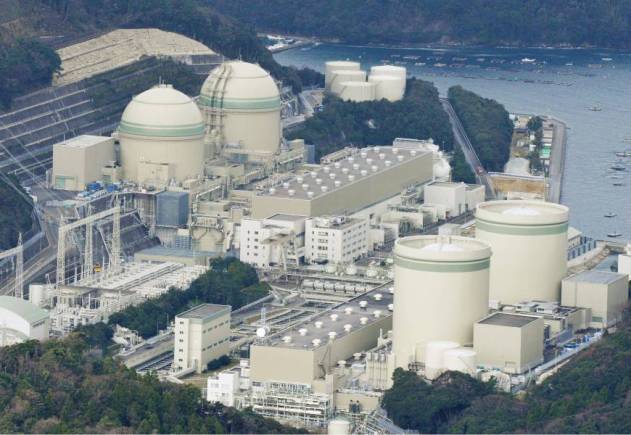
TAKAHAMA, Fukui — A residents’ association in a neighboring district of the Takahama Nuclear Power Plant here adopted a statement on Dec. 18 opposing the extension of the 40-year maximum lifespan rule for nuclear reactors.
Kansai Electric Power Co. aims to restart the No. 1 and 2 reactors at the Takahama plant to operate them over 40 years after the Nuclear Regulation Authority gave the green light for a 20-year extension.
The Otomi district in Takahama, with a population of 136 people as of November, which has adopted the statement, is located in the Uchiura Peninsula facing Wakasa Bay. It is separated from the mainland part of Fukui Prefecture by the Takahama plant, which is built at the base of the peninsula.
In the statement, adopted based on its draft, the neighborhood association expressed concern that restarting the reactors could cause further depopulation, saying that it will accelerate community deterioration due to the growing negative image of nuclear power after the 2011 Fukushima nuclear disaster. It is an unusual move by a residents’ association of a nuclear plant host municipality to approve a motion against the extension of reactor operation.
The association is set to submit the document to Kansai Electric, the Fukui Prefectural Government and the Takahama Municipal Government.
http://mainichi.jp/english/articles/20161219/p2a/00m/0na/003000c
Kansai Electric manager’s suicide result of excess overtime
A manager working on technology for the Takahama nuclear power plant killed himself after working excessive overtime hours, sources have revealed.
The man, in his 40s, was found dead in April in a hotel in Tokyo where he was staying on a business trip.
The suicide of the Kansai Electric Power Co. manager was recognized as a work-related death by the Tsuruga Labor Standards Inspection Office in Tsuruga, Fukui Prefecture, sources said.
It had been a especially hectic time for the Osaka-based utility as two 40-plus-year-old reactors in Takahama, Fukui Prefecture, were at risk of being decommissioned if the safety screening process by the Nuclear Regulation Authority was not completed by July 7.
The company was pushing hard to have the No. 1 and No. 2 reactors at the nuclear power plant pass safety evaluations so that their operational lives could be extended by 20 years.
The dead man was the head of a department in charge of engineering regarding construction at the company, according to the sources.
He was tasked with responding to the NRA as he was responsible for having the construction plans on upgrading the two reactors approved by the nuclear watchdog.
Under the Labor Standards Law, work hours are not restricted for supervisors and managers such as the suicide victim. However, employers still have a responsibility to maintain the health of such employees by ensuring they avoid overwork.
6.6 Magnitude Earthquake in Western Japan
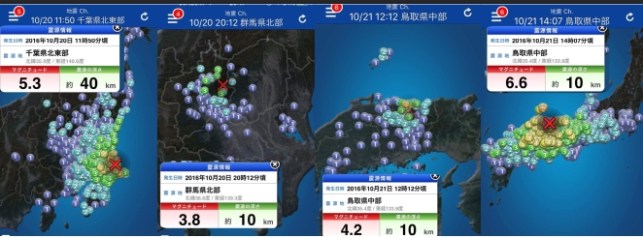
Since the strong earthquake today at 2:07 p.m. in Tottori, of 6.6 magnitude and 6 intensity that shook half of Japan, the earth continues to shake with an impressive number of aftershocks. Officials at the Meteorological Agency say seismic activity continues in Tottori and are asking people to be prepared and take precautions against another possible earthquake.
On this coast of West Japan lies the largest concentration of nuclear power plants in the world. Though stopped, they are full of potentially very dangerous spent nuclear fuel. The epicenter of this earthquake was at 76km from the Shimane nuclear power plant. Of course, no damages say the Authorities, as usual…
Strong quake in western Japan
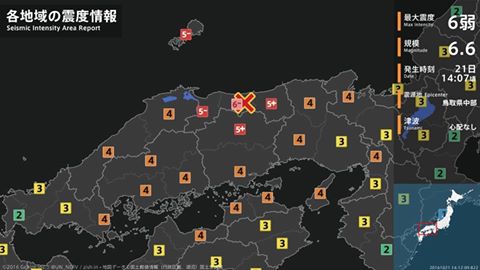
An earthquake with a preliminary magnitude of 6.6 struck Tottori Prefecture in western Japan on Friday afternoon. The Japan Meteorological Agency says there is no tsunami theat.
The jolt registered 6 minus on the Japanese seismic scale of 0 to 7 in central Tottori. The focus was 10 kilometers deep in the prefecture.
There are some reports of injuries and houses collapsing.
About 30,000 households in the prefecture are without power.
The tremors have disrupted transportation.
Local airports have cancelled flights.
Some bullet train services in central Japan are suspended. Parts of highways have been closed to check for damage.
Officials at the nearby Shimane nuclear power plant say there are no irregularities. The plant was off-line at the time of the quake.
http://www3.nhk.or.jp/nhkworld/en/news/20161021_27/
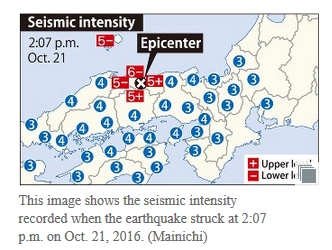
M6.6 quake strikes western Japan, no tsunami warning issued
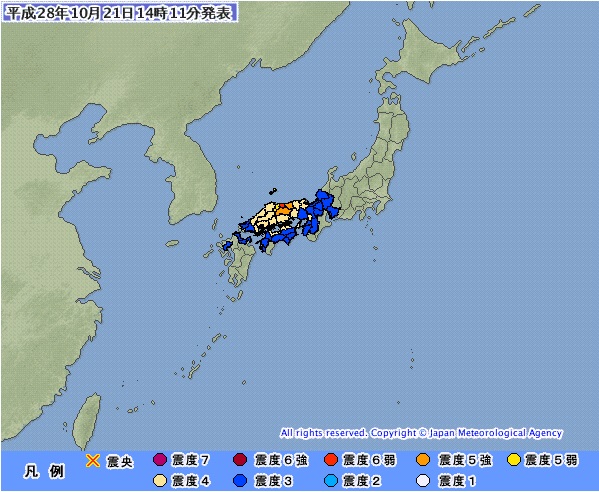
A powerful earthquake struck Tottori Prefecture and surrounding areas shortly after 2 p.m. on Oct. 21, the Japan Meteorological Agency said. No tsunami warning was issued.
The 2:07 p.m. quake, which had an estimated magnitude of 6.6, measured a lower 6 on the 7-point Japanese seismic intensity scale in some parts of the Tottori Prefecture city of Kurayoshi, the town of Yurihama and the town of Hokuei, the agency said. It measured an upper 5 in parts of the city of Tottori, as well as in parts of neighboring Okayama Prefecture.
Reports said that several homes in Yurihama had collapsed. The Tottori Prefectural Government is in the process of confirming the information. The quake caused a blackout affecting nearly 32,000 households in Tottori Prefecture, Chugoku Electric Power Co. reported.
Firefighters in Tottori said that a female employee at a supermarket restaurant was taken to hospital with burns to her legs after an accident with hot oil when the quake struck. Elevators also stopped in the quake and there were reports that at least one person had been trapped.
Broken windows were reported over a wide area of Kurayoshi. A 53-year-old architect in the city, Katsunori Choda, said he was about to get in a vehicle when the ground started shaking, and pedestrians crouched on the ground to balance themselves. Soon afterward there was a blackout. Ambulance sirens could be heard and tiles fell from the roofs of old homes.
“I’d never felt an earthquake this big before,” the architect said. “There is a lot of old town scenery in the area and I’m worried about damage.”
Earthquake sounds could still be heard 30 minutes after the quake and aftershocks were reportedly continuing. The earthquake struck at an estimated depth of 10 kilometers, the meteorological agency said.
Services on the Sanyo Shinkansen bullet train were suspended between Shin-Osaka and Hakata stations following the quake, but resumed at 2:27 p.m., West Japan Railway Co. announced.
http://mainichi.jp/english/articles/20161021/p2g/00m/0dm/062000c
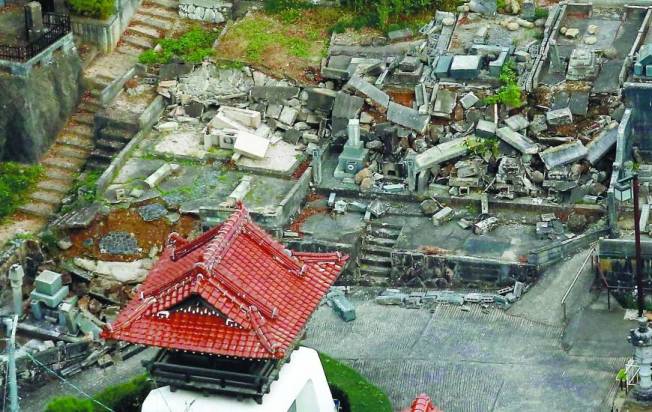
This aerial photo shows broken grave markers and collapsed walls at a cemetery in Kurayoshi, Tottori Prefecture, following a strong earthquake that shook the area Friday.
Homes damaged, power cut after strong quake rattles parts of western Honshu
A powerful earthquake with a preliminary magnitude of 6.6 shook parts of western Honshu early Friday afternoon, damaging homes and roads and cutting power to almost 40,000 households.
The Meteorological Agency said the earthquake occurred at 2:07 p.m. in central Tottori Prefecture, about 700 km west of Tokyo, at a depth of 10 km. It was followed by a weaker aftershock about 30 minutes later.
The agency said there was no danger of a tsunami from the inland temblor.
Two houses collapsed in the town of Hokuei, Tottori Prefecture, according to the local fire department. Roads were cracked and roof tiles laid strewn in the town.
In Kurayoshi in the prefecture, ATMs at some local banks temporarily went offline due to a power outage.
All up, the blackout affected nearly 40,000 households in Tottori Prefecture, according to Chugoku Electric Power Co.
Okayama City Fire Department said a woman in her 70s was taken to hospital after she fell and broke her right leg. Five people are reported to have been injured in Tottori Prefecture.
West Japan Railway Co. temporarily suspended all services on the Sanyo Shinkansen Line between Shin-Osaka and Hakata stations.
The quake registered lower 6 on the Japanese seismic scale of 7 in parts of Tottori Prefecture, and upper 5 in a wide area in Tottori and Okayama prefectures, according to the agency.
No abnormalities were detected at the Shimane nuclear plant, which is currently off-line, in nearby Shimane Prefecture, according to the utility.
Okayama airport closed its runway to check its safety, airport officials said.
According to local officials a house in the town of Yurihama, in central Tottori Prefecture, was destroyed, and a number of dwellings in other parts of the prefecture suffered damage
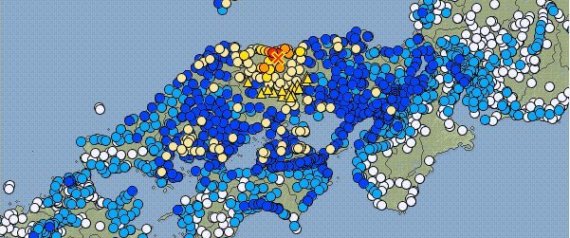
UPDATE: Quake rattles buildings in Tottori; 6 injured
Tottori Prefecture in western Japan was struck by a series of major earthquakes on Oct. 21, causing structural damage to some buildings and homes and at least six injuries.
A quake measuring lower 6 on the Japanese intensity scale of 7 was recorded at 2:07 p.m.
The focus was about 10 kilometers underground, and the temblor had an estimated magnitude of 6.6.
Shaking was felt in a wide area of western Japan and as far as the Kanto and Kyushu regions.
Japan Meteorological Agency officials urged caution because there was a possibility of another quake measuring lower 6 in intensity striking over the next week in areas where the shaking was particularly strong.
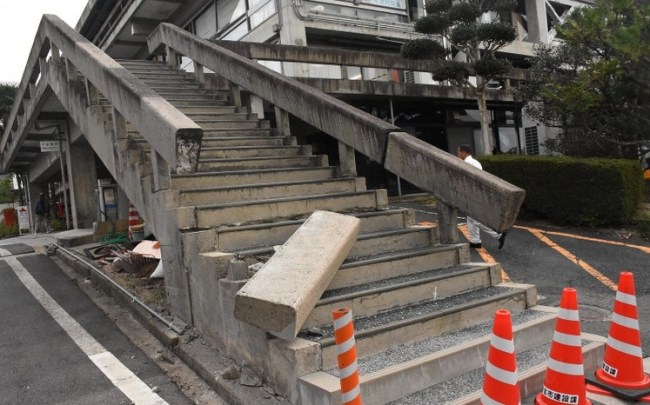
Among the buildings damaged was the Kurayoshi city government building. Government workers evacuated as the building has been declared off-limits.
Homes in Yurihama were also heavily damaged, according to Tottori prefectural officials.
One individual suffered burns at a shopping center in Tottori city while a woman in her 70s in Okayama city, south of Tottori, fell and broke her leg.
Meanwhile, officials of Chugoku Electric Power Co. said about 31,900 households in the prefecture suffered a blackout after the quake struck, centered mainly on Kurayoshi.
However, the quake did not affect the two reactors at the Shimane nuclear power plant in the neighboring prefecture. Both reactors were not operating when the temblor struck.
Various stretches of expressways were closed to traffic.
Bullet train services between Shin-Osaka and Hakata stations operated by West Japan Railway Co. were stopped for about 20 minutes immediately after the quake. Service on the Tokaido Shinkansen line was also temporarily suspended between Shin-Osaka and Toyohashi in Aichi Prefecture.
http://www.asahi.com/ajw/articles/AJ201610210040.html
Japan Extends Reactor Lifetimes for First Time Since Fukushima
Japan’s Nuclear Regulation Authority (NRA) this June approved 20-year license extensions for the aging Takahama 1 and 2 reactors, a first for the power-strapped country that has been conflicted about the future of its nuclear power plants since the Fukushima Daiichi catastrophe in 2011.
A regulatory system established in the aftermath of Fukushima limits the operating lives of Japanese nuclear units to 40 years, though it allows a one-time extension of no more than 20 years. The NRA’s approval to allow the 40-year-old Takahama 1 and 39-year-old Takahama 2 to operate an additional 20 years was carried out as an “extraordinary case.” Kansai Electric Power Co., which owns the two 826-MW reactors, filed applications for the extensions in April 2015, as well as for its 826-MW Mihama 3 reactor in November 2015, saying that they were “important” for its business.
Under its revised long-term energy plan, Japan anticipates getting between 20% and 22% of its total generated electricity from nuclear power by 2030, and industry groups like the Japan Atomic Industrial Forum have argued that the lifetime extensions will be integral to meeting that target.
Four of the nation’s nuclear power plants idled after Fukushima have so far cleared the new regulatory standards required to resume operations, but only Sendai 1 and 2, which are owned and operated by Kyushu Electric Power Co., are online. Kansai started up its Takahama 3 reactor on January 29 and Takahama 4 on February 26, but it took Unit 4 offline just three days later following a “main transformer/generator internal failure” (Figure 1). It was then forced to halt operations at Unit 3 on March 10 after Japan’s Otsu District Court issued a temporary injunction against the operation of both reactors because, the court said, the safety of the units could not be guaranteed. On July 12, Otsu District Court Judge Yoshihiko Yamamoto rejected Kansai’s request to lift the injunction. Kansai now says that—though it has filed to appeal the court’s decision to the Osaka High Court—it will begin removing nuclear fuel from the reactor cores.
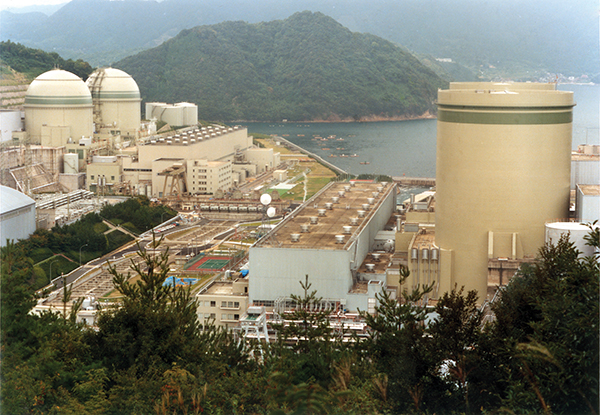
One step forward, two steps back. While Japan’s Kansai Electric Power Co. received Nuclear Regulation Authority approval to extend the lifetimes of Units 1 and 2 at its Takahama Nuclear Power Plant in Oi District, Fukui Prefecture, to 60 years, it has been forced to halt operations at Units 3 and 4 by a temporary injunction issued by a district court.
Meanwhile, applications for 22 more nuclear plant restarts have been filed with the NRA. According to a 2017 economic and energy outlook released by the Institute of Energy Economics of Japan (IEEJ) in late July, at least 12 nuclear power plants should be restarted next year. The research group notes, however, that those projections are clouded by a number of issues, including court judgments and local agreements. That uncertainty could come at a significant cost to the nation, it added.
“Because of the judicial ruling that ceased operations at the Takahama Unit No. 3 and 4, it is important to analyse the effect of stopping operations of nuclear power plants from a local point of view,” the IEEJ’s outlook says. “As a rule, if one nuclear plant with the capacity of 1 MW stops operation for one year in an area where annual demand is about 100 TWh, total fossil fuel costs increase by [$594 million] and the energy-related [carbon dioxide] emissions increases by 4 Mt-CO2 (7% increase for the local emissions). The average electricity unit cost will increase by [$3.96/MWh] (1.8% rise of the average power unit price).”
http://www.powermag.com/japan-extends-reactor-lifetimes-first-time-since-fukushima/
Fukushima scenarios used in evacuation drills at two Japanese nuclear plants
TAKAHAMA, FUKUI PREF. – Some 11,000 residents of Fukui and Kyoto prefectures participated in two major disaster drills on Saturday and Sunday centered on hypothetical nuclear accidents at Kansai Electric Power Co.’s Takahama and Oi nuclear power stations.
The exercises were jointly organized by the central government and the prefectural governments of Fukui, Shiga and Kyoto.
Saturday’s drill at Takahama involved about 9,000 residents. It was intended to examine the workability of evacuation plans approved by the national government last December.
The scenario was a strong earthquake off Wakasa Bay, near the plant. The tremor measured a lower 6 on the Japanese seismic intensity scale of 0 to 7.
The facility’s No. 3 reactor was assumed to have lost all power, leading to the release of radioactive substances — as happened at the Fukushima No. 1 plant in 2011.
Evacuation plans require residents within 5 km of plants to evacuate immediately upon an accident occurring. Those living up to 30 km away are meant to stay indoors until radiation alarms detect fallout in the air.
Some experts have cast doubt on whether it is a good idea to order people to stay indoors when reactors are spewing radiation.
For example, when quakes pummeled Kyushu this spring, about 160,000 houses and buildings collapsed. If that were to occur in Fukui, many residents would find it difficult to shelter indoors.
In the Kumamoto earthquake, there were cases where people returned to their homes after the initial quake, only to be hit when houses collapsed in the second quake, said Hirotada Hirose, a professor emeritus at Tokyo Woman’s Christian University, a specialist in disaster risk management.
“If a severe nuclear disaster occurs, evacuating in phases isn’t likely to go well,” he said. “The evacuation plan should assume many scenarios.”
These could include cases where an earthquake cuts traffic, jamming the roads with panicking residents who ignore advice and are trying to flee in large numbers.
Nonetheless, Saturday’s exercise finished without any major hiccups.
“By doing the drills with local governments and residents over and over again, disaster-prevention skills will improve,” said Fukui Gov. Issei Nishikawa.
As part of the exercise, at the town hall of Mihama, Fukui Prefecture, Kansai Electric workers screened evacuees for radiation exposure. They also checked the buses for contamination.
One of the would-be evacuees was Masatoshi Nose, 46, a city government employee from Obama, Fukui Prefecture.
“As this is a drill, I was able to come here smoothly,” Nose said. “But in a real disaster situation, it may take an entire day.”
Also, poor visibility scrubbed plans to use a Ground Self-Defense Force helicopter to extract 20 residents from near Takahama.About 180,000 people live within 30 km of the plant whose No. 3 and No. 4 reactors were restarted in January and February, only to be halted again after the Otsu District Court in Shiga in March issued a provisional injunction following a petition by residents.
Meanwhile, on Sunday about 2,000 local residents participated in an evacuation drill under a scenario where Kansai Electric’s Oi nuclear power plant in Fukui Prefecture experiences a catastrophic accident.
The drill was organized by the Fukui Prefectural Government.
The residents took shelter in their homes or evacuated to elsewhere in the prefecture as part of an effort to test response times to an accident.
The evacuation drill was only carried out within Fukui Prefecture itself as no evacuation plan covering a wider area has been drawn up for the plant, located in the town of Oi.
Residents within 5 km of the plant fled to the city of Tsuruga, and Oi residents within 30 km of the plant moved to the city of Ono, about 100 km away.
For the evacuees from Oi, a facility was set up for the distribution of iodine tablets to mitigate radiation exposure and to check for contamination.
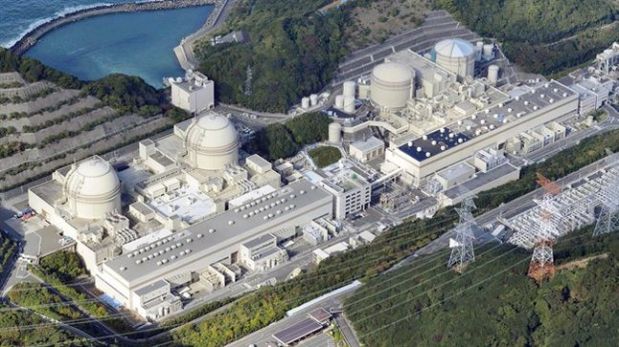
Kansai Electric starts removing fuel from Takahama reactor No. 4
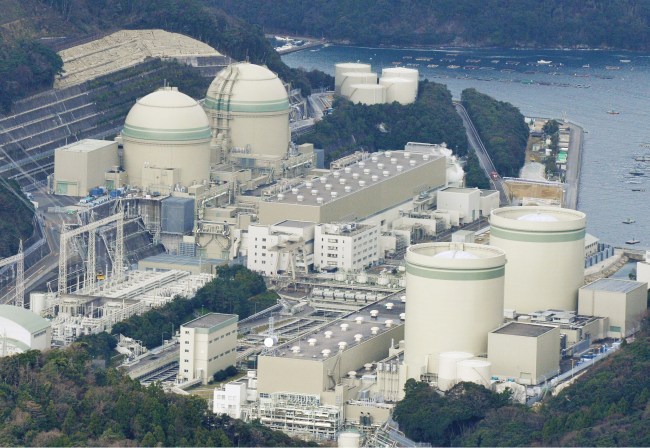
FUKUI – Kansai Electric Power Co. on Wednesday began removing fuel assemblies from the No. 4 reactor at its Takahama nuclear plant in Fukui Prefecture.
The removal is the result of a preliminary injunction issued in early March by the Otsu District Court in neighboring Shiga Prefecture ordering the power utility to halt operations of the No. 3 and No. 4 reactors at the plant. The court upheld a petition filed by a group of residents who live near the plant in Shiga and are concerned over safety.
The work to remove 157 nuclear fuel assemblies from the No. 4 reactor started at noon and is slated to end around 7 p.m. Friday. The fuel assemblies will be transferred to a spent fuel storage pool.
Kansai Electric will begin to remove fuel from the No. 3 reactor on Sept. 5.
The No. 3 reactor, which was brought back online on Jan. 29, was shut down following the injunction. The No. 4 unit was reactivated on Feb. 26, but it automatically shut down on its own three days later due to a technical glitch.
Kansai Electric filed an appeal against the injunction but was turned down by the Otsu court in June.
The utility then filed an appeal with the Osaka High Court in July requesting the cancellation of the district court’s injunction.
Anti-terror facility at nuclear plant confirmed
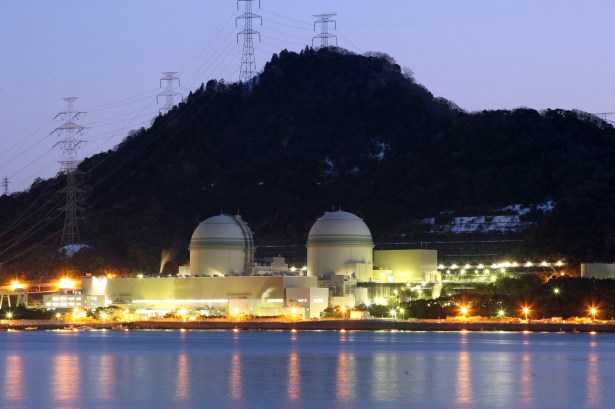
Japan’s nuclear regulator says plans for terrorism-response facilities at the Takahama nuclear plant are the first in Japan to meet its requirements.
New government regulations introduced after the 2011 Fukushima Daiichi accident require nuclear plant operators to build standby control rooms at least 100 meters away from each of their reactors.
The special facilities allow employees to retain control of a plant’s reactors even if main control rooms are destroyed by terrorists or in a plane crash.
Officials at the Nuclear Regulation Authority confirmed that the plans for standby control rooms for the No. 3 and No.4 reactors at the plant are in line with requirements. They will soon issue formal approval for construction.
The decision came at a closed-door session to maintain secrecy of the rooms’ design and location.
The Takahama plant on the Japan Sea coast became the first of 7 nuclear plants in Japan to submit applications for approval.
The plant’s operator, Kansai Electric Power Company, is now required to set up the facility for the No.3 reactor by August 2020 and for the No.4 reactor by the following October.
Some are criticizing the decision to restart reactors yet to be equipped with the standby facilities.
The 2 reactors at Takahama went back online earlier this year. But they were halted after a court ordered their suspension in March.
Court rules a third time against Takahama reactors
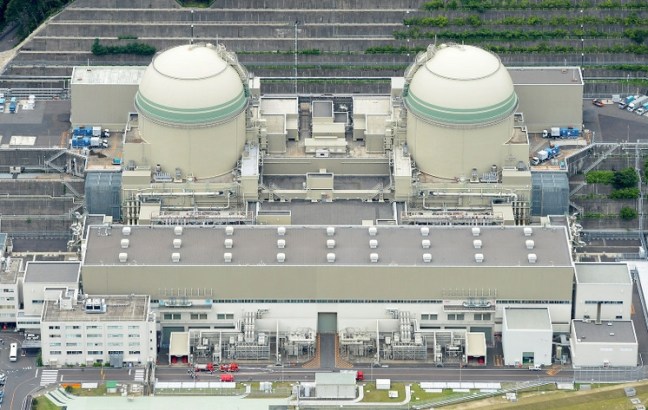
The No. 3 and No. 4 reactors at the Takahama Nuclear Power Plant, from left to right, are pictured in this photo taken from a Mainichi helicopter in Takahama, Fukui Prefecture, on June 15, 2016.
OTSU, SHIGA PREF. – The Otsu District Court ruled against Kansai Electric Power Co. for the third time in five months Tuesday, in a decision that will keep its Takahama No. 3 and 4 reactors in Fukui Prefecture shut down indefinitely.
Both sides are now gearing up for an appeal by Kepco to the Osaka High Court, where a decision could come next year, while the plaintiffs are expected to file further suits.
The utility had filed an objection to the Otsu court’s March decision, which granted a temporary injunction on the reactors, forcing Kepco to shut them down about two months after they had been restarted.
The court reaffirmed its decision in June and again made the same ruling on Tuesday after Kepco fought the June decision.
“The utility was not arguing that both reactors were safe based on expert evidence and reasonable safety standards, but that they were safe due to detailed assertions directly related to their safety and prima facie evidence,” said presiding Judge Yoshihiko Yamamoto, the same judge who has twice ruled against Kepco. “However, the new safety standards haven’t drawn the limits of what dangers should be accepted by society.”
Representatives for the plaintiffs welcomed the ruling.
“Once again, the Otsu court has ruled against the safety of restarting the reactors, especially with Lake Biwa nearby, even though Kepco has said it’ll likely appeal to the (Osaka) High Court,” said Yoshinori Tsuji, one of the chief plaintiffs.
The case boiled down to the basic question of what determines adequate safety for a nuclear power plant. It has raised questions about the way the Nuclear Regulation Authority is handling safety inspections for restarts.
http://www.japantimes.co.jp/news/2016/07/12/national/court-rules-third-time-takahama-reators/
Report: Japan court upholds injunction to halt nuclear reactors
A Japanese court on Tuesday upheld an order for the shutdown of two reactors at Kansai Electric Power Co’s Takahama nuclear plant in western Japan, a Japanese news agency reported, in a widely expected ruling that prevents the utility from restarting them.
Japan’s second-biggest utility had appealed Otsu District Court’s March 9 ruling ordering it to shut the Takahama No. 3 and No. 4 units with immediate effect, which marked the first injunction to shut a nuclear plant in operation. The court last month also denied the utility’s request for a stay of execution of the injunction.
Kansai Electric is expected to appeal the latest decision to the Osaka High Court.
http://www.asahi.com/ajw/articles/AJ201607120042.html
Court again nixes appeal to restart 2 Takahama nuclear reactors
OTSU, Japan (Kyodo) — A Japanese court again disallowed the operation of two nuclear reactors Tuesday, rejecting their operator’s request to suspend an injunction the same court had issued over the once-reactivated units at the Takahama power plant in Fukui Prefecture, western Japan.
The Otsu District Court’s decision, following the injunction issued in March over the Nos. 3 and 4 units at the Kansai Electric Power Co. plant, would continue to legally prevent the Osaka-based utility from restarting operation of the reactors on the Sea of Japan coast about 380 kilometers west of Tokyo.
Kansai Electric plans to appeal the decision to the Osaka High Court, company officials said.
In June, the district court also rejected the plant operator’s appeal to temporarily void the effects of the injunction, with public concerns lingering over the restart of nuclear power plants in Japan in the wake of the 2011 Fukushima Daiichi disaster.
Tuesday’s decision was issued under the same presiding judge, Yoshihiko Yamamoto, who made the judgments in March and June.
The March injunction was the first of its kind affecting operating reactors. One of the reactors was taken offline one day after the order. The other reactor was already offline.
The Takahama plant has cleared the post-Fukushima safety regulations, allowing Kansai Electric to reactivate the Nos. 3 and 4 reactors. But their operation was beset with problems.
Kansai Electric has announced it will remove fuels from the two nuclear power reactors in August, even though Prime Minister Shinzo Abe’s government has expressed a desire to ramp up nuclear power generation at home.
http://mainichi.jp/english/articles/20160712/p2g/00m/0dm/067000c
1 This Month

of the week – Shut Down Drone Warfare!


Tell the Ukrainian Government to Drop Prosecution of Peace Activist Yurii Sheliazhenko

Petition to revoke the licensing of the Near Surface Nuclear Disposal Facility (NSDF) at Chalk River. https://www.ourcommons.ca/petitions/en/Petition/Details?Petition=e-7247
To see nuclear-related stories in greater depth and intensity – go to https://nuclearinformation.wordpress.com
-
Archives
- March 2026 (251)
- February 2026 (268)
- January 2026 (308)
- December 2025 (358)
- November 2025 (359)
- October 2025 (376)
- September 2025 (257)
- August 2025 (319)
- July 2025 (230)
- June 2025 (348)
- May 2025 (261)
- April 2025 (305)
-
Categories
- 1
- 1 NUCLEAR ISSUES
- business and costs
- climate change
- culture and arts
- ENERGY
- environment
- health
- history
- indigenous issues
- Legal
- marketing of nuclear
- media
- opposition to nuclear
- PERSONAL STORIES
- politics
- politics international
- Religion and ethics
- safety
- secrets,lies and civil liberties
- spinbuster
- technology
- Uranium
- wastes
- weapons and war
- Women
- 2 WORLD
- ACTION
- AFRICA
- Atrocities
- AUSTRALIA
- Christina's notes
- Christina's themes
- culture and arts
- Events
- Fuk 2022
- Fuk 2023
- Fukushima 2017
- Fukushima 2018
- fukushima 2019
- Fukushima 2020
- Fukushima 2021
- general
- global warming
- Humour (God we need it)
- Nuclear
- RARE EARTHS
- Reference
- resources – print
- Resources -audiovicual
- Weekly Newsletter
- World
- World Nuclear
- YouTube
-
RSS
Entries RSS
Comments RSS
 nuclear-news