Reviving Japan’s nuclear power industry will not be easy
Jan 3, 2023
Japan is facing its most severe energy crisis in decades and wants to speed up the revival of its nuclear energy industry to reduce its dependence on imported fossil fuels.
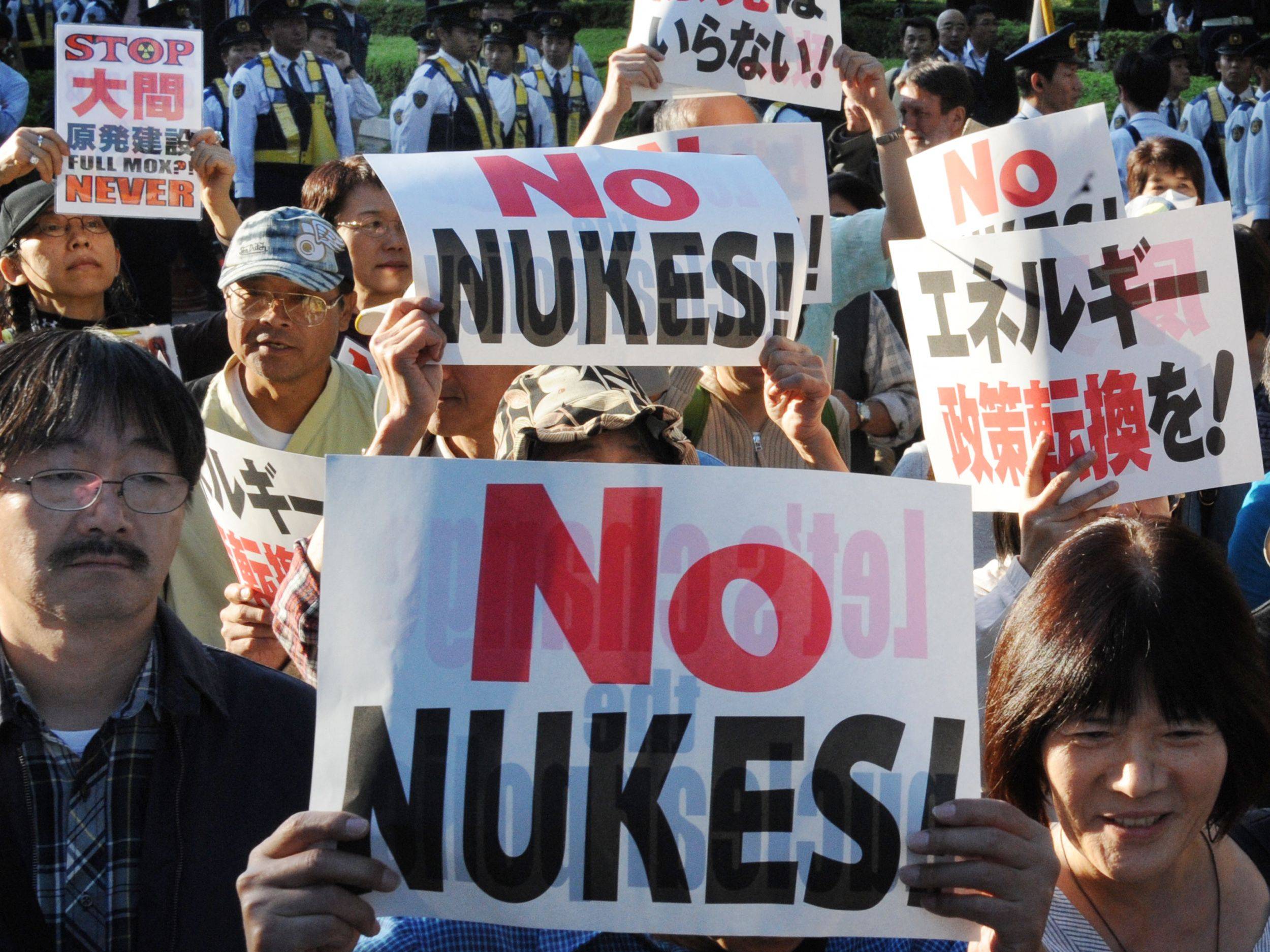
But restarting more nuclear reactors remains controversial, more than a decade after the 2011 Fukushima disaster.
What does the government want?
All the country’s reactors were shut down for safety checks after the Fukushima meltdown, and there are currently 33 considered operable.
By mid-December, nine were generating electricity, meeting a target set by Prime Minister Fumio Kishida this summer to help counter energy shortages and cover around 10% of Japan’s winter power consumption.
The national nuclear safety watchdog has approved the restart of seven other reactors in principle, but such moves often face fierce opposition from local communities.
In August, Kishida called for these seven reactors to come online by summer 2023 and said Japan should also consider building next-generation nuclear reactors.
He also said authorities would discuss extending the service life of existing reactors beyond the current 60-year limit if safety can be guaranteed.
Before the Fukushima disaster, nearly a third of Japan’s power generation came from nuclear energy, but in the fiscal year to March 2022, the figure stood at around 7%.
The government is aiming for nuclear power to account for between 20% and 22% of electricity production by 2030, part of efforts to reach carbon neutrality by 2050.
What are the obstacles?
The success of these nuclear power ambitions lies with Japan’s independent Nuclear Regulation Authority (NRA), which must give a green light to the plans before they go ahead.
“It will be a challenge” to get existing reactors going again, because some have been “stalled for quite a long time,” said Tom O’Sullivan, a Tokyo-based energy consultant at Mathyos Advisory.
Bringing nuclear plants online could also be complicated by “nervousness about anti-terrorism issues,” he added, pointing to concerns around plants caught in Russia’s war in Ukraine.
“Given what’s happening with the Zaporizhzhia nuclear power plant in Ukraine, I think the NRA is probably more sensitive nowadays to potential terrorist attacks.”
Surveys show that reticence among the Japanese public toward a nuclear power revival has eased since the war in Ukraine triggered a steep rise in energy prices last year.
But opposition from people living near the plants will remain a sticking point, while reports of security breaches at one large plant in recent years have added to public unease, said analyst Hiroe Yamamoto of Moody’s Japan.
How quickly the government’s nuclear power revival hopes can become reality depends on local authorities but also Kishida’s popularity this year, said Nobuo Tanaka, chair of the Innovation for Cool Earth Forum steering committee.
The prime minister is currently “in trouble,” with his approval ratings dragged down last year by scandals, Tanaka said at a recent news conference.
So “just saying we need (more reactors online) because of high energy prices — this kind of argument may not be sustainable,” and the government must also address issues such as waste disposal, he said.
https://www.japantimes.co.jp/news/2023/01/03/national/reviving-nuclear-industry/
Nuclear plant hosts split over Japan’s reversed energy policy
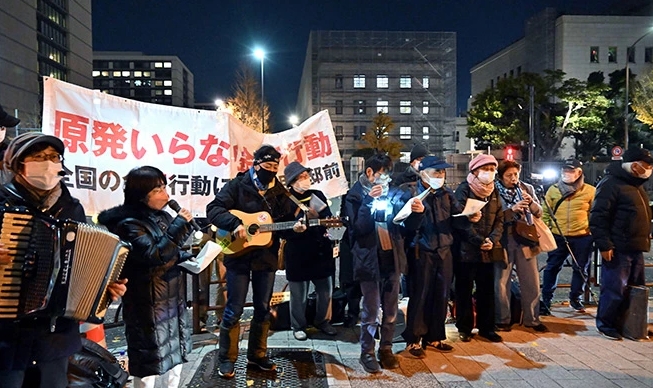
An anti-nuclear rally is held near the prime minister’s office building in Tokyo on Dec. 16.
December 23, 2022
The government’s return to reliance on nuclear energy sparked both anger and joy among municipalities that host nuclear power plants.
The Fumio Kishida administration, in a sweeping reversal of the nation’s nuclear energy policy, says it intends to make “maximum use” of nuclear power to secure a stable energy supply and reduce greenhouse gas emissions.
“We are still struggling to rebuild our community,” said Hisato Iwamoto, a member of the Futaba town assembly. “The central government must have forgotten the Fukushima disaster.”
The town co-hosts the Fukushima No. 1 nuclear plant, which suffered a triple meltdown after the Great East Japan Earthquake and tsunami in March 2011.
Iwamoto’s family was forced to move from one place to another in the prefecture following the disaster.
In fact, all residents of Futaba were told to evacuate their homes.
As a member of the town assembly that had endorsed nuclear power, Iwamoto said he feels responsible.
“It had never occurred to us that an accident could happen at the plant because we constantly asked the central government and Tokyo Electric Power Co. to ensure the plant’s safety,” he said. “I now know there is no such thing as ‘absolutely safe’ no matter how advanced nuclear plants become in the future.”
Since the 2011 triple meltdown, Iwamoto has consistently sounded warnings that a serious accident could occur at any nuclear plant when he attended meetings of assembly members of municipalities hosting nuclear plants across the country.
But their reactions have been lukewarm, according to Iwamoto.
Iwamoto, 65, noted that politicians opposed to nuclear energy would have difficulty winning elections in areas whose economies rely largely on nuclear plants.
His father, Tadao, was a good example.
Tadao was first elected to the Fukushima prefectural assembly in 1971 and began activity opposing nuclear plants. That opposition resulted in three straight election losses since 1975.
Even in the 1979 election, which followed the Three Mile Island nuclear accident in the United States in March that year, he gained the least number of votes among candidates.
After he switched his position and accepted nuclear power, he was elected Futaba mayor. He served five terms at the post.
Evacuees from Futaba were allowed to return to live in their hometown in August.
But Futaba is now a far cry from what it used to be, said Iwamoto, who still lives in evacuation in Iwaki in the prefecture.
“Community ties have never been restored,” he said.
Ritsuko Yanai, a 44-year-old mother who evacuated to Aizuwakamatsu in the prefecture, said she suspects the central government is “trying to wipe the slate clean.”
She is from Okuma, the other co-host of the Fukushima No. 1 nuclear plant.
She fled the disaster with her 1-month-old son. Her parents’ home was dismantled to make space for and interim facility to store debris and waste from decontamination work.
There is no clue on when decommissioning of the plant will be completed. And the release into the sea of tons and tons of treated water stored at the plant is expected to begin in spring.
“The nuclear accident is not over yet,” Yanai said.
But in Mihama, a town hosting the Mihama nuclear plant in Fukui Prefecture, the central government’s decision on nuclear power was mostly welcomed.
The prefecture facing the Sea of Japan hosts 15 reactors, the most in the nation. Seven of them, including two prototype reactors and two reactors at the Mihama plant, are in the process of decommissioning.
“The central government finally took action,” said Jitaro Yamaguchi, a former mayor of the town. “Nothing can serve as an alternative to nuclear energy.”
Yamaguchi, who was Mihama mayor for 20 years until he stepped down in 2019, had lobbied Kansai Electric Power Co., operator of the Mihama nuclear plant, to build more reactors in the town, with a population of about 9,000.
His pro-nuclear power stance remained unchanged even after the Fukushima disaster.
“We need nuclear plants when we think about environmental issues and power supply,” he said. “They have benefitted the local economy.”
The Mihama nuclear plant is called the “heart” of the local economy, sending “blood” to every corner of the town.
More than half of the town’s initial budget of 8.6 billion yen ($65 million) for fiscal 2022 is funded by revenues from nuclear facilities.
Since retiring as mayor, Yamaguchi, 79, has served as head of an organization promoting nuclear power.
He said he is pleased with the government’s new policy to replace retired reactors with new units. Previous governments had refused to commit to such projects following the Fukushima accident.
The town now has better prospects for construction of brand-new reactors–and more money.
“Nuclear power plants are an integral part of the local industry,” he said. “They should be built seamlessly.”
But the town is not without opponents of new reactors as well as advocates for a shift to renewables.
“A nuclear plant is akin to a drug addiction that you cannot break,” said Teruyuki Matsushita, a 74-year-old assemblyman. “Once a huge sum of money from a nuclear project is poured in the town, you are increasingly less likely to give serious thought on how to build the future of the town.”
(This article was compiled from reports by Keitaro Fukuchi, Nobuyuki Takiguchi and Tsunetaka Sato.)
1 This Month

of the week – Shut Down Drone Warfare!


Tell the Ukrainian Government to Drop Prosecution of Peace Activist Yurii Sheliazhenko

Petition to revoke the licensing of the Near Surface Nuclear Disposal Facility (NSDF) at Chalk River. https://www.ourcommons.ca/petitions/en/Petition/Details?Petition=e-7247
To see nuclear-related stories in greater depth and intensity – go to https://nuclearinformation.wordpress.com
-
Archives
- April 2026 (103)
- March 2026 (251)
- February 2026 (268)
- January 2026 (308)
- December 2025 (358)
- November 2025 (359)
- October 2025 (376)
- September 2025 (257)
- August 2025 (319)
- July 2025 (230)
- June 2025 (348)
- May 2025 (261)
-
Categories
- 1
- 1 NUCLEAR ISSUES
- business and costs
- climate change
- culture and arts
- ENERGY
- environment
- health
- history
- indigenous issues
- Legal
- marketing of nuclear
- media
- opposition to nuclear
- PERSONAL STORIES
- politics
- politics international
- Religion and ethics
- safety
- secrets,lies and civil liberties
- spinbuster
- technology
- Uranium
- wastes
- weapons and war
- Women
- 2 WORLD
- ACTION
- AFRICA
- Atrocities
- AUSTRALIA
- Christina's notes
- Christina's themes
- culture and arts
- Events
- Fuk 2022
- Fuk 2023
- Fukushima 2017
- Fukushima 2018
- fukushima 2019
- Fukushima 2020
- Fukushima 2021
- general
- global warming
- Humour (God we need it)
- Nuclear
- RARE EARTHS
- Reference
- resources – print
- Resources -audiovicual
- Weekly Newsletter
- World
- World Nuclear
- YouTube
-
RSS
Entries RSS
Comments RSS
 nuclear-news