Fuel removal unlikely by March 2018
566 fuel assemblies, 514 spent fuel assemblies and 52 unused ones, Tepco has always said so. But since the fuel pool was cleaned up, Tepco only released partial photos of the fuel pool, never any photo of the whole fuel pool. So as of now it is just impossible to verify Tepco’s claim by counting the assemblies. Since the fuel pool also exploded some fuel assemblies must be missing. How many are gone how many remain is still a non answered question, especially as Tepco is not well known for being straightforward.
Will Tepco dare to start decommissioning the reactor 3 fuel pool before the 2020 Tokyo Olympics? I doubt so. In my opinion, Tepco will keep postponing it for after the Olympics, to avoid difficulties and critics

Fuel removal unlikely by March 2018
A government official has suggested that fuel removal from a reactor at the crippled Fukushima Daiichi nuclear plant will not start by March 2018, as planned.
566 nuclear fuel units remain in the No. 3 reactor’s fuel pool. To reach their target period, plant operator Tokyo Electric Power Company must begin placing a cover over the damaged reactor building by this April.
It’s now expected the cover installation will not start until January next year or later. It was determined that stronger measures are needed to protect workers from radiation exposure.
An official with the industry ministry overseeing reactor decommissioning inspected the plant on Monday. He said starting fuel removal within the next fiscal year is difficult.
Tokyo Electric says the cover installation has been slow, but the company will continue decommissioning work with safety as their highest priority.
Fuel Removal from Fukushima Reactor 3 Likely to Be Put Off Again
Tokyo, Nov. 18 (Jiji Press)–Tokyo Electric Power Co. Holdings Inc. <9501> is expected to face a further delay in the start of work to remove fuel from the storage pool at the No. 3 reactor of its disaster-stricken Fukushima No. 1 nuclear power station, it was learned Friday.
It now appears difficult to begin the work in January 2018, as currently targeted by the company, the sources said. The expected postponement is due to a delay in preparations necessary for the removal work.
All six reactors at the power station in Fukushima Prefecture, northeastern Japan, are set to be decommissioned, after the plant was knocked out by the March 2011 earthquake and tsunami. Three of the six reactors suffered core meltdowns in the accident.
The fuel removal from the No. 3 reactor pool was initially planned to begin during April-September 2015.
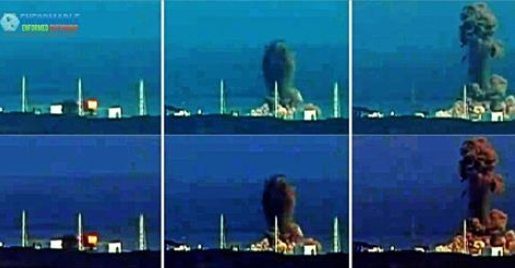
The No. 3 reactor building was heavily damaged by a hydrogen explosion soon after the March 11 disaster. As part of the preparations, TEPCO plans to install a cover and relevant equipment at the reactor.
http://jen.jiji.com/jc/eng?g=eco&k=2016111800715
Japan’s nuclear regulator caves to industry interests yet again–Gives nearly 40 year old reactor a green light before the aging safety review even completed
5 October 2016, Tokyo – Today, Japan’s Nuclear Regulation Authority (NRA) has again exposed itself as industry-captured by giving the Mihama 3 reactor owned by Kansai Electric Power Company (KEPCO) a green light under post-Fukushima guidelines — clearing the way for restart — even before the regulator has completed its ageing-related safety review. The safety risks of age-related degradation can be enormous.
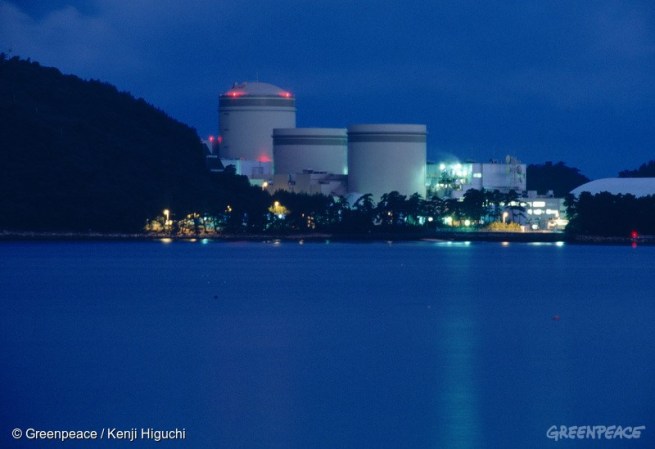
“The Mihama 3 reactor is like a vintage 1976 car that’s been driven at top speed for nearly 4 decades — and then sat idle for more than 5 years. Major safety components wear out, designs become outdated, and extended disuse creates yet another set of safety problems. Worse, it’s already been in a major accident 12 years ago due to a high-pressure pipe rupture that killed 5 workers. Most people wouldn’t just load up the kids in a car like that and speed off on a road trip. Yet, KEPCO and the NRA are trying to do just that, and they haven’t finished looking under the hood to see if the engine is alright. Unlike old cars, if an old reactor has a major accident, the victims can number in the hundreds of thousands and the crash site can extend for hundreds of kilometers. It’s nothing short of reckless, and puts the lives and livelihoods of families throughout the region at unnecessary risk,” said Kendra Ulrich, Senior Global Energy Campaigner for Greenpeace Japan.
Nuclear power plants are enormously complex, and safety-related components are only subject to normal age-related degradation. Constant irradiation of major components embrittles the metal, leading to an increased likelihood of potentially catastrophic failure during operation or emergency shutdown.
The Mihama 3 reactor is also located in the seismically-active Wakasa Bay region. The deep concerns over inadequate seismic assessments for the KEPCO’s Ohi reactors – also located in Wakasa Bay – pushed former NRA commissioner and seismologist, Kunihiko Shimazaki, to challenge the regulator directly. Although the NRA dismissed his concerns, the agency admitted that they could not reproduce the figures submitted by KEPCO in their assessment and so could not independently verify their accuracy. The same potentially faulty seismic assessment method was applied to Mihama 3.
The restart of aging reactors in Fukui has caused concern in surrounding prefectures. On 23 August, the Kyoto Governor Keiji Yamada said of the potential restart of the Takahama 1&2 reactors, “ . . .we should be extremely wary when it comes to aging nuclear reactors.”(1)
The restart of Mihama 3 is currently being challenged in court as a part of an umbrella lawsuit against all Fukui reactors. Greenpeace staff are plaintiffs in a case against KEPCO’s aging Takahama 1 & 2 reactors, also in Wakasa Bay.
Notes:
- Kyoto governor doesn’t accept Takahama 1, 2 reactor restart(京都府知事、容認せぬ姿勢 高浜原発1・2号機) Kyoto Newspaper on 23 August 2016 (accessed on 4 October 2016)
- Tomorrow, 6 October 2016, the Sendai 1 reactor in Kagoshima will be taken offline for scheduled maintenance. The newly-elected Kagoshima governor has repeatedly demanded the Sendai reactors be shut down for further safety checks. Due to his ongoing opposition to the operation of the reactors, it is unlikely that Sendai 1 will restart again before the end of 2016.
http://www.greenpeace.org/japan/ja/news/press/2016/pr201610051/
NRA grants aging Mihama reactor 20-year extension
OSAKA – The Nuclear Regulation Authority gave a green light Wednesday to extending the life of Kansai Electric Power Co.’s 40-year-old Mihama No. 3 reactor in Mihama, Fukui Prefecture, by 20 years.
The ruling was certain to provoke questions in Kansai and elsewhere about whether the NRA is lax on safety concerns.
Safety work related to the extension still needs to be carried out and is expected to take years to complete. Kepco hopes to restart the reactor sometime after the summer of 2020.
Wednesday’s decision marks the second time the NRA has approved extending the life of a 40-year-old reactor to 60. It previously approved restarting Kepco’s Takahama No. 1 and 2 reactors, which are 42 and 41 years old, respectively.
Under new guidelines adopted after the Fukushima triple meltdown in 2011, operators must decide whether to decommission units or apply to the NRA for a one-time, two-decade-maximum extension once a plant becomes 40 years old.
Fukui Gov. Issei Nishikawa and neighboring Shiga and Kyoto prefectures have expressed safety concerns over reactors that are more than 40 years old and questioned the necessity of restarting old reactors.
Obtaining local political consent for a restart could thus prove tougher for Kepco than might be the case for a younger reactor. Kyoto Gov. Keiji Yamada has already expressed wariness over the decision to restart the Takahama No. 1 and 2 reactors.
Citizens’ groups in and around Mihama are also expected to seek temporary injunctions in local district courts to halt the restart, which could mean a further delay in plans to turn it back on.
Greenpeace Japan criticized Wednesday’s decision. In a statement, Senior Global Energy Campaigner Kendra Ulrich said Mihama No. 3 was like a vintage 1976 car that was driven for four decades but has sat idle for more than five years, and that restarting it now puts the lives of people in the Kansai region at risk.
“Major safety components wear out, designs become outdated, and extended disuse creates yet another set of safety problems,” Ulrich said. “Worse, there was a major accident 12 years ago due to a high-pressure pipe rupture that killed five workers.”
Currently, five reactors that are more than 40 years old and one that is 39 years old are to be scrapped over the coming decades, including Kepco’s Mihama No. 1 and 2 reactors.
Shikoku Electric fires up Ehime plant MOX reactor amid protests

MATSUYAMA, EHIME PREF. – Japan restarted another nuclear reactor Friday, as Shikoku Electric Power Co. reactivated reactor 3 at its Ikata nuclear plant in Ehime Prefecture.
It will be the first time in some five years and three months for the reactor to be switched on, since it was suspended for a routine safety inspection in April 2011.
The Ikata reactor 3, which is powered by MOX fuel, is the fifth to go back online under the county’s new safety regulations, introduced in July 2013 after the March 2011 reactor meltdowns at Tokyo Electric Power Company Holdings Inc.’s Fukushima No. 1 plant.
The Ikata plant is now the second nuclear plant in operation in Japan, joining Kyushu Electric Power Co.’s Sendai plant in Kagoshima Prefecture.
On Thursday, local residents staged a protest over the restart.
“Once you put a nuclear reactor back into operation, it’s hard to stop it,” said Shinichi Naide, a 51-year-old company employee.
Aki Hashimoto, 60, who joined the rally from Koriyama, Fukushima Prefecture, questioned what the country has learned from the Fukushima meltdowns. Nuclear authorities “must hear the voices of people who suffered from the Fukushima accident,” she said.
The reactivated reactor is slated to reach criticality, or a self-sustained nuclear fission chain reaction, early Saturday morning. On Monday, it will begin the generation and transmission of electricity, reaching full capacity on Aug. 22.
Shikoku Electric aims to start the plant’s commercial operations in early September.
The Ehime reactor 3 is the only restarted unit in Japan that runs on uranium-plutonium mixed oxide, or MOX, fuel, as a court ordered Kansai Electric Power Co. in March to suspend two reactors at its Takahama plant after they resumed operations earlier this year, citing safety concerns.
MOX fuel, created from plutonium and uranium extracted from spent fuel, is a key component of the nuclear fuel recycle program pursued by the nuclear power industry and the government.
The government aims to bring reactors back online after the Fukushima crisis led to a nationwide halt of nuclear plants, as it plans to have nuclear power account for 20 to 22 percent of the country’s total electricity supply in 2030 to cut greenhouse emissions and lower imported fuel costs.
The Ikata unit is expected to begin generating and transmitting electricity on Monday and resume commercial operation in early September in its first operation since it was halted in April 2011 for regular inspection.
The restart follows the reactivation of two reactors at Kyushu Electric Power Co.’s Sendai plant in Kagoshima Prefecture last year and the brief run of reactors 3 and 4 at the Takahama complex in Fukui Prefecture.
The mayor of Ikata and the governor of Ehime Prefecture have already given their consent to restart reactor 3 after regulators approved its restart in July last year.
In June, Shikoku Electric loaded nuclear fuel at the power plant, looking to reboot it on July 26. However, reactivation was postponed due to problems with the reactor’s cooling system.
A group of local residents filed a suit in May seeking an injunction to halt the restart arguing that a series of earthquakes that have hit nearby Kyushu in April could trigger quakes along the median tectonic line running close to the Ikata reactor.
The plant is about 170 km east of Kumamoto Prefecture, the epicenter of the quakes.
Test run for Fukushima Daiichi 3 cover installation

Sections of the cover upon the base of the fuel removal machine
In preparation for the installation of a fuel removal machine and a protective cover over unit 3 of the damaged Fukushima Daiichi plant in Japan, workers have carried out a practice run of installing roof modules onto the base of the fuel handling machine.
Plans were announced in November 2012 for a cover to be constructed to encase the unit’s damaged reactor building, protecting it from the weather and preventing any release of radioactive particles during decommissioning work.
The section of the reactor building that sheltered the service floor of unit 3 was wrecked by a hydrogen explosion three days after the tsunami of March 2011 – leaving the fuel pond exposed and covered by debris including many twisted steel beams.
The fabrication of the cover has been under way since November 2013 at the Onahama works in Iwaki city. It has been made in sections so that once it is transported to Fukushima Daiichi, the time to assemble it can be shortened and the radiation exposure to the workers on site can be significantly reduced, Tokyo Electric Power Company (Tepco) said.
A separate structure will be built to facilitate the removal by crane of used fuel from the storage pool. This 54-metre-tall structure will include a steel frame, filtered ventilation and an arched section at its top to accommodate the crane. Measuring 57 metres long and 19 metres wide, it will not be fixed to the reactor building itself, but will be supported on the ground on one side, and against the turbine building on the other.
A detailed replica of a portion of the Fukushima Daiichi site has been created at Onahama to enable workers to train in highly realistic conditions, Tepco said. Training began in May and will continue through June.
On 10 June, workers at Onahama assembled sections of the cover on the base of the specially-made fuel removal machine and slid them into place to make a roof, Tepco announced.
Although the largest pieces of rubble have already been removed, once installed the remotely-operated fuel removal machine will be used to clear the remaining rubble and the 566 fuel assemblies from the unit’s storage pool. The removal of debris and fuel using the system is scheduled to begin in fiscal 2017.
The fuel removed from unit 3 will be packaged for transport the short distance to the site’s communal fuel storage pool, although it will need to be inspected and flushed clean of dust and debris.
Dry run kicks off to build huge dome over damaged reactor
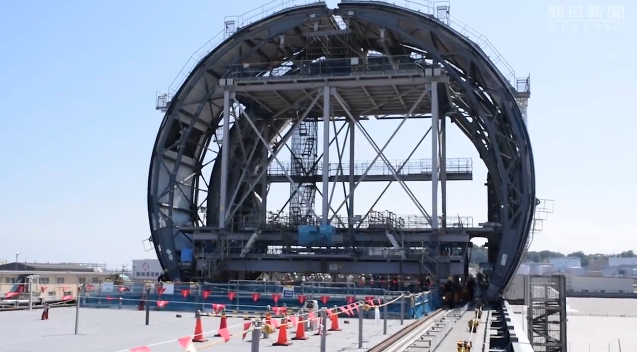
a massive cover will be built over the No. 3 reactor building of the Fukushima No. 1 nuclear power plant during a practice run at Onahama port in Iwaki, Fukushima Prefecture, on June 10.
IWAKI, Fukushima Prefecture–A dress rehearsal is under way to install a huge “hat” over a crippled reactor building at the Fukushima No. 1 nuclear power plant.
The bulky dome-shaped cover is meant to stop the spread of radioactive material and protect equipment necessary to retrieve 566 bundles of nuclear fuel rods from a storage pool in the No. 3 reactor building.
The simulation is designed to get workers fully drilled so they can set up the cover quickly, reducing the time they are exposed to radiation.
Tokyo Electric Power Co., operator of the crippled plant, has started simulating the process at Onahama port in Iwaki.
On June 10, TEPCO invited reporters to witness part of the drill in which portions of the cover measuring about 18 meters high were moved on a rail for about 50 meters.
The No. 3 reactor building, where a meltdown occurred after the March 2011 Great East Japan Earthquake and resulting tsunami, still has an extremely high reading of radiation.
TEPCO plans to begin retrieving the fuel rods during fiscal 2017, starting in April next year.
The drill is expected to continue through this month to ensure there are no flaws in the working procedures and safety measures.
TEPCO plans to first decontaminate the No. 3 reactor building and put up shields so that radiation levels drop when the massive cover is installed.
The cover used in the drill will be dismantled and then shipped to the power plant for reassembly and use in the actual retrieval.
http://www.asahi.com/ajw/articles/AJ201606130029.html

Parts of the cover to be placed over the No. 3 reactor building of the Fukushima No. 1 nuclear power plant are shown during a drill at Onahama port in Iwaki, Fukushima Prefecture, on June 10
1 This Month
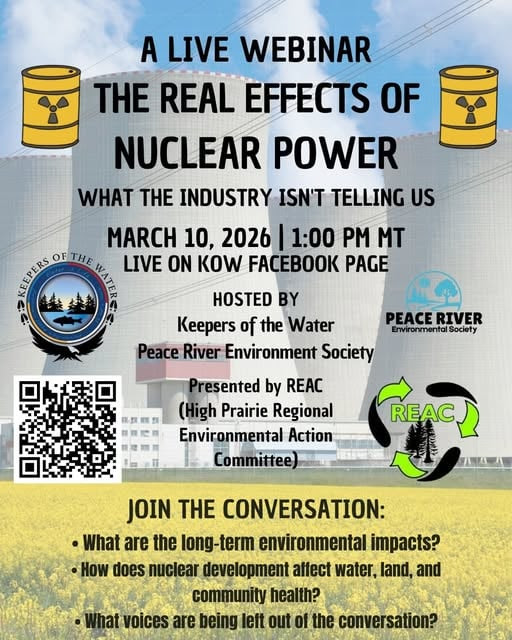
10 March A LIVE WEBINAR THE REAL EFFECTS OF NUCLEAR POWER
What the Industry Isn’t Telling Us
1:00 PM Mountain, 2 pm Central, 3 pm Eastern. Live on the Keepers of the Water Facebook page


18 March Webinar @ 1 PM EST: An Assessment of SMR Projects: The Case of Canada
register for the zoom:
https://us02web.zoom.us/webinar/register/WN_o8BIIOUvQ2ONJR1nta65DQ#/registration


of the week – STOP SMALL MODULAR REACTORS IN CANADA
To see nuclear-related stories in greater depth and intensity – go to https://nuclearinformation.wordpress.com
-
Archives
- March 2026 (119)
- February 2026 (268)
- January 2026 (308)
- December 2025 (358)
- November 2025 (359)
- October 2025 (376)
- September 2025 (258)
- August 2025 (319)
- July 2025 (230)
- June 2025 (348)
- May 2025 (261)
- April 2025 (305)
-
Categories
- 1
- 1 NUCLEAR ISSUES
- business and costs
- climate change
- culture and arts
- ENERGY
- environment
- health
- history
- indigenous issues
- Legal
- marketing of nuclear
- media
- opposition to nuclear
- PERSONAL STORIES
- politics
- politics international
- Religion and ethics
- safety
- secrets,lies and civil liberties
- spinbuster
- technology
- Uranium
- wastes
- weapons and war
- Women
- 2 WORLD
- ACTION
- AFRICA
- Atrocities
- AUSTRALIA
- Christina's notes
- Christina's themes
- culture and arts
- Events
- Fuk 2022
- Fuk 2023
- Fukushima 2017
- Fukushima 2018
- fukushima 2019
- Fukushima 2020
- Fukushima 2021
- general
- global warming
- Humour (God we need it)
- Nuclear
- RARE EARTHS
- Reference
- resources – print
- Resources -audiovicual
- Weekly Newsletter
- World
- World Nuclear
- YouTube
-
RSS
Entries RSS
Comments RSS
 nuclear-news