TEPCO may have located melted fuel for 1st time at Fukushima plant

Tokyo Electric Power Co. said Jan. 30 it may have finally pinpointed the location of melted fuel at the Fukushima No. 1 nuclear plant, nearly six years after the triple meltdown unfolded there.
If confirmation is made, it would represent a breakthrough in the daunting task of decommissioning the stricken nuclear plant.

A remote-controlled camera fitted on a long pipe detected black lumps on grating in the lower part of the containment vessel of the No. 2 reactor at the plant early on Jan. 30, TEPCO said.
The wire-mesh grating is located below the pressure vessel of the reactor. The lumps were not there before the Great East Japan Earthquake and tsunami on March 11, 2011, caused the nuclear disaster, according to TEPCO.

The utility plans to determine whether the lump is melted fuel based on images and radiation levels taken by an investigative robot and other data. The robot, called “Sasori” (scorpion) and fitted with two cameras, a dosimeter and a temperature gauge, will be sent into the No. 2 reactor containment vessel next month.

High radiation levels have hampered efforts at the nuclear plant to determine the condition and location of melted nuclear fuel.
TEPCO tried–and failed–three times to locate melted fuel using an industrial endoscope at the No. 2 reactor.
The latest investigation inside the No. 2 reactor began on Jan. 26 to locate the melted fuel.
The company is preparing to devise a method to retrieve the melted fuel in fiscal 2018 as part of the decommissioning work.
http://www.asahi.com/ajw/articles/AJ201701300058.html
The image shows what is believed to be the remains of melted nuclear fuel that seeped through the grating below the pressure vessel of the No. 2 reactor at the Fukushima No. 1 nuclear power plant. (Provided by Tokyo Electric Power Co.)
TEPCO reinserts camera in Fukushima reactor 2

What appears to be rust is seen on a foothold inside the containment vessel of the No. 2 reactor at the Fukushima No. 1 nuclear plant in this image provided by Tokyo Electric Power Co.
TEPCO reinserts camera in Fukushima reactor
TEPCO, the operator of the damaged Fukushima Daiichi nuclear plant, has again begun using a camera probe inside the containment vessel of the No. 2 reactor.
Taking pictures of the molten fuel inside is regarded as an important step towards decommissioning the reactors that melted down.
On Tuesday, workers at the plant tried to insert a camera into a pipe leading into the containment vessel.
But the camera got stuck in the pipe’s opening. The rubber, which had shrunk due to cold, blocked it.
In a second attempt on Thursday, workers tried to push the camera into the pipe while warming the rubber with thermal material. They were successful.
Footage from the camera shows a black substance adhering to the surface of metal rails in the vessel. The rails will be used as tracks for a robot to do a survey in February.
TEPCO expects the camera may capture footage of molten fuel for the first time since the 2011 meltdown
https://www3.nhk.or.jp/nhkworld/en/news/20170126_31/
TEPCO begins taking video inside Fukushima No. 1 nuke plant reactor
Tokyo Electric Power Co. (TEPCO) began work on Jan. 26 to take video inside the No. 2 reactor at its tsunami-hit Fukushima No. 1 nuclear plant, company officials said.
A camera attached to the tip of a pipe was inserted into the reactor containment vessel to shoot video inside of the vessel to check the condition of the melted fuel within. It was also done in preparation for sending in a camera-equipped robot to get a closer look at conditions. The robot will follow 7.2-meter-long rails leading to an area just below the reactor’s pressure vessel.
Video released by TEPCO on Jan. 26 shows dripping liquid and what appears to be steam drifting inside the containment vessel. What looks like rust is seen on a foothold and the rails, but nothing that could block the robot has been found.
TEPCO is poised to use a longer pipe to check if there is any obstacle inside the reactor next week and beyond. Company officials said the firm may be able to photograph the melted fuel.
http://mainichi.jp/english/articles/20170127/p2a/00m/0na/002000c
Fukushima camera probe hits a snag

Workers attempting to get a better look inside a damaged reactor at the Fukushima Daiichi nuclear power plant have encountered a problem.
On Tuesday they inserted a camera in a pipe leading into the container vessel of the No. 2 reactor, with the aim of capturing footage of molten fuel inside.

But plant operator Tokyo Electric Power Company says the camera, which is marginally smaller than the pipe, quickly became stuck.
TEPCO says a simulated trial run went off without a hitch. The utility will investigate what went wrong before deciding whether to try again.
Workers need a clearer picture of the debris to determine how best to remove it, an important step in the decommissioning process for the 3 reactors that suffered meltdowns.
Completion of drilling a hole toward investigation inside Unit 2 Primary Containment Vessel (PCV) at Fukushima Daiichi
TEPCO released a video showing a drilling rig, used in preparation for internal investigation of containment vessel No. 2 of Fukushima Daiichi Nuclear Power Station. The drilling was seated against the CRD hatch inside unit 2, the selected site where a robot will be inserted into unit 2 containment to collect data and images.
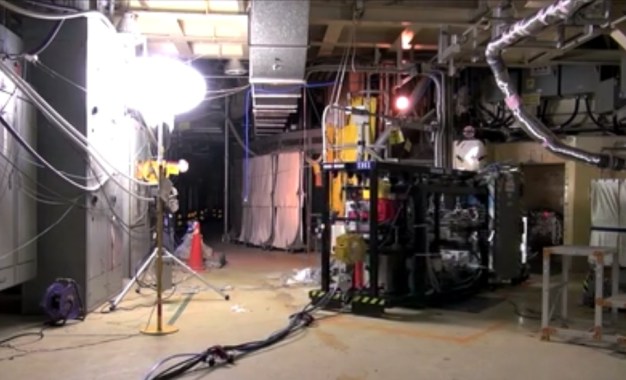
Due to shielding blocks difficult to remove and high radiation levels found where the hatch gasket had melted away, this work has been repeatedly delayed.
Logos from IRID, Toshiba and IHI are displayed on that drilling rig. IRID is the decommissioning research and development group. Toshiba handles the inspection and response work at the site and was a prime contractor at Daiichi before the disaster. IHI Corporation does a variety of high tech work including the energy and aerospace industries.
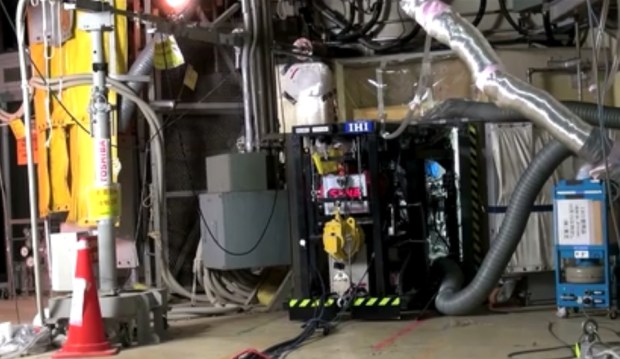
Little is known about the capabilities of that drilling rig. To conduct the containment inspection the workers will have to insert a robot into the CRD hatch tube.Earlier in the process it was decided to drill out an opening on the hatch rathen than trying to open it. In similar works at unit 1 a large tube shaped rig is connected to the containment port to act as a hot cell, to enable the robot to enter and exit the containment structure without having radiation or radioactive materials to escape.
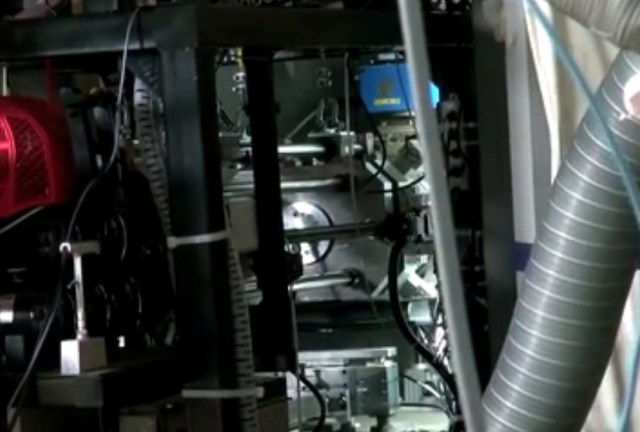
Similar efforts at unit 1 involved connecting a large tube shaped rig to the containment port that acts as a hot cell. This allows the robot to enter and exit the containment structure without allowing radiation or radioactive materials to escape. Earlier practiced work at Unit 2 showed workers training with such a hot cell unit.
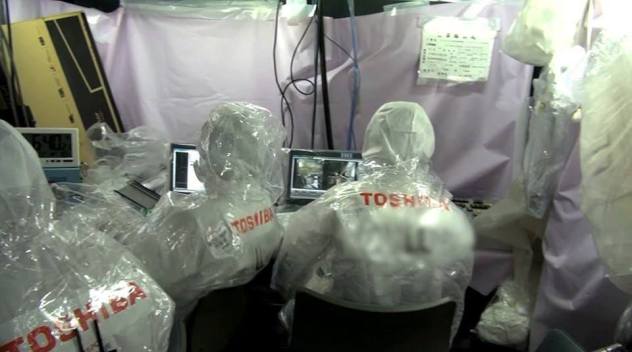
Asahi Shimbun had reported on September 2016 that TEPCO has announced they would begin the robotic containment inspection of unit 2’s containment in early 2017. This new development might be a sign that they have overcome the difficulties that caused delays since 2014.
Sources :
http://www.tepco.co.jp/en/news/library/archive-e.html?video_uuid=e5z65pib&catid=69631
http://www.asahi.com/ajw/articles/AJ201609060001.html
Drone Inspection of Fukushima Units 1 & 2 Vent Tower

TEPCO reported on October 20th they used drones to measure radioactivity at the reactors 1 and 2 vent tower.
Vent towers are quite unstable during earthquakes and are highly contaminated, they are therefore not easy to dismantle, even with robot
When they sent a drone into the vent tower, they found out that a bar prevented the drone to go in lower than 10-20 m below.
It’s pretty amazing that Tepco did not know that this bar was there and that they can not give its position more precisely.
TEPCO only provided two pictures online with a laconic comment. No results of their radioactivity measuring was given. Transparency is progressing …
http://www.tepco.co.jp/en/nu/fukushima-np/handouts/2016/images/handouts_161020_02-e.pdf
Robot to probe nuke fuel debris in Fukushima No. 2 reactor

Tokyo Electric Power Co. plans to send this survey robot into a reactor containment vessel at the crippled Fukushima No. 1 nuclear power plant.
A robot will be sent into the No. 2 reactor containment vessel at the crippled Fukushima No. 1 nuclear power plant to locate the melted fuel inside and assess its spread ahead of future retrieval.
Tokyo Electric Power Co. announced on Aug. 25 that it would undertake the difficult operation early next year at the soonest.
Under consideration for the work is a scorpion-shaped robot developed by Toshiba Corp., whose slender body allows it to pass through narrow openings. It is designed to raise its rear camera toward the front to capture images when it has arrived at a planned survey location.
The robot will crawl through an entrance into the No. 2 reactor containment vessel and travel along a rail to go deeper into its interior and confirm the state of the melted fuel inside and other conditions.
TEPCO and other parties are planning to draw on the survey results to decide on the fuel retrieval method as early as fiscal 2018 and set out on the actual retrieval process, expected to pose extreme difficulties, in 2021.
The initial plan would have sent the “scorpion” into the No. 2 reactor last summer, but radiation levels around the entrance were so high that cleanup work had to be done to reduce them for workers who would be sending the scorpion in.
Remote operations to remove a steel plate that blocked the entrance also turned out to be a time-consuming process.
If the operation to send the robot proceeds as planned, its use will still be a year and a half behind schedule.
Robots of a similar kind were sent last year into the No. 1 reactor and were partially successful in capturing images inside the containment vessel. However, the survey has had rough going, as the robots failed to spot any fuel.
TEPCO and the government are planning to draw on the robot survey results and other information to make a decision in fiscal 2018 on the melted fuel retrieval method for the No. 1, No. 2 or No. 3 reactors.
They are hoping to use the “submersion method,” which would involve filling the containment vessel with water to reduce worker radiation doses, during the retrieval work to be started in 2021. However, water is leaking from holes in the containment vessels, and the holes have yet to be located.
TEPCO and other parties have begun weighing alternative retrieval methods that do not involve filling the containment vessels with water.
Japan Extends Reactor Lifetimes for First Time Since Fukushima
Japan’s Nuclear Regulation Authority (NRA) this June approved 20-year license extensions for the aging Takahama 1 and 2 reactors, a first for the power-strapped country that has been conflicted about the future of its nuclear power plants since the Fukushima Daiichi catastrophe in 2011.
A regulatory system established in the aftermath of Fukushima limits the operating lives of Japanese nuclear units to 40 years, though it allows a one-time extension of no more than 20 years. The NRA’s approval to allow the 40-year-old Takahama 1 and 39-year-old Takahama 2 to operate an additional 20 years was carried out as an “extraordinary case.” Kansai Electric Power Co., which owns the two 826-MW reactors, filed applications for the extensions in April 2015, as well as for its 826-MW Mihama 3 reactor in November 2015, saying that they were “important” for its business.
Under its revised long-term energy plan, Japan anticipates getting between 20% and 22% of its total generated electricity from nuclear power by 2030, and industry groups like the Japan Atomic Industrial Forum have argued that the lifetime extensions will be integral to meeting that target.
Four of the nation’s nuclear power plants idled after Fukushima have so far cleared the new regulatory standards required to resume operations, but only Sendai 1 and 2, which are owned and operated by Kyushu Electric Power Co., are online. Kansai started up its Takahama 3 reactor on January 29 and Takahama 4 on February 26, but it took Unit 4 offline just three days later following a “main transformer/generator internal failure” (Figure 1). It was then forced to halt operations at Unit 3 on March 10 after Japan’s Otsu District Court issued a temporary injunction against the operation of both reactors because, the court said, the safety of the units could not be guaranteed. On July 12, Otsu District Court Judge Yoshihiko Yamamoto rejected Kansai’s request to lift the injunction. Kansai now says that—though it has filed to appeal the court’s decision to the Osaka High Court—it will begin removing nuclear fuel from the reactor cores.
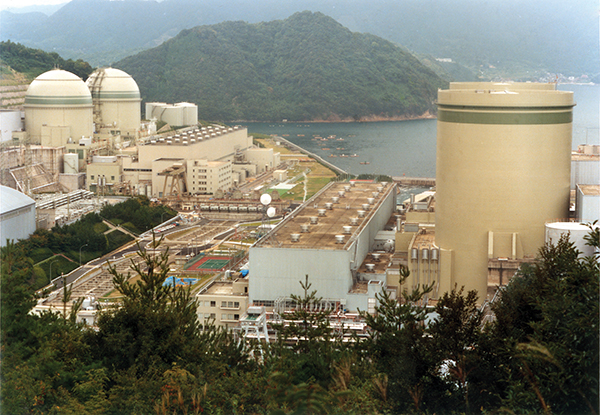
One step forward, two steps back. While Japan’s Kansai Electric Power Co. received Nuclear Regulation Authority approval to extend the lifetimes of Units 1 and 2 at its Takahama Nuclear Power Plant in Oi District, Fukui Prefecture, to 60 years, it has been forced to halt operations at Units 3 and 4 by a temporary injunction issued by a district court.
Meanwhile, applications for 22 more nuclear plant restarts have been filed with the NRA. According to a 2017 economic and energy outlook released by the Institute of Energy Economics of Japan (IEEJ) in late July, at least 12 nuclear power plants should be restarted next year. The research group notes, however, that those projections are clouded by a number of issues, including court judgments and local agreements. That uncertainty could come at a significant cost to the nation, it added.
“Because of the judicial ruling that ceased operations at the Takahama Unit No. 3 and 4, it is important to analyse the effect of stopping operations of nuclear power plants from a local point of view,” the IEEJ’s outlook says. “As a rule, if one nuclear plant with the capacity of 1 MW stops operation for one year in an area where annual demand is about 100 TWh, total fossil fuel costs increase by [$594 million] and the energy-related [carbon dioxide] emissions increases by 4 Mt-CO2 (7% increase for the local emissions). The average electricity unit cost will increase by [$3.96/MWh] (1.8% rise of the average power unit price).”
http://www.powermag.com/japan-extends-reactor-lifetimes-first-time-since-fukushima/
The Mysterious Case Of The Missing Fukushima Fuel
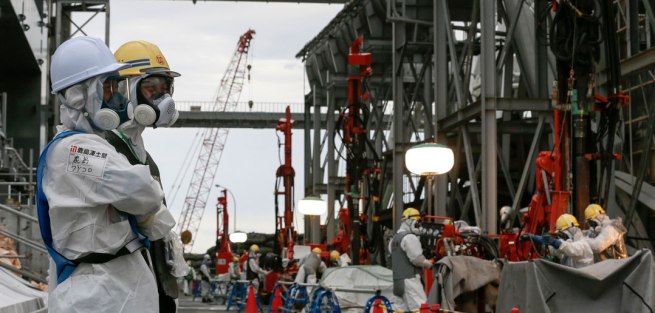
By Richard Wilcox, PhD
As the world forever hurtles toward Armageddon, the Fukushima nuclear disaster has largely faded from the front pages. But the issue is far from resolved. Radiation from nuclear accidents is not easily dispelled with estimates of clean-up time at Fukushima ranging from 40 to 500 years, and nearly six years have already passed. Even safely stored nuclear material is dangerous for 100,000 years (1).
Elvis Has Left The Building
The major question regarding the situation at Japan’s Fukushima Dai-ichi (no.1 nuclear power plant) regards the location of the melted fuel at reactor units 1, 2 and 3.
Recent evidence of the location of the fuel in unit 2 was disputed, with Tokyo Electric Co. (Tepco) and the mainstream media taking one view and independent scientists taking another. Is the melted fuel still inside the container in the reactor building, or has it leaked out and is now penetrating in scattered areas laterally and vertically into the ground?
Large amounts of melted fuel could reach the ground water, and even the aquifer which is ultimately connected to the Tokyo water supply.
Let’s compare two assessments on this important issue based on the use of “Muon tomography”:
According to the Asahi Shimbun (newspaper) version of reality which relies solely on the Tepco report:
Most of the nuclear fuel inside the No. 2 reactor at the Fukushima No. 1 nuclear power plant apparently did not melt through the pressure vessel (2).
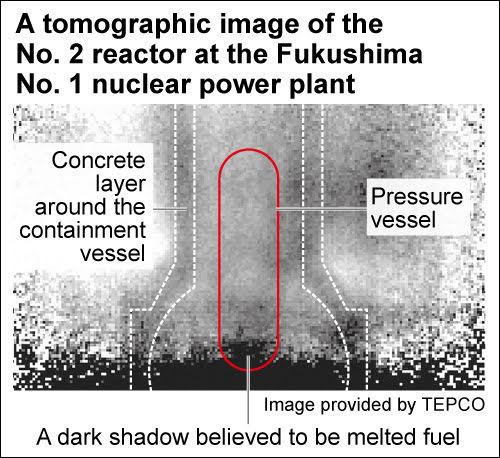
Is it that simple? Tepco’s record of reliability has become rather tarnished over the years.
Note that in the graphic image above, the word “believed” is used, which reinforces the word “apparently” used in the text of the article referring to the uncertainty of the location of the melted fuel. However, the title of the article is more confident, stating that “most fuel was contained.” The title is blatantly misleading and since most readers just skim the news, that will be what they take away from the report.
On the other hand, the independent scientists at the Simply Info website differ about the location of the fuel in relation to the container, the “Reactor Pressure Vessel” (RPV):
Tepco’s superimposed mask demarcates the bottom head too low including fuel inside the rpv which according to the refined image is clearly shown below the bottom head….”there is no fuel in the bottom of the RPV in any significant amount” (3).

This graphic indicates that a different method was used by these scientists to view the location of the melted fuel.
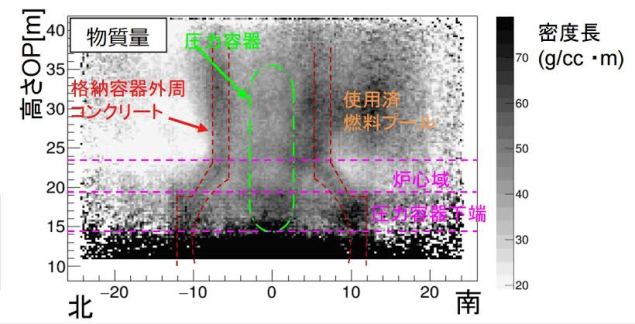
In this graphic the Simply Info scientists argue that the container drawing was placed too low in the Tepco version, whereas in their version, it is higher, making it less obvious that the fuel is in the container.
Careful reading of this article reveals that Tepco’s analysis, as so glibly presented by the mainstream media, was based on technological smoke and mirrors, clearly intended to deceive. Tepco and the media should report on the range of plausible possibilities, not only the small slice of reality they wish the public to see (4; 5).
So will the Asahi Shimbun correct their fallacious reporting? Both the Japan Times and the Asahi Shimbunare heavily owned and controlled by foreign investors and media. TheAsahi shares offices with the New York Times in Tokyo and many Japanese English dailies rely on Western news wires such as the agenda driven, oligarchic news sources, Reutersand the Associated Press (6).
Decommissioning Or Out Of Commission?
In fact, in over five years much progress has been made to control the situation at the destroyed Fukushima nuclear plant. Much of the rubble has been cleaned up and fresh coats of paints are on the buildings, but the place is still intensely radioactive, and no human can approach the specific reactor meltdown sites.
The second major issue at Dai-ichi concerns the future plans for the decommissioning of the plant. All along Tepco has said they will retrieve the melted fuel and complete decommissioning within 40 years. In fact the technology to retrieve the fuel has not yet been invented. Not only is it impossible for human workers to approach the area, but even robots break down due to the radiation short circuiting their wires.
It was recently revealed that Japan is still considering an option that many people feel would be very dangerous in the long term, and that is the “sarcophagus” solution (7). The only time this has been tried is at Chernobyl — it looks like a high-tech barn placed over the site (8). Unlike Chernobyl where the ground is rock hard, at Fukushima the ground is akin to a wet sponge with soft topsoil, so while covering it will reduce radioactive atmospheric fallout, the radiation will continue to leak downwards to the aquifer and outwards to the ocean unless appropriate engineering measures are taken.
Nevertheless, progress is slow with efforts “underway to develop the equipment needed to retrieve corium (melted fuel) samples from inside the containment structures of units 1-3 at the plant. No solid time frame” has yet been was mentioned (9).
The Nuclear Story
In an interesting aside, the best documentary film on Fukushima I have see so far, Fukushima: A Nuclear Story was released in 2015 (10). It is an Italian production but with English narration and subtitles. The plot follows journalist Pio d’Emilio during the nuclear crisis as he tries to uncover the real situation in Fukushima. The film is engaging and educational at the same time, covering new ground and combining dramatic events as they unfold at the time with scientific explanations done in an entertaining, “manga” comic book style.
The film emphasizes the near catastrophe of Tepco’s panic during the accident, and the courage and wisdom of then prime minister Naoto Kan, and the Fukushima 50, led by the plant manager Masao Yoshida whose snap judgement literally “saved the world.”
The film raises one very interesting piece of information that I did not know about which is that it was only the luck of the pool fuel gate at unit 4 not closing, in other words, malfunctioning, which allowed water in to cool the scorching fuel rods. Had that not occurred, the fuel rods could have caught fire spreading massive radiation for hundreds of miles.
Note that had the Fukushima accident happened at night or on the weekend there would have been far fewer workers at the plant to tackle the problem, possibly leading to a completely out-of-control situation.
The Ice Wall Cometh…
The “ice wall” that Tepco built in order to freeze the ground around the plant to block water flow in and out of the plant, continues to have problems. It is a very expensive operation to build and maintain, prone to technical problems and no one really knows when or if it will ever be fully implemented (i.e., taxpayer boondoggle) (11; 12). Even if the ice wall operates as intended it will not stop all of the water flow allowing some to be contaminated (13).
Is this why the sarcophagus option is still on the table? Critics have argued that the ice wall was poorly conceived from the start because it did not address dealing with the source of water flow which is at the water shed above the plant in the nearby mountains (Tepco balked at the project due to the high cost).
Japan Nuke News
Various nuclear related issues pop up from time to time around country. Since the nuclear accident in 2011, the overwhelming public sentiment has been strongly anti nuclear, despite efforts by the Abe administration to downplay the accident and restart as many of the reactors around the country as possible. The logic of the restarts against public opinion is in order to satisfy the big banks who have financed Japanese utility company operations while reactors have remained idle (expensive but not profit producing) over the past years.
Ever since the hugely destructive earthquakes earlier in 2016 on the island of Kyushu, nuclear plant restarts along the path of the fault line, which basically travels through the middle of the entire country, have been in doubt. Still we see for example in Shikoku that nuclear reactors are restarting despite local opposition (14).
Although prime minister Abe keeps pushing for resumption of nuclear operations, he probably would not want to work at the Fukushima nuclear disaster clean up site himself. It was recently reported by Japanese scientists that insoluble radioactive cesium has been detected in workers exposed to high levels of radiation at the plant (15).
Indeed, the wildlife in Fukushima prefecture has long been reported to be contaminated with radiation, recently a wild boar was detected with massive levels of radiation in its body (16). This is an indication of the general contamination of the environment there.
This doesn’t stop the Fukushima tourist board from advertising how safe and wonderful life is there. In order to drum up tourist dollars the national government has carried out a massive public relations campaign despite the lingering possibility of numerous radioactive hotspots in the area (17; 18).
Trump Threatens Nuclear Cartel
Maybe things will change a bit if Donald Trump can be elected president in the United States. Trump has promised to reduce US military presence in Japan and let them sort out their own military affairs. This does not bode well for the US-Japan military racket which siphons off billions of dollars in tax revenue to satisfy the greed of both country’s military industrial complexes, which are intensely tied up with the nuclear weapons and power industries (20).
Isn’t it ironic that the bogeyman of North Korea which is constantly conjured by Japan to justify its own growth in militarism, obtained its original nuclear weapon technology from Britain, a supposed Japan ally (21).
Funny old world ain’t it.
* Special thanks to the Simply Info website for their continuous work on the Fukushima issue; and to Activist Post for their continued reporting.
Richard Wilcox is a contributing editor and writer for the book: Fukushima: Dispossession or Denuclearization? (2014) and a Tokyo-based teacher and writer who holds a PhD in environmental studies. He is a regular contributor to Activist Post. His radio interviews and articles are archived athttp://wilcoxrb99.wordpress.com and he can be reached at wilcoxrb2013@gmail.com.
References
1 – Nuclear waste: keep out for 100,000 years
http://www.ft.com/cms/s/2/db87c16c-4947-11e6-b387-64ab0a67014c.html#axzz4EtlF3Xds
2 – New study on Fukushima reactor shows most fuel was contained
http://www.asahi.com/ajw/articles/AJ201607290050.html
3 – Something Incredible Found In Fukushima Muon Scan
http://www.fukuleaks.org/web/?p=15666
4 – First Fukushima Unit 2 Muon Scans Dispute New Scan Results
http://www.fukuleaks.org/web/?p=15650
5 – Fukushima Unit 2 Muon Scan Not So Conclusive
http://www.fukuleaks.org/web/?p=15637
6 – Democracy in Peril: Twenty Years of Media Consolidation Under the Telecommunications Act
http://www.truth-out.org/news/item/34789-democracy-in-peril-twenty-years-of-media-consolidation-under-the-telecommunications-act;
7 – NDF Tries To Walk Back Fukushima Daiichi Sarcophagus Admission
http://www.fukuleaks.org/web/?p=15607
8 – The Chernobyl Gallery: Sarcophagus
http://chernobylgallery.com/chernobyl-disaster/sarcophagus/
9 – Melted Fuel To Be Sampled From Fukushima Reactors Containment
http://www.fukuleaks.org/web/?p=15608
10 – Fukushima: A Nuclear Story
http://www.nuclearstory.com
11 – Fukushima Frozen Wall Sees Small Progress From Concrete Addition
http://www.fukuleaks.org/web/?p=15659
12 – Fukushima Frozen Wall Report For June 23 2016
http://www.fukuleaks.org/web/?p=15569
13 – Fukushima No. 1 plant’s ice wall won’t be watertight, says chief architect
http://www.japantimes.co.jp/news/2016/04/29/national/fukushima-plants-new-ice-wall-will-not-be-watertight-says-chief-architect/#.V7JtD-lMaRk
14 – Shikoku MOX plant restarts amid outcry over fresh quake fears
http://www.japantimes.co.jp/news/2016/08/12/national/shikoku-electric-poised-fire-ehime-plant-mox-reactor-amid-protests/#.V66L_ulMaRk
15 – THREE-YEAR RETENTION OF RADIOACTIVE CAESIUM IN THE BODY OF TEPCO WORKERS INVOLVED IN THE FUKUSHIMA DAIICHI NUCLEAR POWER STATION ACCIDENT
http://rpd.oxfordjournals.org/content/early/2016/03/14/rpd.ncw036
16 – 960 Bq/kg of Cs-134/137 detected from wild boar in Fukushima
http://fukushima-diary.com/2016/07/960-bqkg-of-cs-134137-detected-from-wild-boar-in-fukushima/
17 – Tokyo to Fukushima: Route to enjoy modern, old Japan
http://showcase.japantimes.co.jp/tokyo/news/?key=tokyo1
18 – Fukushima tourism making strong progress on recovery
http://www.japantimes.co.jp/news/2016/08/14/national/fukushima-tourism-making-strong-progress-recovery/#.V7Eoo-lMaRk
19 – Trump rips U.S. defense of Japan as one-sided, too expensive
http://www.japantimes.co.jp/news/2016/08/06/national/politics-diplomacy/trump-rips-u-s-defense-japan-one-sided-expensive/#.V6bc2elMaRk
20 – North Korea used British technology to build its nuclear bombs
http://www.theecologist.org/News/news_analysis/2987935/what_theresa_may_forgot_north_korea_used_british_technology_to_build_its_nuclear_bombs.htm
Source:
http://www.wakingtimes.com/2016/08/16/the-mysteriously-case-of-the-missing-fukushima-fuel/
Fukushima Unit 2 Muon Scan Inconclusive
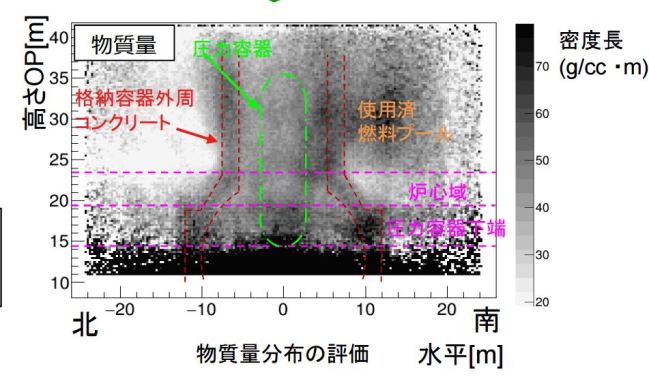
TEPCO and IRID released a set of reports on the muon scan of unit 2, as a follow up report to the June preliminary scan results.
Tepco makes an assertion in the new report that the majority of the melted fuel is present in the bottom of the reactor pressure vessel but that assertion is quite questionable upon further review of the reports.
To justify the assertion that most of the fuel is in the bottom of the RPV, Tepco uses a close view of the actual scan output. Viewed without the wider view it seems there must be some fuel in the bottom of the RPV and there probably is.
When you look at the same image with the entire scan view, the black area inside the RPV becomes less conclusive. This black band reaches far beyond containment and matches an area of interference documented on the earlier reviews of the scans.
TEPCO also goes on to make an estimate of fuel volume in the lower portion of the RPV based on these questionable images. They do not provide any justification for how they take the black spots in the image of the lower RPV and translate that to tons of melted materials and fuel.
Existing meltdown literature and findings expect some amount of fuel residue to exist in the bottom of the RPV even if the bottom of the RPV fails.
Both scans of unit 2′s vessel showed little remaining in the core region.
At this point the scans are inconclusive either way on the question of fuel in the bottom of the RPV.
Sources:
http://mainichi.jp/english/articles/20160729/p2g/00m/0dm/022000c
http://www.asahi.com/ajw/articles/AJ201607290050.html
Fuel in the Fukushima Reactor 2 Playing Hide and seek
In June 2016 Tepco released preliminary information announcing that the unit 2 muon scan showed no fuel in the reactor vessel, that the full scan would be completed by mid-July and should confirm any fuel findings, or lack thereof.
The scanner can detect masses of fuel 1 meter or larger.
The scans had identified the fuel in the spent fuel pool, confirming that the system was working properly and that the results were accurate.
The image below is the actual muon scan results with darker blue indicating areas where fuel is. The internal structures of the reactor are drawn in by TEPCO.
TEPCO originally thought there was fuel remaining in the bottom head of the reactor vessel. The scan clearly showed no significant amount of fuel remaining in the core region where the fuel was before the meltdown or in the bottom of the reactor vessel.
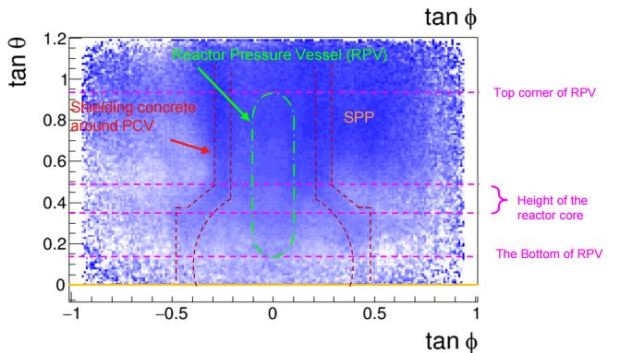
Tepco stating that the final scan report in July might refine the imagery but that it would unlikely change the results.
TEPCO handouts :
https://www.dropbox.com/s/i2bffm237u8osz6/muon%20unit%202%20handouts_160526_01-e.pdf?dl=0
https://www.dropbox.com/s/76w6rryxiwjbhoz/muonscan_2_daiichi_160526_06.pdf?dl=0
Now this Thursday July 28, 2016, one month later, Tepco announces that most of the melted nuclear fuel inside the No. 2 reactor is LIKELY located at the bottom of its pressure vessel.
That a study using muon imaging system was carried out by a team involving Tokyo Electric and the High Energy Accelerator Research Organization in Ibaraki Prefecture, that an ESTIMATED 130 tons of the so-called fuel debris REMAINS at the bottom of the vessel, that it is the first time the location and amount of the melted fuel have been estimated.
As high radiation levels are continuing to hamper direct access to the reactors, researchers have tracked muon elementary particles, which are produced as cosmic rays collide with atmospheric particles and change course when coming into contact with nuclear fuel.
The No. 2 reactor was in operation when the nuclear crisis was triggered by a powerful earthquake and subsequent tsunami that devastated Japan’s northeast.
About 160 tons of fuel assemblies are estimated to have been present inside the reactor vessel prior to the crisis. Most of the fuel is BELIEVED to have fallen to the bottom of the pressure vessel and mixed with nearby structures to form debris.
In the nuclear crisis, massive amounts of radioactive substances were released into the environment, with the Nos. 1, 3 and 4 reactor buildings damaged by hydrogen explosions.
The No. 4 reactor was offline for periodic maintenance work and all of its fuel was stored in the spent fuel pool, avoiding a meltdown.
The finding IF TRUE would be important as the data could help the operator to narrow down methods to remove the fuel debris, the most challenging task in decommissioning the plant’s Nos. 1 to 3 reactors that experienced meltdowns in the nuclear crisis that began in March 2011.
However, in mid-June 2016 using the same muon imaging system Tepco could not detect any fuel at the bottom of the reactor pressure vessel, now one month later Tepco announces that there is an estimated 130 tons of the so-called fuel debris remaining at the bottom of the vessel.
Question : has that fuel been playing hide and seek with Tepco?
Study shows bulk of fuel still in crippled Fukushima No. 2 reactor

TOKYO, July 14, Kyodo
A study on the disaster-hit Fukushima Daiichi nuclear power plant has found that most of the melted fuel in the No. 2 reactor is still present in the reactor core area, sources close to the matter said recently.
According to the study that used a cosmic ray imaging system, around 200 tons of fuel and other melted substances is estimated to have accumulated at the bottom of the pressure vessel, the first time the current location of the fuel has been specified.
The finding is important for devising ways to remove the so-called fuel debris, the most challenging task in decommissioning the Nos. 1 to 3 reactors that suffered meltdowns in the nuclear crisis that began in March 2011.
https://english.kyodonews.jp/news/2016/07/421290.html
Tepco admits molten nuclear fuel is transferred in multiple places of Reactor 2

Tepco admitted the molten fuel is transferred to multiple places in Reactor 2 by 6/30/2016.
Tepco had been implementing the muon scanning investigation with KEK (High Energy Accelerator Research Organization).
Tepco describes the research result as it is highly likely that major part of the molten nuclear fuel remains in the bottom of the reactor with structures of the inside of the reactor. They also detected a part of the molten fuel on the wall of the reactor. This means the molten fuel was separated and remaining in different locations. Tepco did not mention the percentage of the detected fuel.
Tepco did not identify the location either so it is not clear if the fuel remains inside of the Reactor Pressure Vessel or its outer structure, Primary Containment Vessel.
http://nstimes.com/archives/64086.html
Melted fuel may be at the bottom of No.2 reactor
NHK has learned it is highly likely that a large amount of melted nuclear fuel remains at the bottom of one of the damaged reactors at the Fukushima Daiichi nuclear power plant.
Experts from Tokyo Electric Power Company and other institutions confirmed a large black shadow at the bottom of the No.2 reactor, using a device that uses elementary particles called muons.
The probe to see into the reactor’s interior has been conducted with the High Energy Accelerator Research Organization and others.
The analyses of the image led the experts to believe that most of the melted fuel is likely located at the bottom of the reactor together with other structures in the reactor.
This is the first time that an image of what’s believed to be molten fuel has been captured. Similar shadows are said to have been confirmed also on the walls of the reactor.
The results of the probe have a considerable impact on a process to remove melted fuel, the most difficult part of reactor decommissioning.
TEPCO is conducting further analyses of the reactor.
During the accident in 2011, nuclear fuel melted down in the plant’s 3 reactors. Most of the fuel in the No.1 reactor is believed to have melted through the core. But the locations of the fuel in the No.2 and 3 reactors are not yet known.
Up to 100% of No. 2 reactor fuel may have melted
First it was cold shutdown, then it became meltdown, what if most of it had been expelled in the skies, and if so how long it will take for them to finally admit it to the world…
A group of researchers says it is highly likely that 70 to 100 percent of fuel has melted at one of the damaged reactors at the Fukushima Daiichi nuclear power plant.
The group includes researchers from Nagoya University. It has been probing the plant’s No. 2 reactor since April of last year, using a device that uses elementary particles called muons to see into its interior.
The researchers say the results of their study show few signs of nuclear fuel at the reactor core, in contrast to the No. 5 reactor where fuel was clearly visible at its core.
This led them to believe that 70 to 100 percent of fuel at the reactor has likely melted.
The researchers say further analyses are needed to determine whether molten fuel penetrated the reactor and fell down.
The No.2 reactor is said to have released large amounts of radioactive substances following the March 2011 accident.
Tokyo Electric Power Company, the plant’s operator, has estimated that part of nuclear fuel at the reactor remains at its core.
The locations of nuclear fuel will have a significant impact on the process to remove it from the damaged reactors, the most difficult step of the decommissioning work.
The Japanese government and TEPCO plan to scan the No. 2 reactor once again using a different device.
They are also preparing to use robots around the reactor.
The group will announce the results of its study at a meeting of the Physical Society of Japan in Osaka on Saturday.
Source : NHK
Fukushima reactor could have suffered total meltdown – report
Fukushima’s reactor No.2 could have suffered a complete meltdown according to Japanese researchers. They have been monitoring the Daiichi nuclear power plant since April, but say they have found few signs of nuclear fuel at the reactor’s core.
The scientists from Nagoya University had been using a device that uses elementary particles, which are called muons. These are used to give a better picture of the inside of the reactor as the levels of radioactivity at the core mean it is impossible for any human to go anywhere near it.
However, the results have not been promising. The study shows very few signs of any nuclear fuel in reactor No. 2. This is in sharp contrast to reactor No.5, where the fuel is clearly visible at the core, the Japanese broadcaster NHK reports.
The team believes that 70 to 100 percent of the fuel has melted, though they did add that further research was needed to see whether any fuel had managed to penetrate the reactor
A report in May by the Tokyo Electric Power Company (TEPCO), which is the plant’s operator, said that a failure in reactor No.2’s pressure relief systems was one of the causes of the disaster. The team used a robot, which ventured into the building and measured radiation levels at various places, while also studying how much leakage had occurred from the control systems.
TEPCO has used 16 robots to explore the crippled plant to date, from military models to radiation-resistant multi-segmented snake-like devices that can fit through a small pipe.
However, even the toughest models are having trouble weathering the deadly radiation levels: as one robot sent into reactor No.1 broke down three hours into its planned 10-hour foray.
Despite TEPCO’s best efforts, the company has been accused of a number of mishaps and a lack of proper contingency measures to deal with the cleanup operation, after the power plant suffered a meltdown, following an earthquake and subsequent tsunami in 2011.
Recent flooding caused by Tropical Typhoon Etau swept 82 bags, believed to contain contaminated materials that had been collected from the crippled site, out to sea.
“On September 9th and 11th, due to typhoon no.18 (Etau), heavy rain caused Fukushima Daiichi K drainage rainwater to overflow to the sea,” TEPCO said in a statement, adding that the samples taken “show safe, low levels” of radiation.
“From the sampling result of the 9th, TEPCO concluded that slightly tainted rainwater had overflowed to the sea; however, the new sampling measurement results show no impact to the ocean,” it continued.
A recent study by the University of Southern California said the Fukushima disaster could have been prevented. One of the main faults cited was the decision to install critical backup generators in low-lying areas, as this was the first place the 2011 tsunami would strike, following the massive earthquake.
LISTEN MORE:https://soundcloud.com/rttv/fukushima-research
Source: RT
http://www.rt.com/news/316593-fukushima-reactor-meltdown-study/
1 This Month
10 March A LIVE WEBINAR THE REAL EFFECTS OF NUCLEAR POWER
What the Industry Isn’t Telling Us
1:00 PM Mountain, 2 pm Central, 3 pm Eastern. Live on the Keepers of the Water Facebook page



18 March Webinar @ 1 PM EST: An Assessment of SMR Projects: The Case of Canada
register for the zoom:
https://us02web.zoom.us/webinar/register/WN_o8BIIOUvQ2ONJR1nta65DQ#/registration


of the week – STOP SMALL MODULAR REACTORS IN CANADA
To see nuclear-related stories in greater depth and intensity – go to https://nuclearinformation.wordpress.com
-
Archives
- March 2026 (109)
- February 2026 (268)
- January 2026 (308)
- December 2025 (358)
- November 2025 (359)
- October 2025 (376)
- September 2025 (258)
- August 2025 (319)
- July 2025 (230)
- June 2025 (348)
- May 2025 (261)
- April 2025 (305)
-
Categories
- 1
- 1 NUCLEAR ISSUES
- business and costs
- climate change
- culture and arts
- ENERGY
- environment
- health
- history
- indigenous issues
- Legal
- marketing of nuclear
- media
- opposition to nuclear
- PERSONAL STORIES
- politics
- politics international
- Religion and ethics
- safety
- secrets,lies and civil liberties
- spinbuster
- technology
- Uranium
- wastes
- weapons and war
- Women
- 2 WORLD
- ACTION
- AFRICA
- Atrocities
- AUSTRALIA
- Christina's notes
- Christina's themes
- culture and arts
- Events
- Fuk 2022
- Fuk 2023
- Fukushima 2017
- Fukushima 2018
- fukushima 2019
- Fukushima 2020
- Fukushima 2021
- general
- global warming
- Humour (God we need it)
- Nuclear
- RARE EARTHS
- Reference
- resources – print
- Resources -audiovicual
- Weekly Newsletter
- World
- World Nuclear
- YouTube
-
RSS
Entries RSS
Comments RSS
 nuclear-news