Finland’s nuclear plant: more delays, cost overruns
More Delays at Finnish Nuclear Plant
The New York Times. September 2, 2009, By James Kanter
AREVA a French nuclear construction company, said this week that its project to build the world’s most powerful reactor remained mired in delays and was over-budget by 2.3 billion euros, or about $3.3 billion.The price tag of the plant in Olkiluoto, Finland — the first of a fleet of so-called evolutionary power reactors that Areva foresees building in coming years — was about $4.3 billion in 2003 and costs have steadily increased.
The reactor was meant to have gone online early this summer but Areva no longer is committing to any dates for its completion. Patrice Lambert de Diesbach, an energy analyst with CM-CIC Securities in Paris, said the latest developments were “bad news” for Areva and “should be sanctioned by the market.”
The problems faced by Areva are important a time when the nuclear power industry is promising to build safer and more reliable reactors than during the last building boom in the 1960s and early 1970s. …………………………
So far there are few signs of a breakthrough in Finland.
Areva said this week that it would not begin work on the final stages of the reactor until the Finnish utility agreed to a new set of proposals and modifications.
More Delays at Finnish Nuclear Plant – Green Inc. Blog – NYTimes.com
Paladin loss, as uranium price slips
Money Sept 2 09
…….- Paladin’s loss was greater than the broker expected, given greater ramp-up and exploration costs. With cashflow tight Paladin has been forced to draw down on its debt facility although first half FY10 inventory sales mean it’s just a bridging deal.Paladin’s realised uranium price was also lower than expected given a higher level of spot over contract sales. As the U price continues to drift and the Kayakelera ramp-up remains slow, the broker sees no positive catalysts. Hold retained on slightly lower earnings forecasts.
AREVA going to court over Finland nuclear reactor runaway costs
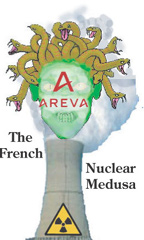 Areva’s half-year results yesterday night brought new information about the Olkiluoto-3 EPR nuclear fiasco:
South Africa’s nuclear company Eskom makes huge loss
Corporate Toughest of times for Eskom
World Nuclear News28 August 2009
Eskom, South Africa’s state-owned utility, has reported a record annual loss and has warned of a funding gap for an expansion program needed to prevent a repeat of the blackouts the country experienced in 2008.The company, which supplies about 95% of South Africa’s electricity and more than 60% of Africa’s, reported a loss of 9.7 billion rand ($1.25 billion) for the year ended 31 March. In the previous year, Eskom made a loss of 210 million rand ($27 million)………….
No public scrutiny for Florida nuclear waste storage
Florida Power and Light’s “dark” business
“…………..As storage of nuclear waste continues to pose concern across the country, an FPL land use change at Turkey Point raises questions about potential safety and environmental risks
Poder 360 By Siobhan Morrissey Sept 09“…………….Plans for the dry cask storage facility have sparked controversy because the project has not been aired at public hearings. Instead, the project was moved along quickly and quietly, with the state Department of Environmental Protection (DEP) granting certification on May 18, roughly six weeks after receiving FPL’s application and without an opportunity for public input. Without fanfare, the approval slipped the notice of interested parties such as the Sierra Club, the Tropical Audubon Society and Clean Water Action. Miami-Dade County officials and environmentalists maintain the utility company and the regulatory agency did an end run to avoid public scrutiny……………
Currently, FPL places the spent nuclear fuel onsite in wet storage structures that resemble cavernous, stainless-steel-lined swimming pools. But it’s getting crowded in the pools, so the utility is resorting to dry cask storage.
“They’re simply running out of room in the spent fuel pools for the current two [reactor] units,” says Roger Hannah, a spokesman for the Nuclear Regulatory Commission. “You never want to get below a certain point [of capacity]. You have to start several years in advance.”…………………
But how did FPL manage to avoid a public discussion of the environmental concerns? FPL presented the proposed dry storage facility as an amendment to an existing certificate that DEP issued last October when the utility sought permission to ramp up its power output. In the industry, this is commonly known as “uprating.” FPL plans to begin increasing its power output at Turkey Point by 14 percent as early as 2011.
It’s a problem nuclear power plants across the country face,
India: nuclear deal will cause problems
A Different Perspective on the U.S.-India Nuclear Deal
MONTHLY REVIEW Peter Custers Sept 09
The U.S.-India nuclear deal was initiated through a framework agreement signed by India’s Prime Minister Manmohan Singh and U.S. President Bush in July 2005.India, at the instigation of Washington, agreed to separate its civilian and military nuclear production facilities, and place all civilian production facilities under the inspection regime of the International Atomic Energy Agency (IAEA), in return for U.S. economic, technological, and military cooperation. The nuclear deal, which took three years to complete, is officially aimed at promoting India’s access to uranium and to civilian nuclear technology, through enlarged importation of both………….
……From its very start, the U.S.-India nuclear deal has generated huge controversies, both in India and internationally. The intent here is to lay bare the implications of the deal for the creation of waste,……………
fears that the controversial deal will enhance the danger of a nuclear conflagration in South Asia appear to be well grounded, even if we leave aside all other interrelated objections that have been raised……………..
the side effects in terms of generation of nuclear waste are so ponderous that, from this perspective too, implementation of the deal needs to be preempted…………….
the U.S.-India nuclear deal is bound to result in huge quantities of extremely dangerous waste that cannot be sold on the market, but needs to be put aside, at great risk to humans and to our natural environment……………….
A Different Perspective on the U.S.-India Nuclear Deal – Monthly Review
Nuclear sites fear they’ll get USA nuclear waste dump
Nuclear sites fear they’re the alternative to Yucca Mountain
Kansas city.com By LES BLUMENTHAL McClatchy Newspapers 1 Sept 09
It is among the nastiest substances on earth: more than 14,000 tons of highly radioactive waste left over from the building of the nation’s nuclear weapons arsenal……………….Local leaders and lawmakers from the sites where the waste is now stored, however, are increasingly concerned the Energy Department will leave it in place, even though that might violate legally binding cleanup agreements.
There’s no backup plan for dealing with the waste. A promised commission to study the issue has yet to be appointed.
“We don’t want to become a long-term repository without even having a discussion,” said Gary Petersen of the Tri-City Industrial Development Council, near Hanford, Wash. “All of this waste is supposed to be going to Yucca. Without Yucca, everyone in the weapons complex has a problem.”
Jared Fuhriman, the mayor of Idaho Falls, the largest city near the Idaho National Laboratory, agreed.
“We are all concerned,” Fuhriman said. “Where are we going to store the waste we have?”
If Yucca is closed, a search for a new site for a national repository likely would start with the 31 states on the original list of potential locations. In addition to Hanford and the Idaho National Laboratory, the states with possible sites include Texas, Georgia, North Carolina, South Carolina, Mississippi and Pennsylvania……………..
The biggest concern has been the liquid waste, stored in aging and occasionally leaking underground tanks. Current plans call for the waste to be vitrified, or solidified into glass-like logs, and shipped to Yucca Mountain. The logs would be encapsulated in two-foot diameter, 14.5-foot-long stainless steel containers that would weigh about four tons each. The waste treatment plant would generate about 480 glass logs a year and somewhere between 10,000 and 15,000 by the time the last of the waste is processed.
Nuclear sites fear they’re the alternative to Yucca Mountain – Kansas City Star
Indian government secretive about uranium pollution of Punjabi children
India’s generation of children crippled by uranium waste
Observer investigation uncovers link between dramatic rise in birth defects in Punjab and pollution from coal-fired power stations
Guardian.co.uk The Observer by Gethin Chamberlain 30 August 2009
Their heads are too large or too small, their limbs too short or too bent. For some, their brains never grew, speech never came and their lives are likely to be cut short: these are the children it appears that India would rather the world did not see, the victims of a scandal with potential implications far beyond the country’s borders………………………Health workers in the Punjabi cities of Bathinda and Faridkot knew something was terribly wrong when they saw a sharp increase in the number of birth defects, physical and mental abnormalities, and cancers. They suspected that children were being slowly poisoned.
But it was only when a visiting scientist arranged for tests to be carried out at a German laboratory that the true nature of their plight became clear. The results were unequivocal. The children had massive levels of uranium in their bodies, in one case more than 60 times the maximum safe limit.
The results were both momentous and mysterious………………..if a few hundred children – spread over a large area – were contaminated, how many thousands more might also be affected? Those are questions the Indian authorities appear determined not to answer. Staff at the clinics say they were visited and threatened with closure if they spoke out. The South African scientist whose curiosity exposed the scandal says she has been warned by the authorities that she may not be allowed back into the country.But an Observer investigation has now uncovered disturbing evidence to suggest a link between the contamination and the region’s coal-fired power stations………………………
India’s reluctance to acknowledge the problem is hardly unexpected: the country is heavily committed to an expansion of thermal plants in Punjab and other states. Neither was it any surprise when a team of scientists from the Department of Atomic Energy visited the area and concluded that while the concentration of uranium in drinking water was “slightly high”, there was “nothing to worry” about. Yet some tests recorded levels of uranium in the ground water as high as 224mcg/l (micrograms per litre) – 15 times higher than the safe level of 15mcg/l recommended by the WHO. (The US Environmental Protection Agency sets a maximum safe level of 20mcg/l.)…………………………
There have also been claims that the contamination may have been exacerbated by depleted uranium carried on the wind from the wars in Iraq and Afghanistan. At a seminar in Amritsar in April, Admiral Vishnu Bhagwat, a former chief of the naval staff, suggested that areas within a 1,000-mile radius of Kabul – including Punjab – may be affected by depleted uranium. Although the prevailing monsoon winds blow either from the north-east or the south-west, there are times when a depression originating in the Mediterranean can result in rainfall in Punjab.
India’s generation of children crippled by uranium waste | World news | The Observer
Nuclear energy on a downward trend: no renaissance in sight
Study shows: Nuclear energy on downward trend worldwide
Federal Ministry for Nuclear safety Germany,
28 August 09Minister Gabriel:
There is no renaissance of nuclear energyThe share of nuclear energy in worldwide energy consumption is marginal and has been declining for several years. This is revealed in a study by independent experts of the energy and nuclear sector which was published by the Federal Environment Ministry today. As Federal Environment Minister Sigmar Gabriel said:“The renaissance of nuclear energy, much trumpeted by its supporters, is not taking place. The only thing frequently revived is the announcement. The study shows: the number of old nuclear power plants which are decommissioned worldwide is greater than the number of new ones taking up operation. Available resources, engineering performance and funds are not even enough to stop the downward trend, let alone increase the number of reactors. All the facts are in favour of phasing out this technology while at the same time expanding the use of renewable energies and energy efficiency, as this is a promising option for the future.”
The authors of the study, headed by Mycle Schneider, Paris, collected crucial quantitative and qualitative facts on nuclear power plants which are in operation, being built or planned today and assess the economic viability of old and new nuclear power plants.
At the time of going to press, 1 August 2009, there were only 435 reactors in operation worldwide, which is nine less than in 2002. Nuclear energy accounts for only about 5.5 % of worldwide commercial primary energy consumption and only around 2 % of worldwide final energy consumption – and consumption has been steadily declining for years.
The authors also found out that the number of nuclear power plants will decrease worldwide over the next decades. Between 2015 and 2025 the capacity of nuclear power plants is expected to sink compared to today’s output……………….
Current and planned building projects of the nuclear industry are becoming increasingly expensive. The EPR, for example, the flagship of the world’s largest manufacturer of reactors, AREVA NP, which is currently in construction in Olkiluoto in Finland, has so far exceeded planned costs by at least 55 %.
US states fearful of becoming host to nuclear waste
S.C. among states fearing they’re the alternative to Nevada nuke site
Herald OnLine By Les Blumenthal– McClatchy Newspapers 30 August 09WASHINGTON — It is among the nastiest substances on earth: more than 14,000 tons of highly radioactive waste left over from the building of the nation’s nuclear weapons arsenal.As the Obama administration and Senate leaders move to scuttle a proposed repository for the waste in Nevada, the Hanford nuclear reservation in Washington state — along with federal facilities in Idaho and South Carolina — could become the de facto dump sites for years to come…………………….
Local leaders and lawmakers from the sites where the waste is now stored, however, are increasingly concerned that the Energy Department will leave it in place, even though that might violate legally binding cleanup agreements.
There’s no backup plan for dealing with the waste. A promised commission to study the issue has yet to be appointed.
S.C. among states fearing they’re the alternative to Nevada nuke site | The Herald – Rock Hill, SC
Nuclear risks rise for French workers
French nuclear workers see risks as conditions worsen
* EDF subcontracts 80 percent of nuclear maintenance
* Nuclear workers say they are under mounting time pressure
* Safety margin is narrowing, expert says
* EDF denies it cuts corners, says subcontracts by choice
Forbes Reuters FEATUREBy Muriel Boselli
PIERRELATTE, France, Aug 31 (Reuters) – Worsening working conditions, inadequate pay rises, pressure to work faster and safety concerns — these are the familiar grievances of a disaffected work force.
When such complaints arise in France’s most sensitive industry — nuclear power — alarm bells start ringing.
Cyril Bouche and his colleagues at the Tricastin nuclear plant in the rolling hills of the Drome region say the state-owned utility EDF, which runs France’s 58 nuclear reactors and has been expanding into the United States and Britain, is not only cutting costs, but also cutting corners.
The 39-year old, who works for one of EDF’s many subcontracting firms, says working conditions at the plant — hit by a series of incidents that shook public trust in 2008 — have deteriorated over the past five to 10 years.
“Today France is selling reactors abroad but it should first put its own house in order,” said Bouche, the only one of 10 workers interviewed by Reuters who was prepared to be identified.
The French government has put forward state ownership of its nuclear sector as a guarantee of its safety, but former monopoly EDF subcontracts 80 percent of the maintenance at its nuclear reactors to firms such as Vinci, Areva ( ARVCF.PK – news – people ), GDF Suez or Bouygues ( BOUYF.PK – news – people )………….
Independent experts including Yves Marignac, executive director of the information agency Wise-Paris, say safety margins in French nuclear power plants are shrinking as plants age, economic pressure mounts and trained staff retire.
FEATURE-French nuclear workers see risks as conditions worsen – Forbes.com
What About the Atomic Vets?
What About the Atomic Vets?
TimesUnion.com August 30, 2009 by Don Rittner
“………….When Saratoga’s John Delay was drafted into the army in 1956, at age 19, he thought his time would be spent like most post war GI’s – perform his assigned duties and go back home. What he didn’t know was that he would become a human guinea pig in a series of radiation experiments conducted by the U.S. Government. Many people have compared these experiments to the human atrocities of Germany and Japan during the second war.
It is estimated that at least 250,000 American soldiers were used as human guinea pigs during some 235 atomic tests conducted between 1946 and 1962 in the Marshall Islands* and State of Nevada to assess, among other things, psychological reaction and how soldiers and civilians would react in case of an all out atomic war. Hundreds of unsuspecting civilians became targets of various studies including the ingestion of very toxic plutonium and other materials. In Nevada and the Marshal Islands, soldiers were placed behind sand bags or in trenches not far from a nuclear blast, were forced to walk into ground zero, and even forced to fly their planes into atomic mushroom clouds. Additionally, some 750,000 civilians have been exposed to radionuclide fall-out.
MORE THAN 200 ATOMIC TESTS PERFORMED”,
The human experiments began with the largest “Operation Crossroad” at Bikini Atoll in 1946 (a proposed series of three shots: Abel, Baker and Charlie), exposing over 42,000 men to potential harmful levels of radiation from the Bikini Lagoon. The lagoon became filled with fission products from the second underwater shot, “Baker.”
Dr. Stafford Warren head of the radiology party found that after Abel and Baker, over 120 ships, the whole lagoon, and the island itself were contaminated to dangerous levels of radiation. He cancelled the third “Charlie” shot fearing lawsuits. More than 200 other tests would follow however under 19 different “operations.”……………………
….What is even worse is the roadblocks that have been set up to prevent these survivors from seeking compensation for themselves and their families. In 1984, Senator John W. Warner, a republican from Virginia attached an amendment to a bill that prevented those exposed to radiation, or otherwise injured as the result of working for the nuclear weapons contractors, from suing either the contractor or the U.S. government. The Warner Amendment came at the request of the Reagan Administration and three contractors in atomic weapons tests: The Lawrence Livermore National Laboratory in California, the Sandia National Laboratories and Los Alamos National Laboratories, both in New Mexico. The amendment resulted in the dismissal of a number of lawsuits brought by atomic veterans and civilians employed by the nuclear contractors as well as their widows. Coupled with the Feres Doctrine, a supreme court ruling that bars veterans from seeking damage from the government while on active duty, most of the survivor’s claims have been refused.
What About the Atomic Vets – Don Rittner – timesunion.com – Albany NY
Shot at nuclear fuel truck a cause for greater worry
Shot at nuclear fuel truck troubles watchdog group
By TOM FOWLER Houston Chronicle Aug. 28, 2009
Shotgun damage to a truck carrying uranium fuel rods to a Texas nuclear power plant last year posed little, if any, immediate radiation danger, but it highlights potential problems the industry could face, a nuclear power industry watchdog says.
The shotgun damage was discovered on the driver’s side of the truck on the morning of Sept. 20, as it delivered eight uranium fuel rods to the South Texas Project nuclear power plant near Bay City, according to a safety report filed at the plant last year.
The driver of the truck, operated by the Utah firm EnergySolutions, said he heard what sounded like a tire blowout several hours earlier while driving through another state. He stopped the truck to check but didn’t see the door damage…………………
………..a fuel rod that has been in a reactor and undergone fission is highly radioactive and can deliver lethal doses within minutes. That’s why trucks carrying spent fuel have much higher security specifications than vehicles that carry new fuel rods, said Scott Burnell, a spokesman for the Nuclear Regulatory Commission.
Shot at nuclear fuel truck troubles watchdog group | Business | Chron.com – Houston Chronicle
Indian Point nuclear power plant shutdown
Shutdown puts Indian Point plant under greater scrutiny
LoHud.com By Timothy O’Connor • August 29, 2009
BUCHANAN – Indian Point 3 faces tighter oversight by the Nuclear Regulatory Commission following Thursday night’s emergency shutdown of the nuclear power plant. The power plant was shut down for the second time in a little over two weeks and the fourth time since March. The plant’s turbine tripped off at 7:32 p.m…………………..
Riverkeeper, an environmental group that opposes the relicensing of Indian Point, said the shutdown bolsters its argument against renewing the licenses for 20 years.
“Another unexpected shutdown in such a short amount of time is certainly cause for concern; it demonstrates a fundamental failure to properly monitor and detect problems at the plant, and leads one to question how reliable Indian Point really is as a source of power for the region,” said Deborah Brancato, a staff attorney for Riverkeeper.
Shutdown puts Indian Point plant under greater scrutiny | LoHud.com | The Journal News
USA desperately needing solution to nuclear waste problem
Wanted: A Nuclear Waste Solution to Replace Yucca Mountain
About.com By Larry West 30 August 09
“…………………Here is the problem:
1. There is a lot of radioactive nuclear waste temporarily stored at sites all over the country.
2. Leaving nuclear waste in place and transporting it to some central and supposedly secure location both pose public safety and national security risks.
3. Nuclear waste can remain toxic, and potentially lethal, for 100,000 years or more (roughly equivalent to the length of time between the emergence of modern Homo sapiens and today), and no one knows whether we can safely store radioactive waste for that long.
4. America is not going to stop producing nuclear energy and nuclear weapons; both are considered far too important to our national security.
5. Nobody wants the waste, making nuclear-waste disposal one of the most controversial NIMBY (Not In My Back Yard) issues in history.There are already about 63,000 tons of used radioactive fuel at 104 operating U.S. nuclear power plants; it is currently stored either underwater or in so-called “dry storage.” Waste from nuclear weapons production, dating back to World War II, is an even bigger problem. It is currently stored at 16 federal sites in 13 states, although most of it is at Hanford in Washington state, the Idaho National Laboratory and Savannah River in South Carolina.Quoting from the McClatchy article:“At Hanford alone, there are 53 million gallons of highly radioactive liquid waste, 2,100 metric tons of spent nuclear fuel and nearly 2,000 capsules containing radioactive cesium and strontium.
1 This Month
Chernobyl: The Lost Tapes – A good documentary on Chernobyl on SBS available On Demand for the next 3 weeks– https://www.sbs.com.au/ondemand/tv-program/chernobyl-the-lost-tapes/2352741955560

of the week–London Campaign for Nuclear Disarmament

Tell the Ukrainian Government to Drop Prosecution of Peace Activist Yurii Sheliazhenko
To see nuclear-related stories in greater depth and intensity – go to https://nuclearinformation.wordpress.com
-
Archives
- April 2026 (139)
- March 2026 (251)
- February 2026 (268)
- January 2026 (308)
- December 2025 (358)
- November 2025 (359)
- October 2025 (376)
- September 2025 (257)
- August 2025 (319)
- July 2025 (230)
- June 2025 (348)
- May 2025 (261)
-
Categories
- 1
- 1 NUCLEAR ISSUES
- business and costs
- climate change
- culture and arts
- ENERGY
- environment
- health
- history
- indigenous issues
- Legal
- marketing of nuclear
- media
- opposition to nuclear
- PERSONAL STORIES
- politics
- politics international
- Religion and ethics
- safety
- secrets,lies and civil liberties
- spinbuster
- technology
- Uranium
- wastes
- weapons and war
- Women
- 2 WORLD
- ACTION
- AFRICA
- Atrocities
- AUSTRALIA
- Christina's notes
- Christina's themes
- culture and arts
- Events
- Fuk 2022
- Fuk 2023
- Fukushima 2017
- Fukushima 2018
- fukushima 2019
- Fukushima 2020
- Fukushima 2021
- general
- global warming
- Humour (God we need it)
- Nuclear
- RARE EARTHS
- Reference
- resources – print
- Resources -audiovicual
- Weekly Newsletter
- World
- World Nuclear
- YouTube
-
RSS
Entries RSS
Comments RSS
 nuclear-news