Is nuclear a green fuel? « Voices from Ghana
Is nuclear a green fuel?June 1, 2009 · Voices From Ghana “…………….some forecasters predict an uptick in nuclear power.
Yet, for nuclear energy to contribute to a significant degree to greenhouse gas abatement, the rate of construction would need to vastly accelerate. Offsetting even 10 percent of global carbon emissions by 2050 would be an immense undertaking, requiring some 2,200 new plants, or more than one per week in the coming decades.
The nuclear power option faces a set of vexing problems that should temper enthusiasm for an expansion of this scale.
Safety and CostAlthough no plant design can be risk-free, new research has brought claims of a new generation of nuclear reactors with advanced safety features. However, they have yet to be tested at full scale, and all reactors on order now use conventional technology. Moreover, nuclear power plants are now considered plausible targets for terrorist attacks. Whether caused by accident or malice, a sudden dispersal of radioactivity would have severe community impact, perhaps exacerbated by inadequate evacuation plans. If such an event triggered a renewal of anti-nuclear sentiment in the general public and led to demands for a nuclear moratorium, the resilience and sustainability of the energy system would be greatly compromised.
The full economic costs of nuclear energy are difficult to determine. A comprehensive accounting would include accident insurance, safety assurance, decommissioning, and radioactive waste disposal — costs that are often buried in generous public subsidies for the nuclear industry or shifted to future generations. As the experience in the U.S. with the first wave of nuclear plants indicated, projected costs will soar as the full costs of the nuclear-fuel cycle are reflected in the price of electricity. Of course, high costs might not be a key issue if nuclear power were the only option for climate mitigation. It is not.some forecasters predict an uptick in nuclear power.
Yet, for nuclear energy to contribute to a significant degree to greenhouse gas abatement, the rate of construction would need to vastly accelerate. Offsetting even 10 percent of global carbon emissions by 2050 would be an immense undertaking, requiring some 2,200 new plants, or more than one per week in the coming decades.
The nuclear power option faces a set of vexing problems that should temper enthusiasm for an expansion of this scale.
Safety and CostAlthough no plant design can be risk-free, new research has brought claims of a new generation of nuclear reactors with advanced safety features. However, they have yet to be tested at full scale, and all reactors on order now use conventional technology. Moreover, nuclear power plants are now considered plausible targets for terrorist attacks. Whether caused by accident or malice, a sudden dispersal of radioactivity would have severe community impact, perhaps exacerbated by inadequate evacuation plans. If such an event triggered a renewal of anti-nuclear sentiment in the general public and led to demands for a nuclear moratorium, the resilience and sustainability of the energy system would be greatly compromised.
The full economic costs of nuclear energy are difficult to determine. A comprehensive accounting would include accident insurance, safety assurance, decommissioning, and radioactive waste disposal — costs that are often buried in generous public subsidies for the nuclear industry or shifted to future generations. As the experience in the U.S. with the first wave of nuclear plants indicated, projected costs will soar as the full costs of the nuclear-fuel cycle are reflected in the price of electricity. Of course, high costs might not be a key issue if nuclear power were the only option for climate mitigation. It is not.
Proliferation and Security
Nuclear power cannot be de-coupled from nuclear weapons. Two paths lead from a nuclear energy program to weapons-grade material; one involves uranium and the other plutonium.
Nuclear Power Deflects Us From the Path to Sustainability……………….With its long-term legacy of heightened risks and toxic burden, nuclear power violates a fundamental principle of sustainability: passing on a resilient world to future generations. At the least, a world laced with nuclear power plants and crisscrossed with commerce of fissionable materials would require a strong international regime of security and control, a world more consonant with an authoritarian Fortress World scenario than a Great Transition.
AREVA and the nuclear illusion
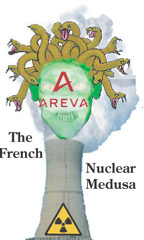 Areva’s difficulties and the nuclear illusion
The View From Brittany June 3 2009Areva is no ordinary company. It is the nuclear arm of the French state, in charge with the building and the supplying of French nuclear plants. Even though it is technically a corporation, it is owned by the Commissariat à l’Énergie Atomique, a public agency whose director is appointed by the French President who has occasionally sold nuclear plants on its behalf.
Areva, supposedly the “jewel” of the French industry is in real troubles. Even though it sells more than ever, its benefits have plummeted and it has been forced to cancel a mining project in Canada. According to the “Réseau Sortir du Nucléaire”, Areva needs 3 billions euros, mostly because of the costly failure the Olkiluoto EPR has proven to be. The Finnish third generation nuclear plant, which should have been put online this year has been delayed due to technical difficulties and costs are sky-rocketing – 5.4 billions instead of the original 3 billions. Moreover, South Africa has recently cancelled the building of 12 nuclear plants while the “sells” announced by the French presidency (4 plants in Italy and 2 in India) remain virtual – nobody know how they are going to be funded.
Areva is presently clamouring for public funds. It will probably get them, no matter how loud we, and others, protest. France, trapped as it is by its own nuclear strategy, simply cannot afford to lose the control of its uranium supply.
That is hardly the whole story, however. What this affair highlight is how problematic is nuclear power at the eve of catabolic collapse. A nuclear plant is very costly and takes a long time to build. Besides, it is of absolutely no use as long as it is not completed. The end result is that to launch a nuclear program you have to immobilize a lot of capital – human, natural and financial – without any hope of anything looking like a return of investment for quite a long time……………………Areva’s difficulties pose, however, another, often overlooked question : what will nuclear plants will become after the nuclear industry fails. In a number of countries, it may happen sooner than one thinks……………….And then what ?
Dismantling a nuclear plant and disposing of the wastes are very costly operation. Will the impoverished societies of forty years from now be able to afford them ? One can seriously doubt it. In fact, in a situation of worsening energy and capital shortage, one can expect them to operate their ageing nuclear plants to very end – the way the Ukrainian government did with Chernobyl – then let them decay away.
The result, needless to say, won’t be good for the neighbourhood,……………. This, by the way, can have interesting geopolitical consequences in countries such as France which are littered with nuclear plants.
The activists who, in the late seventies, have made sure no nuclear plant would ever be built in Brittany may have won their far descendants more than what they thought.
http://theviewfrombrittany.blogspot.com/2009/06/arevas-difficulties-and-nuclear.html
Obama Acknowledges Iran’s Right to Nuclear Energy
 Obama Acknowledges Iran’s Right to Nuclear Energy
NTI, June 3, 2009 U.S. President Barack Obama yesterday expressed support for Iran’s civilian nuclear power ambitions while calling on the Middle Eastern state to abandon activities that could contribute to nuclear weapons development, the Associated Press reported (see GSN, June 2)…………
……….. Iranian President Mahmoud Ahmadinejad yesterday pledged to continue defying the international community’s attempts at coercion if he is re-elected to office June 12, Agence France-Presse reported.
“If I get elected, I will go to the U.N. and tell the nations there who dare to threaten Iran … hold your hands up,” the first-term president said.
“Due to your resistance, Iran is now a nuclear nation” with “space” capabilities, he added (see GSN, April 15).
The U.N. Security Council has imposed three sets of sanctions on Iran over its disputed nuclear activities. The body’s five permanent members and Germany hope to negotiate a permanent halt to Iran’s enrichment program in return for civilian nuclear energy assistance and other benefits (Siavosh Ghazi, Agence France-Presse/Google News, June 2).
http://www.globalsecuritynewswire.org/gsn/nw_20090603_5010.php
Israel gives mixed signals on any attack on Iran
Israel gives mixed signals on any attack on Iran
Wed Jun 3, 2009 By Conor Sweeney
MOSCOW (Reuters) – Israel issued contradictory signals on Wednesday on whether it might bomb Iran, with its foreign minister saying there were no such plans and the defense minister saying all options were on the table.
Israel, widely believed to be the Middle East’s only nuclear power, has repeatedly described Iran’s uranium enrichment as a threat to its existence.
“I have been asked by Saudi journalists about when Israel plans to bomb Iran. We are not planning to bomb Iran,” far-right Israeli Foreign Minister Avigdor Lieberman said during a visit to Russia.
“We do not have a need” to carry out attacks on Iran, Lieberman told reporters in Russian when asked about a possible strike against Iran. “Israel is a strong country and we can defend ourselves.”
Israel has in the past said all options were on the table in preventing Tehran from building atomic weapons, and this was repeated later by Israeli Defense Minister Ehud Barak, who refused to rule out a military strike on Iran.
……………………………..Lieberman, who grew up in the Soviet Union, said if Iran gained nuclear bombs it would trigger an arms race in the Middle East region.
“This is not an Israeli problem,” he said. “This is a threat to the entire world order and entire world community. So we do not want this global problem to be solved (only) by our hands.” http://www.reuters.com/article/worldNews/idUSTRE55239U20090603
Texas has highest number of radioactive metal incidents
Texas has highest number of radioactive metal incidents
06/03/2009 By ISAAC WOLF, Scripps Howard News Service
For more than a month in the summer of 2006, a metal recycler in Longview, Texas, produced half a million pounds of radioactive material, state and federal documents show.
When LeTourneau Inc. workers melted Cesium-137 — a radioactive material commonly released in nuclear accidents — the dust containing the radioactive isotope contaminated the workers, along with sections of the facility, according to a July 2006 U.S. Nuclear Regulatory Commission report…………………..Other radioactive meltings in the Lone Star State include a May 1992 incident when El Paso metal recycler Border Steel melted Cesium-137 into a batch of iron, according to a barebones NRC report that provided no more details. In September 1993, Chaparral Steel in Midlothian also melted Cesium-137, according to a December 2007 Texas Department of State Health Services report.
Radioactive material has also been stolen in Texas. In 1996, at a Houston storage facility, someone swiped industrial X-ray devices containing the isotopes Cobalt-60 and Iridium-192. One of the devices was dropped near a scrap yard, where its protective shield was dislodged.
Scrap workers were exposed to dangerously high levels of radioactivity when they recovered the device, according to research by radiation experts James Yusko, of the Pennsylvania Department of Environmental Protection, and Joel Lubenau, who formerly worked for the NRC. Through reports, articles and personal correspondences, the two have unofficially tracked radioactive melting incidents in the United States and around the world.
‘Embarrassing’ mistake puts US nuclear list online
‘Embarrassing’ mistake puts US nuclear list online
By H. JOSEF HEBERT – 47 minutes ago
Google News WASHINGTON (AP) — The government’s inadvertent and red-faced Internet posting of a 266-page list of U.S. nuclear sites provided a one-step guide for anyone wanting details about such sensitive information. Obama administration officials said Wednesday the document contained no classified material about nuclear weapons. They contended the locations and other details already were available from public sources……………
…………The information, compiled for international nuclear inspectors, is a compilation of hundreds of civilian nuclear sites, along with maps and details of the facilities. The material includes sites for uranium storage, nuclear fuel fabrication plants and nuclear research facilities http://www.google.com/hostednews/ap/article/ALeqM5hCsPqjzeLAVBSZ0nrjjDm7Ywu-sAD98JJTCO1
Fight against foreign nuke waste in Utah continues
Fight against foreign nuke waste in Utah continues
SALT LAKE CITY Google News (AP) 4 June 09 — An eight-state radioactive-waste-management entity plans to appeal a federal court ruling that said a company can dispose of foreign nuclear waste at its facility in the western Utah desert.
A judge last month ruled against the Northwest Compact, which includes Utah and seven other states. The compact’s executive director, Mike Garner, said officials decided Monday to take the case to the 10th U.S. Circuit Court of Appeals in Denver.
Salt Lake City-based EnergySolutions Inc. wants to import up to 20,000 tons of low-level radioactive waste from Italy. After processing in Tennessee, about 1,600 tons would be disposed of in Utah.
Utah Gov. Jon Huntsman had used the state’s veto power on the compact to try to keep the foreign waste out.
http://www.google.com/hostednews/ap/article/ALeqM5hMSdLzDAdHpYWegCkb41SXyjNZqgD98JH2880
Sarkozy to meet Iran’s foreign minister
Sarkozy to meet Iran’s foreign minister Jun 2, 2009
PARIS (Reuters) – French President Nicolas Sarkozy will meet Iran’s foreign minister on Wednesday to discuss Tehran’s nuclear program, in rare talks between a leader of a major power and a senior Iranian politician…………………………
Bilateral encounters at such a senior level between Iran and one of the countries involved in the nuclear issue are highly unusual. It will be the first time Sarkozy has met a top Iranian minister since he took office in 2007.
Iran’s Foreign Ministry spokesman was not immediately available for comment.
The West accuses Iran of secretly developing atomic weapons. Iran, the world’s fifth-largest oil exporter, denies the charge and says it only wants nuclear power to generate electricity………………………………..Sarkozy is due to meet U.S. President Barack Obama on Saturday in France and Iran is certain to be on the agenda.
Sarkozy to meet Iran’s foreign minister Wednesday | International | Reuters
Member of German Parliament Sounds Death Knell for Carbon Energy
Member of German Parliament Sounds Death Knell for Carbon Energy ecoworldly by Tom Schueneman June 3rd, 2009 In Europe“The conventional energy industry is the biggest corrupter in the world”“If there is no change by 2030 there will be a bigger economic crash than the recent banking collapse”“The system must change”“Renewables are the only solution”- Hans-Josef Fell, member of German Parliament, Spokesperson for Energy and Technology, Faction Alliance90/The Greens……………
………………….. these words from Green party member Hans-Josef Fell express the nation’s determination to lead the world to a new energy economy……….
………Carbon capture and storage is unreliable and leads to similar problems as with nuclear energy – the inability to guarantee that our waste doesn’t pollute the lives of future generations.
Member of German Parliament Sounds Death Knell for Carbon Energy : EcoWorldly
DOE Nuclear Clean-Up Program “High-Risk Area For Fraud, Waste, Abuse, And Mismanagement”
DOE Nuclear Cleanup Program “High Risk Area for Fraud, Waste, Abuse and Mismanagement”The Huffington Post | Cara Parks 06- 2-09
The Department of Energy is not adequately reporting the environmental impact of its billion-dollar program to clean up nuclear waste, according to a government audit.
The Government Accountability Office released a report today noting that the DOE’s nuclear clean-up program has been labeled as “a high-risk area for fraud, waste, abuse, and mismanagement” since 1990, which the GOA says is the result of “inadequate management and oversight of its projects.”
As recently as March of 2009, the report stated, the GOA testified that cost increases at some major nuclear clean up projects were estimated to require an additional $25 to $42 billion to complete. Despite the consistent problems with the projects and ballooning budgets, the DOE did not adequately report its progress or the actual environmental impact of its work, the audit states.
The rising costs on major projects are now being funded partially by the stimulus package, which, according to The Washington Post, has earmarked over $6 billion for cleaning up nuclear sites. The article goes on to report that some of the private contractors receiving stimulus money were previously cited by the GAO for serious flaws in their performance.
DOE Nuclear Clean-Up Program “High-Risk Area For Fraud, Waste, Abuse, And Mismanagement”
Radiation contamination by Depleted Uranium
Concerns regarding radiation contamination by the use of Depleted Uranium (DU) weaponry in the Balkans, Kuwait, Iraq, Afghanistan, Pakistan and Eastern Mediterranean Countries. The Palestine Telegraph By Peter Eyre 1 June 09 The majority of high tech weapons today contain Depleted Uranium and or other Heavy Metals. Some are coated in DU and others have both DU and Heavy Metal in their warheads. DU is also used to act as a counterweight…………………………..
The European Parliament has expressed grave concerns on the use of such weapons as follows:
having regard to UN General Assembly resolution of 5 December 2007, highlighting serious health concerns about the use of depleted uranium weapons, having regard to Rule 108(5) of its Rules of Procedure,
A. whereas (depleted) uranium has been widely used in modern warfare, both as ammunition against hardened targets in rural and urban environments and as hardened armoured protection against missile and artillery attacks,
B. whereas, ever since its use by the allied forces in the first war against Iraq, there have been serious concerns about the radiological and chemical toxicity of the fine uranium particles produced when such weapons impact on hard targets; whereas concerns have also been expressed about the contamination of soil and groundwater by expended rounds that have missed their targets and their implications for civilian populations,
C. whereas, despite the fact that scientific research has so far been unable to find conclusive evidence of harm, there are numerous testimonies as to the harmful and often deadly effects on both military personnel and civilians,
D. whereas the last few years have seen great advances in terms of understanding the environmental and health hazards posed by depleted uranium, ………………
………………………..All of my research experts state it is radiation alpha particles from uranium atoms that causes the problem, and this type of contamination can be measured very precisely. It is the alpha particle that once inside your body runs rife and the rate and type of “Cancer” is subject to if it was inhaled or ingested. The latter is caused mainly in areas where DU dust has spread in the atmosphere and returned to earth in precipitation.
Environmental groups seek to overturn Oyster Creek nuclear plant license renewal
Environmental groups seek to overturn Oyster Creek nuclear plant license renewal nj.com by MaryAnn Spoto/The Star-Ledger Monday June 01, 2009,
LACEY TOWNSHIP — Two months after the Oyster Creek Nuclear Generating Station in Lacey Township won a 20-year extension of its license, a coalition of environmental and citizens groups has asked a federal court to overturn the decision.
Citing inadequate information provided to the U.S. Nuclear Regulatory Commission about the plant’s safety, the coalition wants a federal court to invalidate the relicensing of the 40-year-old facility
“We are appealing the decision because the Nuclear Regulatory Commission did not have sufficient information available to it to decide whether Oyster Creek can operate safely for the next 20 years,” said the coalition’s attorney, Richard Webster, of the Eastern Environmental Law Center.
The coalition is composed of the New Jersey Environmental Federation, the New Jersey Sierra Club, the Public Interest Research Group, the Nuclear Information Resource Service and Grandmothers, Mothers and More for Energy Safety (GRAMMES).
They contend the continued operation of the plant, which stores 650 tons of radioactive waste in an above-ground fuel pool, is an unnecessary risk for the 3.5 million people who live within a 50-mile radius of Oyster Creek — the nation’s oldest nuclear power plant. They said its safety record is the second worst of the nuclear plants throughout the country and its thermal releases into a nearby body of water create environmental problems for Barnegat Bay.
Environmental groups seek to overturn Oyster Creek nuclear plant license renewal – NJ.com
The Problem With Nuclear Power
Early on man realized that fossil fuels would soon run out, and so nuclear power was born. It was glorified as the cleaner alternative to oil and coal power stations, promising lower emissions and environmental safety. But has it really lived up to our expectations? And is it the ideal energy solution for the future? We think not…………………
Nuclear power cannot solve global warming:
Once seen as the solution to global climate change, nuclear power is far from it. Everywhere along the nuclear chain – from the mining of uranium to its transportation to the construction of the power plant – greenhouse gases are emitted.
Furthermore, their construction takes too long to solve global warming. In fact, investing in nuclear power deprives other efforts – such as energy efficiency, conservation and renewable energy – of further funding and development.
Nuclear plants release radiation:
The levels of radiation released in the air, water and soil are considered “safe”. However, this standard is based on how it impacts healthy, white males and does not take consideration for children that are sensitive to cancer-causing radiation.
They create harmful radioactive waste:
From mining to milling, processing to enrichment, fuel fabrication to fuel irradiation in reactors, large amounts of harmful, long-lasting radioactive waste is produced. In addition to 20-30 tons of high-level radioactive waste per reactor per year, this includes so-called “low” level radioactive waste.
The current solution for the “disposal” or “storage” of this waste is unacceptable. There is no scientifically safe place to dump this waste, and new reactors would exacerbate the problem. Additional “low” level radioactive waste would have to be dumped in landfills or incinerated, polluting the water and air.
Nuclear plants are too costly:
At $6 to $12 billion each, nuclear reactors are not a cheap solution. Nuclear power has already been subsidized hundreds of billions of dollars. Why should we, the taxpayers, subsidize the electric utility companies’ investments any longer?
Development of nuclear technology brings war and terrorism:…………………..Any accident will be catastrophic:
welcome to my space » Blog Archive » The Problem With Nuclear Power
Cost Overruns at Finland Reactor Hold Lessons
In Finland, Nuclear Renaissance Runs Into Trouble
OLKILUOTO, Finland — As the Obama administration tries to steer America toward cleaner sources of energy, it would do well to consider the cautionary tale of this new-generation nuclear reactor site.
The massive power plant under construction on muddy terrain on this Finnish island was supposed to be the showpiece of a nuclear renaissance. The most powerful reactor ever built, its modular design was supposed to make it faster and cheaper to build. And it was supposed to be safer, too.
But things have not gone as planned.
After four years of construction and thousands of defects and deficiencies, the reactor’s 3 billion euro price tag, about $4.2 billion, has climbed at least 50 percent. And while the reactor was originally meant to be completed this summer, Areva, the French company building it, and the utility that ordered it, are no longer willing to make certain predictions on when it will go online…………………………Most of the new construction is underway in countries like China and Russia, where strong central governments have made nuclear energy a national priority…………………………….resistance is mounting. In April, Missouri legislators balked at a preconstruction rate increase, prompting the state’s largest electric utility, Ameren UE, to suspend plans for a $6 billion copy of Areva’s Finnish reactor…………………………Areva has acknowledged that the cost of a new reactor today would be as much as 6 billion euros, or $8 billion, double the price offered to the Finns.
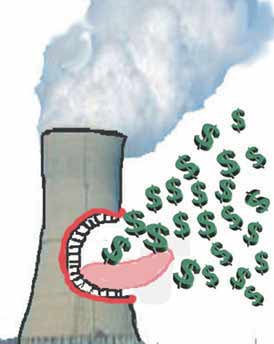
Climate crisis will not be solved by nuclear power
Guest column: Climate crisis will not be solved by nuclear power greenbay pressgazette.com Bill Christofferson • May 27, 2009 Concern about climate change has sparked a campaign by the nuclear power industry to try to sell itself as a “clean” energy solution, with Wisconsin a key target……….the campaign to persuade the Legislature and governor to open the door to more reactors in Wisconsin, which has not built one since 1974……..
……….Nuclear power makes no more sense today than it did when the law was passed in 1983. Wisconsin must address the climate crisis, but renewable energy and energy efficiency technologies are faster, cheaper, safer and cleaner strategies for reducing greenhouse emissions than nuclear power………………
1 This Month



9 September – online public forum THREE MILE ISLAND:
7-8:30 PM ET,
Legacy, resistance to reopening – https://us02web.zoom.us/webinar/register/WN_-LGJU4j6TD2Hgf0rpgAr1A#/registration
The nuclear industry and the U.S. Nuclear Regulatory Commission are threatening to restart Pennsylvania’s permanently closed and decommissioning Three Mile Island Unit 1 nuclear power station. Three expert speakers will present the resistance to this dangerous misadventure in a webinar hosted by the Clamshell Alliance, Beyond Nuclear and Massachusetts Peace Action.

No Nuclear in Cwm Llynfi! Stop the nuclear power station near Maesteg.
To see nuclear-related stories in greater depth and intensity – go to https://nuclearinformation.wordpress.com
-
Archives
- September 2026 (62)
- August 2026 (330)
- July 2026 (355)
- June 2026 (287)
- May 2026 (306)
- April 2026 (356)
- March 2026 (251)
- February 2026 (267)
- January 2026 (308)
- December 2025 (358)
- November 2025 (359)
- October 2025 (375)
-
Categories
- 1
- 1 NUCLEAR ISSUES
- business and costs
- climate change
- culture and arts
- ENERGY
- environment
- health
- history
- indigenous issues
- Legal
- marketing of nuclear
- media
- opposition to nuclear
- PERSONAL STORIES
- politics
- politics international
- Religion and ethics
- safety
- secrets,lies and civil liberties
- spinbuster
- technology
- Uranium
- wastes
- weapons and war
- Women
- 2 WORLD
- ACTION
- AFRICA
- Atrocities
- AUSTRALIA
- Christina's notes
- Christina's themes
- culture and arts
- Events
- Fuk 2022
- Fuk 2023
- Fukushima 2017
- Fukushima 2018
- fukushima 2019
- Fukushima 2020
- Fukushima 2021
- general
- global warming
- Humour (God we need it)
- Nuclear
- RARE EARTHS
- Reference
- resources – print
- Resources -audiovicual
- Weekly Newsletter
- World
- World Nuclear
- YouTube
-
RSS
Entries RSS
Comments RSS
 nuclear-news