Giant uranium companies spinning nuclear to kids
Tenex to Launch Children Nuclear Academy
Gainesville, FL, USA, September 3, 2009 (PRESSbooth.ORG) — Sigma Transnational, Techsnabexport (Tenex) North American Associate Partner, announced that Russian’s Uranium Giant, Tenex, will soon launch the Children Nuclear Academy in the Southeastern region of USA. ……………………… The Russian Children Nuclear Academy project was launched in Russia in January 2002 on the initiative by the Institute of Pandeia textbook and Educational Society public association. See additional information at http://www.dya.ru
Since 2003, the JSC Techsnabexport (Tenex) has been the chief sponsor of the annual Russian scientific and educational projects so-called the “Power of the Future” contest…………. As part of Techsnabexport (Tenex) social responsibility, Tenex supports education, charity and other community involvement.
Colorado: town board vote might stop uranium mining
Uranium mining may get buried in Nunn
Powertech says its process is safe but a vote by Nunn’s town board could make permitting difficult.
The Denver Post, by Monte Whaley 3 Sept 09
NUNN — Opponents of a huge uranium- mining operation northwest of Greeley say they are ready for a showdown tonight before the Nunn town board. Coloradoans Against Resource Destruction — a citizens group formed in 2007 — wants the Nunn board to back a resolution against a plan by Powertech Uranium Corp. to extract uranium from the windy plains that surround Nunn and two other small towns, Wellington and Carr………… CARD claims the mining will damage air and water and bring other health problems. A negative vote by the Nunn board will make state and local officials more reluctant to approve any permits for Powertech’s Centennial Project, said the group’s spokeswoman, Jackie Adolph……….. “The time is now for the town board to speak for the overwhelming majority of residents who think uranium mining this close to the town represents unacceptable risks,” resident Dan Rapelje said.
The project, opponents say, may reap more jobs but would be a detriment to long-term economic growth in the area.
Shock of indigenous people on uranium exploration agreement
Lutselk’e shocked by chief’s support of Ur-Energy exploration
CBC NewsSeptember 3, 2009
Some residents in Lutselk’e, N.W.T., were surprised Wednesday to hear their leadership is supporting a uranium company that’s exploring for uranium in the Upper Thelon area.
Members of the Lutselk’e Dene First Nation, which has long opposed uranium mining there, say they were shocked when Chief Steve Nitah told CBC News the First Nation signed an agreement allowing Ur-Energy Inc. to conduct a small exploration project this summer at its Screech Lane property, just south of the Thelon Game Sanctuary.
……….. Lutselk’e residents have been apprehensive about uranium mining for good reason: toxic waste tailings from a uranium project there in the 1950s were reportedly dumped into nearby Stark Lake.
People in the area have said that as a result, fish in the lake have since become deformed and infested with parasites.
http://www.cbc.ca/canada/north/story/2009/09/03/lutselke-ur-reax.html
US Dept of Energy preventing tax-payer comment about nuclear loan money?
 The U.S. Department of Energy is attempting to fast track its nuclear loan guarantee program by drastically limiting the opportunity for the public to comment on changes to its regulations.
On August 7th, the U.S. Department of Energy (DOE) posted an announcement in the Federal Register in which it weakened the rules, as by moving taxpayers further back in the line of lenders who would be paid back in the event of nuclear project default. This puts taxpayers at increased risk of being left holding the bag for tens of billions of dollars in loan repayments when new nuclear projects go belly up.
Despite such astronomical financial risks, and the complex technical nature of the regulatory changes, DOE has allowed just 30 days for the submission of public comments. The month-long comment period just happened to coincide with the August Congressional recess, with watchdog groups as well as House and Senate Members and staff away on travel. Many could well remain unaware of the changes until Congress resumes the day after Labor Day – the very day comments are due – Tuesday, Sept. 8th.
Read the details on DOE’s proposed nuclear loan guarantees.
Costly delays in fixing nuclear plant
Point Lepreau refurbishment 9 months late
September 2, 2009 ATCBC NewsThe troubled $1.4-billion refurbishment of the Point Lepreau nuclear reactor is suffering another setback, pushing the massive project nine months behind schedule, CBC News has learned.
Sources inside NB Power say the refurbishment of the reactor is being stalled because of problems with the installation of the plant’s new calandria tubes…………
Point Lepreau is the first Candu-6 reactor to undergo a complete gutting and rebuild. It was intended to be a showcase for AECL to display its ability to revive the 1980s-era reactors.
When the refurbishment project started, it was supposed to last 18 months and have the reactor back on line in October 2010
However, crews at Point Lepreau struggled to deconstruct the old reactor, finally finishing that stage in late July, almost eight months behind schedule.
NB Power has acknowledged delays at Point Lepreau will cost $20 million a month.
Finland’s nuclear plant: more delays, cost overruns
More Delays at Finnish Nuclear Plant
The New York Times. September 2, 2009, By James Kanter
AREVA a French nuclear construction company, said this week that its project to build the world’s most powerful reactor remained mired in delays and was over-budget by 2.3 billion euros, or about $3.3 billion.The price tag of the plant in Olkiluoto, Finland — the first of a fleet of so-called evolutionary power reactors that Areva foresees building in coming years — was about $4.3 billion in 2003 and costs have steadily increased.
The reactor was meant to have gone online early this summer but Areva no longer is committing to any dates for its completion. Patrice Lambert de Diesbach, an energy analyst with CM-CIC Securities in Paris, said the latest developments were “bad news” for Areva and “should be sanctioned by the market.”
The problems faced by Areva are important a time when the nuclear power industry is promising to build safer and more reliable reactors than during the last building boom in the 1960s and early 1970s. …………………………
So far there are few signs of a breakthrough in Finland.
Areva said this week that it would not begin work on the final stages of the reactor until the Finnish utility agreed to a new set of proposals and modifications.
More Delays at Finnish Nuclear Plant – Green Inc. Blog – NYTimes.com
Paladin loss, as uranium price slips
Money Sept 2 09
…….- Paladin’s loss was greater than the broker expected, given greater ramp-up and exploration costs. With cashflow tight Paladin has been forced to draw down on its debt facility although first half FY10 inventory sales mean it’s just a bridging deal.Paladin’s realised uranium price was also lower than expected given a higher level of spot over contract sales. As the U price continues to drift and the Kayakelera ramp-up remains slow, the broker sees no positive catalysts. Hold retained on slightly lower earnings forecasts.
AREVA going to court over Finland nuclear reactor runaway costs
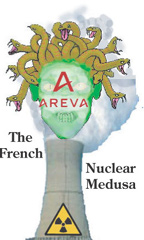 Areva’s half-year results yesterday night brought new information about the Olkiluoto-3 EPR nuclear fiasco:
South Africa’s nuclear company Eskom makes huge loss
Corporate Toughest of times for Eskom
World Nuclear News28 August 2009
Eskom, South Africa’s state-owned utility, has reported a record annual loss and has warned of a funding gap for an expansion program needed to prevent a repeat of the blackouts the country experienced in 2008.The company, which supplies about 95% of South Africa’s electricity and more than 60% of Africa’s, reported a loss of 9.7 billion rand ($1.25 billion) for the year ended 31 March. In the previous year, Eskom made a loss of 210 million rand ($27 million)………….
No public scrutiny for Florida nuclear waste storage
Florida Power and Light’s “dark” business
“…………..As storage of nuclear waste continues to pose concern across the country, an FPL land use change at Turkey Point raises questions about potential safety and environmental risks
Poder 360 By Siobhan Morrissey Sept 09“…………….Plans for the dry cask storage facility have sparked controversy because the project has not been aired at public hearings. Instead, the project was moved along quickly and quietly, with the state Department of Environmental Protection (DEP) granting certification on May 18, roughly six weeks after receiving FPL’s application and without an opportunity for public input. Without fanfare, the approval slipped the notice of interested parties such as the Sierra Club, the Tropical Audubon Society and Clean Water Action. Miami-Dade County officials and environmentalists maintain the utility company and the regulatory agency did an end run to avoid public scrutiny……………
Currently, FPL places the spent nuclear fuel onsite in wet storage structures that resemble cavernous, stainless-steel-lined swimming pools. But it’s getting crowded in the pools, so the utility is resorting to dry cask storage.
“They’re simply running out of room in the spent fuel pools for the current two [reactor] units,” says Roger Hannah, a spokesman for the Nuclear Regulatory Commission. “You never want to get below a certain point [of capacity]. You have to start several years in advance.”…………………
But how did FPL manage to avoid a public discussion of the environmental concerns? FPL presented the proposed dry storage facility as an amendment to an existing certificate that DEP issued last October when the utility sought permission to ramp up its power output. In the industry, this is commonly known as “uprating.” FPL plans to begin increasing its power output at Turkey Point by 14 percent as early as 2011.
It’s a problem nuclear power plants across the country face,
India: nuclear deal will cause problems
A Different Perspective on the U.S.-India Nuclear Deal
MONTHLY REVIEW Peter Custers Sept 09
The U.S.-India nuclear deal was initiated through a framework agreement signed by India’s Prime Minister Manmohan Singh and U.S. President Bush in July 2005.India, at the instigation of Washington, agreed to separate its civilian and military nuclear production facilities, and place all civilian production facilities under the inspection regime of the International Atomic Energy Agency (IAEA), in return for U.S. economic, technological, and military cooperation. The nuclear deal, which took three years to complete, is officially aimed at promoting India’s access to uranium and to civilian nuclear technology, through enlarged importation of both………….
……From its very start, the U.S.-India nuclear deal has generated huge controversies, both in India and internationally. The intent here is to lay bare the implications of the deal for the creation of waste,……………
fears that the controversial deal will enhance the danger of a nuclear conflagration in South Asia appear to be well grounded, even if we leave aside all other interrelated objections that have been raised……………..
the side effects in terms of generation of nuclear waste are so ponderous that, from this perspective too, implementation of the deal needs to be preempted…………….
the U.S.-India nuclear deal is bound to result in huge quantities of extremely dangerous waste that cannot be sold on the market, but needs to be put aside, at great risk to humans and to our natural environment……………….
A Different Perspective on the U.S.-India Nuclear Deal – Monthly Review
Nuclear sites fear they’ll get USA nuclear waste dump
Nuclear sites fear they’re the alternative to Yucca Mountain
Kansas city.com By LES BLUMENTHAL McClatchy Newspapers 1 Sept 09
It is among the nastiest substances on earth: more than 14,000 tons of highly radioactive waste left over from the building of the nation’s nuclear weapons arsenal……………….Local leaders and lawmakers from the sites where the waste is now stored, however, are increasingly concerned the Energy Department will leave it in place, even though that might violate legally binding cleanup agreements.
There’s no backup plan for dealing with the waste. A promised commission to study the issue has yet to be appointed.
“We don’t want to become a long-term repository without even having a discussion,” said Gary Petersen of the Tri-City Industrial Development Council, near Hanford, Wash. “All of this waste is supposed to be going to Yucca. Without Yucca, everyone in the weapons complex has a problem.”
Jared Fuhriman, the mayor of Idaho Falls, the largest city near the Idaho National Laboratory, agreed.
“We are all concerned,” Fuhriman said. “Where are we going to store the waste we have?”
If Yucca is closed, a search for a new site for a national repository likely would start with the 31 states on the original list of potential locations. In addition to Hanford and the Idaho National Laboratory, the states with possible sites include Texas, Georgia, North Carolina, South Carolina, Mississippi and Pennsylvania……………..
The biggest concern has been the liquid waste, stored in aging and occasionally leaking underground tanks. Current plans call for the waste to be vitrified, or solidified into glass-like logs, and shipped to Yucca Mountain. The logs would be encapsulated in two-foot diameter, 14.5-foot-long stainless steel containers that would weigh about four tons each. The waste treatment plant would generate about 480 glass logs a year and somewhere between 10,000 and 15,000 by the time the last of the waste is processed.
Nuclear sites fear they’re the alternative to Yucca Mountain – Kansas City Star
Bulgaria: right wing opposition to nuclear plant
Bulgaria Right-Wingers Call for Halt of Nuclear Plant Plan
novinite.com September 1, 2009,Bulgaria’s biggest right-wing party has reiterated its calls on the new government to give up the planned Belene project as it is still undecided whether to scrap or push ahead the construction of the multi-billion nuclear power plant.
“The price tag of the nuclear power plant at the Danube river town will stand at no less than EUR 10 B,” Martin Dimitrov, leader of the Union of Democratic Forces (UDF), said at a press conference on Tuesday.
According to him Belene nuclear power plant will not benefit local consumers, which makes it completely useless.
“Freezing the project is no solution to the problem,” Dimitrov added.
UDF leadership has repeatedly warned that the construction of the plant will translate into a BGN 1300 tax burden for each Bulgarian taxpayer, electricity hikes for decades on end, outdated and dubious Russian nuke units…………….
…………According to reports and non-governmental organizations RWE AG’s plan to expand in Bulgaria’s nuclear market is on the brink of collapse because financing for the project couldn’t be obtained.
Financial crisis hurts some Eastern Europe nuclear plans
Financial crisis hurts some Eastern Europe nuclear plans
By Anna Mudeva
SOFIA (Reuters) 1 Sept 09
– Domestic political squabbles, funding woes and other hurdles threaten a number of nuclear power plant projects in central and southeast Europe
…………..Analysts say the global economic crisis has made banks reluctant to provide loans for nuclear plants, which cost around 3 billion euros ($4.30 billion) per 1,000 megawatt reactor, for a pay-off that takes decades.
Equipment suppliers and engineering companies are also unwilling to give fixed price tags during volatile times, which makes planning and calculation of costs difficult.
Indian government secretive about uranium pollution of Punjabi children
India’s generation of children crippled by uranium waste
Observer investigation uncovers link between dramatic rise in birth defects in Punjab and pollution from coal-fired power stations
Guardian.co.uk The Observer by Gethin Chamberlain 30 August 2009
Their heads are too large or too small, their limbs too short or too bent. For some, their brains never grew, speech never came and their lives are likely to be cut short: these are the children it appears that India would rather the world did not see, the victims of a scandal with potential implications far beyond the country’s borders………………………Health workers in the Punjabi cities of Bathinda and Faridkot knew something was terribly wrong when they saw a sharp increase in the number of birth defects, physical and mental abnormalities, and cancers. They suspected that children were being slowly poisoned.
But it was only when a visiting scientist arranged for tests to be carried out at a German laboratory that the true nature of their plight became clear. The results were unequivocal. The children had massive levels of uranium in their bodies, in one case more than 60 times the maximum safe limit.
The results were both momentous and mysterious………………..if a few hundred children – spread over a large area – were contaminated, how many thousands more might also be affected? Those are questions the Indian authorities appear determined not to answer. Staff at the clinics say they were visited and threatened with closure if they spoke out. The South African scientist whose curiosity exposed the scandal says she has been warned by the authorities that she may not be allowed back into the country.But an Observer investigation has now uncovered disturbing evidence to suggest a link between the contamination and the region’s coal-fired power stations………………………
India’s reluctance to acknowledge the problem is hardly unexpected: the country is heavily committed to an expansion of thermal plants in Punjab and other states. Neither was it any surprise when a team of scientists from the Department of Atomic Energy visited the area and concluded that while the concentration of uranium in drinking water was “slightly high”, there was “nothing to worry” about. Yet some tests recorded levels of uranium in the ground water as high as 224mcg/l (micrograms per litre) – 15 times higher than the safe level of 15mcg/l recommended by the WHO. (The US Environmental Protection Agency sets a maximum safe level of 20mcg/l.)…………………………
There have also been claims that the contamination may have been exacerbated by depleted uranium carried on the wind from the wars in Iraq and Afghanistan. At a seminar in Amritsar in April, Admiral Vishnu Bhagwat, a former chief of the naval staff, suggested that areas within a 1,000-mile radius of Kabul – including Punjab – may be affected by depleted uranium. Although the prevailing monsoon winds blow either from the north-east or the south-west, there are times when a depression originating in the Mediterranean can result in rainfall in Punjab.
India’s generation of children crippled by uranium waste | World news | The Observer
1 This Month
23-25 October – on Zoom – World BEYOND War’s annual global conferenc

To see nuclear-related stories in greater depth and intensity – go to https://nuclearinformation.wordpress.com

Say No to NASA’s Reckless Nuclear Reactor on the Moon
Say No to NASA’s Reckless Nuclear Reactor on the Moon
-
Archives
- October 2026 (149)
- September 2026 (339)
- August 2026 (330)
- July 2026 (355)
- June 2026 (287)
- May 2026 (306)
- April 2026 (356)
- March 2026 (251)
- February 2026 (267)
- January 2026 (308)
- December 2025 (358)
- November 2025 (359)
-
Categories
- 1
- 1 NUCLEAR ISSUES
- business and costs
- climate change
- culture and arts
- ENERGY
- environment
- health
- history
- indigenous issues
- Legal
- marketing of nuclear
- media
- opposition to nuclear
- PERSONAL STORIES
- politics
- politics international
- Religion and ethics
- safety
- secrets,lies and civil liberties
- spinbuster
- technology
- Uranium
- wastes
- weapons and war
- Women
- 2 WORLD
- ACTION
- AFRICA
- Atrocities
- AUSTRALIA
- Christina's notes
- Christina's themes
- culture and arts
- Events
- Fuk 2022
- Fuk 2023
- Fukushima 2017
- Fukushima 2018
- fukushima 2019
- Fukushima 2020
- Fukushima 2021
- general
- global warming
- Humour (God we need it)
- Nuclear
- RARE EARTHS
- Reference
- resources – print
- Resources -audiovicual
- Weekly Newsletter
- World
- World Nuclear
- YouTube
-
RSS
Entries RSS
Comments RSS

