End the nuclear ‘safety myth’
The International Atomic Energy Agency’s final report on the March 2011 triple meltdowns at Tokyo Electric Power Co.’s Fukushima No. 1 nuclear power plant puts the main blame on the then prevailing assumption that Japan’s “nuclear power plants were so safe that an accident of this magnitude was simply unthinkable.” Constant monitoring is needed to make sure the government, power companies and nuclear regulatory authorities aren’t falling into the same “safety myth” as they push to reactivate idled reactors that meet what is now touted as the “world’s most stringent” nuclear safety standards.
Last week, Kyushu Electric Power Co. began commercial operation of the No. 1 reactor of its Sendai nuclear power plant in Satsumasendai, Kagoshima Prefecture — a little over a month after it became the first reactor idled since 2011 to be reactivated on the basis of the safety standards that were tightened in response to the Fukushima disaster. The utility plans to restart the plant’s No. 2 reactor as early as next month, and the Abe administration and the power industry are pushing to bring more idled plants back online once they have cleared the Nuclear Regulation Authority’s screening.
The regulatory system for nuclear power generation has been reformed since the 2011 crisis. The old Nuclear and Industrial Safety Agency, which came under fire for the Fukushima debacle, has been replaced by the NRA, and new regulations introduced in 2013 require operators of nuclear power plants to beef up their defense against natural disasters such as major earthquakes and tsunamis. But while the NRA itself states that compliance with the new standards does not guarantee the plants’ safety, the government says the plants are ready for restart because they meet the NRA criteria. No one appears ready to take final responsibility for the plants’ safety.
The IAEA report, compiled by around 180 experts from 42 countries and submitted to an annual general conference of the United Nations nuclear watchdog this week, highlights the “assumption” held by Japan’s nuclear plant operators prior to 2011 that a crisis of that magnitude would not happen, which was never challenged by the government or regulatory authorities, leaving the nation unprepared for a severe accident.
The Fukushima power plant lost its emergency power supply after it was flooded by a 15-meter tsunami triggered by the magnitude-9 quake on March 11, 2011. The loss of power crippled its crucial core-cooling functions and led to the meltdowns in its three operating reactors. Citing Tepco’s failure to take precautionary action against such external hazards despite an estimate prior to the disaster that a powerful quake off Fukushima could cause a tsunami of roughly the same scale that hit the plant site, the report said “there was not sufficient consideration of low probability, high consequence external events,” partly because “of the basic assumption in Japan, reinforced over many decades, that the robustness of the technical design of the nuclear plants would provide sufficient protection against postulated risks.” This assumption led to “a tendency for organizations and their staff not to challenge the level of safety” and “resulted in a situation where safety improvements were not introduced promptly.”
The report also pointed to the deficiencies in Japan’s nuclear regulatory system behind the Fukushima disaster. “The regulation of nuclear safety in Japan at the time of the accident was performed by a number of organizations with different roles and responsibilities and complex interrelationships. It was not fully clear which organizations had the responsibility and authority to issue binding instructions on how to respond to safety issues without delay,” it said. “The regulations, guidelines and procedures in place at the time of the accident were not fully in line with international practice in some key areas, most notably in relation to periodic safety reviews, re-evaluation of hazards, severe accident management and safety culture.”
IAEA Director General Yukiya Amano, in his foreword to the report, says Japan’s regulatory system has since been reformed to meet international standards, with regulators given clearer responsibilities and greater authority. Whether the new plant safety standards are the world’s most stringent or not, plants that meet the standards are supposed to withstand much greater levels of external hazards and be better able to respond to emergencies than before.
Still, complacency under the new standards would risk reviving the same safety myth rebuked in the report. Questioning whether the tightened standards are sufficient could be branded as demanding zero tolerance of risks and thereby unrealistic. However, as the IAEA report points out, it was an “unlikely combination of events” that hit the Tepco plant, and the utility’s unpreparedness for such a situation that resulted in the 2011 disaster.
We need to consider whether the tendency to dismiss low-probability risks as “small enough” — as was, for example, the risk of Kyushu Electric’s Sendai plant being hit by a volcanic eruption when the go-ahead was given for its restart — is acceptable from the viewpoint of preventing severe accidents at nuclear plants in the future.
Source: Japan Times
http://www.japantimes.co.jp/opinion/2015/09/14/editorials/end-nuclear-safety-myth/#.Vfjrx5eFSM9
EDITORIAL: Reflections on 2 years without nuclear power ahead of planned restarts
Japan has survived without atomic energy for almost two years since all of the country’s nuclear power reactors were taken offline in the aftermath of the Fukushima nuclear accident triggered by the March 2011 earthquake and tsunami disaster.
The country rode out summers and winters, despite surges in electricity demand for air-conditioning and heating purposes, with no major blackouts.
The triple meltdown at the Fukushima No. 1 nuclear power plant, which threatened the very survival of the Japanese state, has yet to be brought under control.
Opinion polls show that more than half of the general public is opposed to restarting nuclear reactors. The public’s desire to keep the reactors offline, even at the cost of inconvenience, is due to the fact that people have learned how dreadful atomic energy can be.
However, the Abe administration is seeking a return to nuclear power. It is preparing to restart Kyushu Electric Power Co.’s Sendai nuclear power plant in Kagoshima Prefecture in August, and aims eventually to have atomic energy account for 20 percent or more of Japan’s electricity mix in the future.
We oppose any return to nuclear power that comes without serious debate. Japan should make utmost efforts to avoid restarts, while at the same time taking care that doing so will not place an onerous burden on people’s living standards. Our energy needs should be centered on renewable energy sources rather than nuclear power as the primary source of electricity.
POWER DEMAND ALREADY COVERED
The Asahi Shimbun published a series of editorials in 2011 calling for a society free of nuclear power.
We stated that all of Japan’s nuclear reactors should be decommissioned, hopefully in 20 to 30 years, with priority given to aged reactors and high-risk reactors. The reactors to be kept alive should be selected on a “safety first” basis and limited to those necessary from the viewpoint of supply and demand.
We also stated that Japan should do its best to develop and spread the use of renewable energy sources while simultaneously pursuing measures for power saving and energy conservation. Thermal power generation could be strengthened as a stopgap measure, although steps should be sought in the long term so that a departure from nuclear energy does not contribute to global warming.
We also said Japan should push forward with power industry reform to encourage new entrants into the market while moving toward a decentralized energy society where wisdom and consumer choice play a greater role.
Our basic ideas remain the same. But the situation has changed over the last four years.
The most dramatic development is that the amount of electricity generated by nuclear reactors is now zero.
Nuclear reactors were up and running across Japan four years ago. They were subsequently taken offline one after another for regular inspections. Kansai Electric Power Co.’s Oi nuclear power plant in Fukui Prefecture was reactivated temporarily, but no single nuclear reactor has been brought back online since September 2013.
Despite concerns that were raised, no serious power shortages occurred. Emergency power sources were raked up to stave off a crisis on some occasions, but there has always been sufficient supply to cover demand, partly because the practice of saving power has taken root in the public mind, and partly also because capacities were enhanced at thermal power plants and regional utilities cooperated in supplying power to each other.
But it is too early to say that we have a solid foundation for keeping the number of active nuclear reactors at zero.
The clustered siting of power plants, whereby electricity is sent from large-scale power stations to faraway areas with heavy power consumption areas, has remained unchanged after the nuclear disaster. Systemic vulnerability is still an issue. And there is always the danger of unforeseen circumstances unfolding if a key thermal power plant were to malfunction during peak power demand.
SYSTEMIC VULNERABILITY PERSISTS
The current situation, where thermal power accounts for 90 percent of Japan’s electricity, could hardly be called sustainable. As long as Japan relies on imports for its energy sources, the country will remain permanently exposed to the risk of variations in foreign exchange rates and prices.
We are also left to reflect on the extent to which the general public and the Japanese economy could tolerate additional increases in electricity rates. We have to avoid letting rate hikes, without detailed studies, have a serious impact on people’s living standards and general economic activity.
The risk of a serious impact on people’s lives has yet to be reduced to zero. Given the situation, it is difficult to totally rule out the option of restarting nuclear reactors as a last resort.
However, decisions on restarting individual nuclear reactors must be made with extreme care.
What kind of disadvantage could be averted by activating a particular nuclear reactor? Will a nuclear restart still be necessary after power demand has been covered by a mutual supply of electricity over broad areas? Persuasive explanations should be available from viewpoints such as these.
The nuclear reactor in question must be safe enough from the viewpoint of its geographical location. Means must also be available to allow residents of adjacent areas to evacuate in an emergency. These are obvious preconditions for a nuclear restart.
The fact that we have got along without nuclear power has correspondingly heightened the hurdles for a restart.
Japan, under these circumstances, must develop renewable energy sources as quickly as possible and pursue a shift to a distributed system of electric power. Indispensable to that end are policy initiatives for guiding a switch to the new direction.
The central government should set a pathway for reform and focus its resources on upgrades on the power grid, disposal of nuclear waste and other efforts. There should also be organizational arrangement for pursuing the decommissioning of nuclear reactors, assistance to local governments that will lose revenue from the nuclear plants they host, and transitional measures for business operators associated with nuclear power generation.
FUKUSHIMA DISASTER THE STARTING POINT
The Abe administration, however, is heading in the opposite direction.
It initially said it would reduce Japan’s dependence on nuclear energy as much as possible, but then changed course to maintaining nuclear plants, and left it all up to the Nuclear Regulation Authority to make all decisions on the safety of nuclear reactors ahead of any go-aheads for restarts.
The NRA is tasked only with screening procedures to ensure the safe operation of nuclear power plants. It is not in any way responsible for the entire policy.
The administration told local governments hosting nuclear plants that the central government will be responsible, but what precisely this entails remains to be seen. A mountain of unanswered questions remain about the Sendai nuclear plant, such as measures to ensure the safety of local residents and measures against potential volcanic eruptions.
The Fukushima nuclear disaster should be the starting point for reflecting on the issue of nuclear power generation.
We should think about ways to make the most of the fact that no nuclear reactor is active now.
Source : Asahi Shimbun
http://ajw.asahi.com/article/views/editorial/AJ201507300035
Shareholders pressure utilities to ditch nuclear power

Shareholders and politicians on Thursday urged the nation’s top utilities to exit nuclear power as the central government moves to restart reactors idled by public safety fears in the wake of the triple core meltdown in Fukushima Prefecture in 2011.
Despite a number of antinuclear proposals pushed at the shareholders’ meetings, however, officials from the utilities said this week they were eager to restart nuclear power plants as soon as possible after their businesses were staggered by the halt of all commercial nuclear reactors in the country after 3/11.
Nine utilities with nuclear plants, including the biggest, Tokyo Electric Power Co., which manages the meltdown-hit Fukushima No. 1 power station — held their general shareholders’ meetings at a time when a nuclear power plant in the southwest is preparing go back online this summer for the first time under tighter post-Fukushima safety requirements.
Japan, which relies heavily on imported energy, invested heavily in nuclear power for decades, making withdrawal from what some believe to be a cheaper, less-polluting power source a difficult proposition to swallow.
At Tepco’s meeting, Katsutaka Idogawa, former mayor of the town of Futaba — which has been rendered uninhabitable by radiation contamination — said pulling out of atomic power is “the only way for the company to survive.”
Tepco, as the utility is known, has “forced people who were living peacefully into a situation like hell . . . I propose that Tepco break away from nuclear power,” the mayor said. Futaba co-hosts the Fukushima No. 1 plant.
Officials from Kansai Electric Power Co., which held its shareholders meeting in Kobe for the first time in many years, faced a barrage of tough questions about nuclear power, its decision to raise prices, and its ¥148.3 billion net loss in fiscal 2014.
Kepco faced sharp criticism for hiking household rates 8.36 percent at the beginning of the month because, as it acknowledges, its 11 commercial reactors are still idle, forcing it to rely more on imported fossil fuels. That was a sore point Thursday with politicians representing cities that hold Kepco shares.
“It’s regrettable the rise in rates is putting strong pressure on people’s lifestyles. Kepco’s efforts at management efficiency are still lacking,” said Kobe Mayor Kizo Hisamoto. Kobe owns about 3 percent of Kepco’s stock.
Osaka Mayor Toru Hashimoto, one of the utility’s harshest critics, was not present Thursday but submitted a motion together with the city of Kyoto calling on Kepco to get out of nuclear power. The motion was voted down. Osaka owns about 9.4 percent of Kepco’s stock.
Kepco’s heavy losses and its plans to restart reactor Nos. 3 and 4 at the Takahama plant in Fukui Prefecture — despite a provisional injunction from the Fukui District Court in April — prompted calls from many shareholders for management, especially Chairman Shosuke Mori and President Makoto Yagi, to resign. But they and 14 other senior executives were re-elected.
“Nuclear power is part of the national energy policy, an important baseload. For reasons of energy security, economics, and reducing greenhouse gas emissions, we need to restart the reactors,” Yagi said at a news conference in Osaka on Thursday afternoon.
Shareholders expressed worries about how Kepco will adjust to the full deregulation of the electricity market next year, which is expected bring new, more flexible competition for electricity service at a time when the company is financially strapped.
In Fukuoka, shareholders at Kyushu Electric Power Co., which is looking to restart its Sendai nuclear plant in Kagoshima Prefecture in August, proposed that the president be dismissed, saying his stance of continuing nuclear power has hurt earnings.
But President Michiaki Uriu told the meeting that the utility “aims to restart nuclear reactors as soon as possible on the premise that securing safety is the priority.”
Prime Minister Shinzo Abe wants to reactivate reactors that meet safety regulations beefed-up by the new nuclear regulator that was set up after the Fukushima crisis. The majority of the public, however, remains opposed.
The government plans to make nuclear energy account for 20 percent to 22 percent of the country’s total electricity supply in 2030, compared with around 30 percent before.
Source : Japan Times
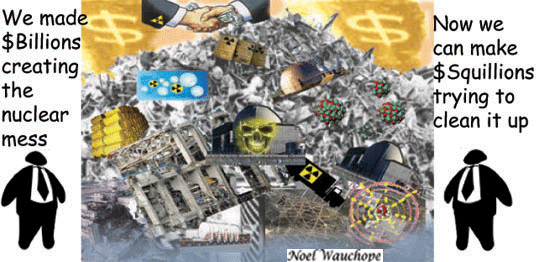
New private consortium to decommission nuclear power stations – will cut 1600 jobs
 Magnox nuclear decommissioning consortium to cut up to 1,600 jobs, Guardian, Terry Macalister, 22 May 15 Cavendish Fluor Partnership says plans reflect ‘stepdowns’ in work at nuclear plants around UK The new private consortium that recently won the £4.2bn management contract for the decommissioning of 12 Magnox nuclear power stations has revealed plans to cut up to 1,600 jobs. Cavendish Nuclear, a division of Babcock International, plus its US partner Fluor, said the cuts reflected “planned stepdowns in the work programme” at a number of atomic sites around the UK.
The move comes amid speculation that Babcock is preparing to demand millions of pounds of extra subsidies from the Nuclear Decommissioning Authority (NDA) on the grounds that the workload was much heavier than anticipated.
Unions expressed shock that staff, agency and contract workers would lose their jobs between now and September 2016, although the Cavendish Fluor Partnership said it would try to find some alternative posts. Eleven of the plants have already shut down and the remaining one in operation – Wylfa on Anglesey in North Wales – is due to stop generating power at the end of the year.
Problems with the decommissioning of the separate Sellafield site in Cumbria have recently led to the private consortium there which includes Amec and Areva of France – being thrown off the management contract.
The 12 nuclear power sites managed by the Cavendish consortium for Magnox include Berkeley, Gloucestershire; Bradwell, Essex; and Hinkley Point A in Somerset.
EDF last month announced plans to cut 400 construction jobs at the site of the planned new atomic plant of Hinkley Point C.
The reduction in workers comes amid continuing delays over a final investment decision on the £24.5bn project as negotiations with potential investors continue to move more slowly than expected. http://www.theguardian.com/business/2015/may/21/magnox-nuclear-decommissioning-consortium-cut-1600-jobs
‘Kantei Santa’ makes himself heard over the din of the election vans Is crime justified in the service of good?

It’s an ancient question. “Thou shalt not kill,” says the Bible — war in God’s service being an implicit exception. Then there’s Don Quixote, lover of justice, upholder of virtue, who founders on the impossibility of doing good without committing outrages. His name became an adjective — quixotic — for a certain kind of activism that fails to allow for the practical limits life imposes on ideals.
“Quixotic” is a word Shukan Bunshun magazine applies to the self-described “Kantei Santa” — kantei meaning the prime minister’s official residence, Santa needing no introduction, surprising though it is to see him at work so far from Christmas. “Kantei Santa” was the signature on a warning note attached to a miniature drone found in late April on the roof of the prime minister’s residence. “Radioactive,” said the note. The stunt, it explained, was a protest against the government’s drive to restart nuclear power stations idled in the wake of the meltdown catastrophe in Fukushima in March 2011. A quantity of earth in a container attached to the drone was in fact found to be mildly radioactive. “Santa” reportedly told police he dug it up in Fukushima.
The “Santa” police have in custody is 40-year-old Yasuo Yamamoto of Obama, Fukui Prefecture. In Shukan Bunshun’s profile, Yamamoto comes across as sufficiently idiosyncratic to beg the question: Is the crime attributed to him explicable simply as the work of one emotionally unstable individual, or is there a broader significance?
Many people are against the nuclear restarts; Yamamoto is not alone there. Japan is a democracy. Democracy means the government is responsive to the popular will, as freely expressed via the media, demonstrations, elections. In undemocratic societies, citizens must resort to crime to make themselves heard. Insisting on being heard is itself a crime.
Japan is a democracy but, as many observers have been noting lately, a flawed one. It comes perilously close, for one thing, to being a one-party state, the Liberal Democratic Party having held power for all but three of the past 60 years. Gerrymandered electoral districts are unrepresentative to the point that the Supreme Court last November, following numerous lower courts, cast doubt on their constitutionality.
Seemingly undemocratic government initiatives lately are growing increasingly bold, conspicuous among them a new state secrets Law that potentially criminalizes a key aspect of a journalist’s job — namely, the pursuit of public information.
Proposed revisions to the 68-year-old Constitution seem to weaken its protection of democratic rights while strengthening the national military. Some at least among those old enough to remember Japan’s undemocratic and militarist past, and some younger people attentive enough to listen to them, are not reassured by the benign official phrase “proactive pacifism.” Should they be?
Elections are the lifeblood of democracy, and Japan has just been through two of them — one national, the other a nationwide series of local ones. The first, in December 2014, gave Prime Minister Shinzo Abe a resounding victory in spite of widespread unease, consistently surfacing in opinion polls, over the course he is charting. The second, in April, was marred by a curious fact unworthy of a vigorous and healthy democracy — 22 percent of incumbents ran unopposed. No wonder voter turnout sank to record lows — less than half on average. Turnout for the national election in December was little better — 52.66 percent, also a record low.
Can democracy survive public apathy? Japan is not the only developed nation facing that question. Democracy prolonged is democracy taken for granted. Infant democracies do better in that regard. Voters take courage from situations that demand courage, streaming en masse to the polls in defiance of army thugs, terrorist threats, even terrorist bombs.
“Sato! Sato! Sato!” Anyone who has lived through a Japanese election campaign will know what that refers to — the incessant screeching of candidates’ names into loudspeakers mounted on campaign vans that roll through your neighborhood and mine, turning daily life into a nightmare of cacophony. Again: No wonder people don’t vote; they feel belittled and insulted. In 70 years of democracy, can campaigning have failed to mature beyond this?
Don’t blame the candidates, said the Asahi Shimbun in a pre-election report. The rules that bind them are strict, minute and seemingly meaningless. “No other country has campaign rules as strict as Japan’s,” Waseda University professor Minoru Tsubogo tells the newspaper. No door-to-door campaigning. No ad balloons. No candidates’ speeches from moving vehicles. No posters larger than 40×30 cm. Each individual poster must bear a certifying seal. Internet campaigning was finally permitted in 2013 but seems not to have caught on. So it’s “Sato-Sato-Sato,” rookie candidates being the worst offenders because the incumbents are already known. The system doesn’t change because the incumbents who can change it are its beneficiaries — which may have something to do with Japan’s virtual one-party statehood.
A society so rigid in some respects can be curiously lax in others. If drones were regulated half as closely as election campaigning, Kantei Santa would never have got off the ground. Granted, technological progress this rapid is bound to outpace legislation; still, Japan, having received a sharp lesson in vulnerability from the Islamic State terrorist group last winter, appears curiously inattentive to the security risks involved.
A former Air Self-Defense Forces enlistee with special skills in electronics, Yamamoto had ample opportunity to ponder the implications of nuclear power — his native Fukui hosts more reactors than any other prefecture. On his blog he named Ernesto “Che” Guevara — not Don Quixote — as his inspiration. Che’s personality and revolutionary zeal were magnetically charismatic. They still are, nearly 50 years after his death. Did pretending to be Che fill a void in Yamamoto’s apparently humdrum, lonely life? Or was he, in his own mind, offering himself, Che-like, as a sacrificial victim to a nation he saw going astray?
Democracy. The Asahi, apropos the April “Sato-Sato” elections, offered its own reflections on the subject. Its exemplar of living democracy was the county council of Cornwall, England, where citizen participation is frequent and impassioned. When local libraries were being closed last year due to budget deficits, the council heard an earful — with respectful attention — from a 10-year-old boy defending his right to read. An Internet campaign was launched to save the libraries.
Imagine that happening in Japan! And yet why shouldn’t it? They’re closing libraries here too.
Source: Japan Times
ASAHI POLL: 27% of Fukushima voters want immediate end to nuclear power
 A temporary housing complex in Iwaki, Fukushima Prefecture, for evacuees
from the Fukushima No. 1 nuclear power plant crisis
October 20, 2014
Twenty-seven percent of voters in Fukushima Prefecture, home to the crippled Fukushima No. 1 nuclear plant, want Japan to immediately abolish nuclear energy, around double the national average, an Asahi Shimbun survey found.
About 55 percent of voters in the prefecture support a break away from nuclear power in the near future, according to the telephone survey conducted on Oct. 18-19.
The survey results showed anti-nuclear sentiment is higher in Fukushima Prefecture than in the rest of the country.
Thirteen percent of voters in Tokyo supported the immediate abolition of nuclear energy in a survey in February, while 15 percent expressed the same opinion in a nationwide survey in January.
In those earlier surveys, 61 percent of Tokyoites and 62 percent of respondents nationwide said Japan should break away from nuclear power in the near future.
The latest survey covered 1,701 voters in Fukushima Prefecture and received 1,091 valid responses.
Only 15 percent of Fukushima voters said Japan should continue relying on nuclear energy, compared with 22 percent in the survey in Tokyo and 19 percent nationwide.
The survey also revealed that 66 percent of Fukushima voters accept Governor Yuhei Sato’s decision to allow the construction of an interim facility to store radioactive waste from cleanup work in the prefecture.
Eighteen percent said they disagree with Sato’s decision.
In addition, 53 percent said they support the central government’s decision to end its policy of helping all evacuees from the nuclear disaster return to their homes and instead assist them in resettling elsewhere. Twenty-eight percent were against the decision.
Up to 56 percent of respondents said they highly evaluate the governor’s efforts to rebuild the prefecture from the damage caused by the 2011 Great East Japan Earthquake, tsunami and nuclear disaster, compared with 25 percent who said otherwise.
Forty percent of Fukushima voters said they support Prime Minister Shinzo Abe’s Cabinet, matching the 40 percent who did not support the Cabinet.
Source: Asahi Fukushima
http://ajw.asahi.com/article/behind_news/social_affairs/AJ201410200030
1 This Month

of the week – Shut Down Drone Warfare!


Tell the Ukrainian Government to Drop Prosecution of Peace Activist Yurii Sheliazhenko

Petition to revoke the licensing of the Near Surface Nuclear Disposal Facility (NSDF) at Chalk River. https://www.ourcommons.ca/petitions/en/Petition/Details?Petition=e-7247
To see nuclear-related stories in greater depth and intensity – go to https://nuclearinformation.wordpress.com
-
Archives
- March 2026 (244)
- February 2026 (268)
- January 2026 (308)
- December 2025 (358)
- November 2025 (359)
- October 2025 (376)
- September 2025 (257)
- August 2025 (319)
- July 2025 (230)
- June 2025 (348)
- May 2025 (261)
- April 2025 (305)
-
Categories
- 1
- 1 NUCLEAR ISSUES
- business and costs
- climate change
- culture and arts
- ENERGY
- environment
- health
- history
- indigenous issues
- Legal
- marketing of nuclear
- media
- opposition to nuclear
- PERSONAL STORIES
- politics
- politics international
- Religion and ethics
- safety
- secrets,lies and civil liberties
- spinbuster
- technology
- Uranium
- wastes
- weapons and war
- Women
- 2 WORLD
- ACTION
- AFRICA
- Atrocities
- AUSTRALIA
- Christina's notes
- Christina's themes
- culture and arts
- Events
- Fuk 2022
- Fuk 2023
- Fukushima 2017
- Fukushima 2018
- fukushima 2019
- Fukushima 2020
- Fukushima 2021
- general
- global warming
- Humour (God we need it)
- Nuclear
- RARE EARTHS
- Reference
- resources – print
- Resources -audiovicual
- Weekly Newsletter
- World
- World Nuclear
- YouTube
-
RSS
Entries RSS
Comments RSS
 nuclear-news