JNFL’s application for examination of a nuclear fuel reprocessing plant was criticized by the Regulatory Commission for “lacking a sense of urgency”

JNFL Senior Managing Executive Officer Rei Sudo (left) and others explain at the Nuclear Regulation Authority’s review meeting in Minato-ku, Tokyo.
November 22, 2022
JNFL found multiple errors in the seismic calculation results of the application it submitted to the Nuclear Regulation Authority during the examination required for the operation of its reprocessing plant for spent nuclear fuel from nuclear power plants in Rokkasho Village, Aomori Prefecture. The errors were discovered when the Nuclear Regulation Commission pointed them out to JNFL. Even two years after the application was submitted, NNFL continues to reveal its inadequacies, and there is no prospect that the review will be completed.
The errors were in the results of seismic calculations for the cooling tower fire detectors, which NNFL submitted on November 8 in the form of an amendment to its application. According to NNFL, when the results of the seismic calculations were transcribed into the application, incorrect values were entered in several places. Although the documents were checked before submission, the mistake was not noticed. The cause of the error has not been disclosed, saying that it is under investigation. The correction will be corrected and resubmitted in the future.
According to the secretariat of the regulatory commission, the error in the calculation results was so simple that a person with expert knowledge would be able to recognize it at a glance.
At the review meeting held on March 15, the person in charge at the secretariat of the regulatory commission commented, “In the review of facility design, making a mistake in numerical values is a definite and serious problem,” and “It is the most rudimentary of rudiments. Why don’t they notice it? Why don’t they realize this? They have no sense of crisis at all. Rei Sudo, executive vice president of Nenryo, who is in charge of handling the review, simply stated, “This is something that really shouldn’t happen. We take this very seriously.
The reprocessing plant, a core facility under the government’s nuclear fuel cycle policy, met the new regulatory standards for basic accident countermeasures in July 2020, and in December of the same year, JNFL applied for a review of detailed facility designs and construction plans. However, there has been no significant progress since the application stage due to inadequate explanations from NNFL.
In September of this year, NNFL announced for the 26th time that it was postponing the completion of the plant due to the difficulties encountered in the review process. The company plans to announce the next target date for completion by the end of this year, but the examination process will inevitably become even more difficult due to the discovery of numerical errors. (Kenta Onozawa)
https://www.tokyo-np.co.jp/article/215291?fbclid=IwAR3axQXraZ9FR1wgBWFW97VsXYaz7LEtnmRwhAa8f6fSsxczwS8WNBpIdY4
Rokkasho plant should be shut down in energy policy shift
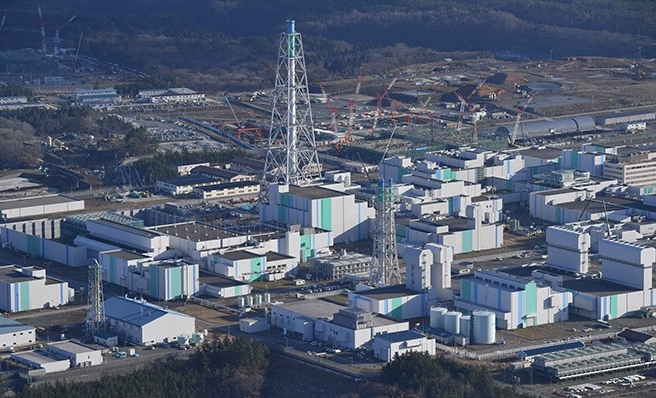 Japan Nuclear Fuel Ltd.’s Rokkasho nuclear fuel reprocessing plant in Rokkasho, Aomori Prefecture, in 2018
July 31, 2020
Japan’s nuclear watchdog has effectively endorsed the safety of a controversial nuclear reprocessing plant being built in a village along the Pacific coast in northern Japan.
The Nuclear Regulation Authority on July 29 approved an outline of safety measures for the trouble-plagued nuclear fuel reprocessing plant Japan Nuclear Fuel Ltd. is building in Rokkasho, Aomori Prefecture.
The NRA said the outline meets the new safety standards introduced after the 2011 Fukushima nuclear disaster.
The NRA’s decision marks a major step forward in constructing the plant for recovering plutonium from spent nuclear reactor fuel, the core facility for the government’s program to establish a nuclear fuel recycling system.
NRA Chairman Toyoshi Fuketa, however, stressed that the body’s decision does not mean an endorsement of the nuclear fuel recycling policy per se, saying in a news conference that it is a “policy issue” whether there is enough of a rationale for pursuing the policy.
Prime Minister Shinzo Abe’s administration should confront the reality that the catastrophic accident at the Fukushima No. 1 nuclear power plant has completely changed the environment surrounding nuclear power generation and make a fundamental review of the government’s nuclear energy policy.
Nuclear fuel recycling involves recovering plutonium from spent nuclear fuel to be reused in reactors. The government has been promoting recycling separated plutonium back into the fuel of reactors since the 1950s under the rationale that Japan, a nation poor in natural resources, needs to make more efficient use of nuclear fuel.
More than half a century on, the share of nuclear power generation in Japan’s overall electricity production is now very small as most of the reactors that were shut down in the wake of the Fukushima meltdowns have yet to be restarted.
It is also nearly impossible to find a site for building a new nuclear plant. As aged reactors will be decommissioned one after another in the coming years, the importance of nuclear power generation for Japan’s energy supply will steadily diminish.
Over the long term, Japan needs to phase out nuclear power generation to remove public anxiety about a large-scale accident.
Nuclear fuel recycling can have no great significance in this new era when Japan has to start shifting away from atomic energy. Many industrial nations have long given up nuclear reprocessing as economically unviable.
Another big problem with reprocessing the spent fuel is that it produces plutonium, a material that can also be used to make nuclear weapons.
Japan has a stockpile of some 46 tons of plutonium, stored both at home and abroad, an amount enough to make 6,000 atomic bombs. It is fueling fears and drawing criticism internationally.
Japan Nuclear Fuel’s plant in Rokkasho is designed to have the capacity of reprocessing 800 tons of spent nuclear fuel annually to recover 7 tons of plutonium.
But the plan to develop a fast neutron reactor that can “consume” plutonium by transforming it into other forms of nuclear waste, the key technology for plutonium consumption, has gone awry with the decision to decommission Japan’s “Monju” prototype sodium-cooled fast-breeder reactor.
There are clearly also limitations to the plan to burn so-called MOX (mixed oxide) fuel, which is usually plutonium blended with natural uranium, in existing nuclear reactors.
The government has promised the international community to reduce the nation’s surplus plutonium. That means the reprocessing operation at the Rokkasho plant will have to be restricted so that the amount of plutonium recovered will not exceed consumption.
It simply does not make sense to spend as much as 14 trillion yen ($134.33 billion) on building the plant to recover a small amount of plutonium.
Given that this huge cost will be passed onto consumers through higher electricity bills, it is impossible to win broad public support for the project.
If the government decides to pull the plug on the fuel recycling program, it will have to face tough policy challenges it has long avoided tackling, such as how to dispose of spent fuel. But the nation cannot make the inevitable leap into the new age of energy if it continues spending huge amounts on nuclear power generation, which is beset by so many problems.
There is a growing global trend toward renewable energy sources such as solar and wind power. This is the time for the government to make a radical shift in its energy policy.
1 This Month

of the week – Shut Down Drone Warfare!


Tell the Ukrainian Government to Drop Prosecution of Peace Activist Yurii Sheliazhenko

Petition to revoke the licensing of the Near Surface Nuclear Disposal Facility (NSDF) at Chalk River. https://www.ourcommons.ca/petitions/en/Petition/Details?Petition=e-7247
To see nuclear-related stories in greater depth and intensity – go to https://nuclearinformation.wordpress.com
-
Archives
- April 2026 (57)
- March 2026 (251)
- February 2026 (268)
- January 2026 (308)
- December 2025 (358)
- November 2025 (359)
- October 2025 (376)
- September 2025 (257)
- August 2025 (319)
- July 2025 (230)
- June 2025 (348)
- May 2025 (261)
-
Categories
- 1
- 1 NUCLEAR ISSUES
- business and costs
- climate change
- culture and arts
- ENERGY
- environment
- health
- history
- indigenous issues
- Legal
- marketing of nuclear
- media
- opposition to nuclear
- PERSONAL STORIES
- politics
- politics international
- Religion and ethics
- safety
- secrets,lies and civil liberties
- spinbuster
- technology
- Uranium
- wastes
- weapons and war
- Women
- 2 WORLD
- ACTION
- AFRICA
- Atrocities
- AUSTRALIA
- Christina's notes
- Christina's themes
- culture and arts
- Events
- Fuk 2022
- Fuk 2023
- Fukushima 2017
- Fukushima 2018
- fukushima 2019
- Fukushima 2020
- Fukushima 2021
- general
- global warming
- Humour (God we need it)
- Nuclear
- RARE EARTHS
- Reference
- resources – print
- Resources -audiovicual
- Weekly Newsletter
- World
- World Nuclear
- YouTube
-
RSS
Entries RSS
Comments RSS
 nuclear-news