Nuclear power’s uncertain prospects
The New Nukes
The WALL STREET JOURNALBy REBECCA SMITH
SEPTEMBER 8, 2009
“…………..nuclear is far from a sure thing. Yes, the plants of tomorrow—some of which could enter construction as soon as 2012—go at least part way toward solving some of the problems of yesterday. But they are still more expensive than fossil-fuel plants, and they still generate waste that must be stored safely somewhere. Continue reading
Belarusian Nuclear Power costly and dangerous
Belarusian Nuclear Power Project: Dangerous and Expensive
BIELAR.US 8 Sept 09 “…………a nuclear plant built by Russia on a Russian loan, serviced by Russian technicians and fed with Russian fuel might be a very good deal for Russia, but will hardly make Belarus more independent. Continue reading
AREVA threatening Finland’s TVO company over nuclear reactor fiasco
The Nukes of (legal) Hazard: Areva threatens work stoppage at Finnish nuke
Climate progress 1 Sept 09
Escalating a dispute between the companies as to who is to blame for the schedule slippage, Areva said Monday it will not proceed with work on the delayed Olkiluoto nuclear reactor project in Finland until Finnish utility TVO makes unspecified changes to the project.Areva, the French government-owned nuclear giant, made that disclosure in a financial statement for the first half of 2009.Ouch. That is from Energy Daily (subs. req’d). The Financial Times story begins:
The financial risks of nuclear power were cast into sharp relief on Monday as Areva, the French state-owned group, revealed new provisions on its troubled Finnish reactor project that virtually wiped out interim operating profits.
Double ouch!
The ongoing saga between Areva and Finland is now more like an episode of Desperate Housewives than a sitcom,
US Dept of Energy preventing tax-payer comment about nuclear loan money?
 The U.S. Department of Energy is attempting to fast track its nuclear loan guarantee program by drastically limiting the opportunity for the public to comment on changes to its regulations.
On August 7th, the U.S. Department of Energy (DOE) posted an announcement in the Federal Register in which it weakened the rules, as by moving taxpayers further back in the line of lenders who would be paid back in the event of nuclear project default. This puts taxpayers at increased risk of being left holding the bag for tens of billions of dollars in loan repayments when new nuclear projects go belly up.
Despite such astronomical financial risks, and the complex technical nature of the regulatory changes, DOE has allowed just 30 days for the submission of public comments. The month-long comment period just happened to coincide with the August Congressional recess, with watchdog groups as well as House and Senate Members and staff away on travel. Many could well remain unaware of the changes until Congress resumes the day after Labor Day – the very day comments are due – Tuesday, Sept. 8th.
Read the details on DOE’s proposed nuclear loan guarantees.
Costly delays in fixing nuclear plant
Point Lepreau refurbishment 9 months late
September 2, 2009 ATCBC NewsThe troubled $1.4-billion refurbishment of the Point Lepreau nuclear reactor is suffering another setback, pushing the massive project nine months behind schedule, CBC News has learned.
Sources inside NB Power say the refurbishment of the reactor is being stalled because of problems with the installation of the plant’s new calandria tubes…………
Point Lepreau is the first Candu-6 reactor to undergo a complete gutting and rebuild. It was intended to be a showcase for AECL to display its ability to revive the 1980s-era reactors.
When the refurbishment project started, it was supposed to last 18 months and have the reactor back on line in October 2010
However, crews at Point Lepreau struggled to deconstruct the old reactor, finally finishing that stage in late July, almost eight months behind schedule.
NB Power has acknowledged delays at Point Lepreau will cost $20 million a month.
Anti-radiation pills for people living near nuclear plants
People who live, work near TMI pick up anti-radiation pills
by MONICA VON DOBENECK, Of The Patriot-News September 01, 2009,
“……………free doses of potassium iodide being distributed by the Pennsylvania Department of Health in case of a radioactive release. The potassium iodide pills can partially protect the thyroid gland from radiation exposure if there is a nuclear accident. They are being distributed over the next few days to anyone who lives or works within ten miles of the state’s five nuclear power plants………..Alice Gray, director of community health systems for the Department of Health, said the state last distributed the pills in 2002, but those expired Monday. The state has enough tablets for the 1.2 million people within the 10-mile radius of the five nuclear plants, she said. She did not know how many will take advantage of the free distribution.
The potassium iodide, or KI pills, protect the thyroid gland against radioactive iodine that may be released in an emergenc……………..The pills do not protect against other forms of cancer or illnesses caused by radiation…
….The state has five nuclear plants: Three Mile Island, Beaver Valley Power Station, Limerick Generating Station, Peach Bottom Atomic Power Station and Susquehanna Steam Electric Station.
People who live, work near TMI pick up anti-radiation pills – PennLive.com
Finland’s nuclear plant: more delays, cost overruns
More Delays at Finnish Nuclear Plant
The New York Times. September 2, 2009, By James Kanter
AREVA a French nuclear construction company, said this week that its project to build the world’s most powerful reactor remained mired in delays and was over-budget by 2.3 billion euros, or about $3.3 billion.The price tag of the plant in Olkiluoto, Finland — the first of a fleet of so-called evolutionary power reactors that Areva foresees building in coming years — was about $4.3 billion in 2003 and costs have steadily increased.
The reactor was meant to have gone online early this summer but Areva no longer is committing to any dates for its completion. Patrice Lambert de Diesbach, an energy analyst with CM-CIC Securities in Paris, said the latest developments were “bad news” for Areva and “should be sanctioned by the market.”
The problems faced by Areva are important a time when the nuclear power industry is promising to build safer and more reliable reactors than during the last building boom in the 1960s and early 1970s. …………………………
So far there are few signs of a breakthrough in Finland.
Areva said this week that it would not begin work on the final stages of the reactor until the Finnish utility agreed to a new set of proposals and modifications.
More Delays at Finnish Nuclear Plant – Green Inc. Blog – NYTimes.com
Paladin loss, as uranium price slips
Money Sept 2 09
…….- Paladin’s loss was greater than the broker expected, given greater ramp-up and exploration costs. With cashflow tight Paladin has been forced to draw down on its debt facility although first half FY10 inventory sales mean it’s just a bridging deal.Paladin’s realised uranium price was also lower than expected given a higher level of spot over contract sales. As the U price continues to drift and the Kayakelera ramp-up remains slow, the broker sees no positive catalysts. Hold retained on slightly lower earnings forecasts.
AREVA going to court over Finland nuclear reactor runaway costs
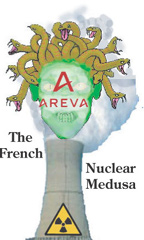 Areva’s half-year results yesterday night brought new information about the Olkiluoto-3 EPR nuclear fiasco:
South Africa’s nuclear company Eskom makes huge loss
Corporate Toughest of times for Eskom
World Nuclear News28 August 2009
Eskom, South Africa’s state-owned utility, has reported a record annual loss and has warned of a funding gap for an expansion program needed to prevent a repeat of the blackouts the country experienced in 2008.The company, which supplies about 95% of South Africa’s electricity and more than 60% of Africa’s, reported a loss of 9.7 billion rand ($1.25 billion) for the year ended 31 March. In the previous year, Eskom made a loss of 210 million rand ($27 million)………….
Bulgaria: right wing opposition to nuclear plant
Bulgaria Right-Wingers Call for Halt of Nuclear Plant Plan
novinite.com September 1, 2009,Bulgaria’s biggest right-wing party has reiterated its calls on the new government to give up the planned Belene project as it is still undecided whether to scrap or push ahead the construction of the multi-billion nuclear power plant.
“The price tag of the nuclear power plant at the Danube river town will stand at no less than EUR 10 B,” Martin Dimitrov, leader of the Union of Democratic Forces (UDF), said at a press conference on Tuesday.
According to him Belene nuclear power plant will not benefit local consumers, which makes it completely useless.
“Freezing the project is no solution to the problem,” Dimitrov added.
UDF leadership has repeatedly warned that the construction of the plant will translate into a BGN 1300 tax burden for each Bulgarian taxpayer, electricity hikes for decades on end, outdated and dubious Russian nuke units…………….
…………According to reports and non-governmental organizations RWE AG’s plan to expand in Bulgaria’s nuclear market is on the brink of collapse because financing for the project couldn’t be obtained.
Financial crisis hurts some Eastern Europe nuclear plans
Financial crisis hurts some Eastern Europe nuclear plans
By Anna Mudeva
SOFIA (Reuters) 1 Sept 09
– Domestic political squabbles, funding woes and other hurdles threaten a number of nuclear power plant projects in central and southeast Europe
…………..Analysts say the global economic crisis has made banks reluctant to provide loans for nuclear plants, which cost around 3 billion euros ($4.30 billion) per 1,000 megawatt reactor, for a pay-off that takes decades.
Equipment suppliers and engineering companies are also unwilling to give fixed price tags during volatile times, which makes planning and calculation of costs difficult.
Nuclear energy on a downward trend: no renaissance in sight
Study shows: Nuclear energy on downward trend worldwide
Federal Ministry for Nuclear safety Germany,
28 August 09Minister Gabriel:
There is no renaissance of nuclear energyThe share of nuclear energy in worldwide energy consumption is marginal and has been declining for several years. This is revealed in a study by independent experts of the energy and nuclear sector which was published by the Federal Environment Ministry today. As Federal Environment Minister Sigmar Gabriel said:“The renaissance of nuclear energy, much trumpeted by its supporters, is not taking place. The only thing frequently revived is the announcement. The study shows: the number of old nuclear power plants which are decommissioned worldwide is greater than the number of new ones taking up operation. Available resources, engineering performance and funds are not even enough to stop the downward trend, let alone increase the number of reactors. All the facts are in favour of phasing out this technology while at the same time expanding the use of renewable energies and energy efficiency, as this is a promising option for the future.”
The authors of the study, headed by Mycle Schneider, Paris, collected crucial quantitative and qualitative facts on nuclear power plants which are in operation, being built or planned today and assess the economic viability of old and new nuclear power plants.
At the time of going to press, 1 August 2009, there were only 435 reactors in operation worldwide, which is nine less than in 2002. Nuclear energy accounts for only about 5.5 % of worldwide commercial primary energy consumption and only around 2 % of worldwide final energy consumption – and consumption has been steadily declining for years.
The authors also found out that the number of nuclear power plants will decrease worldwide over the next decades. Between 2015 and 2025 the capacity of nuclear power plants is expected to sink compared to today’s output……………….
Current and planned building projects of the nuclear industry are becoming increasingly expensive. The EPR, for example, the flagship of the world’s largest manufacturer of reactors, AREVA NP, which is currently in construction in Olkiluoto in Finland, has so far exceeded planned costs by at least 55 %.
Nuclear risks rise for French workers
French nuclear workers see risks as conditions worsen
* EDF subcontracts 80 percent of nuclear maintenance
* Nuclear workers say they are under mounting time pressure
* Safety margin is narrowing, expert says
* EDF denies it cuts corners, says subcontracts by choice
Forbes Reuters FEATUREBy Muriel Boselli
PIERRELATTE, France, Aug 31 (Reuters) – Worsening working conditions, inadequate pay rises, pressure to work faster and safety concerns — these are the familiar grievances of a disaffected work force.
When such complaints arise in France’s most sensitive industry — nuclear power — alarm bells start ringing.
Cyril Bouche and his colleagues at the Tricastin nuclear plant in the rolling hills of the Drome region say the state-owned utility EDF, which runs France’s 58 nuclear reactors and has been expanding into the United States and Britain, is not only cutting costs, but also cutting corners.
The 39-year old, who works for one of EDF’s many subcontracting firms, says working conditions at the plant — hit by a series of incidents that shook public trust in 2008 — have deteriorated over the past five to 10 years.
“Today France is selling reactors abroad but it should first put its own house in order,” said Bouche, the only one of 10 workers interviewed by Reuters who was prepared to be identified.
The French government has put forward state ownership of its nuclear sector as a guarantee of its safety, but former monopoly EDF subcontracts 80 percent of the maintenance at its nuclear reactors to firms such as Vinci, Areva ( ARVCF.PK – news – people ), GDF Suez or Bouygues ( BOUYF.PK – news – people )………….
Independent experts including Yves Marignac, executive director of the information agency Wise-Paris, say safety margins in French nuclear power plants are shrinking as plants age, economic pressure mounts and trained staff retire.
FEATURE-French nuclear workers see risks as conditions worsen – Forbes.com
Europe, Bulgaria: Future of nuclear energy in doubt
NGOs discuss the future of nuclear power in Europe and Bulgaria
Radio Bulgaria Written by: Darina Grigorova
Translated by: Daniela Konstantinova 28 August 09
On 28 and 29 August the town of Svishtov is hosting the Pan-European Energy Conference. It is organized by the Coalition BeleNE, meaning No to Belene where Belene is the site for a new Bulgarian nuclear plant. The forum seeks to identify the problems of the sector and to suggest a few solutions to them. Central to the conference is the need of a new energy strategy of Bulgaria; energy efficiency; and the future of nuclear energy in Europe. Continue reading
1 This Month
23-25 October – on Zoom – World BEYOND War’s annual global conferenc


Shut down the radiation-damaged Heysham nuclear reactors now
To see nuclear-related stories in greater depth and intensity – go to https://nuclearinformation.wordpress.com

Say No to NASA’s Reckless Nuclear Reactor on the Moon
Say No to NASA’s Reckless Nuclear Reactor on the Moon
-
Archives
- October 2026 (180)
- September 2026 (339)
- August 2026 (330)
- July 2026 (355)
- June 2026 (287)
- May 2026 (306)
- April 2026 (356)
- March 2026 (251)
- February 2026 (267)
- January 2026 (308)
- December 2025 (358)
- November 2025 (359)
-
Categories
- 1
- 1 NUCLEAR ISSUES
- business and costs
- climate change
- culture and arts
- ENERGY
- environment
- health
- history
- indigenous issues
- Legal
- marketing of nuclear
- media
- opposition to nuclear
- PERSONAL STORIES
- politics
- politics international
- Religion and ethics
- safety
- secrets,lies and civil liberties
- spinbuster
- technology
- Uranium
- wastes
- weapons and war
- Women
- 2 WORLD
- ACTION
- AFRICA
- Atrocities
- AUSTRALIA
- Christina's notes
- Christina's themes
- culture and arts
- Events
- Fuk 2022
- Fuk 2023
- Fukushima 2017
- Fukushima 2018
- fukushima 2019
- Fukushima 2020
- Fukushima 2021
- general
- global warming
- Humour (God we need it)
- Nuclear
- RARE EARTHS
- Reference
- resources – print
- Resources -audiovicual
- Weekly Newsletter
- World
- World Nuclear
- YouTube
-
RSS
Entries RSS
Comments RSS

