Japan studies plan to extend life of 60-year-old nuclear plants

Nov 28, 2022
Japan will consider keeping some nuclear reactors operating beyond a current 60-year limit as the country focuses increasingly on atomic power as a solution to an ongoing squeeze on energy supply.
Officials are studying a plan to exclude periods when reactors were offline from an existing limit on their lifespan, which would allow some facilities to operate for longer, according to a document released Monday by a trade ministry panel. Reactors are often halted for years to allow the nation’s nuclear watchdog to perform inspections, or as a result of legal challenges.
Following the 2011 Fukushima nuclear disaster, which was triggered by a massive earthquake and tsunami, Japan introduced stricter safety standards limiting the operation of nuclear reactors to 40 years in principle.
But operation for an additional 20 years is possible if safety upgrades are made and a reactor passes screening by regulators.
The proposal to allow operations beyond the 60-year limit comes as Japan’s public and government shift back in favor of nuclear power, despite experiencing one of the worst atomic meltdown disasters. The import-dependent country has this year grappled with more expensive fossil fuel prices as a result of Russia’s war in Ukraine, along with a weak yen, and seen its stretched power grid put under severe pressure.
The government has repeatedly asked people to take steps to limit their electricity consumption, by using fewer appliances or cutting back on heating.
In August, Prime Minister Fumio Kishida said the government will explore developing and constructing new reactors, and that it will also aim to restart seven more idled reactors from next summer.
The trade ministry proposals also call for new, next-generation nuclear reactors to be built at sites where existing units will be decommissioned.
Japanese manufacturers have announced plans to develop next-generation reactors this year. Mitsubishi Heavy Industries is jointly developing an advanced light water reactor with four other Japanese power producers, while a venture between Hitachi and General Electric is also reported to be developing a new reactor model.
https://www.japantimes.co.jp/news/2022/11/28/national/nuclear-plant-extension/
Expert panel full of proponents of nuclear power plants to discuss direction on March 28th, extending operation period and developing next-generation models, rushing to conclusion on “Prime Minister’s directive.

Basic policy subcommittee discusses extending the operational period of nuclear power plants in Kasumigaseki, Tokyo.
November 27, 2022
The Ministry of Economy, Trade, and Industry (METI) will present its direction on measures to utilize nuclear power plants, including the extension of the operating period of nuclear power plants, which is stipulated as “40 years in principle, with a maximum of 60 years,” and the development and construction of next-generation nuclear power plants, at the “Nuclear Energy Subcommittee,” a meeting of experts on November 28. Discussions will reach their final stage about three months after Prime Minister Fumio Kishida ordered the committee to study the issue in August. However, the committee did not solicit opinions from the public before reaching a conclusion, and its deliberations were noticeably more hasty than past energy policy debates. (The discussion has been held in a very slow pace compared to past energy policy debates.)
◆Draft government policy at several subcommittee meetings
Of the 21 members of the Atomic Energy Subcommittee, which discusses nuclear energy policy, only two, including Hajime Matsukubo, executive director of the NPO Nuclear Data and Information Office, have made negative statements about nuclear power at recent meetings. In the discussion on extending the operating period, many committee members called for removing the maximum 60-year limit, and at the meeting on March 28, METI is expected to push for a proposal to exclude from the number of years of operation the period during which a nuclear power plant is shut down to undergo a review before it can be restarted, without removing the limit in consideration of public outcry.
The contents of the Nuclear Energy Subcommittee’s deliberations will be discussed by the Basic Policy Subcommittee, which brings together expert panels on energy policy, and the conclusions of the subcommittee will serve as a draft of the government policy.
At the meeting on March 15, Ms. Chisato Murakami, an advisor on consumer affairs, commented, “The use of nuclear power plants will not directly lead to an end to the tight power supply and demand situation. I would like to propose that we take time to deepen the national debate.” She objected to the way the discussion was proceeding, but no other opinions were expressed calling for a reconsideration.
The subcommittee has met twice so far. The committee is expected to hold one or two more meetings before the end of the year to reach a conclusion, after which public comments will be sought.
◆Energy Basic Plan to be discussed 17 times and opinions solicited via the Internet
The previous energy policy discussions were different.
In the discussion of the “Sixth Basic Energy Plan,” a medium- to long-term guideline for energy policy formulated last October, subcommittee meetings were held 17 times over a period of 10 months. In addition, an opinion box was set up on the website during the discussions in order to listen to the opinions of the public at large. The opinions received were submitted as materials to each of the subcommittee meetings for consideration. In total, about 640 opinions were collected, with about 300 calling for a nuclear power phase-out, while about 80 supported the promotion of nuclear power.
At that time, members of the subcommittee expressed the opinion that extending the operational period of nuclear power plants and building new plants were necessary to realize a decarbonized society by 2050, but this was not explicitly stated in the basic plan. The policy of “reducing dependence on nuclear power plants as much as possible,” which came to be stated after the Fukushima accident, was also maintained.
◆Ministry of Economy, Trade, and Industry (METI) official: “The directive to reach a conclusion by the end of the year cannot take too much time.
The government has been stressing the use of nuclear power plants against the backdrop of the recent tight power supply and demand and soaring fuel prices. However, the development of next-generation nuclear power plants, for example, will take a long time and will not be a quick fix, so there is no need to reach a hasty conclusion. Even after Murakami pointed out this contradiction at the subcommittee meeting, a METI official told the interviewer, “We cannot take too much time because [Prime Minister Kishida] has instructed us to reach a conclusion by the end of the year. We will come up with a direction as soon as possible.
Mr. Matsukubo commented, “This is a heavy-handed way of proceeding, not listening to the public and having the Council of Eminent Persons decide what the government wants to do. The government’s policy of making nuclear power a given may narrow the scope for the introduction of renewable energies in the future.
https://www.tokyo-np.co.jp/article/216285?fbclid=IwAR1q4FkmUf5IMHwP2VfT5TG3LA6wvwN1V1CU7vRueWSFSkMq6upQHAuxkG4
The government is planning to “promote” nuclear power plants…but there are so many difficulties to overcome before this can be realized, and there are doubts about the assurance of safety and security

August 25, 2022
The government aims to make a major change in its nuclear energy policy, which has denied the construction of new nuclear power plants since the accident at TEPCO’s Fukushima Daiichi Nuclear Power Station on August 24. The government also plans to consider extending the operating periods of existing nuclear power plants again and to further promote their restart. The government is moving forward with the use of nuclear power plants because of the tight power supply and demand caused by the crisis in Ukraine. However, there are serious doubts about the safety and security of nuclear power plants, and it is not clear whether the public will understand this. (The government is now considering the use of nuclear power plants.)
The government is clearly stating that it is “considering” the construction of new and additional nuclear power plants…The government is promoting the extension of the operation period and the restart of a total of 17 reactors.
◆Next generation nuclear reactors” – Technology not yet established
We will discuss all options for a stable energy supply. We will discuss all options for a stable energy supply and will not rule out the construction of new reactors. Yuji Iida, director general of the Economic and Industrial Policy Bureau of the Ministry of Economy, Trade and Industry (METI), emphasized this before the Green Transformation (GX) Executive Conference, which was held on March 24 to discuss decarbonization policies.
The “Basic Energy Plan” approved by the Cabinet last October did not mention the construction of new nuclear power plants, and successive prime ministers have repeatedly stated that it was not envisioned at this time. Conscious of public sentiment in the aftermath of the nuclear accident, the government has avoided going into the issue.
The new plants to be considered this time are not existing nuclear power plants, but next-generation models, such as nuclear power plants with improved accident countermeasures and small reactors. Although the government emphasizes safety, many of these next-generation reactors are still in the process of being tested overseas, and it is difficult to say that they have been established as commercial power generation facilities.
One official at an electric power company commented, “We don’t have the capacity to build new reactors when we can’t even restart existing nuclear power plants. The first step is to operate the current nuclear power plants and restore their technological capabilities.
◆ Extension of operating period: Regulatory Commission not optimistic
In 2013, after the Fukushima accident, the law was amended to set the operating period of nuclear power plants at 40 years in principle, and to allow for a one-time extension of 20 years. The law was amended in 2013 after the Fukushima accident to allow for a one-time 20-year extension of the 40-year operating period. Four reactors were approved by the Nuclear Regulation Authority (NRA), of which Kansai Electric Power’s Mihama Unit 3 (Fukui Prefecture) has restarted.
If the units are operated for more than 60 years, which would mean a re-extension, the law may need to be revised again. At a press conference on March 24, Chairman Toyoshi Sarada of the Regulatory Commission said, “Detailed technical discussions are needed. In the U.S., operation for 80 years is permitted, but Mr. Sarada pointed out that “Japan has many earthquakes, and we should not be dragged down by foreign countries.
◆ Seven new reactors restarted → Inadequate anti-terrorism and evacuation plans hindering operations
The government has also set a target of restarting seven reactors at five nuclear power plants that have yet to be restarted, although they meet the new regulatory standards, sometime after next summer or winter.
In April of last year, the regulatory commission ordered a de facto ban on the operation of TEPCO’s Kashiwazaki Kariwa Nuclear Power Station in Niigata Prefecture because of a problem with a faulty intrusion detector that had been left unattended. The order was not lifted until the plant was found to be in an improved condition, and its inspections have continued.
Furthermore, Niigata Prefecture has made its own verification work a condition for whether or not it will agree to restart the plant, and the completion of the work is “not foreseeable” (Prefectural Nuclear Safety Division). In light of the inadequacies of the anti-terrorism measures, even a member of the Liberal Democratic Party’s prefectural assembly, which is pro-nuclear power generation, has voiced his desire not to have TEPCO operate the plant, and the sense of distrust is deep-rooted.
The Japan Atomic Power Company’s Tokai No. 2 Nuclear Power Plant in Ibaraki Prefecture has more than 900,000 people living within a 30-kilometer evacuation zone, the largest in the nation, and the plan has been extremely difficult to formulate. In addition to the prefectural government, only five of the 14 municipalities in the prefecture have been able to formulate a plan. In addition, the Mito District Court ordered an injunction against the operation of the plant last March, citing problems with the effectiveness of the evacuation plan.
There is almost no chance that both reactors will be able to operate within the government’s target of a little over a year.
https://www.tokyo-np.co.jp/article/197879
Cabinet minister rules out new nuclear reactors for 10 years
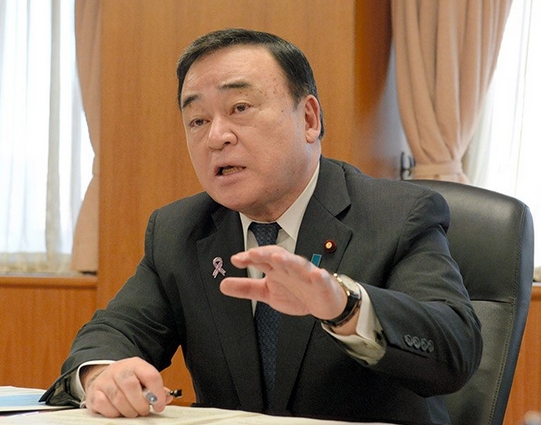
Industry minister Hiroshi Kajiyama during an interview with The Asahi Shimbun on Nov. 10
November 12, 2020
Industry minister Hiroshi Kajiyama is signaling that the government will not allow for the construction of new nuclear reactors to replace aging ones or to be installed additionally at nuclear plants for the next decade.
His position suggests the Ministry of Economy, Trade and Industry, which oversees the nuclear industry, is unlikely to discuss the option of building new reactors in the new Basic Energy Plan it has been developing.
The plan has been revised twice since the 2011 Fukushima nuclear disaster.
Heeding a national sentiment exceedingly anxious of nuclear energy, the government has passed up discussing building new reactors in past revisions of the plan.
In an interview with The Asahi Shimbun on Nov. 10, Kajiyama acknowledged it is still premature to discuss the issue now.
“Public faith has yet to be restored,” he said of public sentiment toward nuclear energy after the triple meltdown at the Fukushima plant. “How can we proceed (without it) in constructing new reactors to replace aging ones or to make additions? We are simply not at the stage where we can talk about the next move.”
Kajiyama said the government’s priority over the next 10 years will be regaining public faith in the nuclear industry, rather than pushing for the construction of new reactors.
But he defended nuclear energy as a “necessary energy” source that the country will still need to rely on.
He said the nation’s 36 nuclear reactors, including three that were under construction before the Fukushima accident occurred, “should be fully utilized.”
The minister said the number of nuclear reactors that will be reactivated over the coming decade will be a point that the government will take into account as an indication of the public’s acceptance of nuclear energy when it comes to mulling over constructing new reactors.
“It is also related to the government’s goal of achieving carbon neutrality in 2050,” he said.
His comments suggest the government may begin considering constructing new reactors if more local governments approve restarting nuclear plants that were idled after the Fukushima accident.
Currently, only one reactor at the Genkai nuclear plant in Saga Prefecture is operating in Japan after a reactor at the Oi nuclear plant in Fukui Prefecture was shut down for maintenance earlier this month.
Kajiyama underlined the need to develop small modular reactors, which are smaller than conventional reactors.
He said engaging in a modular reactor project would be meaningful when it comes to maintaining the nation’s technology for safeguarding nuclear power and nurturing scientists in the field–not to mention the potential for spinoffs.
“It could lead to the development of new materials and other technologies,” he said.
Last month, Prime Minster Yoshihide Suga laid out Japan’s plan to achieve net zero greenhouse gas emissions by 2050.
That may prompt a possible review of Japan’s current energy target for fiscal 2030, with nuclear power and renewables accounting for 20-22 percent and 22-24 percent of total power generation, respectively.
But Kajiyama said whether the 2030 target will be revised is up in the air, as more consultation with energy experts is needed.
The industry minister also doused hopes for the early introduction of carbon taxes and the emission trading system, both of which are initiatives aimed at spurring businesses to cut their carbon dioxide emissions.
“They may eventually be introduced but doing so in the early stages will prove extremely costly,” he said.
(This story was written by Hiroki Ito and Rintaro Sakurai.)
1 This Month

of the week – Shut Down Drone Warfare!


Tell the Ukrainian Government to Drop Prosecution of Peace Activist Yurii Sheliazhenko

Petition to revoke the licensing of the Near Surface Nuclear Disposal Facility (NSDF) at Chalk River. https://www.ourcommons.ca/petitions/en/Petition/Details?Petition=e-7247
To see nuclear-related stories in greater depth and intensity – go to https://nuclearinformation.wordpress.com
-
Archives
- March 2026 (251)
- February 2026 (268)
- January 2026 (308)
- December 2025 (358)
- November 2025 (359)
- October 2025 (376)
- September 2025 (257)
- August 2025 (319)
- July 2025 (230)
- June 2025 (348)
- May 2025 (261)
- April 2025 (305)
-
Categories
- 1
- 1 NUCLEAR ISSUES
- business and costs
- climate change
- culture and arts
- ENERGY
- environment
- health
- history
- indigenous issues
- Legal
- marketing of nuclear
- media
- opposition to nuclear
- PERSONAL STORIES
- politics
- politics international
- Religion and ethics
- safety
- secrets,lies and civil liberties
- spinbuster
- technology
- Uranium
- wastes
- weapons and war
- Women
- 2 WORLD
- ACTION
- AFRICA
- Atrocities
- AUSTRALIA
- Christina's notes
- Christina's themes
- culture and arts
- Events
- Fuk 2022
- Fuk 2023
- Fukushima 2017
- Fukushima 2018
- fukushima 2019
- Fukushima 2020
- Fukushima 2021
- general
- global warming
- Humour (God we need it)
- Nuclear
- RARE EARTHS
- Reference
- resources – print
- Resources -audiovicual
- Weekly Newsletter
- World
- World Nuclear
- YouTube
-
RSS
Entries RSS
Comments RSS
 nuclear-news