Muon Scan in Fukushima Unit 3 Finds No Fuel in Reactor Vessel

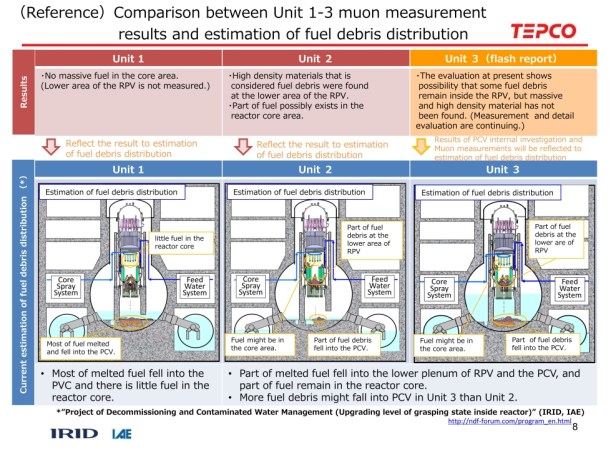
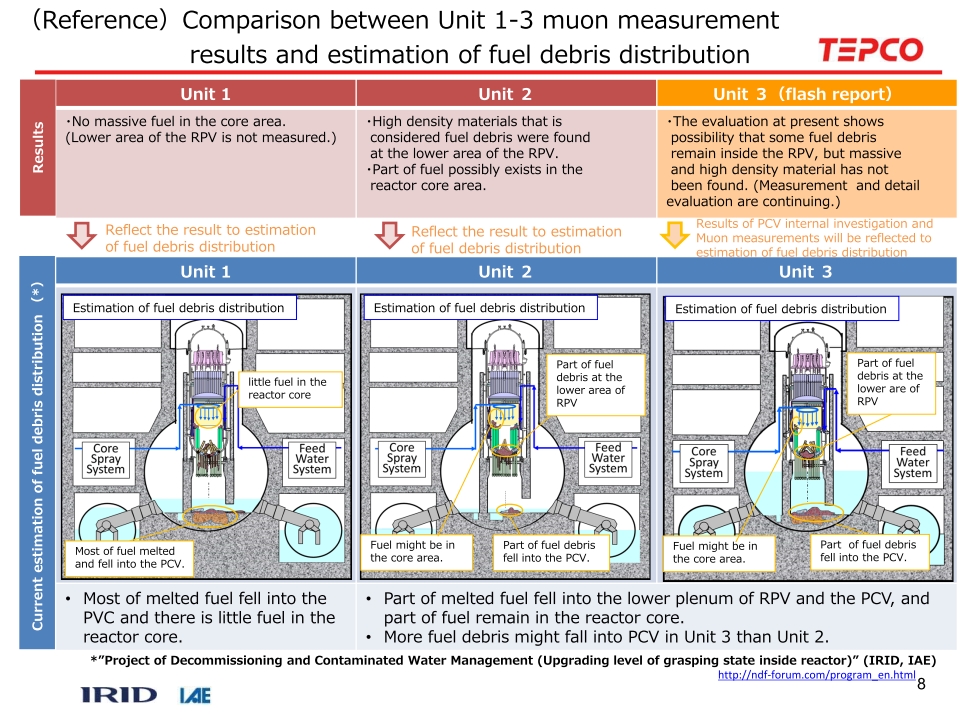
On July 28 Tepco announced the unit 3 reactor muon scan preliminary results. The muon scan can detect masses of nuclear fuel if over at least a cubic meter.
Tepco declared that they will continue the muon scan, however this continued scan will certainly refine the data but not change much the results.
Tepco admitted finding no significant amount of fuel inside the unit 3 reactor vessel. These muon scans do not quantify possible fuel in the containment structure or in the base mat concrete of the building.
A recently done ROV inspection of the unit 3 containment structure, including the pedestal area below the reactor vessel, clearly located some melted fuel. However as the video and imagery published was limited and heavily edited, it is currently unclear how much fuel was found in that area.
Source : Tepco’s handout
http://www.tepco.co.jp/en/nu/fukushima-np/handouts/2017/images/handouts_170727_01-e.pdf
Fukushima Unit 2 Muon Scan Inconclusive
TEPCO and IRID released a set of reports on the muon scan of unit 2, as a follow up report to the June preliminary scan results.
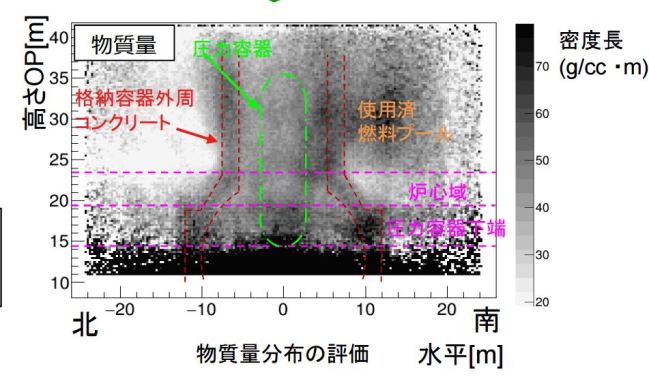
Tepco makes an assertion in the new report that the majority of the melted fuel is present in the bottom of the reactor pressure vessel but that assertion is quite questionable upon further review of the reports.
To justify the assertion that most of the fuel is in the bottom of the RPV, Tepco uses a close view of the actual scan output. Viewed without the wider view it seems there must be some fuel in the bottom of the RPV and there probably is.
When you look at the same image with the entire scan view, the black area inside the RPV becomes less conclusive. This black band reaches far beyond containment and matches an area of interference documented on the earlier reviews of the scans.
TEPCO also goes on to make an estimate of fuel volume in the lower portion of the RPV based on these questionable images. They do not provide any justification for how they take the black spots in the image of the lower RPV and translate that to tons of melted materials and fuel.
Existing meltdown literature and findings expect some amount of fuel residue to exist in the bottom of the RPV even if the bottom of the RPV fails.
Both scans of unit 2′s vessel showed little remaining in the core region.
At this point the scans are inconclusive either way on the question of fuel in the bottom of the RPV.
Sources:
http://mainichi.jp/english/articles/20160729/p2g/00m/0dm/022000c
http://www.asahi.com/ajw/articles/AJ201607290050.html
1 This Month

of the week – Shut Down Drone Warfare!


Tell the Ukrainian Government to Drop Prosecution of Peace Activist Yurii Sheliazhenko

Petition to revoke the licensing of the Near Surface Nuclear Disposal Facility (NSDF) at Chalk River. https://www.ourcommons.ca/petitions/en/Petition/Details?Petition=e-7247
To see nuclear-related stories in greater depth and intensity – go to https://nuclearinformation.wordpress.com
-
Archives
- April 2026 (68)
- March 2026 (251)
- February 2026 (268)
- January 2026 (308)
- December 2025 (358)
- November 2025 (359)
- October 2025 (376)
- September 2025 (257)
- August 2025 (319)
- July 2025 (230)
- June 2025 (348)
- May 2025 (261)
-
Categories
- 1
- 1 NUCLEAR ISSUES
- business and costs
- climate change
- culture and arts
- ENERGY
- environment
- health
- history
- indigenous issues
- Legal
- marketing of nuclear
- media
- opposition to nuclear
- PERSONAL STORIES
- politics
- politics international
- Religion and ethics
- safety
- secrets,lies and civil liberties
- spinbuster
- technology
- Uranium
- wastes
- weapons and war
- Women
- 2 WORLD
- ACTION
- AFRICA
- Atrocities
- AUSTRALIA
- Christina's notes
- Christina's themes
- culture and arts
- Events
- Fuk 2022
- Fuk 2023
- Fukushima 2017
- Fukushima 2018
- fukushima 2019
- Fukushima 2020
- Fukushima 2021
- general
- global warming
- Humour (God we need it)
- Nuclear
- RARE EARTHS
- Reference
- resources – print
- Resources -audiovicual
- Weekly Newsletter
- World
- World Nuclear
- YouTube
-
RSS
Entries RSS
Comments RSS
 nuclear-news