Stand in solidarity Defend the human rights of Fukushima survivors

Disasters like Chernobyl and Fukushima remind the world how dangerous nuclear power is. But right now, the nuclear industry is trying to downplay the risks of a nuclear disaster. In Fukushima radiation exposure is still a very real threat despite failed “decontamination”.
The Japanese government is set to lift evacuation orders in heavily contaminated areas around Fukushima. It will cut compensation and housing support to survivors, who are still struggling six years later.
Their basic rights to health, housing, and environment are being violated. The government is desperately trying to minimize the disaster at the expense of survivors in an attempt to revive the dying nuclear industry and suffocate other cleaner energy sources. We must say no!
Sign now to demand the government provides fair compensation, housing support, and is fully transparent about the radiation risks.
We’ll deliver your signature to the Prime Minister so he hears the global wave of resistance against nuclear!
https://act.greenpeace.org/page/6288/petition/1?_ga=1.23785721.2131293321.1485515415
High radiation risks in Fukushima village as government prepares to lift evacuation order – Greenpeace

A recent Greenpeace Japan led survey team found radiation dose rates at houses in the village of Iitate well above long-term government targets, with annual and lifetime exposure levels posing a long-term risk to citizens who may return. Evacuation orders will be lifted for Iitate no later than 31 March 2017, to be followed one year later by the termination of compensation payments.
“The relatively high radiation values, both inside and outside houses, show an unacceptable radiation risk for citizens if they were to return to Iitate. For citizens returning to their irradiated homes they are at risk of receiving radiation equivalent to one chest X-ray every week. This is not normal or acceptable,” said Ai Kashiwagi, energy campaigner with Greenpeace Japan [1].
As Japan nears the six years from beginning of the nuclear disaster, the Japanese government last week confirmed that it has not yet conducted any assessments of lifetime exposure risks for citizens if they were to return to Iitate.
The Greenpeace Japan survey results are based on thousands of real-time scanning measurements, including of houses spread over the Iitate region. This data was then used to calculate a weighted average around the houses, which were then computed to give annual exposure rates and over a lifetime of 70 years, taking into account radioactive isotope decay. The survey work also included soil sampling with analysis in an independent laboratory in Tokyo, the measurement of radiation hot spots and the recovery of personal dose badges that had been installed in two houses in February 2016.
For lifetime exposure due to external cesium radiation exposure, the dose range has been calculated, at between 39 mSv and 183 mSv, depending on either 8 or 12 hours per day spent outdoors, for citizens living at the houses over a 70 year period beginning in March 2017 [2]. Among the thousands of points Greenpeace Japan measured for each house, nearly all the radiation readings showed that the levels were far higher than the government’s long term decontamination target of 0.23µSv/h, which would give a dose of 1 mSv/yr.
The weighted average levels measured outside the house of Iitate citizen Toru Anzai was 0.7µSv/h, which would equal 2.5 mSv per year; even more concerning in addition, was the dose badges inside the house showed values in the range between 5.1 to 10.4mSv per year raising questions over the reliability of government estimates [3].
These levels far exceed the 1 mSv annual maximum limit recommended by the International Commission on Radiological Protection (ICRP) [4] , yet the decontamination program is being declared complete for the area that will have its evacuation order lifted next month.
“The government is not basing its policies on science or in the interest of protecting public health. It has failed to provide estimates of lifetime exposure rates for Iitate’s citizens, nor considered how re-contamination from forests will pose a threat for decades to come,” said Jan Vande Putte, radiation specialist with Greenpeace Belgium.
“The Abe government is attempting to create a false reality that six years after the start of the Fukushima Daiichi accident life is returning to normal. In the real world of today, and for decades to come, there is and will be nothing normal about the emergency radiological situation in Iitate,” said Vande Putte.
Greenpeace is demanding that the Japanese government provide full financial support to survivors, so that they are not forced to return for economic reasons. It must take measures to reduce radiation exposure to the absolute minimum to protect public health and allow citizens to decide whether to return or relocate free from duress and financial coercion.
Greenpeace has launched a public petition in solidarity in defense of human rights of Fukushima survivors.
Notes to Editors:
The report can be accessed here: “No Return to Normal”.
Photo and video is available here.
[1] X-ray dose rates range depend on multiple factors, including the equipment used and the patient. A typical dose per chest X-ray would be 0.05mSv, which if given each week would be 2.6 mSv over a year.
[2] These figures do not include natural radiation exposures expected over a lifetime, nor does it include the external and internal doses received during the days and weeks following the March 2011 Fukushima Daiichi nuclear accident. In the case of many citizens of Iitate, evacuation was both delayed and complex, the early-stage external radiation exposure estimated for the 1,812 villagers where estimations of external radiation dose average 7 mSv, with the highest being 23.5 mSv according to Imanaka. Internal exposure from consumption of contaminated food products is also not included.
[3] The government estimates that levels of radiation inside houses is 60 percent less than outside due to the shielding effect of the building. The Greenpeace results raise the possibility that this is not a reliable basis for estimating dose levels in houses.
[4] ICRP recommendations for the public, sets the maximum recommended dose for areas that are not affected by a nuclear accident at 1 mSv a year. However, the Japanese government set a condition that it is acceptable for the public to receive up to 20 mSv per year in Iitate, as a response to an emergency right after the Fukushima Daiichi nuclear accident.
University punishes teacher over comment to Fukushima student about glowing in dark
KOBE (Kyodo) — A part-time teacher at Kwansei Gakuin University made a comment ridiculing a student from nuclear disaster-hit Fukushima Prefecture in 2014, saying that she might glow in the dark because of her supposed exposure to radiation, the western Japan university said Tuesday.
The remark was made by an English-language teacher, identified as a foreign national in his 40s, according to the university in Nishinomiya, Hyogo Prefecture. He later explained that it was supposed to be a joke.
The university said the teacher received a three-month pay cut dated last Friday as the university regards his comment as discriminatory and “inconsiderate to people affected by” the March 11, 2011, quake and tsunami disaster, which led to a crisis at the Fukushima Daiichi nuclear plant.
Although the pay cut will be applied from March as a formality, the university will not renew the teacher’s contract when it expires at the end of March in line with the teacher’s request.
During his English class sometime around October or November 2014, the teacher asked the student, who had entered the university in April that year, where she was from. After her answer, the teacher turned off the lights and said he thought she would glow.
The student, who is in her 20s, found it “difficult” to attend classes after the incident, the university said.
After she learned the university had opened a harassment counseling center in April last year, the student sought advice about the incident.
“We would like to apologize to the student and people affected by the disaster,” Shoichi Ito, vice president of the university, said in a statement, adding the school will make sure that such incidents will not occur again.
Disaster reconstruction minister Masahiro Imamura told reporters the same day the incident was “very regrettable” and “really intolerable.”
http://mainichi.jp/english/articles/20170221/p2g/00m/0dm/069000c
Government to cut housing assistance to some Fukushima evacuees

It’s been nearly six years since Japan’s Fukushima nuclear disaster. Now, the local government is preparing to slash housing assistance for those who fled.
It would require them to choose between returning to places affected by radiation or, to bear the financial burden of remaining in their adopted places of refuge.
The huge earthquake and tsunami crippled a nuclear power plant in Fukushima causing tens of thousands of people to evacuate from their homes
According to Fukushima government, at its peak, about 165,000 people were made to evacuate from the contaminated areas.
Some decided to return to their hometown after evacuation orders were lifted. But decontamination and renovation work took time and money
Some decided to leave their homes permanently, finding jobs and life elsewhere.
Over 81000 people are still displaced.
However, the number is said to be much larger, including those that voluntarily evacuated from areas not designated as mandatory evacuation zones, from fears of high levels of radiation in their homes.
The Fukushima local government is preparing to slash unconditional housing assistance for these voluntary evacuees on March 31st.
Many have to choose either to return to areas where they still fear of radiation, or bear the financial burden to remain at their place of refuge
It said that over 32,000 people have to make a choice to self-support themselves or return to Fukushima. where recovery work is slow.
Evacuees said the government is trying to end the Fukushima issues before the Tokyo Olympics, to show the world that “Fukushima is under control.”
It is expected that many will choose to return to Fukushima. But majority say they will not feel safe and under constant fear of lingering radiation. Some even expressed their concerns of possible radiation spills during the decontamination process.
It might be decades until the residents in Fukushima feel truly at ease.
http://america.cgtn.com/2017/02/18/government-to-cut-housing-assistance-to-some-fukushima-evacuees
No Legitimacy, No Principle in Japan’s Nuclear Victim Support Policy

By Toshinori Shishido
In July 2015, the Fukushima prefectural government announced its plan to terminate housing assistance for nuclear evacuees who fled areas outside of the restricted zone at the end of March 2017. It has absolutely no intention to change this policy as of this moment in February 2016.
In addition, by March 2017, the Fukushima Prefectural Office will lift evacuation orders for the entire prefecture, except for the immediate vicinity of the power plant designated the “difficult-to-return zone,” that has “equal to or greater than the external exposure dose of 50mSv/year.” (Insert: “translator’s note: the internationally recognized standard dose limit per year is 1mSv/year.) For residents who may eventually move back to these areas, the Prefectural Office has determined that it will only pay one year’s worth of compensation (1.2 million yen or US$ 10,500) per person and will terminate other special protective measures and financial incentives.
For residents of regions that have been designated as “difficult-to-return areas”, the Office has reportedly finished the payments of reparations in bulk, and is not going to make additional payments.
And for residents outside of Fukushima Prefecture, there has been almost no official support for damages from the nuclear power plant accident in the first place.
While the government has provided extremely limited housing support for very few residents from prefectures adjacent to Fukushima and for evacuees from these prefectures, it has gradually decreased the target population over time and plans to end all financial assistance for them by March 2018.
Although there is room to compensate local industries for damages, even in cases where the “Nuclear Damages Dispute Resolution Center” (or Alternative Dispute Resolution Center, ADR for short), established to bring speedy resolutions, has sought payment from Tokyo Electric Power Company, there are an increasing number of cases in which TEPCO has refused to pay. In addition, even though the ADR Center has repeatedly demanded that the Japanese government instruct TEPCO to comply with the settlements and make payments quickly, the Japanese government has not directed TEPCO to do so.
For sources related to above, please refer to:
It is clear to us that Japanese officials have neglected to work on compensation, reparation, fact-finding, clarification of causes, and information disclosure from the nuclear accident until now. Not only that, but Japanese government agencies have destroyed some official documents from immediately after the nuclear accident without even notifying the public, on the grounds that there is a “legal obligation to preserve these documents for three years”.
Thanks to the destruction of documents from early stages, it has become extremely difficult to obtain proof that there have been measures that should have been implemented immediately after the nuclear accident, and it has become difficult to investigate and prove government blunders.
On matters besides those related to the nuclear accident, both the Japanese government and the Fukushima prefectural government are promoting and activating economic activities, including capital improvement projects fueled with tax money.
As for the motorways, all of Route 6, the main national highway, has been re-opened, and all of the Joban Expressway opened in 2015, ahead of the original construction schedule, which had been planned prior to the nuclear accident.
As for the railway, Japan Railway East Japan is aiming to reopen its entire Joban Line in the summer of 2020, prior to the Tokyo Olympics.
Click to enlarge (source: wikipedia)
“Recovery” can be realized on roads and railroads through ample budgeting, gathering materials, and investing labor. The same is also true for most infrastructure, such as local government offices and electricity. The exception, however, is the water supply – there is no guarantee that radioactive isotopes that have accumulated at the bottom of the lake upstream of the intake will not be mixed into the water supply.
Including the issue of water supply, the fundamental causes of the troubles related to the current “revitalization” programs come from the government and Prefecture’s attitude that ignores the wishes of the residents who are victims. If I may borrow the phrase that has been used over time, there has been no “revitalization of humans.”
In other words, why doesn’t the “revitalization” from the nuclear accident that is promoted by the Japanese national government and the Fukushima prefectural government become the “revitalization” of people? Let us return to the starting point to consider this.
The reasons I propose are two-fold.
First, both the Japanese government and the Fukushima prefectural government continue to avert their eyes from the fact that this is a nuclear disaster. They never told residents about the extremely long timeline and difficulty of managing the aftermath of a nuclear disaster. Most of the media are constantly releasing words straight from the government and Fukushima prefecture without even investigating the contents. Hence, the majority of victims have been unable to face the complexity of the issues.
While it will soon be five years since March 11, 2011, it is hard to say that authorities have correctly communicated to the public how dangerous the situation had become, not only at the Fukushima Daiichi and Daini power plants under declaration of a Nuclear Emergency Situation, but also at the nearby Tokai 2 and Onagawa power plants.
Even Diet members and nuclear “scientists” have spoken unabashedly in the Diet and on television that “no problems occurred at [these] state-of-the-art nuclear power plants”, without being prompted to correct themselves. To say nothing of what happened to the ten reactors in Fukushima Prefecture and what is happening to them today, which is not even known.
On December 16, 2012, then-Prime Minister Noda used what had until then been only a scientific term, “cold shutdown,” to declare a “state of cold shutdown” in circumstances where this could not be [scientifically] declared. In other words, it was so necessary for the Japanese government to domestically fabricate the impression that “the nuclear crisis is over” that it used the term in a way not internationally recognized as a scientific concept.
And in regard to Reactors 1 to 4 at Daiichi, the government didn’t even bother making potentially realizable countermeasures an object of debate. They called issues inside the power plant “on-site” issues, implying there was little room for off-site intervention, and no projects after the “cold shutdown” declaration were deemed urgent. Naturally, we are left with no option to even ask beyond what options are available; how long these options will take to be effective or how long they will last.
Assuming this unstable situation at the power plant, it is impossible to discuss how
people’s daily existence around the accident plant [Daiichi] is possible to what distance, in what way.
The problem is not limited to within the facility. As long as we are unable to see distinctly what types of radioactive isotopes and how much they are present, at least within the vicinity of several miles off the plant, the “revitalization” planning would draw direct link from the clean up of the plant.
However, even in the areas within 10km (6.2 miles) radius of the plant where the airborne radioactive levels are relatively lower than its surroundings, the government has already decided to lift evacuation order by March of 2017.
Therefore, to those who will be living in the close proximity to the plant, the fate of the nuclear crisis is a matter of life and death. The government however insist that on-site (within plant facility) and off-site issues are two separate issues, refusing to incorporate clean-up plans into the “revitalization” roadmap.
Even if I give it extra compromise as to say the situation inside fences of the power plant is not related to “revitalization” activities, I must stress that both the government and Fukushima prefecture continue to defend an absurd stance on any potential radiological effects in the future, stating “any potential impact would be would be small enough to be unrecognizable.”
The state-led plans to proceed with human recovery as if the “disaster wasn’t a nuclear disaster” is extremely reckless, considering cases of Chernobyl nuclear accident and nuclear testings at Marshall Islands.However, the Japanese government and the Fukushima prefectural government continue to be reckless, ignoring “the people.”
My second point is that the Japanese government, the Fukushima prefecture as well as many local municipal offices have been deceiving us without a directly facing the human beings as victims and by neglecting the whereabouts of them.Essentially, when disasters and accidents bring damage, state bodies would have to desperately gather information from the first day in order to clarify the extent of the damage.
On the flip side, in regards to the victims and damages caused by the earthquake and tsunami that occurred on March 11, there have been evidences across the country that municipalities and governments put extensive efforts to grasp and understand the extent of damages as much as possible.even in municipalities where almost all of residences and even offices were damaged by the tsunami, there were attempts to understand the scale and circumstances of the damage.In places where the damages was too great for local municipalities to maintain their functions, prefectural governments cooperated trying to figure out actual damage.
However, with respect to the current nuclear accident, the government did not try to figure out scale of the damage or the actual situations of the victims.There is no way to find out the reason why they chose not to, unless you have access to confidential information by the government.
I suppose that the Japanese government and prefectural offices would have been liable for investigating the nuclear accident and not the local municipalities which didn’t have necessary human, organizational and technical resources. Yet there is no evidence of the government or prefectural offices having actively looked into the actual damages and status of evacuations caused by the nuclear contamination.
Rather, even when evacuees themselves demanded for official investigation, the authorities refused to act on their behalf and at times delayed publications of data they obtained.
I am yet to see a single governmental document on how nuclear evacuations took place. Perhaps such documents never even existed.
To my knowledge, in Japan, there has not been any official agencies or staff positions for creating and maintaining historical records of national events. Due to this, there is a serious lack of documentation that could be used as future reference. Nor the involvement of the responsible parties is ever questioned.
In fact, after writing the above paragraph I attempted to summarize evacuation processes as much as I could within my knowledge, only to find such efforts would require vast amount of writings and I would not know when I could finish such a project. Thus for the time being I would like to conclude my thesis here.
In conclusion, I will verify my points in summary.
The so-called “nuclear disaster victim assistance program” orchestrated by the Japanese government and Fukushima prefecture has been fraudulent since its inception. For the goal of their program has never been to protect the livelihood and safety of the victims and it lacked logical foundation.
By ending the inherently fraudulent assistance program, the government and Fukushima prefecture are crying out loud to the world that Fukushima has been recovered. The Fukushima prefectural government continues to actively send delegations overseas solely for the publicity purpose.
I repeat.
Fukushima Prefecture sends the delegations in order to round down the nuclear disaster victims and to disguise to the world the fact that the “reconstruction” they are proposing is ignoring the voices of victims.
https://jfissures.wordpress.com/2016/02/21/japans-nuclear-victim-support-policy/

What will happen to the evacuees after March 2017?
First I would like to thank Kurumi Sugita, for her essential work in translating and writing this article (and many others) about the situation that the evacuees are now facing, suffering on location, forced out of their temporary housing to make them return in their evacuated homes to live with radiation, all sacrificed for the sake of the Japanese government propaganda that everything is now back to normal in Fukushima Prefecture, everything is now fine and safe in Japan, to welcome all the future visitors to come for the 2020 Tokyo olympics. It is plainly criminal.
At the end of March, 2017 (except for Tomioka village for which the date will be April 1st), the evacuation order will be lifted from many towns and villages accompanied by the end of housing aid and mental damage compensation. The people evacuated by order will become “voluntary evacuees” , those who evacuate even though they are not obliged to. What will happen to them after March ?
To have an idea of what is likely to happen, we shall have a look of the situation of the people of Kawauchi village, where the mental damage compensation ended in August 2012.
We will start with a Facebook posting of Mme Saki Okawara dated January 16th, 2017, followed by a comment of Mr Atsushi SHIDA, president of residents association of Kawauchi villagers living in temporary houses in Koriyama city.
***
I brought about 200 knitted items, such as caps, mufflers, vests, knee blankets, to a temporary housing complex of Kawauchi village. A friend of mine running a knitting café at the Environment Study Information Center in Shinjuku, Tokyo, sent them to me. She has a project named “Sending the Warmth” which is to send hand-knitted items to disaster victims. She wanted to send them to Fukushima too, and I received 5 boxes.

The evacuation order was lifted from Kawauchi village following the mayor’s return declaration of January 2012. Consequently, in August 2012, compensation for mental damage came to the end. The president of the residents association of the temporary housing in Koriyama city issued a call for help on the internet in December 2013, for the residents were lacking such necessities as rice and blankets to get through the winter. I read the message, brought some materials to help, and since then I visit them from time to time.
When the evacuation order is lifted, people living in the temporary housing or in private / public housing considered as “temporary housing” and thus qualified for housing aid, are regarded as “those who continue to evacuate because they want to do so, whereas they can return”. Although they were evacuated by order, they have become jishu hinansha “auto-evacuees“, those who evacuate “voluntarily”. Fukushima prefecture is going to stop the housing aid at the end of March this year. This applies to these people too.

Currently, about 150 people from Kawauchi village are living in temporary housing. Most of them are using the hospitals in Koriyama city because of their frail conditions related to their age or disease.
Since temporary housing belongs to Fukushima prefecture, in September 2016, prefectural employees came to explain about the end of the housing aid. On January 6th this year, employees of Kawauchi village handed out documents entitled “Necessary procedures to quit temporary housing and the donation of housing items”. They say that housing items (translator’s note: air conditioner, lighting, curtains, storage units, fire extinguisher) can be given to the inhabitants if so desired, but to do so they have to leave the housing. Only this page of the document was in yellow. How shrewd! Probably 90% of them would believe that they would have to leave, and might return to the village or move to private apartments. The remaining 10% can’t move, for they are elderly in need of medical care and cannot go anywhere else.
The evacuees are told to return to their homes. But there are only one or two consultations per week at the village medical center. There is no transport service. There are three persons in need of dialysis here. The situation is as follows: at the nearest general hospital at Ono Shinmachi (translator’s note: about 30 minutes by car from Kawauchi village), 27 people are on the waiting list; at the day care of Kawauchi Social Service, the available 30 places are already taken; at the elderly people’s home, 57 households are on the waiting list. How can you go back there? In this situation, if they expel the residents from temporary housing by force, what will happen to people who have nowhere to go? And if Fukushima prefecture forces its way to stop the housing aid, it will likewise affect many more people beyond Kawauchi village.
***
Mr. Shida, President of the residents association of temporary houses, commented to us about the residents and their situation.。
Even after the lifting of the evacuation order, many people living in temporary housing or in housing “considered as temporary”, cannot go back home and will remain evacuated for reasons such as follows: to have access to medical or long-term care, to keep the children in the same schools, or for employment related reasons.
90% of the residents are hoping to continue living in the temporary housing, because there already exists a community here. The residents support each other and check to see if everybody is all right. If you fall ill, somebody will call an ambulance to go to a hospital and get in touch with the family. You feel secure here. However, the end of March (translator’s note: with the end of housing aid) might be the moment of separation. People will try to rebuild their lives. There will be those who return to the village, others will go join their children elsewhere, the younger generations will remain evacuated because of the low-dose radiation related health hazards.
The residents association of the South Temporary Housing Units required an extension of the temporary housing in the 2015 fiscal year, reflecting the needs of the majority of the residents. However, we did not require an extension this year. The reason is that many of the residents are elderly, in their 80s and 90s. Many of them are suffering from cognitive problems and aggravation of health conditions. If they continue their lives in temporary housing, with the weakening of their physical conditions, it will become more difficult to rebuild their lives elsewhere. Starting from April this year, it is very probable that administrative services will be minimalized. This is like living in an elderly people’s home without helpers. As an association, we have reached the conclusion that living in such conditions represents too much risk, and we decided not to require the extension.
Nevertheless, the elderly persons living here had to change places (translator’s note: shelters, etc.) several times and have gone through lots of struggles before finally settling down here. Six years’ life in temporary housing! However, when you live somewhere for 6 years, it is more than temporary life. How many more years can they live? Isn’t it normal that they hope to spend the rest of their lives here? Many people would like to let them have this choice.
Nevertheless, as an association, at the occasion of the termination of housing aid in March 2017, we are appealing for the following:
- let each person decide if they leave the temporary housing or remain;
- let us have a supplementary delay of 2 or 3 years;
- allocate more than 50,000 yen per household, as this amount proposed to cover the moving fee seems insufficient from a practical point of view.
We, the inhabitants of areas affected by the nuclear power station accident, have learned over past six years that the evacuation can last for a long period and that the environmental contamination will remain over several decades or even several centuries.
Currently, there are about 100,000 nuclear accident evacuees dispersed all over Japan. People have different perceptions. For some, the number of 100,000 evacuees is just a simple figure you find in newspapers. For others it represents 100,000 individual lives.
Damages suffered by inhabitants from the current nuclear accident include: the violation of environmental rights by environmental contamination; the violation of moral rights by the disparity and inequality of compensation in the areas of 20 to 30km of distance from the crippled nuclear power station; the violation of the right to have a happy family life by the separation of the family because of the low-dose radiation related health hazards.
We are especially worried about the possibility of rebuilding the lives of 46,000 people from the Futaba district at a distance of 30km, and of 11,000 households (more than 30,000 souls) of so-called “voluntary” evacuees from either inside or outside of Fukushima prefecture. Many have not been supported by financial compensation.
We have also been worried for some time about childless households, old couple’s households, single elderly person’s households, and those people who have chronic disease, or who are having financial difficulties.
It has been six years since the nuclear accident. It is really from now on that the damaged areas need support. It is my strong desire to transmit this message.
___
Useful links about Mr. Shida’s 2013 appeal :
President Shida’s appeal for help on Internet in December 2013 (in Japanese)
http://blog.goo.ne.jp/donationship/e/40401a56a28f74529bfa3bcc09f2f77d
With video image (in Japanese)
http://www.ourplanet-tv.org/?q=node/1710
Source : Kurumi Sugita’s blog « Fukushima 311 Voices »
Thousands Who Left Fukushima Face Hardship

Noriko Matsumoto who fled with her children from Japan’s Fukushima prefecture after the nuclear disaster, cries during a news conference in Tokyo, Jan. 17, 2017.
Nearly six years after Noriko Matsumoto and her children fled Japan’s Fukushima area, they face a new possible hardship: cuts to government assistance for housing.
People who lived near the Fukushima Dai-ichi nuclear center feared for their health after a powerful earthquake and tsunami hit Japan on March 11, 2011.
The nuclear center’s reactors released high levels of radiation. It was the worst nuclear accident since the Chernobyl nuclear disaster in the Soviet republic of Ukraine in 1986.
Matsumoto is among nearly 27,000 people who left areas that the government did not identify as required evacuation zones.
Now, the Fukushima local government is preparing to cut unconditional housing assistance at the end of March. Many people will face the choice of returning to places they fear are still unsafe or learning to deal with financial hardship.
“Because both the national and the local governments say we evacuated ‘selfishly,’ we’re being abandoned. They say it’s our own responsibility,” Matsumoto, who is 55, told reporters, her voice shaking.
“I feel deep anger at their throwing us away.”
A local official noted that while the housing assistance ends on March 31, smaller amounts of aid will still be provided, if needed. The official spoke on the condition that media not identify the official by name.
At the time of the earthquake, Matsumoto lived with her husband and two daughters in Koriyama city, about 55 kilometers west of the Fukushima Dai-ichi nuclear plant.
Japanese officials declared a ‘no-go’ zone 30 kilometers around the plant, but Koriyama was outside of that area.
When her younger daughter, then 12, began suffering nosebleeds and diarrhea, Matsumoto and her children moved to Kanagawa, near Tokyo.
Her husband, who operates a restaurant, stayed behind in Koriyama to ensure they could make payments on their home loan and other bills. But, because of travel costs, the family can only meet every one or two months, and they face social pressure.
“People like us, who have evacuated voluntarily to escape radiation, have been judged by our peers as if we selfishly evacuated for personal reasons,” said Matsumoto.
She feels her only support is housing aid that the Fukushima government gives to voluntary evacuees, who numbered 26,601 by October 2016.
The payment is generally about 90,000 yen, or $795, for a family of two or more in Matsumoto’s area, a Fukushima official said. He added that full rental payments on housing are covered until March 31.
“Things here now are safe, but there are people who are still worried about safety and we understand that,” he said.
The housing assistance will no longer be given to all families. Instead, officials will consider the needs of individual families.
A city official said radiation levels in Koriyama are now safe, that they have decreased by time and clean-up efforts.
But areas where radiation is high remain, say activists, and Matsumoto still worries.
“I’m a parent, and so I’ll protect my daughter,” she said. “Even if I have to go into debt, I’ll keep her safe from radiation.”
http://learningenglish.voanews.com/a/thousands-who-left-fukushima-face-hardship/3690289.html
Another Fukushima evacuee bullied at school: Niigata Pref. education board
NIIGATA — A female junior high school student who evacuated from Fukushima Prefecture to northern Niigata Prefecture in the wake of the 2011 nuclear meltdown has stopped attending classes since mid-December last year due to bullying at school, the Mainichi Shimbun has learned.
According to the Niigata Prefectural Board of Education and other sources, the bullying started at around the end of the first term in the 2016 school year. Several students at the school called her by her name attaching the word “germs” and made her play tag while treating her like a germ.
The student talked to her parents about the matter in mid-December and after being informed from the parents, the school learned about the bullying. The school then imposed guidance on the students who were involved in the case. The bullies and their parents apologized to the parents of the student. The student was also bullied at the elementary school she attended after evacuating from Fukushima Prefecture.
While some of the bullies knew that the student was an evacuee from Fukushima Prefecture, they are reportedly saying that the fact they attached the word “germs” to the student’s name and her being an evacuee are not related.
http://mainichi.jp/english/articles/20170121/p2a/00m/0na/004000c
The “Voluntary Evacuees” of Fukushima
By Ian Thomas ash
I was honoured to be asked by the Foreign Correspondents’ Club of Japan (FCCJ website HERE) to MC today’s press conference “Fukushima Voluntary Evacuees on Verge of Losing Homes” (press release HERE). Noriko Matsumoto, Hidetake Ishimaru and Chia Yoshida spoke about what is referred to as the “March 2017 Problem”, when the government will end support to people they deem to have “voluntarily evacuated” from contaminated areas of Fukushima; this would in effect force those who can not afford to remain evacuated on their own to return to areas many feel are unsafe.

The press conference was live-streamed (and will be posted to the FCCJ YouTube channel HERE tomorrow). As I have done in the past (and as I did when Timothy Mousseau, Professor of Biological Sciences, University of South Carolina, gave a press conference entitled “Fukushima Catastrophe and its Effects on Wildlife“ HERE).
Hidetake Ishimaru, director of “Minna no Data Site”, a citizen’s radiation measuring station, presented documents comparing the government policies regarding Fukushima and Chernobyl radiation levels. After his speech, I wanted to make sure that a very central point was not being lost on those in attendance, and I felt the need to bring it up before the Q&A: the phrase “voluntary evacuee”, which has the connotation that people have chosen to evacuate unnecessarily and with the added implication that they are simply “worrying too much” is being used to describe people who have decided they must evacuate their children from contaminated areas on their own because they live outside the official evacuation zone.
After the Fukushima nuclear disaster, the government arbitrarily created the evacuation zones, I believe making them as small as possible in an effort to pay compensation to as few people as possible. The government then deemed anyone living outside of these zones who evacuated on their own as having “voluntarily evacuated”. This is despite the fact it has been proven that the radiation did not (and does not) spread in neat, concentric circles stopping at government-determined zones. Proof of this lies in the fact that there have been countless incidents where radiation levels many times higher than those inside the evacuation zone have been found outside of it. Using the word “voluntary”, implying that they somehow have a choice, to refer to evacuees from these contaminated areas is nothing short of secondary victimization.
During the Q&A, a journalist in attendance carried this discussion further, asking if there was not some way other than “voluntary evacuee” to refer to this group of people. Author Chia Yoshida, one of the panelists, stated that one official way they can be referred to is as “people from outside the official evacuation zone who have evacuated”, but that such phrasing is awkward and long.

With problems as deep and complex as are happening in Fukushima, issues of language and translation often occur. Part way through the presser, I realized there were some problems with the English interpretation. During the Q&A, some important words in an answer from Mrs. Noriko Matsumoto, an evacuee from Fukushima, had been omitted in the interpretation, lessening the impact of her statement. Wanting to make sure that Mrs. Matsumoto’s courage in sharing her story was not missed by the non-Japanese-speaking attendees, I broke decorum and corrected the translator. Mrs. Matsumoto had given a very emotional account of Fukushima children being bullied at their new school. When parents complained to administrators, they were told “you made the choice to evacuate- if your children are being bullied, that’s your fault” (the unlined/ bold words had been inadvertently omitted by the translator). Mrs. Matsumoto’s account showed that it is not only children being bullied, but adults as well; in addition to the physical threat of exposure to radiation, evacuees are also facing emotional and psychological trauma as well.

Following the press conference, I had the opportunity to speak with documentary directors Kamanaka Hitomi (with whom I published THIS VIDEO and article for the Japan Times in 2015) and Atsushi Funahashi (whom I had first met at Cultural Typhoon in 2013 HERE). Both of these filmmakers have filmed extensively in Fukushima and were supporting today’s panelists.

http://ianthomasash.blogspot.fr/2017/01/the-voluntary-evacuees-of-fukushima.html
Fukushima ‘voluntary’ evacuees to Face Hardship losing housing support

The 2011 accident at the Fukushima nuclear power plant drove more than 160,000 people from their homes, some by evacuation order and others by choice
Fukushima Evacuees Face Hardship As Japan To Slash Subsidies
Tokyo: Nearly six years after Noriko Matsumoto and her children fled Japan’s Fukushima region, fearing for their health after the worst nuclear disaster since Chernobyl, they confront a new potential hardship – the slashing of vital housing subsidies.
Matsumoto is among nearly 27,000 people who left areas not designated as mandatory evacuation zones, spooked by high levels of radiation after nuclear meltdowns unleashed by a powerful earthquake and tsunami on March 11, 2011.
Now, as the Fukushima local government prepares to slash unconditional housing assistance on March 31, many face the painful choice of returning to areas they still fear are unsafe, or reconciling to financial hardship, especially families scattered across different sites, such as Matsumoto’s.
“Because both the national and the local governments say we evacuated ‘selfishly,’ we’re being abandoned – they say it’s our own responsibility,” Matsumoto, 55, told a news conference, her voice trembling.
“I feel deep anger at their throwing us away.”
Speaking on condition of anonymity, a local official said that although unconditional subsidies end on March 31, smaller amounts of aid will still be provided, if needed.
At the time of the magnitude 9 quake, Matsumoto lived with her husband and two daughters in Koriyama city, about 55 km (35 miles) west of the crippled Fukushima Dai-ichi nuclear plant. Authorities declared a no-go zone around the plant, but Koriyama was outside its 30-km (19-mile) radius.
When her younger daughter, then 12, began suffering nosebleeds and diarrhea, Matusmoto took the children and moved to Kanagawa prefecture, bordering Tokyo.
Her husband, who runs a restaurant, stayed behind to ensure they could pay bills and the mortgage on their home. But high travel costs mean they can only meet every one or two months, and they face social pressure.
“People like us, who have evacuated voluntarily to escape radiation, have been judged by our peers as if we selfishly evacuated for personal reasons,” said Matsumoto.
What she called her “only lifeline” is a housing subsidy the Fukushima prefectural government pays to voluntary evacuees, who numbered 26,601 by October 2016.
The payment is typically 90,000 yen ($795) for a household of two or more in Matsumoto’s area, a Fukushima government official said, adding that full rents are covered until March 31.
“Things here now are safe, but there are people who are still worried about safety and we understand that,” he said.
Subsidies, if needed, will be adjusted to suit individual households, rather than handed out unconditionally, he added.
A city official said radiation levels in Koriyama are now safe, dissipated by time and clean-up efforts.
But “hot spots” remain, say activists, and Matsumoto still worries.
“I’m a parent, and so I’ll protect my daughter,” she said. “Even if I have to go into debt, I’ll keep her safe from radiation.”
http://www.ndtv.com/world-news/fukushima-evacuees-face-hardship-as-japan-to-slash-subsidies-1649775
Fukushima ‘voluntary’ evacuees to lose housing support
Thousands of Japanese evacuees from Fukushima should keep getting free housing, supporters said Tuesday, as the local government readies to yank support offered after the worst nuclear accident since Chernobyl.
Some 27,000 so-called voluntary evacuees — people who chose to leave their homes in the region after the 2011 accident due to safety concerns — are set to lose the six-year-old housing subsidy at the end of March.
That means leaving state-paid housing in other parts of Japan and possibly returning to homes in the region where a quake-sparked tsunami swamped the nuclear plant, sending some reactors into meltdown and spewing radiation into the environment.
“If we lose this housing support — the only lifeline we have — single-mother evacuees like me will fall into poverty,” Noriko Matsumoto told a press briefing in Tokyo organised by activists.
Matsumoto left her family’s home 50 kilometres (31 miles) from the plant, after her daughter, then 12, began suffering an array of health problems, including nose bleeds and nausea.
Matsumoto, 55, who now lives with her daughter in Kanagawa, about 250 kilometres from the plant, said she also developed serious health disorders after the accident, including hormonal disorders and a non-cancerous tumour in her thyroid.
“I am furious that the central government and Fukushima prefecture stigmatised and now abandoned us,” she told reporters.
A local government spokesman said areas not covered by the original evacuation orders have been deemed safe to live in.
“The environment is safe for leading a normal life and that means we are no longer in a position to provide temporary housing,” he told AFP.
Some evacuees will still be eligible for a small housing subsidy, the spokesman added.
The 2011 accident drove more than 160,000 people from their homes, some by evacuation order and others by choice.
Some have since returned but many stayed away, creating a new life elsewhere amid lingering concerns about radiation.
Japan has lifted most evacuation orders for areas around the plant, with the total number of evacuees now standing at about 84,000, according to local government figures.
https://www.yahoo.com/news/fukushima-voluntary-evacuees-lose-housing-support-100908972.html
Mother of bullied Fukushima evacuee reveals details of abuse to court
The mother of a student who evacuated from Fukushima Prefecture to Tokyo in the wake of the Fukushima nuclear disaster disclosed to the Tokyo District Court on Jan. 11 that the student had been bullied from elementary school and was told “you’ll probably die from leukemia soon.”
The mother was testifying as part of a damages lawsuit filed against Tokyo Electric Power Co. (TEPCO) and the central government by about 50 plaintiffs including victims who voluntarily relocated to Tokyo after the Fukushima No. 1 Nuclear Power Plant disaster.
“My child was bullied for simply being an evacuee, and not being able to publicly say we are evacuees has caused psychological trauma,” the mother said.
The mother testified that directly after transferring to a public elementary school in Chiyoda Ward following the disaster, her child was bullied by a male classmate who said, “You came from Fukushima so you’ll probably die from leukemia soon.” She said that the teacher, while joking, also added, “You will probably die by the time you’re in middle school.” She also asserted that a classmate pushed her child down the stairs after saying, “You’re going to die anyway, so what’s the difference?”
After moving on to junior high school, the student was reportedly forced by classmates to pay for around 10,000 yen worth of sweets and snacks. This bullying case is currently being investigated by a Chiyoda Ward Board of Education third-party committee.
http://mainichi.jp/english/articles/20170112/p2a/00m/0na/005000c
Voluntary nuclear evacuees to face housing assistance gap

Nine of Japan’s 47 prefectures are planning to provide financial and other support to voluntary evacuees from the Fukushima nuclear disaster as Fukushima Prefecture is set to terminate its free housing services to them at the end of March, the Mainichi Shimbun has learned.
Fukushima Prefecture’s move will affect more than 10,000 households that voluntarily evacuated within and outside Fukushima Prefecture in the wake of the Fukushima No. 1 Nuclear Power Plant meltdowns in March 2011. As many prefectures other than those nine prefectures are set to provide less generous assistance, voluntary evacuees will face a housing assistance gap depending on where they live or will live hereafter.
As of the end of October last year, there were 26,601 people in 10,524 households who were receiving Fukushima Prefecture’s free housing services after they voluntarily evacuated from the nuclear disaster, according to the Fukushima Prefectural Government. Of them, 13,844 people in 5,230 households were living outside Fukushima Prefecture.
Those voluntary evacuees have received full rent subsidies from Fukushima Prefecture for public and private housing units they live in under the Disaster Relief Act after fleeing from the city of Fukushima and other areas that lie outside the nuclear evacuation zone. While that has effectively been the only public assistance they receive, Fukushima Prefecture announced in June 2015 that it will terminate the service in March this year on the grounds that “decontamination work and infrastructure recovery have been set.”
In a nationwide survey conducted by the Mainichi Shimbun after October last year, Tottori, Hokkaido and four other prefectures said they will provide housing units for free to those voluntary evacuees, while three other prefectures said they will provide rent and other subsidies to them. Fukushima Prefecture was not covered in the survey.
Many of the other prefectures said they will provide assistance based no more than on the central government’s request that the conditions for accommodating voluntary evacuees into public housing be relaxed.
The Tottori Prefectural Government will provide prefecture-run housing units to voluntary evacuees for free and will also subsidize all of the rent for private rental housing. The measures will be applied to not only those who already live in Tottori but to also those who will move into the prefecture.
Yamagata Prefecture will provide housing for prefectural employees for free to low-income evacuees, while Hokkaido, Nara and Ehime prefectures will waiver the rent for evacuee households living in prefecture-run housing units. Kyoto Prefecture will exempt the rent for prefecture-run housing units up to six years after move-in, and will allow evacuees to continue living in such units after April this year until contract expiration. Niigata Prefecture will provide 10,000 yen a month to low-income evacuees living in private rental housing in order to prevent their children from having to change schools.
“Evacuees have been feeling anxiety about their housing. (As a local government plagued by aging and the declining population) we also expect them to live in our prefecture permanently,” the Tottori Prefectural Government stated in its response to the survey.
Most of the other prefectures will set up a priority quota for accommodating voluntary evacuees into public housing units, but they will face severe requirements, such as the need to move out after some time.
“The central government should consider responses in a unified manner,” noted the Iwate Prefecture Government in the survey.
http://mainichi.jp/english/articles/20170106/p2a/00m/0na/007000c
Disparities may arise in evacuee support / Fukushima Pref. to trim housing funds
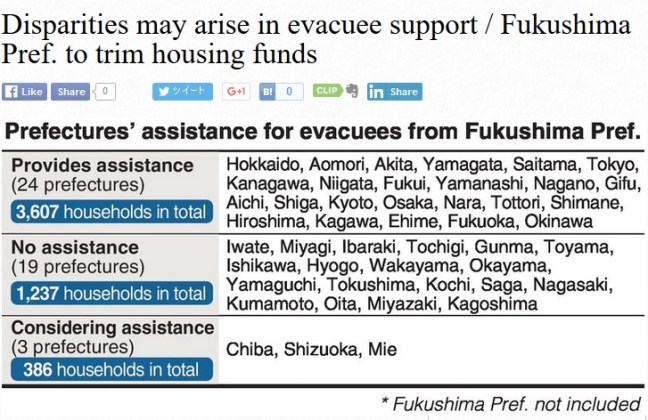
Starting in spring, housing assistance for residents of Fukushima Prefecture who evacuated to other prefectures voluntarily due to the 2011 nuclear accident will vary from prefecture to prefecture and certain disparities will occur, The Yomiuri Shimbun has learned.
The Fukushima prefectural government has so far been providing free-of-charge housing unconditionally and uniformly. However, it will terminate the provision at the end of March. Accordingly, 19 other prefectures will terminate their own initiatives to provide evacuees with free housing, while 24 prefectures will continue to provide housing free of charge and other services.
Although nearly six years have passed since the Fukushima No. 1 nuclear plant accident, many evacuees are still reluctant to return to their homes, and each prefecture that has accepted evacuees is responding to this situation in its own way.
After the accident, the Fukushima prefectural government treated voluntary evacuees — those who evacuated from areas that were not subject to evacuation orders — as equal to those who were instructed by the central government to evacuate. Abiding by the Disaster Relief Law, the prefecture has been shouldering rental fees for apartments or public housing facilities using funds from the state budget and other financial resources. The maximum rent for housing to be provided free of charge to voluntary evacuees is set at ¥60,000 per month in principle.
As of October 2016, the number of voluntary evacuees stood at 10,524 households or 26,601 individuals. Of these, 5,230 households or 13,844 individuals have relocated to areas outside of Fukushima Prefecture. In contrast to those who lived in areas subject to the evacuation order, voluntary evacuees are not eligible for regular compensation payments from Tokyo Electric Power Company Holdings, Inc. Therefore, the provision of free housing has been the main pillar of public support for voluntary evacuees.
Fukushima Prefecture decided in June 2015 to stop providing housing free of charge at the end of March 2017, judging that living conditions were changing for the better as the decontamination of residential areas progressed.
However, many evacuees responded to this by complaining that they did not want to be moved from places they were getting accustomed to. Accordingly, 24 prefectural governments other than Fukushima have decided to take the matter into their own hands by applying the law on public housing facilities and preferential measures by ordinances to compile their own budgets to extend the provision of free housing, give priority to evacuees in providing public housing for a fee or take other steps. A total of 3,607 households have evacuated on a voluntary basis to the 24 prefectures.
Several municipalities have also taken steps to provide public housing facilities free of charge.
Hokkaido, to which 229 households have voluntarily evacuated, has decided to extend provision of free housing for a year for 34 households. The prefectural government explained that it wants to help evacuees put their lives back in order by alleviating the concerns they may have about where to live.
Meanwhile, Hyogo Prefecture has decided to discontinue its support for the 44 households it accommodates. The spokesperson for the prefectural government said it would not take steps to keep the evacuees in the prefecture, which would be incompatible with policies of the Fukushima prefectural government aiming to bring them home.
Upon discontinuing the provision of free housing, Fukushima has procured 170 prefectural housing facilities for a fee to be provided preferentially to evacuees. The prefectural government is also planning to pay ¥100,000 to every household that moves back from outside the prefecture. Single-person households will receive ¥50,000. Residents who have evacuated to areas inside the prefecture will also receive a partial payment.
http://www.the-japan-news.com/news/article/0003439790
Bullying of evacuated children
Recently, the Japanese mass media are busy reporting on the bullying of evacuated children at school. As a matter of fact, this kind of bullying has existed for quite a while. However, after a long silence, the mass media have suddenly started reporting about it. Often, it tends to be reduced to the common bullying found in the education system without reference to the particular environmental hazards caused by the nuclear accident. Akiko MORIMATSU analyzes the bullying from the viewpoint of the nuclear disaster evacuees. She was interviewed in “Minna no News Wonder” at Kansai TV on December 5th 2016.
【3.11 evacuees’ voices】
“The courage to escape” and “the power to ask for help”
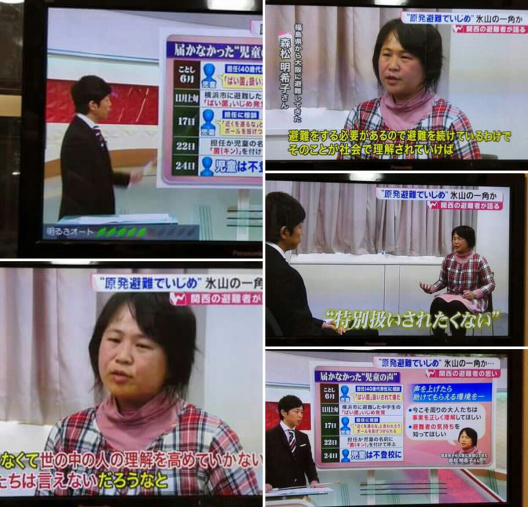
I am worried about what children will learn when they face a society incapable of helping people who have fled from calamity and are asking for aid.
I think that when society does not show how it is possible to help, children won’t be able to have the “courage to escape” or to deploy the power to “ask for help” at school.
I’ve noticed the following through my exerience with the nuclear disaster. We accept too easily that people facing danger will be able to escape without difficulty, and that it is natural to do so.
However, it is possible to create social situations which won’t allow for people to escape from danger, which won’t let them flee, or which pose such big obstacles that people can’t escape even when they are told that they are allowed to do so. This has indeed been our situation for the last 5 years and 8 months. I feel this way as an internal nuclear refugee.
This is how adult society is. In this society in which our evasion is not fully accepted, children are exposed to the risk of bullying, which can happen anywhere unfortunately, amplified by incomprehension, indifference, prejudice and discrimination of the society. I must say that they are facing even greater risks in response to the recent reporting by mass media.
At anytime, evacuee children are facing “the risk which is present here and now”.
This may be true for any children in this country.
And the “bullying” is not limited to children’s society.
It can be certainly said that there are second and third levels (TN 1) of damage from the nuclear disaster.
This is why society as a whole should accept the real situation of the nuclear disaster and set our eyes more directly on the truth.
The evacuees and evacuee children really exist all over Japan.
“They continue being evacuees because it is necessary to evacuate (TN2)”.
That is the truth and reality.
The only thing which counts is to start from this fact and decide how society should deal with it.
(Akiko MORIMATSU evacuated with two children from Fukushima to Osaka)
Broadcasted by Kansai TV on December 5th 2016
Sources: 東日本大震災避難者の会 Thanks & Dream
森松明希子さんのfacebookページ
Facebook of Akiko MORIMATU
(TN 1) For example, psychological, familial or social levels.
(TN2) because the environment is contaminated
https://fukushima311voices.wordpress.com/2017/01/01/bullying-of-evacuated-children/
Fukushima plaintiffs speak up on evacuee plight
A group of people who evacuated due to the 2011 accident at the Fukushima Daiichi nuclear power plant has spoken out about the many problems they face, including recent bullying of evacuee children.
The group consists of plaintiffs in lawsuits demanding compensation for damages from the central government and Tokyo Electric Power Company, which operates the plant.
Group representatives called for understanding of their suffering in a statement released at a news conference in Tokyo on Thursday.
The plaintiffs living in and outside Fukushima Prefecture, where the plant is located, took the action after a revelation last month that a student evacuee was bullied at school in Yokohama, near Tokyo.
The bullies demanded money from the boy. Similar cases have since been revealed elsewhere.
The statement says it is regrettable that evacuees, who are victims of the accident, suffer from insensitive criticism and unreasonable acts by others. It says the group seeks understanding of the seriousness of the situation.
A senior official of the group, Mitsuo Sato, said what has been reported about bullying is the tip of the iceberg. He said adults also face harassment and insensitivity. Sato said he wants people to know that bullying and discrimination affect all evacuees.
A woman who voluntarily evacuated from Fukushima Prefecture with her daughter asked people to think about why they had to leave their home. She added that the nuclear accident is far from over.
1 This Month
10 March A LIVE WEBINAR THE REAL EFFECTS OF NUCLEAR POWER
What the Industry Isn’t Telling Us
1:00 PM Mountain, 2 pm Central, 3 pm Eastern. Live on the Keepers of the Water Facebook page



18 March Webinar @ 1 PM EST: An Assessment of SMR Projects: The Case of Canada
register for the zoom:
https://us02web.zoom.us/webinar/register/WN_o8BIIOUvQ2ONJR1nta65DQ#/registration


of the week – STOP SMALL MODULAR REACTORS IN CANADA
To see nuclear-related stories in greater depth and intensity – go to https://nuclearinformation.wordpress.com
-
Archives
- March 2026 (109)
- February 2026 (268)
- January 2026 (308)
- December 2025 (358)
- November 2025 (359)
- October 2025 (376)
- September 2025 (258)
- August 2025 (319)
- July 2025 (230)
- June 2025 (348)
- May 2025 (261)
- April 2025 (305)
-
Categories
- 1
- 1 NUCLEAR ISSUES
- business and costs
- climate change
- culture and arts
- ENERGY
- environment
- health
- history
- indigenous issues
- Legal
- marketing of nuclear
- media
- opposition to nuclear
- PERSONAL STORIES
- politics
- politics international
- Religion and ethics
- safety
- secrets,lies and civil liberties
- spinbuster
- technology
- Uranium
- wastes
- weapons and war
- Women
- 2 WORLD
- ACTION
- AFRICA
- Atrocities
- AUSTRALIA
- Christina's notes
- Christina's themes
- culture and arts
- Events
- Fuk 2022
- Fuk 2023
- Fukushima 2017
- Fukushima 2018
- fukushima 2019
- Fukushima 2020
- Fukushima 2021
- general
- global warming
- Humour (God we need it)
- Nuclear
- RARE EARTHS
- Reference
- resources – print
- Resources -audiovicual
- Weekly Newsletter
- World
- World Nuclear
- YouTube
-
RSS
Entries RSS
Comments RSS
 nuclear-news