Fukushima nuclear crisis evacuees face unresolved issues 10 years on
Almost 10 years on from a devastating earthquake and tsunami that hit northeastern Japan and triggered one of the worst nuclear disasters in history, Seiichi Nakate still has not returned home.
He is just one of around 30,000 evacuees from Fukushima Prefecture who remained scattered around the country as of February this year, according to government data.

Photo taken Oct. 22, 2017 shows makeshift housing in Iwaki, Fukushima Prefecture, built for evacuees from Futaba, a town co-hosting the crippled Fukushima Daiichi nuclear complex.
March 5, 2021
And while the numbers — including those who voluntarily fled without an evacuation order — have halved from their peak of 62,831 in March 2012, many of the issues facing evacuees remain unresolved.
Nakate, who was living in the prefectural capital of Fukushima when the earthquake struck on March 11, 2011, said the disaster had “pulled the rug out from under” him and left him feeling like he was “fading away.”
While the city was not designated for forced evacuations after the reactor meltdowns at the Fukushima Daiichi nuclear plant some 60 kilometers away, concerns over radiation led Nakate and his wife to decide two weeks later that she and their two children should move to western Japan while he stayed on in the city.
It was not until around a year and a half later that the family finally started living together again, setting up home in Sapporo, the capital of Japan’s northern main island of Hokkaido, where they still remain.
Nakate, 60, currently co-heads Hinan no Kenri, a Hokkaido-based group fighting for the rights of Fukushima evacuees throughout Japan.
The movement was established in 2015 amid government efforts to promote the return of people to Fukushima — a drive that he says was conducted without consideration to the needs and desires of evacuees.
“It had been more than four years since the accident, and the central and local governments were moving forward with lifting evacuation orders, ending compensation, and promoting the return of evacuees as if ignoring our existence and will,” Nakate said.
His organization has a variety of demands for the central government, the foremost being a survey of the actual situation of evacuees, which he believes it has deliberately avoided doing so far.
Critics say the figures compiled by the central government do not accurately reflect reality as they are based on a system under which evacuees voluntarily register themselves as such with their new municipalities of residence.
In December last year, the Fukushima government, using central government data, reported that there were around 36,000 evacuees across Japan, including those within the prefecture. But the total reported by individual local municipalities in Fukushima added up to more than 67,000.
The picture is complicated by the fact that there is no consistency in how municipalities count their evacuees, with some continuing to list all the people who were registered as residents at the time of the disaster.
Nakate also highlighted that economic disparities among evacuees appear to be widening, in part due to “the narrow scope of compensation and the lack of government support.” For example, evacuees who fled from areas without evacuation orders were not eligible for any compensation in terms of rent.
And while some evacuees have fully settled into their new homes, others have been compelled to resettle in the crisis-hit prefecture due to financial difficulties, often caused by family members living separately, he says.
One of the “most pressing issues” his organization is dealing with is trouble over the termination of a scheme financed by Fukushima Prefecture for evacuees to live in vacant units of housing complexes for government workers in other parts of Japan.
The housing was initially offered for free but this arrangement expired in March 2017 for those who fled without an evacuation order, with the accommodation then offered for a maximum of two more years if normal rent was paid.
But some families, claiming financial difficulties, have decided to stay put. The Fukushima government, which had shouldered the rent, demanded in 2019 twice the normal rent as damages and filed a suit last year against four families still living in a Tokyo condominium for bureaucrats.

Yayoi Haraguchi, a sociology professor at Ibaraki University and head of nonprofit organization Fuainet:
Yayoi Haraguchi, a sociology professor at Ibaraki University, said that while most Fukushima evacuees have settled into a rhythm, issues such as poverty, unemployment, a sense of alienation, and mental distress have continued over the past decade.
“It may look like things are alright, but many unseen issues lie under the surface,” said Haraguchi, 48, who also heads Fuainet, a local nonprofit organization providing support to Fukushima evacuees in Ibaraki, northeast of Tokyo.
Haraguchi said she has encountered evacuees in their 20s to 40s who have fallen into depression or become social recluses after they were unable to find a job. Yet others are struggling financially despite having received government compensation for a period of time.
“A study by Fukushima Medical University Hospital showed that those who evacuated to outside Fukushima Prefecture were more likely to suffer from mental issues than those who had evacuated to somewhere within the prefecture,” she said.
While the initial evacuations were often hurried, many of those remaining outside the prefecture have since moved in search of a better life, she said, often choosing to settle in Ibaraki Prefecture bordering Fukushima to its south.
Part of Ibaraki’s appeal to evacuees, she explained, is its cheaper cost of living compared to Tokyo and relatively mild climate.
Post-disaster evacuations were also not limited to Fukushima, with some residents of Tokyo — located about 200 kilometers away from the crippled nuclear power plant — choosing to leave the capital, and even the country, due to their perceptions of how the radiation contamination could affect their health.

Freelance journalist and translator Mari Takenouchi, now based in Okinawa:
Freelance journalist and translator Mari Takenouchi, who has long held strong antinuclear views, fled from Tokyo to Okinawa with her infant son just days after the disaster. She says she picked the southern island prefecture as it is one of the few places in Japan free of nuclear power plants.
“If (the government) doesn’t shut down its nuclear power plants, it is dangerous to live in mainland Japan,” she said. “Japan is on the border of four (tectonic) plates, and 20 percent of the world’s major earthquakes of magnitude 6 or greater occur here.”
Since moving to Okinawa, the 54-year-old has worked to create greater awareness about the effects of radiation on children and fetuses. “The situation after the Fukushima accident has not become better, but worse. Considering the occasional earthquakes, all of us are still at great risk,” she said.

Kaori Nagatsuka, a former Tokyo resident who moved to Malaysia with her two children after the 2011 Fukushima nuclear crisis:
Kaori Nagatsuka, 52, another former resident of Tokyo, moved to Malaysia with her 9-year-old daughter and 2-year-old son in March 2012, also due to concerns over her children’s health.
Shortly after moving to Penang, Nagatsuka assisted other evacuees who were considering migrating outside of Japan by letting them stay in her home and volunteering to show them around potential schools for their children.
“There were quite a lot of people who wanted to emigrate in consideration of their children’s health but in the end couldn’t for various reasons,” said Nagatsuka, who now works for a local Malaysian company as a travel and education consultant.
Nagatsuka said she chose Malaysia due to its lower cost of living compared to other countries and relative proximity to Japan. But despite her husband remaining in Tokyo due to work, she has not returned home even once since leaving.
The family meets on occasion in either Malaysia or Taiwan, where their daughter, now 19, currently studies. And while her children are free to choose where they want to live in the future, Nagatsuka says she personally has taken a liking to Malaysia and has no plans to return to Japan.
“If I return to Japan, my children will likely come and visit me and that worries me because I think it could damage their health,” she said. “I raised my children with an aim that they could live in any country and I fulfilled my goal, so I’m glad I came here.”
Radiation criteria sow confusion for evacuees

Workers decontaminate a road in a special reconstruction district in the town of Futaba, Fukushima Prefecture, in October. | FUKUSHIMA MINPO
February 26, 2021
Traffic was lighter on the Joban Expressway in the Futaba district in Fukushima Prefecture during the New Year holiday, with people avoiding traveling back to see their relatives due to the novel coronavirus pandemic.
Roadside signs show the radiation levels of areas near the no-go zones put in place after meltdowns in 2011 at the Fukushima No. 1 nuclear plant, reflecting the fact that, even after 10 years, Fukushima residents are unable to return to their homes.
The no-go zones, which are considered uninhabitable for the foreseeable future due to high radiation levels, stretch through six Fukushima towns and villages: Tomioka, Okuma, Futaba, Namie, Katsurao and Iitate. Parts of those zones are now designated as special reconstruction districts, where the government will concentrate its decontamination efforts so that residents can return to their homes in the future.
A decade after the tsunami-triggered nuclear disaster, decontaminating the areas damaged by the fallout is a crucial part of the reconstruction that will pave the way for evacuees to come back to their homes and resume the life they had before the disaster.
But two figures of radiation exposure levels — 20 millisieverts a year and 1 millisievert a year — that the government provides as safety criteria are causing confusion among residents, triggering criticism of what could be called a double standard.
One of the criteria for the government to lift evacuation orders is whether the area’s annual cumulative radiation level has become 20 millisieverts or below, based on a recommendation from the nongovernmental International Commission on Radiological Protection.
When there is a nuclear disaster similar to that at the Fukushima No. 1 nuclear power plant, the ICRP recommends that annual radiation exposure should be limited to between 20 to 100 millisieverts immediately after the disaster. It then recommends the exposure is lowered to between 1 to 20 millisieverts during the reconstruction period.
As the minimum recommended exposure level right after a disaster, the 20 millisieverts mark became the radiation level yardstick for the central government to order the evacuation of a certain area after the nuclear meltdowns.
Meanwhile, the government has set up a long-term decontamination goal of reducing the radiation levels of contaminated areas to an annual 1 millisievert and below. This is to keep a lifetime exposure level below 100 millisievert — the level at which it starts to affect one’s health.
Therefore, the government stipulated the annual 1 millisievert exposure level in its reconstruction policy plan for Fukushima approved by the Cabinet in July 2012. The Environment Ministry aims to keep radiation levels in the special reconstruction district under 1 millisievert as a long-term goal.
However, the no-go zones had been above 50 millisieverts on an annual basis immediately after the nuclear meltdowns. The radiation level is on the decline with natural attenuation of radioactive cesium as well as weathering effects, but there are still patches with high radiation levels.
Even within the no-go zones, there is no easy way to carry out decontamination. Typically it is done by mowing lawns, raking up fallen leaves, washing down roads and other surfaces with a high-pressure water hose, and wiping off the walls and roofs of buildings and housing.
“It’s not easy to bring down radiation levels to 1 millisievert or below just with decontamination,” said an Environment Ministry official in charge.
In Article 1 of the radiation decontamination legislation established after the nuclear disaster, it is stipulated that the purpose of decontamination is to “minimize the health risks of radioactive exposure as much as possible.”
Despite the criteria for easing evacuation orders and the long-term goal on bringing down radiation levels, it is unclear how the government can lower radiation levels to 1 millisievert after evacuation orders are lifted for no-go zones.
The two figures are creating a confusion among local residents, who are torn between the desire to return to their homes and concerns over the radiation level.
“I won’t feel safe until annual radiation levels are below 1 millisievert,” one resident said, while another said, “Can you say for sure that an annual exposure of 20 millisieverts won’t affect our health in the future?”
https://www.japantimes.co.jp/news/2021/02/26/national/fukushima-radiation-criteria/
Fukushima struggling to get people back, 10 years after disaster

An elementary school building in Namie, Fukushima Prefecture, is seen deserted in January. Municipalities near the crippled nuclear power plant in Fukushima have been struggling to bring residents back. February 22, 2021
February 22, 2021
Fukushima – Municipalities near the crippled nuclear power plant in Fukushima Prefecture have been stepping up efforts to bring residents back, a decade after the March 2011 triple reactor meltdown.
In areas in 10 Fukushima municipalities that were once off-limits due to radiation from the nuclear disaster, the ratio of actual to registered residents is as low as 31.8%.
Years of evacuation orders following the disaster at Tokyo Electric Power Company Holdings Inc.’s Fukushima No. 1 nuclear plant have left many registered residents unwilling to return, leaving officials concerned about the survival of their municipalities.
Taki Shoji, an 87-year-old former evacuee, returned from the city of Aizuwakamatsu further inland in the prefecture to the town of Okuma in April 2019 after an evacuation order was lifted.
In Aizuwakamatsu, Shoji struggled with snow-removing work during wintertime that he was not accustomed to.
“Living in a large house makes me feel calm,” he said, referring to his life in his warmer, coastal hometown.
Shoji needs to go to a neighboring town by bus to shop because local stores offer only a limited supply of goods. He is looking forward to the opening in spring of a commercial facility in Okuma that houses convenience and grocery stores. It “will allow me to go shopping by foot,” he said.
The ratio of actual to registered residents is especially low, at less than 20%, in the towns of Namie and Tomioka, where it took about six years for people to return after the nuclear accident.
A survey of Namie and Tomioka residents last summer by the Reconstruction Agency and others showed that greater access to shopping and medical and welfare services is needed for evacuees to return to their hometowns.
These municipalities are taking steps to encourage people to relocate to them.
The village of Iitate, where the ratio of actual to registered residents stands at about 30%, offers support measures for those willing to relocate, including up to ¥5 million in subsidies for the construction of a new house. As a result, the number of people who have relocated to Iitate topped 100 in summer last year.
Namie plans to create new jobs mainly in the renewable energy industry to bring more people to the town. “The current population is not enough to maintain infrastructure and administrative services and it’s difficult to keep the town afloat,” Namie Mayor Kazuhiro Yoshida said.
The government will start a new program in fiscal 2021, which begins in April, to provide up to ¥2 million per household to people relocating to Fukushima areas affected by the nuclear accident.
Fukushima Prefecture plans to promote support for both evacuees’ return to hometowns and relocation by making use of the aid from the government. “Unless there are people, there will be no reconstruction,” a prefectural official said.https://www.japantimes.co.jp/news/2021/02/22/national/fukushima-residents-struggle/
Court rules Fukushima nuclear disaster preventable, increases liabilities
Fukushima nuclear disaster preventable, court rules, with more damages claims likely
Government and company Tepco ordered to pay some damages for 2011 event, but ruling could spur further claims
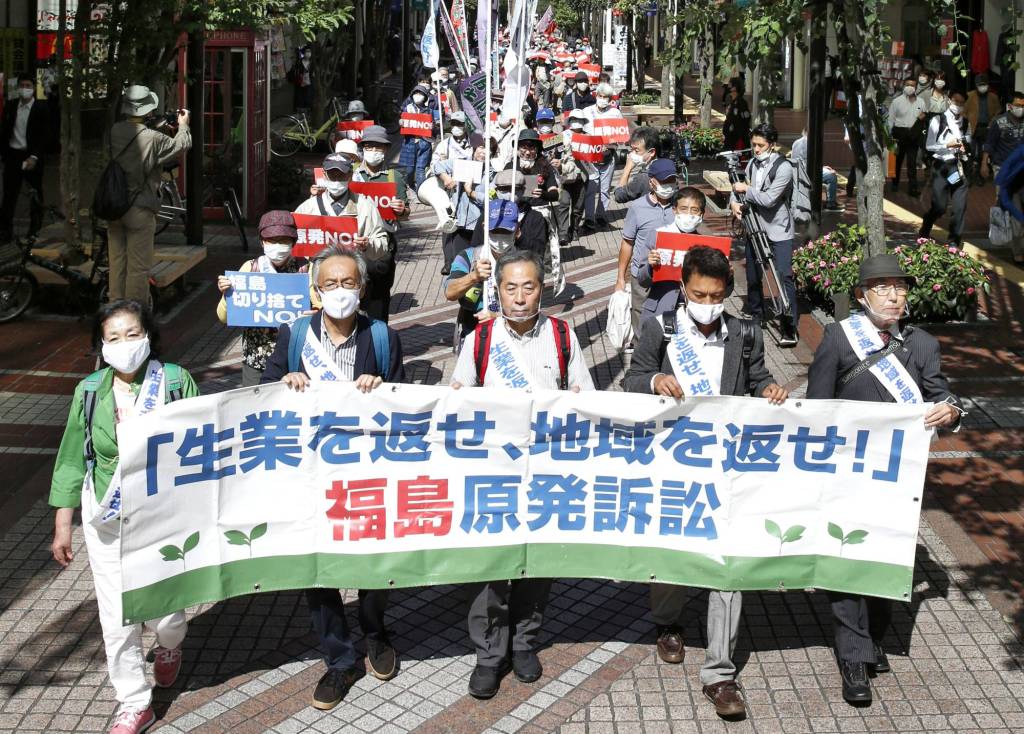
Plaintiffs and their supporters march in Japan ahead of the court ruling in Sendai on the tsunami-crippled Fukushima Daiichi nuclear power plant disaster on Wednesday.
Oct 1, 2020
A Japanese court has found the government and Tepco, the operator of the wrecked Fukushima nuclear plant, negligent for failing to take measures to prevent the 2011 nuclear disaster, and ordered them to pay 1bn yen ($9.5m) in damages to thousands of residents for their lost livelihoods.
The ruling on Wednesday by Sendai high court could open up the government to further damage claims because thousands of other residents evacuated as reactors at the coastal power station overheated and released a radioactive cloud, following the devastating tsunami. While some people have returned home, areas close to the plant are still off limits.
The plaintiffs had sought monthly compensation of about 50,000 yen ($470) per person until radiation levels subside to pre-disaster levels, seeking a total of 28bn yen ($265m).
The plaintiffs’ head lawyer, Izutaro Managi, hailed the ruling as a major victory, saying: “We ask the government to extend relief measures as soon as possible, not only for the plaintiffs but for all victims based on the damage they suffered.”
The latest ruling follows 13 lower court decisions, which were divided over government responsibility in the disaster. The latest ruling doubles the amount of damages against Tepco ordered by a lower court in 2017
In 2011, 3,550 plaintiffs were forced to flee their homes after a magnitude-9 earthquake triggered a tsunami that devastated the country’s north-east and crippled the Fukushima nuclear plant, known as the triple disaster.

Decommissioning work is underway at the Fukushima Daiichi nuclear power plant in Okuma town, north-eastern Japan.
Radiation that spewed from the plant’s melted reactors contaminated the surrounding areas, forcing about 160,000 residents to evacuate at one point. More than 50,000 are still displaced because of lingering safety concerns. The plant is being decommissioned, a process expected to take decades.
The court said that the government could have taken measures to protect the site, based on expert assessments available in 2002 that indicated the possibility of a tsunami of more than 15 metres, reported public broadcaster NHK, which aired footage of the plaintiffs celebrating outside the court after the ruling.
The government has yet to say whether it will appeal in the supreme court against the decision. “We will consider the ruling and take appropriate action,” chief cabinet secretary Katsunobu Kato said after the ruling.
Officials at Tepco were unavailable when Reuters tried to reach them outside regular business hours.
In court, the government argued it was impossible to predict the tsunami or prevent the subsequent disaster. Tepco said it had fulfilled its compensation responsibility under government guidelines.
Plaintiffs said the ruling brought some justice, but that their lives could never return to normal and their struggle was far from over.
“For more than nine years, I have planted seeds on the contaminated soil and grown vegetables, always worrying about the effects of radiation,” plaintiff Kazuya Tarukawa, a farmer from Sukagawa in Fukushima, said at a meeting after the ruling. “Our contaminated land will never be the same.”
Court increases state liability, compensation for nuclear disaster

Plaintiffs hold up signs in front of the Sendai High Court on Sept. 30 stating victory in their lawsuit against the central government and Tokyo Electric Power Co.
October 1, 2020
SENDAI—A high court here on Sept. 30 more than doubled the amount of compensation awarded to victims of the Fukushima nuclear disaster and issued a scathing critique against the central government for its inaction.
The Sendai High Court found the central government equally at fault as plant operator Tokyo Electric Power Co. for failing to take anti-tsunami measures and ordered the defendants to pay a total of about 1.01 billion yen ($9.6 million) to around 3,550 evacuees and residents living in Fukushima Prefecture and elsewhere.
It was the first high court ruling in various lawsuits seeking compensation from TEPCO and the central government for the triple meltdown at the Fukushima No. 1 nuclear power plant caused by a quake-triggered tsunami in March 2011.
In October 2017, the Fukushima District Court ordered the defendants to pay about 500 million yen to about 2,900 evacuees. That decision was appealed to the Sendai High Court, which increased both the compensation amount and the number of recipients.
“We won a total victory over the central government and TEPCO,” Izutaro Managi, a lawyer for the plaintiffs, said. “The effect on the various lawsuits to be decided in the future will be huge.”
A major point of contention in the case was a long-term assessment of the probability of major earthquakes released by the science ministry’s Headquarters for Earthquake Research Promotion in 2002. The report pointed out that Fukushima Prefecture could be hit by a major tsunami.
The high court found the assessment to be a “scientific finding that had a considerable level of objective and rational basis,” making it an important perspective that differed greatly from various views presented by individual scholars or private-sector organizations.
The court ruled that if the economy minister at the time had immediately ordered TEPCO to calculate the height of a possible tsunami, a forecast could have been made of the likelihood of a tsunami striking the nuclear plant.
But the ruling said, “The regulatory authority did not fulfill the role that was expected of it” and that “not exercising regulatory powers was a violation of the law regarding state compensation.”
The Fukushima District Court found that the central government only had a secondary responsibility to oversee the utility.
The high court, however, ruled that the government had the same level of responsibility. It said both the central government and TEPCO avoided making tsunami calculations because they feared the effects that would arise if the urgent measures were taken.
The high court ruling also expanded the range of plaintiffs who could receive compensation to people living in the Aizu district of Fukushima Prefecture as well as Miyagi and Tochigi prefectures where evacuation orders were not issued.
Experts said the high court ruling is a game-changer because of the positive assessment given to the long-term evaluation about possible tsunami.
Other district courts have ruled that the central government was not responsible because even if it had ordered measures to be taken, there would not have been enough time to complete such steps to prevent damage from the tsunami.
“Plaintiffs in the other lawsuits have provided testimony at a similar level so this could turn the tide in the recent trend of plaintiffs losing their cases,” said Masafumi Yokemoto, a professor of environmental policy at Osaka City University who is knowledgeable about nuclear plant issues.
Yotaro Hatamura, a professor emeritus of engineering at the University of Tokyo who headed the government panel that investigated the Fukushima nuclear accident, said, “This was an unprecedented ruling that pointed out in a rational manner the stance of both the central government and TEPCO of not looking at data that they did not want to see.”
Chief Cabinet Secretary Katsunobu Kato said at his Sept. 30 news conference that the central government would carefully go over the court ruling before making a decision on whether to appeal.
TEPCO also issued a statement with similar wording.
Japanese Government Is Ordered to Pay Damages Over Fukushima Disaster
The Sendai High Court said the state and the plant’s operator must pay $9.5 million to survivors of the 2011 nuclear accident. They have until mid-October to appeal to the country’s Supreme Court.

A damaged reactor building at the Fukushima Daiichi nuclear power plant in Japan in 2011.
September 30, 2020
TOKYO — A high court in Japan on Wednesday became the first at that level to hold the government responsible for the 2011 Fukushima nuclear disaster, saying in a ruling that the state and the plant’s operator must pay about $9.5 million in damages to survivors.
The overpowering earthquake and tsunami that ripped through northern Japan in March 2011 caused a triple meltdown at the Fukushima Daiichi plant, leading to the worst nuclear crisis since Chernobyl.
Under Wednesday’s ruling by the Sendai High Court, the government and the Tokyo Electric Power Company, known as Tepco, must compensate 3,550 plaintiffs, the Kyodo news agency reported. The plaintiffs had sought monthly compensation payments of about $475 per person until radiation at their homes returns to pre-crisis levels.
In 2017, a lower court had ordered the government and Tepco to pay about half that amount to about 2,900 plaintiffs. But the ruling by Sendai’s high court, one of eight such courts in Japan, is significant because it could set a legal precedent for dozens of similar lawsuits that have been filed across the country.
The government has long argued that it could not have prevented the tsunami or the nuclear accident, while Tepco says it has already paid any compensation that was ordered by the government. Last year, a Japanese court acquitted three former Tepco executives who had been accused of criminal negligence over their roles in the accident.
Hiroshi Kikuchi, a lawyer for the plaintiffs, called Wednesday’s decision “groundbreaking.”
“The court carefully collected facts for this judgment,” Mr. Kikuchi said at a news conference. “We feel now it will largely impact on other actions nationwide.”

Workers removing the top soil from a garden in Naraha, inside Fukushima’s evacuation zone, in 2013.
Izutaro Managi, another lawyer on the team, said in a brief interview that if the government and Tokyo Electric Power appeal the decision, he expects it to go to the country’s Supreme Court. The deadline for filing that appeal is Oct. 14.
Tepco said in a statement on Wednesday that it would examine the judgment before responding to it.
“We again apologize from our heart for giving troubles and concerns to people in Fukushima as well as in the society largely caused by our nuclear power plant’s accident,” the statement said.
Toyoshi Fuketa, the chairman of the Nuclear Regulation Authority, an agency that was created after the Fukushima accident, said on Wednesday that he would not comment until the details of the judgment were released.
“The Nuclear Regulation Authority was set up based on reflection over, and anger against, the nuclear accident in Fukushima,” Mr. Fuketa added. “I would like to advance strict rules on nuclear power so that a nuclear accident will never happen again.”
Takashi Nakajima, one of the plaintiffs in the case, told reporters that the ruling was a reminder that the consequences of the Fukushima disaster were still real, even if many people in Japan were starting to forget about it.
“Some people say that I’m damaging Fukushima’s reputation,” Mr. Nakajima said. “But now I think we are encouraged by the court to say what we think.”
Another plaintiff, Kazuya Tarukawa, said in a tearful statement that he had been tilling contaminated soil in the area for nearly a decade, and waiting for the government and the plant’s operator to take responsibility.
He said the money was beside the point, and that the ruling raised a larger question about the long-term risks of nuclear energy.
“What will come of Japan if there is another nuclear disaster like that?” he asked.

A roadblock in a contaminated area northwest of the nuclear plant in 2013.
Sendai court upholds ruling that state and Tepco must pay Fukushima evacuees
A group of plaintiffs demanding compensation for the Fukushima No. 1 nuclear plant disaster rally in Sendai on Wednesday prior to the high court’s ruling that held the state and Tepco responsible.
September 30, 2020
Sendai – The Sendai High Court on Wednesday ordered the state and the operator of the crippled Fukushima No. 1 nuclear plant to pay ¥1 billion ($9.5 million) in damages to residents over the 2011 earthquake- and tsunami-triggered disaster.
It was the first time a high court has acknowledged the state’s responsibility for the incident in about 30 similar lawsuits filed nationwide.
The Sendai court told the government and Tokyo Electric Power Company Holdings Inc. to pay about ¥1.01 billion to 3,550 out of some 3,650 plaintiffs, up from the sum of ¥500 million that a lower court ordered them to pay to around 2,900 plaintiffs in an October 2017 ruling.
In line with the 2017 ruling by the Fukushima District Court, the high court made its decision based on three points in dispute, including whether a major tsunami could have been foreseen.
The two other points were whether countermeasures could have been implemented to prevent a disaster, and whether the compensation levels outlined by the government were sufficient.
The plaintiffs had sought monthly compensation payments of around ¥50,000 per person until radiation at their residences returns to the pre-crisis level, bringing their total final demand to approximately ¥28 billion.
The state, meanwhile, argued it was impossible to predict the tsunami and prevent the subsequent disaster. Tepco claimed it had already paid compensation in accordance with government guidelines.
In the district court ruling, the government and Tepco were both blamed for failing to take steps to counter the huge tsunami.
It ruled that the two should have been able to foresee the risks of a maximum 15.7-meter-high wave, based on a quake assessment issued in 2002, and that the disaster could have been prevented if the state had instructed the operator to implement measures that year.
The magnitude 9.0 earthquake and ensuing tsunami struck Tohoku on March 11, 2011, causing multiple meltdowns and hydrogen blasts at the nuclear power plant.
Around 55,000 people remained evacuated both within and outside Fukushima Prefecture as of the end of August.
The Nuclear Regulation Authority issued a comment that said, “We will consider appropriate ways to respond while closely examining the ruling and consulting with relevant authorities.”
Tepco said in a statement, “We deeply apologize again for causing great trouble and worries to the people of Fukushima Prefecture and the whole of society because of the nuclear power plant accident. We will closely examine the ruling by the Sendai High Court and consider ways to respond.”
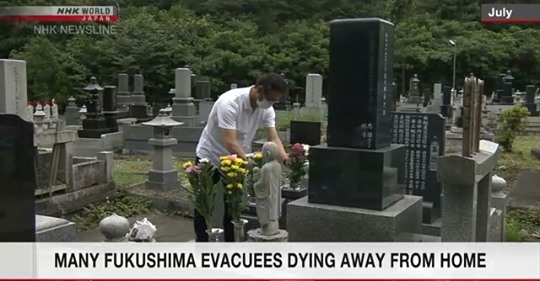
Many Fukushima evacuees die away from home
September 9, 2020
NHK has learned that more than 2,600 people have died over the ensuing years after being evacuated from their hometowns following the meltdowns at the Fukushima Daiichi nuclear power plant in March 2011.
NHK contacted local governments in Fukushima Prefecture and found that at least 2,670 people, about 10 percent of the original population, had died as of August. More than 26,500 people lived in seven municipalities near the plant. Where they lived have been designated no-entry zones for nearly nine and a half years because radiation levels remain high.
By municipality, 895 people from Okuma Town have died, 792 from Futaba Town, 576 from Namie Town, 362 from Tomioka Town, 32 from Iitate Village, 12 from Katsurao Village, and one from Minamisoma City.
The Japanese government is conducting decontamination work and rebuilding infrastructure in some areas with the aim to allow residents to return in two or three years.
But there is no concrete plan to make other parts, or 92 percent of the no-entry zone, habitable again, despite the strong hope of residents to return home.
Fukushima compensation guidelines need further revision
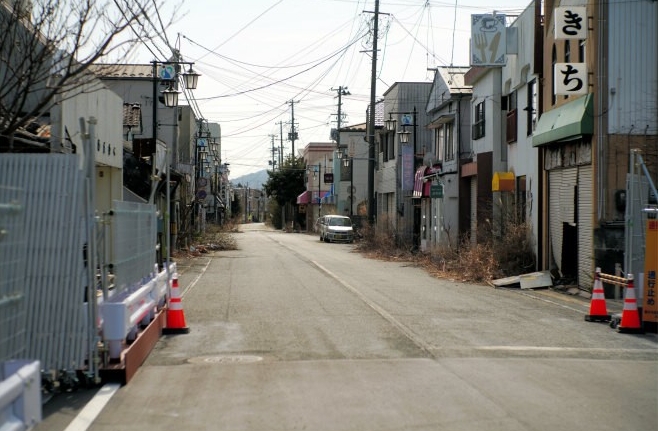 The difficult-to-return-zone around Ono Station on the JR Joban Line in Okuma, Fukushima Prefecture is empty on March 1. A part of evacuation order was lifted on March 5, but most of the area remains eerily the same as when the nuclear disaster happened in 2011.
March 19, 2020
The Sendai and Tokyo high courts recently said in separate rulings that Tokyo Electric Power Co. should pay more in compensation to victims of the 2011 accident at the company’s Fukushima No. 1 nuclear power plant.
Some 30 class action lawsuits have been filed by people who were forced to evacuate from their homes in the wake of the nuclear disaster to seek damages beyond the amounts the electric utility has agreed to pay.
The fact that the two rulings, the first high court decisions concerning these cases, both questioned the adequacy of the existing Fukushima compensation program is highly significant in its legal and policy implications.
During the trials, the plaintiffs argued that it is difficult to return to their homes even if the evacuation orders are lifted. Even if they return, they claimed, they will face local towns and communities that have been radically altered by the accident.
The two high courts acknowledged the seriousness of the corrosive effects of what these victims call “the loss and transformation” of their hometowns and ruled that they deserve to be compensated for this problem in addition to damages for being forced to flee their homes and the mental anguish caused by their lives as evacuees.
The courts awarded the plaintiffs additional damages beyond the amounts the company has already paid.
The utility has adamantly refused to pay any blanket compensation to victims beyond the amounts based on the guidelines set by the Dispute Reconciliation Committee for Nuclear Damage Compensation, a panel established within the government to settle disputes over compensation for victims of the Fukushima disaster.
TEPCO has also rejected deals to settle these class action suits proposed by the Nuclear Damage Compensation Dispute Resolution Center, a body created to help resolve such disputes through simplified procedures.
The company has even turned down a compromise recommendation issued by the Fukushima District Court based on arguments during a trial over a compensation dispute it had heard.
Clearly, the company fears that accepting such a deal would affect the entirety of its compensation talks and cause the total of damages it has to pay to soar.
After the devastating accident, however, TEPCO made “three vows.” It pledged to pay compensation to all victims without leaving a single one uncompensated, ensure that compensation will be paid quickly according to individual circumstances and respect proposals to settle disputes.
As the company that is responsible for the unprecedented nuclear accident, TEPCO has a duty to make sincere responses to the high court rulings in line with its own vows.
The government, which has promoted nuclear power generation as a national policy and is effectively the largest shareholder of the utility, has the responsibility to provide strict guidance for the company’s actions concerning the matter.
The two rulings have also brought to the fore some shortcomings of the guidelines set by the dispute reconciliation committee.
Established immediately after the accident, the guidelines are obviously out of tune with the complicated realities of the accident’s aftermath despite several revisions that have been made.
The “loss and transformation” of hometowns is a consequence of the accident that has become clearly visible over the nine years that have passed since that day in 2011.
It is time for the government to have some in-depth debate on the effects of this problem on affected people and embark on a sweeping review of the guidelines.
The high court rulings are not totally acceptable, however. Arguing that the money TEPCO has already paid covers part of the additional damages owed to the victims, the rulings only awarded the plaintiffs 1 million yen to 2.5 million yen ($23,000) per head in additional compensation.
Many victims have criticized the amounts for being “too small to be fitting compensation for the actual damage” suffered by the victims.
There is no easy solution to this complicated problem. But that does not justify inaction in the face of such gross injustice.
All the parties concerned need to offer ideas and ingenuity to spare the victims the need to spend any more effort and time with regard to compensation issues.
http://www.asahi.com/ajw/articles/13227560
Tokyo High Court slashes damages to Fukushima nuclear disaster evacuees
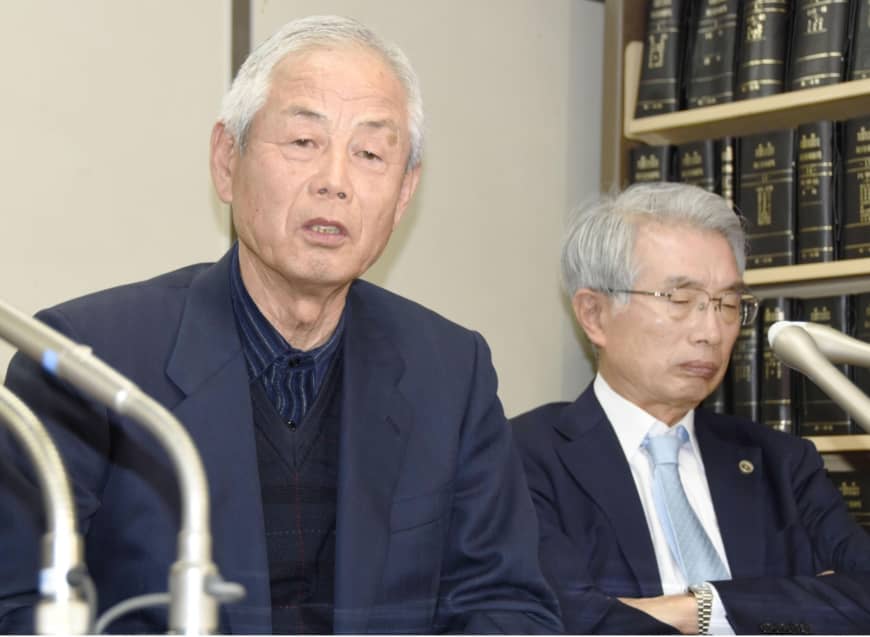 Isao Enei (left), head of a group of plaintiffs seeking damages for evacuating after the 2011 Fukushima No. 1 nuclear power plant accident, speaks at a news conference Tuesday in Tokyo alongside their attorney Junichiro Hironaka.
March18, 2020
The Tokyo High Court on Tuesday ordered ¥1 million in additional damages be paid each to some 300 evacuees from the 2011 Fukushima nuclear disaster, down by two-thirds from the amount awarded by a lower court ruling.
The total amount of additional compensation Tokyo Electric Power Company Holdings Inc. must pay was reduced to about ¥360 million from the ¥1.1 billion awarded by the Tokyo District Court in 2018.
The nuclear accident occurred at the Fukushima No. 1 nuclear power plant operated by Tepco, after it was affected by the March 2011 earthquake and tsunami.
In their petition, the plaintiffs, including former residents of the Odaka district in Minamisoma, Fukushima Prefecture, sought additional damages of ¥10.9 billion in total.
The ruling was the second by a high court on a collective damages lawsuit filed by those displaced by the nuclear accident, following one issued by Sendai High Court last week.
On Tuesday, presiding Judge Wataru Murata said Tepco must pay additional damages on top of the ¥8.5 million it paid per person based on estimates calculated under government-set interim standards.
The additional damages have to be paid to compensate for the loss of hometowns, as “the foundations of residents’ lives have changed greatly and have yet to be restored,” Murata said.
But the amount of the additional damages should be reduced because individual circumstances of the evacuees should not be taken into account, Murata said, denying the need for such consideration as had been recognized by the lower court.
“The reduction is unavoidable, also considering that returning to hometowns is possible,” the judge concluded.
Plaintiff Isao Enei criticized the latest ruling at a news conference, saying that actual circumstances in areas hit by the nuclear disaster were completely ignored.
“There is no point in filing a collective suit if individual damages are ignored. The ruling is inconceivable,” said Junichiro Hironaka, an attorney for the plaintiffs.
Sendai High Court orders Tepco to pay more to Fukushima evacuees
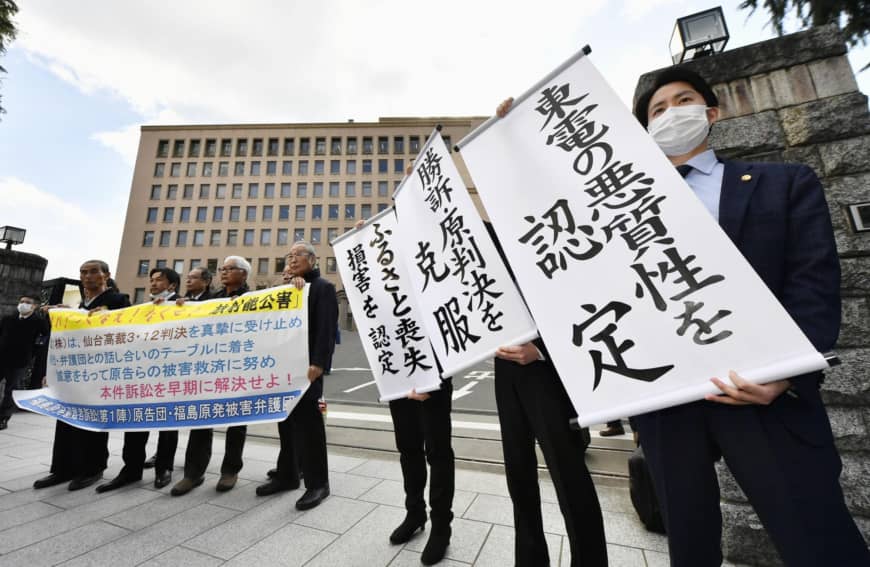 Plaintiffs and lawyers who filed a lawsuit seeking damages for having to evacuate after meltdowns at the Fukushima No. 1 nuclear power plant hold up banners Thursday in front of the Sendai High Court.
March13, 2020
SENDAI – A high court on Thursday ordered the operator of the crippled Fukushima No. 1 nuclear plant to pay ¥730 million in damages to evacuees from the 2011 tsunami-triggered meltdown, up ¥120 million from a lower court ruling.
In their appeal at the Sendai High Court, 216 plaintiffs, most of whom are evacuees from areas within 30 kilometers of the plant, maintained their claim for a total of ¥1.88 billion in compensation from Tokyo Electric Power Company Holdings Inc.
The latest ruling is the first to be handed down by a high court among 30 similar lawsuits filed nationwide by evacuees and victims seeking damages, either from the power company alone or both the utility and the state.
“Tepco knew around April 2008 that there was the possibility of a tsunami that could be high enough to reach the site of the Fukushima No. 1 power plant and might cause the failure of the safety functions intended to halt the nuclear reactor,” presiding Judge Hisaki Kobayashi said when handing down the ruling.
“The accident occurred while countermeasure construction had been postponed. From the victims’ point of view, this is the thing that Tepco should have the greatest amount of regret over,” he said. “Tepco’s lack of proper preparation is extremely regrettable and should be an important factor in calculating the amount of compensation.”
Also taking into account pain caused to the plaintiffs by the loss of their neighborhoods and hardships during evacuation, the court ordered additional compensation of ¥1 million each for evacuees mostly from areas once designated as restricted residence zones and ¥500,000 for those from former emergency evacuation preparation zones.
In the previous ruling at the Iwaki branch of the Fukushima District Court in March 2018, 213 out of 216 plaintiffs were awarded compensation of between ¥700,000 and ¥1.5 million per person, depending on where the victims were living.
Both the utility and the plaintiffs had appealed to the high court.
“It is a fair ruling,” said Tokuo Hayakawa, who leads the plaintiffs. “We cannot go back to our daily lives even if the evacuation orders are lifted.”
Tepco said in a release that it was considering how to respond to the latest ruling.
The value sought in the lawsuit had been lowered by the plaintiffs from ¥13.3 billion to avoid the possibility of a prolonged trial that could have raised court costs and may have undermined the amount of money they could receive at its conclusion.
The plaintiffs argued that the operator could have foreseen the accident caused by the tsunami based on the government’s 2002 long-term assessment of major quakes, and demanded compensation for their “loss of a hometown” in addition to the amount already paid by the power company.
Tepco maintains that it could not have predicted the tsunami, and has claimed that the damages have already been paid to evacuees in accordance with government guidelines on compensation.
Gov’t, TEPCO ordered to compensate Fukushima evacuees to Hokkaido

March 11, 2020
SAPPORO — A court ordered the government and the operator of the crippled Fukushima nuclear plant Tuesday to pay a combined 52.9 million yen in damages to 89 people who evacuated from their hometowns to Hokkaido after the 2011 nuclear disaster.
The Sapporo District Court ruling marked the seventh case where both the government and Tokyo Electric Power Company Holdings Inc were ordered to pay damages, out of 11 cases brought against the two parties. In the four other cases, only TEPCO was ordered to pay damages.
It was also the 15th decision handed down among around 30 similar damages suits filed across Japan over one of the world’s worst nuclear disasters, triggered by the massive earthquake and tsunami in March 2011.
A total of 257 plaintiffs, 90 percent of whom at the time were living in Fukushima city and other locations outside of areas given evacuation orders, had sought a combined 4.24 billion yen from the utility and the state.
“While (the ruling) is a sign of recognition of the government’s responsibility, it doesn’t reflect the actual lives that those who evacuated to Hokkaido have led,” a lawyer representing the plaintiffs told reporters after the court decision.
Following the ruling, TEPCO offered a “heartfelt apology for causing great trouble and worries” to those affected in Fukushima and other areas and said it will consider how to respond to the court decision after closely examining it.
At the court, the operator had said it had already paid damages to some of the plaintiffs and that the amount was adequate as it was based on the government guidelines. The utility also said it was not obligated to compensate the others as they had voluntarily evacuated.
The government has denied responsibility for the disaster, saying it could not have foreseen the flooding of the nuclear plant due to a tsunami.
The plaintiffs argued that TEPCO neglected to take preventive measures although it could have predicted earthquake and tsunami risks at the plant, and that the government did not enforce adequate safety measures despite approving power generation at the complex.
They also said that the psychological distress they suffered due to fears that radiation exposure had damaged their health, among other concerns, had impacted their ability to lead a normal life following the evacuation.
https://japantoday.com/category/national/gov%27t-tepco-ordered-to-compensate-fukushima-evacuees-to-hokkaido
TEPCO ordered to cough up after it refused deal on compensation
“Earlier in February, a Japanese judge ordered TEPCO to pay over 50 plaintiffs: “Refusing the court’s settlement offer was outrageous. It amounted to ignoring the company’s responsibility for causing this unprecedented nuclear disaster.”
 Plaintiffs and supporters at a news conference in Fukushima after the court ruling on Feb. 19
February 20, 2020
FUKUSHIMA–The district court here sided with local residents seeking compensation for psychological damage resulting from the 2011 nuclear disaster after the operator of the stricken facility snubbed mediation efforts for a settlement.
The court on Feb. 19 ordered Tokyo Electric Power Co. to pay 12.03 million yen ($108,000) to 50 of the 52 plaintiffs.
The plaintiffs had sought 99 million yen in damages for their psychological suffering due to their voluntary evacuation after the triple meltdown at the Fukushima No. 1 nuclear power plant and fear of being exposed to high levels of radiation.
In his ruling, Presiding Judge Toru Endo noted that residents who evacuated voluntarily found themselves living an uncertain and insecure existence with no future prospects.
The court acknowledged that those who didn’t evacuate were also unable to move around freely, given that they lived in fear and anxiety over the prospect of being exposed to radiation.
The court ordered TEPCO to pay between 22,000 yen and 286,000 yen to each eligible plaintiff, in addition to a uniform compensation sum of 120,000 yen per person that the utility had already paid.
The court recommended a settlement last December, the first of its kind among 30 or so class action lawsuits filed around the country over the nuclear accident, but TEPCO refused to comply.
Residents living in designated voluntary evacuation zones in Fukushima city and other areas more than 30 kilometers from the nuclear power plant filed the lawsuit in April 2016, seeking higher compensation than the figure stipulated in the government’s guidelines.
The plaintiffs had sought to settle the lawsuit quickly in light of their mental exhaustion and advanced age rather than engage in a drawn-out process.
In a statement, TEPCO said it will consider how to respond to the ruling after thoroughly examining it.
‘REFUSING SETTLEMENT OUTRAGEOUS’
After the ruling, Yoshitaro Nomura, a lawyer representing the plaintiffs, condemned the stance that TEPCO took on the matter.
“Refusing the court’s settlement offer was outrageous. It amounted to ignoring the company’s responsibility for causing this unprecedented nuclear disaster,” Nomura said.
Groups of disaster victims resorted to a system called alternative dispute resolution, or ADR, in the hope of winning compensation for the nuclear accident. But many of them started facing an impasse in the process two years ago after TEPCO refused to accept deals proposed by the Nuclear Damage Compensation Dispute Resolution Center.
The issue was taken up in the Diet, and the industry minister warned the utility to be more cooperative. However, the number of ADR cases that went nowhere continues to rise.
TEPCO refused to change course even after the district court recommended a settlement in a trial where the plaintiffs and the defendant are required to provide more solid arguments and proof.
The court-ordered compensation of 12.03 million yen comes to almost the same amount as the court proposed in the settlement last December. The government guidelines set individual compensation at 120,000 yen.
“TEPCO has made it clear it intends to make no compromise on settlement offers that may lead to a revision of the government’s guidelines,” said lawyer Izutaro Manaki, a member of the Daini Tokyo Bar Association who is well-versed in compensation issues.
As of Feb. 14, TEPCO had paid more than 9.32 trillion yen in compensation. The company has covered the costs through government loans and higher electricity rates.
$4000 Settlement for Fukushima Daiichi Evacuees
$4000 settlement for all their losses and 9 years of misery…
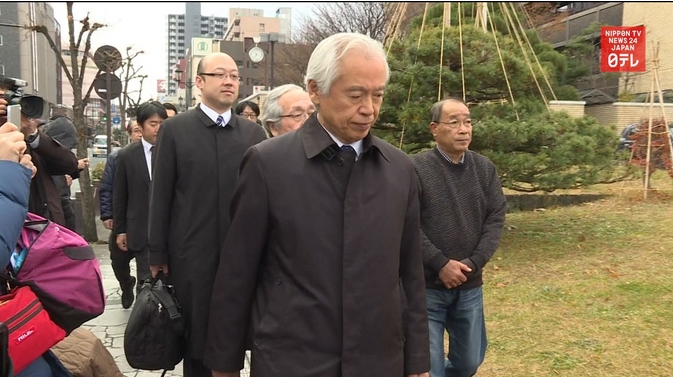
Dec 17, 2019
The Yamagata District Court awards a group of Fukushima evacuees a minor settlement in a suit seeking damages from the government and TEPCO for suffering caused by 2011’s Fukushima Daiichi nuclear disaster.
[© Nippon TV News 24 Japan]
https://www.nippon.com/en/news/ntv20191217002/$4000-settlement-for-fukushima-daiichi-evacuees.html
Japan’s govt urges Fukushima evacuees to return – in drive to promote 2020 Olympics

Restoring crops and a sense of pride


1 This Month

of the week – Shut Down Drone Warfare!


Tell the Ukrainian Government to Drop Prosecution of Peace Activist Yurii Sheliazhenko

Petition to revoke the licensing of the Near Surface Nuclear Disposal Facility (NSDF) at Chalk River. https://www.ourcommons.ca/petitions/en/Petition/Details?Petition=e-7247
To see nuclear-related stories in greater depth and intensity – go to https://nuclearinformation.wordpress.com
-
Archives
- March 2026 (244)
- February 2026 (268)
- January 2026 (308)
- December 2025 (358)
- November 2025 (359)
- October 2025 (376)
- September 2025 (257)
- August 2025 (319)
- July 2025 (230)
- June 2025 (348)
- May 2025 (261)
- April 2025 (305)
-
Categories
- 1
- 1 NUCLEAR ISSUES
- business and costs
- climate change
- culture and arts
- ENERGY
- environment
- health
- history
- indigenous issues
- Legal
- marketing of nuclear
- media
- opposition to nuclear
- PERSONAL STORIES
- politics
- politics international
- Religion and ethics
- safety
- secrets,lies and civil liberties
- spinbuster
- technology
- Uranium
- wastes
- weapons and war
- Women
- 2 WORLD
- ACTION
- AFRICA
- Atrocities
- AUSTRALIA
- Christina's notes
- Christina's themes
- culture and arts
- Events
- Fuk 2022
- Fuk 2023
- Fukushima 2017
- Fukushima 2018
- fukushima 2019
- Fukushima 2020
- Fukushima 2021
- general
- global warming
- Humour (God we need it)
- Nuclear
- RARE EARTHS
- Reference
- resources – print
- Resources -audiovicual
- Weekly Newsletter
- World
- World Nuclear
- YouTube
-
RSS
Entries RSS
Comments RSS
 nuclear-news