Government likely to retain grip on beleaguered Tepco
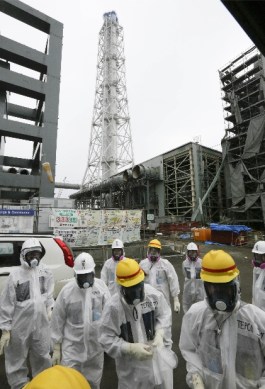
The government might stay involved in the management of Tokyo Electric longer than planned, given the ballooning costs of scrapping the Fukushima No. 1 nuclear power plant, sources close to the matter said.
The delay in reactivating the Kashiwazaki-Kariwa nuclear plant in Niigata Prefecture, the main pillar of the utility’s reconstruction plan, is another factor prompting the government rethink, the sources said Saturday. It had planned to end state control next April.
The government is leading the business operations of struggling Tokyo Electric Power Co. Holdings, which is facing huge compensation payments and other problems from the 2011 Fukushima nuclear disaster, because it has acquired 50.1 percent of the firm’s voting rights via the state-backed Nuclear Damage Compensation and Decommissioning Facilitation Corp.
Some bureaucrats at the Ministry of Economy, Trade and Industry have been dispatched to Tepco.
Tepco said in a business plan in 2014 that it would turn itself from a “temporarily publicly managed” company to a self-managed one starting next April.
The industry ministry will hold the first panel meeting Wednesday to discuss additional government support for the utility.
Tepco faces swelling costs for decommissioning the Fukushima No. 1 plant and compensating those affected beyond the previously estimated ¥11 trillion ($108 billion). Two reactors at the Kashiwazaki-Kariwa plant are under prolonged safety examinations by nuclear regulators.
The prospect of restarting the giant plant is also being complicated by impending changes in the leadership of the Niigata Prefectural Government, which hosts it.
To restart the plant, approval from the Niigata governor is needed.
Hirohiko Izumida, the current governor, was cautious about restarting the reactors because of Tepco’s failure to fully examine the cause of the Fukushima disaster. He withdrew his bid for re-election at the end of August.
Of the four candidates running for the Oct. 16 election, former Nagaoka Mayor Tamio Mori, 67, backed by the Liberal Democratic Party-Komeito ruling coalition, and Ryuichi Yoneyama, a 49-year-old doctor, are leading the race. Yoneyama has said he will follow Izumida’s stance and is opposed to any discussion of restarts unless the Fukushima disaster is thoroughly explained.
Tepco’s new business plan, including the revised schedule for ending state control, is expected to be compiled next January.
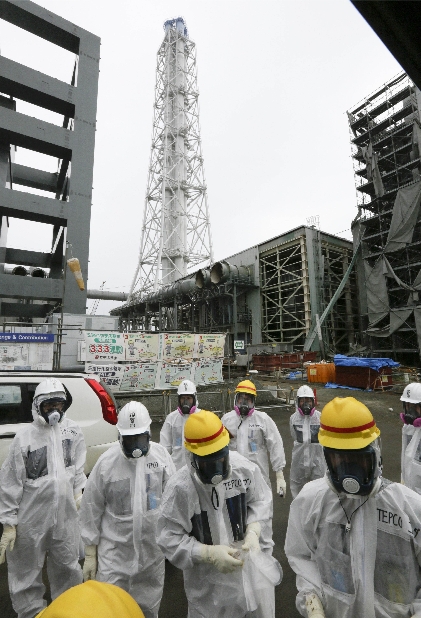
Tokyo Electric Power : Gov’t planning to stay involved in TEPCO’s management longer
The government is considering staying involved in Tokyo Electric Power Co.’s business management longer than currently planned, given larger-than-expected costs for scrapping the Fukushima Daiichi nuclear power plant, sources close to the matter said Saturday.
A delay in the process for reactivating its Kashiwazaki-Kariwa nuclear power plant in Niigata Prefecture, a main pillar of the utility’s reconstruction plan, is another factor prompting the government to think it would be too soon to end state control next April as initially planned, they said.
The government is leading business operations of the utility facing huge compensation payments and other problems from the 2011 Fukushima nuclear disaster as it has acquired 50.1 percent of the firm’s voting rights through the state-backed Nuclear Damage Compensation and Decommissioning Facilitation Corp.
Some bureaucrats of the Ministry of Economy, Trade and Industry are dispatched to the utility, known as TEPCO.
TEPCO said in a business plan in 2014 it would turn itself from the “temporarily publicly managed” company to a self-managed one starting next April.
The industry ministry will hold the first panel meeting Wednesday to discuss additional government support for the utility.
TEPCO faces swelling costs for decommissioning the Fukushima Daiichi plant and compensating those affected beyond the previously estimated 11 trillion yen ($108 billion). Two reactors at the Kashiwazaki-Kariwa plant are under prolonged safety examinations by nuclear regulators.
TEPCO’s new business plan including the revised schedule for ending state control is expected to be compiled next January.
Fukushima plant building exposed as TEPCO opens old wounds
The cover on reactor 1 was installed around the building of the devastated the reactor 1 in October 2011 and Tepco plans to dismantle it by December. It remains 17 panels of 20 tonnes to move. Inside, the spent fuel pool with 392 fuel assemblies in it, which Tepco intends to empty starting 2020 …
Now this uncovered “reactor” freely spits its radioactive lungs again in the open air. Yes that’s right. Tepco had mounted this cover to avoid polluting the air. Today we go back to square one.
The three reactors 1, 2 and 3 have lost their seal and radionuclides roam freely. There is simply no way to seal leaks. Even when the pool will be emptied, the problem will still be the same.
The levels of radioactivity escaping from the three reactors are unknown until Tepco wants to give us some figures, still without any true independent body to verify.
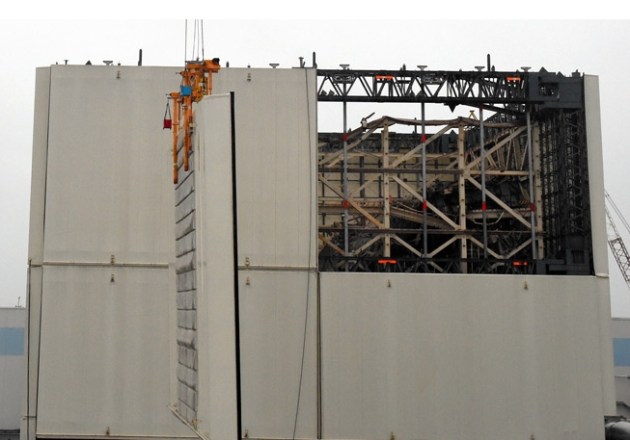
The devastated outer layer of Fukushima No. 1 nuclear power plant’s No. 1 reactor building has been exposed for the first time in almost five years in the painstaking reactor decommissioning process.
Plant operator Tokyo Electric Power Co. began removing on Sept. 13 the exterior walls of the cover installed around the structure to prevent the dispersal of radioactive materials on Sept. 13.
Shortly past 6 a.m., a large crane began removing a massive piece of the cover installed around the reactor building. The panel dismantled that day measured 23 by 17 meters and weighed 20 tons.
The cover was installed in October 2011 as a temporary measure after a nuclear meltdown occurred following the Great East Japan Earthquake and tsunami in March that year. The meltdown caused a hydrogen explosion, blowing the walls off the building.
Once the cover is dismantled, the operator can assess the state of the building’s interiors and remove the debris fallen onto the spent fuel pool inside.
“Steady progress is necessary in reconstruction, but we hope they will carry on the procedure with safety as the No. 1 priority,” said a Fukushima prefectural government official.
TEPCO said that it plans to remove the remaining 17 panels of the covering by the end of the year. The portion covering the roof has already been removed.
Once the cover is removed, the utility will begin drawing up plans to remove the 392 fuel assemblies from the spent fuel pool and melted nuclear fuel from inside the building.
The plant operator said that it plans to be extra careful during the procedure. It will shroud the building in tarpaulins once the cover is removed as a precautionary measure against dust and other materials containing radioactive materials from being carried aloft by the wind.
The utility and central government’s joint schedule for the decommissioning process of the reactor states that the removal of the fuel rods from the pool will start in fiscal 2020.
http://www.asahi.com/ajw/articles/AJ201609130070.html
TEPCO to begin removing tainted water at Fukushima plant
Tokyo Electric Power Co. intends to begin pumping up highly contaminated water accumulating in the basements of buildings at its wrecked Fukushima No. 1 nuclear power plant by the end of March.
TEPCO disclosed its strategy Sept. 28 at a review meeting with the Nuclear Regulation Authority, the government’s nuclear watchdog.
In response, the NRA urged the utility to provide a detailed road map for the project.
Removing the huge volume of radioactive water in the reactor, turbine and other buildings has posed an urgent challenge for TEPCO.
The NRA pressed it to take action as soon as possible, pointing out that the contaminated water in the buildings’ basements is a likely reason flowing groundwater also gets polluted.
The NRA is also concerned that the contaminated water in the basements might leak into the sea if the nuclear complex is struck by another powerful tsunami.
TEPCO estimates that 68,000 tons of tainted water exists below the reactor and turbine buildings, as well as other structures.
Particularly worrisome is the estimated 2,000 tons of highly radioactive water in the condensers of the No. 1 through No. 3 turbine buildings, which accounts for 80 percent of the radioactive materials in all of the tainted water.
The contaminated water was transferred to the condensers in the immediate aftermath of the March 2011 triple meltdown.
TEPCO plans to finish transferring the water in the condensers by the first half of the next fiscal year and all of the contaminated water in the basements by 2020.
Heavy rains stall assessment of frozen wall at Fukushima plant
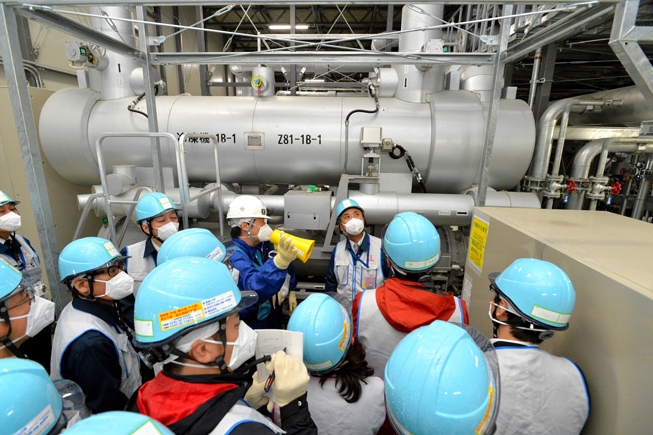
The equipment that cools coolant for the ice wall at the Fukushima No. 1 nuclear power plant
Tokyo Electric Power Co. reported a delay in the underground ice wall project at its Fukushima No. 1 nuclear power plant, citing the stalled assessment of the structure due to heavy rains from a recent typhoon.
The utility reported the delay at a review meeting with the Nuclear Regulation Authority, the government’s nuclear watchdog, on Sept. 28. TEPCO initially planned to assess the effectiveness of the ice wall by the end of this month.
According to TEPCO, the volume of groundwater pumped up in areas on the sea side of the facility was supposed to have dropped by now if the ice wall functioned properly.
But the company acknowledged this had not happened.
TEPCO had sought NRA approval to freeze a section of the ice wall facing the mountainside to enhance the effect of blocking groundwater, but it did not get the go-ahead.
“It does not make sense that the company sought approval to freeze the area facing the mountainside, just because the ice wall on the sea side did not go well,” said Toyoshi Fuketa, a commissioner of the NRA, told the meeting.
The groundwater level in the sea side portion outside the ice wall reached the surface on and off between Sept. 20 and Sept. 23 when the plant was struck by torrential rain as a result of Typhoon No. 16.
TEPCO said rainwater flowed into the sea, rather than seeping into the ground, because of the higher groundwater level.
Radioactive cesium in samples taken from the sea nearby measured a record high 95 becquerels per 1 liter.
According to the company, 0.8 percent of 5,800 or so observation spots set up on the sea side section of the ice wall showed that the soil has not been entirely frozen.
TEPCO officials believe that groundwater penetrated gaps in the ice wall before pushing up the groundwater level in the area downstream near the sea.
The frozen soil wall was built around the No. 1 through No. 4 reactor buildings. The government poured 35 billion yen ($350 million) into the project.
The objective was to block groundwater from mixing with contaminated water in the basements of the reactor and other buildings.
TEPCO started freezing soil in late March, but not all of the soil turned into ice, allowing a huge volume of groundwater to accumulate.
http://www.asahi.com/ajw/articles/AJ201609290073.html
TEPCO Delays Replacing Tainted Water Tanks
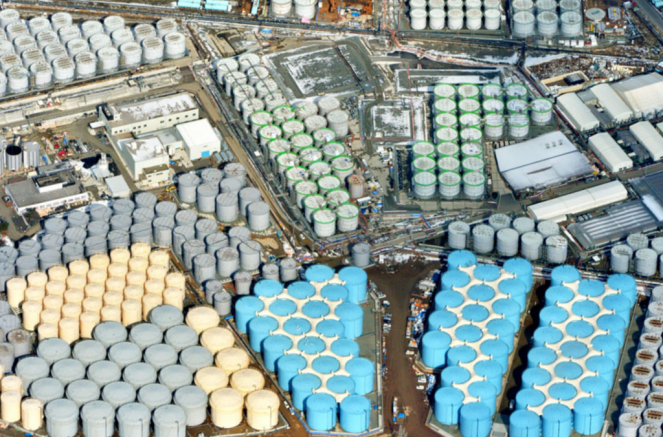
Tokyo, Sept. 28 (Jiji Press)–Tokyo Electric Power Company Holdings Inc. <9501> has effectively given up replacing tainted water storage tanks at its Fukushima No. 1 nuclear power station with safer ones at an early date, it was learned Wednesday.
It is believed to be the first time that the power firm has abandoned a deadline in its decommissioning work timetable, revised in June last year.
TEPCO now expects to finish the work in June 2018 at the earliest, according to documents submitted to a panel of the Nuclear Regulation Authority.
TEPCO initially planned to finish replacing the storage tanks with welded low-leakage ones early in the current business year through March 2017.
TEPCO remains unable to stop increases in the amount of radioactive water. The amount of contaminated water stored in the current tanks with a higher risk of leakage stood above 110,000 tons as of Thursday.
Fukushima ice wall failing to deliver on promise

This Feb. 9 photo shows the crippled No. 3 unit of the Fukushima Daiichi nuclear power plant
TOKYO — Six months since the work began, the “ice wall” has failed to produce its intended results as groundwater continues to flow in and out of damaged facilities at the Fukushima Daiichi nuclear power plant.
An encircling wall of frozen soil, created by pumping a subzero coolant through underground pipes, is getting closer to completion, the Japanese government and plant operator Tokyo Electric Power Co. Holdings reported Tuesday at a meeting of experts convened by the Ministry of Economy, Trade and Industry.
The ocean-facing side of the wall is nearly finished, though gaps remain on the inland side, officials reported. Some of the expert panelists questioned the basis for determining such progress.
Groundwater runs down from the highland and seeps into the damaged reactor buildings, where it becomes tainted with radioactive material before flowing out into the ocean. The frozen wall has been built to stop this flow. But the problem was exacerbated by heavy rains starting around mid-August, as northern Japan was swept by multiple typhoons. This resulted in massive amounts of groundwater rushing into plant buildings, making it difficult to assess the wall’s effectiveness.
The operator, Tepco, thinks the inflows are concentrated at seven unfrozen sections on the inland side. Kunio Watanabe, an associate professor of environmental science at Mie University, blames the utility for having “fallen behind in its responses to address problems” at the Fukushima plant.
“If dealing with the contaminated water takes too long,” warns Masashi Kamon, professor emeritus at Kyoto University, “the entire decommissioning process may be set back.”
More than five and a half years have gone by since the March 2011 earthquake and tsunami that crippled Fukushima Daiichi.
The government and Tepco hope to complete the wall soon. But some outside experts at a meeting held by Japan’s nuclear regulator last month declared the effort a failure.
http://asia.nikkei.com/Japan-Update/Fukushima-ice-wall-failing-to-deliver-on-promise/
Tokyo Responsibility to Reveal Truth of Fukushima
We already know what is Tokyo definition of “truth”: five years and half of continuous deception, lies and cover-ups, tidbits of truth released only when forced to do so….
More than five years after the meltdown of the Fukushima Daiichi nuclear power plant in Japan, the legacy of the accident continues, characterized by constant radiation exposure and an ever-lasting sense of fear, not only in this island country but also beyond its territory.
Numerous reports about nuclear radiation and its damage to human bodies have been filed since the Fukushima disaster. An Asahi Shimbun article in 2014 revealed that high levels of accumulated radioactive cesium had been detected in the mud of 468 reservoirs outside of the Fukushima evacuation zone.
But more discouraging news awaits. According to a recent report by The Mainichi, an Environment Ministry survey found that high concentrations of radioactive cesium have been accumulating at the bottom of 10 major dams 50 kilometers away from Fukushima No.1 nuclear power plant, yet officials were quoted as saying that “it is best to contain cesium at those dams.”
It is the inaction that is most depressing. As people’s physical health is exposed to possible risks, the psychological fallout from the accident is worrying as well. As nuclear radiation reports are always published, people affected by the nuclear leak are fearful.
The aftermath of the Fukushima disaster that concerns the lives of millions has failed to prompt the Japanese government to assume responsibility actively on a massive scale.
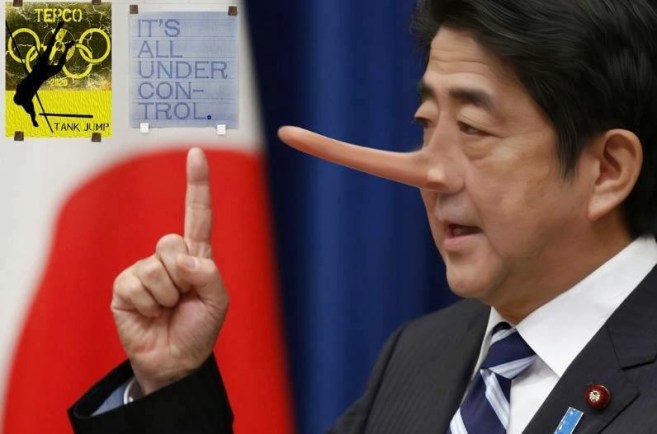
Earlier this month, former Japanese prime minister Junichiro Koizumi accused current leader Shinzo Abe of lying to the international community that the situation at the nuclear power plant is under control.
Those in a position of Japanese authority should release information about Fukushima-related contamination once and for all. The government should also set up a mechanism which can inform the country and the international community of new findings in a timely manner.
As a neighbor of Japan, China has also felt uneasy with the radiation from the disaster. Years after the meltdown of the Fukushima reactors, Chinese travelers are still asking if it is safe to go to Japan. In terms of food safety, despite a ban by Chinese authorities on food imports and agricultural products from Fukushima and 11 other Japanese regions affected by nuclear contamination since the accident, potentially radiation-tainted seafood from Fukushima smuggled to China poses health threats to the Chinese people.
Since a large number of Chinese travelers are going to Japan, related information is indispensable. Therefore, China should also come up with solutions such as assigning experts to monitor the situation in Japan and offer credible advice to the anxious public. This “nuclear war without a war” will attest to the responsibility of a government to its people.
http://www.globaltimes.cn/content/1008771.shtml#.V-sabiwjxlg.facebook
Tokyo Electric Power : Financial Assistance from the Nuclear Damage Compensation and Decommissioning Facilitation Corporation
On September 23, we received a funding grant of 104.1 billion yen from the Nuclear Damage Compensation and Decommissioning Facilitation Corporation (hereinafter referred to as NDF) based on the revision of the Special Business Plan which was approved on March 31, 2016.
This financial assistance was given in response to the 56th request we made in order to cover the compensation payouts due by the end of October 2016. The amount of the payouts to be paid by that time had been estimated to exceed the sum of the compensation we had received in accordance with the ‘Act on Contract for Indemnification of Nuclear Damage Compensation’ (188.9 billion yen) and the financial assistance that the NDF has provided (6,229.9 billion yen).
With financial assistance from the NDF, we are determined to continue to pay the compensation with courtesy and compassion to all of those who have been afflicted by the nuclear damage.
Debris recovery operation in sea carried out for first time since Fukushima nuclear disaster
The Japan Today article cites it as tsunami debris but it would also include debris from the reactor explosions at the plant. Pieces from these explosions have been found as far inland as Naraha. Why this work had not been done sooner was not mentioned.
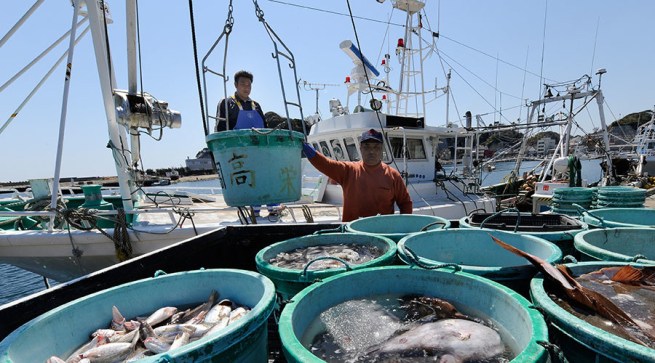
Japan performs tsunami debris cleanup off Fukushima 1st time since nuclear disaster
Local fisheries have begun a debris cleanup near the Fukushima plant for the first time since the tsunami-triggered nuclear disaster. However a plan to start trial fishing next year may face a setback as a nearly-completed ice wall is failing to halt water contamination.
On March 11, 2011, a magnitude-9 earthquake struck northeastern Japan at 2:46pm local time, unleashing a deadly tsunami. Less than an hour after the earthquake, the first of many tsunami waves hit Japan’s coastline. The tsunami waves reached heights of up to 39 meters (128 feet) at Miyako city and reached as far as 10 km (6 miles) ashore in Sendai, destroying everything in its wake. More than 15,000 people died.
At the Fukushima Daiichi Nuclear Power Plant, the tsunami caused a cooling system failure resulting in a nuclear meltdown and the release of radioactive materials. The waves forced the failure of electrical power and backup generators, leading the plant to lose its cooling capabilities. The retreating water sucked a vast amount of rubble into the depths of the Pacific Ocean, contaminating the traditional fishing grounds of the local companies.
Five years after the disaster a cleanup effort to remove the debris has finally been launched by collectives of local fishermen, who aim to start trial fishing expeditions within the area from 5 kilometers (3 miles) to 20 km (12 miles) off the wrecked plant.
On Monday Soma-Futaba Fisheries Cooperative Association send out 32 fishing boats to recover debris from the ocean floor. That fleet is focusing their efforts on the North side of the nuclear power plant.
On Tuesday, the Iwaki City Fisheries Cooperative Association also sent in their fleet to help with the cleanup efforts of the southern side of the contaminated segment.
Once the debris is pulled out and delivered to shore, the unloading of the waste is handled by the industrial waste treatment company. The rubble is then sent to a temporary storage facility where after an inspection for radioactive reading, cleared waste is disposed of in an industrial manner. It is as of yet unclear how the contaminated waste will be treated.
The cleanup work of the seabed endorsed by the Fisheries Agency is scheduled to last at least until February of next year. Fishing on a trial basis can start as early as March.
However such a prospect seem problematic as the recently-completed ice wall around the crippled station has failed to meet expectations, with contaminated groundwater still seeping into the sea.
The $320 million Land-Side Impermeable Wall was built to halt an unrelenting flood of groundwater into the damaged reactor buildings and consequent flow of the contaminated water into the ocean.
But on Tuesday the Japanese government and plant operator Tokyo Electric Power Co. reported that 1.5 km (1 mile) barrier frozen barrier failed to produce the intended results, Nikkei reported.
While gaps still remain in some sections of the ocean-facing side of the wall, TEPCO believes that the inflows that penetrate the contaminated reactor are concentrated at seven unfrozen sections on the inland side.
A similar concern was voiced last month by the operator which claimed that 99 percent of the wall’s is mostly solid and frozen. However, a remaining one percent showed temperatures of the barrier above the freezing point, meaning that the contamination is not fully contained.
TEPCO has been repeatedly facing criticism for the handling of the Fukushima crisis. Despite the ongoing problems encountered following the meltdowns, the company has set 2020 as the goal for ending the plant’s water problem.
The problem of water contamination however is just one of many surrounding the dismantling and decommissioning of the Fukushima plant debris which is estimated to take at least 40 years.
“We will continue to move forward with the decommissioning and contaminated water management in a transparent way, visible to the world, and will also share with the international community the lessons learned from this accident,” Hirotaka Ishihara, state minister of the cabinet office of Japan, told the International Atomic Energy Agency’s 60th General Conference earlier this week.
“We are also making ongoing efforts to ensure the safety of food produced in Japan,” he added. “Recognizing that many countries have already lifted restrictions on food imports from Japan, we encourage the international community to implement import policies based on scientific evidence.”
https://www.rt.com/news/360879-fukushima-fishery-cleanup-debris/#.V-s-7I2uaW0.facebook
Debris recovery operation in sea carried out for first time since Fukushima nuclear disaster
FUKUSHIMA — For the first time since the 2011 nuclear crisis at the Fukushima Daiichi power plant, the removal of debris in seawater located up to 20 km from the plant site has finally started.
The recovery operation, which began Monday, focuses on the removal of rubble in seawater within 5 to 20 km of the wrecked plant, Sankei Shimbun reported.
Five and a half years after the disaster, fishing has yet to be carried out in these waters while tsunami debris on the ocean floor near the Fukushima plant has remained untouched.
With an aim to start trial fishing operations within this targeted cleanup area, the Soma-Futaba Fisheries Cooperative Association employed 32 fishing boats to recover debris such as driftwood and gill nets on Monday.
Following suit, from Tuesday, the Iwaki City Fisheries Cooperative Association started debris removal operations and will continue the cleanup efforts until February of next year.
Records of Diet’s Fukushima investigation still under wraps
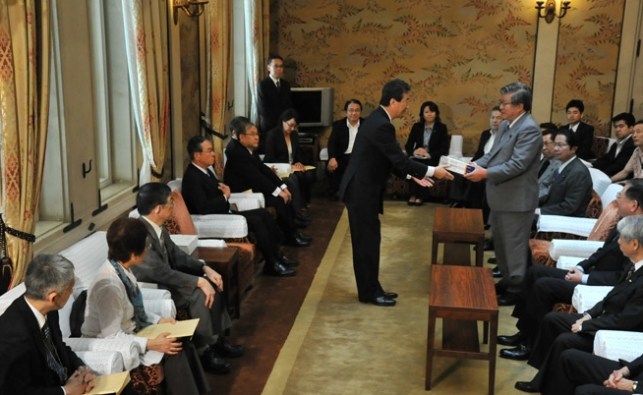
Kiyoshi Kurokawa, chairman of the Fukushima Nuclear Accident Independent Investigation Commission, presents the final report to Lower House Speaker Takahiro Yokomichi, right, in July 2012.
Five years after the accident at the Fukushima No. 1 nuclear power plant, the Diet is still sitting on a trove of raw documents and testimonies of more than 1,100 individuals who were on the front lines during the crisis.
The cache was compiled by the Fukushima Nuclear Accident Independent Investigation Commission, which released a report of its findings that totaled about 600 pages in July 2012.
The documents collected by that commission, including the testimonies of 1,167 individuals, have still not been released to the public more than four years after its disbandment.
Yasunori Sone, a political science professor at Tokyo’s Keio University, said the documents should, in principle, be released to the public because the investigation was conducted by the Diet on behalf of the people.
“The Fukushima Nuclear Accident Independent Investigation Commission was the first established in the Diet with the authority to carry out a thorough investigation,” Sone said. “Disclosure rules should be decided on quickly because it will serve as a precedent for future commissions.”
However, the documents submitted to the commission by the central government as well as Tokyo Electric Power Co., operator of the Fukushima plant, remain in storage at the National Diet Library, along with more than 900 hours of questioning of the 1,167 individuals, many of whom worked to bring the accident under control.
Some of the testimony was given on condition that it would not be released.
For that reason, after the commission disbanded, the rules and administration committees of the two chambers of the Diet were to have established rules for disclosing the commission records.
The commission had left behind a record of its investigation as well as the source of the documents it had accumulated because it felt that it would be helpful when the documents were eventually released.
“It will be possible to learn about the background to the nuclear accident from new reports or books that are written based on the documents,” said Kiyoshi Kurokawa, a professor emeritus at the University of Tokyo, who chaired the commission. “A fundamental point to not repeating mistakes is to learn from one’s past errors.”
Discussions within the rules and administration committees were disrupted when then Prime Minister Yoshihiko Noda dissolved the Lower House in November 2012 and called a snap election.
The December election brought the Liberal Democratic Party and its junior coalition partner, Komeito, back in control of government.
A multiparty group of lawmakers who were seeking to end dependence on nuclear energy asked that the rules and administration committees resume work on establishing disclosure rules. However, a subcommittee held one session that focused on presenting the opinions of members.
“Both the ruling and opposition parties are hesitant about releasing the documents because there is the possibility that they contain contents that are disadvantageous to the LDP, which had pushed nuclear energy, and the then Democratic Party of Japan, which had to deal with the nuclear accident,” said a member of that multiparty group.
The disclosure of the documents is not the only area in which the Diet has been less than aggressive.
In its report, the commission included seven recommendations, including the establishment of a new independent investigation committee, made up mainly of experts from the private sector, to conduct further studies into unanswered questions about the accident.
However, the rules and administration committees have yet to discuss the possibility of establishing such an investigative committee.
The commission also recommended the establishment of special committees in both chambers of the Diet to oversee the nuclear regulatory structure.
In 2013, a Special Committee for Investigation of Nuclear Power Issues was established separately in the two chambers.
However, those special committees have been turned into venues to promote nuclear energy. For example, committee members who were originally from labor unions of the electric power companies or who represented districts where nuclear plants were based criticized the Nuclear Regulation Authority for its strict standards regarding the resumption of operations at nuclear plants.
In a similar manner, the special committees also asked for a review of the rule that limited nuclear plants to a maximum 40-year operating life.
Tomoko Abe, a Democratic Party member who serves as secretary-general of the multiparty group seeking zero nuclear power generation, said, “Although there are some issues regarding the nuclear accident that have become clearer with the passage of time, the arena for looking into those issues has been closed off. It is the responsibility of the legislative branch to set up a structure that will continue to examine the nuclear accident.”
Canada activist found guilty of harassing scientists over Fukushima fallout
Dana Dunford has sensationalized on Youtube for lucrative reasons the Pacific ocean contamination from Fukushima to the American public, having found that making the buzz was quite a good mean to raise donations from people .
He did threaten those scientists with physical violence on his Youtube videos, calling his fans to carry out “justice”.
Though those scientists studies and research depending on funding from government and corporations may be subjected to their influence, I do not believe that threats of violence are proper nor acceptable.
I personally believe that exaggeration, sensationalism, to not talk about insult and personal threat are absolutely counterproductive to our antinuclear cause.
Only truth will set us free from nuclear. Only stating facts with solid reliable proofs will help us to inform adequately the people to become able to get this dangerous, harmful, obsolete industry stopped. Furthermore, any wild exaggeration can be later used by the nuclear lobby to discredit our antinuclear cause, such as in this present occurence.

Canada activist found guilty of harassing scientists over Fukushima fallout
A Canadian environmental activist who waged a sustained online campaign against two prominent marine scientists was found guilty of criminal harassment by a court in Victoria, British Columbia, on Thursday.
The court heard that Dana Durnford, 54, threatened violence against Jay Cullen, of the University of Victoria, and Ken Buesseler, of Woods Hole Oceanographic Institution in Massachusetts, and accused them of underplaying the extent of damage to Pacific ecosystems from the 2011 Fukushima disaster.
Durnford was sentenced to three years’ probation.
“I expected and was pleased with the judge’s ruling,” Cullen said after the verdict. “Mr. Durnford, on many occasions, threatened physical violence against scientists and others who have focused their attention and expertise to better understand how the Fukushima nuclear disaster has affected the marine environment and human health. Such behavior is criminal.”
Buesseler also welcomed the ruling. Threatening violence is “never an appropriate response to scientific findings you might disagree with,” he said.
Durnford, a former professional diver, has a large online presence.
His unscripted videos, recorded in a mock television studio, present what he purports to be research that contradicts mainstream scientific findings.
He alleges collusion between the global scientific establishment and the nuclear industry over the dangers presented by the nuclear industry and, in particular, the Fukushima debacle.
Durnford, of Powell River, British Columbia, did not respond to phone calls and an email for comment on Friday.
In a video apparently recorded shortly before the trial began this week, he alluded to trouble meeting court-related costs.
“They bankrupted us in these court proceedings in order to silence us,” he told viewers.
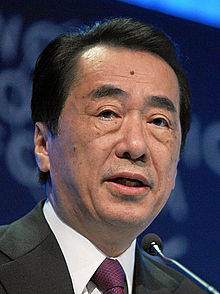
Reassessing the 3.11 Disaster and the Future of Nuclear Power in Japan: An Interview with Former Prime Minister Kan Naoto
Interview by Vincenzo Capodici, Introduction by Shaun Burnie, Translation by Richard Minear
Introduction
For more than two decades, the global nuclear industry has attempted to frame the debate on nuclear power within the context of climate change: nuclear power is better than any of the alternatives. So the argument went. Ambitious nuclear expansion plans inthe United States and Japan, two of the largest existing markets, and the growth of nuclear power in China appeared to show—superficially at least—that the technology had a future. At least in terms of political rhetoric and media perception, it appeared to be a winning argument. Then came March 11, 2011. Those most determined to promote nuclear power even cited the Fukushima Daiichi accident as a reason for expanding nuclear power: impacts were low, no one died, radiation levels are not a risk. So claimeda handful of commentators in the international (particularly English-language) media.
However,from the start of the accident at Fukushima Daiichi on March 11 2011,the harsh reality of nuclear power was exposed to billions of people across the planet, and in particular to the population of Japan, including the more than 160,000 people displaced by the disaster, many of whom are still unable to return to their homes, and scores of millions more threatened had worst case scenarios occurred. One authoritative voice that has been central to exposing the myth-making of the nuclear industry and its supporters has been that of KanNaoto, Prime Minister in 2011. His conversion from promoter to stern critic may be simple to understand, but it is no less commendable for its bravery. When the survival of half the society you are elected to serve and protect is threatened by a technology that is essentially an expensive way to boil water, then something is clearly wrong. Japan avoided societal destruction thanks in large part to the dedication of workers at the crippled nuclear plant, but also to the intervention of Kan and his staff, and to luck. Had it not been for a leaking pipe into the cooling pool of Unit 4 that maintained sufficient water levels, the highly irradiated spent fuel in the pool, including the entire core only recently removed from the reactor core, would have been exposed, releasing an amount of radioactivity far in excess of that released from the other three reactors. The cascade of subsequent events would have meant total loss of control of the other reactors, including their spent fuel pools and requiring massive evacuation extending throughout metropolitan Tokyo, as Prime Minister Kan feared. That three former Prime Ministers of Japan are not just opposed to nuclear power but actively campaigning against it is unprecedented in global politics and is evidence of the scale of the threat that Fukushima posed to tens of millions ofJapanese.
The reality is thatin terms of electricity share and relative to renewable energy,nuclear power has been in decline globally for two decades.Since the FukushimaDaiichiaccident, this decline has only increased in pace. The nuclear industry knew full well that nuclear power could not be scaled up to the level required to make a serious impact on global emissions. But that was never the point. The industry adopted the climate-change argument as a survival strategy: to ensure extending the life of existing aging reactors and make possible the addition of some new nuclear capacity in the coming decades—sufficient at least to allow a core nuclear industrial infrastructure to survive to mid-century.The dream was to survive to mid-century, when limitless energy would be realized by the deployment of commercial plutonium fast-breeder reactors and other generation IV designs. It was always a myth, but it had a commercial and strategic rationale for the power companies, nuclear suppliers and their political allies.
The basis for the Fukushima Daiichi accident began long before March 11th 2011, when decisions were made to build and operate reactors in a nation almost uniquely vulnerable to major seismic events. More than five years on, the accident continues with a legacy that will stretch over the decades. Preventing the next catastrophic accident in Japan is now a passion of the former Prime Minister, joining as he has the majority of the people of Japan determined to transition to a society based on renewable energy. He is surely correct that the end of nuclear power in Japan is possible. The utilities remain in crisis, with only three reactors operating, and legal challenges have been launched across the nation. No matter what policy the government chooses, the basis for Japan’s entire nuclear fuel cycle policy, which is based on plutonium separation at Rokkasho-mura and its use in the Monju reactor and its fantasy successor reactors, is in a worse state than ever before. But as KanNaotoknows better than most, this is an industry entrenched within the establishment and still wields enormous influence. Its end is not guaranteed. Determination and dedication will be needed to defeat it. Fortunately, the Japanese people have these in abundance. SB
The Interview
Q: What is your central message?
Kan: Up until the accident at the Fukushima reactor, I too was confident that since Japanese technology is of high quality, no Chernobyl-like event was possible.
But in fact when I came face to face with Fukushima, I learned I was completely mistaken. I learned first and foremost that we stood on the brink of disaster: had the incident spread only slightly, half the territory of Japan, half the area of metropolitan Tokyo would have been irradiated and 50,000,000 people would have had to evacuate.
Half one’s country would be irradiated, nearly half of the population would have to flee: to the extent it’s conceivable, only defeat in major war is comparable.
That the risk was so enormous: that is what in the first place I want all of you, all the Japanese, all the world’s people to realize.
Q: You yourself are a physicist, yet you don’t believe in the first analysis that people can handle nuclear power? Don’t you believe that there are technical advances and that in the end it will be safe to use?
Kan: As a rule, all technologies involve risk. For example, automobiles have accidents; airplanes, too. But the scale of the risk if an accident happens affects the question whether or not to use that technology. You compare the plus of using it and on the other hand the minus of not using it. We learned that with nuclear reactors, the Fukushima nuclear reactors, the risk was such that 50,000,000 people nearly had to evacuate. Moreover, if we had not used nuclear reactors—in fact, after the incident, there was a period of about two years when we didn’t use nuclear power and there was no great impact on the public welfare, nor any economic impact either. So when you take these factors as a whole into account, in a broad sense there is no plus to using nuclear power. That is my judgment.
One more thing. In the matter of the difference between nuclear power and other technologies, controlling the radiation is in the final analysis extremely difficult.
For example, plutonium emits radiation for a long time. Its half-life is 24,000 years, so because nuclear waste contains plutonium—in its disposal, even if you let it sit and don’t use it—its half-life is 24,000 years, in effect forever. So it’s a very difficult technology to use—an additional point I want to make.
Q: It figured a bit ago in the lecture by Professor Prasser, that in third-generation reactors, risk can be avoided. What is your response?
Kan: It’s as Professor Khwostowa said: we’ve said that even with many nuclear reactors, an event inside a reactor like the Fukushima nuclear accident or a Chernobyl-sized event would occur only once in a million years; but in fact, in the past sixty years, we’ve had Three Mile Island, Chernobyl, Fukushima. Professor Prasser says it’s getting gradually safer, but in fact accidents have happened with greater frequency and on a larger scale than was foreseen. So partial improvements are possible, as Professor Prasser says, but saying that doesn’t mean that accidents won’t happen. Equipment causes accidents, but so do humans.
Q: Today it’s five years after Fukushima. What is the situation in Japan today? We hear that there are plans beginning in 2018 to return the refugees to their homes. To what extent is the clean-up complete?
Kan: Let me describe conditions on site at Fukushima. Reactors #1, #2, #3 melted down, and the melted nuclear fuel still sits in the containment vessel; every day they introduce water to cool it. Radioactivity in the vessel of #2, they say, is 70 sieverts—not microsieverts or millisieverts, 70 sieverts. If humans approach a site that is radiating 70 sieverts, they die within five minutes. That situation has held ever since: that’s the current situation.
Moreover, the water they introduce leaves the containment vessel and is said to be recirculated, but in fact it mixes with groundwater, and some flows into the ocean. Prime Minister Abe used the words “under control,” but Japanese experts, including me, consider it not under control if part is flowing into the ocean. All the experts see it this way.
As for the area outside the site, more than 100,000 people have fled the Fukushima area.
So now the government is pushing residential decontamination and beyond that the decontamination of agricultural land.
Even if you decontaminate the soil, it’s only a temporary or partial reduction in radioactivity; in very many cases cesium comes down from the mountains, it returns.
The Fukushima prefectural government and the government say that certain of the areas where decontamination has been completed are habitable, so people have until 2018 to return; moreover, beyond that date, they won’t give aid to the people who have fled. But I and others think there’s still danger and that the support should be continued at the same level for people who conclude on their own that it’s still dangerous—that’s what we’re saying.
Given the conditions on site and the conditions of those who have fled, you simply can’t say that the clean-up is complete.
Q: Since the Fukushima accident, you have become a strong advocate of getting rid of nuclear reactors; yet in the end, the Abe regime came to power, and it is going in the opposite direction: three reactors are now in operation. As you see this happening, are you angry?
Kan: Clearly what Prime Minister Abe is trying to do—his nuclear reactor policy or energy policy—is mistaken. I am strongly opposed to current policy.
But are things moving steadily backward? Three reactors are indeed in operation. However, phrase it differently: only three are in operation. Why only three? Most—more than half the people—are still resisting strongly. From now on, if it should come to new nuclear plants, say, or to extending the licenses of existing nuclear plants, popular opposition is extremely strong, so that won’t be at all easy. In that sense, Japan’s situation today is a very harsh opposition—a tug of war—between the Abe government, intent on retrogression, and the people, who are heading toward abolishing nuclear reactors.
Two of Prime Minister Abe’s closest advisors are opposed to his policy on nuclear power.
One is his wife. The other is former Prime Minister Koizumi, who promoted him.
Q: Last question: please talk about the possibility that within ten years Japan will do away with nuclear power.
Kan: In the long run, it will disappear gradually. But if you ask whether it will disappear in the next ten years, I can’t say. For example, even in my own party opinion is divided; some hope to do away with it in the 2030s. So I can’t say whether it will disappear completely in the next ten years, but taking the long view, it will surely be gone, for example, by the year 2050 or 2070. The most important reason is economic. It has become clear that compared with other forms of energy, the cost of nuclear energy is high.
Q: Thank you.
TEPCO: Groundwater Surfaced and Possibly Leaked at Fukushima Plant During Typhoon
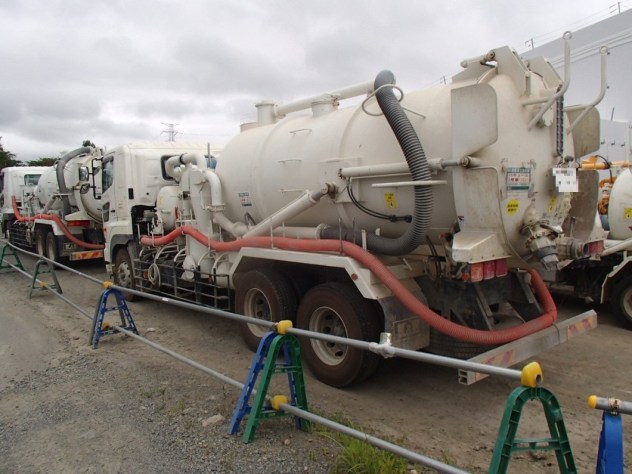
Fukushima Daiichi Floods, Show Lack of Preparedness
News reports indicated that groundwater at Fukushima Daiichi had risen so high it broke the surface and flowed into the port as a recent typhoon passed through the area. As TEPCO prepared to close the steel sea wall and freeze the underground frozen wall, NRA stopped the process for a review of the potential for flooding within the reactor building area.
The conclusion was that TEPCO thought they could sufficiently remove excess groundwater with the sump pump subdrain system near the reactor buildings. There were also concerns of the groundwater dropping too low, allowing contaminated water to flow out of the reactor building basements.
With all this review, nobody conceived a need for more water removal capacity. TEPCO ended up employing some sort of makeshift pumps and also using septic tank trucks to pump up water. This lack of anywhere for rainwater to go may have contributed to the water flowing out into the port as it built up on the surface.
Without some major changes at Daiichi this problem of groundwater rising to the surface and flowing into the port or the sea will continue to happen when significant rainfall takes place.
http://www.fukuleaks.org/web/?p=15765
Typhoon rain raises tainted Fukushima plant groundwater to surface
Heavy rain brought by Typhoon Malakas caused contaminated groundwater to rise to ground level at the radiation-hit Fukushima No. 1 nuclear plant Tuesday night, raising fears of tainted water flooding out to the plant’s port area, its operator said.
Tokyo Electric Power Company Holdings Inc. said in a press release that plant workers are doing their utmost to pump up tainted groundwater at the Fukushima compound, while trying to measure the level of radioactive substances contained in the water.
Under normal circumstances, groundwater taken from wells around the damaged reactor buildings at the Fukushima plant is filtered and stored in numerous tanks built on the compound.
Shortly before 10 p.m. Tuesday, groundwater reached the surface level at an observation well near the seawall at the power plant’s port, and at 11:30 p.m. Tuesday, groundwater stood at 3 cm above the surface level, Tepco said.
The well has a far higher wall and the ground around it is paved, the company said, playing down the possibility that any water flowed out of the well.
By 9 a.m. Wednesday, the water level had dropped to 3 cm below the surface.
Meanwhile, some rainwater may have flowed directly into the port before seeping underground, according to the company.
Tepco will continue pumping groundwater around the seawall, located near the damaged No. 1 to No. 4 reactors, and carry out close examinations of water inside the port, the company said.
In order to curb the flow of groundwater into the sea, the company has covered the seawall with water shields and carries out groundwater pumping operations.
Typhoon Malakas itself was downgraded to an extratropical depression at around 9 p.m. Tuesday as it moved along the coast of the Tokai region and swayed toward the Pacific. It was initially forecast to hit the Kanto region in the early hours of Wednesday.
The previous typhoon, Lionrock, earlier this month killed at least 17 people. Before Lionrock, two typhoons had claimed at least two lives in the northeast.
TEPCO: Possible water leak at Fukushima plant during typhoon
Tokyo Electric Power Co. said Sept. 21 it will check for radiation contamination in seawater near its crippled Fukushima nuclear plant after heavy rain from Typhoon No. 16 brought tainted groundwater to the surface.
The water reached the top of wells at the Fukushima No. 1 nuclear power plant, and there is a possibility that some of it spilled into the sea.
“We will analyze the seawater because we cannot determine whether groundwater containing radioactive materials has actually leaked,” a TEPCO official said.
The official added that the company believes most of the water that may have poured into the sea was rainwater that had not seeped into the ground.
The utility constantly monitors groundwater levels in wells around the reactor buildings at the plant to prevent overflows.
TEPCO said groundwater in wells on the seaside area of the nuclear complex reached the surface around 10 p.m. on Sept. 20 amid the heavy rain brought by the approaching typhoon. The water kept rising despite workers’ efforts to lower the level using makeshift pumps and septic tank trucks.
The groundwater level remained the same as of 7 a.m. on Sept. 21 before it finally dropped to about 3 centimeters from the surface two hours later, the company said.
According to TEPCO, about 575 millimeters of rain fell in the area of the nuclear plant from Aug. 1 to Sept. 20.
http://www.asahi.com/ajw/articles/AJ201609210047.html
1 This Month
Chernobyl: The Lost Tapes – A good documentary on Chernobyl on SBS available On Demand for the next 3 weeks– https://www.sbs.com.au/ondemand/tv-program/chernobyl-the-lost-tapes/2352741955560

of the week–London Campaign for Nuclear Disarmament

Tell the Ukrainian Government to Drop Prosecution of Peace Activist Yurii Sheliazhenko
To see nuclear-related stories in greater depth and intensity – go to https://nuclearinformation.wordpress.com
-
Archives
- April 2026 (114)
- March 2026 (251)
- February 2026 (268)
- January 2026 (308)
- December 2025 (358)
- November 2025 (359)
- October 2025 (376)
- September 2025 (257)
- August 2025 (319)
- July 2025 (230)
- June 2025 (348)
- May 2025 (261)
-
Categories
- 1
- 1 NUCLEAR ISSUES
- business and costs
- climate change
- culture and arts
- ENERGY
- environment
- health
- history
- indigenous issues
- Legal
- marketing of nuclear
- media
- opposition to nuclear
- PERSONAL STORIES
- politics
- politics international
- Religion and ethics
- safety
- secrets,lies and civil liberties
- spinbuster
- technology
- Uranium
- wastes
- weapons and war
- Women
- 2 WORLD
- ACTION
- AFRICA
- Atrocities
- AUSTRALIA
- Christina's notes
- Christina's themes
- culture and arts
- Events
- Fuk 2022
- Fuk 2023
- Fukushima 2017
- Fukushima 2018
- fukushima 2019
- Fukushima 2020
- Fukushima 2021
- general
- global warming
- Humour (God we need it)
- Nuclear
- RARE EARTHS
- Reference
- resources – print
- Resources -audiovicual
- Weekly Newsletter
- World
- World Nuclear
- YouTube
-
RSS
Entries RSS
Comments RSS
 nuclear-news