nuclear-news

The News That Matters about the Nuclear Industry Fukushima Chernobyl Mayak Three Mile Island Atomic Testing Radiation Isotope

Japan wants cruise ship infected separated from country’s total over economy fears
“Exactly what many of us suspected and understood to be happening. J-gov even got the WHO to create a separate category. Somehow the article still manages to avoid using the word “Olympics”. The newest numbers are over 200. Lost track of how many of those are Japanese citizens: around 160?? By keeping the passengers on the ship, they could claim that they weren’t really in Japan even though they are docked at Yokohama harbor in Tokyo Bay. The health and safety of passengers doesn’t seem to have been a concern. Has the ship’s ventilation system been adequately preventing the spread of virus, or promoting it? Nobody knows, since the exact ways the virus spreads hasn’t been pinned down yet, so they were certainly taking chances, endangering the lives of passengers and crew. lying about it to save face. They aren’t taking it seriously. If they took it seriously they would evacuate the passengers to a quarantine facility with isolation and negative air pressure to prevent cross-contamination. And they would test everybody. See how slow they are to gear up to be able to test more than 100 people a day? Only today Abe acknowledged that they need to test everyone and develop the ability to do 1000 tests a day. ” Special credits given to Bruce Brinkman, reporting from Japan.
hkmlmù
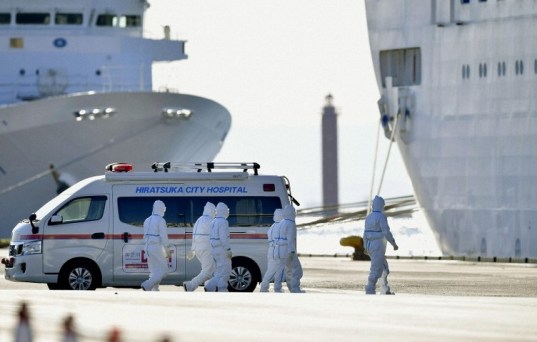
People in protective suits head to the Diamond Princess cruise ship docked in Yokohama near Tokyo, on Feb. 11, 2020.
 
February 12, 2020
TOKYO — As the number of people infected with the coronavirus on the Diamond Princess cruise ship quarantined in the Port of Yokohama continues to rise, the Japanese government has scrambled to inform media outlets to report them as separate to infected totals in Japan.
 
Tokyo’s argument is based on the assertion that the passengers are not on Japanese soil. As of 7 p.m. on Feb. 10, the number of people infected on the Diamond Princess stood at 135. Adding the currently confirmed 26 cases in Japan, the total reaches 161; the highest outside China. Concerns are rife that if the virus is perceived to be widespread in Japan, it may cause a blow to tourism and the economy.
 
According to the Ministry of Health, Labor and Welfare, the Japanese government submitted a request to the World Health Organization (WHO) asking for the separation of numbers of those infected on the cruise ship and in Japan. As a result, from the WHO’s Feb. 6 Situation Report on the virus’ spread, cruise ship infections were split off into an “other” category.
 
The health ministry has been announcing separate results for Japan-based and cruise-based infections, but many media outlets have reported them both together while including a note that it includes the numbers from the Diamond Princess.
 
At a Feb. 10 press conference, Foreign Minister Toshimitsu Motegi said, “We would like to see each news organization taking into consideration the WHO’s policy of separating infected cases in Japan and on the cruise ship, and report in a way that is more appropriate to the facts.”
 
An individual connected to the government indicated their unhappiness with the situation, saying, “The cruise ship just happened to dock in Japan. If we’re going to include those figures with the number of those infected in Japan, countries will stop accepting cruises.”
 
A senior official at the Ministry of Foreign Affairs said, “There could be a spread in countries putting in controls against people from Japan entering, as there has been against China.”
 
But since the number of confirmed cases in Japan also includes many Japanese nationals who are believed to have been infected before coming home on government-chartered jets from Hubei Province, some criticize that the government has not been consistent in reporting the figures by claiming those on the cruise ship have not been on Japanese soil.
 
(Japanese original by Ryuko Tadokoro, Political News Department)

February 18, 2020 Posted by | Japan | , | Leave a comment

The ” task force” stage of Olympic cancellation ?

safe_image.php

Tokyo Olympic coronavirus task force set up

February 6, 2020

The organizing committee for the 2020 Tokyo Olympic and Paralympic Games has launched a task force to respond to the spread of the new coronavirus.

The organizer told reporters on Thursday that it set up the task force on Tuesday headed by Director General Toshiro Muto.

It said officials already held a first meeting and talked about the need for cooperation with relevant organizations such as the central government and Tokyo metropolitan government, as well as the International Olympic Committee and the International Paralympic Committee over the virus outbreak.

They plan to discuss concrete measures to ensure the safety of athletes and spectators in the run-up to the torch relays that start in March, test events and the Olympic and Paralympic Games this summer.

Muto said he finds no problem in holding the Games, and his committee will closely monitor the situation in a calm manner, and take every step necessary to ensure safe conditions for athletes and spectators.

https://www3.nhk.or.jp/nhkworld/en/news/20200206_50/?fbclid=IwAR3ltb5he-giqSgOWS49g44G5nFeDnJp1gBhZHidvZvjNDeML5XRV44Aez0

Tokyo 2020 Organisers set up task force to counter coronavirus

TOKYO (Reuters) – Tokyo Olympics organisers have set up a task force to coordinate with public health authorities on how to respond to the growing coronavirus epidemic.

Tokyo 2020 CEO Toshiro Muto said at a press briefing on Thursday that he chaired the newly created Novel Coronavirus Countermeasures Task Force, which held its first meeting on Feb. 4. A second briefing would be held as early as tomorrow, he said.

Muto said on Wednesday that the coronavirus spread could throw “cold water” over the 2020 Games momentum. At Thursday’s briefing, he pledged that the event “would go on as planned.”

https://www.reuters.com/article/us-china-health-olympics-taskforce/tokyo-2020-organisers-set-up-task-force-to-counter-coronavirus-idUSKBN2001DN?fbclid=IwAR1_CgUFP19OUsZI76HPBXNn_Z2vokOkCF3cybrVDVvIHhnGRyZnlK_jjAU

February 6, 2020 Posted by | Japan | , | Leave a comment

Virus poses stark challenges to Abe’s tourism goals as Tokyo Olympics loom

Some experts say the coronavirus crisis is likely to continue for several months, possibly affecting the Tokyo Olympics starting July 24 — a nightmare scenario for Abe, who has tried to use the world’s largest sporting event to promote the Japanese economy and thereby further drum up voters’ support for his government.

According to a simulation by a medical team led by Gabriel Leung, the dean of the University of Hong Kong’s faculty of medicine, the number of infections in five Chinese mega-cities — Beijing, Shanghai, Guangzhou, Shenzhen and Chongqing — would peak between late April and early May, meaning the crisis would still continue further beyond that period.


n-inbound-b-20200201-scaledTourists stroll near Kiyomizu Temple, a popular sightseeing spot in Kyoto, on Thursday. Japan’s recent tourism boom is being tested amid the coronavirus outbreak.

January 31, 2020

The coronavirus outbreak is posing myriad challenges for the Japanese economy, including a key Abe administration policy initiative — the promotion of inbound tourism.

In recent years, inbound tourism has been one of the few sectors to see rapid growth in the long-stagnant Japanese economy. Top government officials, especially Chief Cabinet Secretary Yoshihide Suga, have touted the country’s “exploding” inbound tourism as a successful example of their “structural reform” deregulation initiatives.

In fact, everything looked to be on track until recently. The number of foreign tourists skyrocketed from 8.36 million in 2012 to 31.88 million in 2019, largely thanks to the yen’s depreciation and Suga’s initiative to ease Japan’s visa conditions for tourists from other Asian countries, most notably China.

Total spending by foreign tourists in Japan likewise surged from an estimated ¥1.1 trillion to ¥4.8 trillion during the same period, with Chinese tourists spending as much as 36.8 percent of total tourism expenditures in 2019, followed by Taiwanese at 11.4 percent and South Koreans at 8.7 percent.

It has been confirmed that the effects from inbound tourism … is turning into one of the main growth engines of the Japanese economy,” declared the Japan Tourism Agency in its 2018 white paper.

By becoming a tourism-oriented country, we have created a large and robust industry that is driving regional revitalization throughout Japan,” Prime Minister Shinzo Abe boasted in his annual policy speech in January last year.

But that rosy vision of “a tourism-oriented country” has recently been put in doubt.

Since July, the number of South Korean tourists, typically the second-largest ethnic group among visitors, plummeted by more than 50 percent as nationalistic sentiment in both countries flared up over thorny history and trade issues.

In December, the number of tourists from the country who came to Japan stood at 248,000, down 63.6 percent from the same month in the previous year. Experts had already said it had become impossible for Abe’s government to meet its target of 40 million foreign tourists in 2020.

And then the coronavirus hit. Beijing has taken the extraordinary step to ban all Chinese from going overseas on group tours, effective Jan. 27. The number of Chinese tourists, the largest group by nationality, is expected to fall drastically as a result.

Some experts say the coronavirus crisis is likely to continue for several months, possibly affecting the Tokyo Olympics starting July 24 — a nightmare scenario for Abe, who has tried to use the world’s largest sporting event to promote the Japanese economy and thereby further drum up voters’ support for his government.

According to a simulation by a medical team led by Gabriel Leung, the dean of the University of Hong Kong’s faculty of medicine, the number of infections in five Chinese mega-cities — Beijing, Shanghai, Guangzhou, Shenzhen and Chongqing — would peak between late April and early May, meaning the crisis would still continue further beyond that period.

The best case scenario, you would have something … where we go through the spring into the summer, and then it dies down,” David Fisman, a professor at the University of Toronto, was quoted as saying by media reports.

During an Upper House Budget Committee session Wednesday, Liberal Democratic Party member Motoyuki Fujii pointed out it took about six months to contain the SARS (severe acute respiratory syndrome) crisis in 2003, which was caused by a similar virus and infected about 8,000 people and killed 774 from Nov. 2002 to Aug. 2003.

The new coronavirus, which was first officially confirmed in Wuhan on Dec. 31, has already infected at least around 9,800 and killed 213, according to the tally compiled by the South China Morning Post as of Friday.

I’m concerned. … Now we have exactly about six months before the Olympic Games will start in July,” Fujii said.

I’d like the government to make its maximum efforts to get rid of the effects of the infectious disease by the time we will have the Olympic Games,” he added.

In response, Seiko Hashimoto, the minister in charge of the Olympics and Paralympics, said that “measures against infectious diseases including the new coronavirus are very important” in organizing the event.

I believe safety and the sense of security must be ensured to make the Tokyo Olympics successful,” Hashimoto said.

It is still probably too early to predict any effects on the Tokyo Games, as many key details of the new coronavirus still remain unknown.

But the outbreak has also highlighted a legal loophole and Japan’s apparent unpreparedness to deal with serious outbreaks of infectious disease in general.

Medical experts were shocked to learn that a carrier of the novel coronavirus could infect others even during the incubation period, when no symptoms are apparent. However, under the law, quarantine officers are not allowed to force a person showing no symptoms to undergo a medical test to determine whether that person is a carrier of a designated infectious disease.

In fact, two Japanese citizens who arrived at Tokyo’s Haneda Airport from Wuhan on a government-chartered airplane Wednesday refused to be tested for the virus. They went home from the airport and did not stay at a housing facility prepared by the government.

Two people have refused to undergo a virus test. We tried to persuade them for hours but there was no legally binding power. It’s very regrettable,” Prime Minister Shinzo Abe admitted during an Upper House budget committee session Thursday.

On the political front, a setback in the promotion of inbound tourism is likely to deal a heavy blow to Abe as he struggles to carve out a legacy for his administration, which began in December 2012. Abe’s term as the president of the ruling LDP will expire in September next year.

His Abenomics policy mix consists of three main components: ultraloose monetary easing by the Bank of Japan, aggressive fiscal spending by the government and structural economic reforms, most notably deregulation.

Many economists have regarded monetary easing and fiscal spending as temporary measures to buy time, given the ballooning central government debt.

Structural economic reforms, in particular deregulation, is the key to achieve sustainable growth, they say, and promotion of inbound tourism has been often pointed out as one of the few successful cases of Abe’s structural reform initiatives.

https://www.japantimes.co.jp/news/2020/01/31/national/virus-abes-tourism-goals-tokyo-olympics/#.XjWiJSNCeUk

February 6, 2020 Posted by | Japan | , | Leave a comment

Tokyo 2020 at real risk as China coronavirus truths come to light

People worry about the possible coronavirus and completely forget the Fukushima radiation present in Tokyo, especially the radioactive contamination of the food, which risk to affect in various mannersTokyo 2020 Olympics’ visitors and athletes health.
 
The 2020 Olympics would have never been attributed to Tokyo if not some paid bribery to the Olympics committee high ranking officials and the lies that Tokyo was safe by PM Abe who needed the Olympics coming so as to whitewash the ongoing Fukushima nuclear disaster to the face of the whole world.
 
hhjkl
A man stands in front of a Tokyo 2020 poster created by artist Tomoko Konoike, one of 20 officially selected for the Olympics and Paralympics.
January 31, 2020
War has been the only reason to prevent previous modern Olympics but revelations over Wuhan outbreak pose problem
Qualifiers have already been moved outside of China but scale of movement around region and visitor numbers add layers
Human to human contact at the Games is unavoidable. The fans are packed in tight at stadiums, athletes come into contact in the sports and, as we know from the rise in condoms given out at the athletes village at every Olympics, often outside of sporting events. No wonder that the president of the German Olympic Sports Confederation, Alfons Hormann, has called the virus “the biggest risk” ahead of the Tokyo 2020 Summer Games. “This is a serious problem because no other part of life is so dependent on international exchange than sport,” he said in Frankfurt at a meeting. Hormann also called on “affected countries and international sport to do everything possible” to find a solution. He pointed to Zika, a mosquito-borne virus, that overshadowed the run-up to the 2016 Rio Olympics. In the end, Zika was of limited concern when Brazil hosted the Games but the potential for the Wuhan coronavirus is much worse. … Olympic boxing qualifiers have been moved from Wuhan to Amman, while the women’s AFC football event was first moved to Nanjing and then to Sydney. Meanwhile, the women’s basketball has been taken from Foshan to Belgrade. The move to Sydney for the women’s football had a deeper effect on the China team. They headed to Australia without star player Wang Shuang and starting midfielder Yao Wei. The pair are both from Wuhan and spent the Lunar New Year in the city visiting their families.
In the long history of the Olympics the Summer Games has been cancelled three times.
On each occasion since the Modern Olympics returned in 1896, it was because of war. The first world war accounted for 1916 and the second world war took out both the 1940 and 1944 Games and their sister Winter Games.
Now, as we near six months out from the Tokyo 2020 Olympics, which run from July 24 to August 9 in the Japanese capital, it might be time to think that another one of the four horseman of the apocalypse – pestilence – could claim the next Games.
This is fuelled by revelations around the ongoing global spread of the deadly Wuhan coronavirus, fuelling fears of a global pandemic.
The first of those is a report published in the medical journal, The Lancet, on January 24. This study, written by researchers and doctors on the ground in Wuhan, suggests that what we all thought we knew might not be the case at all.
They are still understanding the virus and its origins. An article on Vox citing the findings reported in The Lancet suggests that the first patient was not only ill much earlier than previously published but that they had no contact with the Huanan Seafood Wholesale Market that had been assumed to be the epicentre.
Who knows how many people have been carrying the virus and to where since its inception?
Add to that, the number of people from Wuhan who spent their Lunar New Year in Japan, a country whose largest visitor numbers come from Chinese tourists. That’s not to mention that Wuhan mayor Zhou Xianwang said some five million of the 11 million populace left the city during the festive period.
Zhou has also admitted that mistakes were made at the outset when it came to this virus, while Pulitzer winning journalist and virus expert Laurie Garrett pointed out that the virus “could have been controlled fairly easily” but “now it’s too late”.
We are yet to see the aftermath of the world’s largest annual human migration that is China’s Lunar New Year celebrations but it is sure to be a factor in the spread of the disease.
Human to human contact at the Games is unavoidable. The fans are packed in tight at stadiums, athletes come into contact in the sports and, as we know from the rise in condoms given out at the athletes village at every Olympics, often outside of sporting events.
No wonder that the president of the German Olympic Sports Confederation, Alfons Hormann, has called the virus “the biggest risk” ahead of the Tokyo 2020 Summer Games.
“This is a serious problem because no other part of life is so dependent on international exchange than sport,” he said in Frankfurt at a meeting.
Hormann also called on “affected countries and international sport to do everything possible” to find a solution.
He pointed to Zika, a mosquito-borne virus, that overshadowed the run-up to the 2016 Rio Olympics. In the end, Zika was of limited concern when Brazil hosted the Games but the potential for the Wuhan coronavirus is much worse.
Zhong Nanshan, the Chinese scientist who revealed the scale and severity of the Sars epidemic in 2002-03, believes the Wuhan coronavirus epidemic is likely to reach its peak in “a week or 10 days”. Hong Kong University’s predictions put the potential peak at either late April or early May.
It seems the one thing we do know is that no one yet trulyknows the scale and severity of this outbreak.
That and it is already having an effect.
Olympic boxing qualifiers have been moved from Wuhan to Amman, while the women’s AFC football event was first moved to Nanjing and then to Sydney. Meanwhile, the women’s basketball has been taken from Foshan to Belgrade.
The move to Sydney for the women’s football had a deeper effect on the China team. They
headed to Australia without star player Wang Shuang and starting midfielder Yao Wei. The pair are both from Wuhan and spent the Lunar New Year in the city visiting their families.
China need to finish in the top two of their group to advance to the final play-off and the silver medallists of 1996 would be better served with two of their best with them in Australia.
Other Chinese athletes might also miss out on qualifying.
The Asia wrestling qualifiers, which are scheduled for Xi’an from March 27-29, could yet be moved to “Uzbekistan, Kazakhstan and South Korea,” according to International Wrestling Federation President Nenad Lalovic.
He also told AFP in the same interview that should the qualifying event move then Chinese wrestlers would need to be “in quarantine” in order for them to compete.
There are many more sporting events around the region to come before the Summer Games in Tokyo but as they drop the fear is that the biggest of them all is at real risk.

February 1, 2020 Posted by | Fukushima 2020 | , , | Leave a comment

Coronavirus poses a risk to 2020 Olympics, Tokyo City Governor says

safe_image.php
January 30, 2020
With the Olympics approaching in less than six months, Tokyo officials are calling for action to contain the virus
With the 2020 Olympics less than six months away, there is some speculation about the possible risk from the rapidly-spreading coronavirus that has already resulted in the postponement or cancellation of at least four major international competitions. Though the possibility of the Olympics being cancelled seems unthinkable,  Tokyo City Governor Yuriko Koike was quoted yesterday by an Associated Press reporter as commenting: “With only 177 days to go and our preparations accelerating, we must firmly tackle the new coronavirus to contain it, or we are going to regret it.”
The Olympics are scheduled to take place in Tokyo and Sapporo from July 24 to August 9. The Asian Indoor Championships (previously scheduled for February 12 and 13 in Hangzhou, China), Hong Kong Marathon (February 8) and the Gaoligong UTMB ultra (March 21 to 23 in Yunnan, China) have all been cancelled, and the World Indoor Athletics Championships, previously scheduled for March 13 to 15 in Nanjing, China, have been postponed for one year to March, 2021.
According to the World Health Organization, as of yesterday there were 6,065 confirmed cases of coronavirus in 16 countries, almost 6,000 of them in China. Some sources claim there have been 170 deaths, and there have been no deaths outside of China. There are currently three confirmed cases in Canada. Each person infected with the virus could potentially transmit the infection to two or three other people.
Many international public health authorities are downplaying the risk of transmission so as not to induce panic, while discouraging non-essential travel to Wuhan. Meanwhile, sales of surgical masks to reduce the risk of transmission have skyrocketed in many countries.
The postponement of the World Indoor Championships has interesting implications for the Olympics. With the new World Rankings system, championship meets give athletes the chance to accrue points towards Olympic team qualification, giving those who compete at World Indoor Championships a leg up on their compatriots who do not. The one-year postponement means that opportunity is no longer available before the Olympics, so the effect of the postponement is to level the playing field somewhat (assuming the Olympics go ahead as planned).

February 1, 2020 Posted by | Japan | , | Leave a comment

Could the Coronavirus Mean that the Tokyo 2020 Olympic Games are Cancelled?
Japan-Flag-Medal-Silhouette-400px
24 January, 2020
Occasionally, a huge worldwide virus comes along that changes how we well go about our business.
So far, there hasn’t been a major outbreak of the so-called coronavirus on a global scale, however it is being reported that there are now two cases that have been discovered in Japan, including one in Tokyo where thousands of Chinese tourists will arrive to celebrate the Lunar New Year.
And that adds to the devastation witnessed in China, and particularly the city of Wuhan, where more than 20 people are dead and hundreds more infected, according to reports in the country.
Sporting events in the country, including Olympic qualifiers in football, boxing and athletics, have either been relocated or cancelled, while Great Britain’s basketball team – due to fly out to China for their own qualifying – are likely to be advised not to travel.
Anybody that can remember as far back as 2002/03 may well remember the SARS outbreak, which killed nearly 800 people during a pandemic that spread worldwide from its Chinese origin.
The nature of the disease, and just how quickly it spreads, will have major implications in the weeks and months to come.
We are still months shy of the Olympic Games in Japan, but with the number of coronavirus cases found there likely to increase significantly, there are concerns that the Olympic Committee may have to consider alternate plans for arguably the biggest sporting occasion in the calendar.
The hope is that the outbreak can be nullified as quickly as possible with effective treatment and periods of quarantine for the infected, however the concern is that the virus is killing healthy young people as well as the old and infirm.
Anyone who can remember SARS will know how quickly it can spread, and as such the eyes of the world are on Japan as they look to minimise the spread there.
Concern for the safety of the Olympic Games is growing, and especially so if the virus remains active in the weeks prior to the event, with millions travelling into the country from around the globe.
For now, Olympic organisers are sensibly remaining calm. “Countermeasures against infectious diseases constitute an important part of our plans to host a safe and secure games,” the Tokyo 2020 committee have said in a statement.
However, the president of the Japanese Association for Infectious diseases, Kazuhiro Tateda, warned:
“We have to be very careful about what kind of infectious diseases will appear at the Tokyo Olympics.
“At these kinds of mass gatherings, the risks increase that infectious diseases and resistant bacteria can be carried in.”
The major concern – alongside the threat to life – is that the integrity of the Olympic Games will be affected if major athletes withdraw with safety concerns, as they did at Rio 2016 in the wake of the Zika virus, or that the Olympics will have to be moved from Tokyo to somewhere in the Western world, as was the case with the Women’s World Cup football back in 2003.

February 1, 2020 Posted by | Japan | , | Leave a comment



