Ministry green-lights reuse of radioactive soil for public works projects
The Ministry of the Environment formally decided on June 30 to allow limited use of radioactively contaminated soil in public works projects, but sidestepped estimates from a closed-door meeting that the soil may have to be monitored for up to 170 years.
The ministry decided that soil could be reused for embankments as long as the radioactivity of cesium it contained did not exceed 8,000 becquerels per kilogram. Under the Act on the Regulation of Nuclear Source Material, Nuclear Fuel Material and Reactors, contaminated soil can be used freely if the level of radioactivity is 100 becquerels per kilogram or less.
It earlier emerged that the ministry calculated in a closed-door meeting that some soil would have to be monitored for 170 years — well beyond the life of embankments. However, in its basic policy the ministry simply stated, “Safety and administration methods will be examined during verification processes in the future.”
It is expected that up to around 22 million cubic meters of waste contaminated with radioactive material from the Fukushima nuclear disaster will end up piled up at an interim storage facility straddling the border between the Fukushima Prefecture towns of Okuma and Futaba. The central government plans to dispose of the waste for good outside the prefecture by March 2045, but hopes to reuse as much of it as possible to reduce the amount.
Under the ministry’s basic policy, reuse of the soil will be limited to public works where the body in charge of administering it is clearly established, and the radiation dose at a distance of 1 meter is no more than 0.01 millisieverts per year. When using contaminated soil with a level of radioactivity of 8,000 becquerels per kilogram, it would be placed under at least 50 centimeters of cover soil, which would then be covered with sand and asphalt.
During the closed-door meeting, it was calculated that it would take 170 years for the radioactivity of tainted soil to naturally decrease from 5,000 to 100 becquerels per kilogram — much longer than the durability of soil mounds, at 70 years.
http://mainichi.jp/english/articles/20160701/p2a/00m/0na/006000c
Japan approves guidelines of reusing soil from Fukushima for public works
TOKYO, June 30 (Xinhua) — Japan’s Ministry of the Environment approved Thursday guidelines of reusing contaminated soil from the Fukushima nuclear disaster for national public works despite public concerns over safety.
According to the guidelines, Japan would allow tainted soil generated from the Fukushima decontamination work with the radioactive cesium level lower than a certain limit varying from 5,000 to 8,000 becquerels per kilogram according to different uses, to be reused in national public works.
The tainted soil, while reused, shall be covered with clean earth, concrete or other materials, so as to make the amount of radiation sustained by residents living nearby less than 0.01 mSv a year after the construction is completed, according to the guidelines.
The reuse is aimed to cut the amount of radioactive soil from Fukushima disaster to be shipped to other prefectures for final disposal, according to the ministry.
The decision was made despite public concerns that contaminated materials would still leach out as roads or other public works in which the tainted soil is used might decay or collapse during earthquakes, floods or other national disasters or fail over time.
Earlier estimates by a working group of the ministry showed that it would take as long as 170 years before the soil’s radiation levels drop to legal safety standards, while public works such as roads are often durable for just 70 years.
Under the Act on the Regulation of Nuclear Source Material, Nuclear Fuel Material and Reactors, the safety standards for reusing materials generated from the Fukushima decontamination work are less than 100 becquerels of radioactive cesium per kilogram.
http://www.shanghaidaily.com/article/article_xinhua.aspx?id=330465
Japan’s roads to have radioactive foundations

The country’s environment ministry will use irradiated soil from the Fukushima nuclear disaster to build roads, sea walls, railway lines and other public building projects
It is one of the biggest headaches of the Fukushima nuclear accident: how to dispose of vast volumes of radioactive soil, enough to fill 18 sports stadiums, contaminated by fallout from the disaster? Now the government of Japan has found an original, and controversial, answer — use it to build roads.
The country’s environment ministry is pressing ahead with a plan to use the irradiated soil as the foundations of roads, sea walls, railway lines and other public building projects. They insist that the concrete and asphalt which will cover the soil base will shield motorists and local residents from…
http://www.thetimes.co.uk/_TP_/article/japan-s-roads-to-have-radioactive-foundations-wtkvxdgsc
Reuse of radioactive soil approved despite 170-year safety criteria estimate
An Environment Ministry decision to allow reuse of contaminated soil emanating from the Fukushima nuclear disaster under road pavements came despite an estimate that it will take 170 years before the soil’s radiation levels reach safety criteria, it has been learned.
According to the revelation, an Environment Ministry panel approved the recycling of tainted soil generated from Fukushima decontamination work despite an estimate presented during a closed meeting of a working group that it will require 170 years for radioactivity concentrations in the contaminated soil to drop to legal safety standards, shelving a decision over whether such soil should be put under long-term management.
The ministry is planning to allow reuse of the tainted soil in mounds beneath road pavements, asserting that radiation will be shielded by concrete covering such mounds. However, an estimate presented at the closed meeting of the working group on the radiation impact safety assessment states that such mounds would be durable for just 70 years, suggesting that the soil would need to be managed for another 100 years after its road use ends.
“There’s no way they can manage the soil for a total of 170 years without isolating it,” said an angry expert.
The working group is a subgroup of an Environment Ministry panel called “the strategic panel for technical development of volume reduction and reuse of removed soil in temporary storage,” and the two groups share some of their members. According to the working group’s in-house documents obtained by the Mainichi Shimbun, the closed meetings were held six times between January and May, with the attendance of over 20 people including eight group members and officials from the Environment Ministry and the Japan Atomic Energy Agency (JAEA).
Under the Act on the Regulation of Nuclear Source Material, Nuclear Fuel Material and Reactors, the safety standards for recycling metals and other materials generated from the decommissioning of nuclear reactors are set at up to 100 becquerels of radioactive cesium per kilogram. Meanwhile, the special measures law concerning decontamination of radioactive materials, which was enacted after the 2011 Fukushima No. 1 Nuclear Power Plant crisis, classifies materials whose radiation levels top 8,000 becquerels per kilogram as designated waste, and stipulates that waste whose radiation levels are 8,000 becquerels or lower can be put to ordinary disposal.
According to working group chairman and Hokkaido University professor Tsutomu Sato, the group served as a forum to “prepare itself for theoretical argument” over setting the upper radiation dose limit for reusing contaminated soil at 8,000 becquerels.
The Environment Ministry set forth the plan to reuse contaminated soil in public works such as in mounds beneath road pavements and in coastal levees on the grounds that the “radiation levels can be contained to levels on par with clearance levels” by covering tainted soil with concrete and other materials. During the second meeting of the working group on Jan. 27, a member pointed out, “The problem is what to do with tainted soil after use (in roads and other structures). If such soil is allowed to be dug over freely, it would be difficult to convince the upper limit of radiation levels (for soil reuse).”
A JAEA official presented the aforementioned estimate, saying, “For example, it will take 170 years for radiation levels to reduce to 100 becquerels if tainted soil of 5,000 becquerels is put to reuse. Because the durable life of soil mounds is set at 70 years, a total of 170 years will be required to manage that soil — both when the soil is being used in mounds and after that.”
Discussions on the soil management period never went any further, and the strategic panel overseeing the working group on June 7 approved recycling such contaminated soil on condition that the maximum radiation levels of such soil be 8,000 becquerels and that the levels should be no more than 6,000 becquerels if the soil is covered with concrete and no more than 5,000 becquerels if the soil is planted with trees.
The Environment Ministry is set to begin a demonstration experiment possibly later this year, in which radiation levels will be measured in mounds using soil with different radioactivity concentrations at temporary storage sites in Fukushima Prefecture.
Working group chairman Sato, who also serves as a member of the strategic panel, admitted the existence of the 170-year estimate, but said, “We have discussed the matter but haven’t decided anything. We just presented our initial idea for reuse (of tainted soil) this time, and we will examine the feasibility of the plan later.”
Hiroshi Ono, who headed the Environment Ministry’s decontamination and interim storage planning team, said, “We have yet to decide what to do (with the tainted soil) in the end (after reuse), but the Environment Ministry will take responsibility for that.”
Another working group set up under the strategic panel, whose members primarily comprise those from the Japan Society of Civil Engineers, has presented a view, stating, “It will be in no way easy to secure the traceability (of recycled tainted soil).”
http://mainichi.jp/english/articles/20160627/p2a/00m/0na/010000c
Ministry of the environment to decide to reuse contaminated soil for road and coastal levee nationwide
On 6/7/2016, the experts study group of MOE (Ministry of the Environment) admitted to reuse the contaminated soil to public works.
The contaminated soil is from decontamination. Cesium density is supposed to be 5,000 ~ 8,000 Bq/Kg to be recycled. It will be reused for road and coastal levee all around Japan.
The government of Japan decontaminated the ground and spreads it to the entire country.
The ministry is planned to make an official announcement soon.
This March, MOE was stating they would reduce the radiation level with the technology that they didn’t have yet. It is not clear if they developed the technology already.
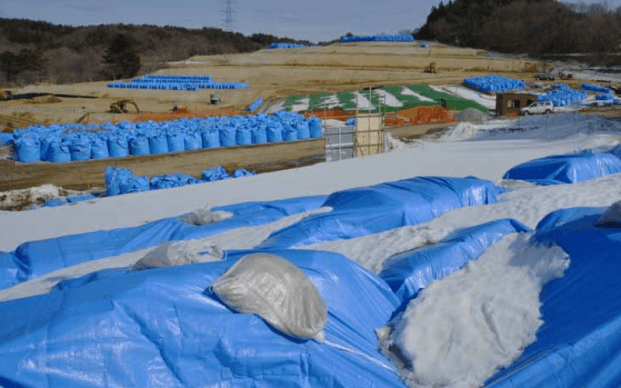
Have you seen images from Japan showing mountains of black bags filled with radioactive soil?

Have you seen images from Japan showing mountains of black bags filled with radioactive soil? You probably wondered what they are going to do with them, right? The bags only last for a few years, and in fact, I’ve seen pictures of bags already broken with weeds sticking out from them.
Well, the mystery is solved. The government changed the law in secret meetings so that the radioactive waste is no longer radioactive. They raised the safety level from 100 becquerel per kg to 8000 becquerel per kg.
According to the secret meetings, the formerly radioactive material will be now safely used as construction material across the nation.
Now I wonder what they will do with the radio active water stored in already leaking giant tanks around the nuclear plants. They are right by the Pacific Ocean.
By the way, for those who can not grasp what all this oddity means, the simple way to understand is that instead of coming up with safe ways to take care of dangerous radioactive materials, the Japanese government decided to work with media and industry to make money off of people’s health. It is more profitable to spread radiation across Japan than taking care of people’s lives. And that way, those who take care of people’s health can make money too.
But if they are dead or surrounded by radiation everywhere, how do they appreciate money? I really think this whole capitalism thing is a huge fucking bullshit.
Japan to Recycle Waste Collected during Fukushima Decontamination:
http://www.laht.com/article.asp?ArticleId=2408901&CategoryId=12395
一億総被ばくの国家プロジェクト… 8,000ベクレル/kg以下の除染土を 全国の公共事業に!?: https://foejapan.wordpress.com/2016/04/15/8000bq_problem/
汚染土壌の再生利用は世界に前例の無い一大ナショナル・プロジェクト: http://oshidori-makoken.com/?p=2059
The picture is from: http://asama888.cocolog-nifty.com/blog/2015/11/post-5f2f.html
1 This Month
10 March A LIVE WEBINAR THE REAL EFFECTS OF NUCLEAR POWER
What the Industry Isn’t Telling Us
1:00 PM Mountain, 2 pm Central, 3 pm Eastern. Live on the Keepers of the Water Facebook page



18 March Webinar @ 1 PM EST: An Assessment of SMR Projects: The Case of Canada
register for the zoom:
https://us02web.zoom.us/webinar/register/WN_o8BIIOUvQ2ONJR1nta65DQ#/registration


of the week – STOP SMALL MODULAR REACTORS IN CANADA
To see nuclear-related stories in greater depth and intensity – go to https://nuclearinformation.wordpress.com
-
Archives
- March 2026 (109)
- February 2026 (268)
- January 2026 (308)
- December 2025 (358)
- November 2025 (359)
- October 2025 (376)
- September 2025 (258)
- August 2025 (319)
- July 2025 (230)
- June 2025 (348)
- May 2025 (261)
- April 2025 (305)
-
Categories
- 1
- 1 NUCLEAR ISSUES
- business and costs
- climate change
- culture and arts
- ENERGY
- environment
- health
- history
- indigenous issues
- Legal
- marketing of nuclear
- media
- opposition to nuclear
- PERSONAL STORIES
- politics
- politics international
- Religion and ethics
- safety
- secrets,lies and civil liberties
- spinbuster
- technology
- Uranium
- wastes
- weapons and war
- Women
- 2 WORLD
- ACTION
- AFRICA
- Atrocities
- AUSTRALIA
- Christina's notes
- Christina's themes
- culture and arts
- Events
- Fuk 2022
- Fuk 2023
- Fukushima 2017
- Fukushima 2018
- fukushima 2019
- Fukushima 2020
- Fukushima 2021
- general
- global warming
- Humour (God we need it)
- Nuclear
- RARE EARTHS
- Reference
- resources – print
- Resources -audiovicual
- Weekly Newsletter
- World
- World Nuclear
- YouTube
-
RSS
Entries RSS
Comments RSS
 nuclear-news