Crane falls on building with spent nuclear fuel at Takahama plant
Large crane collapses at Takahama nuclear plant
A large crane has toppled onto a building storing nuclear fuel at the Takahama nuclear power plant in Fukui Prefecture, central Japan. Part of the building’s roof was damaged. There were no reported injuries.
Workers at the plant found on Friday night that the crane had half-collapsed onto the building next to the containment vessel of the No.2 reactor.
The crane is about 110 meters long. It buckled where it hit the edge of the roof and is lying across another building.
Officials at Kansai Electric Power Company say no one was injured. They confirmed damage to a facility collecting rainwater on the roof, but say they have detected no change to radiation levels in the surrounding area.
The Secretariat of the Nuclear Regulation Authority says its inspectors have confirmed the falling crane caused wall panels inside the building to move. Workers are checking the building’s functions to prevent radioactive materials from leaking.
Kansai Electric officials say they believe strong winds likely toppled the crane. They are investigating whether there was any problem in its installation.
Weather officials had warned of strong winds in the prefecture at the time.
The Takahama plant’s operational chief, Masakazu Takashima, has apologized for the accident.
The Nuclear Regulation Authority in June last year approved the operation of the plant’s No.1 and No.2 reactors beyond the basic limit of 40 years.
The crane was reportedly being used for construction work on the containment vessel as part of safety measures for the operation extension.
https://www3.nhk.or.jp/nhkworld/en/news/20170121_17/

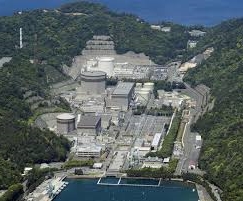
A crane is seen collapsed over a reactor auxiliary building and another structure at the Takahama Nuclear Power Plant in Takahama, Fukui Prefecture, on Jan. 21, 2017. The No. 2 reactor is seen at top.
Crane falls on Takahama nuke plant buildings amid storm warning
TAKAHAMA, Fukui — A large crane fell on a reactor auxiliary building and a fuel handling building at the No. 2 reactor of the Takahama Nuclear Power Plant in Fukui Prefecture on the night of Jan. 20, damaging part of their roofs, Kansai Electric Power Co. said.
There were no injuries in the incident, nor were there any leakages of radiation to the outside environment, the power company said. A storm warning had been issued in the prefecture, with strong winds at a speed of about 15 meters per second (54 kilometers per hour) observed near the plant at the time of the incident, which occurred at around 9:50 p.m.
The 112.75-meter mobile crane, as well as three other similar cranes, was installed for work to refurbish plant facilities in accordance with the new safety standards introduced in the wake of the Fukushima No. 1 Nuclear Power Plant disaster. The collapsed crane was intended for work to install a new dome above the No. 2 reactor’s containment vessel. After the incident, the framework of the collapsed crane was seen bent along the buildings on which it fell, and the metal rails on the edges of the roofs of the two affected buildings were damaged.
According to Kansai Electric Power Co., a worker at the plant’s central control room heard a loud sound and checked to find one of the four cranes collapsed. When a Kansai Electric employee visually checked the inside of the fuel handling building, where 259 nuclear fuel rods are stored in a pool, there were no objects that had fallen upon them. The utility said there were no effects from the accident on the fuel pool or the fuel rods.
“We are sorry for causing concern,” said Masakazu Takashima, a senior official at the Takahama plant at a press conference, suggesting that work involving large cranes would be suspended at the plant for the time being. With regards to the strong winds in the area at the time, he said, “We thought it would be all right after calculating the effects from the wind. However, we hadn’t taken wind direction into consideration.” Takashima said the cause of the incident had yet to be identified.
The Nuclear Regulation Authority (NRA) in June last year granted permission to extend the operation of the plant’s No. 1 and No. 2 reactors, making them the country’s first reactors to be allowed to operate beyond 40 years.
According to the NRA, the management methods for protecting nuclear plant facilities are provided for by each plant’s safety code. Nuclear safety inspectors stationed at each plant monitor to see if work is in progress as specified by the safety code and conduct safety inspections four times a year. While no work was underway at the time of the crane collapse as it was during the night time, the NRA will investigate if work and equipment were properly managed in accordance with the rules as a storm warning had been issued in the prefecture at the time.
“We will check if the series of work involving the cranes had been properly managed to the effect that it wouldn’t affect nuclear reactor facilities,” said an NRA official.
http://mainichi.jp/english/articles/20170121/p2a/00m/0na/007000c

Workers on Saturday examine a crane that collapsed onto a building that houses spent nuclear fuel at the Takahama nuclear power plant in Fukui Prefecture
Crane falls on building with spent nuclear fuel at Takahama plant
FUKUI – A crane collapsed Friday night at the Takahama nuclear power station in Fukui Prefecture, damaging a building housing spent fuel, the plant operator said Saturday.
No one was injured in the accident at around 9:50 p.m. near the No. 2 reactor building and nothing fell into the spent fuel pool, according to the operator, Kansai Electric Power Co.
The crane also damaged the roof of an adjacent building.
A wind warning was in effect in the area, and strong winds were blowing at the time, according to the utility.
The 112-meter crane had been used to prepare for safety-enhancement work in which a concrete dome will be placed over the No. 2 reactor building. Work was not being undertaken at the time of accident.
An official apologized for the accident at a news conference at the plant, saying the utility would re-examine the risk of crane accidents amid strong winds and investigate the cause of the incident.
There are 59 fuel assemblies in the pool, including spent ones, according to Kansai Electric.
The No. 2 reactor is one of two aging reactors at the plant, in operation for over 40 years. Safety-enhancement work for the facility is expected for completion in 2020.
In June last year, nuclear regulators approved the utility’s plan to extend the operation of the Nos. 1 and 2 reactors beyond the government-mandated 40-year service period. It was the first such approval given under new safety regulation introduced following the 2011 Fukushima nuclear accident.
The plant has two newer reactors. All four reactors are currently offline.
100 Meters High Crane Collapsed at Takahama nuclear Plant
In Fukui Prefecture a 100 meters crane collapsed in a storm at Takahama nuclear Plant.


10 Tsuruga nuke plant workers doused with radioactive coolant water
FUKUI – Japan Atomic Power Co. has revealed that 10 workers were doused in radioactive coolant water during maintenance work in an auxiliary building for reactor 2 at the Tsuruga nuclear power plant in Fukui Prefecture.
The 10 employees were not exposed to radiation, the company said on Wednesday.
Up to 160 liters of room-temperature coolant water containing 272,000 becquerels of radioactive substances was spilled — about one-tenth of the level that must be reported to the government, Japan Atomic Power said, adding that the amount of the hazardous materials was “not small.”
Water from a pipe sprayed into a tank room on the second basement floor of the auxiliary building around 10:50 a.m. Wednesday, when a worker loosened a bolt on a valve from a pipe attached to a coolant storage tank, according to Japan Atomic Power.
Of the 15 workers from a subcontracting company who were in the room, four were soaked from head to toe, while six were partially soaked. The water splashed directly onto the faces of some of the workers, according to Japan Atomic Power.
When the water poured in, the workers, wearing jumpsuits, helmets, gloves and goggles, were trying to drain the pipe to allow the valve to be checked and to exchange a rubber part in a tank that temporarily stores coolant water while operations at the plant are halted.
Japan Atomic Power said there was more water in the pipe than had been anticipated.
In November last year, Japan Atomic Power applied to the Nuclear Regulation Authority for safety checks on the Tsuruga reactor. An NRA screening is required before the nuclear reactor is reactivated.
1 This Month


10 March A LIVE WEBINAR THE REAL EFFECTS OF NUCLEAR POWER
What the Industry Isn’t Telling Us
1:00 PM Mountain, 2 pm Central, 3 pm Eastern. Live on the Keepers of the Water Facebook page


18 March Webinar @ 1 PM EST: An Assessment of SMR Projects: The Case of Canada
register for the zoom:
https://us02web.zoom.us/webinar/register/WN_o8BIIOUvQ2ONJR1nta65DQ#/registration


of the week – STOP SMALL MODULAR REACTORS IN CANADA
To see nuclear-related stories in greater depth and intensity – go to https://nuclearinformation.wordpress.com
-
Archives
- March 2026 (76)
- February 2026 (268)
- January 2026 (308)
- December 2025 (358)
- November 2025 (359)
- October 2025 (376)
- September 2025 (258)
- August 2025 (319)
- July 2025 (230)
- June 2025 (348)
- May 2025 (261)
- April 2025 (305)
-
Categories
- 1
- 1 NUCLEAR ISSUES
- business and costs
- climate change
- culture and arts
- ENERGY
- environment
- health
- history
- indigenous issues
- Legal
- marketing of nuclear
- media
- opposition to nuclear
- PERSONAL STORIES
- politics
- politics international
- Religion and ethics
- safety
- secrets,lies and civil liberties
- spinbuster
- technology
- Uranium
- wastes
- weapons and war
- Women
- 2 WORLD
- ACTION
- AFRICA
- Atrocities
- AUSTRALIA
- Christina's notes
- Christina's themes
- culture and arts
- Events
- Fuk 2022
- Fuk 2023
- Fukushima 2017
- Fukushima 2018
- fukushima 2019
- Fukushima 2020
- Fukushima 2021
- general
- global warming
- Humour (God we need it)
- Nuclear
- RARE EARTHS
- Reference
- resources – print
- Resources -audiovicual
- Weekly Newsletter
- World
- World Nuclear
- YouTube
-
RSS
Entries RSS
Comments RSS
 nuclear-news