Community near nuke plant adopts statement against extending 40-year reactor rule
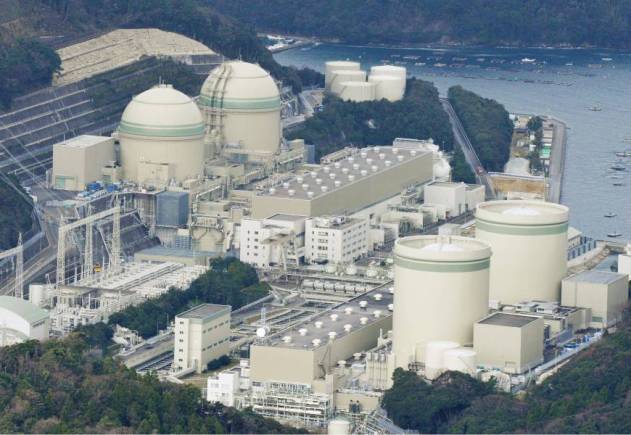
TAKAHAMA, Fukui — A residents’ association in a neighboring district of the Takahama Nuclear Power Plant here adopted a statement on Dec. 18 opposing the extension of the 40-year maximum lifespan rule for nuclear reactors.
Kansai Electric Power Co. aims to restart the No. 1 and 2 reactors at the Takahama plant to operate them over 40 years after the Nuclear Regulation Authority gave the green light for a 20-year extension.
The Otomi district in Takahama, with a population of 136 people as of November, which has adopted the statement, is located in the Uchiura Peninsula facing Wakasa Bay. It is separated from the mainland part of Fukui Prefecture by the Takahama plant, which is built at the base of the peninsula.
In the statement, adopted based on its draft, the neighborhood association expressed concern that restarting the reactors could cause further depopulation, saying that it will accelerate community deterioration due to the growing negative image of nuclear power after the 2011 Fukushima nuclear disaster. It is an unusual move by a residents’ association of a nuclear plant host municipality to approve a motion against the extension of reactor operation.
The association is set to submit the document to Kansai Electric, the Fukui Prefectural Government and the Takahama Municipal Government.
http://mainichi.jp/english/articles/20161219/p2a/00m/0na/003000c
Another operation approval of aging nuclear reactor contradicts 40-year rule
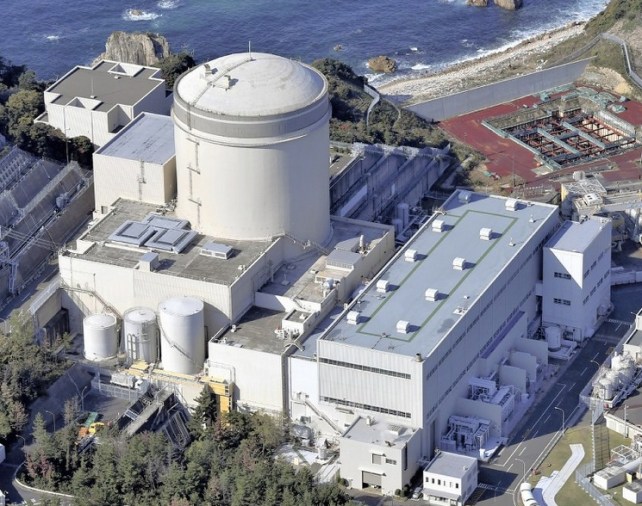
The No. 3 reactor of the Mihama Nuclear Power Station in Mihama, Fukui Prefecture, is pictured in this photo taken from a Mainichi Shimbun helicopter on Nov. 12, 2016.
Another operation approval of aging nuclear reactor contradicts 40-year rule
The Nuclear Regulation Authority (NRA) has allowed Kansai Electric Power Co. to continue running the No. 3 reactor at its Mihama Nuclear Power Station in Fukui Prefecture beyond the 40-year limit.
This is the third nuclear reactor in the country that will have been allowed to continue to operate beyond the 40-year limit — following the No. 1 and 2 reactors at the Takahama plant also in Fukui Prefecture.
The move contradicts rules stipulating that nuclear reactors should be decommissioned after being operated for 40 years, in principle.
It had been viewed as extremely difficult to extend the lifespan of Mihama’s No. 3 reactor because of its old design and difficulties in improving the reactor’s quake resistance as the plant operator is required to largely increase the estimate of the scale of the maximum earthquake that could hit the plant.
As such, the NRA once hinted that it would discontinue examinations of the reactor to see if it meets the new regulatory standards.
However, Kansai Electric Power spent 165 billion yen on measures to enhance the safety of the reactor. The NRA increased its personnel to accelerate the examination of the plant, and managed to approve the continuation of its operation by the deadline.
Six aging nuclear reactors across the country are set to be shut down and decommissioned. Their operators voluntarily decided to decommission these reactors, whose outputs are small, considering the units’ cost-benefit performance.
However, if power companies apply for permission to extend the lifespan of nuclear reactors, the NRA will almost certainly grant permission.
The rules limiting the operation of a nuclear reactor to 40 years, in principle, was established with the aim of reducing Japan’s reliance on atomic power stations following the outbreak of the Fukushima nuclear crisis in March 2011. Both the NRA and power companies should go back to the fundamentals of the rules.
http://mainichi.jp/english/articles/20161116/p2a/00m/0na/019000c
Operation extension approved for Mihama reactor
Japan’s nuclear regulator has said an aging reactor will be allowed to operate beyond its 40-year maximum life span.
The No.3 reactor at the Mihama nuclear power plant, on the Sea of Japan coast, has been given a 20-year extension. The Nuclear Regulation Authority made the unanimous decision on Wednesday.
The reactor, in Fukui Prefecture, went offline in March 2011 for a regular checkup and has not been restarted.
The Mihama reactor turns 40 years old later this year, and it will now be permitted to run until November 2036.
The Nuclear Regulation Authority heard evidence on Wednesday that the reactor’s pipes and electric cables are expected to meet required standards for up to 60 years since operations began in 1976.
Some members referred to a 2004 accident at the reactor in which 5 workers were killed after high-temperature steam leaked from a damaged pipe. They urged the operator, Kansai Electric Power Company, to keep checking for possible decay to the facility.
The reactor is the third in Japan to be granted an extension, after 2 reactors at the nearby Takahama plant were approved for restarts in June.
Kansai Electric said it will not restart operations until additional safety work has been completed, by March 2020 at the earliest. It said it believes the restart will be economically practical.
1 This Month

of the week – Shut Down Drone Warfare!


Tell the Ukrainian Government to Drop Prosecution of Peace Activist Yurii Sheliazhenko

Petition to revoke the licensing of the Near Surface Nuclear Disposal Facility (NSDF) at Chalk River. https://www.ourcommons.ca/petitions/en/Petition/Details?Petition=e-7247
To see nuclear-related stories in greater depth and intensity – go to https://nuclearinformation.wordpress.com
-
Archives
- March 2026 (251)
- February 2026 (268)
- January 2026 (308)
- December 2025 (358)
- November 2025 (359)
- October 2025 (376)
- September 2025 (257)
- August 2025 (319)
- July 2025 (230)
- June 2025 (348)
- May 2025 (261)
- April 2025 (305)
-
Categories
- 1
- 1 NUCLEAR ISSUES
- business and costs
- climate change
- culture and arts
- ENERGY
- environment
- health
- history
- indigenous issues
- Legal
- marketing of nuclear
- media
- opposition to nuclear
- PERSONAL STORIES
- politics
- politics international
- Religion and ethics
- safety
- secrets,lies and civil liberties
- spinbuster
- technology
- Uranium
- wastes
- weapons and war
- Women
- 2 WORLD
- ACTION
- AFRICA
- Atrocities
- AUSTRALIA
- Christina's notes
- Christina's themes
- culture and arts
- Events
- Fuk 2022
- Fuk 2023
- Fukushima 2017
- Fukushima 2018
- fukushima 2019
- Fukushima 2020
- Fukushima 2021
- general
- global warming
- Humour (God we need it)
- Nuclear
- RARE EARTHS
- Reference
- resources – print
- Resources -audiovicual
- Weekly Newsletter
- World
- World Nuclear
- YouTube
-
RSS
Entries RSS
Comments RSS
 nuclear-news