Time running out on Tokyo Olympics

February 19, 2020
Japan needs to rethink the Olympics. The most pressing reason to postpone or cancel the 2020 Tokyo summer games, which are due to start in late July, is a raging public health crisis of unknown dimensions.
The second most important reason to put the Olympics on hold is the Japanese government response to the public health crisis to date: it has shown itself to have feet of clay.
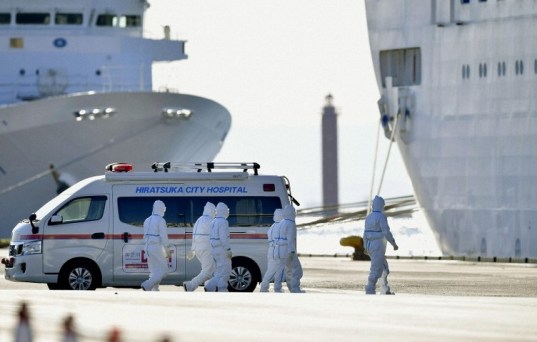
If the Diamond Princess cruise ship, docked in Yokohama Port under quarantine, is a litmus test of Japan’s ability to exercise compassion and competence in an emergency involving thousands of people from around the world, the Abe government has failed miserably.
Prime Minister Abe Shinzo continues to dither while a ship docked in a Japanese port is ravaged by a dangerous virus; nearly 500 infected at latest count. Mr Abe and his political associates continue to proclaim the Olympics will not be delayed, but that is just wishful thinking.
How can a country move forward with plans to “welcome” the world to the Tokyo games when it can’t even deal with a single cruise ship stranded in Tokyo Bay?
- Japan hits back at ‘chaotic’ cruise ship quarantine claims
- Two passengers from quarantined cruise ship in Japan die
- Two die on virus ship
Ever since right-wing firebrand Ishihara Shintaro was mayor of Tokyo, the 2020 Olympics have been a pet project of Japan nationalists seeking to burnish a flawed legacy. They hold the vain hope the 2020 games will be as transformative as the 1964 Tokyo Olympics famously were, again heralding an era of national pride.
Perhaps the turning point of the Beijing Olympics of 2008 is a more apt comparison, given the upsurge of social control, information control and the discordant noise of nationalism.
Among other things, Mr Abe also sees the Olympics as a way of proving to the world that the Fukushima nuclear mess — Japan’s answer to Chernobyl — is not a cause for concern. This is ironic because the messy aftermath of the triple disaster (earthquake, tsunami and meltdown) of March 2011 has been seized upon by Mr Abe and his allies to tighten their grip on power.
Fukushima is an environmental tragedy, but the fact is, it cannot be fully contained, so the struggle has shifted to containing information.
Former prime minister Koizumi Junichiro has called Mr Abe “a liar” for sugar-coating the disaster. Mr Abe had statistics about evacuees were reclassified and altered to make things look more positive. He reassured the Olympic Committee that things at Fukushima were “under control”, which is to say he had the flow of information under control, not the toxic, radioactive leaks. In 2019, Mr Abe’s cabinet shamelessly made a move to dump a million tonnes of “harmless” contaminated water into the open sea.
Mr Abe’s ability to control information is bolstered by an “official secrets act” that criminalises journalists and whistleblowers for reporting leaked information, including radiation leaks. He has exonerated those most responsible for the nuclear mishap — big players in the electric power industry — and put the burden on the taxpayer, reminiscent of the US bailout of Wall Street bailout in 2008.
Only instead of toxic default swaps, it’s a swapping of feel-good stories for news of toxic doom.
Japanese consumers are justifiably nervous about food sourced near the Daiichi Nuclear plant, but Mr Abe is willfully pushing to include food from Fukushima at the Tokyo Olympic Village to “prove” it isn’t tainted.
Nor is it mere coincidence that Mr Abe’s government wants the Olympic Torch Run to commence just 20 kilometres from the damaged Dai-Ichi reactor.
Fearing negative news, hundreds of Japan evacuees from Wuhan were quietly dumped at Haneda Airport without mandatory quarantine. Some took the train home. The Abe government also made a point of asking the World Health Organisation (WHO) not to include the feverish passengers on Diamond Princess in Japan’s national case toll, presumably in order not to dampen “Olympic fever”.
Mr Abe’s icy silence regarding the stricken ship was broken with a silly string of excuses for not being able to test everyone. Hong Kong tested and cleared an entire cruise ship in less time than it took Japan to test a tenth of the passengers.
Even as the coronavirus started to spread among Japanese who had not travelled to China in mid-February, a gala Olympic torch event was held in the streets of Tokyo. Even as public health experts warned of a crisis brewing, it was business as usual for tourist festivals, including the uniquely vulnerable “10,000 naked man festival” in Okayama, which brings to mind the ill-fated “feast for 10,000” held by officials in Wuhan.
The Japanese government’s failure to test all cruise passengers meant even those American passengers “lucky” enough for US evacuation on Monday travelled on planes chartered by the US government in tight spaces with infected passengers.
There are many well-equipped military bases in Japan, dozens under the flag of the Rising Sun, dozens more under the Stars and Stripes.
With so many bases nearby, why is land quarantine not an option?
To portray Mr Abe’s cavalier treatment of the imperilled humans trapped aboard the Diamond Princess as racial or national prejudice is not fair; half of the passengers are Japanese.
But it is not wrong to suggest that the stigmatised human beings aboard that ship are being subject to intense prejudice, despite the fact that many of them happen to hold Japanese passports.
When it comes to stigma and exclusion, Japan can be ruthless to natives and non-natives alike. The tradition of “village outcast” (mura hachibu) in rural Japan has been updated to “shunned to the window” (madogawazoku) in modern offices.
This seems to be the fate of those left on the Diamond Princess, though not all of them have windows to sit by.
Meanwhile, the coronavirus continues to infect human beings regardless of race, creed and myths of national origin. Timely intervention makes a difference, as does common sense and common decency.
Unfortunately, we live in a time of toxic nationalism, intolerance and failed leadership. Not just Japan, but China and the US too. Similar dynamics can be seen at play in smaller countries as well, whether it be Thailand and Cambodia, or England and France.
Any leader who insists that “the show must go on” while doing nothing to help people in real distress proves a fundamental unworthiness to run the show.
Fukushima ‘safe’ to host Olympic torch relay: governor
 Fukushima Gov. Masao Uchibori speaks to foreign media on Feb. 18, 2020, in Tokyo
February 19, 2020
TOKYO (Kyodo) — Fukushima Gov. Masao Uchibori said Tuesday the northeastern Japan prefecture, devastated by the 2011 earthquake, tsunami, and nuclear disaster, is safe to host its leg of the Olympic torch relay.
With the Japanese government designating the upcoming Tokyo Games as “Reconstruction Olympics,” the torch relay in the country will kick off on March 26 at J-Village, a football training center in the prefecture that was once an operational base for dealing with the nuclear crisis. Opening matches for Olympic baseball and softball will be played in Fukushima city as well.
“Through this ‘Reconstruction Olympics,’ we would like to show how Fukushima’s reconstruction has progressed in the past nine years as the result of efforts in cooperation with the Japanese government,” the governor told a press briefing in Tokyo.
Holding the Olympic events “doesn’t mean the reconstruction has finished,” he said, adding the prefecture also suffered damage from Typhoon Hagibis, which left a trail of destruction across wide areas of Japan last fall.
The quake and tsunami disasters in northeastern Japan left more than 15,000 people dead and triggered the world’s worst nuclear disaster since the 1986 Chernobyl crisis. Typhoon Hagibis in October caused massive floods in Fukushima.
The safety of the torch relay route has been confirmed through constant radiation monitoring, among other measures, Uchibori said.
Late last year, Greenpeace Japan informed the Japanese government and Olympic bodies that radiation hot spots were discovered around J-Village, prompting Tokyo Electric Power Company Holdings Inc., the operator of the crisis-hit Fukushima Daiichi nuclear power plant, to remove the soil in the affected areas.
In the town of Naraha, one of the municipalities hosting J-Village, only about half of the residents have returned after the evacuation, according to Uchibori.
https://mainichi.jp/english/articles/20200219/p2g/00m/0na/024000c
Will the 2020 Tokyo Radioactive Olympics be cancelled as well?
List of sports events affected by the coronavirus outbreak
 Meme made by Christian Roy and Hervé Courtois in 2013
List of sports events affected by the coronavirus outbreak
February 18, 2020
ATHLETICS
World indoor championships in Nanjing from March 13-15 postponed to March 2021.
Hong Kong Marathon on Feb. 9 cancelled.
Asian indoor championships in Hangzhou from Feb. 12-13 cancelled.
Tokyo Marathon on March 1: Restricted to elite runners.
AUTO RACING
Formula One’s Chinese Grand Prix in Shanghai on April 19 postponed. New date not set.
Formula E’s Sanya E-Prix in Sanya on March 21 cancelled.
BADMINTON
China Masters in Hainan from Feb. 25-March 1 postponed. New dates not set.
Asian team championships in Manila from Feb. 11-16: China and Hong Kong withdrew.
BASKETBALL
Women’s Olympic qualifying tournament moved from Foshan to Belgrade, Serbia from Feb. 6-9.
Asia Cup qualifiers postponed: Philippines vs. Thailand on Feb. 20; Japan vs. China on Feb. 21, China vs. Malaysia on Feb. 24. Matches scheduled for Hong Kong moved to opponents’ homes.
BIATHLON
Olympic test event in Zhangjiakou from Feb. 27-March 2 cancelled.
BOXING
Asia-Oceania Olympic qualifier moved from Wuhan to Amman, Jordan from March 3-11.
SPORT CLIMBING
Asian Championships in Chongqing from April 25-May 3 to be relocated.
World Cup in Wujiang from April 18-19 cancelled.
World Cup in Chongqing on April 22 cancelled.
EQUESTRIAN
Hong Kong showjumping leg of Longines Masters Series from Feb. 14-16 cancelled.
FIELD HOCKEY
Hockey Pro League matches between China and Belgium on Feb. 8-9 and Australia on March 14-15 postponed.
India women’s tour of China from March 14-25 cancelled.
Ireland women’s tour of Malaysia in March-April cancelled.
GOLF
US LPGA Tour
Honda LPGA Thailand in Pattaya from Feb. 20-23 cancelled.
HSBC Women’s World Championship in Singapore from Feb. 27-March 1 cancelled.
Blue Bay LPGA on Hainan Island from March 5-8 cancelled.
European Tour
Maybank Championship in Kuala Lumpur, Malaysia, from April 16-19 postponed.
China Open in Shenzhen from April 23-26 postponed.
GYMNASTICS
Artistic World Cup in Melbourne, Australia from Feb. 20-23: China team withdrew.
HANDBALL
Olympic women’s qualifying tournament in Montenegro from March 20-22: China withdrew. Hong Kong declined invitation to attend.
ICE HOCKEY
Chinese clubs in Supreme Hockey League playing home games in Russia.
Women’s Challenge Cup of Asia in Manila, Philippines, from Feb. 23-28 cancelled.
JUDO
Paris Grand Slam on Feb. 8-9: China team withdrew.
Dusseldorf Grand Slam on Feb. 21-23: China team withdrew.
RUGBY
Hong Kong Sevens moved from April 3-5 to Oct. 16-18.
Singapore Sevens moved from April 11-12 to Oct. 10-11.
SAILING
Asian Nacra 17 Championship in Shanghai from March 1-6 moved to Genoa, Italy from April 12-19.
Asian 49erFX Championship in Hainan from March 20-29 moved to Genoa, Italy from April 12-19.
SKIING
Alpine World Cup in Yanqing from Feb. 15-16 cancelled.
SOCCER
Asian Champions League: Matches involving Chinese clubs Guangzhou Evergrande, Shanghai Shenhua, and Shanghai SIPG postponed to April-May. Beijing FC allowed to play from Feb. 18.
Asian women’s Olympic qualifying Group B tournament relocated from Wuhan to Sydney from Feb. 3-13. China vs. South Korea playoff on March 11 moved from China to Malaysia.
AFC Cup: All group stage and playoff matches in east zone delayed to April 7.
Chinese Super League, due to start Feb. 22, delayed.
Asian men’s futsal championship in Ashgabat, Turkmenistan from Feb. 26-March 8 postponed.
SWIMMING
Asian water polo championships in Nur-Sultan, Kazakhstan from Feb. 12-16 cancelled.
Diving Grand Prix in Madrid from Feb. 14-16: China team withdrew.
Diving world series event in Beijing from March 7-9 cancelled.
TENNIS
Fed Cup Asia-Oceania Group I tournament moved from Dongguan to Dubai, United Arab Emirates, from March 3-7.
VOLLEYBALL
Beach volleyball World Cup in Yangzhou from April 22-26 postponed.
WEIGHTLIFTING
Asian Championships from April 18-25 moved from Nur-Sultan, Kazakhstan to Tashkent, Uzbekistan.
WRESTLING
Asian Championships in New Delhi from Feb. 20-23: China, North Korea, Turkmenistan teams withdrew.
OTHERS
Chinese Anti-Doping Agency suspended testing from Feb. 3.
Winter X Games events in Chongli from Feb. 21-23 postponed.
Singapore athlete of the year awards on Feb. 26 postponed.
World Chess Federation’s presidential council meeting moved from China to United Arab Emirates on Feb. 28-29.
Association of Southeast Asian Nations (ASEAN) Para Games in the Philippines from March 20-28 postponed. New dates not set.
XTERRA Asia-Pacific Championships (offroad triathlon, duathlon) in Taiwan from March 28-29 cancelled.
Snooker’s China Open from March 30-April 5 cancelled.
SportAccord summit in Beijing from April 19-24 cancelled. New site to be determined.
Singapore bans spectators at National School Games from January-August.
University Athletic Association of the Philippines postponed all sports events.
Japan prepares for widespread coronavirus outbreak

February 18, 2020
As cases of the coronavirus emerge around the country, Japanese health officials are finding it increasingly difficult to identify the routes of infection. The government has announced it is stepping up screening efforts and will have the capacity to test 3,800 people a day starting on Tuesday.
Health ministry official infected despite no close contact
The number of cases in Japan stands at more than 500 as of writing, including 454 from a quarantined cruise ship docked near Tokyo.
Anxiety surrounding the virus has been palpable for weeks, with citizens throughout the country wearing face masks and carrying alcoholic disinfectant. But the concern reached new levels on Monday, after news broke of a health ministry official testing positive. The man, who is in his 50s, had been working on the quarantined cruise ship, reportedly helping control traffic as infected passengers disembarked. Worryingly, he was infected despite only working for about 10 minutes and maintaining a distance of at least two meters from the passengers.
Japan’s health ministry announced on Monday that one of its officials who had been working on the quarantined cruise ship was infected with the coronavirus.
Pressure on government grows
On Monday, the health ministry announced a directive instructing all municipalities to expand screenings to include people with symptoms who have not traveled to the Chinese provinces of Hubei and Zhejiang. Hubei is the epicenter of the outbreak, and has close business links with Zhejiang.
The measure comes after infections were confirmed among people who had neither been to the provinces nor come into contact with people who had.
Laboratories, quarantine stations, universities, and companies around the country are now increasing their personnel in an effort to meet the new testing requirements. The health ministry says the expanded manpower will enable screening of an additional 1,050 people a day.
The ministry says it will also provide medical institutions that have adequate screening equipment with the chemicals and materials needed to conduct testing.
National testing standard
The ministry also announced a set of standards to help people decide when to seek medical assistance:
- People who display symptoms of the common cold or a temperature above 37.5 degrees Celsius for four days are advised to contact a local medical center.
- People experiencing severe fatigue or breathing difficulties, as well as those with fever, are advised to contact a local medical center.
- People vulnerable to viruses, including the elderly and those with pre-existing conditions, are advised to seek medical assistance if they have cold symptoms or fever for two days. Pregnant women are also advised to seek early consultation.
Additionally, ministry officials are urging people to stay home from school or work if they display any symptoms of the cold.
Clinical trials on HIV drug
Health experts are working around the clock on treatment. While it will be some time before a vaccine is available for widespread use, there are signs that one already existing drug may be effective at combating the virus.
The director of Disease Control and Prevention Center, Norio Omagari, told NHK World that a team of researchers from his organization is conducting clinical trials on a drug commonly used to treat HIV. Omagari says that some patients have recovered after the tests, adding that his team is expediting the process to verify the effectiveness of the treatment.
Social impact
The outbreak is affecting a wide range of activities in business and culture.
Japan’s Imperial Household Agency has canceled Emperor Naruhito’s public birthday greetings, which were schedule for February 23. The event would have marked the emperor’s first birthday since ascending to the throne and thousands were expected to attend. It is the first imperial birthday greeting to be called off since 1996, when there was a hostage crisis at the Japanese embassy in Peru.
Meanwhile, the Tokyo Marathon is planning to cancel entries from the general public. The race will be held on March 1, and about 38,000 people had originally registered to take part.
On the business side, Japanese companies with operations in Hubei Province and other parts of China have been struggling to maintain production. The full extent of the impact of the outbreak is difficult to assess but experts say it will prove to be a major setback for the global economy.
Tokyo marathon cancels mass race over coronavirus scare


Tokyo protesting against South Korea’s Tokyo 2020 radioactive Olympics posters
South Korea is definitely right in calling out this shit. No amount of lies and cover ups can bury the truth: 2020 Tokyo Olympics are the radioactive Olympics. Despite the past years gigantic PR campaign to whitewash the still ongoing Fukushima nuclear disater and all its radiation harmful consequences, claiming that all is under control, totally safe, back to normalcy, back to business. Hell no!
So, the multi-billion-dollar propaganda machine of TEPCO and the Japanese Govt is calling out South Korea for creating propaganda against their own propaganda. Again, like always, there is only one truth: radiation kills.
This time, the truth is that Olympians will get high doses of rads that are on the ground in Tokyo, in Fukushima Prefecture, and in every neighboring prefectures all the way down from Fukushima to Tokyo.
There are hot spots all over Eastern Japan. So many of these hotspots have been well documented by folks like you and me, as Japanese citizens had to organized themselves and learned to protect themselves by mapping the radiation present in their living environment, due to the massive campaign of denial of their government prioritizing economics expediency over people’s health.
 VANK put up the posters on the walls of the new Japanese embassy on Jan. 6 before uploading images of the posters on social media. (image: VANK)
Japan wants cruise ship infected separated from country’s total over economy fears
The ” task force” stage of Olympic cancellation ?

Tokyo Olympic coronavirus task force set up
February 6, 2020
The organizing committee for the 2020 Tokyo Olympic and Paralympic Games has launched a task force to respond to the spread of the new coronavirus.
The organizer told reporters on Thursday that it set up the task force on Tuesday headed by Director General Toshiro Muto.
It said officials already held a first meeting and talked about the need for cooperation with relevant organizations such as the central government and Tokyo metropolitan government, as well as the International Olympic Committee and the International Paralympic Committee over the virus outbreak.
They plan to discuss concrete measures to ensure the safety of athletes and spectators in the run-up to the torch relays that start in March, test events and the Olympic and Paralympic Games this summer.
Muto said he finds no problem in holding the Games, and his committee will closely monitor the situation in a calm manner, and take every step necessary to ensure safe conditions for athletes and spectators.
Tokyo 2020 Organisers set up task force to counter coronavirus
TOKYO (Reuters) – Tokyo Olympics organisers have set up a task force to coordinate with public health authorities on how to respond to the growing coronavirus epidemic.
Tokyo 2020 CEO Toshiro Muto said at a press briefing on Thursday that he chaired the newly created Novel Coronavirus Countermeasures Task Force, which held its first meeting on Feb. 4. A second briefing would be held as early as tomorrow, he said.
Muto said on Wednesday that the coronavirus spread could throw “cold water” over the 2020 Games momentum. At Thursday’s briefing, he pledged that the event “would go on as planned.”
Fukushima and the 2020 Olympics
by Shaun Burnie – 5 February 2020As 2020 is the year the Olympics and Paralympics come to Japan, this is an exciting time for sports and for the people of Japan. Amidst all the excitement however, there is the ongoing nuclear crisis in Fukushima prefecture. Labeled as the ‘Reconstruction Olympics’, Prime Minister Abe in 2013 declared that the situation at Fukushima Daiichi was under control. Seven years later there still remains a nuclear emergency at the nuclear plant and surrounding areas. In addition to the enormous challenges of how to safely manage over 1 million tonnes of contaminated water at the site and as much as 880 tonnes of molten nuclear fuel for which there is no credible solution, there remain wider issues regarding radioactive contamination of the environment, its effect on workers and Fukushima citizens, including evacuees and their human rights.
 Greenpeace radiation survey team in Fukushima, Japan
These issues were the subject of a 28 January 2020 documentary
broadcast by the U.S. network HBO as an investigative report by the program ‘Real Sports with Bryant Gumbel ’, the U.S.’s most-honored sports journalism series (with 33 Sports Emmy Awards, including 19 for Outstanding Sports Journalism) during the opening episode of its 26th season.
What does it mean to host the Olympics and Paralympics in the context of an ongoing nuclear disaster, the effects of which are still being felt by tens of thousands of Japanese citizens? What does it tell about the Japanese government and its commitment to respecting the values of transparency and the human rights of its citizens? These are some of the important questions raised by HBO and they warrant careful consideration in the months leading up to this year’s summer games.
 Greenpeace radiation survey team in Fukushima, Japan
Greenpeace Japan applauds Olympic values and spirit, while recognizing that the International Olympic Committee (IOC) has the responsibility to ensure the Olympic Games have a minimum impact on the environment and leave a positive legacy for those hosting the Games. The IOC has an opportunity to do this in a way that fulfills the ideals of the environment as the third pillar of Olympism – sustainability – by making the Games a showcase for environmental solutions. Simultaneously, we recognize that hosting the Olympics and Paralympics requires the Japanese Government to ensure absolute safety for athletes, international visitors, and the Japanese public alike.
The decision to host two sporting events in Fukushima city raises genuine and important questions over radiation risks. The route of the Olympic Torch relay in all the municipalities of Fukushima prefecture includes the districts of Iitate, Namie, and Okuma where Greenpeace Japan’s Nuclear Monitoring & Radiation Protection Team has discovered radioactive hotspots, both in the open areas as well as in the remaining radiation exclusion zones, that remain too high even by revised governmental standards. What does all this mean for the hosting of Olympic events, including for athletes and visitors?
 Greenpeace radiation survey team in Fukushima, Japan
By conducting extensive radiation investigations, Greenpeace Japan attempts to explain the complex radiological environment, where nothing is straightforward, and where judging precise risks to health at the individual level is near impossible. In an effort to better understand and explain the radiological situation in parts of Fukushima, as well as the ongoing issues of human rights for both Fukushima citizens and decontamination workers, Greenpeace Japan will be publishing its latest radiation survey results in early March 2020.
Shaun Burnie is Senior Nuclear Specialist at Greenpeace Germany.
https://www.greenpeace.org/international/story/28509/fukushima-and-the-2020-olympics/
Radioactive 2020 Olympics Torch Run – WTFutaba? Beverly Findlay-Kaneko
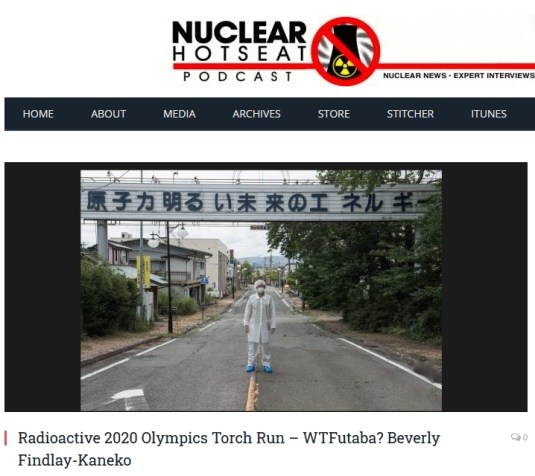
February 5, 2020
Radioactive 2020 Olympics Torch Relay will run through Futaba, town next to Fukushima Daiichi, near former location of PR sign, “Nuclear Power: Energy for a Bright Future.” (pictured above) Runners and tourists will NOT be wearing decontamination garb, unless they’re smart – and if they’re really smart, they won’t be there..
This Week’s Featured Interview:
- Radioactive 2020 Olympics UPDATE: Beverly Findlay-Kaneko again joins us with on-the-ground information about the Olympics torch relay, including blog post interviews with former residents of Futaba, the town that hosted the Fukushima Daiichi nuclear facility, translated from the Japanese exclusively for Nuclear Hotseat.
Virus poses stark challenges to Abe’s tourism goals as Tokyo Olympics loom
Some experts say the coronavirus crisis is likely to continue for several months, possibly affecting the Tokyo Olympics starting July 24 — a nightmare scenario for Abe, who has tried to use the world’s largest sporting event to promote the Japanese economy and thereby further drum up voters’ support for his government.
According to a simulation by a medical team led by Gabriel Leung, the dean of the University of Hong Kong’s faculty of medicine, the number of infections in five Chinese mega-cities — Beijing, Shanghai, Guangzhou, Shenzhen and Chongqing — would peak between late April and early May, meaning the crisis would still continue further beyond that period.
 Tourists stroll near Kiyomizu Temple, a popular sightseeing spot in Kyoto, on Thursday. Japan’s recent tourism boom is being tested amid the coronavirus outbreak.
January 31, 2020
The coronavirus outbreak is posing myriad challenges for the Japanese economy, including a key Abe administration policy initiative — the promotion of inbound tourism.
In recent years, inbound tourism has been one of the few sectors to see rapid growth in the long-stagnant Japanese economy. Top government officials, especially Chief Cabinet Secretary Yoshihide Suga, have touted the country’s “exploding” inbound tourism as a successful example of their “structural reform” deregulation initiatives.
In fact, everything looked to be on track until recently. The number of foreign tourists skyrocketed from 8.36 million in 2012 to 31.88 million in 2019, largely thanks to the yen’s depreciation and Suga’s initiative to ease Japan’s visa conditions for tourists from other Asian countries, most notably China.
Total spending by foreign tourists in Japan likewise surged from an estimated ¥1.1 trillion to ¥4.8 trillion during the same period, with Chinese tourists spending as much as 36.8 percent of total tourism expenditures in 2019, followed by Taiwanese at 11.4 percent and South Koreans at 8.7 percent.
“It has been confirmed that the effects from inbound tourism … is turning into one of the main growth engines of the Japanese economy,” declared the Japan Tourism Agency in its 2018 white paper.
“By becoming a tourism-oriented country, we have created a large and robust industry that is driving regional revitalization throughout Japan,” Prime Minister Shinzo Abe boasted in his annual policy speech in January last year.
But that rosy vision of “a tourism-oriented country” has recently been put in doubt.
Since July, the number of South Korean tourists, typically the second-largest ethnic group among visitors, plummeted by more than 50 percent as nationalistic sentiment in both countries flared up over thorny history and trade issues.
In December, the number of tourists from the country who came to Japan stood at 248,000, down 63.6 percent from the same month in the previous year. Experts had already said it had become impossible for Abe’s government to meet its target of 40 million foreign tourists in 2020.
And then the coronavirus hit. Beijing has taken the extraordinary step to ban all Chinese from going overseas on group tours, effective Jan. 27. The number of Chinese tourists, the largest group by nationality, is expected to fall drastically as a result.
Some experts say the coronavirus crisis is likely to continue for several months, possibly affecting the Tokyo Olympics starting July 24 — a nightmare scenario for Abe, who has tried to use the world’s largest sporting event to promote the Japanese economy and thereby further drum up voters’ support for his government.
According to a simulation by a medical team led by Gabriel Leung, the dean of the University of Hong Kong’s faculty of medicine, the number of infections in five Chinese mega-cities — Beijing, Shanghai, Guangzhou, Shenzhen and Chongqing — would peak between late April and early May, meaning the crisis would still continue further beyond that period.
“The best case scenario, you would have something … where we go through the spring into the summer, and then it dies down,” David Fisman, a professor at the University of Toronto, was quoted as saying by media reports.
During an Upper House Budget Committee session Wednesday, Liberal Democratic Party member Motoyuki Fujii pointed out it took about six months to contain the SARS (severe acute respiratory syndrome) crisis in 2003, which was caused by a similar virus and infected about 8,000 people and killed 774 from Nov. 2002 to Aug. 2003.
The new coronavirus, which was first officially confirmed in Wuhan on Dec. 31, has already infected at least around 9,800 and killed 213, according to the tally compiled by the South China Morning Post as of Friday.
“I’m concerned. … Now we have exactly about six months before the Olympic Games will start in July,” Fujii said.
“I’d like the government to make its maximum efforts to get rid of the effects of the infectious disease by the time we will have the Olympic Games,” he added.
In response, Seiko Hashimoto, the minister in charge of the Olympics and Paralympics, said that “measures against infectious diseases including the new coronavirus are very important” in organizing the event.
“I believe safety and the sense of security must be ensured to make the Tokyo Olympics successful,” Hashimoto said.
It is still probably too early to predict any effects on the Tokyo Games, as many key details of the new coronavirus still remain unknown.
But the outbreak has also highlighted a legal loophole and Japan’s apparent unpreparedness to deal with serious outbreaks of infectious disease in general.
Medical experts were shocked to learn that a carrier of the novel coronavirus could infect others even during the incubation period, when no symptoms are apparent. However, under the law, quarantine officers are not allowed to force a person showing no symptoms to undergo a medical test to determine whether that person is a carrier of a designated infectious disease.
In fact, two Japanese citizens who arrived at Tokyo’s Haneda Airport from Wuhan on a government-chartered airplane Wednesday refused to be tested for the virus. They went home from the airport and did not stay at a housing facility prepared by the government.
“Two people have refused to undergo a virus test. We tried to persuade them for hours but there was no legally binding power. It’s very regrettable,” Prime Minister Shinzo Abe admitted during an Upper House budget committee session Thursday.
On the political front, a setback in the promotion of inbound tourism is likely to deal a heavy blow to Abe as he struggles to carve out a legacy for his administration, which began in December 2012. Abe’s term as the president of the ruling LDP will expire in September next year.
His Abenomics policy mix consists of three main components: ultraloose monetary easing by the Bank of Japan, aggressive fiscal spending by the government and structural economic reforms, most notably deregulation.
Many economists have regarded monetary easing and fiscal spending as temporary measures to buy time, given the ballooning central government debt.
Structural economic reforms, in particular deregulation, is the key to achieve sustainable growth, they say, and promotion of inbound tourism has been often pointed out as one of the few successful cases of Abe’s structural reform initiatives.
Tokyo 2020 at real risk as China coronavirus truths come to light

Coronavirus poses a risk to 2020 Olympics, Tokyo City Governor says

Japan’s effort to downplay any #radioactive problems to health and safety and forge ahead with the Olympics

Could the Coronavirus Mean that the Tokyo 2020 Olympic Games are Cancelled?
1 This Month

of the week – Shut Down Drone Warfare!


Tell the Ukrainian Government to Drop Prosecution of Peace Activist Yurii Sheliazhenko

Petition to revoke the licensing of the Near Surface Nuclear Disposal Facility (NSDF) at Chalk River. https://www.ourcommons.ca/petitions/en/Petition/Details?Petition=e-7247
To see nuclear-related stories in greater depth and intensity – go to https://nuclearinformation.wordpress.com
-
Archives
- March 2026 (244)
- February 2026 (268)
- January 2026 (308)
- December 2025 (358)
- November 2025 (359)
- October 2025 (376)
- September 2025 (257)
- August 2025 (319)
- July 2025 (230)
- June 2025 (348)
- May 2025 (261)
- April 2025 (305)
-
Categories
- 1
- 1 NUCLEAR ISSUES
- business and costs
- climate change
- culture and arts
- ENERGY
- environment
- health
- history
- indigenous issues
- Legal
- marketing of nuclear
- media
- opposition to nuclear
- PERSONAL STORIES
- politics
- politics international
- Religion and ethics
- safety
- secrets,lies and civil liberties
- spinbuster
- technology
- Uranium
- wastes
- weapons and war
- Women
- 2 WORLD
- ACTION
- AFRICA
- Atrocities
- AUSTRALIA
- Christina's notes
- Christina's themes
- culture and arts
- Events
- Fuk 2022
- Fuk 2023
- Fukushima 2017
- Fukushima 2018
- fukushima 2019
- Fukushima 2020
- Fukushima 2021
- general
- global warming
- Humour (God we need it)
- Nuclear
- RARE EARTHS
- Reference
- resources – print
- Resources -audiovicual
- Weekly Newsletter
- World
- World Nuclear
- YouTube
-
RSS
Entries RSS
Comments RSS
 nuclear-news