Nuclear convoys: 40 safety reports in three years

Sunday Post By Rob Edwards, January 15, 2023,
The nuclear bomb convoy that regularly crisscrosses the UK by road has logged 40 safety incidents in the last three years, according to official figures.
Convoy vehicles have crashed twice and got caught up in other road accidents five times. They have suffered multiple brake faults, breakdowns and power losses.
The convoy has also caused the closure of roads or motorway lanes 11 times and been delayed by lorry fires, a spillage and two outbreaks of Covid. In one case it had to deal with an “erratic driver interfering with the convoy” and in another it closed a road after a driver caught using a mobile phone tried to run away.
Campaigners described the safety lapses as “concerning” and argued that small incidents could easily escalate into something more serious. They said the risks being taken by the Ministry of Defence (MoD) were unjustified……
A convoy of 20 or more vehicles transports nuclear warheads between the Burghfield nuclear weapons factory in Berkshire and the Royal Navy’s armaments depot at Coulport on Loch Long in Argyll and Bute at least six times a year. The warheads require regular maintenance.
In response to a request under freedom of information, the MoD released short summary logs of incidents involving the convoy during 2019, 2020 and 2021. The dates are blacked out and no locations are given.
Of the 40 incidents, 22 are categorised as “operational” and 18 as “engineering”. One of the two crashes involving a convoy vehicle caused “minor injuries” and a delay of two hours and 45 minutes. The other was attended by the police and caused a 32-minute delay.
The Ferret news website reported in 2018 the MoD recorded 157 safety incidents involving the convoy between 2008 and 2017. The number logged in 2017 (44) was a record high…………. more https://www.sundaypost.com/fp/nuclear-convoys-40-safety-reports-in-three-years/
—
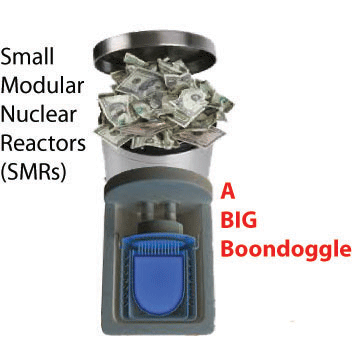
Eye-popping new cost estimates released for NuScale small modular reactor
Key Findings
NuScale and the Utah Associated Municipal Power Systems (UAMPS) announced costs of a 462-megawatt small modular reactor (SMR) have risen dramatically
As recently as mid-2021, the target price for power was pegged at $58 per megawatt-hour (MWh); it’s risen to $89/MWh, a 53% increase.
The price would be much higher without $4 billion federal tax subsidies that include a $1.4 billion U.S. Department of Energy contribution and a $30/MWh break from the Inflation Reduction Act
The higher target price is due to a 75% increase in the estimated construction cost for the project, from $5.3 to $9.3 billion dollars
Last week, NuScale and the Utah Associated Municipal Power Systems (UAMPS) announced what many have long expected. The construction cost and target price estimates for the 462-megawatt (MW) small modular reactor (SMR) are going up, way up.
From 2016 to 2020, they said the target power price was $55/megawatt-hour (MWh). Then, the price was raised to $58/MWh when the project was downsized from 12 reactor modules to just six (924MW to 462MW). Now, after preparing a new and much more detailed cost estimate, the target price for the power from the proposed SMR has soared to $89/MWh.
Remarkably, the new $89/MWh price of power would be much higher if it were not for more than $4 billion in subsidies NuScale and UAMPS expect to get from U.S. taxpayers through a $1.4 billion contribution from the Department of Energy and the estimated $30/MWh subsidy in the Inflation Reduction Act (IRA).
It also is important to remember that the $89/MWh target price is in 2022 dollars and substantially understates what utilities and their ratepayers actually will pay if the SMR is completed. For example, assuming a modest 2% inflation rate through 2030, utilities and ratepayers would pay $102 for each MWh of power from the SMR—not the $89 NuScale and UAMPS want them to believe they will pay.
The 53% increase in the SMR’s target power price since 2021 has been driven by a dramatic 75% jump in the project’s estimated construction cost, which has risen from $5.3 billion to $9.3 billion. The new estimate makes the NuScale SMR about as expensive on a dollars-per-kilowatt basis ($20,139/kW) as the two-reactor Vogtle nuclear project currently being built in Georgia, undercutting the claim that SMRs will be cheap to build.
NuScale and UAMPS attribute the construction cost increase to inflationary pressure on the energy supply chain, particularly increases in the prices of the commodities that will be used in nuclear power plant construction.
For example, UAMPS says increases in the producer price index in the past two years have raised the cost of:
Fabricated steel plate by 54%- Carbon steel piping by 106%
- Electrical equipment by 25%
- Fabricated structural steel by 70%
- Copper wire and cable by 32%
In addition, UAMPS notes that the interest rate used for the project’s cost modeling has increased approximately 200 basis points since July 2020. The higher interest rate increases the cost of financing the project, raising its total construction cost.
Assuming the commodity price increases cited by NuScale and UAMPS are accurate, the prices of building all the SMRs that NuScale is marketing—and, indeed, of all of the SMR designs currently being marketed by any company—will be much higher than has been acknowledged, and the prices of the power produced by those SMRs will be much more expensive.
Finally, as we’ve previously said, no one should fool themselves into believing this will be the last cost increase for the NuScale/UAMPS SMR. The project still needs to go through additional design, licensing by the U.S. Nuclear Regulatory Commission, construction and pre-operational testing. The experience of other reactors has repeatedly shown that further significant cost increases and substantial schedule delays should be anticipated at any stages of project development.
The higher costs announced last week make it even more imperative that UAMPS and the utilities and communities participating in the project issue requests for proposal (RFP) to learn if there are other resources that can provide the same power, energy and reliability as the SMR but at lower cost and lower financial risk. History shows that this won’t be the last cost increase for the SMR project.
David Schlissel (dschlissel@ieefa.org) is IEEFA director of resource planning analysis
Ukraine as a country and its armed forces have become members of NATO: defense minister — Anti-bellum
NoviniteJanuary 13, 2023 Ukraine declared itself a “De Facto Member of NATO” and Warned of a New Russian Offensive “Ukraine has de facto become a member of NATO, and this reality may soon be shaped legally.” Such confidence was expressed by the Minister of Defense of Ukraine, Oleksii Reznikov, in an interview with the Russian […]
Ukraine as a country and its armed forces have become members of NATO: defense minister — Anti-bellum
Savannah River Site, Los Alamos plutonium pit production plan could cost over $30 billion

Matthew Christian, Aiken Standard, S.C. Sat, January 14, 2023 https://news.yahoo.com/savannah-river-los-alamos-plutonium-005900374.html?guccounter=1&guce_referrer=aHR0cHM6Ly9uZXdzLmdvb2dsZS5jb20v&guce_referrer_sig=AQAAADJqdcGm_qX6CdNLQ8_g7p81OistELVP4KvAUR1PfQl-0Q2SBtdSRa8GwdKyTIcwvX8aofXxou_a1DmL9axGTUu9S4o5f35bRYrwMTXGG5ZaoooE2PgjQaFWi5uLyJbf3gg8EShjtVi5A26UqvyJcSYMPWp9GQCX2T9NlsjflzJW
Jan. 13—It could cost over $30 billion for the National Nuclear Security Administration to reestablish plutonium pit production, according to recently released report.
Allison Bawden, director of natural resources and environment at the Government Accountability Office, wrote Thursday the Government Accounting Office has identified between $18-$24 billion in potential costs to begin production of 80 plutonium pits per year by 2036 at the Savannah River Site and Los Alamos National Laboratory.
Plutonium pits are the core of a nuclear weapon into which a neutron is injected to begin an uncontrolled reaction.
The United States has been without a permanent capability for plutonium pit production since 1989 after a combination of environmental mismanagement — the EPA and the FBI raided the facility in 1989 after receiving reports of numerous environmental violations from employees — and the end of the Cold War stopped pit production at the Rocky Flats facility in Colorado.
From 2007-2012, around 10 pits per year were made at the Los Alamos National Laboratory.
Trying to restart plutonium pit production and modernizing the Los Alamos National Laboratory for production has cost $8.6 billion since 2005 according to the report.
NNSA plans to produce 50 pits per year at the Savannah River Site beginning in 2036 and 30 pit per year at the Los Alamos National Laboratory beginning in 2027.
At the Savannah River Site, the plans call for the failed Mixed-Oxide Fuel Fabrication Facility to be converted into the Savannah River Plutonium Production Facility.
Bawden says the NNSA estimates through 2035 a cost of between $6.9-$11.1 billion to make the conversion, which is in three steps: getting the main building ready, providing utilities and other infrastructure to the area and constructing an administration building, security facilities and a training area.
Other costs include $6.94 billion for plutonium modernization program at the Savannah River Site and the Los Alamos National Laboratory .
At the Savannah River Site, Bawden says costs include preparing employees to produce pits and learning from the Los Alamos National Laboratory how to produce pits more efficiently. She says at Los Alamos the costs include designing a pit production line, getting equipment, hiring and training staff and making sure the production line is working and checking the quality of the produced pits.
She adds other costs at the Los Alamos National Laboratory include between $4.17-$5.61 billion for capital projects, $240-244 million for support buildings and $45-46 million for maintenance and recapitalization.
Bawden spends a few pages in the 84-page report discussing activities at other Department of Energy-owned sites that are not included in the NNSA cost estimates.
Those activities include design of a warhead at Lawrence Livermore National Laboratory and the lab making sure the produced pits meet the specifications of the warhead, experimental facilities at the Nevada National Security Site, production of non-nuclear pit components at the Kansas City National Security Campus, disassembling pits at the Pantex Plant in Texas and storing produced waste at the Waste Isolation Pilot Plant in New Mexico.
Including these costs and developing more thorough estimates of the costs at the Savannah River Site and Los Alamos is one of two recommendations the GAO makes in the report.
The other is for the NNSA to develop a more complete schedule of activities and when they’re supposed to happen.
Bawden notes NNSA decision-makers said both recommendations will be implemented later in the process when firm construction plans for the Savannah River Plutonium Production Facility are set in 2024 or 2025. She adds the NNSA decision-makers said they are hesitant to make more thorough cost estimates because of a concern of making an estimate, then paying a higher cost and having the public concerned about rising costs for the project.
Pentagon backs Poland’s plans for German, other tanks for Ukraine — Anti-bellum
Polish Press AgencyJanuary 14, 2023 Polish PM to meet with Germany’s Scholz over tanks for Ukraine The Leopard 2 tanks that Warsaw wants to donate to Kyiv as part of a broader international coalition were purchased from Germany and require the German government’s consent to be given to a non-Nato country. Mateusz Morawiecki, the Polish […]
Pentagon backs Poland’s plans for German, other tanks for Ukraine — Anti-bellum
Shouldn’t a new and experimental reactor deserve a federal impact assessment?
These risks are all new to Canada. No sodium-cooled reactor has ever been built here.
BY M.V. RAMANA AND SUSAN O’DONNELL | January 12, 2023 The Hill Times https://www.hilltimes.com/story/2023/01/12/shouldnt-a-new-and-experimental-reactor-deserve-a-federal-impact-assessment/360512/
Towards the end of December 2022, Environment and Climate Change Minister Steven Guilbeault chose to ignore public concerns about small modular nuclear reactors (SMRs), rejecting a request to put a project through an additional federal impact assessment, favouring the nuclear industry and weakening oversight of an untested and risky technology.
When the revised Impact Assessment Act (IAA) became law in 2019, new nuclear reactors were exempted from assessment if they met certain conditions. Those pushing the exemption aimed to open the path to building new reactors. No surprise, then, that the conditions for exemption apply to almost all the SMR designs being considered for construction, even though Canada has no experience with them whatsoever.
The first SMR officially deemed exempt under the IAA is the ARC-100 sodium-cooled fast reactor proposed by NB Power for the Point Lepreau site on the Bay of Fundy in New Brunswick. Given the ecological sensitivity of the site and inherent problems with such reactors, the Coalition for Responsible Energy Development in New Brunswick (CRED-NB) formally requested Guilbeault to designate the project for a full impact assessment. The minister rejected the request on Dec. 22, claiming that a review by the Canadian Nuclear Safety Commission (CNSC) and the New Brunswick government would be adequate.
The federal impact assessment is the most rigorous form of public review available under law, seeking inputs from multiple stakeholders with different forms of expertise and outlooks. Ideally, the review panel would not be solely constituted by CNSC personnel and staff of the provincial government, a project funder. Indigenous nations and public interest groups had clearly stated their concerns to Guilbeault. Letters of support for CRED-NB’s request were submitted by the Wolastoq Grand Council, and Indigenous organizations representing the Peskotomuhkati Nation and the Mi’gmaq First Nations in New Brunswick, as well as more than 300 groups and individuals.
Why the public concern? Unlike the CANDU reactors operating in Ontario and New Brunswick, the ARC-100 design uses molten sodium instead of heavy water to transfer the intense heat produced by nuclear fission. Sodium reacts badly with air or water, burning or exploding upon such contact. Japan’s Monju demonstration reactor was shut down in 1995 within a few months of the reactor starting to generate power because of a sodium fire; it was reactivated in 2010 but was shut down again after another accident. The total price tag for this reactor and its cleanup is upwards of $10-billion.
Sodium also tends to leak out of pipes and vessels because of chemical interactions with the stainless steel in reactors. France’s Superphénix, the world’s largest sodium-cooled reactor, suffered numerous operational problems, including a major sodium leak. When put out of its misery in 1998, its load factor was under eight per cent, a fraction of the 80 to 90 per cent typical of commercial reactors.
Sodium-cooled reactors have also had numerous accidents, starting with the 1955 partial core meltdown of the EBR-1 in Idaho. A decade later, the Fermi-1 demonstration fast reactor near Detroit, Michigan suffered a similar but more devastating accident, leading to the book We Almost Lost Detroit and a song by Gil Scott Heron.
Sodium-cooled reactors have never been successfully commercialized despite numerous attempts over decades. Shut-down sodium-cooled reactors have proven difficult to decommission. In the U.S., the EBR-II reactor was shut down in 1994, but to date it has been unfeasible to extract the sodium metal from the highly radioactive spent fuel. The challenge is to dispose of this material without causing underground explosions due to a sodium-water reaction, as happened with the sodium-cooled Dounreay reactor in Scotland.
Radioactive particles are still being found on the Dounreay foreshore, more than four decades after the reactor waste exploded. A similar accident with the proposed ARC-100 reactor could result in widely spread radioactive contamination next to the Bay of Fundy.
These risks are all new to Canada. No sodium-cooled reactor has ever been built here. The Canadian Nuclear Safety Commission has never evaluated such reactors, one reason why the CNSC’s claim that its regulatory process provides sufficient oversight for SMR development rings hollow. What’s more, the CNSC’s active lobbying to speed up the regulatory process so SMRs could be more quickly brought to market suggests a fundamental conflict of interest by an “independent” regulator.
The ARC-100 project requires federal oversight and assessment. Its impacts on Indigenous rights as well as socio-economic factors and alternatives to the project will not be within the remit of either a CNSC review or a provincial assessment. The opportunities for an independent and official review of public concerns on these issues have now been significantly curtailed.
Susan O’Donnell is an adjunct professor at the University of New Brunswick and St. Thomas University, and a member of the Coalition for Responsible Energy Development in New Brunswick. M.V. Ramana is the Simons Chair in Disarmament, Global and Human Security and professor at the School of Public Policy and Global Affairs, University of British Columbia.
New delay for Hinkley Point C nuclear power – could start operating in 2036.
Hinkley C ‘on schedule’ despite new delay claim after new agreement.
SUGGESTIONS that completion of the Hinkley Point C nuclear power station
could be delayed by 11 years have been dismissed by the company which is
building it. A number of delays have already hit Europe’s largest
construction site and currently Hinkley is not set to start generating
electricity until June, 2027, two years behind its original schedule. Now,
French company EDF has struck a new deal with the Government which would
allow it to start operating as late as 2036.
West Somerset Free Press 8th Jan 2023
https://www.wsfp.co.uk/news/hinkley-c-on-schedule-despite-new-delay-claim-after-new-agreement-586884
Fukushima nuclear disaster: Japan to release radioactive water into sea this year

By Grace Tsoi BBC News 13 Jan 23,
Japan says it will release more than a million tonnes of water into the sea from the destroyed Fukushima nuclear power plant this year.
After treatment the levels of most radioactive particles meet the national standard, the operator said.
The International Atomic Energy Agency (IAEA) says the proposal is safe, but neighbouring countries have voiced concern.
The 2011 Fukushima disaster was the worst nuclear accident since Chernobyl.
Decommissioning has already started but could take four decades.
“We expect the timing of the release would be sometime during this spring or summer,” said chief cabinet secretary Hirokazu Matsuno on Friday, adding that the government will wait for a “comprehensive report” from IAEA before the release.
Every day, the plant produces 100 cubic metres of contaminated water, which is a mixture of groundwater, seawater and water used to keep the reactors cool. It is then filtered and stored in tanks.
With more than 1.3 million cubic metres on site, space is running out.
The water is filtered for most radioactive isotopes, but the level of tritium is above the national standard, operator Tepco said. Experts say tritium is very difficult to remove from water and is only harmful to humans in large doses.
However, neighbouring countries and local fishermen oppose the proposal, which was approved by the Japanese government in 2021.
The Pacific Islands Forum has criticised Japan for the lack of transparency.
“Pacific peoples are coastal peoples, and the ocean continues to be an integral part of their subsistence living,” Forum Secretary General Henry Puna told news website Stuff.
“Japan is breaking the commitment that their leaders have arrived at when we held our high level summit in 2021.
“It was agreed that we would have access to all independent scientific and verifiable scientific evidence before this discharge takes place. Unfortunately, Japan has not been co-operating.”……. more https://www.bbc.com/news/world-asia-64259043
January 15 Energy News — geoharvey

Opinion: ¶ “Electrifying Everything Is A Critical Pathway To Decarbonize The World And Our Lives” • A number of organizations, such as the World Bank, have developed “pathways” or “pillars” for reaching net zero emissions globally by 2050. The core strategies are remarkably consistent, and one critically important pathway is electrifying everything. [CleanTechnica] Transmission lines […]
January 15 Energy News — geoharvey
Team Korea to bolster exports of nuclear energy systems

Korea Times, By Lee Kyung-min, 13 Jan 23,
State-run energy companies and private firms in the nuclear energy industry will join hands to advance exports of the stable and affordable power generation systems, the energy ministry said following a meeting attended by officials from the sector, Friday.
The Korea-developed APR1400, a nuclear reactor with a capacity of 1,400 megawatts, is increasingly recognized by its industry peers for its cost, quality and technological advantages.
Communication channels will be strengthened with the Czech Republic, the Philippines, the United Kingdom, and Turkey, to win orders to build nuclear reactors there. Also fortified will be government assistance to foster industries related to nuclear power generation equipment manufacturing, as well as facility safety and maintenance.
Second Vice Minister of Trade, Industry and Energy Park Il-jun presided over the meeting attended by members of Team Korea, a task force established to facilitate the export of the country’s nuclear reactors, at InterContinental Seoul COEX, southern Seoul.
In attendance were Korea Power Corp. (KEPCO) and its power subsidiary Korea Hydro & Nuclear Power (KHNP) as well as KEPCO affiliates…………….. https://www.koreatimes.co.kr/www/tech/2023/01/419_343553.html
Asia’s arms race risks spinning out of control
CNN, January 15, 2023
Seoul, South KoreaCNN —
It’s an arms race bigger than anything Asia has ever seen – three major nuclear powers and one fast-developing one, the world’s three biggest economies and decades-old alliances all vying for an edge in some of the world’s most contested land and sea areas.
In one corner are the United States and its allies Japan and South Korea. In another corner, China and its partner Russia. And in a third, North Korea.
With each wanting to be one step ahead of the others, all are caught in a vicious circle that is spinning out of control. After all, one man’s deterrence is another man’s escalation…………….
The visit of Japanese leaders to Washington over the past week only served to highlight the point. On Friday, fresh from a meeting with US President Joe Biden, Japanese Prime Minister Fumio Kishida expressed his concern over China’s military activities in the East China Sea and the launch of ballistic missiles over Taiwan that landed in waters near Japan in August………………….
according to North Korea and China, it is Japan who is the aggressor. They have seen Tokyo pledge recently to double its defense spending while acquiring weapons capable of hitting targets inside Chinese and North Korean territory. And their alleged concerns will only have grown with the announcement just days ago of plans for new US Marine deployments on Japan’s southern islands, including new mobile anti-ship missiles meant to thwart any first strike from Beijing.
To the US and Japan, such moves are about deterrence; to Beijing, they are escalation.
IAEA plans “continuous presence” at all Ukraine nuclear power plants “to help prevent a nuclear accident” amid Russia’s war
BY PAMELA FALK, JANUARY 13, 2023
United Nations – The head of the United Nations atomic energy agency, the IAEA, is scheduled to visit Ukraine next week as a follow-up to his commitment last month to enlarge the watchdog agency’s oversight of Ukraine’s nuclear power plants, which have been shelled during Russia’s nearly 11-month war on the country.
The planned trip, confirmed by the IAEA on Friday, follows discussions by Director General Rafael Grossi, who with Ukraine’s Prime Minister Denys Shmyhal “agreed that the International Atomic Energy Agency (IAEA) will establish a continuous presence of nuclear safety and security experts at all of the country’s nuclear power plants as part of stepped-up efforts to help prevent a nuclear accident during the current armed conflict.”……………………………….
Last week, the IAEA said it “continues to prepare to deploy soon IAEA teams on a continual basis to the four other Ukrainian nuclear facilities, the Khmelnitsky, Rivne and South Ukraine NPPs [nuclear power plants], as well as the Chornobyl site, as agreed in Paris in December by Ukrainian Prime Minister Denys Shmyhal and IAEA Director General Grossi.”
…………………………….. Grossi was “continuing consultations with Ukraine and Russia aimed at agreeing and implementing a nuclear safety and security protection zone around the ZNPP as soon as possible.”
Embedding a team permanently at the Zaporizhzhia plant may be the most difficult part of the IAEA’s plan to implement. Russian forces have occupied the sprawling facility since March, and Russian President Vladimir Putin declared the plant within Russian territory in October…………………… more https://www.cbsnews.com/news/iaea-ukraine-power-plants-continuous-presence-help-prevent-nuclear-accident-russia-war/
How close are we to developing commercial nuclear fusion reactors?
Forbes, 15 Jan 23,
“……………………………………………Here is an analogy I have used to put it in context. There were many milestones on the way to commercial airline travel. The Wright Brothers flew the first successful powered flight in history in December 1903. It would be another 16 years before the first transatlantic flight. But, the first widely successful commercial airliner, the Boeing 707 wouldn’t be introduced until 1958.
The long-running joke has always been that commercial nuclear fusion is 30 years away. In reality, that simply means we still can’t quite see the complete pathway to get there. The recent breakthrough is certainly a milestone on the path to commercial nuclear fusion. But we may still be 30 years away from seeing commercial realization of nuclear fusion. https://www.forbes.com/sites/rrapier/2023/01/15/the-nuclear-fusion-breakthrough-in-context/?sh=c9b59133a072
California PUC launches rulemaking to consider extension of Diablo Canyon nuclear plant

Kavya Balaraman, Jan. 13, 2023
Dive Brief:
- California regulators on Thursday voted to open a rulemaking to consider extending the operations of the 2.2-GW Diablo Canyon nuclear power plant, the last operational nuclear facility in the state.
- The rulemaking stems from legislation approved last September, which among other things required the California Public Utilities Commission to issue a decision by the end of this year establishing new retirement dates for the two units of the nuclear plant.
- The Diablo Canyon nuclear plant, which is owned and operated by Pacific Gas & Electric, is currently licensed to operate until 2024 and 2025 for each of its two units respectively. In 2018, state regulators approved a plan to retire the facility once these licenses expire.
Dive Insight:………………………..
Under SB 846, Diablo Canyon Unit 1 could be kept running through Oct. 31, 2029, and Unit 2 until Oct. 31, 2030.
In November, PG&E applied to the U.S. Nuclear Regulatory Commission to keep the plant running until 2030.
Under the umbrella of its new rulemaking, the CPUC could either authorize extending operations at the plant through 2029 and 2030, or establish earlier retirement dates.
…………………………. California stakeholders remain split on the state’s reversal on the future of the Diablo Canyon nuclear plant.
“The rush to keep Diablo Canyon running beyond 2025 is not only dangerous, but will set back California’s drive to make solar and wind the prevailing sources of electricity in the state,” Ken Cook, president of the Environmental Working Group, said in an emailed statement. …………………. https://www.utilitydive.com/news/california-puc-diablo-canyon-nuclear-extension/640351/
Exposed — Beyond Nuclear International

New book investigates the toxic legacy of Hanford
Exposed — Beyond Nuclear International
1 This Month

Tell Congress: Prevent Nuclear Catastrophe in Iran

Tell Congress: Prevent Nuclear Catastrophe in Iran

Read the Public Inquiry Report, the Commissioners’ report, Surrendering Australia: The AUKUS Deception is available to download for free at aukuspublicinquiry.com. Or just watch the replay of the National Press Club Luncheon.

19 November – Webinar – The Reality of Reprocessing
Time: 11:00 AM Pacific Time (US & Canada) / 2:00 PM Eastern / 7:00 PM UK / 8:00 PM CET
Register for the Zoom Event Here


Shut down the radiation-damaged Heysham nuclear reactors now
To see nuclear-related stories in greater depth and intensity – go to https://nuclearinformation.wordpress.com

Say No to NASA’s Reckless Nuclear Reactor on the Moon
Say No to NASA’s Reckless Nuclear Reactor on the Moon
-
Archives
- November 2026 (138)
- October 2026 (302)
- September 2026 (339)
- August 2026 (330)
- July 2026 (355)
- June 2026 (287)
- May 2026 (306)
- April 2026 (356)
- March 2026 (251)
- February 2026 (267)
- January 2026 (308)
- December 2025 (358)
-
Categories
- 1
- 1 NUCLEAR ISSUES
- business and costs
- climate change
- culture and arts
- ENERGY
- environment
- health
- history
- indigenous issues
- Legal
- marketing of nuclear
- media
- opposition to nuclear
- PERSONAL STORIES
- politics
- politics international
- Religion and ethics
- safety
- secrets,lies and civil liberties
- spinbuster
- technology
- Uranium
- wastes
- weapons and war
- Women
- 2 WORLD
- ACTION
- AFRICA
- Atrocities
- AUSTRALIA
- Christina's notes
- Christina's themes
- culture and arts
- Events
- Fuk 2022
- Fuk 2023
- Fukushima 2017
- Fukushima 2018
- fukushima 2019
- Fukushima 2020
- Fukushima 2021
- general
- global warming
- Humour (God we need it)
- Nuclear
- RARE EARTHS
- Reference
- resources – print
- Resources -audiovicual
- Weekly Newsletter
- World
- World Nuclear
- YouTube
-
RSS
Entries RSS
Comments RSS

