NATO to surge troops to Russian border
As the deteriorating military situation for the Ukrainian armed forces becomes increasingly apparent, NATO is making open plans to massively intensify its conflict with Russia.
Andre Damon@Andre__Damon, 17 April 2023 m\ https://www.wsws.org/en/articles/2023/04/18/tzhv-a18.html
NATO plans to surge troops to Russia’s border as part of an effort to become a “war-fighting alliance,” the New York Times reported Monday.
The Times wrote that “NATO now has deployed a battalion of multinational troops to eight countries along the eastern border with Russia. It is detailing how to enlarge those forces to brigade strength in those frontline states.”
A battalion can include up to 1,000 troops, while a brigade can include up to 5,000 troops, meaning that NATO could potentially plan to increase the number of troops on Russia’s borders fivefold, to up to 40,000 troops.
The Times reports that NATO “is also tasking thousands more forces, in case of war, to move quickly in support, with newly detailed plans for mobility and logistics and stiffer requirements for readiness.”
Politico, meanwhile, has cited even larger numbers. On March 18, it reported, “In the coming months, the alliance will accelerate efforts to stockpile equipment along the alliance’s eastern edge and designate tens of thousands of forces that can rush to allies’ aid on short notice… The numbers will be large, with officials floating the idea of up to 300,000 NATO forces.”
“The North Atlantic Treaty Organization,” wrote the Times, has launched “a full-throttled effort” to prepare for military operations all along its eastern flank.
As the Times put it, this “means a revolution in practical terms: more troops based permanently along the Russian border,” It also means “more integration of American and allied war plans, more military spending and more detailed requirements for allies to have specific kinds of forces and equipment to fight, if necessary, in pre-assigned places.”
The alliance has “shed remaining inhibitions about increased numbers of Western troops all along NATO’s border with Russia,” the Times stated. The aim is “to make NATO’s forces not only more robust and more capable but also more visible to Russia.”
Additional troops will be placed under the direct authority of Gen. Christopher G. Cavoli, NATO’s Supreme Allied Commander Europe, who also commands American forces in Europe, as part of the NATO alliance’s decision.
The Times reports that General Cavoli is integrating American and allied war-fighting plans for the first time since the Cold War. Citing a NATO official, the newspaper wrote, “Americans are back at the heart of Europe’s defense … deciding with NATO precisely how America will defend Europe.”
This will entail a massive military buildup, involving enormous increases in military spending. “Now the demands will be tougher and more rigorous to bring the alliance back to a war-fighting capacity in Europe and make deterrence credible—to ensure that NATO can fight a high-intensity war against a rival, Russia, from the first day of conflict,” the Times wrote.
Instead of meeting the previous goal of 2 percent of gross domestic product devoted to the military, NATO members will be expected to spend between 2.5 and 3 percent, the Times reported.
In perhaps the most ominous passage in the article, the Times wrote, “Previously, the annual exercises of NATO’s nuclear forces, known as Steadfast Noon, were kept quiet. But last year, after Russia’s invasion, the exercise went ahead openly. It was important, a NATO official said, to show Moscow that the alliance wasn’t deterred by nuclear threats.”
NATO’s headquarters is likewise “being transformed into a major strategic and war-fighting command, charged with drawing up the alliance’s plans to integrate and deploy allied troops.”
The accession of Finland to NATO, which doubled the length of NATO’s land border with Russia, will be a key component of these plans, with Russia’s entire border with NATO becoming a militarized zone.
Just weeks after its accession to NATO, Finland has begun building a fence on the Russian border, with the initial section to be completed in June.
In June of last year, NATO published a strategy document declaring that the alliance must prepare for “high-intensity, multi-domain warfighting against nuclear-armed peer-competitors.” The document declared that “the Euro-Atlantic area is not at peace”—all but declaring that the alliance is at war.
In January, Rob Bauer, NATO’s top military spokesperson, declared that the US-led NATO alliance is prepared for a “direct clash with Russia.” Asked by Portugal’s RTP News, “You don’t believe that it’s only about Ukraine?” Bauer replied, “No, it’s about turning back to the old Soviet Union.”
The interviewer continued, “So the entire Eastern Flank is at risk somehow?” Bauer replied, “Yeah.” The interviewer asked, “We are ready to [sic] a direct confrontation with Russia?” To this Bauer replied, “We are.”
In this supercharged environment, NATO will begin Defender 23, the alliance’s annual war game, on April 22.
The exercise will involve 9,000 US troops and 17,000 soldiers from other NATO members. The “nearly two-month-long exercise is focused on the strategic deployment of U.S.-based forces, employment of Army pre-positioned stocks and interoperability with European allies and partners,” a Pentagon spokesperson said April 5.
A key goal of the exercise will be to “increase lethality of the NATO Alliance through long-distance fires” according to U.S. Army’s Europe and Africa commands.
This will be followed by Air Defender 2023, the largest NATO air exercise since its founding. A US Air National Guard official told the War Zone that Russian officials can “take away whatever message they want” from the drill.
Against this background, a group of former top officials from France, Germany, the United States and Spain have written an op-ed in the Guardian Sunday encouraging more direct NATO military intervention against Russia, declaring “We have to go ‘all in’ in our support for Ukraine.” They declare that “Ukraine needs the combined force of tanks, longer-range missiles and aircraft to conduct a successful counterattack, paving the way to Ukrainian victory.”
The press is full of such declarations. David Ignatius, writing in the Washington Post, argued, “President Biden doesn’t want to start World War III, but he will look back with regret if the United States and its allies leave any weapons or ammunition on the sidelines that could responsibly be used in this conflict. Whatever Biden might wish later he had done if things go badly, he should do now.”
As the deteriorating military situation for the Ukrainian armed forces becomes increasingly apparent, NATO is making open plans to massively intensify its conflict with Russia.
The nuclear lobby continues to buy universities- University of Wyoming well and truly bought.

University of Wyoming Receives Faculty Advancement Grant From Nuclear Regulatory Commission
UW, April 21, 2023
The U.S. Nuclear Regulatory Commission’s (NRC) Office of Nuclear Regulatory Research recently announced the University of Wyoming has been selected for a Faculty Development Advancement Award as part of the NRC’s University Nuclear Leadership Program.
The award was announced in person by Commissioner Annie Caputo and Raymond Furstenau, director of the Office of Nuclear Regulatory Research from the NRC, at UW’s Research Explorations for Nuclear Energy in Wyoming (RENEW) event April 14.
“We are pleased to welcome the University of Wyoming as a NRC University Nuclear Leadership Program grant recipient,” Furstenau says. “The university’s proposal is exactly the type of activity we were aiming for with this grant program.”
The $600,000 award is intended to support new faculty in the nuclear-related fields of nuclear engineering, health physics and radiochemistry, and it advances the NRC’s goal of focusing on university-led projects that complement current and future research needs.
UW’s School of Energy Resources (SER) will augment the funding with an additional $100,000……………………… https://www.uwyo.edu/uw/news/2023/04/uw-receives-faculty-advancement-grant-from-nuclear-regulatory-commission.html
Hungary to Prolong Nuclear Plant’s Lifetime as Expansion Stalls

By Marton Kasnyik, April 21, 2023 https://www.bloomberg.com/news/articles/2023-04-21/hungary-to-prolong-nuclear-plant-s-lifetime-as-expansion-stalls?leadSource=uverify%20wall
Hungary aims to extend the lifetime of its sole nuclear power plant by 20 years to bridge major delays to its Russian-managed expansion, according to a senior official.
Extending the operation of the Paks plant in southern Hungary will maintain the source of about 40% of the country’s electricity consumption. The government is currently assessing safety issues after previous 20-year extensions to the four existing reactors in the last decade.
“Our plan is to get a further 20 years of life-extension,” Energy Minister Csaba Lantos said at a conference on Friday.
Prime Minister Viktor Orban’s administration handed a €10 billion ($11 billion) contract to Russia’s Rosatom Corp. in 2014 to expand the Paks plant. The project has been marred by delays, including due to initial European Union opposition to the investment and the quality of Rosatom’s plans, which Hungary’s own regulator has said fell short of stringent requirements.
Last week, Hungary and Russia said they agreed to an amendment of their original contract following media reports of a potentially reduced role for Rosatom amid EU sanctions against Russia for its invasion of Ukraine.
The changes are “technical” in nature and don’t affect the project’s cost, Cabinet Minister Gergely Gulyas told reporters on Thursday, without elaborating.
Scrapping could be next for Russia’s nuclear-powered battle cruiser
It is likely not cost-efficient to do the highly needed upgrade of the Northern Fleet’s 25-year old flagship “Pyotr Velikiy”.
Read in Russian | Читать по-русски
By Thomas Nilsen, 20 Apr 23 https://thebarentsobserver.com/en/security/2023/04/scrapping-could-be-next-russias-nuclear-powered-battle-cruiser
“Currently, the question about withdrawing “Pyotr Velikiy” from the Navy is under consideration. Based on the experience of repairing and modernizing the “Admiral Nakhimov” of the same class has shown that this is very costly,” a navy source said to state-owned news agency TASS.
Like in many speculations on the fate of older navy vessels, Russian state media send mixed information. Shortly after the TASS report came on Thursday, RIA Novosti quoted an unnamed source saying there are no plans to retire the huge warship.
The “Pyotr Velikiy” and “Admiral Nakhimov” are of sister ships, both of the Kirov-class, the only nuclear-powered surface warships in the Russian Navy.
The “Admiral Nakhimov” has not been in operation since the early 1990ties, and has since 1999 been at the yard in Severodvinsk undergoing repair, change of uranium fuel elements in the reactors and a refit to receive new weaponry, including modern cruise-missiles.
However, as repeatedly reported by the Barents Observer over the last decade, the re-commissioning of the warship has seen one postponement following the other. Current plans to set sail in 2024 today seem unlikely.
The “Pyotr Velikiy” was supposed to be docked in Severodvinsk as soon as “Admiral Nakhimov” joins the Northern Fleet.
The warship is armed with several types of cruise missiles, surface-to-air missiles, rocket launchers, torpedos and artillery. The hangar can house three helicopters.
April 18 marked the 25-years anniversary since “Pyotr Velikye” was commissioned. The ship has a crew of more than 700.
Biden willing to damage US economy to counter China – US Treasury
21 Apr 23, https://www.rt.com/news/575100-china-sanctions-impact-us-economy-yellen/
Janet Yellen has conceded that protecting national security may come at an economic cost
President Joe Biden will stop at nothing to protect America against security threats posed by China, even if it means damaging the US economy, Treasury Secretary Janet Yellen has claimed.
“National security is of paramount importance in our relationship with China,” Yellen said during a speech in Washington in Wednesday. She gave the example of blocking China from obtaining certain technologies, adding, “We will not compromise on these concerns, even when they force trade-offs with our economic interests.”
Yellen accused China of “unfair” economic practices and of “taking a more confrontational posture” toward the US and its allies in recent years. Washington has a “broad set of tools” to deal with security threats from China, she added, such as export controls and sanctions against entities that provide support to the People’s Liberation Army (PLA).
The Treasury Department has sanctions authorities to address threats related to cybersecurity and China’s military-civil fusion,” Yellen said. “We also carefully review foreign investments in the United States for national security risks and take necessary actions to address any such risks. And we are considering a program to restrict certain US outbound investments in specific sensitive technologies with significant national security implications.”
The Biden administration has already taken steps to block Chinese companies from securing advanced semiconductor technologies, such as restricting exports of chip-making equipment. Yellen insisted that Washington doesn’t take such actions to gain an economic advantage or to stifle China’s growth and modernization.
Yellen also scolded China for alleged human rights abuses and alleged “no limits” support for Russia amid the Ukraine crisis. She warned that consequences would be severe if China provided material support or helped Russia evade sanctions, and she added that the US would use its “tools” to deter human rights abuses.
“Like national security, we will not compromise on the protection of human rights,” Yellen said. “This principle is foundational to how we engage with the world.”
Beijing has balked at US accusations, suggesting that Washington should “make more effort in solving its own human rights problems.” Chinese leaders also have faulted Washington for a “Cold War mentality” in which Beijing is demonized as a security threat as Biden’s administration tries to contain its economic progress.
“Containment and suppression will not make America great again, nor will it stop China from moving towards national rejuvenation,” Chinese Foreign Minister Qin Gang told reporters last month.
Yellen admitted earlier this week that Washington’s use of its leverage over the global financial system to sanction other countries could diminish the role of the US dollar as the world’s reserve currency. Asked about “weaponization” of the US currency, she told CNN that such tactics “could undermine the hegemony of the dollar.”
Does India have enough insurance coverage for a nuclear disaster?
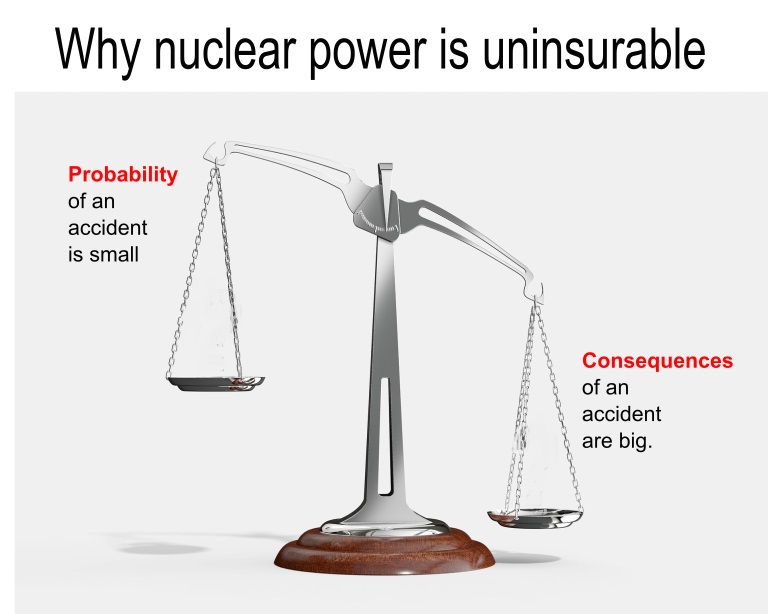
India has barely half the insurance amount required by law for its current nuclear plants, and has many more plants in the works.
Aljazeera, By Urvashi Sarkar 21 Apr 2023
India has barely half the insurance amount it needs in the event of a nuclear disaster, raising concerns among experts about the lack of oversight on the nuclear sector.
The India Nuclear Insurance Pool (INIP) has collected around 7 billion to 8 billion rupees ($84.5m to $96.6m) of the 15 billion rupees ($182.9m) required under the Civil Liability for Nuclear Damage Act, 2010 (CLND), indicating a critical shortfall in funds that will be needed to compensate victims and pay for cleanup in case of a nuclear disaster………………………………………………………..
“The fact that the nuclear insurance pool has not even met what is required by law is concerning — it shows that the Parliament is not overseeing how the nuclear sector is operating,” said MV Ramana, professor at the School of Public Policy and Global Affairs, University of British Columbia and author of The Power of Promise: Examining Nuclear Energy in India. “My greater concern is the approach of NPCIL and other parties involved, which seem to think of liability requirements as a box to check off, rather than something they need to prudently plan for.”
“They seem to be victims of the same ‘safety myth’ that was at the root of the inadequate preparations for nuclear accidents revealed in the aftermath of the multiple reactor accidents at the Fukushima Daiichi nuclear plant in Japan [in March 2011],” Ramana said…………………………………….
India currently has 22 reactors, all of which are operated by the NPCIL. The INIP provides insurance to all of them. Apart from this, it has 10 reactors that are at various stages of construction (one of which has been connected to the grid) and New Delhi has sanctioned another 10 — all of which are expected to start functioning by 2031. But how these plants will be insured is unknown………………………………………………………… more https://www.aljazeera.com/economy/2023/4/21/does-india-have-enough-insurance-coverage-for-a-nuclear-disaster
US military-industrial complex is main beneficiary of fighting Russia in Ukraine – Moscow
21 Apr 23, https://www.rt.com/russia/575116-galuzin-rt-interview-ukraine/
The American arms industry will now have contracts for years to come, Deputy Foreign Minister Mikhail Galuzin has insisted.
US policy on Ukraine is inherently cynical and ignores the interests of the Ukrainian people, Russian Deputy Foreign Minister Mikhail Galuzin claimed in an interview with RT. Washington is the biggest beneficiary from the hostilities, he added.
The US and its NATO allies “consider Ukraine as just raw material for [fulfilling] their aggressive purposes against Russia,” the senior diplomat said in an interview. Washington has declared the “strategic defeat” of Russia in Ukraine as its goal, he noted, with the US and its allies delivering weapons to Kiev on an unprecedented scale.
“The main beneficiary of [arming Ukraine] is the USA. [Its] military industrial complex… is now ensured orders for years to come. They are making profit on the war they conduct in Ukraine against us,” Galuzin said.
The deputy minister also commented on the Chinese peace plan for Ukraine, which Beijing presented earlier this year, affirming it could serve as the basis of a future peace agreement. However, it is up to Kiev to resume negotiations, he said, as it was the party that pulled out in the first place.
“In March 2022, it was Russia that responded positively to a Ukrainian proposal to hold peace talks. And the two sides were close to an agreement. We even formulated a draft treaty with Ukraine,” he said, referring to talks mediated by Türkiye.
Kiev has not responded to a document that Moscow put forward in April based on what Ukraine suggested in Istanbul, Galuzin said.
“The Kiev regime was stopped by its Western mentors,” he claimed, reiterating the view previously expressed by other senior Russian officials. The US “and its satellites” want to weaken Russia and are using Ukraine as a tool to do that, the diplomat stated.
They seem to be ready to continue this fighting to the last Ukrainian, unfortunately,” he remarked.
In the interview with RT, Galuzin also discussed Russian relations with Belarus and Moldova and the escalating religious conflict in Ukraine.
Rep. Gallagher Says War Game Shows US Needs to Arm Taiwan ‘To the Teeth’
The House’s new committee on China conducted a simulation of a Chinese invasion of Taiwan with the think tank CNAS, by Dave DeCamp https://news.antiwar.com/2023/04/20/rep-gallagher-says-war-game-shows-us-needs-to-arm-taiwan-to-the-teeth/
Rep. Mike Gallagher (R-WI) has said that a congressional war game that simulated a Chinese invasion of Taiwan shows that the US must arm Taiwan “to the teeth.”
Gallagher is the head of the House’s new panel on China, which participated in the war game on Wednesday evening, a highly unusual move by members of Congress that demonstrates the US government is preparing for a future war with Beijing.
“We are well within the window of maximum danger for a Chinese Communist Party invasion of Taiwan, and yesterday’s war game stressed the need to take action to deter CCP aggression and arm Taiwan to the teeth before any crisis begins,” Gallagher said in a statement, according to Reuters
The war game was conducted with the Center for a New American Security (CNAS), a hawkish think tank that receives funding from US arms makers and the Taiwanese government through the Taipei Economic and Cultural Representative Office, Taiwan’s de facto embassy.
A source close to the China committee told Reuters that the war game’s conclusions were that a US-China fight over Taiwan would result in high US losses, the depletion of long-range missiles, and would leave global markets in “absolute tatters.”
Gallagher and other China hawks insist increasing support for Taiwan will prevent a Chinese attack. But Beijing has only put Taiwan under more military pressure in response to the growing military and diplomatic ties between Washington and Taipei.
Unmanned Starship explodes over gulf after liftoff
Story by Christian Davenport
SpaceX’s Starship lifted off the pad in Southern Texas and cleared the launchpad, its first milestone, but then began tumbling as it was preparing for stage separation and the vehicle came apart some four minutes i
SpaceX’s Starship lifted off the pad in Southern Texas and cleared the launchpad, its first milestone, but then began tumbling as it was preparing for stage separation and the vehicle came apart some four minutes into flight. “Obviously this does not appear to be a nominal situation,” SpaceX’s John Insprucker said during the broadcast.
SpaceX’s Kate Tice said it was unclear what caused the rocket to come apart. She said that “teams will continue to review the data and work toward our next flight test.”
Still, since it was a test, SpaceX hailed the flight as a success because it would provide the company new information about how the vehicle performs in real life that will help them on future flights. And it did not damage the launchpad, a risk SpaceX CEO Elon Musk had said was his greatest worry.
There were no people on board.
It is not clear when the company might try to fly again. On Twitter, Elon Musk said the company “learned a lot for next test launch in a few months.”
The rocket was about four minutes into flight when it exploded. It is not known yet what caused the explosion or whether SpaceX officials deliberately destroyed the rocket as it tumbled out of control over the Gulf of Mexico.
- The Federal Aviation Administration has assumed control of the investigation as it does with all failed rocket attempts. It said there were no reports of injuries or property damage because of the failure.
- Despite the disappointing ending to the test, congratulations poured into SpaceX for its first successful launch of the integrated Super Heavy Booster and Starship vehicle.
New member Finland leads team in world’s largest, 38-nation NATO cyber warfare exercise — Anti-bellum

NATO Cooperative Cyber Defense Center of ExcellenceApril 21, 2023 World’s largest cyber defense exercise Locked Shields kicks off in Tallinn The NATO Cooperative Cyber Defense Center of Excellence (CCDCOE) annual cyber defence exercise Locked Shields 2023 started in Tallinn. For four days, more than 3,000 participants from 38 nations will…train tactical and strategical decision-making in […]
New member Finland leads team in world’s largest, 38-nation NATO cyber warfare exercise — Anti-bellum
Nuclear Troubles Send French Winter Power Prices Soaring

By Michael Kern – Apr 19, 2023 https://oilprice.com/Latest-Energy-News/World-News/Nuclear-Troubles-Send-French-Winter-Power-Prices-Soaring.html
France’s power prices for early 2024 are double the German prices for next winter as the huge French nuclear fleet continues to show signs of weak output and availability.
The French power price for the first quarter of 2024 was at $455 (416 euros) per megawatt-hour (MWh) on Wednesday. That’s more than double the price for the same period in Germany, where the power price was at $185 (169 euros) per MWh for early 2024, according to data compiled by Bloomberg.
France has had troubles at many of its nuclear reactors, half of which have been shut down for repairs and maintenance at several times over the past year.
Germany, meanwhile, took its last three nuclear power plants offline on Saturday, ending more than six decades of commercial nuclear energy use, Germany ended the nuclear power era despite continued concerns about energy security and energy supply after the Russian invasion of Ukraine and the end of pipeline natural gas deliveries from Russia, which was the largest gas supplier to Europe’s biggest economy before the war.
In France, concerns about the operations at France’s large nuclear power fleet resurfaced last month after the French nuclear safety authority, ASN, told energy giant and large nuclear reactor operator EDF to review its program of reactor checks, following the finding of another crack at a nuclear power plant.
This led to an 8% one-day surge in French power prices for next year, the biggest jump since the end of January.
For much of last year, France’s nuclear power generation was well below capacity, as more than half of the country’s reactors were offline at one point in the autumn due to repairs or maintenance.
At the moment, French nuclear power plants are producing 17.5% less than the average output rate for 2020 and 2021. That’s down from 23% last year, so there is some progress, but concerns remain.
Whaa -at ? Bill in North Carolina legislature would define nuclear as source of CLEAN energy

North Carolina Public Radio | By Rusty Jacobs, April 19, 2023
“…………………………… The bill, which advanced through the Senate Agriculture, Energy and Environment Committee on Wednesday, would change statutory language from “renewable” to “clean” energy, and would add nuclear facilities to that category along with wind and solar.
“I am for the least cost (sic) energy consumers have to buy,” Newton said…………..
Sen. Mike Woodard (D-Durham), a member of the Agriculture, Energy and Environment Committee, expressed reservations about a bill that would change statutory language from “renewable” to “clean” energy and add nuclear facilities to that category along will wind and solar.
…………….The bill now goes to the Senate Rules Committee. https://www.wunc.org/environment/2023-04-19/bill-north-carolina-legislature-nuclear-source-clean-energy
US nuclear taxes — the true costs

Fortunately, there is a rapidly growing movement in our nation called, “Back from the Brink,” supported by 333 elected officials across the country, that supports the elimination of all nuclear weapons while laying out four precautionary steps necessary in the process. Rep. James McGovern (D-Mass.) has demonstrated the courage to support this effort with the recent introduction of H. Res 77.
Ultimately, “Budgets are moral documents,” as theologian Rev. Jim Wallis has noted. What role do nuclear weapons play in that morality?
We find ourselves as a nation grappling with economic, environmental, social and racial justice issues, seemingly oblivious to the fact that the very existence of nuclear weapons — and all that they entail, from mining, production, testing, stockpiling, dismantling and potential for their use — are among the greatest perpetrators of these injustices.
Nuclear weapons threaten us every moment of every day.
BY ROBERT DODGE, – 04/19/23
Every April we fund our nation’s budget and economic priorities on Tax Day. This year finds our nation emerging from the global COVID-19 pandemic and still struggling with years of infrastructure neglect.
This neglect has impacted the health and wellbeing of our communities, resulting in water shortages, contamination, and toxic legacies
…………………………………… We continue to face the growing existential challenges, economic burden, and impact of climate change nationally and globally.
And then there is the ongoing war in Ukraine, which potentially threatens the entire world.
This year the increased risk of nuclear war hangs over us more than at any time since the Cuban missile crisis
The Bulletin of Atomic Scientists moved their Nuclear Doomsday Clock to 90 seconds till midnight earlier this year, the closest to global catastrophe it has ever been.
Russian President Putin’s preparations to place tactical nuclear weapons in neighboring Belarus would lower the threshold of nuclear war, further heightening the risk.
It’s fair to ask, ‘Who determines our priorities and how do we fund them?’
Ultimately, “Budgets are moral documents,” as theologian Rev. Jim Wallis has noted. What role do nuclear weapons play in that morality?
We find ourselves as a nation grappling with economic, environmental, social and racial justice issues, seemingly oblivious to the fact that the very existence of nuclear weapons — and all that they entail, from mining, production, testing, stockpiling, dismantling and potential for their use — are among the greatest perpetrators of these injustices.
Nuclear weapons threaten us every moment of every day.
While most reasonable people recognize that these weapons cannot and must not ever be used, approximately 12,512 weapons remain in the nuclear arsenals of the world. We also know that the use of even a tiny fraction (less than half a percent) of these weapons over a single populated region would cause catastrophic climate change resulting in a global famine putting potentially 2 billion people at risk.
These weapons also threaten us by robbing precious resources that could be redirected to the many needs that our communities cry out for. The Nuclear Weapons Cost Program of the Nobel Prize winning Physicians for Social Responsibility Los Angeles, now in its 34th year, attempts to determine the full cost of nuclear weapons programs to our communities. There have been many excellent calculations of portions of our nuclear weapons costs including the ICAN report on global costs. These reports deal primarily with the cost of warheads, delivery systems and development alone, in an attempt to compare one nation to another.
In our report, we include verifiable costs of all nuclear programs that would not be spent if nuclear weapons did not exist. These include funding of the nuclear missile defense system, environmental cleanup and legacy programs dealing with communities that have been contaminated by the mining, development, testing and stockpiling of these weapons. Also included is nuclear nonproliferation funding and funding to safeguard and sequester nuclear weapons in Russia and former Soviet Union States.
Determining the full cost of U.S. nuclear weapons programs is a tedious process, as the United States is not fully transparent in these figures.
We have chosen to list only figures that we can provide reference to. There are other reports that estimate the forecast to be much higher, including Dr. Timmon Wallis in “Warheads to Windmills: How to Pay for a Green New Deal.” In 2013, with the release of the “Black Budget” by Edward Snowden, it was estimated that there were some $9 billion in “top secret” nuclear operations that were never publicly released. While likely still being funded, it has become impossible to track those expenditures and thus they are not included in our report.
The total costs of all U.S. nuclear weapons programs for the 2022 Tax Year which funds our Fiscal Year 2023 budget is $90.34 Billion.
What does this mean to our communities? In Jackson, Miss., with its 148,761 residents earning a per capita income 62 percent of the national average, their tax dollar contribution to nuclear weapons programs is about $25 million. For Flint, Mich., with its 80,628 residents earning a per capita income of 50 percent of the national average, their nuclear contribution is over $10.8 million. The Navajo Nation — whose 143,435 residents have experienced the health legacy of nuclear weapons, having been victims of significant radiation exposure from nuclear weapons testing and development for decades, and whose per capita income is 40 percent of the national average — will spend over $15.6 million on nuclear weapons programs.
The nation’s poorest county of Buffalo County, S.D., with its 1,923 largely indigenous Crow Creek Sioux Tribe residents, earning on average 32 percent of the national average, will spend about $167,000 dollars as their contribution to nuclear weapons programs. Is this their priority? Does it add in any way to their security, health or wellbeing? In reality, these weapons are among the greatest threats to their security.
In a participatory democracy, is this how they would choose to spend their treasure? Polls show that a 66 percent majority of Americans favor the abolition of nuclear weapons and that 58 percent are also fearful of nuclear war.
…………. Fortunately, there is a rapidly growing movement in our nation called, “Back from the Brink,” supported by 333 elected officials across the country, that supports the elimination of all nuclear weapons while laying out four precautionary steps necessary in the process. Rep. James McGovern (D-Mass.) has demonstrated the courage to support this effort with the recent introduction of H. Res 77.
Will Environmental, social, and governance (ESG) investment managers follow the govt in backing nuclear?

By Chloe Cheung, 19 Apr 23, https://www.ftadviser.com/investments/2023/04/19/will-esg-investment-managers-follow-the-govt-in-backing-nuclear/
Wind turbines and solar panels are commonly associated with low-carbon energy, but nuclear power is also being considered in the pursuit of net zero.
In a move to encourage private sector investment, chancellor Jeremy Hunt said in the spring Budget that the UK green taxonomy will class nuclear power as ‘environmentally sustainable’, subject to consultation.
Although nuclear fuels are not renewable, the classification would enable nuclear power to have the same investment incentives as renewable energy.
But despite being low-carbon, it is not uncommon to come across ESG funds and investment companies that exclude nuclear power generation. So will investment managers follow the UK government’s approach to nuclear power?
William Argent, lead adviser to the VT Gravis Clean Energy Income Fund, says the fund’s responsible investment statement does not currently allow exposure to nuclear power generation assets.
“There may be some very modest exposure to companies involved in the nuclear energy supply chain, providing services; but we do not have exposure to companies that own nuclear energy generation plants themselves,” he adds.
While the UK government wants to class nuclear power as ‘environmentally sustainable’, Argent says his position on nuclear energy has, at this stage, not changed. “We exclude it as a commonly perceived ‘controversial activity’.
“There would need to be a shift in that perception among our investors and more widely. We would not consider changing the stance unless there was a broader acceptance.”
Other funds avoiding companies that generate revenue from nuclear power generation include Quilter Cheviot’s Climate Assets Funds.
“While we recognise that nuclear power does not generate greenhouse gas emissions, and therefore it has a role to play in the net-zero pathway and transition away from fossil fuels, we do not consider it a ‘sustainable investment’,” says Claudia Quiroz, lead fund manager of the Climate Assets Funds, and head of sustainable investment at Quilter Cheviot.
Citing environmental and safety issues that “outweigh” zero emission credentials, she says: “Nuclear energy generates a significant mass of radioactive waste. In addition, however it is disposed of, that radioactive waste will remain for generations to come.
“Safety concerns, both accidental and deliberate, also exist. While the operation of nuclear power plants is undoubtedly safer than previous generations and an accidental disaster on the scale of Chernobyl is unlikely, safety challenges do remain.
“Nuclear power plants are also easy targets for malevolent acts such as terrorist threats, cyberattacks or acts of war.”
Although Quiroz describes the UK government’s intended sustainable classification of nuclear energy as ultimately a positive move, she adds that as sustainable investors, it will not change the fund’s philosophy on investing in nuclear energy.
Online forum: Militarism will cost us the earth, 24 April — GPJA’s Blog
Online Forum: Militarism will cost us the earth On Monday, 24 April 2023, from 1pm to 2pm Links to share: Facebook, https://www.facebook.com/PeaceMovementAotearoa/posts/6089067574473894 Tweet, https://twitter.com/PeaceMovementA/status/1648135785756114944 Has the rapidly escalating climate emergency finally shifted governments’ thinking away from narrow outdated notions of military security based on endless preparations for war towards prioritising spending on human health and […]
Online forum: Militarism will cost us the earth, 24 April — GPJA’s Blog
1 This Month

Read the Public Inquiry Report, the Commissioners’ report, Surrendering Australia: The AUKUS Deception is available to download for free at aukuspublicinquiry.com. Or just watch the replay of the National Press Club Luncheon.



19 November – Webinar – The Reality of Reprocessing
Time: 11:00 AM Pacific Time (US & Canada) / 2:00 PM Eastern / 7:00 PM UK / 8:00 PM CET
Register for the Zoom Event Here



Shut down the radiation-damaged Heysham nuclear reactors now
To see nuclear-related stories in greater depth and intensity – go to https://nuclearinformation.wordpress.com

Say No to NASA’s Reckless Nuclear Reactor on the Moon
Say No to NASA’s Reckless Nuclear Reactor on the Moon
-
Archives
- November 2026 (109)
- October 2026 (302)
- September 2026 (339)
- August 2026 (330)
- July 2026 (355)
- June 2026 (287)
- May 2026 (306)
- April 2026 (356)
- March 2026 (251)
- February 2026 (267)
- January 2026 (308)
- December 2025 (358)
-
Categories
- 1
- 1 NUCLEAR ISSUES
- business and costs
- climate change
- culture and arts
- ENERGY
- environment
- health
- history
- indigenous issues
- Legal
- marketing of nuclear
- media
- opposition to nuclear
- PERSONAL STORIES
- politics
- politics international
- Religion and ethics
- safety
- secrets,lies and civil liberties
- spinbuster
- technology
- Uranium
- wastes
- weapons and war
- Women
- 2 WORLD
- ACTION
- AFRICA
- Atrocities
- AUSTRALIA
- Christina's notes
- Christina's themes
- culture and arts
- Events
- Fuk 2022
- Fuk 2023
- Fukushima 2017
- Fukushima 2018
- fukushima 2019
- Fukushima 2020
- Fukushima 2021
- general
- global warming
- Humour (God we need it)
- Nuclear
- RARE EARTHS
- Reference
- resources – print
- Resources -audiovicual
- Weekly Newsletter
- World
- World Nuclear
- YouTube
-
RSS
Entries RSS
Comments RSS

