Rolls Royce to cut thousands of jobs
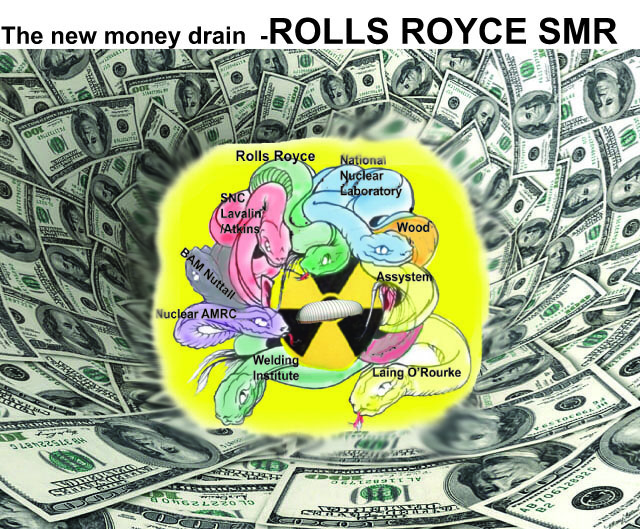
Rolls-Royce is expected to cut thousands of jobs as it launches a dramatic
turnaround plan to save costs. New chief executive Tufan Erginbilgic, who
has described the aero-engineering giant as a “burning platform” that
needs to reform to survive, has parachuted in consultants led by McKinsey
to advise on streamlining the company. Plans to merge departments could cut
10 per cent of the company’s approximately 30,000 non-manufacturing
staff, one consultancy source said. Part of the programme will involve
merging its non-manufacturing departments in each of Rolls’s civil
aerospace, defence and power systems divisions.
Times 27th May 2023
https://www.thetimes.co.uk/article/rolls-royce-prepares-to-swing-the-axe-on-jobs-phlxmxbnk
Slowing ocean current caused by melting Antarctic ice could have drastic climate impact, study says
The Southern Ocean overturning circulation has ebbed 30% since the 90s, CSIRO scientist claims, leading to higher sea levels and changing weather
Donna Lu, Guardian, 26 May 23
A major global deep ocean current has slowed down by approximately 30% since the 1990s as a result of melting Antarctic ice, which could have critical consequences for Earth’s climate patterns and sea levels, new research suggests.
Known as the Southern Ocean overturning circulation, the global circulation system plays a key role in influencing the Earth’s climate, including rainfall and warming patterns. It also determines how much heat and carbon dioxide the oceans store.
Scientists warn that its slowdown could have drastic impacts, including increasing sea levels, altering weather patterns and depriving marine ecosystems of vital nutrients.
“Changes in the overturning circulation are a big deal,” said the study’s co-author, Dr Steve Rintoul, an oceanographer and expert on the Southern Ocean at the Australian government’s Commonwealth Scientific and Industrial Research Organisation (CSIRO)
It’s something that is a concern because it touches on so many aspects of the Earth, including climate, sea level, and marine life.”
The finding comes months after modelling, which Rintoul was involved in, that predicted a 40% slowdown in the circulation by 2050.
“The model projections of rapid change in the deep ocean circulation in response to melting of Antarctic ice might, if anything, have been conservative,” Rintoul said. “We’re seeing changes have already happened in the ocean that were not projected to happen until a few decades from now.”
………………………………………….. The study looked specifically at changes in overturning circulation in the Australian Antarctic basin, but the researchers believe a “circumpolar slowdown” is occurring.
………………………..
“We expect in the longer term that while there will be ups and downs related to sea ice formation, the overall trend is that Antarctica is losing more ice, is melting more, and that will gradually slow down this overturning circulation.
“Unless we act soon we will commit ourselves to changes that we’d really rather avoid,” he said. “We need to act to reduce emissions and we need to do everything we can as fast as we can.”
The study, whose first author is Kathryn Gunn of the CSIRO and the University of Southampton, was published in the journal Nature Climate Change. https://www.theguardian.com/science/2023/may/25/slowing-ocean-current-caused-by-melting-antarctic-ice-could-have-drastic-climate-impact-study-says
Ex-Pentagon Analyst: Biden Faces Shrinking Options on Ukraine
Ekaterina Blinova, https://sputnikglobe.com/20230525/ex-pentagon-analyst-biden-faces-shrinking-options-on-ukraine-1110580213.html
US President Joe Biden is running out of time to score a “victory” in Ukraine, retired Lt. Col. Karen Kwiatkowski told Sputnik’s New Rules podcast.
…………….. Earlier this month, Ukrainian President Volodymyr Zelensky embarked on a diplomatic charm offensive in Europe, drumming up support for the much-discussed Kiev’s “counteroffensive“.
However, the former Pentagon analyst and US Air Force veteran told Sputnik that the Ukrainian armed forces were unlikely to achieve meaningful success, despite an influx of new Western weaponry.
“They have been put on the offense and yet they have been cleaned out militarily,” Kwiatkowski said. “And the aid that they’re getting from NATO isn’t interoperable. It isn’t compatible with what the Ukrainians are used to using. In many cases, it doesn’t work together. So they can’t put together a combined arms operation. They don’t really have an air force. They are really at a disadvantage.”
Many of the military plans announced by the Kiev leadership do not hold water, according to the military expert. For instance, earlier this year Zelensky pledged to seize Crimea, which reunited with Russia in response to the US-backed 2014 February coup d’etat in Kiev.
“Of course, Zelensky says, ‘We’re going to take Crimea’. With what? His armies are largely decimated and exhausted. They’re recruiting teenage boys and 65 year old men. This is not a good sign,” Kwiatkowski said.
She raised the question whether what is left of Ukraine is going to be governable: “Is there enough their territory, culture, people, industry? Is there enough there to constitute a continuing country? That conversation needs to happen. I imagine that Ukrainians are having this conversation.”
Fukushima reactor 1 found to have damaged pedestal supporting nuclear core

(Picture above is of the same structure one year previously)
A nuclear watchdog has asked the operator of Japan’s wrecked Fukushima
nuclear power station to assess potential risks from damage found in a key
supporting structure inside the worst-hit of the three melted reactors. A
robotic probe inside the Fukushima Daiichi nuclear power plant’s Unit 1
primary containment chamber found its pedestal — a main supporting
structure right underneath the core — was largely damaged. The thick
concrete exterior was missing almost all the way around, exposing the
internal steel reinforcement. About 800 tonnes of highly radioactive melted
nuclear fuel remain inside the plant’s three reactors.
LBC 25th May 2023
https://www.lbc.co.uk/world-news/8af57263389e457aa47b8846ede3d7b0/
Nuke Power’s “Renaissance 4.0” Has Already Melted
BY HARVEY WASSERMAN, CounterPunch 24 May 23
Nuclear Renaissance (version 4.0)” is the centralized corporate power industry’s final grab at mega-sums of public money and total control of energy.
Facing a definitive tsunami of cheaper, cleaner, safer, faster-to-deploy renewables, it’s meant primarily to serve the nuclear weapons complex while insulating entrenched centralized power against distributed green social democracy.
The “Renaissance’s” prime medieval reality is the escalated likelihood of another Three Mile Island-Chernobyl-Fukushima disaster at one of America’s lingering 94 reactors.
Most US nukes were designed in the pre-digital 1960s and ‘70s. They are dangerously decayed, with an average age of around 40. They are structurally dubious, seriously under-maintained and inherently unsafe.
None have significant private accident insurance. But a major meltdown/explosion could threaten millions of lives and inflict apocalyptic health, ecological and economic harm.
The Renaissance’s key illusion is that atomic reactors are some kind of magical unicorns, generating limitless cheap clean power while never aging, breaking down, emitting heat, carbon or radiation…and certainly never ever blowing up.
In fact our existing reactors are so hideously complex it’s impossible to meaningfully calculate the odds on which one will explode next …and when. Major disasters at six reactors—Three Mile Island, Chernobyl and the four at Fukushima—have been accompanied by a bevvy of smaller disasters whose impacts have nonetheless been substantial.
After sixty years of operations, the Peaceful Atom still can’t get meaningful private disaster insurance. Nor has it solved its forever problem of safely managing its uniquely dangerous wastes.
Given the realities of a radioactive cloud blowing into Los Angeles, Chicago or Atlanta, or permanently contaminating a few thousand square miles of prime farm and forestland, there are no odds that can counter-balance any possible benefit from the risks being taken to extend the licenses of our current reactor fleet, or to undertake building a new generation whose safety again can’t be guaranteed, and whose costs, deployment times and real risks remain serious unknowns.
Especially when all this comes in the shadow of an astonishingly successful revolution in renewable generation, battery storage and increased efficiency. l
But first let’s follow the money.
Financial disaster has defined the last eight big Euro-American reactor projects. Single nukes in Finland and France, and double projects in England, South Carolina and Georgia, have all gone unimaginably over budget……………………………………………………………..
Thus the French nuclear poster child buys electricity from Germany, with zero reactors.
Likewise, 90+ US nukes can’t compete with wind or solar, can’t manage their wastes, can’t guarantee they won’t below up, can’t get comprehensive accident insurance. Most or all are riddled with serious structural flaws which are rapidly worsening with age…led by embrittlement, a fatal metals flaw likely to let reactors shatter and explode during the inevitable coming melt-down.
But buried amidst the massive “Rennaisance” arer some terrifying medieval realities. Among them are the dozen earthquake faults that surround California’s Diablo Canyon, whose two ancient reactors are riddled with dangerous and structural maintenance failures. Critical oncrete is crumbling at Ohio’s Davis-Besse and Seabrook, NH. Vital intake pumps at South Texas recently froze. Indeed, virtally every one of the world’s 400+ operating reactors suffers individualized problems that seriously threaten another Three Mile Island, Chernobyl or Fukushima…whose four exploded reactors—like about half those worldwide—were designed by General Electric…………………………….
As for the future, any “Renaissance” involving the old-style first-generation big light water reactors starts with zero currently under construction, and no prospect of any new ones even remotely competing with renewables…or opening for an undetermined but very substantial amount of time.
All this comes as wind, solar, batteries, efficiency, micro-grids and other Solartopian assets plummet in price while soaring in reliability and job creation. As nukes careen into a fiscal pit, green energy exceeds all previous expectations, and is pricing out even fully amortized old nukes.
The “Renaissance” multiplies our peril by keeping old nukes operating ever-deeper into the danger zone, making the unthinkable virtually inevitable. The scale of any potential reactor disaster today dwarfs whatever “long odds” the industry might claim against it happening………………………………….
And then there’s the next Apocalyptic explosion.
Despite their sixty-year history, atomic power still can’t get liability insurance. Instead the taxpayers must absorb liability for a reactor apocalypse. No matter the odds, the consequences of such a disaster—human, ecological, financial—can never be compensated…………………..
In addition to fissile bomb materials and trained staff for nuclear weapons, commercial reactors impose a multi-national death grip against democracy. The corporate world’s greatest fear is a green public with local-owned renewables and micro-grids, can open the door to energy democracy.
Thus Ohio’s House Speaker, Larry Householder, took $61 million in utility bribes to help scam through billion in bailouts for two collapsing nukes. Household awaits sentencing.
But the Renaissance attack on renewables is well known. The Legislature in 2016 slipped a single clause into the Ohio Code that’s killed more than $4 billion in private financing. The anti-green attack has cost Ohioans billions in income and millions of safe jobs.
…………………………………………. The industry’s other Inconvenient Truth is that its much-hyped Small Modular Rectors don’t really exist now….and can never compete.
A pre-cursor to the smaller designs has already exploded at Santa Susana, north of Los Angeles, with catastrophic impacts. Provable new prototypes are allegedly on their way. Massive quantities of public money are being spewed at private hype-stars like Bill Gates.
………………………
t as illustrated in the works of Amory Lovins (The Road Not Taken), Mark Jacobson (No Miracles Necessary) and many many others, there is zero doubt that renewables, efficiency and storage can move our economy to carbon-free, saving billions of dollars and creating millions of jobs.
The question is when.
As of now, this latest “Nuclear Renaissance” is a diversion, a roadblock…and a serious danger. Oliver Stone’s super-hyped promo piece “Nuclear Now” might be far more appropriately titled “Apocalypse Again.”
Harvey Wasserman wrote THE PEOPLE’S SPIRAL OF US HISTORY: FROM JIGONSASEH TO SOLARTOPIA. Most Mondays @ 2-4pm PT, he co-convenes the Green Grassroots Election Protection Zoom (www.electionprotection2024). The Mothers for Peace (www.mothersforpeace.org) could use your help in the struggle to shut the Diablo Canyon nukes. https://www.counterpunch.org/2023/05/24/nuke-powers-renaissance-4-0-has-already-melted/
Japan Nuclear Watchdog Asks Fukushima Plant Operator to Assess Reactor Risk
Photo May 22– damaged pedestal supporting reactor core, Unit 1
By Mari Yamaguchi | May 26, 2023
TOKYO (AP) – A nuclear watchdog has asked the operator of Japan’s wrecked Fukushima nuclear power plant to assess possible risks resulting from damage that was found in a key supporting structure inside one of the three melted reactors.
A robotic probe sent inside the Fukushima Daiichi plant’s Unit 1 primary containment chamber found that its pedestal – the main supporting structure directly under its core – was extensively damaged. Most of its thick concrete exterior was missing, exposing the internal steel reinforcement.
About 880 tons of highly radioactive melted nuclear fuel remain inside the plant’s three damaged reactors. Robotic probes have provided some information, but the status of the melted debris is still largely unknown.
Based on data collected from earlier probes and simulations, experts have said most of the melted fuel inside Unit 1, believed to be the worst hit, fell to the bottom of the primary containment chamber, but some might have fallen through to the concrete foundation – a situation that makes the already daunting task of decommissioning extremely difficult.
At a meeting Wednesday of the Nuclear Regulation Authority, its commissioners agreed to order operator Tokyo Electric Power Company Holdings to urgently assess the risks from the pedestal damage, including the possible leak of radioactive substances from cracks and holes caused by the meltdown. The authority also requested that TEPCO assess potential risks if, in the event of another disaster, the pedestal fails to support the reactor.
”We need to think about responses in case of an accident,” commissioner Shinsuke Yamanaka told reporters. “TEPCO has a responsibility to make the risk assessment as soon as possible.”…………………………………………………….
The damage is believed to be from the initial earthquake in 2011, but might have happened more recently. The images of the exposed steel reinforcement have triggered concerns among local residents about the reactor’s safety.
A plan to release treated, but still slightly radioactive, water from the Fukushima Daiichi plant into the sea has also triggered concerns and protests from the local fishing community and neighboring countries, including South Korea.
A South Korean delegation of government experts visited the plant for two days this week to see the facilities related to the planned water release. The team members were to meet with Japanese officials on Thursday in Tokyo, where they said they plan to follow the review of the International Atomic Energy Agency, which has been assisting Japan to improve transparency and credibility…………………. https://www.claimsjournal.com/news/international/2023/05/26/317199.htm—
Everything’s Getting Way More Dangerous And Way More Stupid

CAITLIN JOHNSTONE, MAY 27, 2023
Moon of Alabama has an article out on how an uncomfortable number of relatively restraint-oriented foreign policy officials have been exiting the Biden administration, while a China hawk has just been appointed the next chairman of the Joint Chiefs of Staff.
Antiwar has an article out about how New York congressman Jerry Nadler told an Epoch Times reporter that he “wouldn’t care” if Ukraine used US-made F-16s to strike Russian territory, and doesn’t find the possibility that they might do so concerning.
This comes days after we learned that the Biden administration has signed off on Ukraine getting F-16s while also greenlighting an offensive on Crimea using US-made weapons, a nightmare scenario which greatly escalates the risks of nuclear war.
There are no adults behind the wheel of the vehicle that’s driving us toward World War Three. We’re on a bus that’s being driven straight toward a cliff, and it’s being driven by infants. If we survive this it will not be because of the experienced leadership of western governments, but completely in spite of it.
It’s getting more and more dangerous, and it’s getting more and more stupid. The other day the Ukrainian government tweeted a video in which the faces of characters from the Harry Potter film series are superimposed over Ukrainian soldiers, a perfect compliment to an earlier tweet by NATO about the Ukrainian military saying “We are Harry Potter and William Wallace, the Na’vi and Han Solo. We’re escaping from Shawshank and blowing up the Death Star. We are fighting with the Harkonnens and challenging Thanos.” This truly is the phoniest, most PR-intensive proxy war of all time.
And that’s nothing compared to how stupid the 2024 US presidential race is getting, already in May of 2023. In a recent interview on Fox News, Republican presidential hopeful Ron DeSantis was asked by Trey Gowdy how he would respond to the war in Ukraine on day one of his presidency and he started babbling about wokeness and gender ideology………………………….. more https://caitlinjohnstone.substack.com/p/everythings-getting-way-more-dangerous?utm_source=post-email-title&publication_id=82124&post_id=124081677&isFreemail=true&utm_medium=email
Clean energy transition sparks nuclear reaction

Along with its many known problems, as an inflexible, costly baseload power source, nuclear is becoming as outdated as fossil fuels.
By David Suzuki with contributions from Senior Editor and Writer Ian Hanington, https://davidsuzuki.org/story/clean-energy-transition-sparks-nuclear-reaction/ 26 May 23
As the impacts of climate disruption become more frequent and intense, we need a range of solutions. One that’s getting a lot of attention is nuclear power.
Industry is pushing hard for it, especially “small modular reactors,” and the federal government has offered support and tax incentives. After 30 years without building any new reactors, Ontario is also jumping onto the nuclear bandwagon again. How should we react?
Along with its many known problems, as an inflexible, costly baseload power source, nuclear is becoming as outdated as fossil fuels. Small modular reactors will create even more waste and cost more — and slow the necessary transition to renewable energy.
Many disadvantages of nuclear are well known. It can contribute to weapons proliferation. Radioactive waste remains highly toxic for a long time and must be carefully and permanently stored or disposed of. And while serious accidents are rare, they can be devastating and difficult to deal with, as the Chernobyl and Fukushima disasters demonstrated.
Along with its many known problems, as an inflexible, costly baseload power source, nuclear is becoming as outdated as fossil fuels.
Uranium to fuel nuclear also raises problems, including high rates of lung cancer in miners and emissions from mining, transport and refining. Add that to the water vapour and heat it releases, and nuclear power produces “on average 23 times the emissions per unit electricity generated” as onshore wind, according to Stanford University professor Mark Jacobson.
But the biggest issues are that nuclear power is expensive — at least five times more than wind and solar — and takes a long time to plan and build. Small modular reactors are likely to be even more expensive, especially considering they’ll produce far less electricity than larger plants. And because the various models are still at the prototype stage, they won’t be available soon.
Because we’ve stalled for so long in getting off coal, oil and gas for electricity generation, we need solutions that can be scaled up quickly and affordably.
The last nuclear plant built in Ontario, Darlington, ended up costing $14.4 billion, almost four times the initial estimate. It took from 1981 to 1993 to construct (and years before that to plan) and is now being refurbished at an estimated cost of close to $13 billion. In 1998, Ontario Hydro faced the equivalent of bankruptcy, in part because of Darlington.
Ontario’s experience isn’t unique. A Boston University study of more than 400 large-scale electricity projects around the world over the past 80 years found “on average, nuclear plants cost more than double their original budgets and took 64 per cent longer to build than projected,” the Toronto Star reports. “Wind and solar, by contrast, had average cost overruns of 7.7 per cent and 1.3 per cent, respectively.”
China has been building more nuclear power plants than any other country — 50 over the past 20 years. But in half that time, it has added 13 times more wind and solar capacity.
As renewable energy, energy efficiency and storage technologies continue to rapidly improve and come down in price, costs for nuclear are rising. As we recently noted, the Intergovernmental Panel on Climate Change’s Sixth Assessment report shows that nuclear power delivers only 10 per cent of the results of wind and solar at far higher costs. In the time it takes to plan and build nuclear, including SMRs, and for much less money, we could be putting far more wind, solar and geothermal online, and developing and increasing storage capacity, grid flexibility and energy efficiency.
The amount it will cost to build out sufficient nuclear power — some of which must come in the form of taxpayer subsidies — could be better put to more quickly improving energy efficiency and developing renewable energy such as wind, solar and geothermal.
Putting money and resources into nuclear appears to be an attempt to stall renewable electricity uptake and grid modernization. Small modular reactors are likely to cost even more than large plants for the electricity they generate. And, because more will be required, they pose increased safety issues.
David Suzuki Foundation research shows how Canada could get 100 per cent reliable, affordable, emissions-free electricity by 2035 — without resorting to expensive and potentially dangerous (and, in the case of SMRs, untested) technologies like nuclear.
New nuclear is a costly, time-consuming hurdle on the path to reliable, flexible, available, cost-effective renewable energy. The future is in renewables.
Russia to move newest nuclear sub to Pacific in August
Aljazeera, 24 May 23
The Generalissimo Suvorov, which entered service at the end of 2022, is part of the new Borei class of stealthier, more nimble undersea vessels.
Russia plans to move its newest nuclear submarine to a permanent base in the Kamchatka Peninsula in August, according to Russia’s state-run TASS news agency, as Moscow steps up its military presence in the Pacific.
The Generalissimo Suvorov, which entered service at the end of 2022, carries up to 16 nuclear-tipped Russian Bulava intercontinental ballistic missiles, each of which can carry more than one nuclear warhead. https://www.aljazeera.com/news/2023/5/24/russia-to-move-newest-nuclear-sub-to-pacific-in-august—
Russia moves ahead with deployment of tactical nuclear weapons in Belarus
ABC 26 May 23
Russia has moved ahead with a plan to deploy tactical nuclear weapons in Belarus, whose leader said the warheads were already on the move, in the Kremlin’s first deployment of such bombs outside Russia since the 1991 fall of the Soviet Union.
Key points:
- The plan for the nuclear deployment was announced by Mr Putin in March
- The US has warned that use of chemical, biological or nuclear weapons in the conflict would be met with “severe consequences”
- The US believes Russia has around 2,000 tactical nuclear warheads
The US State Department denounced the deployment plan but said Washington had no intention of altering its position on strategic nuclear weapons and had not seen any signs Russia was preparing to use a nuclear weapon.
Russian President Vladimir Putin says the United States and its allies are fighting an expanding proxy war against Russia after the Kremlin chief sent troops into Ukraine 15 months ago.
The plan for the nuclear deployment was announced by Mr Putin in an interview with state television on March 25.
“The collective West is essentially waging an undeclared war against our countries,” Mr Putin’s defence minister, Sergei Shoigu, said at a meeting with his Belarusian counterpart in Minsk, according to Russia’s Defence Ministry……………………………………………………………….
Russia’s tactical nuclear weapons superiority
Tactical nuclear weapons are used for tactical gains on the battlefield, and are usually smaller in yield than the strategic nuclear weapons designed to destroy US or Russian cities.
Russia has a huge numerical superiority over the United States and the NATO military alliance when it comes to tactical nuclear weapons: the United States believes Russia has around 2,000 such working tactical warheads.
The United States has around 200 tactical nuclear weapons, half of which are at bases in Europe…………………………………….
The Treaty on the Non-Proliferation of Nuclear Weapons, signed by the Soviet Union, says that no nuclear power can transfer nuclear weapons or technology to a non-nuclear power, but it does allow for the weapons to be deployed outside its borders but under its control. https://www.abc.net.au/news/2023-05-26/russia-moves-ahead-with-deployment-of-tactical-nuclear-weapons/102395632
A Nuclear Collision Course in South Asia
The Budding Arms Race Among China, India, and Pakistan
Foreign Affairs, By Andrew F. Krepinevich, Jr., May 26, 2023
………………………………………………………………………………………………… THE RACE IS ON
China and Pakistan have a long and close relationship, in part built around their mutual view of India as a rival. India finds itself sandwiched between these two often hostile powers. Yet despite a history of wars and persistent low-grade conflict between India and its two rivals, a general war has been averted since India and Pakistan became nuclear powers a quarter century ago. Moreover, the three countries have not found themselves caught up in a nuclear arms race. Until recently, they viewed their nuclear weapons primarily as political instruments, not as tools for actual warfighting. All three adopted a “minimum deterrent” nuclear posture, maintaining the lowest number of nuclear weapons necessary to inflict unacceptable damage to their adversaries’ key cities even after suffering a nuclear attack.
In keeping with this strategy, the three Asian rivals avoided maintaining a significant portion of their arsenals on high alert. Instead, they stored their weapons in caves, in deep underground facilities, or in other concealed locations. Rejecting American and Russian notions that “retaliation delayed is retaliation denied,” the three countries, especially China and India, forswore the need for a swift response to a nuclear attack. To be sure, they would respond eventually—in days, weeks, or even months—but they did not accept the imperative of immediacy. As a result, these countries have avoided making heavy investments in early warning systems while retaining centralized control over their arsenals.
But the prospects for sustaining this era of minimum deterrence appear increasingly shaky. The tripolar rivalry has not been locked in amber: Tellis describes strongly held beliefs among top security officials in China, India, and Pakistan that their nuclear postures are inadequate. Led by China and Pakistan, with India following in their wake, the three rivals are now on a course that will result in a dramatic expansion of their nuclear arsenals, even if Russia and the United States pursue substantial cuts to theirs…………………………………………………………………………………………………………………. more https://www.foreignaffairs.com/china/nuclear-collision-course-south-asia
TODAY. It’s the CLIMATE, stupid!
The Southern Overturning Circulation is slowing down, because of the rapidly melting ice around Antarctica. What does this mean?
It means a speed-up of climate effects (double the speed of the effects of slowing down of the better-known Atlantic Meridional Overturning Circulation (AMOC) from the Arctic ). Rapid sea-level rise, changed rain patterns in tropical areas, drastic loss of nutrients essential for marine life – effects will occur within the next few decades.
Why is this not the top news story around the world? The whole process might not now be stopped – but what is so important is that it could be slowed, if homo-not-very-sapiens stopped pouring carbon into the atmosphere.
Why are we swallowing the propaganda about STEM education – with its focus on Technology and Engineering? That focus should be on Temperature and Ecology – not on how to do big industrial stuff, but on how to maintain our planet home, – and whether or not we should be doing big industrial stuff, (including costly, wasteful narcissistic adventuring to Mars.)
I have been focussing on the nuclear industry, But in reality, nuclear is irrelevant to our big threat – Global Heating. [except of course – in the case of nuclear war]
The one important relevance is in regard to Truth and Lies. The propaganda now prevailing from the nuclear lobby is the biggest example of lying. If the world can be persuaded to believe that nuclear spin-rubbish – then any lie can prevail. And that includes the omissions, half-truths, and lies that tell us that climate change doesn’t matter
Stella Assange at Sydney rally: “It’s not just Julian who has lost his freedom, but all of us”
The whistleblower noted the comments of Australian Labor Party Prime Minister Anthony Albanese, who has made extremely tepid statements expressing “concern” over Assange’s plight. Albanese has said that “enough is enough” in relation to the Assange case. He claims to have made private representations to the US and British governments on behalf of Assange, but has stopped far short of any public demand for the Australian journalist’s freedom.
Albanese has recently hinted at the prospect of a plea deal in the Assange case. Kenny forcefully rejected this course. “Is there a Hicks solution? Why should there be? He has not committed any crime. He should not be forced to plead to anything. We need our prime minister to stand up, not just say ‘enough is enough.’”
Oscar Grenfell@Oscar_Grenfell, 24 May 2023
Some 800 people attended a protest in Sydney yesterday morning demanding the immediate freedom of imprisoned WikiLeaks publisher Julian Assange. People came from across New South Wales and from around the country to attend the rally, which was one of the largest demanding Assange’s freedom yet, despite being held on a weekday.
Speaking at the demonstration, Stella Assange, Julian’s wife, declared that the protesters were “at the forefront of a global movement for justice. A global movement that converges on one man, but the meaning of which goes far beyond Julian’s freedom. It’s not just Julian who has lost his freedom, but all of us. Because in order to keep Julian in prison, they have had to corrupt their own rules and their own principles.”
Stella, visiting Australia for the first time, noted that her tour had initially been planned to coincide with a scheduled visit of US President Joe Biden. He had been set down to attend a summit of the warmongering and anti-China Quadrilateral Strategic Dialogue this week in Sydney.
Biden cancelled, however Stella proceeded with the visit. She explained the crucial importance of the fight within Australia to securing her husband’s freedom. Assange is detained in Britain and faces extradition to the US, where he would be tried on Espionage Act charges carrying 175 years imprisonment for exposing American war crimes.
Assange is an Australian citizen. Stella explained: “Julian’s case is a case of global importance. But you guys are at the centre of it because Julian is an Australian, he’s a country boy, and he’s from this country. That means that the key to securing Julian’s release lies with you.”
Assange’s supporters in Australia were part of a “global movement” involving millions of people all over the world, she said. There is a growing recognition, internationally, that “he’s in prison because he exposed the crimes of others. No decent human being will ever tolerate that. The only people whose interest remains Julian’s imprisonment, are the ones who are guilty and implicated in those crimes.”
Within Australia, there had been a “sea change.” Only a few years ago, there had been “radio silence” on Assange’s case. But increasingly it was being discussed in the media, as well as by official politicians. This, Stella stressed, was a consequence of the demands made by ordinary people and a protracted grassroots campaign.
This fight had to be deepened, she said. “You guys need to shout louder, fight harder, put the pressure on each of your representatives, make Julian’s situation visible everywhere, every day, on your cars, on your shirts. Every day you tell all your friends, you talk about it with your family… Make sure Julian remains top priority until he steps out of that prison. I think we’re near, we can achieve this together.”
Stella noted that it was her first time in Australia, but it would not be her last. “I will come back here, home with Julian, and our kids who are Australian citizens will come home too.”
John Shipton, Assange’s father, placed the persecution of Assange within a broader context. Brown University, in the United States, had recently published a report showing that there had been 4.5 million deaths in the Middle East following the 2003 invasion of Iraq. An earlier document, from the same institution, estimated that the predatory US-led wars in the region had displaced 38 million people.
Speaking of those US interventions Shipton condemned a “hegemon standing in a river of blood.” He emphasised the striving of ordinary people for “justice” and “humanity,” which would ultimately be victorious. Assange’s case and the fight for his freedom were integral to this broader struggle.
Gabriel Shipton, Assange’s brother, said: “If anything is to be taken from Julian’s persecution, it is that it has mobilised people all around the world… The fight gives meaning to Julian’s work. It has brought us all together here to fight for something that is so important to our Western democracies and that’s a free press. How can we make decisions about what our governments do in our name if we don’t know? It’s not possible.”
David McBride addressed the protest. A former Australian army lawyer, he faces life behind bars for blowing the whistle on Australian war crimes in Afghanistan. They included verified murders of civilians and prisoners and other violations of international law. For these offenses, McBride, the man who exposed them, is the first to face court proceedings.
“There’s a good chance that even though I reported murders and cover-ups, that I’m going to go to jail for the rest of my life… It’s not something I hang my head about. It’s something I’m proud of… We need to stand up, the future of the planet depends on it.”
The whistleblower noted the comments of Australian Labor Party Prime Minister Anthony Albanese, who has made extremely tepid statements expressing “concern” over Assange’s plight. Albanese has said that “enough is enough” in relation to the Assange case. He claims to have made private representations to the US and British governments on behalf of Assange, but has stopped far short of any public demand for the Australian journalist’s freedom.
McBride responded: “I say this to Anthony Albanese. Enough of you saying ‘enough is enough.’ It means nothing. Imagine if I had witnessed war crimes in Afghanistan, witnessed murder and cover-up… and all I said to them is ‘enough is enough.’ It’s not enough.” McBride called for Albanese to “step up to the plate” and secure Assange’s unconditional freedom.
Stephen Kenny, Assange’s Australian lawyer, issued the same demand. Kenny represented Australian citizen David Hicks, who was rendered to the American military prison in Guantánamo Bay as part of the “war on terror.” Hicks was eventually freed and returned to Australia, as the result of a powerful campaign led by his father Terry Hicks. David Hicks had been compelled to sign a plea deal, despite having committed no crime.
Kenny noted the parallels. “Like David Hicks, Julian Assange has not committed any crime at all. So why is he in jail?” The editors of other major publications, who were involved in WikiLeaks’ 2010 and 2011 releases, for which Assange is being prosecuted, remain at liberty. This, Kenny explained, made clear that the case against Assange was political and required a political solution.
He outlined some of the abuses of the British judiciary. This included placing Assange in a glass box at the back of his courtroom during the first extradition proceedings, denying him the right to participate in his own case. Assange’s lawyers, moreover, had filed their latest appeal in November. The British judges merely need to determine whether he has an arguable case, a process which Kenny said should take several days or at most a week. But six months on and this task has not been completed.
Albanese has recently hinted at the prospect of a plea deal in the Assange case. Kenny forcefully rejected this course. “Is there a Hicks solution? Why should there be? He has not committed any crime. He should not be forced to plead to anything. We need our prime minister to stand up, not just say ‘enough is enough.’”
The rally raised several political issues. Many of the speakers, importantly, emphasised the decisive role of mobilising ordinary people in the fight to free Assange.
Inevitably, the statements of Albanese and other Labor representatives have generated some hope within the Assange camp. But there is no indication, whatsoever, that Albanese is fighting for Assange’s freedom, behind closed doors or anywhere else. This week he refused to even meet with Stella Assange. Albanese was part of the Gillard Labor government, which in 2010 and 2011, played a central role in the initial stages of the persecution of Assange…….. https://www.wsws.org/en/articles/2023/05/25/rgzp-m25.html?fbclid=IwAR1yfKnxx-_FuaTf0qdcSzFjaiYawdDU8YzVOUBFX5GT0RrBI6gj61xvWCE
Canadian reactors that “recycle” plutonium would create more problems than they solve

Bulletin, By Jungmin Kang, M.V. Ramana | May 25, 2023
In 2021, nine US nonproliferation experts sent an open letter to Canada’s Prime Minister Justin Trudeau. In their letter, the experts expressed their concern that the Canadian government was actually increasing the risk of nuclear weapons proliferation by funding reactors that are fueled with plutonium. Earlier that year, the Federal Government had provided 50.5 million Canadian dollars to Moltex Energy, a company exploring a nuclear reactor design fueled with plutonium. The linkage to nuclear weapons proliferation has also led several civil society groups to urge the Canadian government to ban plutonium reprocessing.
Much of the concern so far has been on Canada setting a poor example by sending a “dangerous signal to other countries that it is OK to for them to extract plutonium for commercial use.” But Moltex plans to export its reactors to other countries raise a different concern. Even if a country importing such a reactor does not start a commercial program to extract plutonium, it would still have a relatively easy access to plutonium in the fuel that the reactor relies on to operate. Below we provide a rough estimate of the quantities of plutonium involved—and their potential impact on nuclear weapons proliferation—to help explain the magnitude of the problem. But there is more. By separating multiple radionuclides from the solid spent fuel and channeling it into waste streams, Moltex reactors will only make the nuclear waste problem worse.
Moltex’s technological claims. Moltex established its Canadian headquarters in the province of New Brunswick after it received an infusion of 5 million Canadian dollars from the provincial government. The company offers two products: a molten salt reactor and a proprietary chemical process that Moltex terms “waste to stable salts” technology. Moltex claims that, by using its chemical process, it can “convert” spent fuel from Canada’s deuterium uranium nuclear reactors (CANDUs) into new fuel that can be used in its reactor design. Moltex essentially claims it can “reduce waste.” In light of the problematic history associated with molten salt reactors, Moltex’s proposed reactors, and especially the chemical process needed to produce fuel, deserve more scrutiny. These will have serious implications for nuclear policy.
In its response to the open letter from the US nonproliferation experts, Moltex dismissed the ability of outsiders to comment, arguing that experts “are not aware of [its proprietary] process as only high-level details are made public.” Moltex has been indeed sparse in what it shared publicly about its technologies. Still, there is much one can surmise from earlier experiences with the processing of spent fuel and from basic science. With some simple calculations based on these high-level details provided by Moltex so far—and taking those at face value, i.e., without evaluating the feasibility of the design or their plans—we show that there is reason to be concerned about the amounts of plutonium that will be used in the reactor.
[Technical explanation here about chemical processes]…………………………………………………………………………….
Moltex’s proposed technology has not yet been evaluated by the International Atomic Energy Agency for how well it can be safeguarded; nor is it possible to evaluate how well the technology can be safeguarded in advance of a final design. But there is good reason to think that a determined country—one that might not play by the rules set by the IAEA—might find a way to divert some plutonium from Moltex’s chemical process to use it in nuclear weapons.
Diversion has been a long-standing concern with pyroprocessing, which is closely related to what Moltex is proposing. …………………………………………………………more https://thebulletin.org/2023/05/canadian-reactors-that-recycle-plutonium-would-create-more-problems-than-they-solve/
Nuclear Turns Fashionable
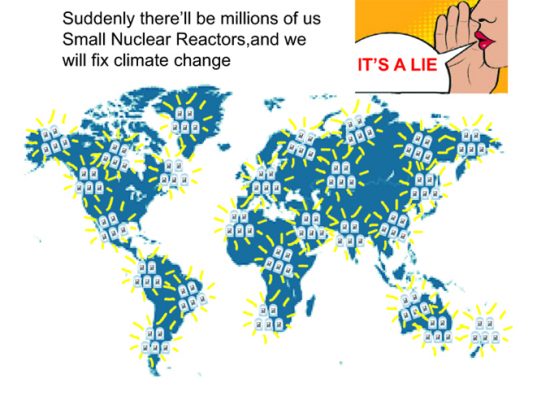
Should nuclear power really circumnavigate the planet with mini-power plants?
BY ROBERT HUNZIKER, CounterPunch 26 May 23
Small Modular Reactors (SMR) are the new nuclear craze, especially with the U.S. Congress, as America’s representatives see SMRs as a big answer to energy needs and reduction of greenhouse gases, advertised as a green deal for clean energy that skirts the heavy costs of paying the Middle East billions upon billions. However, the devil in the details is dangerously overlooked.
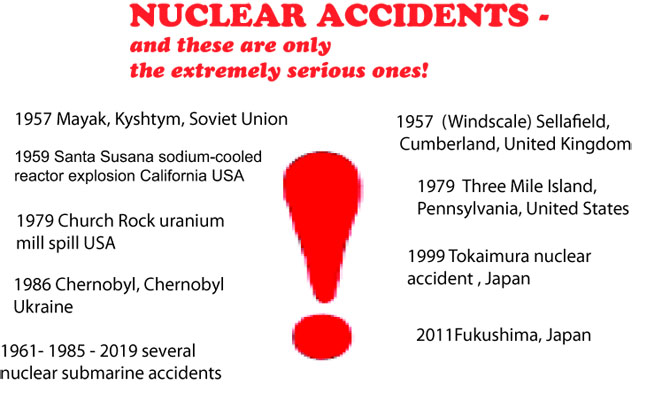
Notable nuclear accidents: NRX (1952) Kyshtym (1957) Windscale (1957) SL-1 (1961) Wood River Junction (1964) K-27 (1968) Three Mile Island (1979) Constituyentes (1983) Mohammedia (1984) K-431 (1985) Chernobyl (1986) Tokai (1997, 1999) Fukushima (2011) … but wait, hundreds, possibly thousands, of Small Modular Reactors (nuclear SMRs) are about to pop up around the world. What could possibly go wrong?
“Multiple and unexpected failures are built into society’s complex and tightly coupled nuclear reactor systems. Such accidents are unavoidable and cannot be designed around.” (Charles Perrow, Normal Accidents (Princeton University Press, 1999)
“On dozens of occasions because of human error or technical miscue or active threat, the world has come dangerously close to the brink of nuclear conflagration… it is a terrifying history of which most people remain ignorant.” (Julian Cribb, How to Fix a Broken Planet, Cambridge University Press, 2023.)
Should nuclear power really circumnavigate the planet with mini-power plants?
For Germany, which closed its last three nuclear plants in April 2023, the country’s Federal Office for the Safety of Nuclear Waste Management conducted a study: “SMRs have been the subject of repeated discussion in recent times. They promise cheap energy, safety, and little waste. BASE commissioned an expert report (in German) to evaluate these concepts and the risks associated with them. The report provides a scientific assessment of possible areas of application and the associated safety issues. It concludes that the construction of SMRs is only economically viable for a very large number of units and poses significant risks if widely deployed.”
Yet, “resistance to nuclear power is starting to ebb around the world with support from a surprising group: environmentalists… This change of heart spans the globe, and is being prompted by climate change, unreliable electrical grids and fears about national security in the wake of Russia’s invasion of Ukraine.” (Source: Why Even Environmentalists are Supporting Nuclear Power Today, NPR, August 30, 2022
U.S. senators recently introduced a nuclear energy bill called the Advance Act with bipartisan support, hopefully enhancing and advancing America’s world leadership role in nuclear energy by deploying SMRs by the bucketful, idealized as a “cleaner smarter safer solution” to today’s bulky nuclear power plants. Advance Act will cut red tape and make it easier and much faster for SMRs to gain a foothold in the marketplace……………………..
The excitement over nuclear is palpable, as politicians’ hands tremble with excitement, introducing what’s billed as the perfect green clean way to solve energy needs. There are cheerleaders galore. The U.S. Congress for one is a very influential cheerleading group, but it’s more pervasive than that. Big players like Japan and China are going all-in for nuclear. Japan Adopts Plan to Maximize Nuclear Energy, in Major Shift, AP News, December 22, 2022.

Wait a moment… isn’t Japan currently being criticized in several quarters of the world for dumping Fukushima toxic radioactive water into the ocean? After all, the U.S. National Association of Marine Laboratories, with over 100 member laboratories, issued a position paper strongly opposing the toxic dumping because of a lack of adequate and accurate scientific data in support of Japan’s assertions of safety.
Regardless, last week the G7 nations gave its blessing for Japan to dump Fukushima’s toxic water into the Pacific Ocean. Hmm.
Interestingly, PM Shinzo Abe (1954-2022) shortly after Fukushima’s meltdown 10 years ago, assured the International Olympic Committee in consideration of holding the games in Tokyo, that “everything was under control.” Notwithstanding numerous assurances by Japanese authorities of no harm, no foul, over the years, several independent journalists in Japan have reported numerous deaths because of the Fukushima meltdown and its aftermath but never acknowledged by the government. Assurances are not always assurances!
Therefore, it’s only fair that the darker side of nuclear cheerleading — yea yea yea no nuclear no nuclear — deserves some notoriety. For starters, the results of a recent study by Stanford University’s Center for International Security and Cooperation published in the prestigious Proceedings of the National Academy of Sciences, May 31, 2022, entitled Nuclear Waste from Small Modular Reactors.
Stanford News also published the study: Sandford-led Research Finds Small Modular Reactors Will Exacerbate Challenges of Highly Radioactive Nuclear Waste. The study concludes that SMRs will generate more radioactive waste than conventional nuclear power plants. Stanford and the University of British Columbia jointly conducted the study, e.g., SMRs will be manufactured in factories and industry analysts claim SMRs will be cheaper and produce fewer radioactive byproducts than the big bulky conventional reactors; however, the study discovered the upsetting fact that, pound-for-pound when compared to the big bulky conventional nuclear plants, SMRs will increase nuclear waste… considerably!
………………………………………………………………………………………. Meanwhile, SMRs are about to enter a world of nuclear power that has sharp critics. For example, crib notes of a detailed analysis of nuclear by Greenpeace, which has considerable nuclear expertise on staff, provides an offset to the ringing applause around the world for SMRs: 6 Reasons Why Nuclear Energy is not the Way to a Green and Peaceful World d/d March 18, 2022.
Greenpeace is not at all hesitant about exposing the “myths being perpetuated by the nuclear industry.”

For starters the scale of proposed nuclear energy installations does not come close to meeting the needs to go to net zero emissions in a timely fashion, according to projections by the World Nuclear Association, greenhouse gas emissions would only drop by 4% by 2050, assuming 37 new large nuclear reactors brought onto the grid per year from now to 2050. Yet only 57 new reactors are schedule for construction over the next 15 years. A number for SMRs is unknown currently.

Nuclear power plants are extremely dangerous as easy targets for terrorists, cyberattacks or acts of war. Moreover, they are unique hazards for accidents by nature like Fukushima and/or by human error like Chernobyl, and some accidents never go away.
“For the first time in history, a major war is being waged in a country with multiple nuclear reactors and thousands of tons of highly radioactive spent fuel. The war in southern Ukraine around Zaporizhzhia puts them all at heightened risk of a severe accident…. Nuclear power plants are some of the most complex and sensitive industrial installations, which require a very complex set of resources in ready state at all times to keep them operational,” Ibid.
Nuclear power plants are a water-hungry technology that must, must, must have a lot of water to cool the radioactive hot stuff. Nuclear power facilities are vulnerable to water stress, warming rivers, and rising temperatures. Facilities in the US and France have often been shut down during heatwaves or have scaled down activity, especially France’s shakiness in 2022. Global warming is nuclear power’s biggest enemy.
And, then there’s this: “Electricite de France SA’s fleet of 56 atomic power plants has long been the backbone of Europe’s energy system, but in 2022 it was more of a millstone……………………………………………..
For a prize-winning compelling read about the most toxic place in America and a terrifying look at the radioactive nuclear materials produced at Hanford for four decades: Atomic Days, The Untold Story of the Most Toxic Place in America (Haymarket Books, 2022)
Regardless of the strongest assurances, nuclear accidents happen. They just happen!
Robert Hunziker lives in Los Angeles and can be reached at rlhunziker@gmail.com. https://www.counterpunch.org/2023/05/26/nuclear-turns-fashionable/
1 This Month
Tell Congress: Prevent Nuclear Catastrophe in Iran

Tell Congress: Prevent Nuclear Catastrophe in Iran

Read the Public Inquiry Report, the Commissioners’ report, Surrendering Australia: The AUKUS Deception is available to download for free at aukuspublicinquiry.com. Or just watch the replay of the National Press Club Luncheon.


Shut down the radiation-damaged Heysham nuclear reactors now
To see nuclear-related stories in greater depth and intensity – go to https://nuclearinformation.wordpress.com

Say No to NASA’s Reckless Nuclear Reactor on the Moon
Say No to NASA’s Reckless Nuclear Reactor on the Moon
-
Archives
- November 2026 (255)
- October 2026 (302)
- September 2026 (339)
- August 2026 (330)
- July 2026 (355)
- June 2026 (287)
- May 2026 (306)
- April 2026 (356)
- March 2026 (251)
- February 2026 (267)
- January 2026 (308)
- December 2025 (358)
-
Categories
- 1
- 1 NUCLEAR ISSUES
- business and costs
- climate change
- culture and arts
- ENERGY
- environment
- health
- history
- indigenous issues
- Legal
- marketing of nuclear
- media
- opposition to nuclear
- PERSONAL STORIES
- politics
- politics international
- Religion and ethics
- safety
- secrets,lies and civil liberties
- spinbuster
- technology
- Uranium
- wastes
- weapons and war
- Women
- 2 WORLD
- ACTION
- AFRICA
- Atrocities
- AUSTRALIA
- Christina's notes
- Christina's themes
- culture and arts
- Events
- Fuk 2022
- Fuk 2023
- Fukushima 2017
- Fukushima 2018
- fukushima 2019
- Fukushima 2020
- Fukushima 2021
- general
- global warming
- Humour (God we need it)
- Nuclear
- RARE EARTHS
- Reference
- resources – print
- Resources -audiovicual
- Weekly Newsletter
- World
- World Nuclear
- YouTube
-
RSS
Entries RSS
Comments RSS

