World’s Largest Fusion Project Is in Big Trouble, New Documents Reveal

The ITER project formally began in 2006, when its international partners agreed to fund an estimated €5 billion (then $6.3 billion), 10-year plan that would have seen ITER come online in 2016. The most recent official cost estimate stands at more than €20 billion ($22 billion), with ITER nominally turning on scarcely two years from now. Documents recently obtained via a lawsuit, however, imply that these figures are woefully outdated: ITER is not just facing several years’ worth of additional delays but also a growing internal recognition that the project’s remaining technical challenges are poised to send budgets spiraling even further out of control and successful operation ever further into the future.
With each passing decade, this record-breaking monument to big international science looks less and less like a cathedral—and more like a mausoleum.
The International Thermonuclear Experimental Reactor (ITER) is already billions of dollars over budget and decades behind schedule. Not even its leaders can say how much more money and time it will take to complete
By Charles Seife on June 15, 2023. https://www.scientificamerican.com/article/worlds-largest-fusion-project-is-in-big-trouble-new-documents-reveal/?fbclid=IwAR3siLk4iSD43-SE6sBStfYeTIl9YNeZ5QcLz27JgQwMd85DcYV7kUmciw8
It could be a new world record, although no one involved wants to talk about it. In the south of France, a collaboration among 35 countries has been birthing one of the largest and most ambitious scientific experiments ever conceived: the giant fusion power machine known as the International Thermonuclear Experimental Reactor (ITER).
But the only record ITER seems certain to set doesn’t involve “burning” plasma at temperatures 10 times higher than that of the sun’s core, keeping this “artificial star” ablaze and generating net energy for seconds at a time or any of fusion energy’s other spectacular and myriad prerequisites. Instead ITER is on the verge of a record-setting disaster as accumulated schedule slips and budget overruns threaten to make it the most delayed—and most cost-inflated—science project in history.
ITER is supposed to help humanity achieve the dream of a world powered not by fossil fuels but by fusion energy, the same process that makes the stars shine. Conceived in the mid-1980s, the machine, when completed, will essentially be a giant, high-tech, doughnut-shaped vessel—known as a tokamak—that will contain hydrogen raised to such high temperatures that it will become ionized, forming a plasma rather than a gas. Powerful magnetic and electric fields flowing from and through the tokamak will girdle and heat the plasma cloud so that the atoms inside will collide and fuse together, releasing immense amounts of energy. But this feat is easier said than done.
Since the 1950s fusion machines have grown bigger and more powerful, but none has ever gotten anywhere near what would be needed to put this panacea energy source on the electric grid. ITER is the biggest, most powerful fusion device ever devised, and its designers have intended it to be the machine that will finally show that fusion power plants can really be built.
The ITER project formally began in 2006, when its international partners agreed to fund an estimated €5 billion (then $6.3 billion), 10-year plan that would have seen ITER come online in 2016. The most recent official cost estimate stands at more than €20 billion ($22 billion), with ITER nominally turning on scarcely two years from now. Documents recently obtained via a lawsuit, however, imply that these figures are woefully outdated: ITER is not just facing several years’ worth of additional delays but also a growing internal recognition that the project’s remaining technical challenges are poised to send budgets spiraling even further out of control and successful operation ever further into the future.
The documents, drafted a year ago for a private meeting of the ITER Council, ITER’s governing body, show that at the time, the project was bracing for a three-year delay—a doubling of internal estimates prepared just six months earlier. And in the year since those documents were written, the already grim news out of ITER has unfortunately only gotten worse. Yet no one within the ITER Organization has been able to provide estimates of the additional delays, much less the extra expenses expected to result from them. Nor has anyone at the U.S. Department of Energy, which is in charge of the nation’s contributions to ITER, been able to do so. When contacted for this story, DOE officials did not respond to any questions by the time of publication.
The problems leading to these latest projected delays were several years in the making. The ITER Organization was extremely slow to let on that anything was wrong, however. As late as early July 2022, ITER’s website announced that the machine was expected to turn on as scheduled in December 2025. Afterward that date bore an asterisk clarifying that it would be revised. Now the date has disappeared from the website altogether. ITER leaders seldom let slip that anything was awry either. In February 2017 ITER’s then director general, the late Bernard Bigot, discussed its progress with DOE representatives. “ITER is really moving forward,” he said. “We are working day and night…. The progress is on schedule.” The timeline he presented implied that everything was on track. Construction of the ITER complex’s foundation, which incorporates an earthquake protection system with hundreds of tremor-dampening rubber- and metal-laminated plates, should have been almost complete. From there, assembly of the reactor itself was planned to begin in 2018. At the time of Bigot’s remarks, two of its major pieces—a massive magnetic coil to wrap around the doughnutlike tokamak and a large section of the vacuum vessel that makes up the tokamak’s walls—were supposed to be ready to ship within the month and by the end of the year, respectively. Instead the coil would take almost three more years to complete, as would the vessel sector. The pieces were completed in January and April 2020, respectively. In fact, a large proportion of the big components of the machine were behind schedule by a year or two years or even more. Soon ITER’s official start of assembly was bumped from 2018 to 2020.
Then, in early 2020, the COVID pandemic struck, slowing manufacturing and shipping of machine components.
Continue readingThe Greatness of Daniel Ellsberg, From Heroic Vietnam War Whistleblower to Fearless Free Press Activist
June 18, 2023. By Glenn Greenwald / Rumble
Saudi Arabia demands own nuclear program in exchange for ties with Israel

According to NYT, Riyadh may sideline long-held demand to establish Palestinian state for normalization with Israel; Netanyahu could face strong opposition from defense establishment, fearing move would initiate a nuclear arms race across Middle East
In discreet U.S.-mediated talks between Saudi Arabia and Israel, Riyadh has conditioned normalizing ties with Jerusalem on the establishment of a civilian nuclear program, as well as a robust defense pact with Washington and removing restrictions on American arms sales, the New York Times reported on Saturday.
The demand reportedly came during U.S. Secretary of State Antony Blinken’s visit to the Gulf kingdom earlier this month where he held a lengthy meeting with Saudi Crown Prince Muhammed bin Salman.
Blinken then held a 40-minute phone call with Netanyahu, briefing him about the details of bin Salman’s demands.
The Times cited two American officials who described the phone call as “a turn in the Biden administration’s long-shot bid to broker a landmark diplomatic deal” between Jerusalem and Riyadh
For such a deal to fructify, each side would have to have to reverse course on at least one long-held position: Israel would have to allow the Saudi kingdom to enrich uranium; Saudi Arabia will have to abandon its policy to avoid normalization with Israel as long as the Palestinians are not allowed to establish their own state; and Biden would have to explain his volte-face on bin Salman, whom he promised to make a “pariah” during his 2020 presidential election campaign for his alleged involvement in the murder of Saudi-American journalist Jamal Khashoggi.
According to the report, Prime Minister Benjamin Netanyahu could face strong opposition from the national security establishment to consenting to a Saudi nuclear enrichment program, fearing such a move would initiate a nuclear arms race across the Middle East.
Humza Yousaf vows to rid independent Scotland of nuclear weapons
First Minister wants to enshrine a nuclear-free Scotland in a post-independence constitution.
Mark Macaskill19 , Telegraph, June 2023
The removal of nuclear weapons from Scottish soil will be enshrined in a post-independence constitution, Humza Yousaf, the first minister, has said.
The plan is contained in the SNP’s latest blueprint to help the country meet future challenges in the event that the union is dismantled.
The nuclear pledge revives a call made almost a decade ago by Mr Yousaf’s predecessor, Nicola Sturgeon, who questioned why Scottish taxpayers were funding “one of the largest concentrations of nuclear weapons in Europe on our doorsteps”…………………..
“What we will not see under these proposals, are nuclear weapons on the Clyde. This proposed constitution would ban nuclear weapons from an Independent Scotland.”
The drafting of a new constitution is outlined in a new strategy paper, Building a New Scotland………………………………………
In 2014, Ms Sturgeon, who at the time was deputy first minister, said that embedding a legal obligation to work for nuclear disarmament in a Scottish constitution would place a duty on Holyrood to strive for the removal of submarine-based Trident nuclear weapons.
In 2021, the Ministry of Defence reversed a 10-year-old disarmament plan by announcing the “ceiling” on the UK’s nuclear weapons stockpile would increase from 225 to 260 because of “technological and doctrinal threats”.
The same year, Nukewatch, which monitors the transport of nuclear weapons, claimed that the UK government had quietly boosted the number of Trident nuclear warheads stored on the Clyde in the previous five years. It estimated that 37 new warheads were delivered from England to Scotland between 2015 and 2020. Nine were added in 2019 and 13 in 2020. https://www.telegraph.co.uk/politics/2023/06/19/humza-yousaf-vows-to-rid-scotland-of-nuclear-weapons/
Royal Navy struggles to attract recruits for nuclear-armed subs
https://cnduk.org/royal-navy-struggles-to-attract-recruits-for-nuclear-armed-subs/ 20 June 23
The head of the Royal Navy has called for the service to “get bigger” as it struggles to attract new recruits for its vessels and nuclear-armed submarines.
Speaking to parliamentary magazine The House, First Sea Lord Admiral Sir Ben Key said the Navy he joined over thirty years ago was 75,000 people. This has now dropped to about 36,000. “We are effectively in a war for talent in this country – there is no great secret in that,” Kay said noting that workplace expectations across generations have changed in recent years.
The lack of communication while submariners are at sea was raised as one of the concerns, with the desire for “permanent connectivity” with friends and family not possible while on patrol.
Another reason, according to Kay, was the lack of engagement with the nuclear question. “I think it is fair [to say] that this country is not very good about talking about…nuclear power as opposed to nuclear weapons,” he said, referring to the perceived significance of being a nuclear-armed ‘power’.
The Navy hopes to improve recruitment with a new drive to better explain what life on a submarine is like. The service is also looking at expand beyond its traditional base audience of those who come from Navy families, and showcase the variety of roles the Navy can offer such as accountants and doctors.
Kay’s comments comes as Britain’s nuclear-armed submarine crews are spending record amounts of time at sea, prompting concerns over the psychological pressure on crews spending up to five months at sea.
CND General Secretary Kate Hudson said:
“Admiral Kay rightly points out the list of difficulties that life on a nuclear-armed submarine poses for potential recruits. Extended periods of time at sea out of contact with friends and family comes with serious psychological pressures, but so does the responsibility of carrying weapons that can kill millions of people. Scrapping the Navy’s nuclear-armed subs would go towards easing the the service’s recruitment problems and free up billions of pounds for other uses.”
Building nuclear plant would increase costs in the need for guards, police and rescue workers

If a nuclear power plant is to be constructed in Estonia, this would lead to an increased need for rescue workers and police officers, according to an analysis by the Ministry of the Interior on nuclear security and emergency preparedness. This is in addition to the specialists, who would be required to ensure all the necessary procedures are in place to safeguard against any potential risks involved.
Earlier this year, a sub-group on nuclear security and emergency preparedness was established under the Ministry of the Interior. The sub-group’s aim is to prepare an analysis and provide an expert assessment of the situation related nuclear security and emergency preparedness for the final Estonian national nuclear energy report.
Estonian Minister of the Interior Lauri Läänemets (SDE) said, that by the end of the year, the report would make it clear what the cost of a nuclear power plant would be for the country.
“In light of this expert assessment, it has to be said that, given the situation with the state budget, finding the money to build a nuclear power plant seems questionable, to say the least,” said Läänemets.
According to Läänemets, the one-off investment needed to build a nuclear power plant would be just shy of €100 million, with millions of additional euros needed each year to cover maintenance costs.
The minister noted, that unless Estonia’s population protection plans are developed, building a nuclear power plant will not be possible.
The issue of human resources would also become increasingly important. “We need experts and nuclear scientists. We need more police officers and Internal Security Service (Kaitsepolitsei) officers. We need to upgrade the rescue teams, and we need to be able to offer them salaries to match. Building a nuclear power station means hiring more staff within the Ministry of the Interior. A lot of money will also be needed when it comes to internal security,” Läänemets said.
Viola Murd, secretary general for rescue and crisis at the Ministry of the Interior, said that Estonia currently does have an emergency plan in case an accident involving nuclear power plant occurs in a neighboring country.
Murd explained, that the International Atomic Energy Agency (IAEA) has regulated practically everything in advance. Therefore, it would be up to Estonia to abide by these rules and regulations. “As far as security risk management and accident prevention are concerned, the Ministry of the Interior’s would not be able to cope with the tasks foreseen today. Above all, these concern human resources and competences, which the agency cannot provide us with. We would need to create them ourselves and that takes time,” Murd said.
“The construction of a nuclear power plant will require the development of top specialists and experts but also staff throughout the program more broadly. This would include the need to ensure security by conducting background checks, the number of which will increase significantly as the program progresses,” added Murd.
There will also be a need to establish an independent national body with the power to assess license applications and make decisions on safety and security issues.
Ministry of the Interior advisor Aigo Allmäe said, that when it comes to security, Estonia’s main responsibility is to protect nuclear material from theft and sabotage. “We have to provide physical protection and control over the material. Physical protection means surveillance and control. The security of personnel also has to be guaranteed,” Allmäe said.
Allmäe stressed, that there are a number of safety aspects that must be considered when designing and constructing a nuclear power plant in order to minimize any potential risk of an accident taking place.
—
A heating world can’t afford a cold war
Mads Flarup Christensen, 19 June 2023, https://www.greenpeace.org/international/story/60291/a-heating-world-cant-afford-a-cold-war/
Bombing a home to pieces is not the path to a peaceful or green world. Yet right now, there are 3844 nuclear warheads deployed worldwide with missiles and aircraft. That’s ten nuclear warheads for every day of the year. Two thousand of these are ready for immediate launch and if that weren’t enough, an additional ten thousand are stacked high in military stockpiles waiting to be used. Most of today’s modern warheads are at least five times more powerful than those dropped on Hiroshima and Nagasaki. My home town of Copenhagen is well within range of many of these missiles, like most other places. Casualties would be staggering.
Missiles of particular note and concern stem from Russia, which has started deploying tactical nuclear warheads a step closer to Europe and into Belarus, its close military ally ruled by “Europe’s last dictator”. This is especially alarming as it is the first time since the fall of the Soviet Union in 1991 for such weapons to be moved outside of Russia. This has led to the UN Disarmament chief warning that the threat of nuclear weapons use is higher than at any time since the Cold War.
Echoing this dismay is the Stockholm International Peace Research Institute (SIPRI). Releasing its annual assessment of the state of international security a few days ago, the independent institute stated “We are drifting into one of the most dangerous periods in human history”. Their research shows that the world’s nine nuclear armed states – the US, Russia, the UK, France, China, India, Pakistan, the Democratic People’s Republic of Korea (North Korea) and Israel – are continuing to grow and modernize their arsenals. According to the International Campaign to Abolish Nuclear Weapons (ICAN), the nuclear nine spent $157,664 per minute on nuclear weapons in 2022. That’s a total of $82.9 billion. Overall, all military expenditure saw a big increase worldwide, reaching a new high of $2240 billion. This is more than twenty times the annual financial goal agreed at the 2009 Copenhagen UN climate talks for adaptation and mitigation, which has never been met. What drove this boost in military spending? Largely, Russia’s full scale invasion of Ukraine.
While the impacts of Russia’s war in Ukraine are deep, tragic and far-reaching, it is not the only major crisis taking place. 2022 saw the sharpest rise in the number of people forcibly displaced due to social and climate crises worldwide. As of mid-2022, an estimated 1 in every 77 people – 108.4 million – had to flee their homes, more than twice as many as a decade ago. The United Nations’ refugee agency says this is the greatest number of forcibly displaced people ever recorded. Many of those people are in or from Ukraine, Syria, Afghanistan and Sudan. Yet conflict is not the only cause, as climate disasters led to 32.6 million internal displacements last year.
In the face of so much suffering and injustice, as usual there are those who stand to profit at any cost. Arms sales have gone up by 50% leaving manufacturers with blossoming balance sheets. But they are not the only vultures. Big Oil continues to make record war profits, the latest figures being to the tune of more than $200 billion. Added to this brutal bounty, and despite their promises and pledges to transition to renewable energy, governments are doubling spending on fossil fuel subsidies and approving new oil and gas projects. And, as exposed by Greenpeace’s Unearthed and Lighthouse Reports, on the back of a global food crisis that’s pushing millions more people into hunger, the world’s top ten hedge funds made an estimated $1.9bn profit from the food price spike triggered by Russia’s invasion of Ukraine.
Global solutions to borderless problems abound but too many political and business leaders are pushing for dirty profits and hateful division over peace, prosperity and frankly, the planet’s future. We are at a critical juncture where the focus should be on strengthening multilateralism for peace and climate, rather than promoting false solutions and profit mongering. The increase in nuclear weapons does not make our world safer and cannot address today’s challenges, quite the contrary. The Treaty on Prohibition of Nuclear Weapons made history by declaring nuclear weapons illegal under international law, but nuclear armed states have not only failed to ratify it, they are deterring other countries from doing so.
Instead of this race to spend big on destruction, more time and resources could and should go on addressing the root causes of our interconnected environmental and social crises. Climate change is transforming our understanding of security, and beefing up arsenals is a folly against the reality of increasing economic disruption, flooding, disease, famine, drought and crop-failure, migration and intensified competition for food, water and energy in regions where resources are already hugely stretched. The smarter approach would be for the current system’s power brokers to focus on the root causes of today’s discontent alongside diplomacy and sustainable development, instead of cosying up to warmongers and disaster capitalists.
Take action and support the Treaty on Prohibition of Nuclear Weapons here.
NATO arsenals ‘empty’ – Stoltenberg
Continued support for Ukraine will require more industrial production, the military bloc’s chief has said.
https://www.rt.com/news/578307-nato-stoltenberg-arsenals-empty/ 19 June 23
NATO needs a “more robust” industry in order to refill the stocks of weaponry and ammunition emptied by a year of supplying Kiev, the bloc’s Secretary General Jens Stoltenberg said on Monday, at an industrial conference in Germany.
The US-led military bloc “must continue to support Ukraine” as it has done since 2014, Stoltenberg insisted at the Day of Industry in Berlin, hosted by the Federation of German Industries (BDI).
“We also need a more robust defense industry,” the secretary general argued. “Our weapons and ammunition stocks are depleted and need to be replenished. Not just in Germany, but in many countries across NATO.”
He added that he met with representatives of the military industry last week and discussed how best to ramp up production and streamline supply chains, adding that this was “key to sustain our support for Ukraine.”
Stoltenberg also repeated his argument that only a Ukrainian victory on the battlefield can result in a just and lasting peace. Kiev’s forces had attempted a large-scale offensive on the southern front over the past week, with heavy losses in manpower, as well as in weaponry provided by the West.
The US and its allies have sent over $100 billion worth of weapons, equipment and ammunition to Kiev in the last year, after the conflict escalated. They insist this does not actually make them a party to the hostilities with Russia.
Russian Foreign Minister Sergey Lavrov has accused the West of direct involvement, not just with the weapons deliveries but also by training Ukrainian troops in the UK, Germany, Italy and elsewhere.
Kiev has complained that a lot of the weapons coming in are in such poor condition they have to be cannibalized for parts. At least a third of Ukraine’s military potential is undergoing repairs at any given time, according to the New York Times.
Central Europe’s nuclear plans – fraught with problems
CENTRAL EUROPE’S NUCLEAR PLANS: HOT STUFF
Claudia Ciobanu, Edit Inotai, Tim Gosling and Nicholas Watson, Budapest, Prague, Warsaw, BIRN. June 20, 2023 https://balkaninsight.com/2023/06/20/central-europes-nuclear-plans-hot-stuff/
Since the war in Ukraine, CEE countries have stepped up efforts to build more nuclear power plants and reduce nuclear supply chain dependency on Russia’s Rosatom. Yet the disposal of waste remains an issue and could impact financing of new reactors.
Central Europe has put nuclear power at the forefront of efforts to quit Russian oil and gas and decarbonise economies, yet breaking the region’s dependency on Russia’s giant nuclear holding company Rosatom – for fuel, financing and waste disposal – promises to complicate those efforts.
The region’s reliance on Rosatom is historic. Until last year, all 14 reactors operating in Czechia, Hungary and Slovakia were built by Russia (Slovakia’s third reactor at Mochovce, of Soviet design but not built by Rosatom, started up this year). Furthermore, Rosatom is building two more reactors in Hungary.
That latter project, thrown into some disarray by the war in Ukraine, epitomises this longstanding dependency. Rosatom dominates the global nuclear industry because of its ability to act as a “one-stop nuclear shop”, which is attractive to countries because it can finance the plant; build the plant; provide training, support and maintenance for the plant; dispose of the nuclear waste produced at the plant; and finally decommission the plant.
While Europe is taking steps to reduce its 30 per cent reliance on Russian nuclear fuel – Czech energy company CEZ has signed contracts with US-based Westinghouse Electric Company and French company Framatome – waste disposal will be a much harder nut to crack.
Nuclear energy produces mainly low-level radioactive waste, while high-level radioactive waste, which includes the hot spent fuel, accounts for about 1 per cent of total nuclear waste. Most of this spent fuel – over 60,000 tonnes stored across Europe – is kept in cooling pools located within or near the plants that generated it.
Last year’s EU taxonomy of what it considers green energy makes having existing disposal facilities for low-level waste and a detailed plan to have in operation by 2050 a disposal facility for high-level radioactive waste strict requirements for any new nuclear energy projects to qualify as sustainable investments – a definition needed to keep down the huge financing costs of new reactors. In addition, the technical screening criteria for nuclear energy prohibit the export of radioactive waste for disposal in third countries.
While there are many existing disposal facilities for low-level waste dotted around Europe, Finland is the only country currently constructing a permanent disposal facility for used fuel, the deep geological repository (DGR) under construction at Olkiluoto, which is scheduled to be operational around 2025.
From Rosatom with love
Hungary is pretty much stuck with Rosatom, most experts in Hungary believe. They tend to praise the technology and cooperation provided by Russia, though most are aware that political realities have significantly changed since the war in Ukraine. Yet restructuring the current Paks 1 power plant (four VVER440 reactors) and replacing Rosatom as the main contractor for Paks 2 (two VVER1200 reactors) is regarded as a non-starter by most industry experts. If the EU slaps sanctions on Russia’s nuclear industry, a move currently being debated, it would cause major difficulties for Hungary.
Rosatom is Hungary’s sole provider of nuclear fuel, which since the war in Ukraine began has had to be airfreighted to Hungary across Belarusian and Polish airspace. “The fact is that Russian nuclear fuel is both technologically and economically excellent,” Tamas Pazmandi, head of the Radiation Protection Department of the Centre for Energy Research, tells BIRN.
Pazmandi admits that diversification of the nuclear supply chain is probably necessary, but warns it will take longer than many might hope or expect. “Replacing Rosatom with another supplier would require years, due to the complicated process of development, production and licensing. In a best-case scenario, it would be possible around 2026-2027,” he explains.
Others point out that currently no alternative fuel is even available for the VVER440-type reactors, dismissing speculation that Westinghouse or Framatome could offer an immediate alternative to Rosatom.
Even for the Paks 2 project, where construction work has not started, a switch to a different company would mean starting again from scratch. “If you want to buy a Mercedes, you don’t ask Volvo to manufacture it – it is an entirely different car,” Pazmandi says by way of example. “It is the same with nuclear power plants. This is a Russian-designed plant, with all its licenses. On the supplier level there are possibilities for diversification, but the main design and the main contractor cannot be replaced or you will have a completely different project.”
Government-close experts like Otto Toldi from the Climate Research Institute have argued that Rosatom holds another unique advantage: it takes care of the nuclear waste, which none of its rivals can do. Yet this, it turns out, is not actually true: although the original contract between Hungary and the Soviet Union in the 1980s included a paragraph about the repatriation of nuclear waste, that ceased in the mid-1990s on Russia’s request. When Hungary joined the EU in 2004, it came under Euratom regulations, which basically forbids the export of nuclear waste. Spent fuel is now stored for five years in a cooling pond on-site, and then put in a dry storage facility. Last year, an International Atomic Energy Agency (IAEA) team of experts reported that, “Hungary is moving ahead in the development of a deep geological disposal facility for high level waste.”
Media friendly to the government, however, have been speculating that Rosatom could offer in the case of the Paks 2 project to take back some of the spent fuel and recycle it. Remix technology, which was tested in the Balakovo nuclear power plant in southwest Russia, is based on extracting uranium and plutonium from spent fuel and converting it into new fuel rods. The recycled fuel rods could then be used for nuclear fuel, with the remaining waste sent back to Hungary. Western companies can offer similar technology, called MOX fuel (mixed oxide fuel, consisting of plutonium blended with uranium), with France being one of the pioneers in Europe.
Hungary’s only real alternative to Russian-built reactors would be small modular reactors, or SMRs. Though touted as the future of nuclear energy, the technology is still in its infancy: there are only three SMRs operational in the world – in Russia, China and India – with three under construction and another 65 in design. Hungarian Energy Minister Csaba Lantos said recently SMRs are a viable option for the future.
“In an ideal situation, one-third of Hungary’s electricity demand would be covered by a regular nuclear power plant, one-third by SMRs and one-third by renewables,” Pazmandi says.
Czech nuclear problem: Where to store toxic waste?

Prague wants to accelerate plans to store nuclear waste underground, but is running into strong local resistance.
Politico, BY TIM GOSLING, JUNE 16, 2023
PRAGUE — The Czech Republic is betting big on nuclear as part of a shift away from polluting fossil fuels. But it’s struggling to find the answer to a key question: Where will it dump all of that radioactive waste?
The government’s new long-term energy strategy involves adding up to four new reactors to the six aging units that currently provide around 35 percent of the country’s electricity. The government hopes to finalize a tender for the first in 2024.
“It is vital” for the Czech Republic “or any country expanding its nuclear fleet, to have a comprehensive strategy for managing the radioactive waste,” said Miluš Trefancová, a spokesperson at the ministry of industry and trade.
Spent fuel from its existing reactors is currently stored at the country’s two nuclear power plants, Dukovany and Temelín. But with the country building out its nuclear fleet, it will need to find a new solution.
Prague is now racing to speed up highly ambitious, decades-old plan to build a deep geological repository that would see the high-level detritus buried half a kilometer underground for the next 100,000 years. Finland hopes to launch the world’s first such facility in the next year or two.
Time is running out for the Czechs, though, with new EU rules on what counts as a sustainable investment demanding that new nuclear projects secure a building permit by 2045 and file detailed plans for storing high-level radioactive waste by 2050 in order to qualify for a green label.
Those deadlines have focused minds in Prague, which lobbied hard alongside like-minded EU countries to have nuclear technology included in the EU’s list of sustainable investments.
The Czech government is already struggling to find a financing model to build new nuclear units, the first of which is widely expected to cost significantly more than the original estimate of €6 billion. A failure to qualify such projects as sustainable investments under the EU rules would make them unfeasible.
Building a deep geological repository is “an essential component” of the country’s energy strategy, said Trefancová. Plans are in place “to accelerate the preparation by 15 years,” she added.
Prague vs. the NIMBYs
Selecting a site has proved to be a major headache. Not only do countless geological, hydrological and other tests need to be undertaken, but the government has run into strong resistance from locals, who are wary of hosting the waste facility.
If the technical evaluation process was the only issue, plans could easily be sped up, but the social dimension is trickier, said Lukáš Vondrovic, head of the state’s Administration of Radioactive Waste Repositories.
The government is now favoring locations close to existing nuclear power plants in the hope that local resistance there will be lower. But the four municipalities shortlisted in 2020 are also putting up a fight, accusing the government of poor planning and a lack of communication. They also say their concerns about the likely impact on the environment, house prices or tourism are being ignored.
“The municipalities are not anti-nuclear,” said Hana Konvalinková from the Platform Against Deep Storage NGO, a group that involves three of the four municipalities. “They understand that the waste must be dealt with, but they want full transparency and participation.”
As part of a bill aimed at accelerating the plans, presented to parliament in May, the government pledged to give municipalities a greater say in the process.
But the NGO is highly skeptical of the move, saying the bill is vaguely worded and has too many loopholes, according to Konvalinková. The municipalities want the right to veto any nuclear waste project, pointing to Finland as the example to follow………………………
the Czech authorities are wary of allowing the localities the option of blocking decisions. Trefancová said the government “cannot guarantee the right to veto.”
Prague appears determined to push ahead: The ministry now says it hopes a site will be identified by the end of the decade. All of the preparatory and construction work would then likely need to be completed by 2050 to meet the EU’s taxonomy requirements.
Trefancová pointed out that Finland’s Onkalo project took 27 years to build, but suggested that Prague continue its push to convince Brussels to offer flexibility on the deadline. https://www.politico.eu/article/czech-republic-nuclear-power-problem-where-store-toxic-waste/
TODAY. Two ruthless killer regimes, who hate each other, are now to cosy up for the benefit of the “peaceful” nuclear industry. What could possibly go wrong?

ISRAEL has been systematically committing serious human rights violations against Palestinians for decades. Violations such as forcible transfer, administrative detention, torture, unlawful killings and serious injuries, and the denial of basic rights and freedoms have been well documented by Amnesty and others.
SAUDI ARABIA – Torture is used as a punishment – Executions are on the increase – No free speech – No protests – Women are widely discriminated against – Torture in police custody is common – You can be detained and arrested with no good reason – Religious discrimination is rife – Migrant workers have been deported en masse – Human rights organisations banned.
The glorious global nuclear industry now brings these despicable national leaders together. For the “peace-loving” USA etc, all is now forgiven and forgotten .
Israel – ever ready for nuclear war – and Saudi Arabia soon to be. What could possibly go wrong?
Jun 17, 202 NBC News , Hanan Khashoggi says she lives in fear, afraid she could “be assassinated at any time,” following the brutal killing of her husband, Washington Post journalist Jamal Khashoggi, which a U.S. intelligence report found was approved by Saudi Crown Prince Mohammad Bin Salman. CNBC’s Eamon Javers brings us the NBC News exclusive interview.
Workers, residents, at US site that made Nagasaki A-bomb’s plutonium, are still suffering
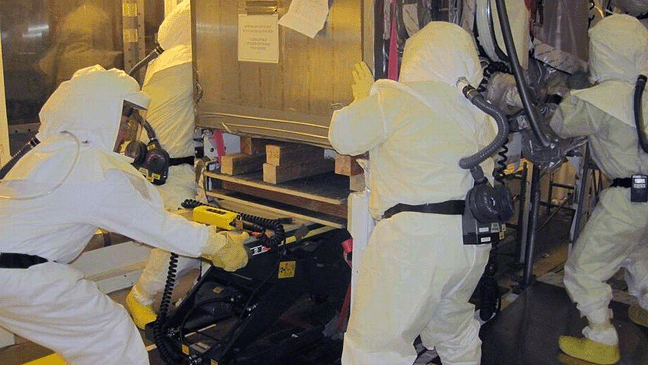
after he and a local journalist conducted a survey on surrounding farms in 1985, Bailie began to have doubts. Nearly all the families living nearby suffered from cancer, birth defects, or thyroid disease, he says — health issues that could be attributed to radiation exposure. This led to the area being coined “the death mile” by some journalists at the time.
documents that were declassified in the late 1980s showed that Hanford had contaminated the surrounding farmland, air, farm animals, and crops with unsafe levels of radiation for years.
June 18, 2023 , Mainichi, Japan
HANFORD, Washington (Kyodo) — As cleanup efforts continue in Washington state at a decommissioned U.S. nuclear facility that played a crucial role in the country’s acquisition of the atom bomb in World War II, questions linger over whether the site has caused serious health issues for workers and local residents.
Construction began on the facility, known as the Hanford site, eighty years ago in 1943 and involved the building of the world’s first large-scale nuclear reactor.
Through the Manhattan Project, a U.S. government research and development program for building nuclear weapons, the site’s B reactor, erected on a 580-square-mile stretch of land next to the Columbia River in south-central Washington, produced the nuclear material for one of the only two atomic bombs ever used in an armed conflict.
Codenamed “Fat Man,” the device was detonated over the city of Nagasaki in southwestern Japan on Aug. 9, 1945, effectively ending Japan’s involvement in the conflict.
The 6.2 kilograms of plutonium contained in the nuclear device released energy equivalent to 21 kilotons of TNT, taking the lives of tens of thousands of innocent people while subjecting the surrounding area to deadly radiation, killing countless more.
But citizens of Nagasaki may not be the only victims of Hanford’s plutonium production. During its decades of operation, U.S. residents living near and mainly downwind of the complex experienced severe health effects that they believe stem from the site’s activities.
One such resident is Tom Bailie, 76, who grew up and still resides just miles downwind from Hanford in a farming community.
Reflecting on his upbringing, Bailie recalled during an interview in April that no one ever thought the site at Hanford would cause harm to “patriotic American citizens.”
But, after he and a local journalist conducted a survey on surrounding farms in 1985, Bailie began to have doubts. Nearly all the families living nearby suffered from cancer, birth defects, or thyroid disease, he says — health issues that could be attributed to radiation exposure. This led to the area being coined “the death mile” by some journalists at the time.
Bailie said that his wife, father, and three uncles all had cancer before passing away, while his two sisters also have cancer and take thyroid medicine. The year before Bailie was born, his mother had a stillbirth. Bailie himself was born with birth defects and was on an iron lung when he was 4 years old. He now requires medication for a thyroid problem.
Bailie vividly remembers encounters with “men in space suits,” equipped with dosimeters to measure radiation levels, walking on his farm. The men would collect soil samples and even ask the farmers to send the heads and feet of ducks and rabbits they would kill while hunting to Hanford for analysis.
When he began speaking out about the hardships and health problems that he attributed to the Hanford site, many people from the community dismissed him as “nuts” or “crazy.” Some even mockingly referred to him as the “glow-in-the-dark farmer.”
But documents that were declassified in the late 1980s showed that Hanford had contaminated the surrounding farmland, air, farm animals, and crops with unsafe levels of radiation for years…………………….
Before being decommissioned in 1989, Hanford produced around 74 tons of plutonium, nearly two-thirds of all the plutonium produced for government purposes in the United States. One of the consequences of the site’s work was massive amounts of contamination and dangerous leftover byproducts, most of which remain on the site today.
Currently, 177 underground tanks containing 56 million gallons of highly radioactive waste, contaminated buildings, and cocooned reactors still exist there, alongside multiple other buried waste sites.
The same year Hanford was decommissioned, cleanup efforts began for dealing with the dangerous byproducts left over from the production of plutonium. Efforts to clean the area of waste are anticipated to be astronomically costly and time-consuming.
According to Hanford’s latest estimate, released in 2022, the total cost of the cleanup is projected to range from $319.6 billion to $660 billion, with a completion date not expected until at least fiscal 2078.
But Tom Carpenter, 66, former head of Hanford Challenge, a nonprofit organization dedicated to ensuring the responsible and safe clearing of the Hanford site, argues that using the word “cleanup” is misleading.
Carpenter says complete eradication of contamination from thousands of acres is impossible, and not the goal of the cleanup process. He asserts that the best that can be achieved at Hanford is “the mitigation of some risks.”
Hanford Challenge’s primary goal, he says, is to ensure authorities prioritize a swift cleanup and make sure that no corners are cut, nor workers put in unnecessary danger. This includes fighting for those who are currently working on the site.
Many workers involved in the cleanup of the Hanford site continue to be exposed to toxic chemicals, vapors, and radioactive materials, resulting in debilitating health conditions.
A recent survey of the workers by Washington state revealed more than 50 percent of them had been exposed to radioactive or toxic chemicals. Workers exposed to these dangerous materials and vapors have developed beryllium disease, cancers, organ damage, and occupational dementia.
Until recently, these workers had to prove that their health issues were directly caused by their work at the Hanford site to receive assistance with their medical expenses.
According to former worker and Hanford Challenge director Jim Millbauer, 65, proving this was extremely difficult, costly, time-consuming, and often fruitless, as most occupational illness claims were rejected.
But a recent law has changed this, presuming that any health effects suffered by workers who spend just eight hours working at Hanford are caused by working at the facility, making it easier for sick workers to get their treatment paid for. https://mainichi.jp/english/articles/20230616/p2g/00m/0in/069000c
Putin warns NATO over being drawn into Ukraine war
By Zahid Mahmood, CNN, June 17, 2023
Russian President Vladimir Putin has warned there is a “serious danger” of NATO being drawn further into the Ukraine war if members of the alliance continue to supply military weaponry to Kyiv.
“NATO, of course, is being drawn into the war in Ukraine, what are we talking here,” Putin said at the St. Petersburg International Economic Forum on Friday.
“The supplies of heavy military weaponry to Ukraine are ongoing, they are now looking into giving Ukraine the jets.”
The comment appeared to be a reference to the F-16 fighter jets some members of the NATO alliance are making plans to supply Ukraine with.
NATO, or the North Atlantic Treaty Organization, was formed in the aftermath of World War II to defend Western nations from the Soviet Union [despite USSR being their ally in WW2 !]and the alliance contains a mutual defense clause where an attack on any one member is considered an attack on all. While Ukraine is not a member of NATO, some NATO members have been supplying Kyiv with tanks, armored vehicles and other weaponry – prompting threats of retaliation from Russia.
German Leopard 2 tanks, British Challenger 2 tanks and American Bradley and Stryker vehicles are among the Western equipment that has been sent to Ukraine.
In late April, NATO Secretary-General Jens Stoltenberg said that NATO allies and partners had delivered more than 1,500 vehicles and 230 tanks to the country.
During his speech in St. Petersburg, Putin said Russia had destroyed tanks “including Leopards” at the front lines.
“And if they are based abroad, but used in fighting we’ll see how to hit them, and where we can hit those means that are used against us in fighting,” Putin said.
“This is a serious danger of further drawing NATO into this military conflict,” he added………………………….. https://edition.cnn.com/2023/06/17/europe/nato-danger-ukraine-war-putin-intl-hnk/index.html
1 This Month

Read the Public Inquiry Report, the Commissioners’ report, Surrendering Australia: The AUKUS Deception is available to download for free at aukuspublicinquiry.com. Or just watch the replay of the National Press Club Luncheon.


19 November – Webinar – The Reality of Reprocessing
Time: 11:00 AM Pacific Time (US & Canada) / 2:00 PM Eastern / 7:00 PM UK / 8:00 PM CET
Register for the Zoom Event Here



Shut down the radiation-damaged Heysham nuclear reactors now
To see nuclear-related stories in greater depth and intensity – go to https://nuclearinformation.wordpress.com

Say No to NASA’s Reckless Nuclear Reactor on the Moon
Say No to NASA’s Reckless Nuclear Reactor on the Moon
-
Archives
- November 2026 (94)
- October 2026 (302)
- September 2026 (339)
- August 2026 (330)
- July 2026 (355)
- June 2026 (287)
- May 2026 (306)
- April 2026 (356)
- March 2026 (251)
- February 2026 (267)
- January 2026 (308)
- December 2025 (358)
-
Categories
- 1
- 1 NUCLEAR ISSUES
- business and costs
- climate change
- culture and arts
- ENERGY
- environment
- health
- history
- indigenous issues
- Legal
- marketing of nuclear
- media
- opposition to nuclear
- PERSONAL STORIES
- politics
- politics international
- Religion and ethics
- safety
- secrets,lies and civil liberties
- spinbuster
- technology
- Uranium
- wastes
- weapons and war
- Women
- 2 WORLD
- ACTION
- AFRICA
- Atrocities
- AUSTRALIA
- Christina's notes
- Christina's themes
- culture and arts
- Events
- Fuk 2022
- Fuk 2023
- Fukushima 2017
- Fukushima 2018
- fukushima 2019
- Fukushima 2020
- Fukushima 2021
- general
- global warming
- Humour (God we need it)
- Nuclear
- RARE EARTHS
- Reference
- resources – print
- Resources -audiovicual
- Weekly Newsletter
- World
- World Nuclear
- YouTube
-
RSS
Entries RSS
Comments RSS

