Feds digging up nuclear waste in Los Alamos for disposal at Carlsbad-area repository
Adrian Hedden, Carlsbad Current-Argus, 21 Jul 23, https://www.currentargus.com/story/news/2023/07/21/feds-digging-up-nuclear-waste-in-los-alamos-for-disposal-at-carlsbad-area-repository/70426843007/
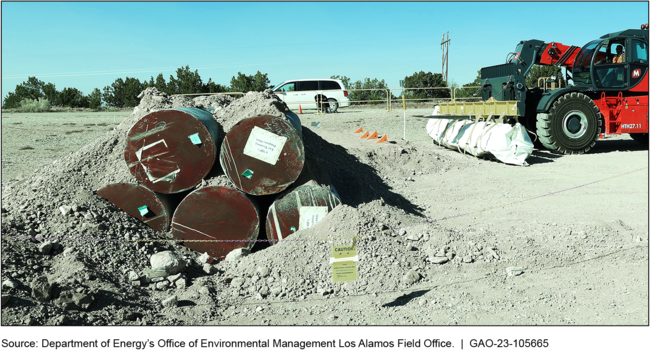
Workers at Los Alamos National Laboratory dug up buried nuclear waste they planned to dispose of at the federal repository near Carlsbad, amid pressure from State officials that the facility prioritize New Mexico waste.
The U.S. Department of Energy’s Los Alamos Field Office and the lab’s cleanup contractor Newport News Nuclear BWXT (N3B) Los Alamos announced Tuesday they began exhuming corrugated metal pipes containing transuranic (TRU) nuclear waste and preparing them for shipment.
At the Waste Isolation Pilot Plant near Carlsbad, TRU waste is disposed of via burial in a salt deposit about 2,000 feet underground, trucked into the site from DOE facilities throughout the country.
TRU waste is made up of irradiated clothing, equipment and other debris from nuclear research and development activities around the U.S.
Before it can be shipped to WIPP, the pipes must be cut using hydraulic sheers, allowing them to be loaded into waste boxes for shipment and disposal.
The pipes weight about 10,000 to 14,000 pounds, and measure about 20 feet long. They are cut into five pieces, with each piece loaded into a box.
It’s occurring at portion of the lab known as Dome 375, and the waste came from Los Alamos’ former radioactive liquid waste treatment facility operating during the Cold War at Technical Area 21 (TA-21).
There were 158 pipes in total transferred from TA-21, records show, containing cemented waste.
They were buried in 1986, where the waste sat until recently when worked began preparing it for final disposal.
The DOE hoped to finish digging up and preparing the pipes for disposal by spring 2024.
More: No progress to report on nuclear waste site aside from Carlsbad-area repository, feds say
The US should end its use of nuclear power plants – the intractible problem of dangerous spent fuel rods

Chicago Tribune, Jul 21, 2023 , Larry R. Eaton, Chicago
Fifty years ago, as chief of the Illinois attorney general’s Environmental Control Law Division, a relatively new field of law at that time, I had the occasion to tour an Illinois nuclear power plant. I was taken aback to see extensive pools of water containing bundles of spent nuclear fuel rods standing on end just beneath the surface of the water. I was advised that a pilot plant study had indicated that it would have an essentially closed-loop system that would not generate large amounts of spent fuel; however, once the full-scale plant became operational, the system failed to perform as anticipated. Plant workers were left with no good alternative but to store spent fuel rods in pools of water, at least temporarily, pending (hopefully) a better idea.
It appears that the nuclear power industry is still waiting for that better idea. A supporter of nuclear power production now maintains, in essence, that we have nothing to be concerned about regarding spent nuclear fuel because all we need to do is encase it in concrete and then open it up and repackage it in concrete every several decades. (In perpetuity, presumably; the radioactivity will remain unabated for a very long time indeed.) To understand how absurd this proposal is requires little more than to say it out loud.
Chernobyl and Three Mile Island were wake-up calls, but we do not appear to have fully awakened. It does not help that a nuclear power plant now sits near the front lines of a shooting war between Russia and Ukraine. Hopefully, we will somehow be lucky enough never to have a massive nuclear power plant disaster. But regardless of that, we will have radioactive spent fuel problems with us forever. We can no longer escape that fact. However, we can choose to stop making it worse.
Germany has decided to end its use of nuclear power. The U.S. should do the same. If there is anything worse than having an enormous carbon footprint, it has to be for that footprint to be radioactive too!
UN proposes elimination of all nuclear weapons as first step under new agenda for peace

Rising geopolitical and geo-economic tensions across the globe need a better, reformed, and updated UN system which reflects the growing multipolarity and is more representative, unbiased, and effective
July 21, 2023 by Peoples Dispatch
United Nations Secretary General António Guterres presented a new policy brief on global security on Thursday, July 20, which calls for the abolition of all nuclear weapons and widespread reforms in the UN structure to make it more representative and efficient.
The New Agenda for Peace policy brief, based on the discussions during the 75th anniversary celebrations of the foundation of the UN in 2020, is part of the preparations for the UN Summit of the Future to be held in 2024.
While launching the brief, Guterres acknowledged that “the post-Cold war period is over, and we are moving towards a new global order and a multipolar world.” The changing world is marred by a new set of geopolitical and geo-economic conflicts with rising “insecurity about the threat of nuclear war” and growing skepticism among a large number of member states about the existing forums of multilateralism.
The brief claims that most of the challenges to global security and peace are interlinked and proposes ways to address this complexity.
Complex nature of rising conflicts
The brief notes that increasing geo-strategic tensions and competition across the globe is pushing global military expenditure to an unprecedented level. In 2022, the cumulative global defense expenditure exceeded $2.24 trillion.
The brief also points out that several arms control regimes created during the Cold War and its immediate aftermath, which were containing great power rivalries, have been eroded in the last few years, which has increased the risk of regional and global wars and paved the way for an arms race. ……………………………………………………………….
Five priority areas and 12 steps to achieve collective security
The brief proposes that trust, solidarity and universality—the well-known principles of the UN charter—would be the basis of its agenda for peace. Guterres emphasized the role of cooperation among nations, saying that it “does not require states to forego their national interest, but to recognize that they have shared goals.”
The brief recommends a 12-point plan of action, divided in five priority areas, to address the growing threats to peace at the global level.
It calls for the elimination of all nuclear weapons and boosting preventive diplomacy to address strategic risks and geopolitical divisions in the world.
It also calls for preventing domestic conflicts by adopting sustainable development methods and catering to climate-related issues and social discrimination with increased funding and help to developing countries to achieve their SDGs by 2030. Peacekeeping and peace enforcement, as well as regional initiatives of peace, should also be updated and strengthened. There should also be steps taken to prevent weaponization of emerging domains and technologies, such as artificial intelligence (AI), and promotion of responsible innovation.
It additionally calls for reforms in the UN system, including in the Security Council to make it more “just and representative,” and talks about countries respecting the impartiality of the UN secretariat so that it can work more effectively as a multilateral forum. https://peoplesdispatch.org/2023/07/21/un-proposes-elimination-of-all-nuclear-weapons-as-first-step-under-new-agenda-for-peace/
Corruption In Ukraine & The U.S. Mutually Rewarding
The Pentagon failed its 5th consecutive audit last year, appearing to lose track of 61% of its $3.5 trillion in assets.
Substack, LISA SAVAGE, JUL 20, 2023
“…………………………………………………………………………………………. Ukraine’s leaders are so over the top that it’s becoming impossible to ignore. Add in the fact that they have been enriched by U.S. taxpayers more or less directly despite crumbling infrastructure, catastrophic homelessness, apartheid healthcare, and a host of other problems that the U.S. could address with adequate funding.
From RT (whose editor-in-chief, Margarita Simonyan, just survived a second assassination attempt):
On July 7, US Under Secretary of Defense for Policy Colin Kahl spoke about a new package of aid from the US which includes cluster munitions – which are banned in 120 countries. The cost was $800 million.This is the 42nd delivery of aid that Ukraine has received from the US in the past year and a half.[emphasis mine] Since the beginning of Russia’s offensive, the US Congress has approved military and economic assistance to Ukraine amounting to over $70 billion – and that’s only counting direct expenses..
“Ukraine needs only one thing… To have someone come to power who won’t steal. Someone who won’t do it himself and won’t allow others to do so. Unfortunately, so far we haven’t been lucky,” [Aleksey Arestovich, former advisor to President Zelensky] said.
Ok, so Arestovich has a motive for trashing the government that used to include him. How about Pulitzer Prize-winning U.S. investigative journalist Seymour Hersh? Hersh does not approve of Russia’s entry into the war but he nonetheless published a piece on rampant corruption in Ukraine, “Trading with the Enemy,” back in April.
Zelensky has been buying fuel from Russia, the country with which it, and Washington, are at war, and the Ukrainian president and many in his entourage have been skimming untold millions from the American dollars earmarked for diesel fuel payments. One estimate by analysts from the Central Intelligence Agency put the embezzled funds at $400 million last year, at least; another expert compared the level of corruption in Kiev as approaching that of the Afghan war………………………………
Then there is President Zelensky, elected on pledges to end corruption and, incidentally, the war on the Donbas.
Pre-2022, i.e. when corporate media headlines about Ukraine did a 180, even The Guardian found he was part of the problem and not likely to be part of the solution.
Neither is the U.S. government likely to be part of the solution. The Pentagon failed its fifth consecutive audit last year, appearing to lose track of 61% of its $3.5 trillion in assets……………………….. more https://went2thebridge.substack.com/p/corruption-in-ukraine-and-the-us?utm_source=post-email-title&publication_id=1580975&post_id=135301485&isFreemail=true&utm_medium=email_medium=email
The Big Problem With Small Nuclear Reactors
The diminutive reactors are likely to be just as prone to delays and cost overruns as their behemoth predecessors.

I just read Pal Hockenos’ fine story about small nuclear reactors. But Hockenos is naive to think that Bill Gates and co. give a hoot about our future. What they do care about is their own increasing $squillions. And the coming source of new $squillions is in weaponry – that’s where all sorts of applications for SMRs lie. And Gates etc are well aware that the fixing-climate story is just a cover for the real practical purpose.
UNDARK BY PAUL HOCKENOS , 07.20.2023
IN RECENT YEARS, the nuclear power lobby and its advocates have begun to sing a new song. They have bailed on the monstrous reactors of the 20th century — not because of safety or toxic waste concerns, but because of the reactors’ exorbitant expense and ponderous rollout schedules. And they have switched their allegiance to a next generation nuclear fission technology: small modular reactors, which they claim will help rescue our warming planet, as well as the nuclear power industry— once they exist.
Respected thinkers such as former U.S. president Barack Obama, French president Emmanuel Macron, and Microsoft co-founder and philanthropist Bill Gates have toasted the idea of small modular reactors, or SMRs, as a potentially reliable, almost-emissions-free backup to intermittent renewable energy sources like wind and solar. Advocates claim that because SMRs will be smaller than the giants that currently dominate horizons, they will be safer, cheaper, and quicker to build. Although SMRs will have only a fraction of the power-generating capacity of traditional nuclear power reactors, proponents envision that they will, one day, be assembled in factories and transported as a unit to sites — like Sears’ mail-order Modern Homes of the early 1900s.
Currently, half of the states in the EU, both major political parties in the U.S, and the five BRICS nations — Brazil, Russia, India, China, and South Africa — have indicated that they want to split atoms for the purpose of generating energy. U.S. President Joe Biden included billions of dollars in tax credits for nuclear energy in the Inflation Reduction Act and the Infrastructure Investment and Jobs Act. Gates has gone so far as to invest a chunk of his fortune in a firm he founded, TerraPower, a leading nuclear innovation company. But despite the prodigious chatter, the endeavor to blanket the Earth with SMRs is a Hail Mary pass that’s very unlikely to succeed.
Granted, it is certainly a step in the right direction that most observers now see the postwar, giga-watt-scale water-cooled reactors as obsolete. When constructed new, these behemoths generate electricity at up to nine times the cost of large-scale solar and onshore wind facilities, and can take well over a decade to get up and running. Perhaps for this reason, there has been one, and only one, new nuclear power project initiated in the U.S. since construction began on the last one 50 years ago: a two-reactor expansion of the Vogtle Electric Generating Plant in Georgia. The first of the reactors came online this year — seven years behind schedule. The staggering $35 billion cost for the pair is more than twice the original projection.
But SMRs are just as likely to face similar delays and cost overruns. Currently, there are just two existing advanced SMR facilities in the world that could be reasonably described as SMRs: a pilot reactor in China and Russia’s diminutive Akademik Lomonosov. More small reactors are under construction in China, Russia, and Argentina, but all of them are proving even more expensive per kilowatt than traditional reactors.
It’s worth noting that in the U.S., and everywhere else in the world, nuclear policy relies heavily on subsidies to be economically competitive. Starting next year, utilities operating nuclear facilities in the U.S. can qualify for a tax credit of $15 per megawatt-hour — a break that could be worth up to $30 billion for the industry as a whole. However, even these giveaways won’t reduce the projected costs of SMR-generated electricity to anywhere near the going prices of wind and solar power.
In the U.S., the only SMR developer with a design approved by the Nuclear Regulatory Commission is NuScale, which plans to deploy six modules at one site in Idaho that will together generate less electricity than a smallish standard nuclear reactor. So far, however, NuScale has yet to lay a single brick. Its biggest win to date is securing $4 billion in federal tax subsidies. In January of this year, NuScale announced plans to sell electricity not at $58 per megawatt-hour, as originally pledged, but at $89 per megawatt-hour, citing higher than anticipated construction costs. The new projection is nearly twice the average global cost of utility-scale solar and onshore wind, according to calculations by BloombergNEF. And without the government subsidies, NuScale’s price tag would be that much higher.
In fact, there’s a fair chance that not a single NuScale SMR will ever be built: The company has said it will not begin construction until 80 percent of its expected generation capacity is subscribed, and currently buyers have signed up for less than a quarter of the plant’s capacity.
Gates’s TerraPower has an even longer way to go, although it too is cashing in on subsidies. The U.S. Department of Energy has pledged up to $2 billion in matching funds to construct a demonstration plant in Wyoming. Yet TerraPower recently announced it’s facing delays of at least two years because of difficulties securing uranium fuel from its lone supplier: Russia.
Even if the unlikely rollout of SMRs eventually happens, it will unfold too late to curb the climate crisis. And the reactors will face many of the same safety and radioactive waste concerns that plagued their larger counterparts, if only at smaller scales. Meanwhile, the siren song of nuclear energy is diverting critical resources from the urgent task of building out clean technologies. And the idea that nuclear reactors would serve as “backups” for wind and solar is misguided because the reactors can’t be ramped up and down quickly.
……………………………The technology of the future is already here. Clean wind and solar energy — coupled with updated smart grids, expanded storage capacity, hydrogen technology, virtual power plants, and demand response strategies — can work. Our energy systems of the future will look like a patchwork quilt, with diverse energy sources kicking in at different times during the day, and with the mix differing from one day to the next.
Bill Gates and like-minded innovators should put their minds and fortunes to work on this futuristic project of the present — and leave the 20th century relic that is nuclear power in the past, where it belongs
Anti-nuclear groups welcome Oppenheimer film but say it fails to depict true horror

UK campaigners hope movie will draw attention to ‘real and present danger’ posed by atomic weapons
Guardian, Rachel Hall 21 July 23
Strips of translucent, flesh-toned material tear off a woman’s face in one of the closing scenes of Oppenheimer, the new film about the invention of the atomic bomb. She represents its victims in Hiroshima and Nagasaki, whose skin was burned off in the blast.
Yet the reality in Japan was far more gruesome than the artful depiction in the film, which skirts around the human suffering caused by the bomb.
Instead, the blockbuster movie from director Christopher Nolan is a pacy look at the scientific quest led by the eponymous J Robert Oppenheimer in the US to build a nuclear weapon faster than the Nazis at the end of the second world war.
The film explores Oppenheimer’s moral quandary over his role in creating the most destructive weapon ever made, but nuclear disarmament campaigners fear its power to persuade people of the existential threat posed by nuclear arms may be diminished by its focus on scientific achievement.
“The overall impact of the film is unbalanced – people leave the theatre thinking how exciting a process it was, not thinking ‘God, this was a terrible weapon of mass destruction and look what’s happened today’,” said Carol Turner, a co-chair of the Campaign for Nuclear Disarmament’s London branch.
“The effect of the [Hiroshima and Nagasaki] blasts was to remove the skin in a much more gory and horrible way – in the film it was tastefully, artfully presented. There’s nothing wrong with that, but if you look at photographs of actual survivors and read accounts of what happened to them it was a very horrifying, gory death.”
She added that although it was historically accurate to portray Oppenheimer’s ethical doubts about his invention, and his subsequent persecution by the US government, in effect this turned him into the film’s hero.
Despite these reservations, Turner considers it positive that the film is drawing people’s attention to the “real and present danger” of nuclear weapons arising from the Russia-Ukraine war, especially at a time when there is limited public discussion, for example the comparative silence around the storage of US nuclear weapons in the UK, relative to the outrage of past decades.
…………………………………………………………………………….. [Nuclear weapons] are as out of control as the climate emergency is, but it’s just getting much, much less attention.” https://www.theguardian.com/world/2023/jul/21/anti-nuclear-groups-welcome-oppenheimer-film-fails-depict-true-horror
The Dynamics of War Insanity: NATO’s Ukraine Roulette
By Alfred de Zayas / CounterPunch https://scheerpost.com/2023/07/20/the-dynamics-of-war-insanity-natos-ukraine-roulette/
Deliberate provocations of a nuclear rival, coups d’état, colour revolutions, broken promises, broken treaties, escalation of tensions, demonization, invective, double-standards — all this while asserting adherence to international legal norms and playing innocent about our aggressions, our violations of the Hague and Geneva Conventions, of articles 1(2)[1], 2(3)[2], 2(4)[3] and 39[4] of the UN Charter.
Abrams tanks, Leopard tanks, F-16, indiscriminate weapons, depleted uranium, cluster bombs. Summits illustrate how the moral compass of the collective West is lost in the avalanche of fake news[5], fake history, fake law, bellicose rhetoric, media hyperbole, serial mobbing of dissenters, persecution of whistleblowers, censorship. The Western binary mindset continues to divide the world into good and bad countries, democracies and autocracies. There is little room to accommodate a comprehensive picture of the pre-history, root causes of conflicts, and nuances. One observes an almost total absence of a sense for proportions.
The Global Majority in Latin America, Africa and Asia is increasingly alarmed by the surrealistic spectacle of a collective West that seems out of control, developing its own lethal dynamic, displaying a paroxysm of Russophobia and Sinophobia, incitement to hatred, cancel culture, refusal to entertain serious dialogue, doubling-down on eschatological demands. Many non-Western thinkers and politicians are articulating justified warnings that the on-going intestinal conflicts in the West are adversely impacting the economies of third-world countries and may ultimately result in Apocalypse for the entire planet. The West is not playing the classical Russian roulette – it has developed its own version: Ukrainian roulette, compulsive apocalyptic vabanque.
Meanwhile the Western media, notably Reuters, AP, CNN, Fox, New York Times, Washington Post, BBC, Le Monde, Figaro, FAZ, der Spiegel, even the Swiss NZZ ensure the daily indoctrination doses for the Western public, purveying skewed narratives that repeat and embellish what Washington and Brussels ordain, blithely ignoring other views and perspectives and the principle audiatur et altera pars. Freedom of the media in the collective West seems to mean the right to repeat NATO narratives ad nauseam, even when they have been proven wrong. This “freedom” also includes the freedom to ignore every critical voice about NATO and to refrain from asking critical questions at NATO press conferences.
Council defers decision over Test of Public Support on the issue of disposal of high level nuclear waste

East Lindsey fudge: Council defers decision over Test of Public Support, Nuclear Free Local Authorities, 20th July 2023
The UK/Ireland Nuclear Free Local Authorities noted that, at last night’s meeting (19 July) of East Lindsey District Council, Councillor Craig Leyland clearly found the notion of determining whether to call for a Test of Public Support on the nuclear waste dump too hard to swallow; instead, the Council Leader appeared to create a new form of confectionary more to his liking – East Lindsey Fudge.
The UK Government is currently looking for a coastal site to locate an undersea repository – a so-called Geological Disposal Facility – in four locations in either West Cumbria or East Lincolnshire. This facility will be used to dispose of the nation’s legacy and future high level radioactive waste. Theddlethorpe, being part of the area administered by East Lindsey District Council, is one of the sites under consideration. Acting on behalf of government, Nuclear Waste Services, which is part of the taxpayer-funded Nuclear Decommissioning Authority, is taking the lead role in the GDF siting process.
Calling for a Test of Public Support is one of the few matters that East Lindsey District Council can determine as part of this, but the administration was clearly reluctant to exercise its mandate when two motions were brought before Council by Councillors from the impacted area last night.
Leader Councillor Craig Leyland was most apologetic to members of the public who had unwittingly traipsed to the meeting expecting their elected representatives to take a vote, but he explained that the matter would be deferred and brought back to Council after taking further legal advice……………………………………………………………………….more https://www.nuclearpolicy.info/news/east-lindsey-fudge-council-defers-decision-over-test-of-public-support/
Is the UK Government unable to fund its promised nuclear renaissance?

- “Great British Nuclear has no legal basis – the Energy Bill has been delayed till the autumn, so it can’t do anything legally.
- “Great British Nuclear has no budget, so it can’t buy anything or commission anything.
- “Great British Nuclear has no premises.
- “Great British Nuclear has no paid staff.”
Great British Nuclear officially launched, sparks funding doubts.
Electrical Review 18th July 2023
“………………… So we’ve heard that Great British Nuclear has high hopes to kickstart a renaissance period for nuclear power in the UK, but how does it plan on achieving that? Well, thanks to the official launch, we now have more concrete information as to what the body plans to do.
The UK Government has officially launched Great British Nuclear, a new Government agency that is designed to support the growth of nuclear energy in the UK.
The official launch of Great British Nuclear was initially tipped for July 13, although the launch was pushed back due to “unforeseen circumstances.” Despite the delayed start, the Government has high hopes for the new department, with it hoping to create a renaissance for nuclear energy in the UK.
One of Great British Nuclear’s first acts will be to kickstart a competition for small modular reactor (SMR) technology, which it believes could help boost energy security, create cheaper power, and grow the economy through well-paid jobs.
Many in the industry have been calling for the UK Government to do more to encourage the construction of more nuclear power, including SMRs, as the UK transitions towards cleaner power generation. The UK Government has even gone so far as to claim that nuclear will be essential to our net zero future, noting that it will provide a ‘baseload’ to cover more intermittent renewable energy generation – something that our Gossage Gossip columnist recently described as a ‘load of cobblers’.
How will Great British Nuclear Help?
So we’ve heard that Great British Nuclear has high hopes to kickstart a renaissance period for nuclear power in the UK, but how does it plan on achieving that? Well, thanks to the official launch, we now have more concrete information as to what the body plans to do.
From today, companies can register their interest with Great British Nuclear to participate in a competition to secure funding support to develop their SMRs. Additionally, the Government body is eager to explore future sites for new large gigawatt-scale nuclear power plants, such as those at Hinkley Point C and Sizewell C.
That’s about as much as we know about Great British Nuclear’s initial plans – although the UK Government is throwing its weight behind the nuclear industry with a brand-new funding package totalling up to £157 million.
This includes:
Up to £77.1 million of funding for companies to accelerate advanced nuclear business development in the UK and support advanced nuclear designs to enter UK regulation, maximising the chance of small and advanced modular reactors being built during the next ParliamentUp to £58 million funding for the further development and design of a type of advanced modular reactor (AMR) and next generation fuel. AMRs operate at a higher temperature than SMRs and as a result they could provide high temperature heat for hydrogen and other industrial uses alongside nuclear power. This includes:
- Up to £22.5 million to Ultra Safe Nuclear Corporation UK in Warrington to further develop the design of a high temperature micro modular reactor, a type of AMR suited to UK industrial demands including hydrogen and sustainable aviation fuel production.
- Up to £15 million to the National Nuclear laboratory in Warrington to accelerate the design of a high temperature reactor, following its success in Japan.
- Up to £16 million to National Nuclear Laboratory in Preston to continue to develop sovereign coated particle fuel capability, a type of robust advanced fuel which is suitable for high temperature reactors.
A further £22.3 million from the Nuclear Fuel Fund will enable eight projects to develop new fuel production and manufacturing capabilities in the UK, driving up energy security and supporting the global move away from Russian fuel. This will include:
- Over £10.5 million to Westinghouse Springfields nuclear fuel plant in Preston to manufacture more innovative types of nuclear fuel for customers both in the UK and overseas, boosting jobs and skills in the North West.
- Over £9.5 million to Urenco UK in Capenhurst Chester, an international supplier of nuclear materials, to enrich uranium to higher levels, including LEU+ and high assay low enriched uranium (HALEU). LEU+ will allow for current reactors and SMRs to run for longer between refuelling outages, improving reactor efficiency and economics both in the UK and abroad. HALEU development will ensure that the UK remains at the forefront of fuel development for future advanced reactors.
- Over £1 million has also been awarded to Nuclear Transport Solutions, a subsidiary of the Nuclear Decommissioning Authority, to develop transport solutions to facilitate a supply chain for highly enriched uranium in the UK and internationally.
- Over £1.2 million to support MoltexFLEX, a UK molten salt reactor developer based in the North West, to build and operate rigs for the development of molten salt fuel. Molten Salt Reactors (MSRs) are an AMR type that use a molten salt as a coolant and fuel, leading to intrinsic safety compared with conventional fuels.
Is the UK Government unable to fund its promised nuclear renaissance?
Despite announcing £157 million in investment for the nuclear industry in the UK, many experts will argue that the UK Government’s funding plans are woefully inadequate to meaningfully move the needle.
Recent nuclear projects within the UK have been unable to get off the ground without significant Government intervention, including Hinkley Point C, which the Government has committed at least £679 million towards, despite the new reactor facing constant delays – with its opening date now set for September 2028.
Rolls-Royce, which is currently undergoing regulatory testing on its small modular reactor technology, has suggested that SMRs will be cheaper – although the company still believes each SMR will carry a price tag of at least £1.8 billion when they start rolling out of factories in 2030. That is expected to get you around 440 MW of generation – which for the same price, you could purchase 782 Enercon E82 onshore wind turbines, netting you up to 2346 MW of generation.
One industry insider suggested that the UK Government’s woeful funding figures was “the best example I have ever seen of what a Government on its last legs sounds like when it has nothing to say and no money to spend.” Adding that, “All this amount will buy you, literally, is a very large pile of paper and possibly a few more headlines.”
Given the Conservative Party’s performance in recent polls, it’s likely the UK Government is unwilling to commit large amounts to Great British Nuclear when it’s unlikely to be in Government for much longer. Unfortunately, large infrastructure projects of this nature require huge investment across multiple parliamentary terms – and the short-sighted nature of the country’s leaders got us into this situation in the first place. In fact, by the time Hinkley Point C comes online, it will be 20 years since the Government of the day supported a new reactor.
Will the launch of Great British Nuclear move the needle?
The UK Government is hopeful that Great British Nuclear will move the needle in the development of nuclear power technology in the UK. While it may not have the budget to invest in new nuclear reactors itself – it could potentially foster an environment that is ultimately friendly to nuclear power.
Unfortunately, as our industry insider notes:
- “Great British Nuclear has no legal basis – the Energy Bill has been delayed till the autumn, so it can’t do anything legally.
- “Great British Nuclear has no budget, so it can’t buy anything or commission anything.
- “Great British Nuclear has no premises.
- “Great British Nuclear has no paid staff.”
So, the chance of meaningfully moving the needle is essentially nil. But at least the current Government can capture headlines and act like it’s trying to help. https://electricalreview.co.uk/2023/07/18/great-british-nuclear-officially-launched-sparks-funding-doubts/
Repeating This Nuclear Power Mistake Will Be Catastrophic For Artificial Intelligence – Venture capitalist Marc Andreessen.

Marc Andreessen Thinks Repeating This Nuclear Power Mistake Will Be Catastrophic For AI
by Rounak Jain, Benzinga Staff Writer, July 19, 2023
Venture capitalist Marc Andreessen has chimed in on the ongoing debate about AI regulation, stating that repeating the mistake of the proliferation of nuclear power again will be catastrophic for AI.
What Happened: Andreessen stressed that trying to regulate artificial intelligence using the same ideas used for regulating and controlling nuclear power would prove fatal for AI in his address during the University of Austin’s 2023 Forbidden Courses program.
“For the last 50 years, we’ve played out this experiment with so-called precautionary principles. It did not work well for the technology it was invented for,” Andreessen said, referring to the Non-Proliferation Treaty that was signed to prevent the spread of nuclear weapons and technology.
Growing Calls For AI Regulation: OpenAI co-founder Sam Altman, Microsoft Corp, Bill Gates and others have called for regulation of AI. Altman testified in a Senate hearing about the risks of AI and called for its regulation. In contrast, Gates called for creating a global regulatory body on the lines of the International Atomic Energy Agency.
Elon Musk went a step further and called for a “pause” on the development of AI.
However, Andreessen disagreed and said, “The future hangs in the balance because there are a lot of people pushing for that right now.”
Others want a more balanced approach to regulation. In a recent conversation with Benzinga, Ole Lehmann, founder of AI Solopreneur, said, “I think with powerful technology, there always is a need for some regulation, but I think builders in this space need to be involved in this legislation.”
https://www.benzinga.com/news/23/07/33279834/marc-andreessen-thinks-repeating-this-nuclear-power-mistake-will-be-catastrophic-for-ai
To the Pacific islands, the West’s support for Japan’s Fukushima nuclear waste ocean dumping is hypocrisy
Having been used for nuclear tests and dumping by the US and France, the Pacific islands deeply oppose Japan’s plan and see it as a ‘nuclear legacy’ issueThat the likes of Australia and the US support Japan’s plan just ups the region’s geopolitical stakes – and gives China a trump card
Kalinga Seneviratne, SCMP, 18 Jul 23
International Atomic Energy Agency (IAEA) director general Rafael Mariano Grossi, after travelling to Tokyo earlier this month to present a report endorsing Japan’s approach to discharging Fukushima’s treated nuclear waste water into the Pacific, has been trying to convince Japan’s sceptical Pacific neighbours of the authenticity of the report’s findings.
The IAEA, which has opened the door for Tokyo Electric Power Company (Tepco) to dump about 1.3 million tonnes of contaminated water into the Pacific Ocean, insists the controlled, gradual release would have a “negligible radiological impact on people and the environment”.
But the small island nations of the Pacific remain deeply concerned about Japan’s intention to dump nuclear waste into the ocean. They see this as not merely a nuclear safety issue but a “nuclear legacy issue” – the Pacific has been used as a nuclear weapon testing and dumping site since the end of the second world war………………….(Subscribers only) more https://www.scmp.com/comment/opinion/article/3228154/pacific-islands-wests-support-japans-fukushima-nuclear-waste-ocean-dumping-hypocrisy
Don’t believe the UK government’s hype about small nuclear reactors and Great British Nuclear.

In response to Energy Security Secretary Grant Shapps’ announcements
relating to ‘Great British Nuclear’, Dr Doug Parr, Chief Scientist for
Greenpeace UK, said – “As the government tries to whip up investment for
the latest generation of reactors, it is striking how many of the nuclear
industry’s speculative claims are being repeated by ministers as fact.
The hype seems to have been enough to convince our government that nuclear’s
last gasp is in fact a new dawn, but at their radioactive cores SMRs remain
the same bad bet. SMRs have no track record, but initial indications are
that the familiar problems of cost overruns and delays will be repeated,
and the accumulation of unmanageable waste will continue.
Maybe the hope is that splitting one big mistake into several smaller mistakes means each
reactor’s inevitable problems receive less scrutiny?
By continually obsessing about nuclear the government is taking its eye off the net zero
ball, which will have to be delivered through a predominantly renewable,
modern electricity grid. No number of SMRs will fix the government’s
lacklustre effort to address issues of delayed connections, smart local
grids and home efficiency.
The government may argue that renewables can
compete in the market unaided, while nuclear still needs state support to
survive, but atomic power has been showered with money and support for the
best part of a century without ever working well enough to pay its way.
This is a technology that has gone straight from adolescence to
obsolescence without passing through maturity.”
Greenpeace 18th July 2023
Ukraine Again Bombs Crimean Bridge
18, July, 2023 https://scheerpost.com/2023/07/18/ukraine-again-bombs-crimean-bridge/—
Ukrainian sources are telling media outlets it was a joint operation between the SBU and the Ukrainian Navy.
By Dave DeCamp / Antiwar.com
The Crimean Bridge that links Crimea to the Russian mainland was again targeted by Ukrainian forces in a bombing early Monday morning that killed two civilians and injured a young child.
Russian authorities said the Crimean Bridge, also known as the Kerch Bridge, was targeted by drones operating on the surface of the water. The previous attack on the bridge that took place in October 2022 was a truck bombing.
Ukrainian sources are telling media outlets that the attack was a joint operation between Ukraine’s Security Service (SBU) and Ukraine’s Navy. The government in Kyiv hasn’t officially taken credit for the attack but has hinted at responsibility, which is typical of their covert attacks on Russian territory.
Russian authorities have halted vehicle traffic on the bridge and are assessing the damage. According to RT, rail transport on the bridge was temporarily halted but has resumed.
The Crimean Bridge is a sensitive target for Russia, and the last time it was attacked, Russian President Vladimir Putin significantly escalated the war. In response, the Russian military began large-scale missile strikes on Ukrainian infrastructure, which it hadn’t done before October 2022.
Russian Foreign Ministry spokeswoman Maria Zakharova hinted at Western involvement in the Monday attack, saying that Ukrainian decisions on such operations are made “with the direct participation of American and British intelligence services and politicians.”
The Grayzone previously reported that British intelligence officials were plotting ways to blow up the Crimean Bridge before the October 2022 attack. The Grayzone obtained a presentation drawn up for British intelligence in April 2022 that reviewed options for attacking the bridge.
The document suggested using cruise missiles or divers to plant mines to blow up the bridge. The Ukrainian attacks differed operationally, but the existence of the document signals the British could have helped Ukraine plot the attacks or at least offered advice.
Putting the Nuclear Genie Back in the Bottle
CounterPunch, BY KARL GROSSMAN 18 July 23
With the film Oppenheimer opening in theatres on Friday and being widely heralded by media, and this past Sunday the 78th anniversary noted of the first explosion of a nuclear device, and, so importantly, the Treaty on the Prohibition of Nuclear Weapons becoming international law, the time for putting the nuclear genie back in the bottle has arrived with great timeliness and strength.
Can it be done? Can nuclear weapons be abolished?
Yes.
Consider what the world did in the wake of World War I when the terrible impacts of poison gas had been tragically demonstrated. Mustard gas, chlorine gas, phosphene gas killed thousands on both sides of the conflict. Thereafter, the Geneva Protocol of 1925 and the Chemical Weapons Convention of 1933 outlawed chemical warfare, and to a large degree the prohibition has held.
This month The New York Time ran a front-page story headlined: “Toxic Arsenal Nears Its End, Decades Later.” The July 6th article began: “In a sealed room behind…armed guards and three rows of high barbed wire at the Army’s Pueblo Chemical Depot in Colorado, a team of robotic arms was busily disassembling some of the last of the United States’ vast and ghastly stockpile of chemical weapons. In went artillery shells filled with deadly mustard agent that the Army had been storing for 70 years. The bright yellow robots pierced, drained and washed each shell, then baked it at 1,500 degrees Fahrenheit. Out came inert a harmless scrap metal, falling off a conveyer belt into an ordinary brown dumpster with a resounding clank.”
The article continued: “’That’s the sound of a chemical weapon dying,’ said Kingston Rief, who spent years pushing for disarmament outside government and is now deputy assistant secretary of defense for threat reduction and arms control. He smiled as another shell clanked into the dumpster. The destruction of the stockpile has taken decades, and the Army says the work is just about finished.”
“They were a class of weapons deemed so inhumane that their use was condemned after World War I, but even so, the United States and other powers continued to develop and amass them,” said the piece.
The Treaty on the Prohibition of Nuclear Weapons, adopted by the United Nations in 2017—with 122 nations in favor—and entered into force in January 2021 can be the nuclear counterpart to the chemical weapons genie being, at long last, put back in the bottle.
…………………………………………………………………………………………………. “Let’s eliminate these weapons before they eliminate us,” said UN Secretary-General Antonio Guterres, the former prime minister of Portugal, at the conclusion last year of a “Political Declaration and Action Plan” for implementation of the Treaty on the Prohibition of Nuclear Weapons—“important steps,” he said, “toward our shared goal of a world free of nuclear weapons.” Guterres said that with 13,000 nuclear weapons still held across the globe, “the once unthinkable prospect of nuclear conflict is now back within the realm of possibility.”
“In a world rife with geopolitical tensions and mistrust, this is a recipe for annihilation. We cannot allow the nuclear weapons wielded by a handful of States to jeopardize all life on our planet,” he said. “We must stop knocking at doomsday’s door.”
Recently I did a TV program with Seth Shelden, a professor of law, an attorney, and UN liaison for the International Campaign to Abolish Nuclear Weapons which received the Nobel Peace Prize in 2017. The Treaty on the Prohibition of Nuclear Weapons was passed at the UN that year much due to the work of ICAN……………………………………. You can view the program by visiting www.envirovideo.com
The treaty declares that because of the “catastrophic humanitarian consequences that would result from any use of nuclear weapons, and recognizing the consequent need to completely eliminate such weapons, which remains the only way to guarantee that nuclear weapons are never used again under any circumstances,” nations agree not to “develop, test, produce, manufacture, otherwise acquire, possess or stockpile nuclear weapons.” Further, no country may “threaten to use” them.
Asked about the lack of coverage by media of the treaty creating a nuclear weapons-free world, and thus so few people being aware of it, Shelden points to “myopic framing” by media. He cites how long it took “for journalists to accept that there were not two sides to the climate crisis.” The horrendous impacts of nuclear weapons, “like the climate crisis, even more so, is a very black-and-white issue,” he says. Shelden notes that the abolition of nuclear weapons has been a focus of the UN since its formation, the subject of its first resolution. He discusses the years of work that have led to the treaty.
ICAN says: “The release of the Oppenheimer film, and the wave of (media) attention surrounding it, creates an opportunity to spark public attention on the risks of nuclear weapons and invite new audiences to get involved in the movement to abolish nuclear weapons. We can educate about the risks, and share a much-needed message of hope and resistance: Oppenheimer is about how nuclear weapons began, the UN Treaty on the Prohibition of Nuclear Weapons (TPNW) is how we end them. That is why we have put together some resources for all ICAN campaigners—or anyone who is willing to take action—to use at local theatres around the world or to join the conversation online!”
Shelden of ICAN on my Envirovideo TV program also has many suggestions for action.
1 This Month

Read the Public Inquiry Report, the Commissioners’ report, Surrendering Australia: The AUKUS Deception is available to download for free at aukuspublicinquiry.com. Or just watch the replay of the National Press Club Luncheon.


19 November – Webinar – The Reality of Reprocessing
Time: 11:00 AM Pacific Time (US & Canada) / 2:00 PM Eastern / 7:00 PM UK / 8:00 PM CET
Register for the Zoom Event Here



Shut down the radiation-damaged Heysham nuclear reactors now
To see nuclear-related stories in greater depth and intensity – go to https://nuclearinformation.wordpress.com

Say No to NASA’s Reckless Nuclear Reactor on the Moon
Say No to NASA’s Reckless Nuclear Reactor on the Moon
-
Archives
- November 2026 (94)
- October 2026 (302)
- September 2026 (339)
- August 2026 (330)
- July 2026 (355)
- June 2026 (287)
- May 2026 (306)
- April 2026 (356)
- March 2026 (251)
- February 2026 (267)
- January 2026 (308)
- December 2025 (358)
-
Categories
- 1
- 1 NUCLEAR ISSUES
- business and costs
- climate change
- culture and arts
- ENERGY
- environment
- health
- history
- indigenous issues
- Legal
- marketing of nuclear
- media
- opposition to nuclear
- PERSONAL STORIES
- politics
- politics international
- Religion and ethics
- safety
- secrets,lies and civil liberties
- spinbuster
- technology
- Uranium
- wastes
- weapons and war
- Women
- 2 WORLD
- ACTION
- AFRICA
- Atrocities
- AUSTRALIA
- Christina's notes
- Christina's themes
- culture and arts
- Events
- Fuk 2022
- Fuk 2023
- Fukushima 2017
- Fukushima 2018
- fukushima 2019
- Fukushima 2020
- Fukushima 2021
- general
- global warming
- Humour (God we need it)
- Nuclear
- RARE EARTHS
- Reference
- resources – print
- Resources -audiovicual
- Weekly Newsletter
- World
- World Nuclear
- YouTube
-
RSS
Entries RSS
Comments RSS

