Heatwaves: Why this summer has been so hot

It is hot. Very hot. And we are only a few weeks into summer. Texas and
part of the south-west of the US are enduring a searing heatwave. At one
point, more than 120 million Americans were under some form of heat
advisory, the US National Weather Service said. That is more than one in
three of the total population.
In the UK, the June heat didn’t just break
all-time records, it smashed them. It was 0.9C hotter than the previous
record, set back in 1940. That is a huge margin. There is a similar story
of unprecedented hot weather in North Africa, the Middle East and Asia. No
surprise, then, that the European Centre for Medium-Range Weather forecasts
said that globally, June was the hottest on record. And the heat has not
eased. The three hottest days ever recorded were in the past week,
according to the EU climate and weather service, Copernicus.
These highs are in line with what climate models predicted, says Prof Richard Betts, climate scientist at the Met Office and University of Exeter.
“We should not be at all surprised with the high global temperatures,” he says. “This is all a stark reminder of what we’ve known for a long time, and we will see ever more extremes until we stop building up more greenhouse gases in the atmosphere.”
When we think about how hot it is, we tend to think about the air temperature, because that’s what we experience in our daily lives.
But most of the heat stored near the surface of the Earth is not in the atmosphere, but in the oceans. And we’ve been seeing some record ocean temperatures this spring and summer.
The North Atlantic, for example, is currently experiencing the highest surface water temperatures ever recorded.
That marine heatwave has been particularly pronounced around the coasts of the UK, where some areas have experienced temperatures as much as 5C above what you would normally expect for this time of year……………………………………………………………
Most of the extra heat trapped by the build-up of greenhouse gases has gone into warming the surface ocean, he explains. That extra heat tends to get mixed downwards towards the deeper ocean, but movements in oceans currents – like El Niño – can bring it back to the surface.
“When that happens, a lot of that heat gets released into the atmosphere,” says Prof Lenton, “driving up air temperatures.”
It’s easy to think of this exceptionally hot weather as unusual, but the depressing truth is that climate change means it is now normal to experience record-breaking temperatures.
Greenhouse gas emissions continue to increase year on year. The rate of growth has slowed slightly, but energy-related CO2 emissions were still up almost 1% last year, according to the International Energy Agency, a global energy watchdog.
And the higher the global temperature, the higher the risk of heatwaves, says Friederike Otto, a climatologist at the Grantham Institute of Climate Change at Imperial College London.
“These heatwaves are not only more frequent, but also hotter and longer than they would have been without global warming,” she says.
Experts are already predicting that the developing El Niño is likely to make 2023 the world’s hottest year.
They fear it is likely to temporarily push the world past a key 1.5C warming milestone.
And that is just the start. Unless we make dramatic reductions to greenhouse gas emissions, temperatures will continue to rise.
The Met Office said this week that record June temperatures this year were made twice as likely because of man-made climate change.
These rising temperatures are already driving fundamental and almost certainly irreversible changes in ecosystems across the world………………………………….
The world is effectively in a race.
It is clear we are speeding towards an ever hotter and more chaotic climate future, but we do have the technologies and tools to cut our emissions.
The question now is whether we can do so rapidly enough to slow the climate juggernaut and keep the impacts of global warming within manageable boundaries.
BBC 9th July 2023https://www.bbc.com/news/science-environment-66143682
Terrible truths about nuclear energy exposed
“We are all seeing a global political agreement centred in the UN organisations, tie IAEA [International Atomic Energy Agency], the World Health Organisation… All the international agencies are whitewashing what is happening in Fukushima.
By Karl Grossman | 11 July 2023 https://independentaustralia.net/environment/environment-display/terrible-truths-about-nuclear-energy-exposed,17704
A NEW documentary titled The Fukushima Disaster: The Hidden Side of the Story is a powerful, moving, informative film that is superbly made. Directed and edited by Philippe Carillo, it is among the strongest ever made on the deadly dangers of nuclear technology.
Australians featured in the film are Dr Helen Caldicott, former president of Physicians for Social Responsibility, and John Keane, professor of politics at the University of Sydney. Carillo is a resident of the nation of Vanuatu, 1,750 kilometres northeast of Australia.
The documentary begins with the words of U.S. President John F Kennedy from 1961:
“Every man, woman and child lives under a nuclear sword of Damocles, hanging by the slenderest of threads, capable of being cut at any moment by an accident, or miscalculation or by madness.”
It then goes to the March 2011 disaster at the Fukushima Daiichi nuclear power plant in Japan after it was struck by a tsunami. Its backup diesel generators kicked in but “did not run for long,” notes the documentary. That led to three of the six plant reactors exploding – and there’s video of this – “releasing an unpreceded amount of nuclear radiation into the air”.
“Fukushima is the world’s largest ever industrial catastrophe,” then says Professor John Keane. He says there was no emergency plan and, as to the owner of Fukushima, Tokyo Electric Power Company (TEPCO), with the accident its CEO “for five nights and days… locked himself inside his office”.
Meanwhile, from TEPCO, there was “only good news” with two Japanese government agencies also “involved in the cover-up” — the Nuclear Industry Safety Agency and the Ministry of Economy, Trade and Industry.
“Japanese media was ordered to censor information. The Japanese Government failed to protect its people,” the documentary relates.
Yumi Kikuchi of Fukushima, since a leader of the Fukushima Kids Project, recalls:
“On TV, they said that ‘it’s under control’ and they kept saying that for two months. The nuclear power plant had already melted and even exploded but they never admitted the meltdown until May. So, people in Fukushima during that time were severely exposed to radiation.”
Arnie Gundersen, a nuclear engineer and now a principal of Fairewinds Energy Education in Burlington, Vermont in the United States, speaks of being told by Naoto Kan, the Prime Minister of Japan at the time of the accident, that “our existence as a sovereign nation was at stake because of the disaster at Fukushima Daichi”.
Kan then appears in the documentary and speaks of “manmade” links to the disaster.
The documentary tells how Kan, following the accident, became “an advocate against nuclear power… ordered all nuclear power plants in Japan to shut down for safety” and for the nation “to move into renewable energy”.
Subsequently, “a nuclear advocate”, Shinzo Abe, became Japan’s Prime Minister.
Yoichi Shimatsu, a former Japan Times journalist, appears in the film and speaks of “the cruelty, the cynicism of this government”. He speaks of how in the accident’s aftermath, “nearly every member of Parliament and leaders of the major political parties”, along with corporate executives, “moved their relatives out of Japan”.
He says:
“Shanghai is the largest Japanese community outside Japan now… while these same people [had been] telling the people of Fukushima ‘go home’, ten kilometres from Fukushima, ‘go home, it’s safe’, while their families are overseas in Los Angeles, in Paris, in London and in Shanghai.”
“If it’s safe, why they left?” asks Kikuchi.
Gundersen says:
At Fukushima Daichi, the world is already seeing deaths from cancer related to the disaster…There’ll be many more over time. [There has been a] huge increase in thyroid cancer in the surrounding population.
Unfortunately, the Japanese Government is not telling us all the evidence. There’s a lot of pressure on the scientists and the medical community to distort the evidence so there’s no blowback against nuclear power.
There is a section in the documentary on the impacts of radioactivity which includes Dr Caldicott discussing the impacts of radiation on the body and how it causes cancer.
She states:
There is no safe level of radiation. I repeat, there is no safe level of radiation. Each dose of radiation is cumulative and adds to your risk of getting cancer and that’s absolutely documented in the medical literature.
The nuclear industry says, well, there are ‘safe doses’ of radiation and even says a little bit of radiation is good for you and that is called the theory of hormesis. They lie and they lie and they lie.
Maggie Gundersen, who was a reporter and then a public relations representative for the nuclear industry and, like her husband Arnie, became an opponent of nuclear power, speaks of how nuclear power derives from the World War II Manhattan Project program to develop atomic weapons and post-war so-called “Atoms for Peace” push.
Gundersen says in becoming a nuclear industry spokesperson, “the things I was taught weren’t true”. The notion, for example, that what is called a containment at a nuclear plant is untrue because radioactivity “escapes every day as a nuclear power plant operates” and in a “calamity” is released massively.
As to economics, she cited the claim decades ago that nuclear power would be “too cheap to meter”.
The president of Fairewinds Energy Education says:
Regarding the radioactive waste produced by nuclear power, she says “there is literally no technology” to safeguard it for the many years it remains lethal. “It does not exist.”
As to international oversight, the documentary presents the final version of the Report of the United Nations Scientific Committee on the Effects of Atomic Radiation issued in 2014 which finds that the radiation doses from Fukushima ‘to the general public during the first year and estimated for their lifetimes are generally low or very low… The most important effect is on mental and social well-being’.
Shimatsu says it is not only in Japan but on an international level that the consequences of radioactive exposure have been completely minimised or denied:
“We are all seeing a global political agreement centred in the UN organisations, tie IAEA [International Atomic Energy Agency], the World Health Organisation… All the international agencies are whitewashing what is happening in Fukushima. We take dosimeters and Geiger counters in there, we see a much different story.”
In Germany, says Maggie Gunderson, “the politicians chose” to do a study to substantiate that no health impacts “happened around nuclear power plants… But what they found was the radiation releases cause significant numbers of childhood leukemia”.
A summary of that 2008 study comes on the screen. The U.S. followed up on that research, she says, but recently “the [U.S.] Nuclear Regulatory Commission said it was not going to do that study,” that “it doesn’t have enough funding; it had to shut it down”. She said the real reason was that it was producing “data they don’t want to make public”.
Beyond the airborne releases of radiation after the Fukushima accident, now, says the documentary, there is the growing threat of radioactivity through water that has and still is leaking from the plant as well as more than a million tons of radioactive water stored in a thousand tanks built at the plant site.
After the accident, TEPCO released 300,000 tons of radioactive water into the Pacific Ocean. Now there is no land for more tanks, so the Japanese Government, the documentary relates, has decided, starting this year, to dump massive amounts of radioactive water over a 30-year period into the Pacific.
Arnie Gundersen speaks of the cliché that “the solution to pollution is dilution,” but with the radiation from Fukushima being sent into the Pacific, there will be “bio-accumulation” — with vegetation absorbing radiation, little fish eating that vegetation and intensifying it and bigger fish eating the smaller fish, further bio-accumulating the radioactivity. Already, tuna off California have been found with radiation traced to Fukushima. With this planned further and yet greater dispersal, thousands of people “in the Pacific basin will die from radiation,” he says.
Andrew Napuat, a member of the Parliament of Vanuatu, an 83-island archipelago in the Pacific, says in the documentary:
“We have the right to say no to the Japan solution. We can’t let them jeopardise our sustenance and livelihood.”
Vanuatu, along with 13 other countries, has signed and ratified the South Pacific Nuclear Free Zone Treaty.
As the documentary nears its end, Arnie Gundersen says that considering the meltdown at the Three Mile Island nuclear plant in Pennsylvania in 1979, the meltdown at the Chernobyl nuclear plant in Ukraine in 1986, and now the three Fukushima meltdowns in 2011, there has been “a meltdown every seven years roughly”.
He says:
“Essentially, once every decade the world needs to know that there might be an atomic meltdown somewhere.”
And, he adds:
“The nuclear industry is saying they want would like to build as many as 5,000 new nuclear power plants.”
(There are 440 in the world today.)
Meanwhile, he says:
“Renewable power is no longer alternative power. It’s on our doorstep. It’s here now and it works and it’s cheaper than nuclear.”
The cost of producing energy from wind, he says, is three cents a kilowatt hour, for solar, five cents and for new nuclear power plants, 15 cents. Nuclear “makes no nuclear economic sense”.
Maggie Gundersen says, with tears in her eyes:
“I’m a woman and I feel it’s inherent for us as women to protect our children, our grandchildren, and it’s our job now to raise our voices and have this madness stop.”
Philippe Carillo, who worked for 14 years in Hollywood and who since 2017 has lived in Vanuatu, has worked on several major TV documentary projects for the BBC, 20th Century Fox and French National TV as well as doing independent productions. He says he made The Fukushima Disaster: The Hidden Side of the Story to “expose the nuclear industry and its lies”.
His previous award-winning documentary, Inside the Garbage of the World, has made changes regarding the use of plastic.
The Fukushima Disaster, The Hidden Side of the Story can be viewed at Amazon (UK and U.S.), Apple TV, iTunes, Google Play and Vimeo on demand.
NATO is ‘malicious poison’ – former Australian PM, Paul Keating, (some agreement with this, in Paris)

Elysee Palace official claimed that Paris is against NATO expansion beyond the North Atlantic. “NATO means North Atlantic Treaty Organization,” the French presidential staffer reportedly emphasized.
Paul Keating has argued that the military bloc should remain confined to Europe and the Atlantic and not try to expand into Asia
NATO has no place in Asia and should stick to its original focus, that is the security of the Transatlantic region, former Australian Prime Minister Paul Keating has argued. The Labour politician, who served in office from 1991 to 1996, also warned against attempts to “circumscribe” China.
In his statement published on Sunday, Keating appeared to refer to a recent report in Politico, which claimed French President Emmanuel Macron had blocked NATO’s plans to establish a liaison office in Japan.
The former premier lauded the French head of state for “doing the world a service” by apparently emphasizing the military bloc’s focus on Europe and the Atlantic.
According to Keating, the alliance’s very existence past the end of the Cold War “has already denied peaceful unity to the broader Europe.”
Exporting such “malicious poison to Asia would be akin to Asia welcoming the plague upon itself,” he insisted. The former prime minister warned that NATO’s presence on the continent would negate most of the region’s recent advances.
Keating went on to describe NATO Secretary General Jens Stoltenberg as the “supreme fool” on the international stage who is conducting himself like an “American agent.”
He cited a comment Stoltenberg made back in February when he called for the West not to repeat the “mistake” it had made with regard to Russia, suggesting it should work to contain China.
The former Australian leader noted that the NATO chief conveniently ignored the fact that “China represents twenty per cent of humanity and now possesses the largest economy in the world.” He added that Beijing, unlike Washington, “has no record of attacking other states.”
Over the weekend, Politico cited an anonymous Elysee Palace official who claimed that Paris is against NATO expansion beyond the North Atlantic. “NATO means North Atlantic Treaty Organization,” the French presidential staffer reportedly emphasized.
Back in May, the Japanese ambassador to the US, Koji Tomita, revealed that his country was working toward opening a NATO liaison office in Tokyo, which would become the bloc’s first in Asia. Prime Minister Fumio Kishida confirmed the plans to Japanese lawmakers, noting that Tokyo did not intend to join the US-led organization.
Commenting on the news, Chinese Foreign Ministry spokesperson Mao Ning advised NATO against “extending its geopolitical reach.” The diplomat pointed out that the “Asia-Pacific does not welcome bloc confrontation or military blocs.”
An Accident Waiting to Happen: NATO Looks to Asia

Australian Independent Media, July 10, 2023, by: Dr Binoy Kampmark
Since the end of the Cold War, the North Atlantic Treaty Organisation has distinctly strayed from its original purpose. It has become, almost shamelessly, the vessel and handmaiden of US power, while its burgeoning expansion eastwards has done wonders to upend the applecart of stability.
From that upending, the alliance started bungling. It engaged, without the authorisation of the UN Security Council, in a 78-day bombing campaign of Yugoslavia – at least what was left of it – ostensibly to protect the lives of Kosovar Albanians. Far from dampening the tinderbox, the Kosovo affair continues to be an explosion in the making.
Members of the alliance also expended material, money and personnel in Afghanistan over the course of two decades, propping up a deeply unpopular, corrupt regime in Kabul while failing to stifle the Taliban. As with previous imperial projects, the venture proved to be a catastrophic failure.
In 2011, NATO again was found wanting in its attack on the regime of Muammar Gaddafi. While it was intended to be an exemplar of the Responsibility to Protect Doctrine, the intervention served to eventually topple the doomed Colonel Gaddafi, precipitating the de-facto partitioning of Libya and endangering the very civilians the mission was meant to protect. A continent was thereby destabilised. The true beneficiaries proved to be the tapestry of warring rebel groups characterised by sectarian impulses and a voracious appetite for human rights abuses and war crimes.
The Ukraine War has been another crude lesson in the failings of the NATO project. The constant teasing and wooing of Kyiv as a potential future member never sat well with Moscow and while much can be made of the Russian invasion, no realistic assessment of the war’s origins can excise NATO from playing a deep, compromised role.
The alliance is also proving dissonant among its members. Not all are exactly jumping at the chance of admitting Ukraine. German diplomats have revealed that they will block any current moves to join the alliance. Even that old provoking power, the United States, is not entirely sure whether doors should be open to Kyiv. On CNN, President Joe Biden expressed the view that he did not “think it’s ready for membership of NATO.” To qualify, Ukraine would have to meet a number of “qualifications” from “democratisation to a whole range of other issues.” While hardly proving very alert during the interview (at one point, he confused Ukraine with Russia) he did draw the logical conclusion that bringing Kyiv into an alliance of obligatory collective defence during current hostilities would automatically put NATO at war with Moscow.
With such a spotty, blood speckled record marked by stumbles and bungles, any suggestions of further engagement by the alliance in other areas of the globe should be treated with abundant wariness. The latest talk of further Asian engagement should also be greeted with a sense of dread. According to a July 7 statement, “The Indo-Pacific is important for the Alliance, given that developments in that region can directly affect Euro-Atlantic security. Moreover, NATO and its partners in the region share a common goal of working together to strengthen the rules-based international order.” With these views, conflict lurks.
The form of that engagement is being suggested by such ideas as opening a liaison office in Japan, intended as the first outpost in Asia. It also promises to feature in the NATO summit to take place in Vilnius on July 11 and 12, which will again repeat the attendance format of the Madrid summit held in 2022. That new format – featuring the presence of Australia, Japan, New Zealand and South Korea, or the AP4, should have induced much head scratching. But the Australian Strategic Policy Institute, Washington’s beady eyes in Canberra, celebrated this “shift to taking a truly global approach to strategic competition.”
……………………………………………………. In 2021, Macron made it clear that NATO’s increasingly obsessed approach with China as a dangerous belligerent entailed a confusion of goals. “NATO is a military organisation, the issue of our relationship with China isn’t just a military issue. NATO is an organisation that concerns the North Atlantic, China has little to do with the North Atlantic.”
Such views have also pleased former Australian Prime Minister Paul Keating, whose waspish ire has also been trained on the NATO Secretary-General. In his latest statement, Stoltenberg was condemned as “the supreme fool” of “the international stage”. “Stoltenberg by instinct and policy, is simply an accident on its way to happen.” In thinking that “China should be superintended by the West and strategically circumscribed,” the NATO official had overlooked the obvious point that the country “represents twenty percent of humanity and now possesses the largest economy in the world … and has no record for attacking other states, unlike the United States, whose bidding Stoltenberg is happy to do.”
The record of this ceramic breaking bloc speaks for itself. In its post-Cold War visage, the alliance has undermined its own mission to foster stability, becoming Washington’s axe, spear and spade. Where NATO goes, war is most likely. Countries of the Indo-Pacific, take note. https://theaimn.com/an-accident-waiting-to-happen-nato-looks-to-asia/
N Korea slams US move to deploy nuclear submarines to peninsula
Pyongyang also accused US spy planes of violating its airspace and warns such aircraft may be shot down.
North Korea has condemned a United States plan to deploy a nuclear missile submarine to waters near the Korean peninsula, warning the move could incite a devastating atomic conflict.
In a statement carried by the Korean Central News Agency (KCNA) on Monday, a spokesperson for the North Korean defence ministry said Washington’s plan – agreed to by the leaders of the US and South Korea during an April summit – would introduce US strategic nuclear weapons to the Korean peninsula for the first time since 1981………………………………………………… more https://www.aljazeera.com/news/2023/7/10/n-korea-slams-us-move-to-deploy-nuclear-submarines-to-peninsula
Global Impact: Japan, nuclear watchdog under intense scrutiny over discharge of Fukushima nuclear-contaminated water
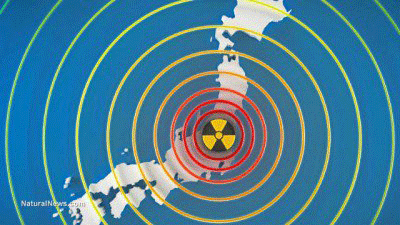
SCMP, 10 July 23, This week, the International Atomic Energy Agency (IAEA) said that Japan’s plan to release radioactive water from the Fukushima nuclear disaster in 2011 into the ocean meets international safety standards.
But instead of allaying concerns of neighbouring countries and activists, the stamp of approval from the global nuclear watchdog has drawn howls of disapproval, particularly from China, and even within Japan.
………………. The China Atomic Energy Authority said that more than 70 per cent of nuclear-contaminated water at the Fukushima nuclear power plant fails to meet discharge limits after going through a filtration system and requires further treatment.
Its secretary general, Deng Ge, said that even if international standards are met, the IAEA cannot prove that the discharge is the only or the best option for the disposal of nuclear-contaminated water………………………………………………………..
Not letting their own government off the hook, Japanese activists said they are very disappointed by the IAEA decision, arguing that Tokyo has gone back on its promise that the water would not be released until the plan received the public’s widespread acceptance.
Even though South Korea said that it respects the nuclear watchdog’s endorsement of Japan’s plan to release treated water into the ocean, Seoul also made it clear that it would issue its own assessment of the IAEA’s findings.
The IAEA report and an earlier offer by South Korean Prime Minister Han Duck-soo to drink treated Fukushima water had clearly done little to convince the country’s activists, fisheries and seafood industries, even its consumers, many of whom had stockpiled sea salt and other seafood items…………………..
Earlier this year, Pacific island nations also called on Japan to delay the release of water from the destroyed Fukushima nuclear power plant over fears that fisheries will be contaminated…………………………
more https://www.scmp.com/economy/global-economy/article/3227113/global-impact-japan-nuclear-watchdog-under-intense-scrutiny-over-discharge-fukushima-nuclear
Safe or septic – Japan’s nuclear wastewater dumping
RNZ, From The Detail, Tom Kitchin, co-host of The Detail @inkitchnz tom.kitchin@rnz.co.nz 11 July 23
There are diplomatic headaches and heated scientific debates after Japan revealed plans to dump the wastewater it’s been using to cool the Fukushima nuclear power plant – in the Pacific.
…………………………… Sea and ground water has been used to cool the damaged reactors, and now there’s about 1.3 million tonnes of that sitting in tanks while the Japanese government and plant operator Tokyo Electric Power Company (TEPCO) figure out what to do with it.
They want to release the wastewater into the ocean – diluting all the cancer-causing nuclear fission products out of it – such as caesium, which can build up in muscles, strontium-90 which can build up in bones and iodine-129 which can build up in the thyroid.
…………………………………………. journalist Nic Maclellan, a Melbourne-based correspondent with Islands Business Magazine, tells The Detail.
“The Pacific Islands Forum has been especially critical, and appointed an independent scientific panel to investigate safety issues around the proposed dumping,” he says.
“The panel has raised a series of issues around the quality of the sampling, the cost of the sampling, the cost of the programme over decades, the maintenance of safety sampling and the fact that they really don’t know whether Japan can maintain the quality that will stop other radioactive isotopes being released into the ocean.”
There are also questions over whether the wastewater dump is a breach of the Treaty of Rarotonga, signed in 1985, which created a South Pacific nuclear-free zone.
It was largely about nuclear weapons, but article seven talks about preventing nuclear waste dumping.
“Japan has been acting as if these safety concerns are not serious and it’s taken a lot of pressure for Japan to be dragged kicking and screaming into addressing questions, many of which are still unresolved,” Maclellan says.
AUKUS is also a factor now – a security pact between Australia, the United Kingdom and United States. The main news out of that is the US and UK will help Australia get nuclear-powered submarines.
“The nuclear submarines are a breach of the spirit of the Rarotonga treaty. There’s going to be interesting debates about a technical definition of whether this is… a breach of the letter as well as the spirit,” Maclellan says. https://www.rnz.co.nz/programmes/the-detail/story/2018897817/safe-or-septic-japan-s-nuclear-wastewater-dumping
Archbishop to denounce nuclear arms on Trinity test’s 78th anniversary
Jul. 10—The first atomic blast that lit up the early morning sky at the Trinity Site in south-central New Mexico on July 16, 1945 — an event that opened the door for two nuclear bombs to be dropped on Japan — had an immense impact on the state that is still felt to this day.
Santa Fe Archbishop John Wester will mark the 78th anniversary of the Trinity test by denouncing the nuclear weapons program that has escalated since the long-ago detonation in a remote desert, and for which New Mexico finds itself in a primary role.
Wester and anti-nuclear groups are organizing an event Sunday at the Santa Maria de la Paz Community Hall, featuring speakers, music, exhibitions and moments of reflection and prayer on the atomic blast that reshaped civilization. The public can attend or livestream it;
We can no longer deny or ignore the extremely dangerous predicament of our human family,” Wester said in a statement. “We are in a new nuclear arms race far more dangerous than the first, and I believe we need to rejuvenate a sustained, serious conversation about universal, verifiable nuclear disarmament.”
Because of Trinity, New Mexico will be forever linked to the two bombs dropped on the Japanese cities of Hiroshima and Nagasaki. The bombs, credited by many with hastening the war’s end and saving tens of thousands of American lives, killed more than 200,000 Japanese people and inflicted radiation poisoning on much of the populace.
The atomic test released radioactive fallout in downwind communities in New Mexico, causing fatal illnesses such as cancer in what many believe are a large number of residents, though the actual quantity remains unknown because the federal government didn’t track such aftereffects as part of the secrecy surrounding the project………………………………………………… more https://news.yahoo.com/archbishop-denounce-nuclear-arms-trinity-033300743.html?guccounter=1&guce_referrer=aHR0cHM6Ly9uZXdzLmdvb2dsZS5jb20v&guce_referrer_sig=AQAAADJqdcGm_qX6CdNLQ8_g7p81OistELVP4KvAUR1PfQl-0Q2SBtdSRa8GwdKyTIcwvX8aofXxou_a1DmL9axGTUu9S4o5f35bRYrwMTXGG5ZaoooE2PgjQaFWi5uLyJbf3gg8EShjtVi5A26UqvyJcSYMPWp9GQCX2T9NlsjflzJW
Ukraine stepping up mercenary recruitment effort
High battlefield losses have reportedly forced Kiev to look elsewhere after a reduction in hired guns from Europe
Ukrainian units formed from foreign mercenaries have suffered high battlefield casualties, forcing Kiev to change its approach to finding hired fighters, the Russian Defense Ministry claimed on Monday.
In a statement, the ministry alleged that the Ukrainian military command views foreign fighters as cannon fodder, sending them into the riskiest missions and placing them at the back of the line when it comes to the evacuation of injured troops. This has made recruiting fighters in European countries such as Poland much harder for Kiev, the assessment claimed.
……………………………….. Ukraine created the so-called International Legion for what it describes as foreign volunteers fighting for its cause. https://www.rt.com/russia/579490-ukraine-foreign-fighters-recruitment/
Ukraine admits responsibility for terror attack on Crimean bridge
Rt.com, 9 Jul 23
The strike sought to derail Russian logistics, a deputy defense minister has said
Ukraine has, for the first time, apparently admitted playing a role in the deadly attack on the Crimean Bridge last autumn. The incident belongs in the list of achievements for the country’s armed forces, a senior official has claimed.
While Moscow has repeatedly claimed that the attack was staged by the Ukrainians, officials in Kiev had never before directly admitted responsibility.
On Saturday, Ukrainian Deputy Defense Minister Anna Maliar published a post on Telegram commemorating 500 days since the start of the conflict between Kiev and Moscow, outlining several highlights.
The list includes an apparent public acknowledgment of Kiev’s role in the attack on the key link between the eastern part of the Russian peninsula and the rest of the country. “[It has been] 273 days since the first strike was conducted on the Crimean bridge to break the Russian logistics,” Maliar wrote.
The Crimean Bridge was damaged in a truck explosion last October, resulting in several people dead and serious damage to the facility. It has been fully repaired since……………………
Shortly after the incident, several Western media outlets reported, citing sources, that Kiev was indeed behind the explosion.
https://www.rt.com/russia/579419-crimean-bridge-ukraine-milestone/—
Cluster Bombs for Ukraine? A Warning From Kosovo
SCHEERPOST, by EDITORJuly 10, 2023
With Washington poised to ship cluster bombs to Kyiv, Declassified visits Kosovo to review the grim legacy of NATO firing this banned weapon in the Balkans.
By Phil Miller / Declassified UK
GRACANICA, KOSOVO – “In the village where we lived, there were nine bombs dropped by NATO in the space of two minutes,” Dzafer Buzoli recalls, as we discuss his traumatic childhood in Yugoslavia. A leading member of Kosovo’s Roma, his community went from pillar to post.
Many were dragooned into Slobodan Milosevic’s Serb-dominated Yugoslav army or targeted by Albanian rebels as suspected collaborators, before Bill Clinton and Tony Blair launched their ‘humanitarian intervention’ in 1999.
“When the first bomb fell, we were just confused and wondered what was happening,” he reflects. “But after the second bomb I felt the hot air and fell down from the pressure of the blast.
“Ever since then I’ve had a heightened sense of hearing. When there’s a loud noise or people yelling I have to really back up, because it’s too much for me.”
Buzoli was lucky to survive the airstrike. Two soldiers and a five year old boy were killed in the attack on his village of Laplje Selo, which was hit with controversial cluster munitions.
These scatter a blizzard of ball-shaped bomblets over target areas, like a minefield falling from the sky. Human Rights Watch said NATO killed between 90 and 150 civilians with this weapon across Serbia and Kosovo.
Thousands of bomblets failed to detonate on impact, posing a hazard to children who mistook their little yellow parachutes for toys. In the decade after the war, these remnants claimed another 178 casualties in Kosovo.
While this war might seem like a distant memory for those beyond the Balkans, it offers a cautionary tale to Western states now assisting Ukraine’s fight against Russia.
US officials are said to be seriously considering supplying Kyiv with cluster bombs, possibly as soon as next month.
That’s despite the weapon being banned by more than 120 countries including the UK, following a UN treaty in 2008. ……………………………………………………………………………………………………..
Clearing the remnants of these weapons from Kosovo is not expected to finish until 2024 – a quarter century after the war ended.
That marathon process, coupled with dubious performance on the battlefield, might give Joe Biden pause for thought about sending cluster bombs to Ukraine. https://scheerpost.com/2023/07/10/cluster-bombs-for-ukraine-a-warning-from-kosovo/
TODAY. Nuclear power is SO IRRELEVANT – to climate! It’s almost funny, -but it’s NOT funny.

Today, Australia’s Prime Minister is in Germany, to joining several countries, including other big carbon polluters, in a “Climate Club” to preach about “zero carbon emissions by 2050”.
2050? It’s too late – big boys!
The Australian big boys, like those of USA – will pay lip service to a worthy principle – but it’s pointless, because Climate Change – better named as Global Heating – is upon us NOW.
The job now is to slow the Global Heating process down – by energy conservation, truly renewable energy. The job is also justice, fairness, global effort to help those most affected by the heat, floods, fires – now raging.
Oh and what about nuclear power? And those stupid little “small modular nuclear reactors (SMRs)”?
Well, one or two of them might be working commercially by 2050, having no effect on climate change.
But of course, that’s not the point, is it? Small nuclear reactors are for weaponry, for nuclear submarines etc. Those powerful blokes, (and a few token women) – they love weaponry, high-technology for killing people – war is such fun!
So they just lie about “SMRs to solve climate change”

Will the Ukraine war be the undoing for the European Union?

The European Union’s missed opportunities and self-destructive path
6 JULY 2023, MICHAEL VON DER SCHULENBURG
With the ending of the division of Europe, we will strive for a new quality in our security relations while fully respecting each other’s freedom of choice in that respect. Security is indivisible, and the security of every participating state is inseparably linked to that of all the others. We therefore pledge to cooperate in strengthening confidence and security among us and in promoting arms control and disarmament.
(Charter of Paris for a New Europe November 21, 1990)
The madness of war reigns again in Europe. The delusion that only weapons provide security is once again in high season among politicians, think tanks, and the media across Europe. It has become acceptable once again in Europe that human sacrifices are being offered at the altar of alleged decisive battles. As if we had learned nothing from the past, the Ukrainian counter-offensive is now supposed to become such a decisive battle that it should bring a military solution to what we could not or did not want to achieve politically. In doing so, we Europeans are leaving the future of Ukraine and Europe, and perhaps even that of the world, to the unpredictability, fury, and brutality of the battlefield. And all of this, although it remains completely unclear what “solution” could be expected through the present intensification of the war, will certainly not bring peace to Europe.
This war has increasingly become a war between Russia and NATO, with nuclear weapons playing a decisive role in military calculations. No one can say where the red lines would be in such a “decisive battle,” beyond which there could be a nuclear escalation. By ignoring this and continuing all-out war efforts, we are exposing not only ourselves but all of humanity to incalculable danger in a conflict that could have been resolved diplomatically.
Despite all those enormous dangers, finding a peaceful solution to the underlying conflict that triggered the war—NATO’s planned expansion into Ukraine and Georgia—appears no longer to be possible among NATO, Ukrainian, and Russian politicians. This is appalling political irresponsibility, for which we cannot blame only Ukraine, Russia, or the United States. The European Union and its member states also bear considerable responsibility for the catastrophe that has now befallen Europe. As this is a war on European soil and between European countries, the EU, as the largest community of states on the European continent, cannot just pretend it had no part in all of this. Indeed, the EU and its members carry heavy blame for failing to prevent this war, for escalating the war, and for refusing a negotiated solution to this war!
The 27 EU members hold the majority among NATO members and could, or better yet, should have used their influence to prevent this war and, once it had broken out, to end it as quickly as possible. In the conflict over NATO’s eastward enlargement, which had been brewing since 1994, the EU, in its own interests, should have tried to mediate between the geopolitical ambition of the USA in expanding its global dominance and Russia’s fears of being militarily encircled by NATO and cut off from its access to the Black Sea. After the war broke out, the EU should have supported the Russian-Ukrainian peace negotiations in March or April 2022 and attended the Istanbul peace summit. It could have ended the war one month after it started. However, the EU didn’t do either.
Instead, the EU aggressively supported NATO’s eastward expansion as well as its own eastward enlargement. It must have been clear to EU politicians that with their support, Europe has been put on a path of confrontation, a confrontation that has now led to war with Russia…………………………..
Yet peace, not war, should be the EU’s main concern. However, the EU has neither developed its own peace proposal nor undertaken any diplomatic peace initiative, and it remains firmly opposed to any immediate ceasefire. The EU continues to insist on the maximum demands in the Zelensky peace plan: that Russia must first be defeated militarily and that the entire Ukrainian territory must be recaptured before negotiations can take place. With this uncompromising stance, the EU stands alone in the world. None of the world’s major regional organizations, whether the G20, the BRICS countries, the states of Central Asia, the Shanghai Cooperation Organization, ASEAN, the African Union, the OIC, or CELAC, support such a demand. Even the US is increasingly skeptical, and the voices of influential US politicians are growing stronger in favor of a negotiated peace with Russia to end the war.
This path of confrontation and escalation taken by the EU was in no way preordained or even inevitable.
In 1990, only one year after the end of the Cold War, all European states, as well as the USA and Canada, solemnly pledged, in the “Charter of Paris for a New Europe”, to build a common peaceful Europe spanning from the Pacific to the Atlantic coast, including Russia, a Europe that would be free of wars and military blocs. According to the Charter, the security of each state in Europe should now be regarded as inseparable from that of all other states, and any conflict that arises should be settled peacefully in accordance with the UN Charter. In other words, a lasting peace in Europe could only be created by working together and not against each other. There was no role envisaged for NATO; NATO was not mentioned once in the Charter of Paris.
And yet, early on, the EU abandoned the Charter of Paris for a New Europe and opted for a Europe dominated by NATO, a Cold War military alliance. Such a drastic reorientation was not in Europe’s interest…………………………………………………………………………… It was NATO’s advance to Russia’s borders that triggered Russia’s military backlash, not the other way around.
The EU member states should have known better and avoided a war in Ukraine. Already in the First and Second World Wars, control of the territory that today constitutes Ukraine was of great strategic importance for Russia (the Soviet Union), and the German Kaiser-Nazi Reich, leading to some of the fiercest military battles in these wars. The recently discovered remains of German Wehrmacht soldiers found in the now dried-up riverbed of the Dnieper bear witness to these terribly bloody “decisive battles.” Is history repeating itself?
Then, as now, each side took advantage of the internal divisions among the Ukrainian population. Even after Ukraine’s independence in 1991, presidential and parliamentary elections regularly showcased the country’s deep division into two roughly equal parts with pro-Ukrainian and pro-Russian loyalties, a division that also geographically divides the country between western and central Ukraine on the one hand and eastern and southern Ukraine on the other.
In the last free all-Ukrainian elections in 2010 and 2012, in which people living in Crimea and the Donbass still participated, there was even a narrow majority for a pro-Russian president and pro-Russian parliament.
If the EU had really been concerned with preserving and strengthening Ukraine, it should have supported the cohesion and striving for harmony between the two populations and vigorously promoted the continuation of the project of a bi-national and federal Ukraine, as proclaimed in 1991. However, it did the opposite and sided with a policy of mono-ethnic Ukrainian nationalism.
In the last free all-Ukrainian elections in 2010 and 2012, in which people living in Crimea and the Donbass still participated, there was even a narrow majority for a pro-Russian president and pro-Russian parliament.
If the EU had really been concerned with preserving and strengthening Ukraine, it should have supported the cohesion and striving for harmony between the two populations and vigorously promoted the continuation of the project of a bi-national and federal Ukraine, as proclaimed in 1991. However, it did the opposite and sided with a policy of mono-ethnic Ukrainian nationalism…………………………………………………………………………….
While constantly proclaiming a desire to help Ukraine, the EU is de facto contributing to its destruction and immense human suffering. The weapons supplied by the EU not only prolong the war but also contribute to death and destruction on Ukrainian territory, just like Russian weapons do.
Today, Ukraine may not only be the most destroyed country in Europe but also the politically and ethnically most deeply divided country. After a year and a half of war, Ukraine, which was already the poorest country in Europe before the war, has been driven deeper into poverty and foreign debt while becoming the most militarized country in Europe. The Ukrainian economy is in ruins and plagued by one of the highest levels of corruption in Europe. Ukraine is also the country with the fastest-shrinking population in Europe. Moreover, Ukraine could lose up to 20% of its territory as well as its access to the Azov and Black Seas. How can Ukraine survive as a functioning state under such conditions?
…………………………………………………………………………………………………… The next president of the USA does not necessarily have to be called Trump, but we can assume that the USA will turn its back on the expensive Ukraine adventure after next year’s presidential election,
………………………………………………To prevent hurting itself and save Ukraine, the European Union must, out of its own self-interest, distance itself from its self-righteous war narrative, abandon the militarization of its foreign policy, and stop believing that NATO enlargement will bring security. The European Union must return to a language of peace and develop a peace plan for Europe that is built on the “Charter of Paris for a New Europe” and includes Russia and Ukraine. In doing so, the EU would prevent further bloodshed in Europe, forestall the danger of internal frictions breaking out within its members, and prevent its own economic decline. This would help improve the EU’s standing in the world as the peace project it was once conceived as after the Second World War. For this, it will need courage—peace requires a lot of courage! https://www.meer.com/en/74782-will-the-ukraine-war-be-the-undoing-for-the-european-union
US cluster bombs deal is clear signal that war is not going well for Ukraine
America risks losing the moral high ground by supplying Ukraine with a weapon banned by much of the world, so why are they supplying it?
Mark Stone, US correspondent @Stone_SkyNews
The White House is fully aware of the huge controversy surrounding this cluster munitions decision.
Some 123 countries are part of the 2008 International Convention on Cluster Munitions which bans the use or transfer of this particular weapon.
Almost all of America’s allies are signatories to the convention.
Even within US government circles, there has been deep unease about supplying its own stockpile of cluster munitions to Ukraine.
Ukraine war latest: US to send Kyiv controversial weapon banned by more than 100 countries
As recently as last week, within the state department, there was division about the decision to supply the weapon.
The long and grim record of the cluster bomb explains the unease and the controversy.
Globally, civilians represent 97% of cluster munition casualties, according to a report last year by the Landmine and Cluster Munition Monitor – an organisation that seeks to ban them altogether.
Children are overwhelming the victims.
By supplying the weapon, there is a clear risk to civilians, not now necessarily, but in the future. The legacy of unexploded cluster bomblets is evident on former battlefields globally.
America also risks losing the moral high ground against Russia by supplying a weapon banned by much of the world.
So why supply it?
Well, the facts on the ground are not in Ukraine’s favour. The transfer is a clear signal that the war is not going well for Ukraine.
The so-called spring offensive did not materialise in the spring and looks set to falter through the summer too.
Ukraine is fast running out of more conventional artillery with supply stocks in America and elsewhere running low.
A ‘bridge of supply’ is necessary.
………………. The munitions would be used by Ukraine on occupied Ukrainian soil. The risk to civilians would be owned by Ukraine. The onus would be on Ukraine, with a pledge of American help, to clear the unexploded munitions when the war comes to an end.
The announcement is part of a multi-million dollar tranche of new weaponry which is an attempt by the Biden administration to future-proof the conflict; to give Ukraine the weapons it needs now in case domestic political circumstances change in the next 18 months.
American politics is in flux.
There is no guarantee of open-ended support for Ukraine. https://news.sky.com/story/us-cluster-bombs-deal-is-clear-signal-that-war-is-not-going-well-for-ukraine-12917101
1 This Month
15 October. Joint Appeal for Nuclear Abolition Day -presentation to the UN on October 15 will be live on UNWebTV
Endorse the Nuclear Abolition Day Appeal
23-25 October – on Zoom – World BEYOND War’s annual global conference

To see nuclear-related stories in greater depth and intensity – go to https://nuclearinformation.wordpress.com
-
Archives
- October 2026 (149)
- September 2026 (339)
- August 2026 (330)
- July 2026 (355)
- June 2026 (287)
- May 2026 (306)
- April 2026 (356)
- March 2026 (251)
- February 2026 (267)
- January 2026 (308)
- December 2025 (358)
- November 2025 (359)
-
Categories
- 1
- 1 NUCLEAR ISSUES
- business and costs
- climate change
- culture and arts
- ENERGY
- environment
- health
- history
- indigenous issues
- Legal
- marketing of nuclear
- media
- opposition to nuclear
- PERSONAL STORIES
- politics
- politics international
- Religion and ethics
- safety
- secrets,lies and civil liberties
- spinbuster
- technology
- Uranium
- wastes
- weapons and war
- Women
- 2 WORLD
- ACTION
- AFRICA
- Atrocities
- AUSTRALIA
- Christina's notes
- Christina's themes
- culture and arts
- Events
- Fuk 2022
- Fuk 2023
- Fukushima 2017
- Fukushima 2018
- fukushima 2019
- Fukushima 2020
- Fukushima 2021
- general
- global warming
- Humour (God we need it)
- Nuclear
- RARE EARTHS
- Reference
- resources – print
- Resources -audiovicual
- Weekly Newsletter
- World
- World Nuclear
- YouTube
-
RSS
Entries RSS
Comments RSS

