General Mark Milley had a point – USA should have pushed for peace talks on Ukraine
Politico, By ALEXANDER WARD, LARA SELIGMAN, MATT BERG and ERIC BAZAIL-EIMIL 08/18/2023
The conversation about Ukraine’s counteroffensive has shifted from one of excitement to disappointment, as Kyiv’s slow gains lead some U.S. officials and insiders alike to whisper: Should we have listened to Gen. MARK MILLEY?
In November, the Joint Chiefs chair said Ukraine’s strong military position and upcoming winter season combined to make a good time to consider peace talks. Plus, operations to expel Russian forces out of the whole of Ukraine –— which VOLODYMYR ZELENSKYY demands — had a slim chance of success. Administration officials immediately scrambled to assure their counterparts in Kyiv that Milley was riffing and not reflecting a secret sentiment in the White House.
But listen to Milley lately, and you can hear the implicit “I told you so.”
“If the end state is Ukraine is a free, independent, sovereign country with its territory intact, that will take a considerable level of effort yet to come,” he told The Washington Post this week. “That’s gonna take a long, long time, but you can also achieve those objectives — maybe, possibly — through some sort of diplomatic means.”
One U.S. official, who didn’t want to run afoul of the administration by offering real views on the record, said the realities of the counteroffensive are sinking in around Washington. Ukraine’s tactics to preserve troops and equipment, Russia’s dug-in positions and the fight on multiple fronts have led to slow advances, shifting a possible breakthrough further into the future.
While the U.S. still backs Ukraine’s fight, the official said, “We may have missed a window to push for earlier talks………………………………… more https://www.politico.com/newsletters/national-security-daily/2023/08/18/milley-had-a-point-00111878
Risk of cancer death after exposure to low-dose ionizing radiation underestimated, suggests nuclear industry study

by British Medical Journal, 16 Aug 23, https://medicalxpress.com/news/2023-08-cancer-death-exposure-low-dose-ionizing.html
Prolonged exposure to low-dose ionizing radiation is associated with a higher risk of death from cancer than previously thought, suggests research tracking the deaths of workers in the nuclear industry, published in The BMJ.
The findings should inform current rules on workplace protection from low-dose radiation, say the researchers.
To date, estimates of the effects of radiation on the risk of dying from cancer have been based primarily on studies of survivors of atomic bombs dropped on Japan at the end of the Second World War.
These estimates are used to set the level of protection required for workers regularly exposed to much lower doses of radiation in the nuclear industry and other sectors such as health care.
But the latest data from the International Nuclear Workers Study (INWORKS) suggest that risk estimates, based on the acute exposures among atomic bomb survivors to an extremely high dose of radiation, may underestimate the cancer risks from exposure to much lower doses of ionizing radiation delivered over a prolonged period in the workplace.
The researchers therefore tracked and analyzed deaths among 309,932 workers in the nuclear industry in the UK, France, and the US (INWORKS) for whom individual monitoring data for external exposure to ionizing radiation were available.
During a monitoring period spanning 1944 to 2016, 103,553 workers died: 28,089 of these deaths were due to solid cancers, which include most cancers other than leukemia.
The researchers then used this information to estimate the risk of death from solid cancers based on workers’ exposure to radiation 10 years previously.
They estimated that this risk increased by 52% for every unit of radiation (Gray; Gy) workers had absorbed. A dose of one Gray is equivalent to a unit of one Joule of energy deposited in a kilogram of a substance.
But when the analysis was restricted to workers who had been exposed to the lowest cumulative doses of radiation (0-100 mGy), this approximately doubled the risk of death from solid cancers per unit Gy absorbed.
Similarly, restricting the analysis only to workers hired in more recent years when estimates of occupational external penetrating radiation dose were more accurate also increased the risk of death from solid cancer per unit Gy absorbed.
Excluding deaths from cancers of the lung and lung cavity, which might be linked to smoking or occupational exposure to asbestos, had little effect on the strength of the association.
The researchers acknowledge some limitations to their findings, including that exposures for workers employed in the early years of the nuclear industry may have been poorly estimated, despite their efforts to account for subsequent improvements in dosimeter technology—a device for measuring exposure to radiation.
They also point out that the separate analysis of deaths restricted to workers hired in more recent years found an even higher risk of death from solid cancer per unit Gy absorbed, meaning that the increased risk observed in the full cohort wasn’t driven by workers employed in the earliest years of the industry. There were also no individual level data on several potentially influential factors, including smoking.
“People often assume that low dose rate exposures pose less carcinogenic hazard than the high dose rate exposures experienced by the Japanese atomic bomb survivors,” write the researchers. “Our study does not find evidence of reduced risk per unit dose for solid cancer among workers typically exposed to radiation at low dose rates.”
They hope that organizations such as the International Commission on Radiological Protection will use their results to inform their assessment of the risks of low dose, and low dose rate, radiation and ultimately in an update of the system of radiological protection.
More information: Cancer mortality after low dose exposure to ionising radiation in workers in France, the United Kingdom, and the United States (INWORKS): cohort study, The BMJ (2023). DOI: 10.1136/bmj-2022-074520
Journal information: British Medical Journal (BMJ)
Japan’s nuclear plants are short of storage for spent fuel. A remote town could have the solution.
Chugoku Electric’s plan to build a nuclear power plant in Kaminoseki has been stalled for more than a decade since the Fukushima Daiichi disaster, delaying subsidies for the remote town, whose population is aging and shrinking.
“The town will only get poorer if we just keep waiting,” Kaminoseki Mayor Tetsuo Nishi – “We should do whatever is available now.”
ByMARI YAMAGUCHI Associated Press, https://abcnews.go.com/Business/wireStory/japans-nuclear-plants-short-storage-spent-fuel-remote-102373016 August 19, 2023
TOKYO — A Japanese town said Friday it has agreed to a geological study to determine its suitability as an interim storage site for spent nuclear fuel.
Kaminoseki, a small town in the southwestern prefecture of Yamaguchi, said it would accept the offer of a survey by Chugoku Electric Power Co., one of two major utility operators, along with Kansai Electric Power Co., whose spent fuel storage pools are almost full.
The Japanese government is promoting the greater use of nuclear power as a low-carbon energy source, but the country’s nuclear plants are running out of storage capacity.
The problem stems from Japan’s stalled nuclear fuel recycling program to reprocess plutonium from spent fuel for reuse. The government has continued to pursue the program, despite serious technical setbacks. A plutonium-burning Monju reactor failed and is being decommissioned, while the launch of the Rokkasho reprocessing plant in northern Japan has been delayed for almost 30 years.
After the meltdown of the Fukushima Daiichi nuclear power plant in 2011, many reactors were temporarily taken offline and their restarts delayed, helping to reduce the spent fuel stockpile.
However, when Prime Minister Fumio Kishida’s government decided to reverse a phaseout and maximize nuclear power as clean energy, concerns over the lack of storage space were rekindled.
Earlier this month, Chugoku put forward a proposal to build a storage facility jointly with Kansai Electric, but the plan was met by angry protests from residents, who surrounded the mayor and yelled at him.
Chugoku Electric’s plan to build a nuclear power plant in Kaminoseki has been stalled for more than a decade since the Fukushima Daiichi disaster, delaying subsidies for the remote town, whose population is aging and shrinking.
“The town will only get poorer if we just keep waiting,” Kaminoseki Mayor Tetsuo Nishi told a televised news conference Friday. “We should do whatever is available now.”
Kansai Electric, Japan’s largest nuclear plant operator, is urgently seeking additional storage for spent fuel: the cooling pools at its plants are more than 80% full. The company pledged to find a potential interim storage site by the end of this year.
About 19,000 tons of spent fuel, a byproduct of nuclear power generation, is stored at power plants across Japan, taking up about 80% of their storage capacity, according to the economy and industry ministry.
The continuation of spent fuel reprocessing program and the delay have only added to Japan’s already large plutonium stockpile, raising international concern. Japan also lacks a final repository for high-level nuclear waste.
An intermediate facility is designed to keep nuclear spent fuel in dry casks for decades until it is moved to a reprocessing or to a final repository. Experts say it is a much safer option than keeping it in uncovered cooling pools at their plants.
If the storage is actually built, it will be the second such facility in Japan. The only other one is in Mutsu, near Rokkasho, which is reserved for Tokyo Electric Power Co. and a smaller utility.
Lukashenko shares thoughts on future of Ukraine
https://www.rt.com/russia/581437-lukashenko-ukraine-interview-recap/— 18 Aug 23
Kiev should sue for peace before it loses the remnants of its sovereignty, the leader of Belarus said in an interview
Ukraine needs to stop the war and start rebuilding its statehood on a healthier foundation before it ceases to exist completely, Belarusian President Alexander Lukashenko said in an interview with Ukrainian journalist Diana Panchenko on Thursday.
1 Ukraine could lose everything
Ukraine could lose all of its territory if it chooses to continue fighting, Lukashenko said, insisting that Kiev should first “end the war” in order to preserve its statehood. “Yes, you can continue to struggle for these territories,” he said, pointing to Donbass, Kherson and Zaporozhye on the map. “I’m not telling you to give them up or anything. But choose another method. If you fight for these territories, you will lose those,” he added, pointing to the areas further west.
2 Conflict was avoidable
“The war was avoidable… at any point in time. It can be stopped now and it could have been avoided then,” Lukashenko said, noting that in 2015, he was at the heart of events and facilitated communication between then-President of Ukraine Pyotr Poroshenko and Russian President Vladimir Putin.
“The Minsk agreements should have been implemented. We agreed on everything… But they were ignored,” he said, adding that Putin was “100% ready” to implement the agreements, but Poroshenko was “afraid that the wrong people would have been elected” if Donbass returned to Ukraine as an autonomous region.
3 Belarus will go to war if Ukrainians cross the border
Lukashenko stated that Minsk will “keep helping our ally Russia,” but if “Ukrainians do not cross our border, we will never get involved in this hot war.” He went on to say that dozens of NATO and other countries are backing Ukraine with military coordination, intelligence, and training, as well as ammunition and weapons supplies, while “only Belarus is openly helping Russia.”
4 Russia has enough firepower
Lukashenko also rejected as “complete nonsense” the notion that Putin is pressing him to become more involved in the conflict. He observed that Russia has more than enough manpower and firepower to reach its goals, saying, “an additional 70,000 troops will change nothing.”
5 Putin withdrew troops from Kiev to avoid civilian casualties
The Belarusian leader dismissed suggestions that Ukrainian President Vladimir Zelensky protected Kiev and that the Ukrainian army repulsed the early Russian invasion, calling the idea a “fairy tale… cooked up by mass media and Zelensky himself, in order to present him as a hero.” Lukashenko claimed that, at the time, Putin told him Kiev could be captured “right away, instantaneously, but a huge number of people will die.”
Lukashenko noted that Ukrainian forces had deployed not only tanks but multiple-launch rocket systems in the streets of Kiev, near “kindergartens, schools, hospitals,” and other public buildings. “You probably know that the Russian troops, who were on the outskirts of Kiev, withdrew from there. Did [Zelensky] destroy the Russian army there? No… He was sitting in a root cellar at the time,” Lukashenko said.
6 Main Russian objective already achieved
Moscow has already reached the principal aim of its military operation in Ukraine, the Belarusian president continued, explaining that “Ukraine will never be so aggressive towards Russia after this war ends, as it was before. Ukraine will be different. People in power [there] will be more cautious, smart – more cunning if you will.”
7 Zelensky ready to surrender western Ukraine to Poland
Lukashenko believes that in order to get Ukraine into NATO, Zelensky might go as far as to surrender part of the country’s territory under a Polish protectorate. However, he said “Ukrainians themselves will not let it happen.”
If they come in, they will not go away, because Americans are standing behind Poland. Well, this will be Polish territory. Why would NATO not accept them in this case? It will already be Polish territory,” Lukashenko said.
“This is unacceptable for us and for Russians. It is necessary to preserve Ukraine’s integrity, so that the country will not be sliced up and divided by other countries. Negotiations come next,” he added.
8 Ukraine is not Zelensky, and Zelensky is not Ukraine
Lukashenko claimed that Ukrainians are increasingly disenchanted with Zelensky, who is not a “national hero,” but an image created for international audiences by the Western propaganda machine, drawing parallels to how, before the Soviet Union’s collapse, the West “went into raptures about Gorbachev” in a similar fashion.
“People in Ukraine are beginning to see things clearly. And millions of people who fled the country are raising their voices saying that they want to return home and asking why the war is still going on,” he said. “There is a growing understanding that Zelensky should find a way out of this situation, to put it mildly.”
9 Only the United States benefits from the war
The Belarusian leader said the US-led forces seek to weaken Russia with the help of Ukraine. “It does not bother them that the Slavic peoples are fighting with each other, and killing each other. It is beneficial for them. Thus, having weakened Russia, they will get closer to China from this side. That’s their rationale. Zelensky is playing along. But in the end, Ukraine – a flourishing, beautiful country blessed with natural resources – will cease to exist.”
‘The Greatest Fighting Force in Human History’ – The Perpetual Wars You Aren’t Supposed to Notice
byEDITOR August 17, 2023
By William J. Astore / TomDispatch.com
In his message to the troops prior to the July 4th weekend, Secretary of Defense Lloyd Austin offered high praise indeed. “We have the greatest fighting force in human history,” he tweeted, connecting that claim to the U.S. having patriots of all colors, creeds, and backgrounds “who bravely volunteer to defend our country and our values.”
The nuclear industry needs to show it can deliver economically viable big reactors in time and on budget.

Power projects in the west are too often delayed and over budget
Ft.com THE EDITORIAL BOARD 18 Aug 23
A UK parliamentary committee recently urged the government to come up with a strategy, rather than vague targets, to more than triple nuclear generating capacity by 2050. In the US, the Vogtle 3 unit began delivering electricity to Georgia’s power grid — the first reactor the country has built from scratch in more than three decades. Yet the fact that Vogtle 3 and the coming unit 4 might also be among the last big US reactors to be built is a sign of the questions over such plants, despite their promise……………………………….
nuclear is much more expensive than renewables, whose cost has come down sharply, even when everything runs smoothly, which it rarely does. The challenge of safely storing nuclear waste has not been entirely resolved. And recent experience in Europe and the US is almost entirely of projects being completed late and over budget. That has put off private investors, too.
France’s EDF now says Hinkley Point C, Britain’s first new nuclear power station for almost 30 years, is likely to cost more than envisaged. EDF’s Flamanville-3 reactor in France is over a decade behind schedule. In the US, the $14bn original cost of Vogtle 3 and 4 has blown past $30bn.
Japan and South Korea have a better record, but Japan is not building overseas. South Korea’s Kepco, though it successfully built Abu Dhabi’s first nuclear plant, is facing a copyright lawsuit from America’s Westinghouse over using the same design elsewhere. China and Russia have completed multiple reactors largely on time, but few western nations want to buy from them.
Small modular reactors — cheaper and quicker to build — may start to play a role, but are still in development. So if nuclear power is to play the part many western governments envisage, the industry needs to improve financing, construction and supply chains, and demonstrate it can build big reactors within the time and resources allotted………………………………………………..
Many of the things engineers say are needed to keep nuclear costs down — better planning and communications, applying best practice — sound humdrum, but seem hard to achieve in real life. If “gigawatt-scale” reactors are to play their part in the west’s climate transition, the nuclear industry must be better at planning and execution. https://www.ft.com/content/2b5e0a50-dcf7-4932-a293-6fa82cebc027—
Back in another quagmire – in Biden’s relentless “Big Muddy” of Ukraine.
Walt Zlotow, West Suburban Peace Coalitioin. Glen Ellyn IL 18 Aug 23
Biden to Zelensky: ‘Here’s another $24 billion to further destroy your country.’
Ignoring US public opinion, President Biden wants and will get another $24 billion in weapons and other aid to keep the Russo Ukraine war bleeding out Ukraine in perpetuity.
That will ratchet up US aid to a gargantuan $137 billion, about half of which are weapons that have proved nearly worthless in Ukraine’s failed war and counteroffensive. Most honest military and administration officials admit Ukraine wasn’t ready for a counteroffensive and has suffered staggering death and disability of his forces thrown against nearly overwhelming Russian defenses.
While there is only darkness ahead in the tunnel of America’s proxy war against Russia, the Commander in Chief says ‘more, more, more weapons, but not one negotiation.’ He’s requested a supplemental emergency spending bill of $40 billion. Fearing recent polling showing 55% of voters oppose more Ukraine aid, Biden packaged the $24 billion for Ukraine with $16 billion for the Homeland. Congress wouldn’t dare vote down that needed domestic dough, ensuring passage of the endless waste of our treasure to ensure more death and destruction in Ukraine.
Back in ’68, protest song maestro Pete Seeger penned ‘Waste Deep In The Big Muddy’. It was an allegory of an Army squad leader, The Big Fool’, who forced his troops to wade The Big Muddy, a stream too deep to cross. It was a perfect take on the Big Fool LBJ, who keep pouring troops into the meat grinder of Vietnam with no chance of victory.
Here we are 55 years on with another quagmire in The Big Muddy…and the current Big Fool in the White House says to push on.
Finland’s OL2 nuclear reactor off grid; power prices rise
Reuters, August 18, 2023
OSLO, Aug 18 (Reuters) – Finland’s OL2 nuclear power reactor was shut down early on Friday and will remain offline until Aug. 28 due to problems caused by increased moisture in the facility’s turbine, operator TVO said, helping to pushing up electricity prices.
There was no impact on nuclear safety, TVO added.
The outage comes at a time of low wind power generation that has already lifted Finnish prices, according to Refinitiv analyst Petter Engblom Nordby.
Electricity prices for Friday soared up to 270 euros per megawatt hour (MWh) for hours where demand is typically highest, far exceeding prices in other parts of the Nordics and continental Europe, data from power exchange Nord Pool showed……………….. Reporting by Nora Buli in Oslo and Louise Rasmussen in Copenhagen, editing by Terje Solsvik https://www.reuters.com/business/energy/finlands-ol2-nuclear-reactor-off-grid-power-prices-rise-2023-08-18/
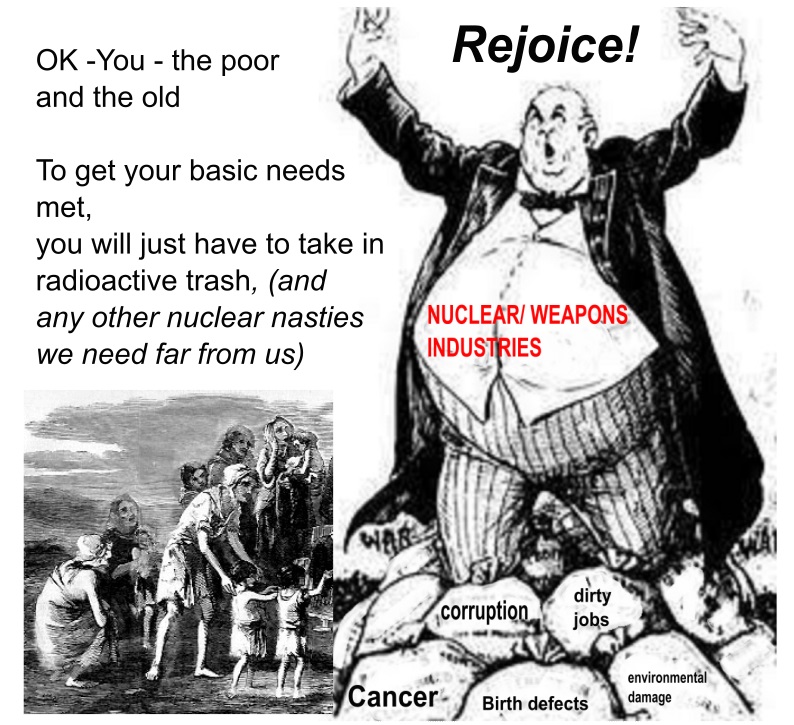
TODAY. Bribery and Blackmail: these are the tools for continuing success of the nuclear industry
The sociopaths who run this world assure us that disposal sites for radioactive trash wiil be found. And, these sites will be decided upon only with informed consent of the local community.
And they mean this – they sure do. Apart from all the technical blah blah – on safety etc, the really significant part will be the “goodies” that they will charitably bestow on the community.
It’s so simple. You find a poor, aging, struggling community. preferably remote, that is lacking in adequate medical educational, and other human services. They can’t seem to get these. Governments are slow to respond to their needs.
But then – hey presto ! Along comes the nuclear industry, and suddenly – purses open -and this poor community is suddenly grateful to have those essential facilities – that everyone else has got anyway , (without having to accept nuclear trash).
I was prompted to note this today, as one Japanese town [or more correctly, its Mayor], considers hosting a nuclear waste dump. – “The town will only get poorer if we just keep waiting,” Kaminoseki Mayor Tetsuo Nishi – “We should do whatever is available now.”
Earlier this month, Chugoku put forward a proposal to build a storage facility jointly with Kansai Electric, but the plan was met by angry protests from residents, who surrounded the mayor and yelled at him.
Assange Be Weary: The Dangers of a US Plea Deal

August 18, 2023
By Binoy Kampmark / CounterPunch, https://scheerpost.com/2023/08/18/assange-be-weary-the-dangers-of-a-us-plea-deal/
At every stage of its proceedings against Julian Assange, the US Imperium has shown little by way of tempering its vengeful impulses. The WikiLeaks publisher, in uncovering the sordid, operational details of a global military power, would always have to pay. Given the 18 charges he faces, 17 fashioned from that most repressive of instruments, the US Espionage Act of 1917, any sentence is bound to be hefty. Were he to be extradited from the United Kingdom to the US, Assange will disappear into a carceral, life-ending dystopia.
In this saga of relentless mugging and persecution, the country that has featured regularly in commentary, yet done the least, is Australia. Assange may well be an Australian national, but this has generally counted for naught. Successive governments have tended to cower before the bullying disposition of Washington’s power. With the signing of the AUKUS pact and the inexorable surrender of Canberra’s military and diplomatic functions to Washington, any exertion of independent counsel and fair advice will be treated with sneering qualification.
The Albanese government has claimed, at various stages, to be pursuing the matter with its US counterparts with firm insistence. Prime Minister Anthony Albanese has even publicly expressed his frustration at the lack of progress in finding a “diplomatic solution” to Assange’s plight. But such frustrations have been tempered by an acceptance that legal processes must first run their course.
The substance of any such diplomatic solution remains vague. But on August 14, the Sydney Morning Herald, citing US Ambassador to Australia Caroline Kennedy as its chief source, reported that a “resolution” to Assange’s plight might be in the offing. “There is a way to resolve it,” the ambassador told the paper. This could involve a reduction of any charges in favour of a guilty plea, with the details sketched out by the US Department of Justice. In making her remarks, Kennedy clarified that this was more a matter for the DOJ than the State Department or any other department. “So it’s not really a diplomatic issue, but I think there absolutely could be a resolution.”
In May, Kennedy met members of the Parliamentary Friends of Julian Assange Group to hear their concerns. The previous month, 48 Australian MPs and Senators, including 13 from the governing Labor Party, wrote an open letter to the US Attorney General, Merrick Garland, warning that the prosecution “would set a dangerous precedent for all global citizens, journalists, publishers, media organizations and the freedom of the press. It would also be needlessly damaging for the US as a world leader on freedom of expression and the rule of law.”
In a discussion with The Intercept, Gabriel Shipton, Assange’s brother, had his own analysis of the latest developments. “The [Biden] administration appears to be searching for an off-ramp ahead of [Albanese’s] first state visit to DC in October.” In the event one wasn’t found, “we could see a repeat of a very public rebuff delivered by [US Secretary of State] Tony Blinken to the Australian Foreign Minister two weeks ago in Brisbane.”
That rebuff was particularly brutal, taking place on the occasion of the AUSMIN talks between the foreign and defence ministers of both Australia and the United States. On that occasion, Foreign Minister Penny Wong remarked that Australia had made its position clear to their US counterparts “that Mr Assange’s case has dragged for too long, and our desire it be brought to a conclusion, and we’ve said that publicly and you would anticipate that that reflects also the positive we articulate in private.”
In his response, Secretary of State Blinken claimed to “understand” such views and admitted that the matter had been raised with himself and various offices of the US. With such polite formalities acknowledged, Blinken proceeded to tell “our friends” what, exactly, Washington wished to do.
Assange had been “charged with very serious criminal conduct in the United States in connection with his alleged role in one of the largest compromises of classified information in the history of our country. The actions that he has alleged to have committed risked very serious harm to our national security, to the benefit of our adversaries, and put named sources at grave risk – grave risk – of physical harm, and grave risk of detention.”
Such an assessment, lazily assumed, repeatedly rebutted, and persistently disproved, went unchallenged by all the parties present, including the Australian ministers. Nor did any members of the press deem it appropriate to challenge the account. The unstated assumption here is that Assange is already guilty for absurd charges, a man condemned.
At this stage, such deals are the stuff of manipulation and fantasy. The espionage charges have been drafted to inflate, rather than diminish any sentence. Suggestions that the DOJ will somehow go soft must be treated with abundant scepticism. The pursuit of Assange is laced by sentiments of revenge, intended to both inflict harm upon the publisher while deterring those wishing to publish US national security information. As the Australian international law academic Don Rothwell observes, the plea deal may well take into account the four years spent in UK captivity, but is unlikely to either feature a complete scrapping of the charges, or exempt Assange from travelling to the US to admit his guilt. “It’s not possible to strike a plea deal outside the relevant jurisdiction except in the most exceptional circumstances.”
Should any plea deal be successfully reached and implemented, thereby making Assange admit guilt, the terms of his return to Australia, assuming he survives any stint on US soil, will be onerous. In effect, the US would merely be changing the prison warden while adjusting the terms of observation. In place of British prison wardens will be Australian overseers unlikely to ever take kindly to the publication of national security information.
Huge study of nuclear workers in France, the United Kingdom, and the United States confirms low dose radiation as a cause of cancer.

What this study adds
- The results of an updated study of nuclear workers in France, the UK, and the US suggest a linear increase in the relative rate of cancer with increasing exposure to radiation
- Some evidence suggested a steeper slope for the dose-response association at lower doses than over the full dose range
- The risk per unit of radiation dose for solid cancer was larger in analyses restricted to the low dose range (0-100 mGy) and to workers hired in the more recent years of operations
Cancer mortality after low dose exposure to ionising radiation in workers in France, the United Kingdom, and the United States (INWORKS): cohort study
BMJ 2023; 382 doi: https://doi.org/10.1136/bmj-2022-074520 (Published 16 August 2023)Cite this as: BMJ 2023;382:e074520
David B Richardson, professor1, Klervi Leuraud, head of service2, Dominique Laurier, deputy director of health2, Michael Gillies, medical statistician3, Richard Haylock, senior research scientist3, Kaitlin Kelly-Reif, senior research scientist4, Stephen Bertke, research statistician4, Robert D Daniels, senior research scientist4, Isabelle Thierry-Chef, senior research scientist5, Monika Moissonnier, research assistant6, Ausrele Kesminiene, senior visiting scientist6, Mary K Schubauer-Berigan, programme head6
Abstract
Objective To evaluate the effect of protracted low dose, low dose rate exposure to ionising radiation on the risk of cancer.
Design Multinational cohort study.
Setting Cohorts of workers in the nuclear industry in France, the UK, and the US included in a major update to the International Nuclear Workers Study (INWORKS).
Participants 309 932 workers with individual monitoring data for external exposure to ionising radiation and a total follow-up of 10.7 million person years.
Main outcome measures Estimates of excess relative rate per gray (Gy) of radiation dose for mortality from cancer.
Results The study included 103 553 deaths, of which 28 089 were due to solid cancers. The estimated rate of mortality due to solid cancer increased with cumulative dose by 52% (90% confidence interval 27% to 77%) per Gy, lagged by 10 years. Restricting the analysis to the low cumulative dose range (0-100 mGy) approximately doubled the estimate of association (and increased the width of its confidence interval), as did restricting the analysis to workers hired in the more recent years of operations when estimates of occupational external penetrating radiation dose were recorded more accurately. Exclusion of deaths from lung cancer and pleural cancer had a modest effect on the estimated magnitude of association, providing indirect evidence that the association was not substantially confounded by smoking or occupational exposure to asbestos.
Conclusions This major update to INWORKS provides a direct estimate of the association between protracted low dose exposure to ionising radiation and solid cancer mortality based on some of the world’s most informative cohorts of radiation workers. The summary estimate of excess relative rate solid cancer mortality per Gy is larger than estimates currently informing radiation protection, and some evidence suggests a steeper slope for the dose-response association in the low dose range than over the full dose range. These results can help to strengthen radiation protection, especially for low dose exposures that are of primary interest in contemporary medical, occupational, and environmental settings.
Conclusions This major update to INWORKS provides a direct estimate of the association between protracted low dose exposure to ionising radiation and solid cancer mortality based on some of the world’s most informative cohorts of radiation workers. The summary estimate of excess relative rate solid cancer mortality per Gy is larger than estimates currently informing radiation protection, and some evidence suggests a steeper slope for the dose-response association in the low dose range than over the full dose range. These results can help to strengthen radiation protection, especially for low dose exposures that are of primary interest in contemporary medical, occupational, and environmental settings.
…………………………………………………………………………………………………………………………………………………………………………………………………………………………… Discussion
This study, which involved a major update to an international cohort mortality study of radiation dosimeter monitored workers, reports evidence of an increase in the excess relative rate of solid cancer mortality with increasing cumulative exposure to ionising radiation at the low dose rates typically encountered by French, UK, and US nuclear workers. The study provides evidence in support of a linear association between protracted low dose external exposure to ionising radiation and solid cancer mortality.
…………………………………………………
What is already known on this topic
- Ionising radiation is an established cause of cancer
- The primary quantitative basis for radiation protection standards comes from studies of people exposed to acute, high doses of ionising radiation
What this study adds
- The results of an updated study of nuclear workers in France, the UK, and the US suggest a linear increase in the relative rate of cancer with increasing exposure to radiation
- Some evidence suggested a steeper slope for the dose-response association at lower doses than over the full dose range
- The risk per unit of radiation dose for solid cancer was larger in analyses restricted to the low dose range (0-100 mGy) and to workers hired in the more recent years of operations
What Happened When the US Set Off Nuclear Weapons in One of the Most Geologically Active Places on Earth?
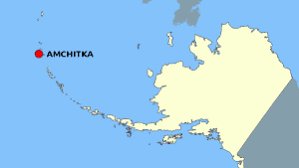
the enduring impact on the island remains as the copious radioactive elements made when we try to come up with ways to destroy us all keep seeping from their tomb underground.
Imagine a Bond villain saying they were going to set off three nuclear bombs in one of the most volcanically and seismically active places on Earth. Now imagine that the US already did it.
Rocky Planet. By Erik Klemetti. Aug 16, 2023
“……………. the United States set three nuclear bombs off in one of the most geologically active parts of the world … and nothing happene
These days it is hard to imagine a world with nuclear testing. However, in the 1940s to 1990s, the US and USSR (amongst others) were setting off bombs like they were going out of style. In the air, on land, under the sea and eventually underground, these “experiments” were both means to develop even bigger weapons and displays of force. The consequences of many of these tests are still being felt thanks to the copious radioactive fallout produced.
Bombs in Alaska
One set of the over 1,000 nuclear explosions run by the US was conducted on Amchitka in the Aleutian Islands. Long Shot, Milrow and Cannikin were the code names given to three blasts performed from 1965 to 1971. This included the largest underground nuclear bomb ever detonated, the 5 megaton weapon as part of Operation Grommet.
The most astonishing thing about these tests is that Amchitka Island is in the middle of the Aleutian subduction zone, where the Pacific Plate is diving underneath the North American Plate. There are six potentially active volcanoes within 100 miles of the island. On top of that, the Rat Islands region has produced numerous and gigantic earthquakes across the 20th and 21st centuries. This area is highly volatile, geologically speaking.
So, why run nuclear tests there? For one, it is remote. Very few people live anywhere near these islands. It’s remoteness also allowed Amchitka to be a proxy for the USSR so that the US could work on methods to detect underground nuclear blasts from afar. The island previously hosted a US Air Force base during World War II that had over 15,000 soldiers stationed in this desolate island. This meant that the infrastructure for tests was there after the armed forces moved out.
The first nuclear test on Amchitka was 1965’s Long Shot. It was an 80-kiloton warhead that was used to test early methods of seismic detection of distant nuclear blasts. After that, nothing happened on the island again until 1969. It was realized that the Cannikin test was way too big to do in Nevada, so off to Alaska it went.
Volcanoes and Earthquakes
Let’s set out stage: the US planned to test a massive nuclear weapon in a shaft last 1 mile (2 kilometers) deep in a location that was volcanically and seismically active. Remember those six volcanoes with 100 miles? They include Semisopochnoi (currently erupting, and prior to test, 1873), Little Sitkin (last erupted 1830), Gareloi (last erupted 1989, and prior to the test, 1952), Davidof (Holocene), Segula (1600s?) and Kiska (last erupted 1990, erupting in 1969!)
On top of that, the M8.7 Rat Islands earthquake that generated a tsunami that swept across the Alaskan coast occurred ~30 miles from Amchitka on February 4, 1965. That was less than 9 months before the Long Shot test! It is hard to imagine how a massive earthquake could happen that close to the test site … and they still went ahead and did it! Combine that with the vivid memories of the 1964 M9.2 earthquake and tsunami in Alaska, and no wonder people were edgy about bomb tests.
Just to show how strange the pre-test ban treaty world was, the US Atomic Energy Commission set off a smaller (1-1.2 megaton, or 12-15 times larger than Long Shot) earlier to calibrate their sensors for the larger blast to come. Later, it was admitted that the Pentagon had run the Milrow explosion to also test if a big blast could, just maybe, cause an earthquake or eruption.
The Big One
Although the tests were performed under the auspices of the US Atomic Energy Commission, they were really being done for the Pentagon. The Cannikin test was meant to investigate the feasibility of using a 5-megaton warhead as part of an anti-ballistic missile program (the Spartan Missile). Although there was a lot of resistance to the test (see below), President Nixon still went ahead and ordered the test to proceed (with support from the Supreme Court).
Cannikin went off on November 6, 1971. It produced a M7 earthquake from the blast. You can see in this video how the land surface jumped as much as 20 feet during the explosion as the shockwave moved across the island. Thousands of birds and otters died in the shockwave. A crater over a mile wide was produced but even with the same energy released as the 2010 earthquake in Haiti, no tsunami was generated. Supposedly, very little radiation was detected either. In the eyes of the US Atomic Energy Commission and the Pentagon, it was a great success.
……………………………………………………… Looking Back 50 Years
The one long-term impact of the tests is the groundwater of Amchitka. Although little radiation was detected directly after the blast, water percolating through the underground remains of the Cannikin blast becomes radioactive. The US Department of Energy doesn’t agree with findings that show elements like plutonium in groundwater at Amchitka, but it does seem that the island still feels the effects of those blasts even today.
The other impact is a human impact. By the late 1960s, environmentalists became increasingly enflamed by the frequency of nuclear weapon tests … and rightly so. The amount of fallout produced by these tests is clearly seen in the deep-sea sediment and ice core records. When word got out about the immense Cannikin test, a group headed out in a rented boat they dubbed “Greenpeace” to try to stop the test, both in fear of fallout and the potential for triggering another earthquake and tsunami like the M8.7 event in 1965. Stormy weather with winds over 120 miles per hour prevented the ship from reaching Amchitka for the test, but the name “Greenpeace” remained as the environmental organization we know today.
Maybe the myth that we can set off eruptions and earthquakes using nuclear weapons can be (partially) put to bed. The only earthquake caused by these explosions were, well, caused by the explosion. Little evidence exists to suggest that the blasts had any trigger effect on faults and volcanoes near Amchitka. However, the enduring impact on the island remains as the copious radioactive elements made when we try to come up with ways to destroy us all keep seeping from their tomb underground. https://www.discovermagazine.com/planet-earth/what-happened-when-the-us-set-off-nuclear-weapons-in-one-of-the-most
Fukushima water release poses test for Japan-South Korea unity
TOKYO/SEOUL – Japan Times , BY TIM KELLY, SAKURA MURAKAMI AND HYONHEE SHIN
REUTERS 18 Aug 23
U.S. President Joe Biden wants to lock in friendly ties between Japan and South Korea at a summit on Friday, but their readiness to shelve grievances will be tested when Tokyo begins pumping water from its wrecked Fukushima nuclear plant into the sea.
Japan already delayed the release to avoid stirring up political opposition in South Korea before President Yoon Suk-yeol joins Prime Minister Fumio Kishida for a meeting with Biden at the Camp David retreat on Friday, four officials in Japan and South Korea said.
The dumping of radioactive water may happen days after the summit, which the United States is billing as a “historical” trilateral meeting that will deliver a “bold counter” to regional rival China.
That puts less domestic political pressure on Yoon, said one of the officials, who asked not to be identified because of the sensitivity of the issue.
Washington needs its Asian allies to work together because they see the military power balance in East Asia, including around Taiwan, shifting in China’s favor.
…………………….. Even if Fukushima fades as an issue, the risk of bad blood remains real. As relations soured in 2019, for example, Moon nearly scrapped a critical intelligence-sharing deal with Japan, reversing the decision at the last minute under U.S. pressure.
By accepting an International Atomic Energy Agency (IAEA) report last month that greenlit Japan’s Fukushima water release, Yoon could encourage fresh dissent that China will try to amplify, analysts say.
“There is certainly some possibility that Yoon will come under pressure over this, particularly if there is data that shows that the water is more dangerous than we otherwise thought,” said Christopher Johnstone, a former East Asia director of Biden’s National Security Council who is now with the Center for Strategic and International Studies.
Japan says it will remove most radioactive elements from the water except for tritium, a hydrogen isotope that must be diluted because it is difficult to filter.

U.S. Secretary of State Antony Blinken on Tuesday expressed satisfaction with Japan’s plans.
………………….a Gallup poll in late June showed that 78% of South Koreans worry about potential contamination of the ocean and seafood…………………………
more https://www.japantimes.co.jp/news/2023/08/18/japan/politics/south-korea-fukushima-radioactive-water/
Japan mothers’ group fears Fukushima water release could revive health concerns
By Kiyoshi Takenaka, Akiko Okamoto and Tom Bateman, August 18, 2023
IWAKI, Japan, Aug 17 (Reuters) – Waves crashing on a Japanese beach lashed a man and a woman wearing waders and hats as they demonstrated the use of a blue bucket to scoop some of the liquid into large plastic containers to be taken away and tested for radiation.
Members of a group that tracks such levels in food and seawater, they fear Japan’s plans to release treated radioactive water into the sea near the Fukushima nuclear plant could stir an anxiety among residents reminiscent of the 2011 disaster.
“The people of Fukushima endured the risks for the last 12 years and have confirmed the radiation level has dropped,” said Ai Kimura, director of non-profit group Mothers’ Radiation Lab Fukushima, also known as Tarachine.
“But if radioactive materials are released into the ocean now, it will again bring back the tragedy of 12 years ago,” she added, speaking at the lab in the city of Iwaki, 50 km (30 miles) south of the power plant.
Japan is preparing this summer to start discharging into the Pacific more than a million tons of water from the tsunami-crippled power plant, but has not yet revealed the date.
Although the government and an international nuclear regulator say the plan is safe, it has alarmed neighbours, particularly China, and the regional fisheries industry.
Tarachine comprises 13 members – mostly mothers – who had no experience in radiology when they started, but were taught by scientists and doctors how to run tests and keep records.
After losing a job cooking school lunches in the wake of the disaster, Kimura joined the group in 2014 and taught herself how to measure radiation, in hopes of protecting her daughters, who were teenagers at the time, as well as others.
Now she says she wants more dialogue between the government and plant operator Tokyo Electric Power (9501.T) on one side, and citizens, fishermen and others on the other, to allay concerns over safety and other fears.
“Since the ocean has no walls … and what’s been released can’t be taken back, this issue is not only for Fukushima or for Japan to give consideration to, but for the whole world,” Kimura added.
…………… Kimura’s group vowed to continue its activities after the release begins.
“We will keep on providing data, so that fathers and mothers can decide for themselves, and children can also decide, when they grow up, whether to eat Fukushima fish or whether to go swimming in the sea,” Kimura said.
Reporting by Kiyoshi Takenaka, Akiko Okamoto and Tom Bateman; Editing by Chang-Ran Kim and Clarence Fernandez https://www.reuters.com/world/asia-pacific/japan-mothers-group-fears-fukushima-water-release-could-revive-health-concerns-2023-08-17/
Over Budget and Delayed—What’s Next for U.S. Nuclear Weapons Research and Production Projects?
August 17, 2023, https://www.gao.gov/blog/over-budget-and-delayed-whats-next-u.s.-nuclear-weapons-research-and-production-projects [Excellent diagrams]
The United States’ nuclear weapon stockpile depends on facilities that are, on average, about 50 years old. In fact, the processing of enriched uranium used in nuclear weapons is still conducted in an Oppenheimer-era facility built in 1945. These aging facilities pose safety and operational risks and cost taxpayers almost a billion dollars to maintain each year.
Over the next two decades, the United States plans to spend tens of billions of dollars to modernize the research and production infrastructure on which the nuclear stockpile depends. Today’s WatchBlog post looks at our new report about the status of these efforts, led by the National Nuclear Security Administration (NNSA), and the challenges that have resulted in them being over budget and delayed.
New infrastructure projects are important, complex, and expensive
NNSA is currently designing or constructing 23 major projects (each costing more than $100 million). Some projects will process nuclear components containing plutonium or enriched uranium, which are critical to the functioning of nuclear weapons. These projects are expensive and include three multi-billion dollar, one-of-a-kind efforts to build new or modify existing uranium and plutonium component production facilities in New Mexico, South Carolina, and Tennessee. Other projects do not involve nuclear materials and are less expensive, such as a $270 million project to build a high explosives laboratory and related facilities in Texas.
New projects will cost more and take longer to build than NNSA planned
As of March, NNSA’s projects that were in the construction phase collectively overran their cost estimates by over $2 billion and their schedules by almost 10 years. Some of the reasons for these increased costs and delays include poor management and planning, as well as COVID-19. Of the projects that are under construction, the multi-billion-dollar Uranium Processing Facility family of projects in Tennessee is responsible for a majority of the cost increases and schedule delays. These cost increases and schedule delays, as well as NNSA’s decision to refocus resources on higher-priority projects, led NNSA to propose placing two other projects (in Texas and South Carolina) currently in the design phase on hold for multiple years.
In addition, six projects in the design phase are implementing significant changes that may increase their cost and schedule beyond NNSA’s preliminary estimates. These include a project to modify existing plutonium processing facilities at Los Alamos National Laboratory in New Mexico.
We’ve made recommendations to help NNSA improve its oversight of these projects
We have previously made recommendations that would help NNSA better manage its projects as well as the programs that will operate the completed projects to achieve agency goals. For example, we recommended that the NNSA complete a lifecycle cost estimate for establishing the agency’s capability for producing plutonium pits (the central core of a nuclear weapon), as this effort involves dozens of programs, projects, and other activities, including two multi-billion dollar projects and multiple other projects that will cost hundreds of millions of dollars. However, NNSA has not taken action on some of these recommendations. We have expressed concerns about the management of nuclear projects and programs since 1990, and NNSA acquisition and program management remains on our most recent High Risk List.
Learn more about NNSA’s projects, their statuses, and challenges by checking out our new report.
1 This Month
Tell Congress: Prevent Nuclear Catastrophe in Iran

Tell Congress: Prevent Nuclear Catastrophe in Iran

Read the Public Inquiry Report, the Commissioners’ report, Surrendering Australia: The AUKUS Deception is available to download for free at aukuspublicinquiry.com. Or just watch the replay of the National Press Club Luncheon.


Shut down the radiation-damaged Heysham nuclear reactors now
To see nuclear-related stories in greater depth and intensity – go to https://nuclearinformation.wordpress.com

Say No to NASA’s Reckless Nuclear Reactor on the Moon
Say No to NASA’s Reckless Nuclear Reactor on the Moon
-
Archives
- November 2026 (246)
- October 2026 (302)
- September 2026 (339)
- August 2026 (330)
- July 2026 (355)
- June 2026 (287)
- May 2026 (306)
- April 2026 (356)
- March 2026 (251)
- February 2026 (267)
- January 2026 (308)
- December 2025 (358)
-
Categories
- 1
- 1 NUCLEAR ISSUES
- business and costs
- climate change
- culture and arts
- ENERGY
- environment
- health
- history
- indigenous issues
- Legal
- marketing of nuclear
- media
- opposition to nuclear
- PERSONAL STORIES
- politics
- politics international
- Religion and ethics
- safety
- secrets,lies and civil liberties
- spinbuster
- technology
- Uranium
- wastes
- weapons and war
- Women
- 2 WORLD
- ACTION
- AFRICA
- Atrocities
- AUSTRALIA
- Christina's notes
- Christina's themes
- culture and arts
- Events
- Fuk 2022
- Fuk 2023
- Fukushima 2017
- Fukushima 2018
- fukushima 2019
- Fukushima 2020
- Fukushima 2021
- general
- global warming
- Humour (God we need it)
- Nuclear
- RARE EARTHS
- Reference
- resources – print
- Resources -audiovicual
- Weekly Newsletter
- World
- World Nuclear
- YouTube
-
RSS
Entries RSS
Comments RSS

