Massachusetts rejects request to discharge radioactive water from closed nuclear plant into bay
Pilgrim Nuclear Power Station was closed in 2019. Kevin Clark
By MARK PRATT Associated Press https://www.power-eng.com/ap-news/massachusetts-rejects-request-to-discharge-radioactive-water-from-closed-nuclear-plant-into-bay/
BOSTON (AP) — Massachusetts environmental regulators have denied a request by the company dismantling a shuttered nuclear power plant to release more than 1 million gallons (3.8 million liters) of radioactive wastewater into Cape Cod Bay.
The state Department of Environmental Protection’s draft decision issued July 26 said it denied Holtec’s request for a permit modification because the discharge from Pilgrim Nuclear Power Station in Plymouth would violate a state law that designates the bay as an ocean sanctuary.
The draft will not be finalized until after a public comment period that ends Aug. 25.
Environmentalists and politicians praised the decision.
Release of the treated wastewater would pose a threat to the bay’s environment, human health, the fishing and shellfishing industries, and the economy of the region, Andrew Gottlieb, executive director of the Association to Preserve Cape Cod, said in a statement.
“Holtec sought to profit at the expense of the people, the environment and economy of Cape Cod and, like most corporate bullies, needed to be told no,” he said.
Holtec promised a transparent decommissioning process when it took over the plant after it stopped generating power in May 2019, U.S. Sen. Edward Markey said.
UK Government’s infrastructure advisors cast doubt over uks biggest energy projects including nuclear clearup
The UK Government’s infrastructure advisors have warned that it is unlikely
that work to efficiently categorise hazardous waste at the Sellafield site
will be a success.
The Infrastructure and Project Authority (IPA) has also
raised concerns about the majority of the Government’s other key energy
infrastructure programmes, including the Low-Cost Nuclear Programme funding
R&D for small modular reactors.
These warnings are contained within the
Authority’s new annual assessment. Published late last week, it assesses
whether 244 Government-backed projects with a total whole-life cost
exceeding £805bn are progressing well. Projects are given a ‘green’
rating if delivery if on time, there are no significant quality issues and
no other issues that could threaten delivery. Those that are unlikely to be
delivered without a major change of direction are ranked as ‘red’. Those
with delays, quality issues or other problems which may yet be resolved
receive an ‘amber’ rating.
Of the 19 projects covered that are overseen
by the Department for Energy Security and Net-Zero (DESNZ), only three get
the ‘green’ rating. These are the Local Authority Delivery scheme, which
funds councils to upgrade homes and reduce carbon; the SIXEP effluent
treatment plant and the storage plant at Sellafield.
But efforts to improve
analytical services at Sellafield, the former centre of nuclear
reprocessing in the UK, received a ‘red’ ranking. The Authority believes
that the successful delivery of the project “appears to be
unachievable”. The project concerts assessing and categorizing waste on
site.
The Authority has also downgraded the UK Government’s plans for a
major geological nuclear waste storage facility to ‘amber’, from
‘green’ in 2021. This facility is being built both to deal with waste
from new nuclear sites, but also to consolidate existing waste storage; at
present, more than 20 above-ground facilities across the UK are used, each
with a maximum design life of 100 years.
Two DESNZ Projects – Sizewell C
and the development of carbon capture and storage – are exempt from
assessment due to commercial sensitivities. Besides the analytical services
at Sellafield, the others are all ranked as ‘amber’. These include the
national rollout of smart meters to homes; the Net-Zero Hydrogen fund; the
Homes Upgrade Grant (HUG) for home retrofitting; the Public Sector
Decarbonisation Scheme; the Industrial Decarbonisation and Hydrogen Revenue
Support scheme and the Green Homes Grant.
Edie 24th July 2023
Now, not in 15 years’: Call for public vote on Theddlethorpe nuclear waste dump
Campaigners say the area is stuck in limbo. Campaigners are
calling for an immediate public vote on the proposed nuclear waste storage
facility at Theddlethorpe after it was taken off a council agenda last
week.
East Lindsey District Council had been due to discuss whether to move
forward with a public test of support on an underground storage facility.
However this was cancelled as the council sought legal advice, triggering
criticism from both residents and the UK/Ireland Nuclear Free Local
Authorities (NFLA).
The Lincolnite 24th July 2023
The coming Russian-Polish war
Armageddon Newsletter GILBERT DOCTOROW, JUL 23, 2023
This evening’s News of the Week program on Russian state television opened with a 30 minute documentary survey of Polish-Russian relations from the end of WWI and during the period of the Russian Civil War, when the government under Marshal Pilsudski wrested substantial territory from Russian control. It also dealt extensively with Poland’s well documented role as aggressor and occupier of Czechoslovak, Lithuanian, Ukrainian and Belarus lands from before the start of WWII and until Hitler overran Poland. ……………………..
Let us recall that on Friday Putin explained how and why we may expect the formal entry into the war of a Polish-Lithuanian-Ukrainian joint military force that will officially be presented as defending Ukrainian statehood by occupying the Western Ukraine. However, Putin described this as an occupying force which once installed in Lvov and Western Ukraine would never leave. This would in effect be a repeat of the sell-out of Ukrainian interests to Poles and cession of territory to Poland such as had been perpetrated by their leader Semyon Petlyura in April 1920 and has now been repeated in the secret agreements between presidents Zelensky of Ukraine and Duda of Poland. ……………………………………………………..
From Russian talk shows of the past several days, it is easy to understand the Kremlin’s reading of the present proxy war in and around Ukraine: Washington sees that the Ukrainian counter-offensive is a complete failure that has cost tens of thousands of lives among the Ukrainian armed forces and has seen the destruction of a large part of the Western equipment delivered to Ukraine over the past months. Instead of suing for peace, Washington seeks to open a ‘second front,’ using Poland for this purpose. …………………………………………….
The inescapable conclusion from the latest news is that Washington’s incendiary policies and continuing escalation of the conflict cannot secure Russia’s defeat. On the contrary, they may well lead to the total collapse of the NATO alliance once its military value is disproven in a way that cannot be talked away or papered over by the most creative propagandists in DC. https://gilbertdoctorow.substack.com/p/the-coming-russian-polish-war?utm_source=profile&utm_medium=reader2
Will the small states of Oceania be able to maintain their independence in the face of a new Sino-American Cold War?
The ‘friends to all, enemies to none’ strategy is living its last days as the US and China press the island nations to take sides
By Timur Fomenko, a political analyst, https://www.rt.com/news/580174-friends-to-all-enemies-to-none/ 23 July 23
Papua New Guinea is a gateway between continents. The island, being effectively cut in half, demarcates an artificial boundary between Asia and Oceania. In the past several centuries, the broader island has been carved upon between almost every colonial power going, having been ruled at various points by the Dutch, Spanish, German, Japanese and British empires. Even after gaining its formal independence from Australia in 1975, these legacies continue to scar the island, with half of it still belonging to Indonesia, known as West Papua, which is now a source of unrest and insurgency.
The history of constantly fluctuating overlords only demonstrates the country’s perceived strategic and military importance. That’s because whoever dominates it has direct access to both Australia and the Pacific, and can project into Asia itself. It is of little surprise that Papua New Guinea (PNG) became one of the most gruesome fronts of the Pacific War in World War II, which subsequently brought it firmly into the hands of the Anglosphere, where it has remained ever since, making it an effective dependency of Australia in terms of aid and humanitarian assistance.
Despite this, the island has nothing to show for centuries of colonial dominion, or from being a subordinate of the English-speaking world as a black Melanesian country. It is one of the world’s poorer nations, and is in desperate need of infrastructure to develop itself. Because of this, it has developed a foreign policy it describes as ‘friends to all, enemies to none’, which seeks to attain and exploit as many development opportunities as possible and better sustain its own strategic autonomy. This of course, has drawn interest from China, who sees the islands as an important partner as a post-colonial, Global South country. Thanks to PNG being part of the Belt and Road Initiative, Beijing has built airports, highways, sea ports, and telecommunications infrastructure across the country.
Port Moresby, in turn, sees Beijing as a critical economic partner that can help bolster its own infrastructure and development, the two countries recently having negotiated a free trade agreement. But that doesn’t mean trouble is not afoot. While China seeks to bolster economic relations with the country, the US has other ideas; that is, to forcibly transform Papua New Guinea into a military outpost for the purpose, of course, of containing China. Recently, Washington was able to pry a Defense Cooperation Agreement out of the country, which will give the US access to its bases.
PNG, of course, denies that the is specifically opposing China, and does not rule out security cooperation with Beijing itself. However, it is also a reminder that the country’s weak and vulnerable position, along with its historical subservience to the West, means it does not have the power or political privilege to resist these kinds of overtures, and instead must seek a more delicate balance. In response to this, China is likely to increase its engagement with the country; for example, the Bank of China is working to establish a presence there.
Growing competition over Papua New Guinea also comes amid China’s successes in its relationship with the Solomon Islands, which switched allegiance from Taipei to Beijing in 2019. On July 11, the two countries finally signed a security cooperation pact, which has met with vitriol from Western media and politicians.
What this demonstrates is that the Pacific region has become a ‘cold war’ theater between China and the US, with the latter working through its ally, Australia. The US, after all, has long attempted to make the Pacific an ‘extended backyard’ or ‘ranch’, a large open space over which it seeks to be the exclusive military power. But now, China is expanding into it, and this has led to the emergence of strategic competition.
However, these Pacific countries do not really want to take sides – they are tired of being tossed from one master to the other. This means the fundamental challenge for countries such as Papua New Guinea is to gain benefits to strengthen itself, while nonetheless avoiding subservience. This means it has a fight to continue its ‘friends to all, enemies to none’ approach, while tensions rise and both powers start demanding it take sides on various issues. But if worst-case scenarios can be avoided, and the pace of investment in the country from all sides accelerates, the end product may be that competition could ultimately make PNG and the island countries a lot better off, and therefore a lot more capable of exerting their own will.
No new nuclear facilities along vulnerable coasts, Alaska regulators say
By James Brooks, Alaska Beacon-July 26, 2023
You can build a small nuclear reactor in Alaska, but not within 2,700 feet of a house.
On Monday, Lt. Gov. Nancy Dahlstrom signed a package of regulations that dictate where small nuclear reactors, sometimes called “microreactors,” may be built in Alaska.
The regulations arrive as the U.S. Air Force advances plans to build the state’s first microreactor at Eielson Air Force Base, southeast of Fairbanks. …………………………………………………………………..
The regulations signed this week don’t deal specifically with nuclear safety, only where a reactor could be sited. Among the restrictions: A reactor can’t be built within 2,700 feet of a residence, 300 feet of a national park or game reserve, in a coastal area vulnerable to storm surge, within 100 feet of a public road or trail, or in an area protected because it’s used for drinking water.
Any reactor site must be approved by the local municipal government, and if a reactor is planned for a site outside an organized borough, the Alaska Legislature must approve the site.
Those site restrictions could also apply to a nuclear waste site or a facility that processes nuclear fuel, the regulations state. None have been publicly announced here.
During a public comment period earlier this year, the proposed regulations were opposed by the Alaska Community Action on Toxics, Copper Country Alliance and several individual residents who said they were concerned about dangers posed by nuclear power.
“It seems to be that Alaska is going to be a guinea pig for this experimental technology. Seeing all the polluted places the Army left here does not give me any confidence that they would act responsibly here,” wrote Brigitte Jaeger of Fairbanks……………………………………………………… https://alaskapublic.org/2023/07/26/no-new-nuclear-facilities-along-vulnerable-coasts-alaska-regulators-say/
Cumbria set for more nuclear reactors as questions are raised over why land isn’t being used for renewable energy
Cumberland Council are set to discuss small modular reactors and nuclear
power in Cumbria. Councillor Jill Parry for Bothel and Wharrels, Green
Party will ask her question to leader of Cumberland Council Councillor Mark
Fryer, who represents St Johns and Great Clifton, Labour.
“Can the leader please ask the Solway Community Power Company for more detail of the
proposal, including an outline what investigations, surveys and other
preparatory work are needed at this very early stage, and share the
response with council? “
“Would it not be more appropriate for the council
to push that the land is used for renewable energy technologies, such as
solar, in the meantime, which could generate real-time useable electricity
for residents now and could stay in place if SMRs don’t happen?”
Lancashire Live 24th July 2023
https://www.lancs.live/news/cumbria-news/cumbria-set-more-nuclear-reactors-27375167
Small Modular Nuclear Reactors (SMRs) are supported by ideology alone

The ”tech bro” libertarian culture that valorizes new technology, loathes regulation, and embraces the marketplace has spawned a new generation of, according to the Washington Post, “nuclear bros.”
The media has become an echo chamber, with each outlet clambering over the next to crow about the great benefits of nuclear power in misleading language that suggests this technology is already entirely proven out.
The end of Oppenheimer’s energy dream

iai news, Allison Macfarlane Allison Macfarlane is the director of the School of Public Policy and Global Affairs at the University of British Columbia and former chairman of the US Nuclear Regulatory Commission. 21st July 2023
Nuclear energy is both lauded as a baseload renewable power and decried as risky, expensive and outdated technology. Small modular reactors have received billions in venture capital and unprecedented media attention, but are they a red herring, with philosophy, rather than science, driving our fixation? Professor Allison Macfarlane explores the current sombre state of the technology, where it is falling short, and what philosophy is driving the interest in this unpromising tech.
From the inception of Oppenheimer’s harnessing of the power of the atom, first as a device for war, and later, as a means of peaceful energy production, nuclear energy has possessed both promise and peril. With large nuclear power plants struggling to compete in a deregulated marketplace against renewables and natural gas, small modular reactors (SMRs) offer the promise to save the nuclear energy option. In the past few years, investors, national governments, and the media have paid significant attention to small modular nuclear reactors as the solution to traditional nuclear energy’s cost and long build times and renewable’s space and aesthetic drawbacks, but behind the hype there is very little concrete technology to justify it. By exploring the challenges facing small modular reactor technology, I will demonstrate that this resurgence in nuclear energy speaks to the popular imagination, rather than materializing as actual technological innovation.
News broke last week that Oklo, a company that has designed an advanced micro-nuclear power plant, will go public via a merger with AltC Acquisition Corporation. Co-founder of AltC Acquisition and Chair of Oklo’s board, Sam Altman, hopes to raise US$500 million with this offering. Oklo’s news is a sample of the almost-constant barrage of excitement around the potential of small modular reactors (SMRs) to help mitigate climate change.
But can they?
The Oklo story is intriguing, since its license application to build and operate its Aurora design reactor was outright rejected by the U.S. Nuclear Regulatory Commission, the country’s nuclear safety regulator (full disclosure: I was Chairman of the NRC from 2012-2014). And note that such rejection is an accomplishment: the NRC rarely outright rejects an application, instead working with licensees until they either get the application right or decide to walk away. In this case, Oklo refused to fill “information gaps” related to “safety systems and components.”
Most of these designs are just that: designs. Very few of the proposed SMRs have been demonstrated and none are commercially available.
There are many new SMR companies in the U.S., Canada, U.K., Europe, China, and elsewhere, and the reactor designs themselves are numerous as well. There are smaller versions of existing light water reactors, like those in the U.S., France, Japan, and elsewhere. There are more “advanced” designs like sodium-cooled fast reactors (like Oklo and Bill Gate’s company Terrapower’s design), high-temperature gas reactors, and molten salt reactors.
…………………………….. One U.S. company, NuScale, is the only SMR design in the US to received “design certification” from the NRC. NuScale has an agreement with UAMPS, a consortium of utility companies, to build the first NuScale reactors in Idaho in the U.S. But NuScale won’t build the already-certified design in Idaho; the company has a new application at the NRC to build a larger, and presumably more economic, model of the reactor. Nonetheless, cost estimates for the reactor have risen from US$55/megawatt electric (MWe) in 2016 to $89/MWe in 2023, according to the Institute for Energy Economics and Financial Analysis.
Many of the non-light water SMR designs will likely be even costlier, based on recent analyses. A recent Massachusetts Institute of Technology study suggests that SMRs will run significantly higher in cost than large light water reactors, especially in per MW comparable “overnight” costs (how much it would cost to build a new reactor if one could do so overnight) and operations and maintenance costs.
Advanced reactors do not solve the problems of nuclear waste and may, in fact, exacerbate the problem.
Recent construction experience in the US and Europe does not herald success for SMR new builds. The two French-design evolutionary power reactor (EPR) builds have been far over budget and schedule. The EPR in Finland was originally supposed to cost 3 billion euros and open in 2009. It finally began producing electricity in 2023 at a cost of 11 billion euros. There is a similar story in France, where the EPR at Flamanville was set to begin operation in 2012 at a cost of 3.5 billion euro. Instead, it is still under construction and costs have ballooned to 12.4 billion euros.
And Europe is the rule, not the exception. US – based Westinghouse’s AP-1000, a robust design with passive safety features has suffered similarly. The two units under construction in South Carolina were abandoned in 2017, after an investment of US$9 billion. The two AP-1000 units in Georgia were to start in 2016/2017 for a price of US$14 billion. One unit started in April, 2023, the second unit promises to start later in 2023. The total cost is now over US$30 billion.
SMR designers appeal to factory construction to avoid some of the pitfalls of large reactor construction (thus the “modular” in Small Modular Reactor). But the AP-1000 should provide a cautionary tale: ……………………………………
One of the reasons SMRs will cost more has to do with fuel costs. Most non-light water designs require high-assay low enriched uranium fuel (HALEU), in other words, fuel enriched in the isotope uranium-235 between 10-19.99%, just below the level of what is termed “highly enriched uranium,” suitable for nuclear bombs. Currently, there are no enrichment companies outside of Russia that can produce HALEU, and thus the chicken-and-egg problem: an enrichment company wants assurance from reactor vendors to invest in developing HALEU production. But since commercial-scale SMRs are likely decades away, if they are at all viable, there is risk to doing so. Use of HALEU will also result in increased security and safeguards requirements that will add to the price tag.
The ”tech bro” libertarian culture that valorizes new technology, loathes regulation, and embraces the marketplace has spawned a new generation of, according to the Washington Post, “nuclear bros.”
HALEU fuel is needed to offset the smaller size of the reactor core, which results in increased neutron leakage – and neutrons are the initiators of fission reactions that release the energy harnessed as electrical power. Smaller reactor sizes can also result in comparatively more waste volume, next to existing large light water reactors. In fact, a recent U.S. National Academy of Science analysis noted that advanced reactors do not solve the problems of nuclear waste and may, in fact, exacerbate the problem. Some reactor designs will produce significantly more high-level waste by volume that current light water reactors, other designs will produce waste the requires chemical processing prior to disposal. These types of issues are relatively little examined and will add to the final price tag of the new technology.
With all these potential drawbacks and delays, why would anyone invest in an SMR company? I put a similar question to Ray Rothrock, a venture capitalist, at a meeting of a committee of the National Academy of Engineering that was studying the potential of these new reactors (and of which I was a member). If these reactors won’t be commercially available for a decade or more, how do investors make money? His response? “Even before they sell [energy], they go public and that’s how early investors make money…it fits the model – the company hasn’t made money, but the investors have made money.” He goes on to say that going public opens the door to much more money that is needed.
But all of this in the future. If SMRs are not ready to deploy in the next ten years, what are the implications? There are two significant ones. The first is that, given the development timelines for these new reactor designs, they are not likely to have a significant impact on CO2 emissions reductions for decades, and as a result their relevance to the climate argument shrinks.
The media has become an echo chamber, with each outlet clambering over the next to crow about the great benefits of nuclear power in misleading language that suggests this technology is already entirely proven out.
More significantly, if, as a recent study showed, that SMRs will be significantly more expensive than solar photovoltaic (PV) and on-shore wind, and even geothermal, what will the marketplace look like in 20 or 30 years, when renewables will presumably be even cheaper?
………………….. So why there so much hype around new nuclear power technologies that so far, largely, don’t exist and will likely be very costly? The need to decarbonize energy production plays a role
The advent of large amounts of available venture capital in the past decade is another factor. One analyst told me, “there’s a lot of stupid money out there right now [for investing].”
The ”tech bro” libertarian culture that valorizes new technology, loathes regulation, and embraces the marketplace has spawned a new generation of, according to the Washington Post, “nuclear bros.” Naomi Oreskes notes that an appeal to nuclear power to address our energy needs in a warming world reflects our “technofideism,” the faith that technology will solve our problems.
In the nuclear celebratory mood of the moment, there is little patience or political will for sober voices to discuss the reality that new nuclear power is actually many decades away from having any measurable impact on climate change – if at all. https://iai.tv/articles/the-end-of-oppenheimers-energy-dream-auid-2549
More Warmongers Elevated In The Biden Administration

It’s too soon to draw any firm conclusions, but to see voices of restraint stepping down and proponents of escalation stepping up could be a bad portent of things to come.
CAITLIN JOHNSTONE, JUL 26, 2023 https://www.caitlinjohnst.one/p/more-warmongers-elevated-in-the-biden?utm_source=post-email-title&publication_id=82124&post_id=135458379&isFreemail=true&utm_medium=email
| The Biden administration looks set to become even more warlike than it already was if you can imagine, with virulent Russia hawk Victoria Nuland and virulent China hawk Charles Q Brown now being elevated to lofty positions by the White House. Nuland, the wife of alpha neocon Robert Kagan, has been named acting deputy secretary of state by President Biden, at least until a new deputy secretary has been named. This places her at second in command within the State Department, second only to Tony Blinken. |

In an article about Nuland’s unique role in souring relations between the US and Russia during her previous tenure in the State Department under Obama, Responsible Statecraft’s Connor Echols writes the following of the latest news:
Nuland’s appointment will be a boon for Russia hawks who want to turn up the heat on the Kremlin. But, for those who favor a negotiated end to the conflict in Ukraine, a promotion for the notoriously “undiplomatic diplomat” will be a bitter pill.
A few quick reminders are in order. When Nuland was serving in the Obama administration, she had a now-infamous leaked call with the U.S. ambassador to Ukraine. As the Maidan Uprising roiled the country, the pair of American diplomats discussed conversations with opposition leaders, and Nuland expressed support for putting Arseniy Yatseniuk into power. (Yatseniuk would become prime minister later that month, after Russia-friendly former President Viktor Yanukovych fled the country.) At one memorable point in the call, Nuland said “Fu–k the EU” in response to Europe’s softer stance on the protests.
The controversy surrounding the call — and larger implications of U.S. involvement in the ouster of Yanukovych — kicked up tensions with Russia and contributed to Russian President Vladimir Putin’s decision to seize Crimea and support an insurgency in eastern Ukraine. Her handing out food to demonstrators on the ground in Kyiv probably didn’t help either. Nuland, along with State Department sanctions czar Daniel Fried, then led the effort to punish Putin through sanctions. Another official at State reportedly asked Fried if “the Russians realize that the two hardest-line people in the entire U.S. government are now in a position to go after them?”
In a 2015 Consortium News article titled “The Mess That Nuland Made,” the late Robert Parry singled out Nuland as the primary architect of the 2014 regime change operation in Ukraine, which, as Aaron Maté explained last year, paved the way to the war we’re seeing there today. Hopefully her position winds up being temporary.
In other news, the Senate Arms Services Committee has voted to confirm Biden’s selection of General Charles Q Brown Jr as the next chairman of the Joint Chiefs of Staff, replacing Mark Milley. A full senate vote will now take place on whether to confirm Brown — currently the Air Force Chief of Staff — for the nation’s highest military office.
Brown is unambiguous about his belief that the US must hasten to militarize against China in the so-called Indo-Pacific to prepare for confrontation between the two powers, calling for more US bases in the region and increased efforts to arm Taiwan during his hearing before the Senate Arms Services Committee earlier this month.
Back in May, Moon of Alabama flagged Brown’s nomination in an article which also noted that several advocates of military restraint had been resigning from their positions within the administration, including Wendy Sherman, the deputy secretary of state who Nuland has taken over for.
It’s too soon to draw any firm conclusions, but to see voices of restraint stepping down and proponents of escalation stepping up could be a bad portent of things to come.
Discarding Illusions, Ending Wars

Eighteen months later Ukraine is in ruins. Its latest counteroffensive achieved nothing. In the last three weeks, an estimated 26,000 Ukrainian soldiers died in pointless attacks against world-class Russian defenses ‘in depth.’
The attempt to extend NATO’s “new globalist world order” to Russia has failed.
By Colonel (ret.) Douglas Macgregor, US Army, THE KENNEDY BEACON JUL 20, 2023 https://thekennedybeacon.substack.com/p/discarding-illusions-ending-wars?utm_source=post-email-title&publication_id=1712557&post_id=135282964&isFreemail=true&utm_medium=email
From the moment the war in Ukraine started, Western reporting on the war was a radical repudiation of the truth. Washington and its NATO allies always knew that NATO expansion to Russia’s borders would precipitate an armed conflict with Moscow, but NATO’s ruling globalist class did not care. For them, Russia in 2022 was unchanged from the weak and incapable Russia of the late 1990s. The risk of failure seemed low. Ergo, Russia could be bullied into submission.
Americans and most Europeans did not bother to question or analyze. Widespread strategic ignorance about Russia and Eastern Europe ensured that most Americans and even West Europeans would react quickly and viscerally to the Western media’s distorted images and lies about Russia. At the same time, tolerance for criticism of Washington’s role in fashioning the corrupt and deceitful conduct of the Volodymyr Zelenskyy Regime and its war was disallowed in the press
Washington’s ruling class was cheered when it dismissed Russian proposals for talks on any grounds that did not recognize NATO’s right to transform Ukraine into a base for U.S. and Allied Military Power aimed at Russia. Ukrainian flags sprouted from the lush grounds of America’s wealthier neighborhoods like flowers in an arboretum and wonders in the form of limitless military assistance, miracle weapons, and cash were promised to President Zelenskyy––promises that strategic reality did not justify.
In 2022 the Biden Administration no longer possessed the military and economic strength to wage high-end conventional warfare that it had in 1991. Waging a major war 10,000 miles from home on the Eurasian continent is impossible without the support of truly powerful Allies on the model of the British Empire during WWII. Washington’s NATO allies are military dependencies, not formidable strategic partners.
Whereas Russian Military Power is still structured for decisive operations launched from Russian soil, U.S. Military power is geared to project limited air, naval, and land power thousands of miles from home to the periphery of Asia and Africa. American military power consists of boutique forces designed for safari in Africa and the Middle East, not decisive combat operations against great continental powers like Russia or China.
Eighteen months later Ukraine is in ruins. Its latest counteroffensive achieved nothing. In the last three weeks, an estimated 26,000 Ukrainian soldiers died in pointless attacks against world-class Russian defenses ‘in depth.’ (Defenses ‘in depth’ mean a security zone of 15 -25 kilometers in front of the main defense, that consists of at least three defense belts twenty or more kilometers deep.)
By comparison, Russian losses were minimal.
Today, more than 100,000 Russian troops are conducting offensive operations along the Lyman-Kupiansk axis. These forces include 900 tanks, 555 artillery systems and 370 multiple rocket launchers. It does not take much imagination to anticipate the breakthrough of these forces to the North where they can encircle Kharkiv.
Once Russian Forces surround the city, they will become an irresistible magnet for Ukraine’s last reserve of 30-40,000 troops. Ukrainian Forces attacking to the East to break through to Kharkov will present the combination of Russian space and terrestrial-based ISR (intelligence, surveillance, reconnaissance) assets and Precision Strike Aerospace, Artillery, Rocket, and Missile Systems with a target array that only a blind man could miss.
None of these developments should surprise anyone in the West. Building a Ukrainian army on the fly with a hotchpotch of hastily assembled equipment from a multitude of NATO members and an officer corps of many courageous, but inexperienced officers had little chance of success even under the best of circumstance.
Wars are decided in the decades before they begin. In war, the sudden appearance of “Silver Bullet” technology seldom provides more than a temporary advantage and strong personalities in the senior ranks do not compensate for inadequate military organization, training, thinking, and effective equipment. A new, leaked memorandum from sources inside Ukraine illustrates these points:
“Units of the Ukrainian Armed Forces are at such terrible states of degradation that soldiers are abandoning their posts, and whilst not mentioned in these documents, a flood of videos have been published from Russian sources claiming Ukrainian service personnel are surrendering at the first opportunity owing to the belief that they are being treated as ‘nothing more than cannon fodder.’”
Events on the ground are beginning to overtake the carefully orchestrated charade in Kiev. There is little that pontificating retired generals and armchair military analysts can do to halt the inevitable. Moscow understands that the war will not end without Russian offensive action. Whatever the Washington’s original goals may have been, theybeen they are unrealizable. Russian Forces will soon fall on the Ukrainian forces with the momentum and the impact of an avalanche.
In view of these points, before all of Ukraine’s manpower is annihilated, or a “Coalition of the Willing” from Poland and Lithuania marches into Western Ukraine, Washington can arrest Ukraine’s downward spiral into total defeat, and Washington’s own irresponsible drift into a regional war with Russia for which Washington and its allies are not prepared.
Cooler heads can prevail inside the beltway. The fighting can stop, but a ceasefire, and the diplomatic talks that must proceed from a ceasefire, will not occur unless Washington and its Allies acknowledge three critical points:
First, whatever form the Ukrainian State assumes in the aftermath of the conflict, Ukraine must be neutral and non-aligned. NATO membership is out of the question. A neutral Ukraine on the Austrian model can still provide a buffer between Russia and its Western Neighbors.
Second, Washington and its Allies must immediately suspend all military aid to Ukraine. Doubling down on failure by introducing more equipment and technology the Ukrainian Forces cannot quickly absorb and employ is wasteful and self-defeating.
Third, all U.S. and allied personnel, clandestine or in uniform, must withdraw from Ukraine. Insisting on some form of NATO presence as a face-saving measure is pointless. The attempt to extend NATO’s “new globalist world order” to Russia has failed.
The point is straightforward. It is time for Washington to turn its attention inward and address the decades of American societal, economic, and military decay that ensued after 1991. It’s time to reverse the decline in American national prosperity, and power; to avoid unnecessary overseas conflict;and to shun future interventions in the affairs of other nation states and their societies. The threats to our Republic are here, at home, not in the Eastern Hemisphere.
Failed Fukushima System Should Cancel Wastewater Ocean Dumping

The global ban on ocean dumping of radioactive waste adopted in 1993 applies only to barrels. It has allowed Britain and France to pump billions of gallons of radioactive wastewater into the Irish Sea and the North Sea respectively, for decades.
BY JOHN LAFORGE, 25 July 23 https://www.counterpunch.org/2023/07/25/failed-fukushima-system-should-cancel-wastewater-ocean-dumping/
From the Fukushima-Daiichi triple-reactor meltdown wreckage, Japan’s government and “Tepco,” the owner, are rushing plans to pump 1.37 million tons (about 3 billion pounds) of radioactive wastewater into the Pacific.
Their record is poor. Their lies are documented. This is not safe, at all.
To keep the three meltdowns’ wasted fuel from melting again, Tepco continuously pours cold water over 880 tons of “corium,” the red-hot rubblized fuel amassed somewhere under three devastated reactors. “That water leaks into a maze of basements and trenches beneath the reactors and mixes with groundwater flowing into the complex,” Reuters reported Sep. 3, 2013.
Most of this water is collected and put through Tepco’s jerry-rigged mechanism dubbed ALPS, for Advanced Liquid Processing System, which it turns out hasn’t processed much of anything.
Tepco, Japan’s Nuclear Regulatory Authority, the International Atomic Energy Agency (IAEA), and much of the media endlessly repeat that ALPS removes over 62 radioactive materials from the ever-expanding volume of wastewater. Reports regularly claim the planned dumping is routine, safe, and manageable.
This unverified PR loop has fooled a lot of people, but the ALPS is a fraud. As early as 2013, the filter system stalled and the IAEA reported that April that ALPS had not “accomplished the expected result of removing some radionuclides,” Reuters reported.
In September 2018, the ALPS was revealed to have drastically failed, forcing Tepco to issue a public apology and a promise to re-filter huge volumes of the waste.
According to Reuters, Oct. 11, 2018, documents on a government committee’s website show that 84 percent of water held at Fukushima contains concentrations of radioactive materials higher than legal limits allow to be dumped.
Among the deadly isotopes still in the waste are cesium-137, strontium-90, cobalt-60, ruthenium, carbon-14, tritium, iodine-129, plutonium isotopes, and more than 54 more.
In a June 14, 2023 op/ed for the China Daily, Shaun Burnie, the Senior Nuclear Specialist at Greenpeace East Asia, reported that the ALPS “has been a spectacular failure,” and noted:
“About 70 percent or 931,600 cubic meters of the wastewater needs to be processed again (and probably many more times) by the ALPS to bring the radioactive concentration levels below the regulatory limit for discharge. Tepco has succeeded in reducing the concentration levels of strontium, iodine, and plutonium in only 0.2 percent of the total volume of the wastewater, and it still requires further processing. But no secondary processing has taken place in the past nearly three years. Neither Tepco nor the Japanese government has said how many times the wastewater needs to be processed, how long it will take to do so, or whether the efforts will ever be successful. … none of these issues has been resolved.”
Tepco says it will re-filter more than 70 percent of the wastewater through ALPS again, a process that itself leaves massive amounts of highly radioactive sludge that must be kept out of the environment for centuries.
Hoping to slow the rush to dump, Professor Ryota Koyama from Fukushima University, said in an interview with China Media Group last May, “If the Japanese government or the Tokyo Electric Power Co. really wants to discharge contaminated water into the sea, they need to explain in more detail whether the nuclides have really been removed.”
International law governing state-sponsored or corporate pollution of the seven seas is relatively useless in challenging Tepco’s outrageous transfer of private industrial poison into the public commons. The global ban on ocean dumping of radioactive waste adopted in 1993 applies only to barrels. It has allowed Britain and France to pump billions of gallons of radioactive wastewater into the Irish Sea and the North Sea respectively, for decades.
Not in our backyard: Securing a referendum over Canada’s plan for a nuclear waste dump.
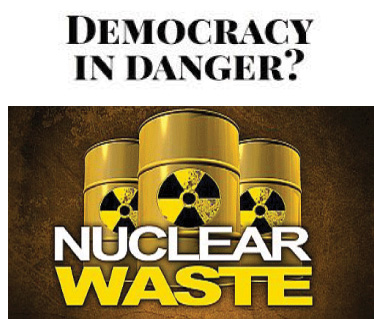
In the UK, Nuclear Waste Services continues to investigate the
suitability of locating a Geological Disposal Facility (GDF) at one (or
perhaps two) of four sites in West Cumbria and East Lincolnshire.
In Canada, the Nuclear Waste Management Organisation is also looking for a
site for a Deep Geological Repository (DGR), focusing upon Ignace and South
Bruce, both in Ontario. The names may be different, but the intention and
impact will be the same for the sites selected will receive their
respective nation’s high-level radioactive waste which will be disposed of
beneath the sea or below ground.
In the UK and in Canada, local people have
mobilised in opposition to the plans. Aware that British and Canadian
nuclear agencies, and supportive politicians, are in contact to exchange
knowledge and experience, the UK/Ireland NFLAs, working in partnership with
Northwatch in Canada, arranged an online meeting between campaigners in our
two nations. We intend this to be an ongoing dialogue.
NFLA 25th July 2023
The misguided push to weaken nuclear safety standards is gaining steam
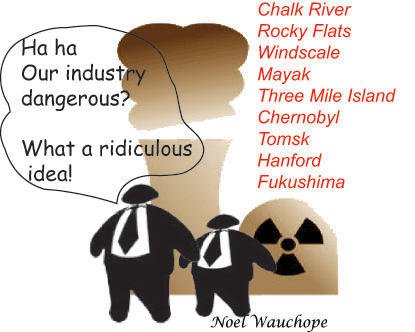
The Hill, BY EDWIN LYMAN, OPINION CONTRIBUTOR – 07/25/23
Imagine a future where experimental nuclear reactors are scattered across the U.S. landscape like so many Starbucks, in densely populated and rural areas alike. Also, imagine they are allowed to operate without thoroughly reviewed and validated safety analyses, highly trained personnel at the controls, the protection of armed security officers, any provisions for off-site emergency planning and robust containment structures that would help prevent the release of highly hazardous radioactive materials if the worst happens.
This is the future that many in the nuclear industry, along with their vocal supporters, are working overtime to achieve.
The only bulwark against the most dangerous proposals is the Nuclear Regulatory Commission, the independent federal agency in charge of protecting the public from the radiological hazards of civil nuclear facilities. However, the NRC is facing a coordinated, massive push by the industry to drastically weaken its safety and security regulations and speed up the implementation of its back-to-the-1950s dystopian vision.
NRC critics blame the agency for the slow pace of new nuclear reactor licensing and construction in the U.S. But the NRC should not be scapegoated for the nuclear industry’s own failures. These include repeatedly missing cost and schedule targets for the Vogtle-3 reactor in Georgia, or supplying technically deficient, inadequate applications, such as Oklo’s attempt to apply for a license for a “micro” nuclear reactor, which the NRC justifiably rejected, and NuScale’s application for a standard design approval for its small modular reactor, which the NRC found contained numerous gaps.
The industry’s ire has focused on the NRC’s development of the “Part 53” rule for so-called risk-informed licensing of new reactors, which proponents argue are so much safer than the currently operating fleet that they need far less regulatory oversight across the board. But the fundamental problem is that many of these reactor designs, which introduce new safety and security risks, only exist on paper or have had extremely limited (and not necessarily relevant) real-world experience………………………………………………………………………………………………………………….
Some may ask why nuclear power still requires stringent regulation given that proponents claim it is already the safest form of energy. But although some nuclear supporters attempt to gaslight the public by playing down the massive health, environmental and economic impacts of the 1986 Chernobyl and 2011 Fukushima disasters, the fact remains that, unlike renewable energy technologies, nuclear power generates vast amounts of uniquely hazardous and long-lived radioactive materials as they operate. Not only are these substances highly carcinogenic, but evidence of their role in cardiovascular disease is growing.
Keeping these materials isolated from the environment will remain a critical obligation of the nuclear power sector as long as reactors continue to run and nuclear waste persists. NRC’s statutory authority must remain focused on ensuring radiological safety and security……………… https://thehill.com/opinion/energy-environment/4116386-the-misguided-push-to-weaken-nuclear-safety-standards-is-gaining-steam/
Oppenheimer and nuclear energy: Is India and the world moving away from this power source?
Nuclear energy has grabbed headlines ever since Christopher Nolan’s biographical film “Oppenheimer” was released. However, the world now making a gradual shift towards solar energy
Inia Today, Samrat Sharma, New Delhi, Jul 26, 2023
With the release of Christopher Nolan’s biographical film “Oppenheimer”, the awesome power of nuclear energy is once again under the spotlight…………. However, the invention that was once considered a game changer is gradually losing its charm now.
…………………………..it is not just in India that nuclear energy has little role to play in the overall electricity mix. Aside from countries like France, the U.S., Japan, etc, the popularity of nuclear power has declined significantly across the world. Earlier this year, the German government closed down the country’s three remaining nuclear power plants.
……………….. One of the major reasons for the downfall is the rise of renewable energy prospects, mostly solar energy.
“In 2021, the global solar capacity was 1.04 terawatts, while the global nuclear capacity was 463 gigawatts. This means that solar energy is already more than twice as abundant as nuclear energy,” Manish Purohit, a former scientist in the Solar Panel Division of the Indian Space Research Organisation, told India Today.
There are multiple reasons behind solar power replacing nuclear power, which include the falling cost of solar panels and units, higher speed of deployment, no threat of waste disposal and accidents, and increased government support, Purohit explained. Currently, there are over 90,000 metric tonnes of nuclear waste that require careful disposal globally.
Iran says ready to settle remaining dispute with IAEA over nuclear program
IXinhua https://www.chinadaily.com.cn/a/202307/27/WS64c15113a31035260b818ab4.html 2023-07-27
TEHRAN – Iran’s nuclear chief said on Wednesday the country is determined to close a remaining case of outstanding differences with the International Atomic Energy Agency (IAEA) regarding its nuclear program, according to the Iranian Students’ News Agency.
Speaking to reporters on the sidelines of a cabinet meeting in the Iranian capital Tehran on Wednesday, President of the Atomic Energy Organization of Iran (AEOI) Mohammad Eslami said the country has sent a “comprehensive and written” response to the IAEA regarding the two remaining “undeclared sites,” in which the agency claims to have found “traces of uranium.”
If the agency does not accept the response and has any uncertainty or doubt regarding the issue, Iran will provide further explanation and review the documents, he added.
The AEOI chief said his organization is enriching uranium according to the level stipulated in a 2020 law passed by the Iranian parliament to counter the U.S. sanctions.
He added Iran’s “relations with the agency are based on the agreement reached with IAEA Director General Rafael Grossi during his visit to Tehran in March as well as the safeguards agreements and the Non-Proliferation Treaty and we are implementing what we have agreed to do.”
He noted that Iran and the IAEA are in “constant and sustainable” interactions with each other.
Faced with international sanctions, the country signed a nuclear deal, formally known as the Joint Comprehensive Plan of Action (JCPOA), with world powers in July 2015, agreeing to put some curbs on its nuclear program in return for the removal of the sanctions on the country. The United States, however, pulled out of the deal in May 2018 and reimposed its unilateral sanctions on Iran, prompting the latter to drop some of its nuclear commitments according to the law passed by its parliament in December 2020.
The Iranian parliament’s law mandated the government to restrict inspections of Iran’s nuclear facilities by the IAEA and accelerate the development of the country’s nuclear program beyond the limits set under the JCPOA.
The talks on the JCPOA’s revival began in April 2021 in Vienna. No breakthrough has been achieved after the latest round of talks in August 2022.
-
Archives
- October 2026 (120)
- September 2026 (339)
- August 2026 (330)
- July 2026 (355)
- June 2026 (287)
- May 2026 (306)
- April 2026 (356)
- March 2026 (251)
- February 2026 (267)
- January 2026 (308)
- December 2025 (358)
- November 2025 (359)
-
Categories
- 1
- 1 NUCLEAR ISSUES
- business and costs
- climate change
- culture and arts
- ENERGY
- environment
- health
- history
- indigenous issues
- Legal
- marketing of nuclear
- media
- opposition to nuclear
- PERSONAL STORIES
- politics
- politics international
- Religion and ethics
- safety
- secrets,lies and civil liberties
- spinbuster
- technology
- Uranium
- wastes
- weapons and war
- Women
- 2 WORLD
- ACTION
- AFRICA
- Atrocities
- AUSTRALIA
- Christina's notes
- Christina's themes
- culture and arts
- Events
- Fuk 2022
- Fuk 2023
- Fukushima 2017
- Fukushima 2018
- fukushima 2019
- Fukushima 2020
- Fukushima 2021
- general
- global warming
- Humour (God we need it)
- Nuclear
- RARE EARTHS
- Reference
- resources – print
- Resources -audiovicual
- Weekly Newsletter
- World
- World Nuclear
- YouTube
-
RSS
Entries RSS
Comments RSS

