I met U.S. Rep. Joe Courtney (D-CT) for the first time recently. I had a short, but revealing conversation with him.
I don’t know what he thought coming away from the exchange, but I know what I felt. I felt afraid. I saw someone who was enthusiastic about the current proxy war with Russia and the potential war with China, two nuclear armed nations. I saw someone who believes that the US only fights for freedom and democracy although I wonder if he could tell me that last war that was fought for freedom or that resulted in democracy.
I will admit that the weapons manufacturers–who Joe staunchly assists at every turn–have experienced more financial freedom (read “profits”) as a result of Joe’s efforts.
I saw someone who had no use for diplomacy because he believes that you can’t negotiate with adversaries, a belief that has led to countless wars through the millennia and continuous war in this century.
This is deeply concerning to me. Violent conflict over land, resources, ideology, power, and ego may have been the only model we’ve been exposed to, but we can no longer afford to continue working within this old paradigm of might makes right, zero-sum games, and endless arms races. All this has led us to where we find ourselves today, on the brink of self-annihilation.
The fear I felt coming away from this conversation stems from the realization that many of our elected officials adamantly maintain that violence is the only way.
We must find a way to talk, negotiate, build trust, and ultimately cooperate with all nations. I come to this conclusion based on the premise that all people of all nations now face the same existential threats from pandemics, climate collapse, and war escalating to nuclear annihilation.
For the first time in history, the entire human species has obvious common interests. The only rational way forward is to put aside our petty grievances and come together to deal with these existential threats. No one nation can solve these threats alone. There is no other way but together as an international community.
People like Joe are unwilling to give peace a chance and in doing so they are condemning all of us to hardship, suffering, and potentially death. They know only “us versus them” thinking.
They cannot get past the obsolete and barbaric paradigm of resolving conflict by violence or the threat of violence. They don’t realize that we will only have safety and security when all nations have safety and security. Their belief system is incompatible with the realities that we face.
They think that fighting over there protects us here. They don’t realize that there is always blowback and tragic predictable consequences from war that come back to bite us in many ways. We now have epidemic levels of violence within a society that has been shown by its government that violence is the best way to settle disputes.
The blood and treasure that war has stolen from us has left us with crumbling infrastructure, poor results in education and health, and a failing democracy. The planet’s climate is fast approaching tipping points (points of no return) as people around the world experience escalating climate catastrophes including deadly heat waves, floods, wildfires, droughts, and storms.
We continue to spend $1 trillion/year on war and militarism when we know from experience that the military cannot protect us from the real threats that we are now facing. In fact, war exacerbates these threats. War is the worst investment ever.
We must start with a reassessment of U.S. foreign policy and draw down our overreaching military with its expensive and ineffective 750 bases on the sovereign soil of some 80 foreign countries.
If we are to survive and help head the world in the right direction, we must join treaties for nuclear weapons. We must create strong democratized international institutions.
The clock is ticking.
Someone needs to take the lead and break the cycle of mistrust we helped create. It takes courage to do this. We must realize that only peace serves our interest and the interests of all our fellow inhabitants of earth.
I believe people can change. People do change. But not everyone will change. There were people who believed that owning slaves was morally acceptable even after slavery was outlawed.
That’s the way it will be with war and militarism as well. Even when it becomes quite obvious to most of us that the only way to deal with the global threats we face is through international cooperation, I suspect that Joe will believe that wars are still the preferable way to resolve our differences. I suspect he will always believe that all US wars are good and noble even though they kill civilians, create refugees, result in war crimes, and creates poverty, trauma, and desperation just like all war does.
Fortunately, we don’t have to convince everyone that war is barbaric and destructive. We only have to convince enough of our fellow citizens. When we reach a tipping point, the old paradigm will come tumbling down like the Berlin Wall.
Joe prefers to cling to his childhood games where he played the “good” cowboy that killed the “evil savages.” I’ve got some bad news for him about that story as well.
Joe is scared to death of Russia, China, Iran and North Korea.
I am scared to death of Joe.
Joe thinks that we should continue fighting over slivers of land on the other side of the planet.
I think we should be fighting to save the planet and all living things.
Joe thinks that nuclear war is on the table.
I think we must do everything in our power to reduce and ultimately eliminate the threat of nuclear annihilation.
Joe’s fear of other nations brings us ever closer to nuclear annihilation while distracting us from dealing with impending climate collapse and future pandemics.
I believe we need international cooperation for the safety, security, and well-being of all people.
Joe’s actions jeopardize the health and well-being of all people.
I believe we need to send an unequivocal message to Joe and the many other warmongers in Congress that they need to give peace a chance, not someday, but now.
https://www.kennedy24.com/peace31 July 23, In the long term, a nation’s strength does not come from its armies. America spends as much on weaponry as the next nine nations combined, yet the country has grown weaker, not stronger, over the last 30 years. Even as its military technology has reigned supreme, America has been hollowing out from the inside. We cannot be a strong or secure nation when our infrastructure, industry, society, and economy are infirm.
A high priority of a Kennedy administration will be to make America strong again. When a body is sick, it withdraws its energy from the extremities in order to nourish the vital organs. It is time to end the imperial project and attend to all that has been neglected: the crumbling cities, the antiquated railways, the failing water systems, the decaying infrastructure, the ailing economy. Annual defense-related spending is close to one trillion dollars. We maintain 800 military bases around the world. The peace dividend that was supposed to come after the Berlin Wall fell was never redeemed. Now we have another chance.
As President, Robert F. Kennedy, Jr. will start the process of unwinding empire. We will bring the troops home. We will stop racking up unpayable debt to fight one war after another. The military will return to its proper role of defending our country. We will end the proxy wars, bombing campaigns, covert operations, coups, paramilitaries, and everything else that has become so normal most people don’t know it’s happening. But it is happening, a constant drain on our strength. It’s time to come home and restore this country.
In Ukraine, the most important priority is to end the suffering of the Ukrainian people, victims of a brutal Russian invasion, and also victims of American geopolitical machinations going back at least to 2014. We must first get clear: Is our mission to help the brave Ukrainians defend their sovereignty? Or is it to use Ukraine as a pawn to weaken Russia? Robert F. Kennedy will choose the first. He will find a diplomatic solution that brings peace to Ukraine and brings our resources back where they belong. We will offer to withdraw our troops and nuclear-capable missiles from Russia’s borders. Russia will withdraw its troops from Ukraine and guarantee its freedom and independence. UN peacekeepers will guarantee peace to the Russian-speaking eastern regions. We will put an end to this war. We will put an end to the suffering of the Ukranian people. That will be the start of a broader program of demilitarization of all countries.
We have to stop seeing the world in terms of enemies and adversaries. As John Quincy Adams wrote, “Americans go not abroad in search of monsters to destroy.” Robert F. Kennedy will revive a lost thread of American foreign policy thinking, the one championed by his uncle, John F. Kennedy who, over his 1000 days in office, had become a firm anti-imperialist. He wanted to exit Vietnam. He defied the Joint Chiefs of Staff and refused to bomb Cuba, thus saving us from nuclear Armageddon. He wanted to reverse the imperialistic policies of Truman and Eisenhower, rein in the CIA, and support freedom movements around the world. He wanted to revive Roosevelt’s impulse to dissolve the British empire rather than take it over.
John F. Kennedy’s vision was tragically cut short by an assassin’s bullet. But now we have another chance. The country is ailing, yes, but underneath there is vitality still. America is a land rich in resources, creativity, and intelligence. We just need to get serious about healing our society, to become strong again from the inside.
America was once an inspiration to the world, a beacon of freedom and democracy. Our priority will be nothing less than to restore our moral leadership. We will lead by example. When a warlike imperial nation disarms of its own accord, it sets a template for peace everywhere. It is not too late for us to voluntarily let go of empire and serve peace instead, as a strong and healthy nation.
In a major report, the Science, Innovation and Technology Committee calls on the Government to develop and publish a Nuclear Strategic Plan to turn high level aspirations into concrete steps to deliver new nuclear. The Committee says that the Government is right to look to nuclear power to meet our future electricity needs and that this requires a substantial programme of nuclear new build.
But the Report warns that the Government target of 24 GW of nuclear generating capacity by 2050 and the aspiration to deploy a new nuclear reactor every year are more of a ‘wish list’ than the comprehensive detailed and specific strategy that is required to ensure such capacity is built.
The Government’s stated aim of 24 GW of nuclear capacity is ambitious: it is almost double the highest installed nuclear capacity the UK has ever achieved. It could involve new gigawatt-scale nuclear power, small modular reactors (SMRs) and advanced modular reactors (AMRs), and further development of nuclear fusion. It would require substantial progress on technologies, financing, skills, regulation, decommissioning and waste management.
Science, Innovation, Technology Committee 31st July 2023
Greg Clark, former energy minister, writes that the absence of policy continuity has undermined strategy on this issue. The current government claims to be all-in for new nuclear. Its Energy Security Strategy, published last year, set a target of 24 gigawatts of nuclear energy generating capacity by 2050.
That is highly ambitious. To put it in context, it is three times our current capacity and nearly twice the highest nuclear capacity that the UK has ever achieved, even before Magnox plants were retired from service.
Today the cross-party House of Commons Science, Innovation and Technology Select Committee, which I chair, will publish a report endorsing the government’s decision to look to nuclear power to meet our future electricity needs — especially if we are to achieve the legal requirement of net zero carbon emissions by 2050. At a time when imported supplies of energy leave us vulnerable to price spikes at best, and shortages at worst, there is an energy security case for nuclear power under our own control.
However, we will also warn that expansive ambition will not get nuclear power built. Much more than with other energy technologies, the scale, financial demands, workforce planning and — in the case of advanced nuclear technologies — research and development needed for new nuclear requires a dependable strategic plan if hopes are to have any chance of being turned into reality.
Witness after witness who appeared before our inquiry told us that such a strategic plan for nuclear is missing. For example, there is no indication from the government on what proportion of the 24GW is intended to be met by gigawatt-scale plants like Hinkley Point C, or smaller, more distributed nuclear reactors such as small modular reactors.
The government’s stated aim to deploy a nuclear reactor a year is not grounded in any explanatory detail. The role of the new organisation, Great British Nuclear, is obscure beyond running a competition between potential developers of small modular reactors. Britain has an opportunity to break out of 70 years of on-off policy towards nuclear power, with the twin imperatives of energy security and net zero favouring a substantial future contribution of nuclear to our electricity needs. But this will not happen without a clear and deliberate plan on which very long-term investors can rely. If Britain is to have substantial new nuclear capacity, there is an urgent need to turn hopes into action.
Critics blast the ever-extending timeline and bloated budget of Plant Vogtle’s expansion. Supporters say the Georgia project is part of a nuclear revival.
Georgia Power was set to reach a milestone last month and open the first of two long-awaited nuclear reactors at Plant Vogtle. Then came a delay — and more uncertainty.
Missed deadlines are a familiar refrain for the project near Augusta, Ga. The expansion is placing the country’s first major reactors built from scratch this century near two existing nuclear units brought online in the 1980s……………………….
The Vogtle expansion’s arrival is a huge moment for the U.S. electric industry that experts and officials expect to ripple well beyond eastern Georgia. Never mind that the two new nuclear gems Southern is scrambling to add to its crown were supposed to be up and running in 2016 and 2017. Or that their cost has more than doubled to over $30 billion.
………………………………… “Yes, we’ve had our challenges,” CEO Chris Womack said during the company’s annual meeting. “I’m confident that the state of Georgia and our customers, our company, the world, will be so proud of the work that we’ve done in bringing Vogtle online.”
Spokespeople for Southern and Georgia Power did not provide updates on future nuclear investment plans when asked last week by E&E News.
‘U.S. nuclear renaissance’
Vogtle’s steps toward completion come as the Georgia Public Service Commission plans to decide how much ratepayer costs should rise to cover the project’s overruns. And U.S. senators last week passed legislation that’s supportive of the nuclear industry.
………………….To help construct the expansion to Vogtle, the Department of Energy’s Loan Programs Office had issued $12 billion in loan guarantees to Georgia power providers. Its director, Jigar Shah, said in an interview that there were a lot of mistakes made and lessons learned……………………
Clean energy groups like the Southern Alliance for Clean Energy warn that the enormous costs of units 3 and 4 could fall on ratepayers, because monopoly utilities, they say, aren’t meaningfully regulated in the region.
“There is no nuclear power plant that we’re aware of that has ever come on in the Southeast on budget or on schedule,” Stephen Smith, the alliance’s executive director, said in an interview.
…………………..Challenges ranged from workforce constraints — the project required 9,000 builders, welders, electricians at the peak of construction — to what critics called a lack of meaningful regulation from public utility commissions to the Nuclear Regulatory Commission.
“It’s not that simple to manufacture these complex components and just stamp them together like Legos,” Lyman said.
Smith from the Southern Alliance for Clean Energy pointed to difficulties at a similar South Carolina nuclear project.
An attempt to add two AP1000s to South Carolina’s V.C. Summer nuclear plant fell through in 2017. The expansion was designed to be similar to Vogtle’s and had an estimated $9.8 billion cost. But its price quickly ballooned, and its construction timeline was pushed back years past scheduled operational dates of 2016 and 2019.
Even a relatively small slice of the Pentagon and Department of Energy nuclear budgets could create many more jobs if invested in green energy, sustainable infrastructure, education, or public health – anywhere from 9% to 250% more jobs, depending on the amount spent…..
Tom Dispatch, JULY 30, 2023
Yes, the atomic bombs dropped on Hiroshima on August 6 and Nagasaki on August 9, 1945, would kill staggering numbers of people and be an eerily (if all too grimly) appropriate ending to the war that started with the Japanese sneak attack on Pearl Harbor on December 7, 1941, and, by August 1945, had resulted in the saturation bombing of 64 Japanese cities.
The scientist who led the team responsible for creating the bombs that destroyed those two cities (and for the initial nuclear test in New Mexico that, as we only recently learned, spread fallout over 46 states, Canada, and Mexico), the 41-year-old J. Robert Oppenheimer, would later borrow a line from the Bhagavad Gita, the Hindu scriptures, to describe his mood at the time: “Now, I am become death, the destroyer of worlds.” And eerily enough, the use of the weapon that would prove to be the second way humanity found to destroy our planet — the first, climate change, was already in effect but not yet known — would find all too few in the U.S. government hesitant to use it at that time. As historian John Dower would put it in his memorable book Cultures of War,
“The policy makers, scientists, and military officers who had committed themselves to becoming death… never seriously considered not using their devastating new weapon. They did not talk about turning mothers into cinders or irradiating even the unborn. They brushed aside discussion of alternative targets, despite the urging of many lower-echelon scientists that they consider this. They gave little if any serious consideration to whether there should be ample pause after using the first nuclear weapon to give Japan’s frazzled leaders time to respond before a second bomb was dropped.”
They just did it, twice, and the world changed radically. Almost 80 years later, at a moment when a global leader is once again evidently considering the possible use of what are now called “tactical nuclear weapons” (but can be several times more powerful than the bombs that destroyed Hiroshima and Nagasaki), Oppenheimer is having his moment in the sun (or is it a blaze of atomic light?) in a film that, to the surprise of many, has hit the big time in an almost nuclear fashion. And as TomDispatch regular and Pentagon expert William Hartung reminds us while considering that three-hour odyssey of a film, what “Oppie” began then has by now become a full-scale nuclear-industrial complex on a planet where ultimate destruction, it often seems, always lurks just around the corner. Tom
The Profiteers of Armageddon
Oppenheimer and the Birth of the Nuclear-Industrial Complex
“…………………………………………………………………………………………………………………… A feature film on the genesis of nuclear weapons may not strike you as an obvious candidate for box-office blockbuster status. As Nolan’s teenage son said when his father told him he was thinking about making such a film, “Well, nobody really worries about nuclear weapons anymore. Are people going to be interested in that?” Nolan responded that, given what’s at stake, he worries about complacency and even denial when it comes to the global risks posed by the nuclear arsenals on this planet. “You’re normalizing killing tens of thousands of people. You’re creating moral equivalences, false equivalences with other types of conflict… [and so] accepting, normalizing… the danger.”
These days, unfortunately, you’re talking about anything but just tens of thousands of people dying in a nuclear face-off. A 2022 report by Ira Helfand and International Physicians for the Prevention of Nuclear War estimated that a “limited” nuclear war between India and Pakistan that used roughly 3% of the world’s 12,000-plus nuclear warheads would kill “hundreds of millions, perhaps even billions” of us. A full-scale nuclear war between the United States and Russia, the study suggests, could kill up to five (yes, five!) billion people within two years, essentially ending life as we know it on this planet in a “nuclear winter.”
Obviously, all too many of us don’t grasp the stakes involved in a nuclear conflict, thanks in part to “psychic numbing,” a concept regularly invoked by Robert Jay Lifton, author of Hiroshima in America: A History of Denial (co-authored with Greg Mitchell), among many other books. Lifton describes psychic numbing as “a diminished capacity or inclination to feel” prompted by “the completely unprecedented dimension of this revolution in technological destructiveness.”
Given the Nolan film’s focus on Oppenheimer’s story, some crucial issues related to the world’s nuclear dilemma are either dealt with only briefly or omitted altogether.
The staggering devastation caused by the bombings of Hiroshima and Nagasaki is suggested only indirectly without any striking visual evidence of the devastating human consequences of the use of those two weapons. Also largely ignored are the critical voices who then argued that there was no need to drop a bomb, no less two of them, on a Japan most of whose cities had already been devastated by U.S. fire-bombing to end the war…………………..
The film also fails to address the health impacts of the research, testing, and production of such weaponry, which to this day is still causing disease and death, even without another nuclear weapon ever being used in war. Victims of nuclear weapons development include people who were impacted by the fallout from U.S. nuclear testing in the Western United States and the Marshall Islands in the Western Pacific, uranium miners on Navajo lands, and many others. Speaking of the first nuclear test in Los Alamos, New Mexico, Tina Cordova of the Tularosa Basin Downwinders Consortium, which represents that state’s residents who suffered widespread cancers and high rates of infant mortality caused by radiation from that explosion, said “It’s an inconvenient truth… People just don’t want to reflect on the fact that American citizens were bombed at Trinity.”
Another crucially important issue has received almost no attention. Neither the film nor the discussion sparked by it has explored one of the most important reasons for the continued existence of nuclear weapons — the profits it yields the participants in America’s massive nuclear-industrial complex.
Once Oppenheimer and other concerned scientists and policymakers failed to convince the Truman administration to simply close Los Alamos and place nuclear weapons and the materials needed to develop them under international control — the only way, as they saw it, to head off a nuclear arms race with the Soviet Union — the drive to expand the nuclear weapons complex was on. Research and production of nuclear warheads and nuclear-armed bombers, missiles, and submarines quickly became a big business, whose beneficiaries have worked doggedly to limit any efforts at the reduction or elimination of nuclear arms.
The Manhattan Project and the Birth of the Nuclear-Industrial Complex
……………………………………………………. According to nuclear expert Stephen Schwartz, author ofAtomic Audit, the seminal work on the financing of U.S. nuclear weapons programs, through the end of 1945 the Manhattan Project cost nearly $38 billion in today’s dollars, while helping spawn an enterprise that has since cost taxpayers an almost unimaginable $12 trillionfor nuclear weapons and related programs. And the costs never end. The Nobel prize-winning International Campaign to Abolish Nuclear Weapons (ICAN) reports that the U.S. spent $43.7 billion on nuclear weapons last year alone, and a new Congressional Budget Office report suggests that another $756 billion will go into those deadly armaments in the next decade.
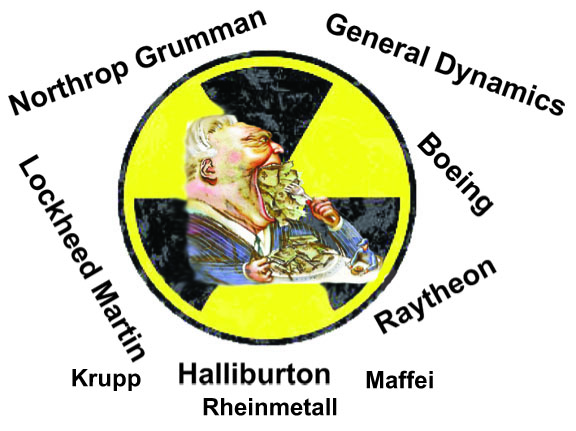
Private contractors now run the nuclear warhead complex and build nuclear delivery vehicles. They range from Raytheon, General Dynamics, and Lockheed Martin to lesser-known firms like BWX Technologies and Jacobs Engineering, all of which split billions of dollars in contracts from the Pentagon (for the production of nuclear delivery vehicles) and the Department of Energy (for nuclear warheads). To keep the gravy train running — ideally, in perpetuity — those contractors also spend millions lobbying decision-makers. Even universities have gotten into the act. Both the University of California and Texas A&M are part of the consortium that runs the Los Alamos nuclear weapons laboratory.
The American warhead complex is a vast enterprise with major facilities in California, Missouri, Nevada, New Mexico, South Carolina, Tennessee, and Texas. And nuclear-armed submarines, bombers, and missiles are produced or based in California, Connecticut, Georgia, Louisiana, North Dakota, Montana, Virginia, Washington state, and Wyoming. Add in nuclear subcontractors and most states host at least some nuclear-weapons-related activities.
And such beneficiaries of the nuclear weapons industry are far from silent when it comes to debating the future of nuclear spending and policy-making.
Profiteers of Armageddon: The Nuclear Weapons Lobby
The institutions and companies that build nuclear bombs, missiles, aircraft, and submarines, along with their allies in Congress, have played a disproportionate role in shaping U.S. nuclear policy and spending. They have typically opposed the U.S. ratification of a Comprehensive Nuclear Test Ban treaty; put strict limits on the ability of Congress to reduce either funding for or the deployment of intercontinental ballistic missiles (ICBMs); and pushed for weaponry like a proposed nuclear-armed, sea-launched cruise missile that even the Pentagon hasn’t requested, while funding think tanks that promote an ever more robust nuclear weapons force.
A case in point is the Senate ICBM Coalition (dubbed part of the “Dr. Strangelove Caucus” by Arms Control Association Director Daryl Kimball and other critics of nuclear arms). The ICBM Coalition consists of senators from states with major ICBM bases or ICBM research, maintenance, and production sites: Montana, North Dakota, Utah, and Wyoming. The sole Democrat in the group, Jon Tester (D-MT), is the chair of the powerful appropriations subcommittee of the Senate Appropriations Committee, where he can keep an eye on ICBM spending and advocate for it as needed.
The Senate ICBM Coalition is responsible for numerous measures aimed at protecting both the funding and deployment of such deadly missiles. ……………………….. That Coalition’s efforts are supplemented by persistent lobbying from a series of local coalitions of business and political leaders in those ICBM states. Most of them work closely with Northrop Grumman, the prime contractor for the new ICBM, dubbed the Sentinel and expected to cost at least $264 billion to develop, build, and maintain over its life span that is expected to exceed 60 years.
Of course, Northrop Grumman and its 12 major ICBM subcontractors have been busy pushing the Sentinel as well. They spend tens of millions of dollars on campaign contributions and lobbying annually, while employing former members of the government’s nuclear establishment to make their case to Congress and the executive branch. And those are hardly the only organizations or networks devoted to sustaining the nuclear arms race. You would have to include the Air Force Association and the obscurely named Submarine Industrial Base Council, among others.
The biggest point of leverage the nuclear weapons industry and the arms sector more broadly have over Congress is jobs. How strange then that the arms industry has generated diminishing job returns since the end of the Cold War. According to the National Defense Industrial Association, direct employment in the weapons industry has dropped from 3.2 million in the mid-1980s to about 1.1 million today.
Even a relatively small slice of the Pentagon and Department of Energy nuclear budgets could create many more jobs if invested in green energy, sustainable infrastructure, education, or public health – anywhere from 9% to 250% more jobs, depending on the amount spent. Given that the climate crisis is already well underway, such a shift would not only make this country more prosperous but the world safer by slowing the pace of climate-driven catastrophes and offering at least some protection against its worst manifestations.
A New Nuclear Reckoning?
Count on one thing: by itself, a movie focused on the origin of nuclear weapons, no matter how powerful, won’t force a new reckoning with the costs and consequences of America’s continued addiction to them. But a wide variety of peace, arms-control, health, and public-policy-focused groups are already building on the attention garnered by the film to engage in a public education campaign aimed at reviving a movement to control and eventually eliminate the nuclear danger.
Past experience — from the Campaign for Nuclear Disarmament that helped persuade Christopher Nolan to make Oppenheimer to the “Ban the Bomb” and Nuclear Freeze campaigns that stopped above-ground nuclear testing and helped turn President Ronald Reagan around on the nuclear issue — suggests that, given concerted public pressure, progress can be made on reining in the nuclear threat. The public education effort surrounding the Oppenheimer film is being taken up by groups like The Bulletin of the Atomic Scientists, the Federation of American Scientists, and the Council for a Livable World that were founded, at least in part, by Manhattan Project scientists who devoted their lives to trying to roll back the nuclear arms race; professional groups like the Union of Concerned Scientists and Physicians for Social Responsibility; anti-war groups like Peace Action and Win Without War; the Nobel Peace prize-winning International Campaign to Abolish Nuclear Weapons; nuclear policy groups like Global Zero and the Arms Control Association; advocates for Marshall Islanders, “downwinders,” and other victims of the nuclear complex; and faith-based groups like the Friends Committee on National Legislation. The Native American–led organization Tewa Women United has even created a website, “Oppenheimer — and the Other Side of the Story,” that focuses on “the Indigenous and land-based peoples who were displaced from our homelands, the poisoning and contamination of sacred lands and waters that continues to this day, and the ongoing devastating impact of nuclear colonization on our lives and livelihoods.”
On the global level, the 2021 entry into force of a nuclear ban treaty — officially known as the Treaty on the Prohibition of Nuclear Weapons — is a sign of hope, even if the nuclear weapons states have yet to join. The very existence of such a treaty does at least help delegitimize nuclear weaponry. It has even prompted dozens of major financial institutions to stop investing in the nuclear weapons industry, under pressure from campaigns like Don’t Bank on the Bomb.
In truth, the situation couldn’t be simpler: we need to abolish nuclear weapons before they abolish us. Hopefully, Oppenheimer will help prepare the ground for progress in that all too essential undertaking, beginning with a frank discussion of what’s now at stake. https://tomdispatch.com/the-profiteers-of-armageddon/
J Robert Oppenheimer advocated for the regulation of nuclear energy after the bombings of Hiroshima and Nagasaki, and attempted to communicate with Jawaharlal Nehru about this in 1951.
Director Christopher Nolan’s Oppenheimer has once again put the spotlight on one of history’s most controversial figures, and by Nolan’s own estimation, ‘the most important person who ever lived’. Oppenheimer was in charge of the Manhattan Project in the 1940s, a American endeavor which resulted in the creation of the world’s first atomic bombs.
Oppenheimer often spoke about the guilt that he feltafter two bombs were dropped on the Japanese cities of Hiroshima and Nagasaki, and dedicated the rest of his days to advocating for the regulation of nuclear power. He refused to participate in the creation of the hydrogen bomb, and urged his government to tread very carefully. These themes are prominently explored in Nolan’s film, which ends with a guilt-ridden Oppenheimer having a vision of the world’s destruction.
And according to writer Nayantara Sahgal, Oppenheimer attempted to communicate with then prime minister Jawaharlal Nehru about the US government’s efforts to build a weapon ‘far more deadly than the atomic bomb’, and begged Nehru to not trade all-important thorium with the Americans in exchange for the wheat that India needed at the time. In her book Nehru: Civilizing A Savage World, Sahgal, who is Nehru’s niece, reproduced a letter that received in 1951 from her mother and his sister, Vijaya Lakshmi Pandit, who was serving at the time as India’s envoy in Moscow, Washington and London.
In the letter, she told him about a conversation she had with Oppenheimer, who’d rung her up from Princeton, and told her that he had ‘something very urgent to communicate’ and was sending an emissary, Amiya Chakravarti, who brought the ‘chilling message that the United States was developing a weapon far more deadly than the atom bomb.’ For this purpose, the US needed access to India’s ‘inexhaustible supply’ of thorium, and was prepared to offer wheat in exchange. Oppenheimer begged of India not to sell any thorium to the US voluntarily or through pressure, but Nehru wouldn’t have done it either way, as he ‘abhorred nuclear weapons and strove passionately to seek their total elimination’, as Sahgal wrote.
Three Ukrainian drones have attacked Moscow in the early hours on Sunday, Russian authorities said, injuring one person and prompting a temporary closure of traffic in and out of one of four airports around the Russian capital.
Key points:
The Russian Defence Ministry referred to the incident as an “attempted terrorist attack by the Kyiv regime”
Moscow Mayor Sergei Sobyanin said the attack “insignificantly damaged” the outsides of two buildings in the Moscow city district
A spokesperson for the Ukrainian air force said the Russian people were seeing the consequences of Russia’s war in Ukraine
Ukrainian President Volodymyr Zelenskyy warned on Sunday that “war” was coming to Russia after the attack.
“Gradually, the war is returning to the territory of Russia — to its symbolic centres and military bases, and this is an inevitable, natural and absolutely fair process,” Mr Zelenskyy said on a visit to the western city of Ivano-Frankivsk.
It was the fourth such attempt at a strike on the capital region this month and the third in a week, fuelling concerns about Moscow’s vulnerability to attacks as Russia’s war in Ukraine drags into its 18th month.
The Russian Defence Ministry referred to the incident as an “attempted terrorist attack by the Kyiv regime” and said three drones targeted the city.
One was shot down in the surrounding Moscow region by air defence systems and two others were jammed. Those two crashed into the Moscow business district…………………………………………………………………
Without directly acknowledging that Ukraine was behind the attack on Moscow, a spokesperson for the Ukrainian air force said that the Russian people were seeing the consequences of Russia’s war in Ukraine………………………………….
Mr Ihnat also referenced a drone attack on Russian-occupied Crimea overnight.
Moscow announced on Sunday that it had shot down 16 Ukrainian drones and neutralised eight more with an electronic jamming system. There were no casualties, officials said.
In Ukraine, the air force reported that it had destroyed four Russian drones above the country’s Kherson and Dnipropetrovsk regions.
The central question now is whether the US build-up is transforming Australia into a base for offensive US operations into Asia.
James Curran, Finsncial Review, International Editor, Jul 30, 2023
The AUSMIN talks over the weekend continued a trend since the late 1990s of tying Australia more tightly into both American grand strategy and war planning in Asia.
The mainstream media has once more tried to generate alarm about the presence of two relatively innocuous Chinese electronic spy ships in international waters during the latest biennial Talisman Sabre military exercise spread across the Australian mainland and offshore oceans. It involves 30,000 troops from 13 countries. Although the Indian prime minister Narendra Modi had publicly assured his Australian counterpart Anthony Albanese that his country would attend, India did not turn up.
The unnamed enemy is China. A London based journalist reported from Townsville that the latest exercise was occurring against a “changing security landscape in which China grows evermore belligerent”. Apparently, he didn’t see any need to give evidence for this dubious claim. The defence minister, Richard Marles said Talisman Sabre provided an opportunity to practice “high-end” warfare. Just how participants such as PNG, Tonga and Fiji can do this is not clear. In a war, their role would be to let the US operate from their territory.
During the last exercise, the ABC’s national television news each night ran a video of the spy ships across the top of the screen. It hasn’t gone that far this time, but has given extensive coverage to the spy ships without explaining what harm they might be doing.
The participants don’t seem alarmed. During the last exercise, an ABC journalist asked an American soldier on an amphibious ship if he was worried about the presence of Chinese spy ships. He replied, “No, we do it to them and they do it to us”. An Australian military spokesman said this time that it had taken the appropriate precautions to ensure the spy ships don’t cause any harm. A core reason is that all signals traffic is encrypted. The reality is that the US and its allies conduct electronic intelligence gathering on a much greater scale than China can. The Pine Gap satellite ground station in central Australia, for example, generates billions of pieces of intelligence every day. This did not stop the ABC defence correspondent Andrew Green commenting on the activities of one Chinese spy ship, “If knowledge is power, China has just become more powerful”.
The RAAF’s P8A Poseidon electronic spy planes pose an aggressive threat to China by dropping sonar buoys in the South China Sea where its submarines are based on Hainan island close to the mainland. The small buoys contain an underwater microphone to pick up the sounds from submarines and relay the data to the spy planes conducting surveillance for potential military use.
Australia’s behaviour in the South China Sea is the same as if Chinese planes dropped sonar buoys outside the Fremantle base for Australian and US submarines. But the Chinese planes don’t do this. …………………………………………………………………………………
Certainly, Australian media would consider it provocative if China developed a long-range air capability and dropped sonar buoys off the submarine base at Fremantle. Albanese portrays the co-operation between the US and Australia to conduct potentially aggressive military activities in the South China Sea as part of the struggle between autocracies and democracy. Unfortunately, the draconian nature of some of Australia’s national security laws, deprive Australia of the right to call itself a liberal democracy.
Similar problems arise with Albanese’s iron grip on the Labor party’s federal conference in Brisbane on August 17-19. Although he describes Labor as a democratic party, he has effectively banned any parliamentarians attending the conference from supporting motions in favour of scrapping the AUKUS pact or the acquisition of nuclear submarines. Albanese has also banned any parliamentarian from supporting the existing conference policy of making it a priority to recognise of Palestine as a state. https://johnmenadue.com/australian-medias-alarm-over-chinese-spy-ship-highlights-stark-double-standard/
The spectre of an international nuclear waste dump in Australia hangs over AUKUS and what this secretive agreement commits Australia to. Does it oblige us simply to dispose of spent nuclear reactors from our submarines if and when we get them? Or is there a hidden agenda whereby we also take the expired nuclear reactors from US and British submarines? If so, could it lead to Australia becoming a dump for high-level waste from civil nuclear reactors around the world?
Crikey.com is the latest to set speculative hares running. On 26 July it published an article by David Hardaker claiming the Albanese government had struck a secret deal under AUKUS to build a high-grade nuclear waste facility in Australia. Crikey claimed the deal has echoes that resound from 26 years ago.
Indeed it does. In December 1998, a proposal was made by Jim Voss, an American nuclear evangelist, who through his company Pangea proposed constructing an international nuclear waste repository on Billa Kalina, a pastoral lease near Roxby Downs in South Australia. Roxby Downs is a town built to service the giant BHP uranium, gold, copper and silver mine at Olympic Dam. Water for the town and the mine comes from Australia’s Great Artesian Basin.
As I wrote in Fact or Fission – the truth about Australia’s nuclear ambitions (Scribe 2003 and 2022), Voss’s proposal was leaked to the public by Friends of the Earth. Pangea was flying a kite on behalf of Anglo-American and possibly other nuclear interests. It made the unassailable observation that there is a real risk of nuclear weapons proliferation through the theft of plutonium or highly enriched uranium from nuclear power programs. Voss proposed a nuclear waste dump in Western Australia to take about a quarter of the high-level waste from the 445 commercial power reactors in 30 countries around the globe.
This, he claimed, would achieve several things – support international efforts to reduce nuclear weapons proliferation, further the objectives of nuclear disarmament, strengthen Australia’s relations with the United States, protect the global environment, and support the International Atomic Energy Agency (IAEA) and the United Nations. How all this would happen he didn’t say.
Such a repository has also been a gleam in the eyes of the Australian nuclear lobby and several politicians for many years. In 2006, John Howard’s Nuclear Review sought to expand Australia’s nuclear footprint by making nuclear power ‘a practical option’ in Australia’s electricity production. He also envisioned an international nuclear waste dump somewhere in the Outback. In 2014, former Prime Minister Bob Hawke, supported by then South Australian Premier Adam Giles, proposed to put a high-level nuclear waste depository at Muckaty Station north of Tennant Creek in South Australia. Hawke said the money earned would be of immense value to indigenous communities.
Prime Minister Tony Abbott had similar aspirations. So did Malcolm Turnbull, who in 2015 suggested that Australia should not just export uranium oxide (U3O8), but enrich it, process it into fuel rods, retain Australian ownership by leasing the rods abroad, and take them back as spent fuel for permanent disposal in Australia. That way, he said, Australia retained ownership of the uranium, preventing it from being diverted into clandestine weapons programs.
None of these proposals resulted in practical action. Except for qualified acceptance of the export of Australian yellowcake under safeguards to approved civil nuclear energy companies, the Australian public maintained an aversion to all things nuclear. The earlier careless disposal of nuclear tailings at Radium Hill, the contemptuous and ineffective clean-up of highly toxic plutonium in the aftermath of Britain’s nuclear tests at Emu Field and Maralinga in the 1950s, and French nuclear tests in the Pacific in the 1990s, all consolidated Australians’ aversion.
Following negative public reactions to his proposal, Voss quietly closed his Pangea office In January 2002 and retreated to Europe. But several years later, he was given renewed hope.
In 2016, the South Australian Nuclear Fuel Cycle Royal Commission under former South Australian governor Kevin Scarce concluded that although nuclear energy in Australia would not be economically viable for the immediate future, research should continue regarding the feasibility of an international spent fuel repository.
Voss returned to Australia in 2022, and took over the optimistically-named Ultra Safe Nuclear Corporation in Melbourne. Safe disposal of nuclear waste remained on his agenda. According to Crikey, Voss reckons very deep boreholes of around three to five kilometres could safely incarcerate spent fuel from the reactors of Australia’s nuclear-powered submarines for thousands of years.
Could such a storage facility attract US or British attention? Could their governments pressure Australia to take their own submarine spent fuel reactors as well as those of Australia?
They have strong motives to do so. Around 90 British spent fuel submarine reactors are said to be lying around Devonport Docks in Plymouth and the Rosyth dock in Fife, safeguarded only at huge expense. The US Navy has many more in open trenches at the Hanford Nuclear Reservation in Washington State. There are plans to process and store their transuranic elements somewhere permanently, but the Yukka Mountain Deep Geological repository in Nevada was de-funded in 2010, and has been subject to complex political manoeuvring ever since.
Given Albanese’s and Marles’ supine acceptance of US conditions to keep the reactors from our own submarines after their service lives, they could also easily be leant on to take US and UK used submarine reactors as well.
Could this in turn lead to Voss’s grand vision of Australia becoming a spent fuel repository for the international nuclear industry? Since we cannot even decide on the location of a repository for low-level nuclear waste from hospitals and materials testing laboratories, let alone places for intermediate and high-level waste, such an expansion seems a pipe dream. But we must not under-estimate the persistence of the Australian nuclear industry or its backers in Federal and State parliaments and in the Murdoch press.
Our first president in his farewell address warned us about three things: debt, political parties and foreign entanglements. Few now would doubt the prescient wisdom of the first two warnings, but we have also become entrapped in the third. Most notably we are forced by a declining Russia and a rising China to engage in a dangerous game of nuclear deterrence.
George Washington likely could not have envisioned a world in which his country was threatened with destruction either intentionally or accidentally by ballistic missiles launched from a foreign country thousands of miles away. Despite the new nature of the threats there may still be a measure of wisdom to be distilled from his advice. It is unlikely he would engage China in a destructive war over Taiwan although he might well provide them with the weapons to defend themselves. The problem with nuclear weapons would be more complicated and the only thing we can know for sure is that Washington would do what he perceived to be in his country’s best interest.
What is his country’s best interest? As we near the 78th anniversary of the atomic bombing of Hiroshima and Nagasaki, which resulted in the instant death of 150,000 people, we should take pause. United Nations general secretary Antonio Guterres warned us over a year ago that that we are one accident or miscalculation away from disaster.
The Power 5 nuclear weapon states: China, France, Russia, United Kingdom and the United States jointly stated over a year ago that “a nuclear war cannot be won and should never be fought.” Yet all the nuclear weapon states are renewing and trying to enhance their weapons in an ever-increasing cycle of ratcheting up that undermines stability and benefits no one. Secretary of Defense Robert McNamara said after the Cuban Missile Crisis “we lucked out.” Only good luck prevented a nuclear war and to depend on continued good luck, as the risks increase, is magical thinking better suited for children’s books of fairy tales, than as part of national defense policy.
We must tear down the metaphorical wall between the soothing idea of security through nuclear deterrence and the reality of the cataclysmic threat that nuclear weapons pose. The U.S. must lead the way and work with the authoritarian states, convincing them that it is in everyone’s best interest to maintain security without the ever-present threat of global annihilation.
The United Nations’ Treaty to Prohibit Nuclear Weapons, TPNW, in force since January 2021, is the best hope to begin the multi-generational trust building that will allow the required rigid verification regimes. Pursuing the path to global elimination of nuclear weapons is the only way to free ourselves from this dreadful foreign entanglement.
Although the total elimination of nuclear weapons is the ultimate solution there are things that can be done right now to reduce the risk of catastrophe. There is a grassroots movement endorsed by hundreds of nongovernmental organizations and municipal and state governments. Back from the Brink — preventnuclearwar.org — has four additional actions that can reduce risk and encourage our adversaries to follow.
The U.S. should have a No First Use policy. Using nuclear weapons first against a nonnuclear weapon state would merit world condemnation; using them against a nuclear weapon state would bring devastating retaliation. The second and third actions are linked. The U.S. should take nukes off high alert status and eliminate sole presidential authority to launch. Only Congress can declare war and loitering nuclear-armed submarines virtually undetectable allow that option. Finally, many former military leaders including former Secretary of Defense William Perry have spoken against replacing the entire U.S. arsenal. The ground-based ICBMs are “sitting ducks” virtually inviting a first strike by a deranged tyrant.
It is also important to remember that the military industrial political complex that President Dwight Eisenhower warned us about is often disingenuous touting weapon systems for profit that do not make us safer. U.S. House of Representatives Resolution 77 introduced by Representative McGovern endorses the Back from the Brink campaign and already has 34 cosponsors. A companion bill should be introduced in the senate. The grace of public pressure by “we the people” can force our government to adopt a less insane nuclear policy.
I feel that a real leader, like Washington, would have the audacity, like presidents Reagan and Gorbachev, who made great progress ending the cold war, to pursue this path.
The UK government’s ambition to more than triple Britain’s nuclear power generation capacity by 2050 badly lacks of a strategic plan to achieve it, according to a report published on Monday.
The “stretching” government target on nuclear energy is the right direction but ministers need to be clear on how they propose to get there in order to encourage investment, MPs on the House of Commons science, innovation and technology committee said.
Their report is the latest criticism of the government over its progress towards meeting the UK’s net zero carbon emissions goal by 2050. The Climate Change Committee, which advises ministers, said in June that the UK’s progress on cutting emissions was “worryingly slow”.
In 2022, then prime minister Boris Johnson announced that the government wanted the UK to have about 24 gigawatts of nuclear power generation capacity by 2050 — supplying about a quarter of the country’s electricity. That compares to less than 7GW now.
………………………..It highlighted continuing uncertainty over, among other things, what mix of nuclear technologies the government intends to meet the target and the shape of state support
The MPs said: “Witnesses to our inquiry characterised the government’s energy security strategy, published in April 2022, as more of a ‘wish list’ than a strategy to achieve those ambitions.” The committee called on government to develop a “comprehensive nuclear strategic plan” by the end of this parliament. …………………..
The energy department highlighted this month’s launch of Great British Nuclear, a government body to oversee nuclear development “which will help generate billions for the UK economy and support thousands of jobs”. It added: “We have already made clear we will publish a nuclear road map . . . https://www.ft.com/content/c76a1d8b-248e-4bbb-9802-5a99bb8139c5
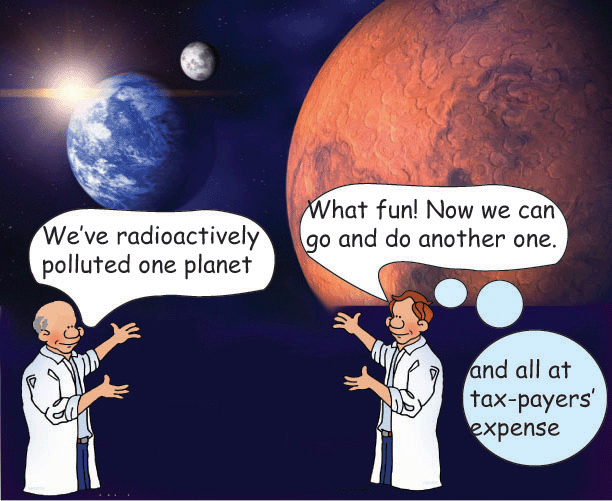
The space race has been revived, but this time, the goal post has been shifted much further – to Mars. As recent technological advancements promise to open new horizons of exploration, NASA plans to cut the travel time to Mars with a nuclear-powered spacecraft.
A trip to Mars currently takes approximately seven months, covering a staggering 300-million-mile journey. NASA, in collaboration with the US Defense Advanced Research Projects Agency (DARPA), now proposes an ambitious plan that hinges on the promise of nuclear thermal propulsion technology to reduce this duration significantly.
DRACO spacecraft is nuclear-powered
NASA aims to launch a nuclear-powered spacecraft, known as DRACO (Demonstration Rocket for Agile Cislunar Operations), into Earth’s orbit either by late 2025 or early 2026. The spacecraft, under construction by Lockheed Martin, a leading aerospace and defense company, will serve as a testbed for this groundbreaking technology.
NASA administrator Bill Nelson said that this technology “would allow humans to travel in deep space at record speed.” However, it remains unclear by how much the nuclear thermal propulsion technology can decrease the travel time.
…………………………………………………………………. The history of NASA’s interest in nuclear propulsion dates back over six decades. The concept was first explored in the 1960s when Wernher von Braun, a pioneer of rocket technology, advocated for a Mars mission utilizing a nuclear propulsion system. Unfortunately, budgetary constraints and shifting priorities resulted in the abandonment of this vision in 1972
But with the dawn of the new space age, NASA’s pursuit of the Red Planet has been rekindled. In collaboration with the US government, the space agency aims to expedite progress with the DRACO nuclear thermal rocket program.
“The ability to accomplish leap-ahead advances in space technology through the DRACO nuclear thermal rocket program will be essential for more efficiently and quickly transporting material to the Moon and eventually, people to Mars,” commented Dr Stefanie Tompkins, director at DARPA………………………………………………………………………………………………
More about Mars…………………….
Size
Mars is about half the size of Earth but has the same amount of dry land. It is much colder than Earth, with temperatures ranging from -195 degrees F in winter at the poles to 70 degrees F in summer near the equator. Mars has the largest dust storms in the solar system, capable of covering the entire planet and lasting for months.
Atmosphere
The planet’s atmosphere is very thin, composed mainly of carbon dioxide (95%), with traces of nitrogen and argon. It lacks a magnetic field, which on Earth serves to protect us from harmful solar radiation. As a result, the surface of Mars is exposed to higher levels of radiation, which can be a challenge for human exploration and potential colonization.
………………………….... Potential for life on Mars
The possibility of liquid water in the past, and thus the potential for life, has made Mars a prime target for future human exploration. The planned missions to Mars, such as NASA’s Artemis program and SpaceX’s Starship project, aim not only to land humans on Mars but also to establish a sustainable colony, marking a significant leap in our exploration of the cosmos. https://www.earth.com/news/could-a-nuclear-powered-spacecraft-shorten-the-trip-to-mars/
The Biden administration announced a $345 million weapons package for Taiwan on Friday, the first tranche in a total of $1 billion the U.S. has allotted to be transferred directly from Pentagon stockpiles to the island this year.
The move is sure to anger China as Washington has been trying to rebuild relations with Beijing. Senior administration officials, including Secretary of State Antony Blinken and Treasury Secretary Janet Yellen, recently visited China, but the outreach has done little to quell tensions over a range of issues, from U.S. support to Taiwan to Beijing’s spy balloon program…………………..
The package marks the first time the U.S. has used new authority from Congress to transfer military equipment directly from Pentagon inventory to Taiwan. The transfer is done under the Presidential Drawdown Authority, the same mechanism Washington uses to send weapons to Ukraine………………………………………..
Defense Secretary Lloyd Austin told lawmakers in May that a presidential drawdown package was in the works for Taiwan, but it’s taken weeks of additional work before the aid could be officially announced. Among other challenges, DOD had to work through an “accounting error” that forced officials finalizing packages for Ukraine and Taiwan to recalculate the value of equipment that was being sent………….. more https://www.politico.com/news/2023/07/28/u-s-300million-weapons-taiwan-00108811