Ukraine: Zaporizhzhya nuclear plant initiates reactor shutdown following water leak, reports IAEA
UN News, 10 August 2023
The Zaporizhzhya Nuclear Power Plant in Ukraine has begun transitioning one of its reactor units from a hot shutdown to a cold shutdown after a water leak was detected in one of its steam generators, the International Atomic Energy Agency (IAEA) said on Thursday.
The purpose of placing reactor unit 4 in cold shutdown is to investigate the exact cause of the leak and carry out necessary maintenance to repair the affected steam generator, according to a statement by Rafael Mariano Grossi, IAEA Director General.
There was no radiological release to the environment, the statement noted, adding that over the next three days, the nuclear power plant will move unit 6 to hot shutdown to continue steam production.
Unit 6 had been in cold shutdown since 21 April to facilitate safety system inspections and maintenance.
“The IAEA team on the site will closely monitor the operations for the transition between the shutdown states of Units 4 and 6,” said Mr. Grossi.
Power challenges
The IAEA has been monitoring the situation at Europe’s largest nuclear power plant since the early days of the conflict. The ZNPP is controlled by Russian forces but operated by its Ukrainian staff.
Mr. Grossi reported that there were power disruptions on Thursday after the 750kV power line disconnected twice during the day.
The ZNPP had to rely on 330 kV backup line, to supply the electricity required, for example, to perform safety functions such as pumping cooling water for the plant; and there was no total loss of off-site power to the site and emergency diesel generators were not needed.
According to IAEA, the nuclear power plant has been experiencing major off-site power problems since the conflict began in February 2022, exacerbating the nuclear safety and security risks facing the site currently located on the frontline.
“The repeated power line cuts underline the continuing precarious nuclear safety and security situation at the plant,” Mr. Grossi said.
Availability of cooling water remains relatively stable, with measures to mitigate water loss from the cooling pond by pumping in water from the ZNPP inlet channel.
IAEA experts’ site inspections
IAEA experts at the nuclear power plant have also conducted multiple walkdowns in different parts of the site, including visits to spent fuel storage and reactor control rooms, the agency said.
In one of the visits, on Tuesday, to the main control room, emergency control room and other safety-related rooms, the team did not observe any mines or usual objects in the main control; but in the turbine hall of unit 2, they noted the presence of a number of military trucks parked in an area reserved for vehicle maintenance…………………………….. https://news.un.org/en/story/2023/08/1139662
Anti-nuclear protesters at Faslane charged after blocking entrance
Anti-nuclear protesters blocked the entrance of a naval base in Helensburgh
on Wednesday for several hours. Three activists were arrested and charged
with breach of the peace on August 9 at HMNB Clyde, commonly known as
Faslane. A Royal Navy spokesperson said: “We can confirm that three
individuals were arrested yesterday outside of HMNB Clyde and charged with
breach of the peace. “At no time did the individuals gain entry to the
site and the safety and security of the Naval Base and our vessels were not
compromised.
STV 10th Aug 2023
Background to Proposed radioactive waste dump in Deep River -opposition from indigenous and non-indigenous groups

| Gordon Edwards 11 Aug 23 |
A consortium of multinational corporations, headed by SNC-Lavalin, was hired by the government of Canada in 2015 to “reduce the liability” associated with federally owned radioactive wastes. The dollar value of that liability has been estimated to exceed $7 billion.
For the last 5 1/2 years, the consortium has been proposing to store the most voluminous waste in a “megadump” intended to hold about one million cubic metres of radioactive and nonradioactive toxic wastes in perpetuity. The proposed dump is essentially a landfill operation one kilometre from the Ottawa River, a heritage river that courses through the nation’s capital and feeds into the St Lawrence River at Montreal.
The project is opposed by all but one of the 11 Algonquin communities on whose unsurrendered territory the megadump is to be sited. It is part of the Chalk River Nuclear Laboratories site – land that was stolen from the Algonquin Nation in 1944. The federal government expropriated the site on national security grounds, required for the World War II Atomic Bomb Project, without asking or notifying or compensating the Algonquins for whom the site had cultural and religious significance for thousands of years.
On Thursday August 10, 2023, three Algonquin communities gave their final arguments to two members of the Canadian Nuclear Safety Commission (CNSC). Both of these Commissioners had previously worked for many years for the nuclear industry. The Algonquins were not allowed to present in person before the Commissioners, so they rented a hall for $8000 and had their own live audience to witness the proceedings as they made their presentations to the Commissioners by zoom.
In addition to Chiefs, elders, councillors, researchers and lawyers from three Algonquin communities – Kebaowek First Nation, Kitigan Zibi Anishinabeg, and Barriere Lake First Nation – there were in attendance members of several Algoquin communities, as well as many non-Indigenous people. The latter included representatives from federal parliamentarians, mayors of local communities, Ottawa city councillors, and representatives of the following Non-Governmental Organizations:
Ottawa Riverkeeper, Grennspace Alliance of Canada’s Capital, Ecology Ottawa, Ottawa River Institute, Canadian Coalition for Nuclear Responsibility, Canadian Environmental Law Association, The Atomic Photographers’ Guild, First United Church Water Care Allies, Old Fort William Cottagers’ Association, Ottawa Charter of the Council of Canadians, Sierra Club Canada Foundation, Pontiac Environmental Protection, Friends of the Earth, Ottawa Raging Grannies, Canadian Parks and Wilderness Society (Ottawa Valley), Biodiversity Conservancy International, Bonnechere River Watershed Project, Council of Canadians Regional, Coalition Against Nuclear Dumps on the Ottawa River, National Capital Peace Council.
Mony of the non-Indigenous representatives who came to hear the Algonquin Nations final arguments before the Canadian Nuclear Safety Commission (CNSC) signed their names to the following statement:
“NO CONSENT, NO DUMP. August 10, 2023″Today, CNSC conducts its final hearings on the planned ‘megadump’ at Chalk River – a gigantic mound of radioactive and non-radioactive toxic wastes, seven stories high, one kilometre from the Ottawa River. Most of the radionuclides to be dumped have half-lives of more than 5000 years. 99 percent of the initial radioactivity is from profit-making companies – waste that is imported for permanent disposal at public expense.
“Chalk River is sited on the unceded traditional territory of the Algonquin Nation. The Kebaowek and Kitigan Zibi Anishinabeg Algonquin communities do not consent to this radioactive and toxic dump, which is euphemistically called a Near Surface Disposal
Facility (NSDF).“We are non-Indigenous citizens. We do not presume to speak on behalf of Indigenous peoples, but as proud Canadians we wish to state clearly that if CNSC grants permission for the NSDF despite the lack of free, prior and informed consent from the Kebaowek and Kitigan Zibi Anishinabeg, it will be an act that dishonours all Canadians.
“We – and many others across Canada – regard such a decision as a blow to the process of reconciliation. It will set a dire precedent by suggesting that Indigenous consent is not a priority. Such a development could set back the cause of reconciliation for generations.”[56 signatures by attendees]
Agency to test for tritium in fish after Fukushima water discharge
The Fisheries Agency will conduct daily checks of tritium levels in fish
caught off the coast of Fukushima Prefecture after treated water from the
Fukushima No. 1 nuclear power plant is released into the ocean.
The agency announced on Aug. 10 that the results of the checks would be released two
days later. The study will continue for about a month after the start of
the discharge of water treated after being contaminated with radiation
within the plant grounds.
The government plans to begin releasing the
water, which has accumulated at the crippled plant for more than a decade
and is nearing the capacity of storage tanks on the site, later this
summer. China has been especially virulent in opposing the discharge of the
treated water due to environmental concerns. The results of the daily
checks will be released in Japanese and English by the Fisheries Agency.
Asahi Shimbun 11th Aug 2023
Medical Journals Issue Urgent Call for Elimination of Nuclear Weapons

August 10th, 2023
More than 100 medical journals, including the Lancet, the British Medical Journal, the New England Journal of Medicine, and the JAMA, have issued a joint call for urgent steps to decrease the growing danger of nuclear war and to move rapidly to the elimination of nuclear weapons. At a time of expanded fighting in Ukraine and increased tensions in Korea, leaders of the global health community underscore that any use of nuclear weapons would be catastrophic for humanity. https://peaceandhealthblog.com/2023/08/02/medical-journals-issue-urgent-call-for-elimination-of-nuclear-weapons/
The unprecedented call to action comes in the form of an editorial co-authored by the editors of 11 of the leading medical and health journals, the World Association of Medical Editors and leaders of the International Physicians for the Prevention of Nuclear War (IPPNW). The editorial was released on August 1st in conjunction with the start of the United Nations Nuclear Non-Proliferation Treaty (NPT) Preparatory Committee Meeting and the 78th year since the bombings of Hiroshima and Nagasaki. https://meetings.unoda.org/npt-/treaty-on-the-non-proliferation-of-nuclear-weapons-preparatory-committee-for-the-eleventh-review-conference-first-session-2023
The editorial warns, “The danger is great and growing. The nuclear armed states must eliminate their nuclear arsenals before they eliminate us.”………………………………………………………………………………………………………………………………………………………… more http://nuclearactive.org/medical-journals-issue-urgent-call-for-elimination-of-nuclear-weapons/
Oppenheimer, Japan bombings put nuclear energy in a harsh light
Utah Public Radio | By Eric Tegethoff, August 11, 2023 , https://www.upr.org/utah-news/2023-08-11/oppenheimer-japan-bombings-put-nuclear-energy-in-a-harsh-light
The power and destructiveness of nuclear energy has been in the spotlight since the film “Oppenheimer” was released in July. It is in focus again this week with the anniversaries of the atomic bombs dropped on Hiroshima and Nagasaki, Japan during World War II.
Mary Miller, a member of Idaho nuclear energy watchdog Snake River Alliance, explained the movie about J. Robert Oppenheimer and the first experiment with the atomic bomb stops short of the bombs dropped on Japan. But Miller noted Oppenheimer’s ideas changed after that.
“His message was that humanity must learn humility in the face of nature and use its experience with atomic energy to prosper international peace,” she said. “The nuclear power that was unleashed on Japan was just unimaginably too big and too lethal for humankind.”
The 78th anniversary of the dropping of the atomic bomb on Hiroshima was Sunday, and the anniversary of the Nagasaki bombing is on Wednesday. It is estimated the two bombs may have killed as many as 226,000 people, most of whom were civilians.
Advocates for nuclear energy are increasingly promoting its ability to help move the country from dirty sources of fuel in the fight against climate change, but Miller said it should not be considered a clean source of energy because its negatives outweigh the good it might be able to achieve.
“Just like that power that was unleashed in the bomb, the use of nuclear energy for electricity, which is called nuclear power, cannot be safely anticipated, predicted or controlled,” she explained.
Miller pointed to a number of issues with nuclear energy, such as safe transportation and storage of its waste, which sometimes has a radioactive half life that extends thousands of years. Experiments on new types of nuclear reactors are eing conducted at the Idaho National Laboratory.
Melissa Parke to spearhead International Campaign to Abolish Nuclear Weapons, as Oppenheimer thrusts issue into spotlight

ABC News, By David Weber, 11 Aug 23
As the film Oppenheimer and war in Ukraine both draw the world’s attention to the threat of nuclear weapons, Melissa Parke says there is no better time for change.
Key points:
- Melissa Parke says a nuclear weapons ban is urgently needed
- Ms Parke says the film Oppenheimer had raised public awareness around the issue
- She says the war in Ukraine had also made people more aware of the risks
The former West Australian federal politician and UN Human Rights lawyer has been announced as the new executive director of the International Campaign to Abolish Nuclear Weapons.
With the majority of the world’s nations supporting the UN Treaty on the Prohibition of Nuclear Weapons, Ms Parke said there was no better time for Australia to sign up.
“There’s never been a more urgent time with the heightened tensions and conflict around the world to take action to eliminate nuclear weapons,” she said.
The former Labor MP for Fremantle called for “honest negotiations” around disarmament.
“Nuclear weapons do not make the planet safer, they make it an infinitely more dangerous place to be,” she said.
“Australia’s had a proud history of championing nuclear disarmament.
“The Australian Labor Party has made a commitment in its national policy platform … [and] when they were in opposition in 2018, they made a commitment that when Labor was in government it, would sign the treaty.”…………………………………………… more https://www.abc.net.au/news/2023-08-11/melissa-parke-to-spearhead-campaign-to-abolish-nuclear-weapons/102715862
YouTube Deletes Scott Ritter’s Channel
Sputnik, Ilya Tsukanov 11 Aug 23,
The veteran former US Marine Corps intelligence officer, UN weapons inspector, geopolitical observer and Sputnik contributor has spent over a year providing incisive commentaries about the NATO proxy war against Russia in Ukraine, challenging the Western mainstream narrative and offering his own perspective on the origins of the crisis.
Google-owned video hosting giant YouTube has deleted Scott Ritter’s YouTube channel.
A banner reading “This account has been terminated due to multiple or severe violations of YouTube’s policy prohibiting hate speech” greets anyone trying to navigate to Ritter’s channel.
The company did not provide any information about the nature of these alleged “multiple or severe violations,” or how Ritter’s mostly Ukrainian crisis-related commentaries and interviews constituted “hate speech.”
YouTube allows for user-based reporting of any alleged “hate speech,” prompting concerns from content creators over the years that the video hosting giant lets organized online activists to silence voices and views they might not like or agree with, or which challenge important state and corporate narratives.
Ritter Reacts
Ritter responded to YouTube’s decision in a pair of tweets Friday, saying the move is an attempt by US-based social media platforms to silence him…………………………………………………. more https://sputnikglobe.com/20230811/youtube-deletes-scott-ritters-channel-1112539769.html
Company involved in decommissioning of the Dounreay nuclear plant has gone into administration
A COMPANY, which was involved in the decommissioning of the Dounreay
nuclear plant, has gone into administration. James Fisher Nuclear (JFN) had
a base at Bower in premises previously occupied by Nicolson Engineering and
was part of Nuclear Decommissioning Ltd (NDL) – a joint venture which was
set up to decommission the Caithness site and others throughout the UK. JFN
was acquired by Myneration, a wholly-owned investment vehicle of Rcapital
Partners, from Cumbria-based James Fisher & Sons in March. It is based in
Preston, Lancashire.
John O’Groat Journal 10th Aug 2023
TODAY. The “modern” nuclear industry manages its radioactive sewage in a medieval way
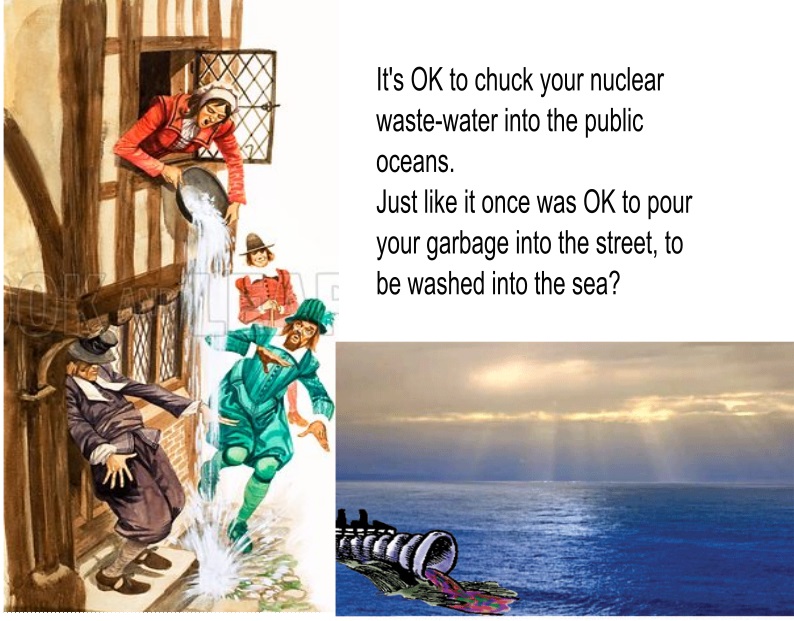
The nuclear industry prides itself on being such a “modern” “civilised” industry. However, it is quite happy to deal with its garbage in a medieval way. Just as, centuries ago, in “civilised” Europe it was just fine to pour your sewage into the street – to flow on to public waterways and oceans.
This mendacious industry cons us all into believing that the Fukushima nuclear waste-water is the same as water released from active nuclear power plants. It is not.
Normally, water that is used in cooling a nuclear plant in routine operation and then discharged to the environment has no direct contact with the nuclear reactor fuel cores. In contrast, the contaminated water generated by the Fukushima disaster has come into direct contact with contamination from the melted down cores of three reactors and as such is severely contaminated with many radionuclides. It has greater variety of radioactive materials but also the overall much higher radioactivity.
But that’s not the only deception. With its customary false logic, the nuclear industry claims that because several countries already pour nuclear-irradiated wastewater into the sea, that proves that it is OK to do so. That’s like a medieval person explaining that pouring sewage into the street is fine, because the neighbours do it.
The global ban on ocean dumping of radioactive waste adopted in 1993 applies only to barrels. It has allowed Britain and France to pump billions of gallons of radioactive wastewater into the Irish Sea and the North Sea respectively, for decades. The mind boggles at the thought of what the Russians do with theirs.

It took the Black Plague in 1350 to make people realise that sewage, garbage, and dead bodies in the streets were really a bad idea.
What is it going to take for the world to stop this wonderful “modern” nuclear industry pour its radioactive sewage into the public oceans?
And for that matter, since nuclear power and nuclear weapons are not essential – why allow their toxic sewage to be produced at all?
Atomic Bombing of Japan Was Not Necessary to End WWII. US Gov’t Documents Admit It
US government documents admit the atomic bombing of Hiroshima and Nagasaki was not necessary to end WWII. Japan was on the verge of surrendering. The nuclear attack was the first strike in Washington’s Cold War on the Soviet Union.
By Ben Norton / Geopolitical Economy Report August 10, 2023 https://scheerpost.com/2023/08/10/atomic-bombing-of-japan-was-not-necessary-to-end-wwii-us-govt-documents-admit-it/
It is very common for Western governments and media outlets to tell the rest of the world to be afraid of North Korea and its nuclear weapons, or to fear the possibility that Iran could one day have nukes.
But the reality is that there is only one country in human history that has used nuclear weapons against a civilian population – and not once, but twice: the United States.
On the 6th and 9th of August, 1945, the US military dropped atomic bombs on the Japanese cities of Hiroshima and Nagasaki. Around 200,000 civilians were killed.
Today, nearly 80 years later, many US government officials, journalists, and educators still claim that Washington had no choice but to nuke Japan, to force it to surrender and thus end World War Two. Some argue that this horrifying atrocity was in fact a noble act, that it saved even more lives that would have been lost in subsequent fighting.
This narrative, although widespread, is utterly false.
US government documents have admitted that Japan was already on the verge of surrendering in 1945, before the nuclear strikes. It was simply not necessary to use the atomic bomb.
The US Department of War (which was renamed the Department of Defense later in the 1940s) conducted an investigation, known as the Strategic Bombing Survey, analyzing its air strikes in World War II.
Published in 1946, the Strategic Bombing Survey stated very clearly, “Japan would have surrendered even if the atomic bombs had not been dropped”:
… it seems clear that, even without the atomic bombing attacks, air supremacy over Japan could have exerted sufficient pressure to bring about unconditional surrender and obviate the need for invasion.
Based on a detailed investigation of all the facts, and supported by the testimony of the surviving Japanese leaders involved, it is the Survey’s opinion that certainly prior to 31 December 1945, and in all probability prior to 1 November 1945, Japan would have surrendered even if the atomic bombs had not been dropped, even if Russia had not entered the war, and even if no invasion had been planned or contemplated
The nuclear strikes on Japan represented a political decision taken by the United States, aimed squarely at the Soviet Union; it was the first strike in the Cold War.
In August 1945, the USSR was preparing to invade Japan to overthrow its ruling fascist regime, which had been allied with Nazi Germany – which the Soviet Red Army had also just defeated in the European theater of the war.
Washington was concerned that, if the Soviets defeated Japanese fascism and liberated Tokyo like they had in Berlin, then Japan’s post-fascist government could become an ally of the Soviet Union and could adopt a socialist government.
The atomic bombs dropped on Hiroshima and Nagasaki, therefore, were not so much aimed at the Japanese fascists as they were aimed at the Soviet communists.
This expressly political decision to use nuclear weapons against Japan was in fact opposed by several top US military officials.
As one of the most famous generals in US military history, Dwight Eisenhower led operations in the European theater of the war and oversaw the subsequent occupation of what was formerly Nazi Germany.
Eisenhower later became president of the United States, following Harry Truman, the US leader who had nuked Japan.
Eisenhower is renowned worldwide for his leadership in the fight against fascism in Europe. But what is little known is that he opposed the US nuclear attacks on Japan.
After leaving the White House, Eisenhower published a memoir titled Mandate for Change. In this 1963 book, the former top general recalled an argument he had in July 1945 with then US Secretary of War Henry Stimson.
Stimson had notified him that Washington was planning to nuke Japan, and Eisenhower criticized the decision, stating that he had “grave misgivings” and was convinced “that Japan was already defeated and that dropping the bomb was completely unnecessary”.
The incident took place in [July] 1945 when Secretary of War Stimson, visiting my headquarters in Germany, informed me that our government was preparing to drop an atomic bomb on Japan. I was one of those who felt that there were a number of cogent reasons to question the wisdom of such an act. … But the Secretary, upon giving me the news of the successful bomb test in New Mexico, and of the plan for using it, asked for my reaction, apparently expecting a vigorous assent.
During his recitation of the relevant facts, I had been conscious of a feeling of depression and so I voiced to him my grave misgivings, first on the basis of my belief that Japan was already defeated and that dropping the bomb was completely unnecessary, and secondly because I thought that our country should avoid shocking world opinion by the use of a weapon whose employment was, I thought, no longer mandatory as a measure to save American lives. It was my belief that Japan was, at that very moment, seeking some way to surrender with a minimum loss of “face”. The Secretary was deeply perturbed by my attitude, almost angrily refuting the reason I gave for my quick conclusions.
These “completely unnecessary” nuclear attacks on Hiroshima and Nagasaki killed some 200,000 civilians. But they had a political goal, aimed at the Soviet Union.
The political reasons behind the atomic bombing of Japan have been publicly acknowledged by the US Department of Energy’s Office of History, which runs a website with educational information about the Manhattan Project, the scientific initiative that developed the bomb.
The US government website conceded that the Truman administration’s decision to nuke Japan was politically motivated, writing:
After President Harry S. Truman received word of the success of the Trinity test, his need for the help of the Soviet Union in the war against Japan was greatly diminished. The Soviet leader, Joseph Stalin, had promised to join the war against Japan by August 15th. Truman and his advisors now were not sure they wanted this help. If use of the atomic bomb made victory possible without an invasion, then accepting Soviet help would only invite them into the discussions regarding the postwar fate of Japan.
Other historians argue that Japan would have surrendered even without the use of the atomic bomb and that in fact Truman and his advisors used the bomb only in an effort to intimidate the Soviet Union.
…
Truman hoped to avoid having to “share” the administration of Japan with the Soviet Union.
Mainstream historians have acknowledged this fact as well.
Ward Wilson, a researcher at the establishment London-based think tank the British American Security Information Council, published an article in Washington’s elite Foreign Policy magazine in 2013 titled “The Bomb Didn’t Beat Japan. Stalin Did”.
“Although the bombs did force an immediate end to the war, Japan’s leaders had wanted to surrender anyway and likely would have done so before the American invasion planned for Nov. 1. Their use was, therefore, unnecessary”, he wrote.
Wilson explained:
If the Japanese were not concerned with city bombing in general or the atomic bombing of Hiroshima in particular, what were they concerned with? The answer is simple: the Soviet Union.
…
Even the most hard-line leaders in Japan’s government knew that the war could not go on. The question was not whether to continue, but how to bring the war to a close under the best terms possible.
One way to gauge whether it was the bombing of Hiroshima or the invasion and declaration of war by the Soviet Union that caused Japan’s surrender is to compare the way in which these two events affected the strategic situation. After Hiroshima was bombed on Aug. 6, both options were still alive. … Bombing Hiroshima did not foreclose either of Japan’s strategic options.
The impact of the Soviet declaration of war and invasion of Manchuria and Sakhalin Island was quite different, however. Once the Soviet Union had declared war, Stalin could no longer act as a mediator — he was now a belligerent. So the diplomatic option was wiped out by the Soviet move. The effect on the military situation was equally dramatic.
When the Russians invaded Manchuria, they sliced through what had once been an elite army and many Russian units only stopped when they ran out of gas.
…
The Soviet invasion invalidated the military’s decisive battle strategy, just as it invalidated the diplomatic strategy. At a single stroke, all of Japan’s options evaporated. The Soviet invasion was strategically decisive — it foreclosed both of Japan’s options — while the bombing of Hiroshima (which foreclosed neither) was not.
Attributing the end of the war to the atomic bomb served Japan’s interests in multiple ways. But it also served U.S. interests. If the Bomb won the war, then the perception of U.S. military power would be enhanced, U.S. diplomatic influence in Asia and around the world would increase.
…
If, on the other hand, the Soviet entry into the war was what caused Japan to surrender, then the Soviets could claim that they were able to do in four days what the United States was unable to do in four years, and the perception of Soviet military power and Soviet diplomatic influence would be enhanced. And once the Cold War was underway, asserting that the Soviet entry had been the decisive factor would have been tantamount to giving aid and comfort to the enemy.
Thus, before World War II was even over, the United States launched a Cold War against its ostensible “ally”, the Soviet Union – and against the potential spread of socialism anywhere around the world.
US spy agencies began recruiting former fascists and Nazi collaborators. US officials freed Class A Japanese war criminals from prison, some of whom went on to lead the government in Tokyo.
Many of these figures were involved in founding the right-wing Liberal Democratic Party (LDP), which has essentially run Japan as a one-party state since 1955 (excluding a mere five years of opposition rule).
A textbook example of this was Nobusuke Kishi, a notorious war criminal who ran the Japanese empire’s Manchukuo puppet regime and oversaw genocidal atrocities in collaboration with the Nazis. He was briefly imprisoned, but later pardoned by US authorities and, with Washington’s support, rose to become prime minister of Japan in the 1950s.
Kishi’s fascist-linked family still commands significant control over Japanese politics. His grandson, Shinzo Abe, was the longest-serving prime minister in the East Asian nation’s history.
Today, it remains important to correct widespread myths about this history, because they have a profound impact on popular culture.
In July 2023, Hollywood released a blockbuster film, “Oppenheimer”, by award-winning director Christopher Nolan. The movie was a huge commercial success, but was also criticized for its politics.
The film humanized the eponymous physicist who directed the Manhattan Project’s Los Alamos laboratory, J. Robert Oppenheimer, commonly known as the “father of the atomic bomb”.
Later in life, Oppenheimer came to regret the role he played in developing the weapon, and he campaigned against nuclear proliferation.
Ironically, Oppenheimer also became a victim of the US government’s McCarthyism, and was persecuted for his links to left-wing groups.
But while the movie was celebrated for depicting Oppenheimer’s complex internal struggles, it was accused of whitewashing the brutality of the US atomic bombings of Hiroshima and Nagasaki.
The Japanese civilians who lost their lives in these totally unnecessary attacks were eerily absent from the film.
By incessantly repeating the falsehood that nuking 200,000 people was the only way to get Japan to surrender, US officials have normalized this erasure of the civilian victims of its unnecessary, politically motivated war crimes.
…
Putin profits from US and European reliance on Russian nuclear fuel
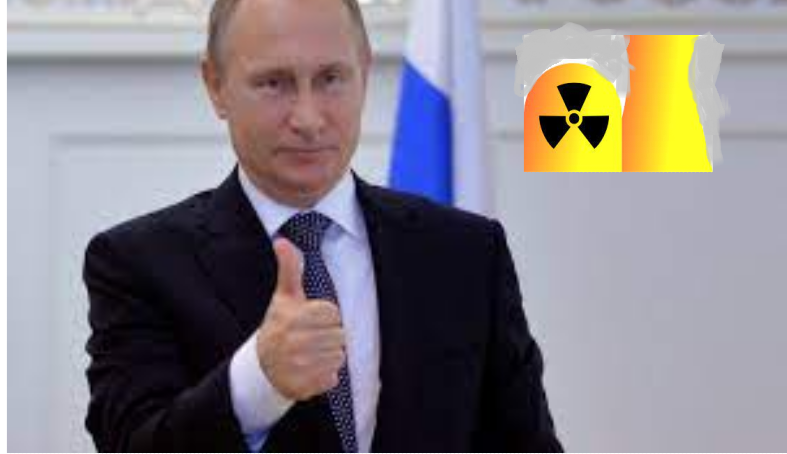
MARTHA MENDOZA and DASHA LITVINOVA, Yahoo News, 10 August 2023
WASHINGTON (AP) — The U.S. and its European allies are importing vast amounts of nuclear fuel and compounds from Russia, providing Moscow with hundreds of millions of dollars in badly needed revenue as it wages war on Ukraine.
The sales, which are legal and unsanctioned, have raised alarms from nonproliferation experts and elected officials who say the imports are helping to bankroll the development of Moscow’s nuclear arsenal and are complicating efforts to curtail Russia’s war-making abilities. The dependence on Russian nuclear products — used mostly to fuel civilian reactors — leaves the U.S. and its allies open to energy shortages if Russian President Vladimir Putin were to cut off supplies……
“We have to give money to the people who make weapons? That’s absurd,” said Henry Sokolski, executive director of the Washington-based Nonproliferation Policy Education Center. “If there isn’t a clear rule that prevents nuclear power providers from importing fuel from Russia — and it’s cheaper to get it from there — why wouldn’t they do it?”
Russia sold about $1.7 billion in nuclear products to firms in the U.S. and Europe, according to trade data and experts. The purchases occurred as the West has leveled stiff sanctions on Moscow over its 2022 invasion of Ukraine, blocking imports of such Russian staples as oil, gas, vodka and caviar.
The West has been reluctant to target Russia’s nuclear exports, however, because they play key roles in keeping reactors humming. Russia supplied the U.S. nuclear industry with about 12% of its uranium last year, according to the U.S. Energy Information Administration. Europe reported getting about 17% of its uranium in 2022 from Russia.
………………………………………. Many of the 30 countries generating nuclear energy in some 440 plants are importing radioactive materials from Russia’s state-owned energy corporation Rosatom and its subsidiaries. Rosatom leads the world in uranium enrichment, and is ranked third in uranium production and fuel fabrication, according to its 2022 annual report.
……………………………Rosatom’s CEO Alexei Likhachyov told the Russian newspaper Izvestia the company’s foreign business should total $200 billion over the next decade. That lucrative civilian business provides critical funds for Rosatom’s other major responsibility: designing and producing Russia’s atomic arsenal, experts say.
…………………………………. The value of Russian nuclear fuel and products sent to the U.S. hit $871 million last year, up from $689 million in 2021 and $610 million in 2020, according to the U.S. Census Bureau. In terms of weight, U.S. imports of uranium products from Russia nearly doubled from 6.3 tons in 2020 to 12.5 tons in 2022, according to trade data from ImportGenius.
……………………………………………………………………………….Europe is in a bind largely because it has 19 Russian-designed reactors in five countries that are fully dependent on Russian nuclear fuel. France also has a long history of relying on Russian-enriched uranium. In a report published in March, Greenpeace, citing the United Nations’ Comtrade database, showed that French imports of enriched uranium from Russia increased from 110 tons in 2021 to 312 tons in 2022.
Europe spent nearly $828 million (almost €750 million) last year on Russian nuclear industry products — including fuel elements, nuclear reactors, and machinery — according to Eurostat, the EU’s statistics office………………………………………more https://uk.news.yahoo.com/putin-profits-off-global-reliance-040103115.html?guccounter=1
War is a Racket… U.S. and NATO Arms Industries Make Record $400 BILLION in Sales from Proxy War With Russia

Strategic Culture Foundation, 11 Aug 23
Western capitalism is at once a sponsor and an addict of war.
Western weapons manufacturers are popping champagne corks over record sales with total revenues hitting $400 billion for last year. According to media reports, this coming year-end will see that record figure exceeded by another salivating $50 billion.
Ukraine may be resembling a bloodbath, as we noted in last week’s editorial. But apparently, Western military corporations are swimming in a bonanza of profits and stock market investments.
Most of this lucrative new business stems from NATO’s proxy war with Russia in Ukraine, which is heading toward its second year. There is no sign of a diplomatic effort from the West or the Kiev regime it sponsors to end the bloodshed.
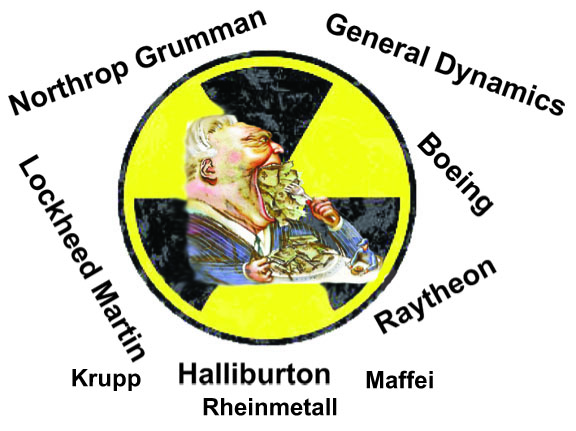
The main corporate beneficiaries making a financial killing from Ukraine are by far the American firms. They include such behemoths as Lockheed Martin, Boeing and RTX (formerly Raytheon). But also enjoying soaring profits are arms makers in other NATO countries: BAE in the United Kingdom, Airbus in France, Netherlands and Spain, Leonardo in Italy, and Germany’s Rheinmetall.
This week the Joe Biden administration requested another $24 billion in U.S. taxpayer-funded aid to Ukraine. It’s hard to keep track of the money flowing from NATO countries to prop up the Nazi regime in Kiev. Even the NATO authorities don’t seem to know the precise figures, such is the rampant corruption that is inevitably associated with the vast doling of funds. But estimates of total U.S. and NATO aid to Ukraine range from $150 billion to $200 billion over the past year alone.
What we are seeing is an audacious racket whereby the American and European public are subsidizing the funneling of their own taxpayers’ money into the coffers of weapons firms. And there is no democratic choice in the matter. It’s a fait accompli. Or, put another way, extortion.
Of course, too, part of this huge scam is the hefty financial cuts for the inner circle of the Kiev regime, including its puppet president, Vladimir Zelensky, and the brazenly sleazy defense chief Aleksy Reznikov. It is reckoned that at least $400 million has been grafted by the top members of the regime from the arms bazaar flowing into Ukraine. Reznikov has even boasted that his country serves as a testing ground for NATO weaponry.
Nearly a century ago, former U.S. Marine Corps General Smedley D Butler popularized the phrase, “war is a racket” as the title of his classic book in which he condemned how American capitalism profits obscenely from military invasions and killing.
Butler’s critique is as relevant today, perhaps more so, as evinced by the conflict in Ukraine.
Western media reports are increasingly admitting – albeit coyly – that the war is a disaster for the Kiev regime and, by extension, the NATO powers. The death toll among Ukrainian forces may be as high as 400,000 since the conflict erupted last February. The much-anticipated Ukrainian counteroffensive launched in early June has resulted in no territorial gains despite the horrendous casualties and despite the gargantuan supply of NATO weapons, training and logistical support.
A report in the Washington Post this week shows that most Ukrainian people are despairing of the grinding war and endless casualties. They see no point in the continuation of hostilities given the failure of the NATO-backed forces to make any advance against well-fortified Russian defense lines.
Yet against this grim reality, the U.S. and European officials keep running the taps of blood.
We see NATO leaders like Polish President Andrzej Duda this week urging for more weapons to be sent to Ukraine even while he concedes the military defeat so far.
Zelensky and his cronies are, not surprisingly, also demanding more NATO arms and claiming with bravado they will never negotiate with Russian President Vladimir Putin. Some people want this conflict to keep going because of their irrational Russophobia and simply because it is too lucrative for their own personal gain.
Where does democracy come into this? It doesn’t, whatsoever. Polls show that most Americans are opposed to the continuing supply of military aid to Ukraine. There are sound reasons to believe that most European citizens are also firmly against the fueling of a bloody war in which Ukrainian corpses keep piling higher. In addition, the perpetuation of this conflict runs the outrageous risk of spiraling out of control into an all-out war between the United States and Russia, the world’s biggest nuclear powers……………………………….. more https://strategic-culture.org/news/2023/08/11/war-iracket-us-nato-arms-industries-make-record-400-billion-sales-from-proxy-war-with-russia/
Chinese UN mission releases working paper on Fukushima nuclear-contaminated wastewater issue, urging Japan to discharge in responsible manner
By Global TimesP Aug 09, 2023 https://www.globaltimes.cn/page/202308/1295954.shtml
Chinese UN mission releases working paper on Fukushima nuclear-contaminated wastewater issue, urging Japan to discharge in responsible manner
China’s Permanent Mission to the United Nations (UN) and Other International Organizations in Vienna has submitted the working paper on the disposal of nuclear-contaminated water of Japan’s Fukushima Daiichi Nuclear Power Station to the First Preparatory Committee for the Eleventh Review Conference of the Treaty on the Non-Proliferation of Nuclear Weapons (NPT).
The disposal of nuclear-contaminated water from Fukushima concerns the global marine environment and public health. There is no precedent for artificially discharging nuclear-contaminated water into the ocean and no internationally recognized disposal standards.
The international community should attach great importance to Japan’s ocean discharge of the nuclear-contaminated water and urge Japan to dispose of the contaminated water in a responsible manner, according to the working paper released on Wednesday.
The working paper pointed out that Japan had previously discussed five ways to dispose of the contaminated water, namely injection into the ground, discharge into the ocean, vapor release, release as hydrogen gas into the atmosphere, and underground burial. However, Japan did not conduct a thorough study of all disposal options and insisted on choosing ocean dumping, which was the lowest cost option, thus transferring the risk of nuclear contamination.
If the so-called ”treated-water” is really safe and harmless, why does Japan not dispose of it within its own territory or use it for industrial and agricultural purposes? The working paper pointed out.
The paper noted that Japan fails to prove the long-term effectiveness and reliability of the purification equipment for treating the contaminated water. According to the data released by Japan, nearly 70 percent of the nuclear-contaminated water treated by Japan’s ALPS (Advanced Liquid Processing System) still fails to meet the discharge standard and needs to be purified again.
Japan has failed to prove the authenticity and accuracy of the data on contaminated water. Fukushima power plant operator TEPCO has repeatedly concealed and falsified nuclear-contaminated water related data in recent years. The IAEA conducted its review and assessment solely based on the data and information provided by Japan, and carried out inter-laboratory comparative analyses of only a small number of nuclear-contaminated water samples collected by Japanese officials, read the working paper.
According to general international law and the provisions of UN Convention on the Law of the Sea, Japan has the obligation to protect and preserve the marine environment. The Convention on the Prevention of Marine Pollution by Dumping of Wastes and Other Matter 1972 (the London Convention) prohibits the dumping of radioactive waste into the sea by means of man-made structures at sea. Japan’s discharging of nuclear-contaminated water into the sea by means of submarine pipelines is in violation of the relevant provisions of the London Convention.
Japan has failed to demonstrate the perfection of the monitoring program. Tokyo must not start discharging until the long-term monitoring mechanism is established, and must stop discharging water once anomalies are detected in the data on the discharge of nuclear contaminated water.
The Chinese UN mission stressed that Japan should not confuse the concept of nuclear-contaminated wastewater with the wastewater from the normal operation of nuclear power plants.
The working paper warned Japan of not making use of IAEA’s comprehensive assessment report on the disposal of Fukushima nuclear-contaminated water as ”shield” or ”greenlight” for the dumping plan.
In addition, the paper urged Japan to fully respond to the concerns of China and the international community, and dispose of the nuclear-contaminated water in a responsible manner in line with its obligations under international law, stop pushing through the dumping plan, fully consult with stakeholders including neighboring countries, make sure to handle the nuclear contaminated water in a science-based, safe and transparent way, and subject itself to rigorous international oversight
Australian Opposition’s likely embrace of nuclear energy is high-risk politics
Crazy brave, or just crazy? If, as seems likely, the opposition embraces
nuclear power in its 2025 election policy, it will be taking a huge
political gamble. The Coalition might argue this would be the best (or
only) way to ensure we achieve net zero by 2050.
But “nuclear” is a trigger word in the political debate, and the reactions it triggers are
mostly negative. Opposition Leader Peter Dutton has been open since the
election about nuclear energy being on the Coalition’s agenda. It’s a “no
surprises” tactic – but one that has allowed the government, especially
Climate Change Minister Chris Bowen, to regularly attack and ridicule the
idea.
The Conversation 10th Aug 2023
-
Archives
- October 2026 (120)
- September 2026 (339)
- August 2026 (330)
- July 2026 (355)
- June 2026 (287)
- May 2026 (306)
- April 2026 (356)
- March 2026 (251)
- February 2026 (267)
- January 2026 (308)
- December 2025 (358)
- November 2025 (359)
-
Categories
- 1
- 1 NUCLEAR ISSUES
- business and costs
- climate change
- culture and arts
- ENERGY
- environment
- health
- history
- indigenous issues
- Legal
- marketing of nuclear
- media
- opposition to nuclear
- PERSONAL STORIES
- politics
- politics international
- Religion and ethics
- safety
- secrets,lies and civil liberties
- spinbuster
- technology
- Uranium
- wastes
- weapons and war
- Women
- 2 WORLD
- ACTION
- AFRICA
- Atrocities
- AUSTRALIA
- Christina's notes
- Christina's themes
- culture and arts
- Events
- Fuk 2022
- Fuk 2023
- Fukushima 2017
- Fukushima 2018
- fukushima 2019
- Fukushima 2020
- Fukushima 2021
- general
- global warming
- Humour (God we need it)
- Nuclear
- RARE EARTHS
- Reference
- resources – print
- Resources -audiovicual
- Weekly Newsletter
- World
- World Nuclear
- YouTube
-
RSS
Entries RSS
Comments RSS

