Germany facing up to its nuclear waste problem

German nuclear phaseout leaves radioactive waste problem
Klaus Deuse, August 30, 2023 https://www.dw.com/en/german-nuclear-phaseout-leaves-radioactive-waste-problem/a-66661614?maca=en-Facebook-sharing&mibextid=2JQ9oc&fbclid=IwAR1xPxzvz3kfLoNV1JbUx70rWCRa5tiML4tl2jffIm0ILDquq2-av2j7bxw
While Germany searches for a permanent storage facility for its nuclear waste, it risks sitting on piles of dangerous waste for decades. The problem drains public finances by hundreds of millions of euros every year.
Germany ended the era of nuclear energy in Europe’s biggest economy when it decommissioned the last three remaining nuclear power plants on April 15 this year. Decades of nuclear power generation, however, have left a legacy that is unlikely to go away as smoothly as the phaseout: nuclear waste.
Since a permanent German storage facility is out of sight in the near future, the spent fuel rods, packed into specialized containers called Casks for Storage and Transport of Nuclear Material (CASTOR), will likely remain in interim storage for decades.
About 1,200 CASTOR containers are currently stored at 17 interim sites in Germany. A state-owned company, the Bundeseigene Gesellschaft für Zwischenlagerung mbH (BGZ), is tasked with operating the sites.
BGZ spokesperson Janine Tokarski told DW that the company finally expects “about 1,800 containers from across Germany to be designated for final disposal.”
Another state company, the Federal Company for Radioactive Waste Disposal (BGE), is exploring sites in Germany for the final disposal of the dangerous waste. According to Tokarski of BGZ, experts plan to find a site and, more importantly, reach a political consensus on it “in the 2040s at the earliest.”
From then on, another 20 to 30 years are likely to be spent on planning and construction, said Tokarski. She anticipates the beginning of final storage “in the 2060s at the earliest.” The shipping of all the waste from the various interim sites will probably take another 30 years, she added.
The century-long operation is expected to cost hundreds of billions of euros. Last year alone, BGZ spent €271 million ($292 million) just to ensure Germany’s nuclear waste is safely stored — €191 million of the sum on operating the interim sites and €80 million on investments in them.
A nuclear fortress
In 1992, the first CASTOR containers with highly radioactive fuel rods were stored in the interim storage site of Ahaus in northwestern Germany.
The 200-meter-long (218-yard-long) central storage building towers 20 meters high above the flat landscape of the Münsterland region and is protected by a wire fence surrounding the sprawling 5,700-square-meter (61,354-square-feet) site.
Bisected by a reception and maintenance area, the building currently holds more than 300 yellow casks containing burned fuel rods. Additionally, six CASTOR containers, each 6 meters long and weighing 120 tons, are stored in one of the two halls, keeping the waste leak-tight for a calculated 40 years.
Leak tightness is achieved through a pressure switch installed in the double-wall sealing system of these containers, said David Knollmann from BGZ in Ahaus.
“A gas is inserted between the two walls, specifically helium gas, at a certain pressure. This switch ensures the pressure doesn’t fall below a certain level,” he told DW.
David Knollmann proudly added that in 30 years, there hasn’t been a single case of a container requiring repairs.
The nuclear safety at the Ahaus interim storage site is not only overseen by German nuclear authorities but also by Euratom, an independent nuclear energy organization run by European Union member states, and the International Atomic Energy Agency (IAEA). Their auditors inspect the site regularly but without advance notice.
Pressure of time
In addition to the two central interim storage facilities in Ahaus and Gorleben, Germany operates other decentralized temporary storage facilities at the sites of all former German nuclear power plants.
Moreover, additional waste, shipped for reprocessing to France and the UK, will eventually return to Germany. Knollmann said this will only happen “when all the necessary regulatory conditions are met.”
Much of the waste, he explained, comes from “dismantled nuclear power plants” and includes contaminated pumps and filters. Those would eventually be stored at the Schacht Konrad site near the town of Salzgitter, a former iron ore mine proposed as a deep geological repository for medium- and low-level radioactive waste.
The Schacht Konrad mine, said Tokarski, is expected to become operational as a nuclear waste storage “around the early 2030s.”
All German interim storage sites are subject to limited operating permits of 40 years. For example, the permit for the Ahaus site will be up for renewal by 2028 at the latest. As all experts agree that a final central repository for Germany’s nuclear waste won’t be fully operational before 2090 at the earliest, the country faces the problem of what to do with the radioactive material until then.
Without political consensus on the issue, Ahaus residents fear that their neighborhood’s storage facility might secretly become “a final repository solution.”
Report: US, Israel to Conduct Joint Drills Simulating Attacks on Iran
The US and Israel held their largest-ever joint exercise earlier this year
By Dave DeCamp / AntiWar.com September 3, 2023 https://scheerpost.com/2023/09/03/report-us-israel-to-conduct-joint-drills-simulating-attacks-on-iran/
The US and Israel will simulate striking Iranian nuclear facilities as part of a series of joint military exercises that will be held in the coming months, The Times of Israel reported Wednesday, citing Israeli TV.
Back in January, the US and Israel conducted the Juniper Oak exercises, which were the largest-ever joint drills between the two nations. The Israeli military said Juniper Oak was just the first of a series of drills that the US and Israel will hold this year.
Israel’s Channel 12 reported one of the upcoming drills would simulate Israel facing a multi-front missile attack that will involve the US deployment of Patriot missile systems. Another drill will rehearse a joint US-Israeli attack on Iranian nuclear facilities.
The plan to simulate attacks on Iran has not been publicly confirmed by the US or Israel, but the two nations have previously rehearsed bombing Iran, including during drills that were held over the Mediterranean Sea in November 2022.
While nuclear facilities would be the target in the simulated drills, there’s no sign Iran is looking to build a nuclear weapon, which was affirmed by a recent US intelligence report. Often missing from the conversation about Iran’s civilian nuclear program is the fact that Israel has a secret nuclear weapons program and an arsenal of nukes that the US does not acknowledge exists.
The report comes amid heightened tensions between the US and Iran in the Persian Gulf. The US seizure of a tanker carrying Iranian oil in April provoked two Iranian tanker seizures, and the US responded by beefing up its military presence in the region.
An Argument for the Relevance of RFK, Jr.

He is showing himself a serious candidate with his measured stance on stopping the Ukraine war
It is clear that despite the relentless propaganda, the U.S. proxy war against Russia in Ukraine is lost, with the failed Ukrainian “spring offensive” meeting its demise due to overwhelming Russian firepower and the futility of Ukraine’s U.S.-ordered suicide charges against impregnable Russian defenses. Biden’s debacle in Ukraine may be added to his humiliating departure from Afghanistan.
byEDITORSeptember 3, 2023
By Ricard C. Cook / Original to ScheerPost
The U.S. today is facing catastrophe with the leading 2024 election candidates of both the Democratic and Republican parties being fatally compromised at a moment when our foreign policy is on the verge of collapse.
I believe that we can assess that President Joe Biden has less than a 25 percent chance of remaining in office until the election only 14 months from now. According to an Associated Press-NORC Center for Public Affairs poll, 77 percent of respondents, including 69 percent of Democrats, say Biden is too old to run for office again. Further, I would make a 50 percent assessment that Biden will face an impeachment inquiry for his alleged financial crimes within three to six months. These developments could force Biden to step down. But Vice President Kamala Harris appears to have a zero percent chance either of guiding the country to safety abroad or becoming the Democratic Party’s 2024 nominee.
We can further assess that ex-President Donald Trump has less than a 10 percent chance of avoiding prison time. But Trump has no credible Republican opponent ready to step in, with Mike Pence having no support, Ron DeSantis slipping, and Vivek Ramaswamy only a curiosity. The other candidates appear to be running for a VP or cabinet position or just publicity.
It is clear that despite the relentless propaganda, the U.S. proxy war against Russia in Ukraine is lost, with the failed Ukrainian “spring offensive” meeting its demise due to overwhelming Russian firepower and the futility of Ukraine’s U.S.-ordered suicide charges against impregnable Russian defenses. Biden’s debacle in Ukraine may be added to his humiliating departure from Afghanistan.
The loss of Ukraine will explode the myth of U.S. full-spectrum dominance and discredit NATO. China can only be emboldened. The Russia-China showcase institution of BRICS just doubled in size, with Saudi Arabia, Iran, and several other countries becoming full members. The loss of the U.S. dollar as the world’s reserve currency is on the way to happening, which will cause the mechanism to disappear by which the U.S. has maintained global military hegemony since World War II. Europe is on the verge of rebellion against U.S. overlordship due to the deindustrialization resulting from the Ukraine war and U.S. culpability in cutting off Europe from Russian energy sources.
…………………………………………………………….. Meanwhile, the Biden administration and Congress continue to pour billions of dollars into Ukraine as they pressure that unfortunate country into losing hundreds of thousands of lives in a war where the main beneficiaries are the holders of stocks and bonds in the U.S. military-industrial complex. Also profiting are members of Congress, starting at the top, who themselves own stock or receive campaign contributions from rich donors or directly from the weapons suppliers.
…………………………………………………………….Who then will be our next president, the individual we will be asking to face this mess?
………………………………………………………………………..The most credible candidate remaining on either side may be Robert F. Kennedy, Jr., whose standing is rising daily. Even though only about 20 percent of Democratic voters favor him over Biden, his numbers will rise dramatically as Biden fades into oblivion
………………………………He is showing himself a serious candidate with his measured stance on stopping the Ukraine war
…………………………………………..I believe we can make an assessment of a 40-50 percent chance at present of Robert F. Kennedy, Jr., winning the Democratic Party nomination. If he does, I would assess his chances of winning the presidency at 90 percent.
China Outlines ‘Obstacles’ to Resuming High-Level Military Talks With U.S.
The US has always sold weapons to Taiwan but has never financed the purchases or provided them free of charge until this year. China is opposed to all US arms sales to Taiwan, and the new military aid especially angers Beijing.
A Chinese official mentioned US sanctions on China’s defense minister, US military support for Taiwan, and US patrols in the South China Sea
By Dave DeCamp / Antiwar.com https://scheerpost.com/2023/09/02/china-outlines-obstacles-to-resuming-high-level-military-talks-with-us/
A spokesman for the Chinese Defense Ministry on Thursday outlined “obstacles” that are preventing the resumption of high-level military talks between the US and China.
Secretary of Defense Lloyd Austin and Chinese Defense Minister Li Shangfu both attended the Shangri-La Security Dialogue in Singapore back in June. Beijing declined to hold a meeting between Austin and Li, primarily due to US sanctions that are imposed on the Chinese defense chief.
The US sanctioned Li in 2018, when he was in a lower-level position, and has refused to lift the measures since he became defense minister. Chinese Defense Ministry spokesman Col. Wu Qian outlined other issues impeding high-level military talks, including US support for Taiwan, and US military activity in the South China Sea and the Taiwan Strait.
Wu noted that while there have not been talks at the defense minister level, there are other communications between the US and Chinese militaries. “I want to clarify that military-to-military communication between China and the United States has not stopped,” he said at a press briefing, according to The South China Morning Post.
Wu said that Gen. Xu Qiling, deputy chief of China’s Joint Staff Department of the Central Military Commission, attended a recent US-hosted military conference in Fiji, the 25th annual Indo-Pacific Chiefs of Defense. While at the conference, which took place from August 14-16, Xu met with his American counterparts.
But Wu said that there were a series of “difficulties and obstacles” preventing talks between Austin and Li, including new forms of military aid the US recently approved for Taiwan, which is unprecedented since Washington severed diplomatic relations with Taipei in 1979.
The US has always sold weapons to Taiwan but has never financed the purchases or provided them free of charge until this year. China is opposed to all US arms sales to Taiwan, and the new military aid especially angers Beijing.
Addressing US military activity in the South China Sea and Taiwan Strait, Wu said the US should “mind its own business.”
“China urges the US to stop its military provocations to prevent any extreme events that the world doesn’t want to see happening. We can only have communication and dialogue that is in line with our principles and does not go against our bottom lines,” he said.
‘Then the black rain fell’: survivor’s recollections of Hiroshima inspire new film
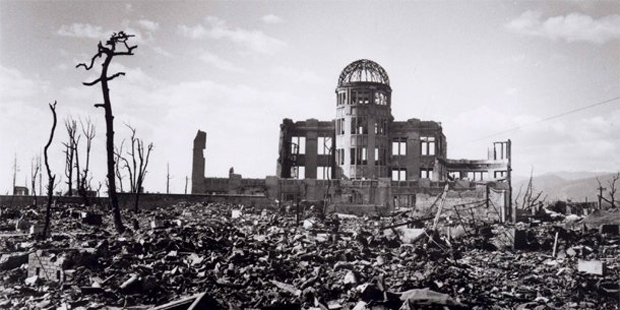
A major feature film on Hiroshima is going into production, inspired in
part by an unpublished memoir of a Japanese man who witnessed the
devastation of the city after the atomic bomb was dropped in 1945.
Scriptwriter Elisabeth Bentley was taken aback by the personal
recollections of Kiyoshi Tanimoto in a 230-page memoir that she unearthed
in a US archive. A Christian convert, Tanimoto was a Methodist priest whose
life was saved because he was moving a large wardrobe to another town on a
cart when Hiroshima was bombed.
Observer 3rd Sept 2023
USA Nuclear Regulatory Commission ready to remove “barriers” so as to speed up licensing of new untested nuclear reactors.
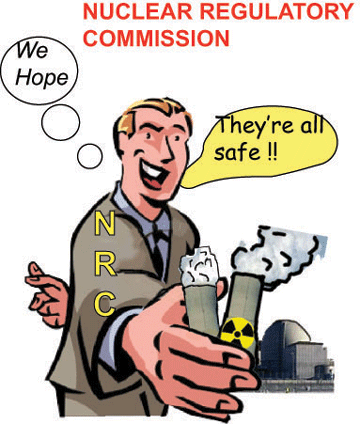
U.S. regulators are ready to review and license the next generation of
nuclear reactors while staying committed to safety, the Nuclear Regulatory
Commission (NRC) says. The NRC is under pressure to show it can move fast
on a new generation of nuclear technology, including small modular reactors
(SMRs) and other previously untested designs, as many in the industry call
for deep reforms at the regulator.
The regulator must be willing to remove
operational and organizational barriers that are in the way of rapid and
efficient licensing and understand that time is of the essence to reduce
emissions and solve energy security issues, critics say.
Reuters 1st Sept 2023
https://www.reuters.com/business/energy/us-regulator-ready-next-generation-nuclear-nrc-2023-09-01/
Chancellor Scholz dismisses talk of keeping nuclear energy option open in Germany
German Chancellor Olaf Scholz dismissed a suggestion by a junior coalition
partner that the country should keep open the option of using its closed
nuclear power plants, declaring that atomic energy is a “dead horse” in
Germany.
Germany switched off its last three nuclear reactors in April,
completing a process that received wide political support after Japan’s
Fukushima nuclear reactor disaster in 2011. But some argued for a rethink
after energy prices spiked because of the war in Ukraine. Among those who
advocated a reprieve were members of the Free Democrats, a pro-business
party that is part of Scholz’s governing coalition.
Daily Mail 2nd Sept 2023
Hinkley Point C Nuclear Station will need daily 4,200 Olympic swimming pools’ amount of cooling water.
Hinkley Point C nuclear power station will keep itself cool by drawing in
and flushing out enough water to fill 4,200 Olympic swimming pools – every
day. To do this, it needs 5.5 miles (8.8 kilometers) of tunnels located
nearly 100 feet (30 meters) underneath the Bristol Channel, which has the
second highest tidal range in the world. …………..These are the first nuclear qualified tunnels to be designed in the U.K.,” says Jacobs’ HPC Marine Works Project Manager Steve Marshall.
“They will have the capacity to transfer 2.7 billion U.S. gallons (10.4 million cubic meters) of coolingwater a day. “There is a blueprint for building reactors but marine works
to deliver the cooling water can never be exactly the same because we’re
always dealing with different geology and tidal ranges,” he explains.
“Added to this we have the nuclear safety aspect and the need to build
structures that are capable of doing their jobs for an 85-year design life
with very little maintenance. They also have to be capable of withstanding
a 1-in-10,000 year earthquake and extreme waves in the stormiest sea
conditions.”
Market Screener 1st Sept 2023
Top prosecutors back compensation for those sickened by US nuclear weapons testing.
Niagara Gazette, SUSAN MONTOYA BRYAN | Associated Press 4 Sept 23
ALBUQUERQUE, N.M. — New Mexico Attorney General Raúl Torrez and 13 other top prosecutors from around the U.S. are throwing their support behind efforts to compensate people sickened by exposure to radiation during nuclear weapons testing.
The Democratic officials sent a letter Wednesday to congressional leaders, saying “it’s time for the federal government to give back to those who sacrificed so much.”
The letter refers to the estimated half a million people who lived within a 150-mile (240-kilometer) radius of the Trinity Test site in southern New Mexico, where the world’s first atomic bomb was detonated in 1945. It also pointed to thousands of people in Idaho, Colorado, Nevada, Utah, Arizona, Montana and Guam who currently are not eligible under the existing compensation program.
The U.S. Senate voted recently to expand the Radiation Exposure Compensation Act as part of a massive defense spending bill. Supporters are hopeful the U.S. House will include the provisions in its version of the bill, and President Joe Biden has indicated his support.
“We finally have an opportunity to right this historic wrong,” Torrez said in a statement………………………………………………………..
The attorneys general who signed onto Torrez’s letter are from Arizona, Colorado, Connecticut, Delaware, Maryland, Minnesota, Nevada, New York, Pennsylvania, Oregon, Rhode Island, Vermont and the District of Columbia.
The attorneys mentioned the work of a team of researchers who mapped radioactive fallout from nuclear weapons tests in the U.S., starting with the Trinity Test in 1945. The model shows the explosions carried out in New Mexico and Nevada between 1945 and 1962 led to widespread radioactive contamination, with Trinity making a significant contribution to exposure in New Mexico. Fallout reached 46 states as well as parts of Canada and Mexico.
“Without any warning or notification, this one test rained radioactive material across the homes, water, and food of thousands of New Mexicans,” the letter states. “Those communities experienced the same symptoms of heart disease, leukemia, and other cancers as the downwinders in Nevada.”………………………………………….. more https://www.niagara-gazette.com/news/top-prosecutors-back-compensation-for-those-sickened-by-us-nuclear-weapons-testing/article_1458a962-4903-11ee-94c0-7b044542b2ae.html
Ukraine war: how China can get the world to step back from nuclear Armageddon
China and the US have reached nuclear weapons agreements before. After India and Pakistan launched nuclear tests in 1998, China and the US, in a rare show of solidarity, declared they would not target their nuclear weapons at each other. This led to a joint statement in 2000 from the five nuclear-weapon states of China, the US, Britain, France and Russia that their nuclear weapons would not target each other or any other state.
- Hope lies in getting nuclear powers to agree to a ‘no first use’ policy. If China can persuade the US, then Britain and France are likely to fall in line
- The challenge is getting Moscow on board – which is likely to require Nato to agree to ‘no first use’ against Russia and back down on its eastward expansion
SCMP, Zhou Bo 4 Sept 23
No one knows how long the war in Ukraine will last. But everyone knows what the worst nightmare is: Russia unleashing nuclear weapons. The Russian leadership has repeatedly hinted at this.
Russian scholars such as Sergei Karaganov and Dmitri Trenin have recently joined the chorus, calling for tactical nuclear attacks on a Nato country, say Poland, to break “the West’s will” and convince them that Russia’s nuclear threats are no bluff.
By giving people pause, Russia’s nuclear deterrence seems to be working. But what if Moscow is not bluffing?
With the West nibbling away at its own red lines by sending more sophisticated weapons to Kyiv that were considered taboo at the beginning of the war effort, how can one rest assured that Moscow will not reach for nuclear weapons eventually?
The battle is in a stalemate. Kyiv’s attack drones have reportedly been found in Moscow. Ukrainian President Volodymyr Zelensky recently warned that “war is returning” to Russia. As the threat of an unspeakable horror against humanity looms larger, there is an urgent need to prevent a nuclear fallout.
Perhaps China can persuade the US to agree first to a nuclear weapons policy of “ no first use”, which can then be joined by Britain, France and finally – hopefully – Russia.
China and the US have reached nuclear weapons agreements before. After India and Pakistan launched nuclear tests in 1998, China and the US, in a rare show of solidarity, declared they would not target their nuclear weapons at each other. This led to a joint statement in 2000 from the five nuclear-weapon states of China, the US, Britain, France and Russia that their nuclear weapons would not target each other or any other state.
More recently, in January last year, a month before Russia’s invasion of Ukraine, the five nuclear power powers agreed that “a nuclear war cannot be won and must never be fought”.
So why can’t they pledge a “no first use” policy? Such a stance would neither exclude nuclear retaliation nor neutralise a nuclear power’s ability to deter an attack.
For China, “no first use” has been its ironclad policy since its detonation of a nuclear device in 1964. Relations with Russia will not change China’s time-honoured policy. The Biden administration has declared that it “would only consider the use of nuclear weapons in extreme circumstances to defend the vital interests of the United States or its allies and partners”. This stance is not so far away from that of Beijing……………………………………………………………………………………………………………………… more https://www.scmp.com/comment/opinion/article/3233136/ukraine-war-how-china-can-get-world-step-back-nuclear-armageddon
Peace a winning strategy for Democrats in ‘24.
Walt Zlotow, West Suburban Peace Coalition, Glen Ellyn IL 3 Sept 23
Many of my progressive comrades are terrified President Biden will lose reelection to Trump or other regressive Republican. So am I.
And rightly so. Biden narrowly defeated traitor Trump in ’20 by clawing back 5 swing states Trump won in ’16. The GOP nominee has a good shot at keeping the 25 states Trump won and clawing back those 5 precious states to retake the White House.
What not to do? For starters, close ranks behind Biden’s foreign policy, the worst foreign policy their lifetime. Progressives can’t brook any opposition to Biden’s provoking nuclear confrontation at opposite ends of the globe with Russia and China simultaneously. That is not progressive, it’s self-destructive.
While the possible confrontation with China over Taiwan is simmering, the US proxy war against Russia is on the big front burner and may boil over into mushroom clouds every day this failed war continues.
How failed? For the US homeland, $137 billion in treasure is gone, with the total likely to reach half a trillion bucks if the war ends today. Fageddabout that. Crazed US war planners led by Biden are planning for a multiyear war to topple Russia, making it our next trillion dollar plus war.
How failed? Ukraine has ceased to be a functioning country, kept on life support by the US/NATO and a couple others. 80% of the world’s 195 nations are either neutral or supporting Russia, in part to degrade US worldwide hegemony.
How failed? Upwards of 400,000 Ukrainians have died, almost as many as all US WWII deaths. US deaths? Zero. That is grotesque…and mostly on Biden.
What about the new Hitler, Putin? Had Biden implemented Minsk II and proclaimed “No NATO for Ukraine”, Putin would not have invaded. But Biden, Congressional Democrats and their sycophantic media, airbrushed that preface out of the US narrative, making the Russian invasion virtually inevitable.
What my progressive comrades appear to dismiss in their unwavering support for a monstrous foreign policy, is that public opinion is turning against US weaponing this war in perpetuity. If they would join us peaceniks in demanding an end to weapons and promoting a negotiated settlement, President Joe just might get the message. Biden promoting a negotiated settlement is not only the correct thing to do to keep Ukraine from completely collapsing while it builds more cemeteries, it will help him stay in the White House for another 4 years.
Come on my progressive comrades. Join the peace movement for Ukraine and send a message to President Biden that just might get him reelected. Maybe even a Nobel Peace Prize.
Fukushima Daiichi adds Insult to Injury for the Pacific’s Coral Reefs.
September 1, 2023 by Kevin Hester
As the El Niño builds to a terrifying crescendo, that won’t peak before April 2024, the Pacific’s Coral Reefs will become stressed, and a bleaching event will unfold as it did in the 2016 El Niño. What is our response? TEPCO and the Japanese government have decided to dump 1.3million tons of radioactive water into my beloved Pacific Ocean. After careful consideration the criminal cohort in Japan have decided to take the cheapest option and dump the radioactive sludge into the adjacent Pacific Ocean.
In the video above, I mentioned that Sea Surface Temperatures hit 38C off the coast of Florida. Here’s the evidence:
“Sea surface temperatures of more than 38C (100.4F) have been recorded off the coast of Florida – potentially setting a new world record.” Sea temperature off Florida reaches 38C- potentially a world record.
Almost every coral reef in the Northern Hemisphere is under stress.
Daily Global 5km Satellite Coral Bleaching Heat Stress Degree Heating Week
…………………………………………. We discussed the compounding consequences of the Pacific Ocean being irradiated thanks to TEPCO, the Japanese Government and Fukushima Daiichi. The very same people who triggered this disaster, by building a sea wall half the size their own analysis called for.
My Polynesian neighbours are furious. Niue and Tuvalu ‘concerned, dismayed, disappointed’ with Fukushima release
A bottomless pit of public money for the UK government’s nuclear vanity project
In response to Nuclear Minister, Andrew Bowie’s announcement of an
additional £341m government support for the Sizewell C project, TASC
deputy Chair, Pete Wilkinson, said “There seems to be a bottomless pit of
public money when it comes to funding Sizewell C, so besotted is the
government with this already redundant nuclear vanity project.
Not so for cash-strapped public sector workers though. The £341m recently announced,
taking taxpayer funding over an eye-watering £1.2bn, is apparently
designed to speed up preparations for construction of a plant which has yet
to receive dozens of licences and permits – not the least of which is the
Office for Nuclear Regulation’s permission to build on a site threatened by
climate change impacts – and is still subject to determination of an
outstanding legal challenge.
Put another way, it is public money to be
spent on the destruction of a coast which is designated as an area of
outstanding natural beauty for a project which may still not happen. It
also claims that it will ‘help to drive Putin further out of global
energy markets’, apparently missing the point that uranium supplies –
essential for the mythical nuclear renaissance and already at peak supply –
come largely from Russian-influenced countries, so out of the oil and gas
fire into the uranium frying pan.
As for the ‘rapid expansion of UK
nuclear energy’, the fantasy of 24GW from nuclear, should it ever be
attempted, will be cripplingly expensive and generate a mountain of waste
for which there is no universally acceptable disposal route, in short, a
recipe for future financial and environmental disaster rather than energy
security”
TASC 30th Aug 2023
The Fukushima Nuclear Disaster Still Casts a Shadow Over Japan


The “great powers” in the past had given island peoples repeated assurances that there would be no risk to health or environment from testing or dumping. Those peoples watch sadly now as Japan does likewise, engaging in intense propaganda efforts to line up regional states to endorse its wastewater dumping campaign.
The Jacobin, BYGAVAN MCCORMACK 2 Sept 23
Twelve years after the Fukushima disaster, Japanese authorities have started pumping wastewater from the plant into the ocean. They insist there’s no danger to public health, but Japan’s neighbors are up in arms about the controversial plan.
In 2011, Fukushima Daiichi Nuclear Power Plant, roughly 250 kilometers north of Tokyo, was hit by a magnitude 9.0 quake and tsunami. Three reactors stopped immediately, but the loss of electricity supply led over the following days and months to breakdown of the cooling system and to a series of hydrogen explosions and meltdowns of the cores of Reactors 1 to 3.
Prime Minster Kan Naoto feared for the worst. He faced the possible need to evacuate the whole Kanto region, including the Tokyo metropolitan area. Japan itself, its state and society, stood on the brink of catastrophe. That fate was only narrowly averted………………………
The Half-Life of Catastrophe
The flow of water to cool the debris polluted with various forms of radioactivity has had to be maintained to this day. Over the past twelve years, some 1.34 million tons of water have accumulated and is being held in a vast array of more than one thousand tanks along the coast of Fukushima prefecture.
Those tanks are now about 98 percent full, but the flow of contaminated water will have to be continued for at least the next three decades, or until such time as the site can be cleaned up. Nobody today can say with any confidence when that might be.
The polluted waters contain sixty-four radioactive elements, or radionuclides, the ones of greatest concern being carbon-14, iodine-131, caesium-137, strontium-90, cobalt-60, and hydrogen-3, also known as tritium. Some have a short life and might already have ended, but others take longer to decay, with a half-life of more than five thousand years in the case of carbon-14………………………………………………….
The Cheapest Option
In 2016, the Japanese government considered multiple methods of treating the water. Ruling out simple continuation of the status quo — more and more tanks along an already crowded seafront — there seemed to be three options: ocean discharge, atmospheric discharge, and underground burial. The estimated cost was 34.9 billion yen to release the problem materials as gas into the atmosphere, 24.3 billion to dig a deep hole and bury it, but just 3.4 billion to pour it out gradually into the sea…………………………………………………
Anxiety, alarm, and increasingly anger have been spreading, both within Japan itself (and especially in the Fukushima vicinity that bore the brunt of the initial 2011 disaster) and on the part of Japan’s Pacific neighbor states: China (including Hong Kong), Korea (both north and south), Russia, the Philippines, and the mini-states of the South Pacific, with eighteen countries and regions. In Japan, just 44 percent of people said they had “no worries” over the release, while about 75 percent said the government had not properly explained what it was doing.
The Japanese government had promised it would take no step without duly consulting all concerned parties. Yet it proceeded to ignore that principle both when it came to its own citizenry (especially those employed in its once-vibrant fishing industry) and in relation to its Pacific neighbors, whose shores are washed by the same Pacific waters.
Under Control”
True, the United Nations’ International Atomic Energy Agency (IAEA) has provided helpful cover for the Japanese government and the Tokyo Electric Power Company (TEPCO) by taking the view that the environmental impact of the discharge would be “negligible.” That judgment, however, is neither surprising nor decisive.
The IAEA, founded in 1957, is an organization devoted to the propagation of “safe” civil nuclear energy. Japan is its third-largest source of its funds, and the future of the global nuclear industry depends on there being seen to be a “final solution” to the problems posed by Fukushima………………
Though it has received little attention in media coverage of the problem, a small but significant body of scientific opinion has begun to express severe criticism of the IAEA for failing to apply its own fundamental principles. One paper accused the agency of being in some important respects “at least 10,000 times in error,” neglecting to give proper consideration to the nondumping solutions, and “grossly overstating well-known facts” in its “eagerness to assure the public that harm will be ‘negligible.’”
When Japan’s then prime minister Abe Shinzo told the world in September 2013 that Fukushima was ‘under control,’ he lied.
According to the paper’s author, Arjun Makhijani of the Institute for Energy and Environmental Research, a very different approach is required:
The IAEA should, starting with Japan, provide guidance to nuclear power-possessing countries to stop dumping so that the oceans that have been much abused in so many ways for so long can at least have a chance to begin recovering.
When Japan’s then prime minister Abe Shinzo told the world in September 2013 that Fukushima was “under control,” he lied. Until 2018, all attempts to locate the missing reactor cores, let alone to place them “under control,” had failed. Only in 2021 did it become possible at least to locate the debris in one reactor.
However, knowing the location is just the start. Now we know where it is, we are no closer to knowing how to deal with it. The recovery effort for two of the reactors will not commence until 2024.
If they succeed in locating the debris, estimated to be about 880 tons, it will then have to be extracted, gram by gram. Meanwhile, as of 2023, between four and five thousand workers are mobilized each day to perform various high-risk tasks in the disaster zone.
People of the Ocean
The “great powers” in the past had given island peoples repeated assurances that there would be no risk to health or environment from testing or dumping. Those peoples watch sadly now as Japan does likewise, engaging in intense propaganda efforts to line up regional states to endorse its wastewater dumping campaign.
Japan’s word today rings as hollow to Pacific Island peoples as that of the United States or France once did. Even the Japanese people themselves have “little trust in TEPCO or the Japanese Government” when it comes to Fukushima wastewater dumping, according to Suzuki Tatsujiro, former vice chairman of the Japan Atomic Energy Commission.
Japanese governments far into the future are to be bound now by the decisions taken by the current administration and by the process launched on August 24. The support given to Japan’s ocean dumping by prominent Western industrial countries strikes Pacific Islanders as hypocritical. Motarilavoa Hilda Lini is chief of the Turaga nation of Pentecost Island, Vanuatu, and an activist with the Nuclear Free and Independent Pacific (NFIP) movement. She put it this way:……………………………………………………………. more https://jacobin.com/2023/09/fukushima-nuclear-reactor-radioactive-waste-japan-ocean
Anger over claims RAF Lakenheath could host US nuclear weapons
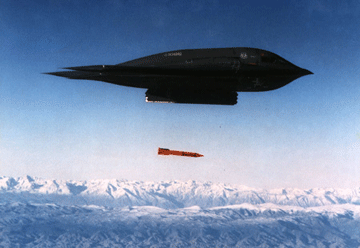
By Stuart Bailey, BBC News 31 Aug 23 https://www.bbc.com/news/uk-england-suffolk-66657765
Campaigners have urged the government to refuse the US any permission to base nuclear weapons in the UK again.
A US Air Force report showed plans to build a “surety dormitory” at RAF Lakenheath in Suffolk, which experts said implied a return of nuclear arms.
The Campaign for Nuclear Disarmament (CND) said it would be “beyond irresponsible” and put the UK at risk.
The Ministry of Defence and the Pentagon said they would not comment on the location of weapons.
US Air Force budget documents included a justification for a 144-bed dormitory “to house the increase in enlisted personnel as the result of the potential Surety Mission.”
The word “surety” is often used by the US government to refer to the concept of ensuring American nuclear weapons are kept safe and secure.
The Federation of American Scientists (FAS), which first reported the plans, said they “strongly imply” the intention to re-establish nuclear arms at Lakenheath, which hosted them until 2008.
CND general secretary, Kate Hudson, said: “It’s increasingly clear that Lakenheath is once again a vital cog in Washington’s overseas nuclear machine.
“The deployment of the new B61-12 (gravity bombs) to Europe undermines any prospects for global peace and ensures Britain will be a target in a nuclear conflict between the US/NATO and Russia.
“It’s beyond irresponsible that the UK government is allowing this deployment.”
Construction of the $50m (£39.5m) building is due to begin in June 2024 and end in February 2026, the budget report said.
The Ministry of Defence, which owns the site, said it was unable to comment on US spending decisions and capabilities.
Deputy Pentagon press secretary Sabrina Singh said: “It is US policy to neither confirm nor deny the presence or absence of nuclear weapons at any general or specific location.”
RAF Lakenheath is home to USAF’s 48th Fighter Wing, which consists of more than 4,000 military members and 1,500 civilians. Control of the base transferred from the RAF to USAF in 1948.
Last year more than 200 people protested outside the base after the US added the UK to a list of nuclear weapons storage site locations in Europe.
-
Archives
- October 2026 (112)
- September 2026 (339)
- August 2026 (330)
- July 2026 (355)
- June 2026 (287)
- May 2026 (306)
- April 2026 (356)
- March 2026 (251)
- February 2026 (267)
- January 2026 (308)
- December 2025 (358)
- November 2025 (359)
-
Categories
- 1
- 1 NUCLEAR ISSUES
- business and costs
- climate change
- culture and arts
- ENERGY
- environment
- health
- history
- indigenous issues
- Legal
- marketing of nuclear
- media
- opposition to nuclear
- PERSONAL STORIES
- politics
- politics international
- Religion and ethics
- safety
- secrets,lies and civil liberties
- spinbuster
- technology
- Uranium
- wastes
- weapons and war
- Women
- 2 WORLD
- ACTION
- AFRICA
- Atrocities
- AUSTRALIA
- Christina's notes
- Christina's themes
- culture and arts
- Events
- Fuk 2022
- Fuk 2023
- Fukushima 2017
- Fukushima 2018
- fukushima 2019
- Fukushima 2020
- Fukushima 2021
- general
- global warming
- Humour (God we need it)
- Nuclear
- RARE EARTHS
- Reference
- resources – print
- Resources -audiovicual
- Weekly Newsletter
- World
- World Nuclear
- YouTube
-
RSS
Entries RSS
Comments RSS

