Fyodor Lukyanov: Why the ‘world majority’ sees the Ukraine conflict as an example of declining European and North American power
Most believe ethnic Europeans are colonialists and hope to end their stranglehold on power
By Fyodor Lukyanov, the editor-in-chief of Russia in Global Affairs, chairman of the Presidium of the Council on Foreign and Defense Policy, and research director of the Valdai International Discussion Club.
It’s now the fall of 2023, and the Ukraine conflict has become an integral part of the international political and economic landscape. A cessation of hostilities is not expected.Meanwhile, neither a decisive victory for one side nor a compromise peace agreement seems likely in the foreseeable future.
The situation remains the most important factor influencing the global balance of power.
When the fighting started, it was immediately clear that relations between Russia and the West were entering an acute phase. But the severity and persistence of the conflict have exceeded expectations. In February 2022, few could have imagined the current level of NATO’s military-technical support of Ukraine and such a thorough dismantling of all ties between Russia and the Western countries.
The predictions of the first phase did not work out for anyone. Moscow misjudged the military-political and public mood in Ukraine and the willingness of the United States and its allies to go so far in supporting Kiev. The West made the mistake of assuming that the Russian economic system could not withstand an external blockade, but that the global economy could do without Moscow relatively painlessly. Both parties’ perception of their own ability to force their adversaries to change course and make concessions did not match reality.
The mistakes made in the early stages were the result of stereotypes formed earlier. If we strip away the nuances, the opponents exaggerated each other’s vulnerability and mistook their rivals as “paper tigers.” This is still partly an element, but more as a figure of speech in propaganda. The game has turned into a protracted process in which each side tries to mobilize its advantages and accumulate decisive superiority in order to escape the stalemate. The intensity of the confrontation between Russia and the West is increasing, but not its quality.
The most significant changes have taken place in the part of the world that is not involved in the conflict, although it is affected by it. The currently fashionable Russian notion of a “world majority,” which applies to the non-Western part of humanity, is somewhat confusing because it suggests a consolidated community. However, the essence of this majority is its heterogeneity – in contrast to the universal cohesion of values that the West offers. However, the term does outline the contours – a set of countries that are unwilling to be drawn into processes that follow the tradition of Western politics. The Ukraine crisis is a product of Western political culture, to which all the immediate participants belong. Russia, which has adopted an extremely anti-Western stance, is also acting (or let’s say is forced to act) within the Western military-political paradigm.
There is a growing opinion among the world’s majority that the influence of those who have long dictated the rules in the international arena is waning. ………………………………………………………………………….more https://www.rt.com/russia/582455-declining-europe-america-power/
Does Europe need Niger’s uranium?
Will the lights go out in Europe if Niger were to prevent France from mining more of its uranium? DW asked experts in Niger and Europe about the energy supply chain in the wake of the coup. Niger’s greatest treasure lies underground: Uranium is the most
important commodity in the Sahel state. But coup plotters have been in
charge for just over a month, fuelling fears that the uranium supply to
global markets is in jeopardy. France, the former colonial power in Niger,
is in a particularly tight spot. Around two-thirds of its electricity comes
from nuclear power plants powered by uranium sourced in Niger. It also
exports electricity to other countries in Europe that have no nuclear
plants of their own.
Deutsche Welle 4th Sept 2023
https://www.dw.com/en/does-europe-need-nigers-uranium/a-66711717
US to Arm Ukraine With Toxic Depleted Uranium Ammunition
The munitions will be used with US-made Abrams tanks
by Dave DeCamp https://news.antiwar.com/2023/09/03/us-to-arm-ukraine-with-toxic-depleted-uranium-ammunition/
The US is set to arm Ukraine with controversial depleted uranium (DU) ammunition as part of an upcoming arms package for use with US-made Abrams tanks, Reuters reported on Friday.
DU is a heavy metal that’s a byproduct of enriched uranium and is extremely dense, making it a good material for armor-piercing rounds. But DU ammunition is toxic and is linked to cancer and birth defects in places it has been used, including Iraq, where the US used an enormous amount of DU in the Gulf War and the 2003 invasion.
The UK has already provided Ukraine with DU ammunition for use with British-made Challenger 2 tanks, but the US has yet to take the step. Earlier this year, when Russian President Vladimir Putin announced he was deploying nuclear weapons to Belarus, he said it was a response to the UK arming Ukraine with DU.
According to Reuters, the arms package for Ukraine that will include DU ammunition is expected to be announced this week. The first Abrams tanks are due to arrive in Ukraine in the coming weeks.
The Wall Street Journal reported in June that the Biden administration was expected to arm Ukraine with DU. The report said some officials were concerned the move would open up the US to criticism for providing weapons that could cause health and environmental damage.
But at this point in the war, the administration has shown it’s not concerned about damaging Ukraine’s environment. In July, the US started arming Ukraine with cluster bombs, which spread small submunitions over large areas. Unexploded submunitions, or bomblets, can be found by civilians years or decades after use. Because of their history of killing civilians, cluster munitions have been banned by over 100 countries.
World meteorologists point to ‘vicious cycle’ of heatwaves and air pollution.
Heatwaves across the world are worsening air quality and pollution,
scientists have said. The World Meteorological Organization (WMO) has said
extreme temperatures are not the only hazard from heatwaves but that they
also cause pollution-related health problems. In their annual air quality
and climate bulletin, the meteorologists have highlighted a “vicious
cycle” of climate breakdown and air pollution.
They have shown that
heatwaves sparked wildfires in the north-western US and heatwaves
accompanied by desert dust intrusions across Europe, which both caused
dangerous air quality in 2022. The hot temperatures in Europe, which in
2022 were record-breaking, led to higher levels of particulate matter in
the air, the bulletin says. During the second half of August 2022, there
was also an unusually high intrusion of desert dust over the Mediterranean
and Europe.
Guardian 6th Sept 2023
Unite urges employer to pay a fair wage and avoid nuclear plant shutdown
Unite urges employer to pay a fair wage and avoid nuclear plant shutdown.
Electricians who certify tools for use in nuclear power stations are taking
strike action.
Unite, the country’s leading trade union, announced today
(Wednesday 6 September) that its members at Altrad Babcock Ltd are taking
strike action following a dismal pay offer from the employer. Electricians
at Altrad Babcock, based in Tipton in the West Midlands, are responsible
for certifying that electrical tools are safe to use in nuclear facilities
across the country. Yet this safety-critical role is not being valued by
the employer, with some members earning as little as £13.62 per hour.
Unite 6th Sept 2023
Could new nuclear kill one of the world’s most promising offshore windmarkets?
Sweden is slated to host some of the biggest projects at sea
globally but its government is talking up the virtues of atomic power,
writes Bernd Radowitz.
Recharge 5th Sept 2023
Taiwan’s ‘clear and present’ spent nuclear fuel danger

Above-ground storage pools at Chinshan and Kuosheng nuclear power plants would be vulnerable to missiles in a Chinese attack
ASIA TIMES, By JORSHAN CHOI, SEPTEMBER 6, 2023
The war in Ukraine has drawn concerns that there is potential for a conflict to happen across the Taiwan Strait.
In Ukraine, the attack and occupation of nuclear facilities, including the Zaporizhzhia nuclear power plant by the Russian military, initiated a dangerous situation for the safe and secure operation of civilian nuclear power plants, including the spent fuel facilities. It also hindered the International Atomic Energy Agency’s effort to ensure the proper accounting and control of nuclear materials in these facilities.
If a military conflict were to happen across the Taiwan Strait, there would be similar concerns. There are six operating or shut-down nuclear reactors in Taiwan: two pressurized water reactors and four boiling water reactors in Taiwan. Of the six, the four BWRs situated on the northern tip of Taiwan pose the biggest safety, security, and safeguards concerns.
Taiwan’s first nuclear power plant, Chinshan 1 & 2, consisted of BWRs similar to Fukushima Daiichi 1, which was involved in the 2011 accident in Japan, with spent fuel pools that are high up above ground.
Taiwan’s second plant, Kuosheng 1 & 2, featured a later BWR design, with spent fuel pools at a lower elevation. The two pressurized water reactors have spent fuel pools at ground level.
When Chinshan 1 & 2 went offline in 2018-2019, more than 6,000 spent fuel assemblies were stored in the two elevated spent fuel pools. At Kuosheng 1 & 2, the capacities of both ground-level spent fuel pools have become insufficient to support reactor operation.
To free up space in the pools for newly discharged spent fuel, TAIPOWER, the utility company, moved those 15-year-old spent fuel assemblies for storage in the upper (refueling) pools, which are well above the ground level.
According to the US National Academies of Sciences, the vulnerability of a spent fuel pool depends in part on its location with respect to ground level as well as its construction. In a potential military conflict across the Taiwan Strait, the spent fuel pools built above ground in Chinshan and Kuosheng may thus be susceptible to accidental attacks from misfired or stray missiles.
Significantly, to protest the Pelosi visit to Taiwan in August 2022, two missiles fired by the Chinese military landed in water about 50 km north of the Chinshan plant.
The Fukushima accident highlighted the vulnerability of elevated spent fuel storage. The explosion that occurred in the reactor building of Fukushima Daiichi 4 destroyed the roof and most of the walls on the fourth and fifth (refueling) floors……………………………………………………………………..
A sense of urgency
Spent fuel has accumulated in the Chinshan and Kuosheng plants over the 40 years of their operating lives. Due to objections from the local public over moving the spent fuel to dry cask storage and the lack of suitable storage or disposal sites on the geographically limited island, spent fuel discharged from Chinshan 1 & 2 reactors has remained in the refueling-turned-into-storing pools adjacent to the reactor wells, high above ground……………………………………………..
The war in Ukraine and rockets/missiles landing in or around the Zaporizhzhia plant (with all six pressurized water reactors’ spent fuel pools situated at ground level) should have given TAIPOWER another warning that spent fuel in high-elevation pools should be moved to ground-level pools or dry cask storage.
TAIPOWER should have a sense of urgency for this “clear and present” danger in Taiwan, especially given that it has the technology and resources to accomplish the task. Taiwan’s internal politics and objection of the local public are the primary causes for the procrastination.
The longer-term problem with moving the spent fuel off the island centers around something called “consent rights,” which is complicated given US involvement in the installation of the nuclear power plants in Taiwan…………………………………………………………………….
The US rights over Taiwan’s nuclear activities are so extensive that Washington instructed the German government in the 1980s that any nuclear items supplied to Taiwan by a German exporter would be subject to US “control rights,” which included US “fallback safeguards rights” if deemed necessary.
Nowhere else does the United States have as much leverage over a foreign nuclear program. Yet whenever Taiwan has requested the United States to take back the spent fuel, Washington has declined…………………………………………….
Removing the spent fuel from Taiwan would eliminate its “clear and present” spent fuel danger, while fulfilling the goal of ensuring a “nuclear-free” Taiwan. This should be a priority. https://asiatimes.com/2023/09/taiwans-clear-and-present-spent-nuclear-fuel-danger/
How a nuclear disaster spurred Fukushima to become a renewables leader

Japan Times, BY FRANCESCO BASSETTI, MINAMISOMA, FUKUSHIMA PREF. – 5 Sept 23
As you reach the coast on Fukushima Prefectural Route 74, which runs between the towns of Minamisoma and Soma, scenes typical of the Japanese countryside — rice paddies and hills blanketed by lush green forests — undergo a swift transformation.
Now, expanses of metal, glass and silicon shimmer in the midday sun, stretching out to a horizon dotted with four white wind turbines, blades humming as they turn in the summer breeze.
Following the 2011 triple disaster — and the subsequent cratering of support for nuclear energy — Fukushima Prefecture has positioned itself at the forefront of Japan’s low-carbon transition.
Few projects better exemplify that than the Minamisoma Mano-Migita-Ebi solar power plant, which was the largest in Fukushima Prefecture until 2019 and is made up of 220,000 solar panels that, if laid end to end, would cover 350 kilometers — roughly the distance between Nagoya and Tokyo. The panels can generate up to 60 megawatts of electricity, enough to power 20,000 households.
Because of projects like the Minamisoma facility, Fukushima Prefecture has claimed the crown as the Tohoku region’s leader in cumulative solar power generation since 2013, and this is a direct consequence of the reconstruction policies that were put in place after the March 2011 earthquake, tsunami and nuclear disaster.
But today, grid connection issues, opposition by incumbent energy companies and a return to nuclear energy in some parts of the country are slowing progress in Fukushima and beyond. In 2022 almost 80% of the increase in total electricity generation in Japan came via fossil fuels — a worrying signal that, although renewable energy generation continues to increase, it is not keeping up with the pace of electrification.
Renewable recovery
Particularly in the coastal areas of Fukushima Prefecture, solar panels have a strong presence: They cover fields, occupy clearings that have been carved out of forests and hillsides, and rest on the rooftops of houses. Cars and trucks brandishing the names of the companies that operate them are a regular feature as they carry equipment and workers along well-kept roads…………………………………………………………………………………………………………………….
“Recovery plans have always been tied to developing a society that is no longer dependent on nuclear power,” says Masaki Moroi, deputy director of Fukushima Prefecture’s Energy Division.
By the end of 2021, Fukushima Prefecture had covered 47% of its energy demand with renewables, compared with just 23.7% in 2011. That’s a particularly impressive feat when compared with Japan’s national average of just 22.7% in 2022.
“Fukushima took the lead after 2011 because of its direct experience with disaster and clear commitment by policymakers to quit nuclear energy and back renewables,” says Hikaru Hiranuma of the Tokyo Foundation for Policy Research.
According to Hiranuma, the single most influential policy in the initial boom in renewable energy was the introduction of a feed-in-tariff program by the Ministry of Economy, Trade and Industry in July 2012………………………………………………………………………………………..
Beyond Minamisoma, Fukushima Prefecture implemented policies promoting renewable energy projects in areas affected by the tsunami and nuclear fallout where there were high rates of abandoned land………………………………………………………………………………………………………………………. more https://www.japantimes.co.jp/environment/2023/09/05/fukushima-renewable-energy-leader/
Revisiting John Pilger’s 2016 Warnings About US Warmongering Against Russia And China
CAITLIN JOHNSTONE, SEP 6, 2023 https://www.caitlinjohnst.one/p/revisiting-john-pilgers-2016-warnings?utm_source=post-email-title&publication_id=82124&post_id=136786147&isFreemail=true&r=1ise1&utm_medium=email
In March of 2016 the renowned Australian journalist and filmmaker John Pilger published an article titled “A world war has begun. Break the silence.” which urgently warned of the US empire’s aggressive escalations against Russia and China. Re-reading parts of it in 2023 is like watching someone placing flags next to recently planted seeds that would eventually grow into the towering problems our world now faces.
It’s like listening to a time traveler warning people from the past about a grave mistake they were about to make. Pilger points to US provocations in Ukraine, NATO militarism, and the encirclement of China and warns of the surging risk of nuclear war, noting that nuclear warhead spending “rose higher under Obama than under any American president.”
“In the last eighteen months, the greatest build-up of military forces since World War Two — led by the United States — is taking place along Russia’s western frontier,” Pilger wrote. “Not since Hitler invaded the Soviet Union have foreign troops presented such a demonstrable threat to Russia.”
“Ukraine — once part of the Soviet Union — has become a CIA theme park,” wrote Pilger. “Having orchestrated a coup in Kiev, Washington effectively controls a regime that is next door and hostile to Russia: a regime rotten with Nazis, literally. Prominent parliamentary figures in Ukraine are the political descendants of the notorious OUN and UPA fascists. They openly praise Hitler and call for the persecution and expulsion of the Russian speaking minority.”
“In Latvia, Lithuania and Estonia — next door to Russia — the US military is deploying combat troops, tanks, heavy weapons,” Pilger said. “This extreme provocation of the world’s second nuclear power is met with silence in the West.”
“What makes the prospect of nuclear war even more dangerous is a parallel campaign against China,” Pilger continued. “The United States is encircling China with a network of bases, with ballistic missiles, battle groups, nuclear-armed bombers. This lethal arc extends from Australia to the islands of the Pacific, the Marianas and the Marshalls and Guam, to the Philippines, Thailand, Okinawa, Korea and across Eurasia to Afghanistan and India. America has hung a noose around the neck of China. This is not news. Silence by media; war by media.”
Pilger highlighted the way his home country Australia was being roped into Washington’s war preparations against China, a trend which has since grown much worse as the drums of war grow louder.
“In 2015, in high secrecy, the US and Australia staged the biggest single air-sea military exercise in recent history, known as Talisman Sabre,” he wrote. “Its aim was to rehearse an Air-Sea Battle Plan, blocking sea lanes, such as the Straits of Malacca and the Lombok Straits, that cut off China’s access to oil, gas and other vital raw materials from the Middle East and Africa.”
Pilger wrote all this while preparing to release his excellent film “The Coming War on China”, which would come out later that year. In it, he shows how the US has been surrounding China with war machinery in a way that would be considered an act of war if it was happening near American shorelines, and drives home the seriousness of the prospect of nuclear conflict.
Everything Pilger warned about turned out to be everything he said it was. A war in Ukraine has erupted from the spark of the US-backed coup in 2014 and Russia’s fear of an increasingly expansionist and militaristic NATO, while the US military encirclement of China has been rapidly increasing as hostilities between the two superpowers accelerate toward a breaking point, facilitated in no small part by the continent-sized military base known as Australia. What were only background stories in 2016 now dominate the headlines of today.
I bring this up because I think it’s useful to show that we’ve been on this track toward global conflict between major powers for years, and it’s been unfolding in ways that some saw coming from miles away. Much of Pilger’s work could be called prophetic, but Pilger is no prophet — he’s just a journalist with an ear to the ground who’s been critically scrutinizing the behavior of the empire for decades. He was able to accurately mark the trajectory our world has been on earlier than most, and it has continued along that same trajectory with frightening speed ever since.
If you can see the trajectory that an object is on, you can determine where you need to stand in order to obstruct its path. The fact that we’ve been on a linear trajectory toward global conflict between nuclear-armed states all these years shows that opposing that trajectory is of existential importance for every living organism on this planet. And yet the media still want us focused on celebrity gossip and party politics and Donald Trump.
World war is still closing in on us. We still need to break the silence and oppose it. Our rulers have been steering us in this direction for a long time now, and they’re not going to turn away until we make them.
South Korea: Mass protests continue against Fukushima nuclear waste dumping
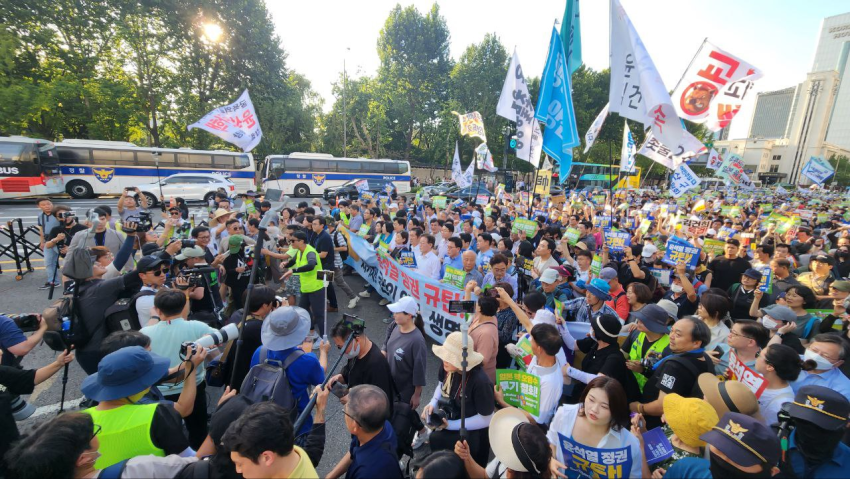
South Korea Peter Boyle, Denise Yoon , September 6, 2023
The biggest of the global protests against Japan’s dumping of radioactive wastewater from the Fukushima nuclear power plant into the Pacific Ocean — which began on August 25 — have been in Seoul, the capital of South Korea. Green Left‘s Peter Boyle spoke to Denise Yoon, a key organiser of the movement.
Since August 26, we have had two big national rallies in Seoul and around 50,000 people have gathered at each.
About half of the demonstrators are members of four opposition parties: the Democratic Party, the Justice Party, the Progressive Party and the Basic Income Party. The rest are from religious and civil society groups, including environmental and consumer organisations, parents organisations, justice and democracy activists and human right defenders.
According to a public poll by the Seoul city government in August, around 80% of citizens oppose Japan’s ocean dumping of nuclear wastewater and condemn the Korean government’s support of Japan without appropriate regard for Korean people’s safety from ocean pollution.
People think the Korean government has failed to explain scientifically, environmentally and economically why they claim that the Fukushima wastewater is not a big deal. They also distrust the International Atomic Energy Authority’s report because its conclusion [supporting Japan’s dumping] is based on deficient data and evidence.
Due to the Korean government’s very active promotion of Japan’s unilateral decision to commence dumping, many Korean people are getting very angry at the government. Polls show that President Yoon Suk Yeol now has a disapproval rate of 58% and this is influenced not only by the Fukushima issue, but also by government incompetence on other issues.
This is why we were able to hold these two big rallies.
We will organise a national rally every Saturday in September and expect more people will join the protest.
We will hold the 4th National Candlelight Rally in Gwanghwamun Plaza and we expect more than 50,000 people to join in for speeches, bands and cultural performances. Global solidarity messages will be shared. This rally will call on Japan to stop the dumping and it will demand that the Korean government prohibit the import of marine products from Japan.
Japan’s nuclear-contaminated water discharge should consider hazard accountability and compensation mechanisms

International legal mechanisms, such as the United Nations Convention on the Law of the Sea, grant countries the right to assert their interests, and Japan’s discharge of nuclear-contaminated water has direct and indirect impacts on the global marine environment. Therefore, countries can seek compensation from Japan through international legal mechanisms for environmental restoration and economic compensation.
Chunding Li, Zelei Xing, https://news.cgtn.com/news/2023-09-06/Japan-s-nuclear-wastewater-discharge-should-have-hazard-accountability-1mSm5S2bJsY/index.html
The plan over nuclear-contaminated water discharge from the Fukushima Daiichi nuclear power plant in Japan was launched on August 24, 2023, attracting widespread attention, controversy and condemnation from the international community.
Currently, the Fukushima nuclear power plant generates, per day, approximately 140 tonnes of nuclear-contaminated water, with over 1 million tonnes of accumulated stored radioactive water. According to the plan, the nuclear-contaminated water will undergo treatment before discharge to reduce the concentration of radioactive substances.
However, even after treatment, this nuclear-contaminated water still contains a certain amount of radioactive materials. It is estimated that around 1 million tonnes of nuclear-contaminated water will be released into the sea, being discharged over a period of 30 years, and seeing a daily discharge of approximately 460 tonnes of nuclear-contaminated water.
This poses huge risks to the environment and human health of neighboring countries, not discounting the threat to the development of industries such as agriculture and fisheries. Given the risks involved, countries have the right to demand that Japan assume corresponding compensation responsibilities.
Japan’s nuclear-contaminated water discharge poses potential hazards to human health. The nuclear-contaminated water contains radioactive isotopes, such as cesium, tritium, and strontium, which can enter the food chain of marine ecosystems, affecting the marine ecosystems of surrounding countries directly. When contaminated seafood is consumed, there is a potential risk to human health.
Furthermore, these radioactive substances can spread to distant regions through the influences of climate and oceanic currents, causing long-term impacts on marine ecosystems globally. This can result in the death or migration of marine organisms, biodiversity disruption, and the potential negative impact on the sustainable utilization of fishery resources.
Japan’s nuclear-contaminated water discharge has a negative impact on the development and trade of agriculture and fisheries. Firstly, when contaminated seafood is banned from import or faces consumer scrutiny, it will have a significant impact on the fishing industry of exporting countries. Many countries rely on seafood exports to increase trade revenue and promote economic development. The impacts caused by nuclear-contaminated water will directly threaten the economic interests of these nations, leading to reduced income for fishermen and potentially, even job losses.
Moreover, the discharge of nuclear-contaminated water could also contaminate freshwater resources in neighboring countries, negatively affecting irrigation in farmland and the growth of crops. This poses a threat to the sustainable development of a nation’s agriculture, subsequently impacting the income of farmers and food supplies.
Countries have the right to demand that Japan assumes corresponding compensation responsibilities. Firstly, as the source country of nuclear contamination, Japan should take responsibility for the environmental and human health risks caused by its discharge of nuclear-contaminated water and take measures to mitigate and restore potential damages.
International legal mechanisms, such as the United Nations Convention on the Law of the Sea, grant countries the right to assert their interests, and Japan’s discharge of nuclear-contaminated water has direct and indirect impacts on the global marine environment. Therefore, countries can seek compensation from Japan through international legal mechanisms for environmental restoration and economic compensation.
Secondly, existing international laws should promptly regulate Japan’s actions to ensure that the discharge of nuclear-contaminated water meets international standards and requirements, avoiding irreversible harm to global marine ecosystems and human health.
International cooperation is necessary to seek sustainable development solutions. The international community should enhance supervision and collaboration to collectively address the global challenges posed by the discharge of nuclear-contaminated water and safeguard the sustainable development of human health and the environment.
The discharge of nuclear-contaminated water not only poses significant environmental and health risks within Japan, but also has potential long-term impacts on marine ecosystems of neighboring countries, not excluding the wider global community. Therefore, the international community should strengthen cooperation to jointly formulate and implement relevant policies and standards, to dissuade against nuclear-contaminated water discharge.
In addressing this issue, advancements in science and technology, as well as the principles of equality and cooperation among different countries, should be fully considered. Resolving the global challenges posed by the discharge of nuclear-contaminated water requires joint efforts from all countries, including cooperation in areas such as technological collaboration, information sharing, and exchange of experiences.
Additionally, the international community should also strengthen regulatory oversight and safety controls over nuclear energy, in order to prevent the recurrence of nuclear accidents and pollution.
Ukraine war realises predictions of nuclear power plant threat, says Leicester civil safety expert

29 August 2023, https://le.ac.uk/news/2023/august/nuclear-power-plant-ukraine
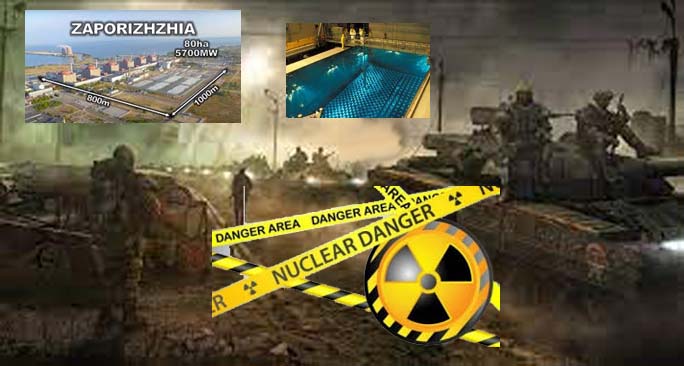
Governments need to be aware of the risk of their country’s nuclear power plants being weaponised as they turn to nuclear to tackle the ongoing energy crisis, a University of Leicester civil safety expert has argued.
In his new book Atomic Blackmail? The weaponisation of nuclear facilities during the Russia-Ukraine War, Dr Simon Bennett lays out how the ongoing conflict is confirming long-running concerns about the security of nuclear power plants and their potential to be weaponised to gain political traction over an opponent.
The events of the Russia-Ukraine War have demonstrated the capacity that nuclear power plants have to amplify protagonists’ hitting power, Dr Bennett argues. This is believed to be the first time in the history of nuclear electricity that nuclear power plants have been occupied by an invading force.
The installations at Chernobyl and Zaporizhzhia have been captured by Russian forces and Zaporizhzhia remains under Russian control. Other installations in Ukraine have been overflown by Russian munitions, such as cruise and ballistic missiles. Outbuildings at both the Chernobyl and Zaporizhzhia sites have been struck by munitions. Both Russia and Ukraine deploy munitions in the vicinity of nuclear power plants.
The possibility of gaining tactical or strategic advantage by weaponising an opponent’s nuclear facilities makes them an attractive target – especially for protagonists who find themselves on the back foot.
Dr Simon Bennett at the University of Leicester said: “The risk is not that of a nuclear detonation. Rather it is that of creating a dirty bomb when a conventional munition such as a ballistic or cruise missile, artillery shell or suicide drone breaches a containment, liberating radionuclides to the environment.
“A dirty bomb creates transborder or transboundary hazard, a serious radiological contamination of the environment – land, air and water – potentially over vast areas and for decades. Radionuclides liberated during the 26 April, 1986 Chernobyl fire were transported on easterly winds as far as Cumbria in north-west England.”
The International Atomic Energy Agency (IAEA) has called on the protagonists to create and respect cordons sanitaires around Ukraine’s nuclear installations, including the highly-vulnerable six-reactor Zaporizhzhia Nuclear Power Plant (NPP). A cordon sanitaire is defined by the IAEA as a military exclusion zone created to mitigate the risk of accidental damage to a NPP, which protagonists would be forbidden from entering. The UK has lent the IAEA diplomatic support.
Dr Bennett adds: “As countries expand existing nuclear electricity programmes, and as other countries go nuclear, the risk of weaponisation and atomic blackmail will grow. After years of prevarication, Britain, alarmed at the unreliability of so-called green energy and worried about energy insecurity, is set to expand its nuclear electricity programme. There is a positive relationship between the number of NPPs in a country and its atomic blackmail risk-exposure. In a European or World War, Britain’s NPPs would be as much a target as the NPPs of any other country.
“Any country with a nuclear power programme, and countries neighbouring countries with nuclear power programmes, should take note of what has happened in Ukraine, and what might happen in the future. There will probably be a 2024 Ukrainian offensive and, possibly, a 2025 offensive. This war will not end quickly.”
- Atomic Blackmail? The Weaponisation of Nuclear Facilities During the Russia-Ukraine War is published by Libri Publishing
Nuclear reactors: Malaysia lacks maintenance culture.

Impossible to guarantee ongoing maintenance and safety of such projects.
Malaysia Kini, Yoursay, Sep 7, 2023
This KiniGuide on small nuclear reactors states that there are only two such small modular reactors in operation – one in Russia and another in China.
Both countries are notoriously secretive about problems in their respective countries. So what models are there in countries where objective, open, and transparent data may be obtained?
That is the first problem that should have been highlighted.
Secondly, former prime minister Abdullah Ahmad Badawi famously referred to our situation as a country of first-world infrastructure and third-world mentality.
What are the safety standards, level of knowledge, expertise, number of experts, and safety professionals needed to manage this venture?
What is the state of knowledge in our universities to manage and produce such professionals
Are we going to pay billions if we do not have to import this knowledge and expertise and then be left high and dry when such expertise should suddenly abandon the project?
It is not very unreasonable to say that our state of knowledge in universities is probably outdated if not backward (considering syllabuses of popular subjects).
Most importantly, going by our poor leadership in public infrastructure departments, it is impossible to guarantee the ongoing maintenance and safety of such projects.
In Selangor where I live, missing drain covers do not get replaced despite regular reminders, nor are the drains ever cleaned despite decades of muck that can lead to flooding.
The contractors hired to maintain the landscape rarely send workers to maintain the grounds.
Areas that are under state or public sector entities are sometimes suddenly converted into makeshift shanties where foreign workers and undocumented workers are housed and charged exorbitant amounts by what appears to be dodgy gangster-like groups operating in those areas.
So, with elements of neglect, apathy, poor understanding of professionalism, and indications of bribery and corruption, how can you provide this “happily-ever-after” version to parrot some opportunistic ministers who may never last their terms in the first place?
Anonymous 1092837465: If the government wants to reduce carbon emissions, it should give thought to saving energy first
Only truth: “Can a fleet of smaller, more flexible nuclear reactors be part of the solution to Malaysia’s energy puzzle?”
In this day and age, our ‘budak kita’ cannot even sort out the basic catering supply to the national airline,……………………………..
Dilapidated public facilities at parks and forest reserves say a lot about the people who managed them and also the high-ranking ministers involved.
These people cannot be trusted with dangerous things like uranium or plutonium.
We have a nuclear research facility in name only, allocations were given, grandiose pipedream proposals were made, and allocations were given for years. https://www.malaysiakini.com/news/678306
Nation-States as “Business Models”: Ukraine as Another Neoliberal Privatization Exercise
By Dr. T. P. Wilkinson, Global Research, August 31, 2023 https://www.globalresearch.ca/states-business-models-ukraine-another-neo-liberal-privatization-exercise/5830818
Introduction
Perhaps the leading two veteran critics of US policy in Ukraine, Colonel Douglas MacGregor USA and Major Scott Ritter USMC, have said loud and clear that at least from a military standpoint the Ukrainian armed forces have lost the war against Russia.
There have been numerous voices calling for an end to the conflict, not least because the more than USD 46 billion and counting in military aid alone, has yet to produce any of the results announced as aims of what has finally been admitted is a war against Russia.[i]
If Mr Zelenskyy, the president of the Ukraine’s government in Kiev, is to be taken at face value, then the hostilities can only end when Crimea and the Donbass regions are fully under Kiev’s control and Vladimir Putin has been removed from office as president of the Russian Federation. To date no commentator has adequately explained how those war aims are to be attained. This applies especially after the conservatively estimated 400,000 deaths and uncounted casualties in the ranks of Kiev’s forces since the beginning of the Special Military Operation in February 2022.
Before considering the political and economic issues it is important to reiterate a few military facts, especially for those armchair soldiers who derive their military acumen from TV and Hollywood films.
As MacGregor and Ritter, both of whom have intimate practical knowledge of warfare, have said. Armies on the ground need supplies, i.e. food, weapons, ammunition, medical care for wounded, etc.
These supplies have to be delivered from somewhere.
In ancient times, armies could live off the land. Essentially this was through looting and plunder—stealing their food from the local population as they marched. To prevent the local population from becoming the enemy in the rear and avoid early exhaustion of local supply, generals started paying for what was requisitioned.
To prevent this defending forces would often withdraw the civilian population and destroy what could not be taken. In fact this kind of rough warfare against civilians still occurs although it has been forbidden under the Law of Land Warfare.[ii]
Naturally the soldier in the field can no longer make weaponry and even less plundered from the local inhabitants—unless one comes across some tribe the US has armed with Stingers perhaps.
All the weapons the Ukrainian armed forces deploy have to be imported from countries with factory capacity.
As the two officers among others have said, the capacity is unavailable for the Ukraine.
Obviously it would also be unavailable to NATO forces were they able to deploy in Ukraine in any numbers.
It is illusory to believe that a NATO army can do what the Wehrmacht could not some eighty years ago with three million men under arms and the most modern army of its day.
This was so obvious from the beginning that one has to wonder why this war ever started.
Is it possible that wars are started without any intention of winning them?
If winning the war is not the objective, then what is?
The deep roots of the Yucca Mountain nuclear waste fight — and why it continues to this day

Sep 05, 2023, By: Paulina Bucka, https://www.ktnv.com/news/the-deep-roots-of-the-yucca-mountain-nuclear-waste-fight-and-why-it-continues-to-this-day?mibextid=2JQ9oc&fbclid=IwAR2n8wFDd8P4EIq0HqFMPy2ASLEGa_caRDfN8zyxddED3YKpB-bNpPAV8H4
YUCCA MOUNTAIN (KTNV) — For Nevada, it’s the question that doesn’t go away.
The fight to stop Yucca Mountain from becoming a nuclear waste repository has gone on for more than three decades now. Despite an official halt to the project in 2010, that fight continues for Nevada’s Congressional delegation and the Western Shoshone people.
For the Western Shoshone, it’s a cause large than themselves — a calling to preserve their identity for generations to come.
“For the Shoshone people, our identity is the land,” said Ian Zabarte, principal man of the Shoshone Nations. “We developed our language in relation to the land — to be able to talk about it, to be able to share it.”
For decades, those ties have been threatened by the radioactive fallout of nuclear testing.
“You used to be able to drink the water from any of the springs around you,” Zabarte said. “Now, you can’t do that any more because of the pollution.”
One hundred miles northwest of the bright lights of Las Vegas, miles past Mercury, Nevada, sits Yucca Mountain — a 60-million-acre formation made up of mostly fractured volcanic tuffs.
It’s almost home to the Western Shoshone Nation people — a home Zabarte says he hopes to see restored to its most natural form within his lifetime.
Some of the big pollution is radioactive fallout from the nuclear weapons testing,” Zabarte said. “We cannot just pick up and leave in the event of the radiation, the fallout — we lose our identity.”
Zabarte has spent his life on the front lines of the fight to keep nuclear waste out of his ancestral home.
“We would walk all the way across the valley to the main gate at the Nevada Test Site doors and have our protests there,” Zabarte said. “I received a letter in 2001 that said I’m at risk of developing silicosis because of the number of hours I spent underground at Yucca Mountain.”
While the U.S. no longer performs nuclear testing, nuclear advances continue, and questions about what happens to the nation’s nuclear waste remain.
“After testing, Nevada was angry enough about what had happened because of nuclear weapons testing that it said, ‘Never again. We’re not going to be the high-level waste dump for this country,'” said Kevin Kamps, a radioactive waste specialist.
Kamps has walked alongside the Shoshone Nation people for decades in protest of nuclear testing and the proposed repository that would have sat roughly 1,000 feet under Yucca Mountain.
“What happened in our state was Nevada never had consent, and in 1982, when the bill was passed that designated Nevada as the nation’s nuclear storage waste disposal area, that didn’t come with any of our consent,” said Rep. Susie Lee, a Democrat representing Nevada’s 3rd Congressional District.
The late U.S. Senate Majority Leader Harry Reid spent his career leading the battle against the project, which began in the 1980s, during President Ronald Reagan’s administration.
President Barack Obama called the Yucca Mountain project “unworkable” in 2010 and made good on his campaign promise to Nevadans to end it and cut funding for the project.
“This was a political cartoon that ran in the Las Vegas Review-Journal back in 2010, and it really celebrated the end of the Yucca Mountain Project, this attempt by the U.S. government to attempt to dump all the country’s high radioactive waste here in Nevada,” Kamps said.
Ten years later, President Donald Trump — a supporter of nuclear energy — initially called for the licensing process of Yucca Mountain to restart. But in 2020, Trump announced that he would reverse his policy and halted his support of the project.
Today, the question still remains: Where should the nation’s nuclear waste be stored? It’s a near-constant fight for members of Nevada’s congressional delegation to this day.
“The fact of the matter is, there are 27 states that have nuclear waste, spent fuel from nuclear reactors, and those states want a solution,” Lee said.
Lee says the bipartisan position from Nevada lawmakers is clear: Nevadans don’t want to see any funding go back into the Yucca Mountain project.
“There will need to be a long-term solution for this,” she said. “I’m working with my counterparts to try and come up with a solution, how we can reprocess that waste, but most importantly, how and where it can be put where there is consent.”
For the Shoshone Nation lineage, the Yucca Mountain fight goes beyond politics. Its members say it’s a race to preserve what’s left of the mountain to leave behind for future generations.
“They say that we are as naive as Native Americans because of our holistic conservation of the land for future generations,” Zabarte said. “They don’t see that as value, that the land is somehow being wasted.
“We’re trying to protect this land so our future generations can live a good quality of life,” he said.
-
Archives
- October 2026 (112)
- September 2026 (339)
- August 2026 (330)
- July 2026 (355)
- June 2026 (287)
- May 2026 (306)
- April 2026 (356)
- March 2026 (251)
- February 2026 (267)
- January 2026 (308)
- December 2025 (358)
- November 2025 (359)
-
Categories
- 1
- 1 NUCLEAR ISSUES
- business and costs
- climate change
- culture and arts
- ENERGY
- environment
- health
- history
- indigenous issues
- Legal
- marketing of nuclear
- media
- opposition to nuclear
- PERSONAL STORIES
- politics
- politics international
- Religion and ethics
- safety
- secrets,lies and civil liberties
- spinbuster
- technology
- Uranium
- wastes
- weapons and war
- Women
- 2 WORLD
- ACTION
- AFRICA
- Atrocities
- AUSTRALIA
- Christina's notes
- Christina's themes
- culture and arts
- Events
- Fuk 2022
- Fuk 2023
- Fukushima 2017
- Fukushima 2018
- fukushima 2019
- Fukushima 2020
- Fukushima 2021
- general
- global warming
- Humour (God we need it)
- Nuclear
- RARE EARTHS
- Reference
- resources – print
- Resources -audiovicual
- Weekly Newsletter
- World
- World Nuclear
- YouTube
-
RSS
Entries RSS
Comments RSS

