Zelensky Issues Veiled Threat To Destabilize Europe If Weapons Flow Curtailed

Zero Hedge, TYLER DURDEN, WEDNESDAY, SEP 13, 2023 –
As predicted by a number of independent geopolitical commentators, including ourselves, the emerging official narrative on why Ukraine’s counteroffensive ended in failure will be to falsely claim the West didn’t provide “enough” weapons in a timely fashion. Despite the literally tens of billions of US taxpayer dollars sunk into Kiev’s war effort at record-breaking pace and scale, it will be the “fault” of the United States and its allies—or at least this will be solidified as the Ukrainian government’s perspective and narrative (and then will be parroted among Zelensky’s most diehard hawkish supporters).
Ukrainian President Volodymyr Zelensky has this week been busy advancing this as a key talking point, first telling CNN’s Fareed Zakaria on Sunday his country “waited too long” to start counteroffensive. The reason? He blames the West for forcing his military leaders to wait so long for the necessary weaponry and equipment.
“We — look, we waited too long. It’s true. No, I’m thankful to partners, to the United States, EU, other partners,” Zelensky said. “I’m thankful very much to President Biden and to Congress, but we have to understand: We waited too long, they put mines.”
“Then when we been ready from the point of view of our partners because the decision to give us, for example, Bradley [Fighting Vehicles] and other kind of weapons, the decision, it doesn’t mean the result.” And The Hill underscores of his remarks, “Zelensky noted that Ukraine does not get the weapons promised to it immediately after they are announced by allies.” This is not the first time Zelensky has blamed slowness in supplies and training from his Western sponsors. But behind the scenes, his Western patrons have criticized him for being “ungrateful”.
In late March, Zelensky when asked about why the counteroffensive was being delayed said that he can’t “start yet” as he’s unable to “send our brave soldiers to the front line without tanks, artillery and long-range rockets.” And then in May he reasserted that “We can advance with what we’ve got and I think we can be successful but we will lose a lot of people, I think that is unacceptable.” He had added at the time, “We need to wait, we need a bit more time.” The offensive later belatedly kicked off in full force in June.
In another interview freshly published this week with US media, Zelensky took this theme of “blame the West” even further. In remarks to the Economist, he issued a thinly veiled threat to those countries thinking about curtailing aid in any way, warning that “millions of Ukrainian refugees in European countries” are capable of destabilizing the West.
Here’s what Zelensky said as captured by the Economist interview published this week:
Curtailing aid to Ukraine will only prolong the war, Mr Zelensky argues. And it would create risks for the West in its own backyard. There is no way of predicting how the millions of Ukrainian refugees in European countries would react to their country being abandoned.
Ukrainians have generally “behaved well” and are “very grateful” to those who sheltered them. They will not forget that generosity. But it would not be a “good story” for Europe if it were to “drive these people into a corner”.
A number of online commentators took note of his surprisingly open and aggressively accusatory rhetoric, saying he seems to be threatening Europe with terrorism if Ukraine doesn’t get its way.
“Am I misreading this or is Zelenskyy actually threatening European countries with terrorism if they don’t send the weapons he wants to Ukraine?” Arnaud Bertrand reacted. And Max Abrahms, a counterterrorism expert and professor of international relations had this to say…
Zelensky is now threatening that Ukrainian refugees will attack Europe if it doesn’t keep the gravy train running.
In the same interview Zelensky tripled down on prior repeat vows to never negotiate with Putin or to contemplate ceding territory. …………………………………………………..
When will US, UK, and European leaders begin to say “enough is enough” when it comes to Zelensky’s chastising, humiliating and threatening them?https://www.zerohedge.com/geopolitical/zelensky-issues-veiled-threat-destabilize-europe-if-weapons-flow-curtailed
Small modular nuclear reactors for Ukraine (safe?)

Ukraine’s Energoatom and the US firm Westinghouse have signed a memorandum
of understanding (MoU) relating to the development and deployment of AP300
small modular reactors (SMRs) in Ukraine.
World Nuclear News 12th Sept 2023
https://www.world-nuclear-news.org/Articles/Westinghouse-and-Energoatom-agree-AP300-SMR-cooper
Japan to start old nuclear reactor checks in October
Japan’s Nuclear Regulation Authority (NRA) will begin receiving
applications for nuclear safety inspections of aged reactors from October,
ahead of the country’s new nuclear safety regulations that will take effect
on 6 June 2025.
Under the new rule, all the country’s reactors that will be
operating for or beyond 30 years as of 6 June 2025 will in advance need to
secure approval from the NRA for safety plans by 5 June 2025. Nuclear power
operators will have to obtain such permission every 10 years or less after
their 30-year operating period is over. The NRA will start safety screening
of each old reactor.
But it is still unclear how long the process will
take. If a nuclear power operator fails to secure safety permission by 5
June 2025, the company could shut down the reactor, an official at the NRA
said.
Argus Media 13th Sept 2023
https://www.argusmedia.com/en//news/2488629-japan-to-start-old-nuclear-reactor-checks-in-october
Ukraine plans up to 1GW wind farm in Chernobyl nuclear disaster zone
Five years after a small solar farm was built at the site, Ukraine has
unveiled plans to develop a potentially huge wind power plant in the
Chernobyl exclusion zone – the site of the worst nuclear power plant
disaster in world history. Der Spiegel reports that a declaration of intent
was signed this week between German-based developer Notus Energy, the
Ukrainian government and electricity transmission system operator
Ukrenergo, to build an up to 1,000MW wind farm, capable of supplying power
to around 800,000 homes – including in the capital Kyiv.
Renew Economy 13th Sept 2023
Ukraine joining NATO ‘would not promote peace’ – ex-French president
https://www.rt.com/news/582921-france-sarkozy-ukraine-nato-eu/ 12 Sept 23
Kiev must adopt a neutral stance between Russia and the West, Nicolas Sarkozy has said
Former French President Nicolas Sarkozy has warned that Ukrainian membership of NATO and the EU “would not promote peace” and would be perceived as a “provocation” by Russia.
Speaking to French news station BFMTV on Wednesday, Sarkozy argued it is in Kiev’s best interests to remain “neutral” regarding Western blocs. The former leader also insisted that diplomacy with Moscow remains the most prudent option for Ukraine to end the current conflict.
“Bringing Ukraine into NATO would not promote peace,” said Sarkozy, who served as French president between 2007 and 2012.
NATO leaders declared at a summit in Lithuania in July that the bloc would only invite Ukraine to become a member “when allies agree and conditions are met.” NATO had already denied Kiev’s calls for a “fast-track” to full membership in September of 2022.
Moscow has frequently expressed its opposition to NATO’s eastward expansion. President Vladimir Putin cited the bloc’s involvement in Ukraine as among the key reasons when Moscow began its military operation against Kiev last year.
Ukraine has also pursued EU membership and was granted formal candidate status in 2022. In June, sources within the bloc told Reuters that Kiev currently meets two of the seven conditions required to be considered for full membership.
Rather than chasing closer ties with the West, Sarkozy told BFMTV there are “two solutions” available to Ukraine and its allies to bring an end to the hostilities. The first, he claimed, is the “annihilation” of Russia – before explaining that this is unrealistic because “we are not going to wipe out the second nuclear power in the world, or the world risks falling into total war.”
According to Sarkozy, a more achievable scenario is “diplomatic discussion.” The former president stated that his experience had given him a clear view of what can be achieved over the negotiating table. “They tell me Putin has changed and [that] we cannot have discussions with him,” Sarkozy said. “Those who say that are generally those who have never met him.”
Sarkozy reiterated to BFMTV his stance that Ukraine should pursue firm neutrality in its relationships with Russia and the West, arguing: “When you wave the muleta under the bull’s nose, you shouldn’t be surprised if he attacks.”
Sarkozy’s comments follow the backlash he received for an interview with French publication Le Figaro last month, in which he said Kiev should disregard joining NATO or the EU in favor of “an international agreement providing it with extremely strong security assurances to protect it against any risk.”
Endless energy use needed for endless data storage – so, small nuclear reactors for Sweden

Nuclear-powered campus in Sweden will power data centers
Small modular player Kärnfull Next plans commercial campus at Nyköping
September 11, 2023 By Peter Judge
Swedish nuclear company Kärnfull Next has announced plans for a campus of small modular reactors (SMRs) on the Swedish coast, which will power data centers.
The company plans to build the campus at a site in Nyköping, on the east coast of Sweden, where nuclear software firm Studsvik currently operates test reactors. It is planned to come on stream in 2030.
DCD has asked Kärnfull for more details, including the type of data center partners the company hopes to engage with…………………………………………
The company is still checking on aspects such as financing, permitting, and the possibility of power purchase agreements with power off-takers, and expects to finalize some decisions on all that towards the end of 2024……………………………………………………………. https://www.datacenterdynamics.com/en/news/nuclear-powered-campus-in-sweden-will-power-data-centers/
Windfarm bid withdrawn after Ministry of Defence raises nuclear testing station concerns
Midlothian View, by Local Democracy Reporter, Paul Kelly, Wednesday September 13th 2023
A bid for a domestic windfarm in Hawick has been withdrawn after the Ministry of Defence (MoD) raised concerns over its potential impact on a nearby nuclear testing station.
Scottish Borders Council received a planning application for the erection of a 10.4m high turbine on land south east Of Wynburgh Cottage at Langburnshiels.
But the MoD objected to the application due to its potential impact on the Eskdalemuir Seismological Recording Station.
The normally unmanned station was established by the UK Atomic Energy Authority in 1962 as the British contribution to an international network intended to identify and locate underground nuclear tests and, later, monitor compliance with the Comprehensive Nuclear Test Ban Treaty…………………………more https://www.midlothianview.com/news/windfarm-bid-withdrawn-after-mod-raises-nuclear-testing-station-concerns
TODAY. Blatant hypocrisy and lies from Rafael Grossi and the International Atomic Energy Agency

There are no significant radiological consequences from the use of depleted uranium ammunition in the Ukrainian conflict, the International Atomic Energy Agency (IAEA) Director General Rafael Grossi claimed.
regarding the Russian-occupied Zaporizhzhia plant in Ukraine – “the problem there is war, the problem is not nuclear energy,” Grossi said.
Sweden’s renewed commitment to nuclear power highlights growing global interest in this clean source of energy , IAEA Director General Rafael Mariano Grossi said during his official visit.
Actually – you could say that Rafael Grossi’s lies are not blatant. Rather like that other silvery-slimy mealy-mouthed international disaster, Anthony Blinken, Grossi swans around, covering his main message with meaningless “ifs” and “buts” aimed at both confusing the public, and covering his own back – should anyone dare to challenge that essential lie.
Yes – he surrounds his statements – “Maybe in some very specific cases, people near a place that was hit with this kind of ammunition, there could be contamination,” he continued, adding that “this is more of a health issue of a normal nature than a potential radiological crisis.”
In the Sweden visit – Grossi also promoted nuclear medical technology – pushing nuclear energy as therapy for cancer, ignoring the fact that ionising radiation is the major cause of cancer.
Corporate media blathers on about evil dictators Putin, Xi … but is full of praise for these slimy silvery purveyors of nuclear lies – the oh so presentable Grossi and Blinken

The Discharge of Fukushima’s Radioactive Water could be a Precedent for Similar Actions

Obviously, it would be misleading to rely on the IAEA’s statements suggesting that radioactive wastewater does not pose any risk to global health. This information strengthens the likelihood that the IAEA did not reveal valid and precise radiation data regarding the Chornobyl accident and Zaporizhia nuclear power plant during the ongoing Ukrainian war either.
Pinar Demircan 7 Sept 23 https://www.dianuke.org/the-discharge-of-fukushimas-radioactive-water-could-be-a-precedent-for-similar-actions/
Underlying the disregard for objections from global civil society and transforming the ocean into a nuclear waste dump lies a bigger goal inspired by capitalist practices that arise from its crisis: to achieve another threshold by normalization of cost-cutting measures for the sake of the nuclear industry.
While the climate crisis is rapidly turning forests and habitats of living creatures into coal and ash with a tiny spark of fire in Turkiye, Greece, and Canada, the planet’s seas, already polluted with plastics and waste, are also being recklessly infused with radioactivity, driven by profit and cost-centered policies. On August 24, within the framework of the procedures carried out by the Japanese government and TEPCO, the discharge of 1.34 million tonnes of radioactive water which is accumulated in tanks at the plant site, started.
The installation of a treatment system costing 23 million USD, the discharge of wastewater without an Environmental Impact Assessment (EIA) is being realized by foregoing safer alternatives such as solidification of wastewater into construction materials or long-term storage costing 100 times more that constitutes ecocide. Clearly, this method of release that is expected to be carried out over the next 40 years, indicates a systemic assault on the global ecosystem that is longer and more severe than presently apparent.
The Japanese Government is not telling the truth about ‘purification’
The discharge process of the wastewater resulting from the complete meltdown of three reactor cores at the Fukushima nuclear facility began in 2011 and is at par with the danger level ascribed to the Chornobyl disaster. This also highlights how the Fukushima discharge differs from the regular discharge processes of nuclear power plants and indicates the extent of danger that nuclear power plants pose. Furthermore, the radioactive isotopes treated in the accumulated wastewater is only half of the whole amount according to what was stated on the website of the Japanese Ministry of the Environment.
A detail that has been overlooked till today is that there is no information regarding the amount of discharge during this 40-year time frame for the disposal of radioactive water into the ocean. This might indicate that the discharged amount may even be equivalent to the period of, for example, 100 years despite the declared duration of 40. In addition, since the present objections have been disregarded, it is worth considering the potential impact of future oppositions at the end of the 40 years.
A threshold to be achieved
Apparently, over the next decade, the radioactive water discharged from Fukushima is anticipated to disseminate into multiple seas worldwide, encompassing the Marmara, Mediterranean, Aegean, and Black Sea, which surrounds Turkiye. A recent scientific study [2] suggests that the evaporation in these seas will escalate industrial radioactivity levels in the ecosystem. Given this backdrop, it is important to ask why TEPCO, the Japanese government, and the IAEA continue to disregard the adverse impacts of the discharge, which also makes them responsible for the potential increases in cancer, DNA damage, increased miscarriages, hormone imbalances, and unhealthy future generations worldwide? Underlying the disregard for objections raised by global civil society, and transforming the ocean into a nuclear waste dump, lies a bigger goal inspired by capitalist practices that arise from its crisis: to achieve another threshold of the normalization of cost-cutting measures for the sake of nuclear industry.
How can we be sure of the exact amount to be released?
It is also possible to consider the above statement with the possibility of adding wastewater from the other nuclear power plants across Japan to the already 1 million 340 thousand tonnes of water accumulated over the past 12 years at Fukushima. While nuclear power plants operate under higher costs and have to cope with four times cheaper renewable energy production costs, the ocean dumping of the radioactive wastewater offers an easy solution for the nuclear industry. Crossing this threshold guarantees the capability to manage climate-induced hazards to nuclear facilities since now, societal consent has been obtained for this plan of action. Imagine how beneficial this course of action will be for the nuclear industry, with the IAEA promising its support for the industry – to the 410 reactors operating worldwide, approximately 50 reactors under construction, and 80 reactors [3] in various stages of maintenance, repair, decommissioning, and dismantling.
Take for example, Rosatom of Russia, the owner of the Akkuyu Nuclear Power Plant which reached its final stage of construction for the first reactor in Turkiye. It has a long history of concealing the Mayak nuclear power plant accident, well into the 1990s. Furthermore, from 1948 to 2004, Rosatom discharged nuclear waste into the Techa River, thus reinforcing its already questionable track record, and also points to how the legalization of nuclear discharge might be beneficial for the industry. It is also easy to predict the potential impact of this approach in the Mediterranean region by a nation with an underdeveloped democratic system and institutional dynamics dominated [4] by political power. This is especially important since an exemption made for the Akkuyu NPP in the article which allows for the discharge water from the facilities around the Mediterranean temperature of the plant and allows the sea temperature to reach up to 35 Celsius and poses serious ecological challenges indicating that Turkiye violates Barcelona Agreement.
The Role of the IAEA
The example of Fukushima’s radioactive water discharge presents us a picture of a political power that has adopted the corporate management mentality prioritizing profits and industry interests under the guise of efficiency and profitability. The International Atomic Energy Agency (IAEA) plays a vital role in ensuring that nuclear energy generation is conducted safely and within established guidelines. However, a leaked document [5] from the IAEA reveals that the agency, which declared its support for TEPCO and the Japanese government, advised them to refrain from making statements that could portray nuclear power plants negatively and disseminate information that influences the press and public opinion. As this scandal brings to light the deep connections between the IAEA, the Japanese government, and TEPCO, it is important to consider the role of the IAEA as a highly regarded global organization.
It is noteworthy to mention that the IAEA’s involvement in the nuclear industry stems from a confidential agreement WHA 12-40 [6] with the World Health Organization (WHO) in 1959, stating that “whenever either organization proposes to initiate a programme or activity on a subject in which the other organization has or may have a substantial interest, the first party shall consult the other with a view to adjusting the matter by mutual agreement”. Consequently, the IAEA, established to promote the growth of nuclear power plants worldwide, refrained from disclosing any potential health hazards posed by these plants.
Obviously, it would be misleading to rely on the IAEA’s statements suggesting that radioactive wastewater does not pose any risk to global health. This information strengthens the likelihood that the IAEA did not reveal valid and precise radiation data regarding the Chornobyl accident and Zaporizhia nuclear power plant during the ongoing Ukrainian war either.
It is important to inform the global society that the IAEA, which focuses mainly on promoting nuclear power, should not be involved in discussions related to public health in line with the principle of separating responsibilities to avoid conflict of interest. Therefore, it is recommended that civil society should inform the international community about the content of the recently disclosed IAEA document and demand an end to the discharge of radioactive water from Fukushima into the ocean. Accordingly, it should be ensured that all processes involved in disposing radioactive contamination in Fukushima are subject to internal and financial control measures performed by a minimum of two separate units.
At this stage, it is essential to take measures by clarifying the issues emphasized by the non-governmental organizations following the processes, and it should be ensured that realistic solutions can only be produced with the involvement of a consortium of neighbouring countries such as South Korea, China, Taiwan and the Pacific Islands. In this regard, the process management for the construction of the steel dome shelter, which was completed in 2016 with financing by 40 countries that came together in 1997 to protect the exploded fourth reactor of the Chornobyl Nuclear Power Plant from external weather conditions, can be taken as an example. [7]
Undoubtedly, the economic and administrative control mechanisms created for Chornobyl due to Ukraine’s lack of financial resources is not acceptable for the technology-giant Japan, which bears the costs of the disaster on its own. However, since global society has not entirely shown its commitment to changing the system, an in-system solution can prevent adding the radioactive disaster to the climate crisis before the transformation of life on the planet hits its constraints. In other words, claiming efficiency and profitability and institutionalization of the logic of ‘running the state like a business’, which has become the common discourse of political powers will at least help to achieve the rationality of emulated corporate management.
Antony Blinken mouths complacent lies: “very confident in Ukraine’s ultimate success”

Blinken’s wrong-headed confidence and his acceptance of a significant escalation in the Ukraine war defies belief, given the reality on the ground today in the war.
WHEN THE INTELLIGENCE IS INCONVENIENT. What goes wrong when politics suppresses the truth
Substack SEYMOUR HERSH, SEP 13, 2023
On Sunday Secretary of State Antony Blinken told Jonathan Karl of ABC’s This Week that he remained “very confident in Ukraine’s ultimate success” in the ongoing war with Russia. He depicted Ukraine President Volodymyr Zelensky’s decision to escalate its attacks inside Russia as “their decision, not ours.”
Blinken’s wrong-headed confidence and his acceptance of a significant escalation in the Ukraine war defies belief, given the reality on the ground today in the war. But it also could be based on insanely optimistic assessments supplied by the Defense Intelligence Agency. The DIA’s assessments, as I have reported, are now the intelligence of choice inside the White House.
As a journalist who has written about national security matters for many decades, how can I explain a process that is clearly contrary to the best interests of the people of the United States and its leadership?……………………………(Subscribers only) more https://seymourhersh.substack.com/p/when-the-intelligence-is-inconvenient?utm_source=post-email-title&publication_id=1377040&post_id=136980218&utm_campaign=email-post-title&isFreemail=true&r=ln98x&utm_medium=email
∙
” The future of nuclear as an alternative energy source relies on the success of the Fukushima release” – Rafael Grossi.

“more broadly, the future of nuclear as an alternative energy source relies on the success of the Fukushima release,” he said. Though there has been heightened public alarm toward nuclear plants recently – for instance, regarding the Russian-occupied Zaporizhzhia plant in Ukraine – “the problem there is war, the problem is not nuclear energy,” Grossi said.
AEA chief ‘completely convinced’ it’s safe to release treated Fukushima nuclear wastewater .
By Jessie Yeung, Marc Stewart and Emiko Jozuka, Tokyo CNN, 7 July 23
Japan’s plan to release treated radioactive water into the ocean is safe and there is no better option to deal with the massive buildup of wastewater collected since the 2011 Fukushima nuclear disaster, the head of the United Nations’ nuclear watchdog told CNN.
Japan will release the wastewater sometime this summer, a controversial move 12 years after the Fukushima nuclear plant meltdown. Japanese authorities and the IAEA have insisted the plan follows international safety standards – the water will first be treated to remove the most harmful pollutants, and be released gradually over many years in highly diluted quantities.
But public anxiety remains high, including in nearby countries like South Korea, China and the Pacific Islands, which have voiced concern about potential harm to the environment or people’s health. On Friday, Chinese customs officials announced they would maintain a ban on food imports from 10 Japanese prefectures including Fukushima, and strengthen inspections to monitor for “radioactive substances, to ensure the safety of Japanese food imports to China.”……………………..
On Tuesday, Grossi formally presented the IAEA’s safety review to Japanese Prime Minister Fumio Kishida. The report found the wastewater release plan will have a “negligible” impact on people and the environment, adding that it was an “independent and transparent review,” not a recommendation or endorsement……………………….
The 2011 disaster caused the plant’s reactor cores to overheat and contaminate water within the facility with highly radioactive material. Since then, new water has been pumped in to cool fuel debris in the reactors. At the same time, ground and rainwater have leaked in, creating more radioactive wastewater that now needs to be stored and treated.
That wastewater now measures 1.32 million metric tons – enough to fill more than 500 Olympic-sized swimming pools.
Japan has previously said there were “no other options” as space runs out – a sentiment Grossi echoed on Friday. When asked whether there were better alternatives to dispose of the wastewater, the IAEA chief answered succinctly: “No.”
It’s not that there are no other methods, he added – Japan had considered five total options, including hydrogen release, underground burial and vapor release, which would have seen wastewater boiled and released into the atmosphere………………………………………
International skepticism
But some critics have cast doubt on the IAEA’s findings, with China recently arguing that the group’s assessment “is not proof of the legality and legitimacy” of the wastewater release.
Many countries have openly opposed the plan; Chinese officials have warned that it could cause “unpredictable harm,” and accused Japan of treating the ocean as a “sewer.” The Secretary General of the Pacific Islands Forum, an inter-governmental group of Pacific island nations that includes Australia and New Zealand, also published an op-ed in January voicing “grave concerns,” saying more data was needed.
And in South Korea, residents have taken to the streets to protest the plan. Many shoppers have stockpiled salt and seafood for fear these products will be contaminated once the wastewater is released – even though Seoul has already banned imports of seafood and food items from the Fukushima region.
International scientists have also expressed concern to CNN that there is insufficient evidence of long-term safety, arguing that the release could cause tritium – a radioactive hydrogen isotope that cannot be removed from the wastewater – to gradually build up in marine ecosystems and food chains, a process called bioaccumulation…………………………………
more broadly, the future of nuclear as an alternative energy source relies on the success of the Fukushima release, he said. Though there has been heightened public alarm toward nuclear plants recently – for instance, regarding the Russian-occupied Zaporizhzhia plant in Ukraine – “the problem there is war, the problem is not nuclear energy,” Grossi said……….. https://edition.cnn.com/2023/07/06/asia/japan-fukushima-water-iaea-chief-interview-intl-hnk/index.html
IAEA sees no problem with depleted uranium weaponry – Grossi
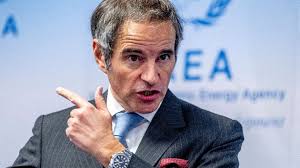
The US and UK have sent the toxic ammunition to Ukraine
Rt.com 12 Sept 23
There are “no significant radiological consequences” to the use of depleted uranium ammunition, International Atomic Energy Agency (IAEA) Director General Rafael Grossi has declared. Russia insists that Grossi is “not telling the whole story.”
“From a nuclear safety point of view there are no significant radiological consequences” to the use of this ammunition, Grossi told reporters during a briefing on Monday.
“Maybe in some very specific cases, people near a place that was hit with this kind of ammunition, there could be contamination,” he continued, adding that “this is more of a health issue of a normal nature than a potential radiological crisis.”
Depleted uranium is used to make the hardened cores of certain armor-piercing tank and autocannon rounds. Although it is not highly radioactive, uranium is still a toxic metal, and this metal is turned into a potentially hazardous aerosol when a depleted uranium round strikes its target.
US forces utilized depleted uranium tank shells during the 1991 Gulf War, reportedly causing a spike in birth defects, autoimmune disorders, and cancer cases in Iraq over the following decades. NATO also used depleted uranium in its 1999 air campaign against Yugoslavia. Earlier this year, Serbian Health Minister Danica Grujicic described the carcinogenic consequences of this ammunition on the Serb population a “horrible and inhumane experiment.”
The UK began supplying Ukraine with depleted uranium tank shells in March, while the US announced last week that it would send depleted uranium ammunition for its M1 Abrams tanks, which are expected to arrive in Ukraine in the coming weeks.
By focusing on the issue from a nuclear safety point of view, Grossi was being deliberately disingenuous, Russian Foreign Ministry spokeswoman Maria Zakharova wrote on Telegram on Monday.
“Mr. Grossi is, of course, right in saying that there are no significant radiological consequences from the standpoint of ‘nuclear safety,” she wrote. “It’s likewise obvious, though, that he is not telling the whole story.”
Zakharova pointed out that depleted uranium releases “extremely toxic aerosols” when ignited and vaporized. “Perhaps this is beyond Mr. Grossi’s expertise as head of the IAEA,” she concluded. “This question should be addressed to chemists, who will tell us about the harmful effects of heavy metal accumulation on the environment and human health.”
Russian forces claim to have destroyed at least one warehouse in Ukraine containing British depleted uranium shells. Kremlin spokesman Dmitry Peskov warned last week that the West will ultimately be responsible when this ammunition “inevitably” contaminates Ukrainian land………………. https://www.rt.com/news/582793-iaea-depleted-uranium-grossi/
Australia: the normalisation of nuclear power and militarism in our schools

Solidarity Brakfast (transcript of podcast)
Saturday, 9 September 2023 – 7:30am to 9:00am https://www.3cr.org.au/solidaritybreakfast/episode/palestine-laboratory-ii-militarization-schools-ii-within-these-walls-ii
Annie interviews Sanne de Swart from ACE Nuclear-Free Collective (Friends of the Earth Melbourne) on the normalisation of nuclear power and militarism in our schools.
The issue of normalising nuclear weapons and nuclear power has become a hot topic. STEM competitions financed by weapons companies supported by the Ministry of Defence.
- Friends of the Earth Nuclear Free Collective has an email petition to Environment Ministers to show dissent on this and has other suggestions for actions https://www.melbournefoe.org.au/no_defence_curriculum
Sanne de Swart. Normalisation of nuclear promotion under the guise of STEM education. Nuclear propulsion submarine challenge is directed at primary school students. Very young kids groomed to take part in military preparation. Teachers approached FOE with their concernsVictorian teachers unions are resisting this, and the matter has been taken up by Australian teachers union. AEU federal executive has condemned the programme.Education department guidelines are not to accept sponsorships from tobacco companies. and weapons companies. The STEM hub is working together with Dept of Defence and with BAE weapons manufacturer to promote this nuclear submarine technology.. BAE has been taken to the UN over human rights issues. BAE has pecuniary interest in this promotion.
Vic Education Dept is in breach of their own policy by promoting this actively on their website. Use of financial support from large weapons companies in our schools is against Victorian education Dept policy, probably also the policy in NSW. and SA. STEM education – impression given that STEM has only relevance to fighting machines..
Sanne – But really the STEM hub – we will need the brightest minds for the transition to a greener, more liveable society, need engineering and science and technology. This programme is taking away from that need, and directing education towards militarism and war efforts.It also fails to acknowledge from a nuclear perspective the devastating history around nuclear, that Australia has, starting from the British nuclear bomb tests 70 years ago , through to uranium mining and trying to impose radioactive waste dumps on Aboriginal land, all of which disproportionately affects First Nations people.
The Victorian Education Department is very actively promoting the nuclear submarine project The whole government, with AUKUS deal, is preparing for war, and being quite straightforward about that. Probably the Ed Dept is working with the Defence Dept on the same pathTeachers are concerned that this happening in their classrooms. That it is so explicit. Even BAE Systems is saying they want to create an extraordinary workforce. ADF Careers are talking about the pipeline of recruits that they need. Real concerns from teachers that this will be taught in their classrooms, and that the military agenda will be perpetuated for children – which is irresponsible and unethical, because children under 18 – it is all about positive brand association, they cannot make those decisions, as adults can, they are being groomed from a very young age.
Primary school programmes.
There is a LEGO challenge that is ongoing – also run by weapons companies The weapons companies come in, and promote what they do as something exciting and innovative. There’s a programme called Beacon – it is targeted at years 4 to 6 students. It is funded by BAE Systems – it is less explicit – focussed towards AUKUS, but it’s focussed at lower socioeconomic areas and schools,. That makes it hard for schools to say “No” to them, because those come as well-resourced projects. It is quite insidious in the way that it is targeted at young children, to have that positive brand association with military and weapons companies.I think that this is happening in other countries as well. Teachers in Britainhave been working on this, tooFOE has a few calls for action, for teachers to become aware of this. Also parents are encouraged to take this up , FOE is contacting the government on the issue.There is a lack of alternative programmes for STEM education
What is the Digital Prison?

The Countermeasure 6 Aug 23
Your phone alarm wakes you up and you get ready for work. You scan your face to use your phone so you can text your coworker that you’ll be late. You stop to get a coffee anyways, and you scan the QR code to enter the coffee shop. Your membership is still good. You order and go to pay, and the barista reminds you it is “card only.” You grab your coffee and go. Getting ready to cross the street, you notice a camera pointing right at you and everyone else on the corner. You think nothing of it — its for safety after all. Remembering that you are running a bit late, you pull out Google Maps to look for a shortcut right from your immediate location…
That short scene may sound like a very typical day for a lot of people around the world, not just in the US. And because it seems typical, it seems normal. And normal always means right, right? Wrong.
In 2023, people are starting to familiarize themselves with the idea of a digital prison, but what is it? The digital prison idea suggests that as a species, we are moving closer and closer to a state of society in which we will be asked, coerced, or even forced to utilize a digital identity to engage with aspects of life that we currently utilize freely, such as the internet, online and conventional shopping, voting, or accessing personal finances.
To many, the idea seems conspiratorial and out of a paranoid science fiction novel, but some of the effects already permeate the “free” West. In some places, like China, this digital panopticon is already functioning in the form of a Social Credit System used to surveille, control, and conform China’s citizens into inert, malleable pawns of the state.
Like most issues in 2023, the digital prison is no different in that two loud voices on either “side” of the metaphorical aisle are speaking up in defiance or defense of the issue. In the case of the digital prison, I see it as more severe.
This issue permeates borders and cultures. It has no regard for personal preferences, religious or cultural beliefs. And the defenders of such an idea do not seem to know exactly what they are supporting. That is in part because the current effects are normalized, people are conditioned to accept them. As for the future terrors, they have yet to be fathomed or revealed.……………………….
The disagreement that anti-digital-prison folks have is not with the principles behind some of the 21st century’s technological developments, it is disagreement with the collective effect of a society that forces inescapable compliance from individuals.
……………………………………………………………………………………………………….. Cell phones are a great example of the development of this fear. When they were originally created, they made the function of voice communications even more convenient. And technologies that do that tend to alter the fabric of society without a need to do so subliminally or subversively. In other words, because the thing (in this case cellphones) appears to be an unequivocal asset for the everyman of the modern era, it permeates into our lives without second thought.
The Ulez System in the UK is a good example of this:
I would imagine that most people in UK would agree that crime should be reduced and criminals held accountable; that a reasonable element of policing, patrolling, undercover work, and surveillance may even be acceptable to do so. What is not acceptable, however, is the establishment of a surveillance network, seeing everything all the time, that backlogs the personal lives, actions, and whereabouts of all of the UK’s citizens.
So we can see the problem here with rampant digital “progress”; there are great principles and functions being made by technology, but the employment of such capabilities needs to be checked.
It is in this idea — the application of technology, and the potentially tyrannical and sinister goals behind it — that we return to the collective effects of various tech that define what the digital prison is.
Ulez alone may not have been such a big deal in the UK. After all, there are cameras at street lights, government buildings, museums, stores, banks and ATMs. People walk with cameras on their phones and take pictures and videos all the time.
But as an implementation alongside everything we currently have, it’s a bit much. Cell phones are a great example of the development of this fear. When they were originally created, they made the function of voice communications even more convenient. And technologies that do that tend to alter the fabric of society without a need to do so subliminally or subversively. In other words, because the thing (in this case cellphones) appears to be an unequivocal asset for the everyman of the modern era, it permeates into our lives without second thought.
………………………. Continuing with cellphones, the problem is remains that they developed too quickly. Before we knew it, cell phones were also entertainment systems, our credit cards, our MP3s, our ledgers and address books, our maps, our news streams, our fitness trackers… The technology developed so quickly, so efficiently — and society with it — that to get by, any individual had to buy in.
That is the digital prison — unwilling consent to an inescapable lifestyle.
And if the principle of the fear is not enough, look at the application of it. In China, for example, there is a social credit system that bars people from jobs, schooling, eating or shopping establishments. The system even goes so far as to publicly shame Chinese citizens who maintain “insufficient” scores. They go so far as posting their picture, ID information, and address to the public. The reason? To entice submission and compliance.
And once again, like the Ulez rhetoric, many will present the excuse that “That is in China, such a thing won’t happen here.” But it does. We have facial ID, thumb print scanners, grocery stores that can only be accessed by QR code or facial recognition. Some places are switching to digital payment altogether, and excluding the use of cash entirely. The WEF once entertained the idea of “prescriptive elections,” in which the need to vote would no longer exist because governing entities would already “know the result” through data trends.
……………………………………………………………………………………. And aside from the examples we write off as acceptable because of “crisis,” it would appear that in the most subliminal and seemingly harmless ways, we have already taken the first plunge; we have already submitted ourselves to be molded by further effects of digitization.
In my opinion, the full-blown digital prison is nearing reality. There are zero indications that the companies who make the technologies are looking to make their platforms safer, less addictive, and less invasive. What is worse, there is also no indication that governments want to remain a healthy distance away from a society that is grafted to technology dependence.
So what do you think? Are we nearing life in a digital prison? Are we there already? What are we currently subjected to? What will we be subjected to in the future? More importantly, what can we do to stop it?
 | |||
| |||
https://countermeasuremedia.medium.com/what-is-the-digital-prison-9c3438b3a1a0
Safety fears : the problem of Britain’s ageing nuclear submarines
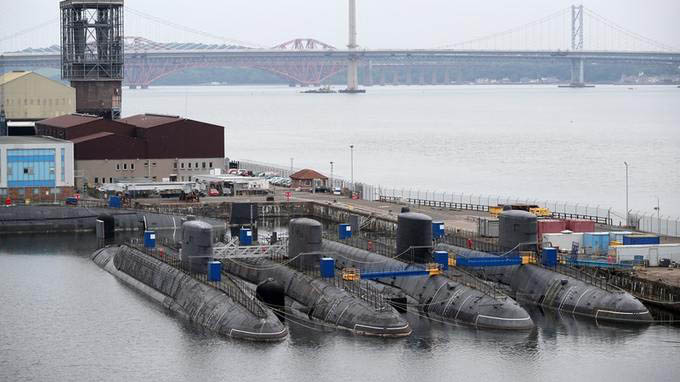
A British nuclear submarine has broken the record for the longest patrol at
sea as safety fears grow over the Royal Navy’s ageing fleet. The
Vanguard-class vessel returned to the Faslane naval base in Scotland on
Monday encrusted with barnacles and covered in slime after a gruelling tour
understood to have lasted more than six months.
Naval experts have raised concerns that the long patrols result in immense physical strain on the vessels and take a psychological toll on the crews. The UK has four
Vanguard-class submarines, which are armed with up to eight Trident
ballistic missiles carrying Britain’s nuclear warheads. At least one
submarine is on patrol at all times to maintain a continuous at-sea
deterrent. The fleet has been effectively reduced to two functioning
vessels, HMS Vigilant and HMS Vengeance, owing to repair works on the other
two.
Times 12th Sept 2023
-
Archives
- October 2026 (112)
- September 2026 (339)
- August 2026 (330)
- July 2026 (355)
- June 2026 (287)
- May 2026 (306)
- April 2026 (356)
- March 2026 (251)
- February 2026 (267)
- January 2026 (308)
- December 2025 (358)
- November 2025 (359)
-
Categories
- 1
- 1 NUCLEAR ISSUES
- business and costs
- climate change
- culture and arts
- ENERGY
- environment
- health
- history
- indigenous issues
- Legal
- marketing of nuclear
- media
- opposition to nuclear
- PERSONAL STORIES
- politics
- politics international
- Religion and ethics
- safety
- secrets,lies and civil liberties
- spinbuster
- technology
- Uranium
- wastes
- weapons and war
- Women
- 2 WORLD
- ACTION
- AFRICA
- Atrocities
- AUSTRALIA
- Christina's notes
- Christina's themes
- culture and arts
- Events
- Fuk 2022
- Fuk 2023
- Fukushima 2017
- Fukushima 2018
- fukushima 2019
- Fukushima 2020
- Fukushima 2021
- general
- global warming
- Humour (God we need it)
- Nuclear
- RARE EARTHS
- Reference
- resources – print
- Resources -audiovicual
- Weekly Newsletter
- World
- World Nuclear
- YouTube
-
RSS
Entries RSS
Comments RSS

