New research to be presented at this year’s Annual Meeting of The European Association for the Study of Diabetes (EASD), Hamburg (2-6 Oct), suggests that exposure to low doses of radiation may contribute to an increased risk of diabetes.
The study by Dr Huan Hu and Dr Toshiteru Ohkubo from the Japanese National Institute of Occupational Safety and Health involved more than 6,000 out of around 20,000 emergency workers who responded to the radiation accident at the Fukushima Daiichi Nuclear Power Plant, which was hit by a huge tsunami in March 2011.
Substantial amounts of radioactive materials were released into the environment following explosions at the nuclear plant.
In 2014, the Epidemiological Study of Health Effects in Fukushima Emergency Workers (NEWS) was established to clarify the long-term health effects of radiation among emergency workers.
Few human studies have examined the impact of radiation exposure on diabetes development, particularly at low doses. To find out more, researchers examined the association between low-dose radiation exposure and risk of diabetes in 5,326 male emergency workers (average age 46 years) taking part in the NEWS study.
Between March and December 2011, individual emergency worker’s radiation exposure was measured using a pocket alarm dosemeter for external exposure and a whole-body counter for internal exposure.
Study participants underwent regular health examinations involving more than 70 components, including blood sugar, lipids, urine tests, inflammation biomarkers, thyroid function tests, and eye examinations.
Between 2012 and 2021, 392 participants developed diabetes—defined as a fast plasma glucose level of at least 126 mg/dL, an HbA1c level of at least 6.5%, or self-reported diagnosis of diabetes.
The researchers assessed the association between incident diabetes and cumulative radiation exposure after adjusting for a wide range of potential confounders including age, body mass index, smoking, alcohol consumption, leisure-time physical activity, employment at the nuclear power plant, dyslipidaemia (abnormally high levels of fats in the blood), and high blood pressure.
The analysis found that compared with the lowest cumulative low-dose radiation exposure (0-4 millisieverts [mSv]), the risk of developing diabetes was 6% higher for workers exposed to 5-9 mSv, and 47% and 33% greater for those exposed to 10-19 mSv and 20-49 mSv, respectively.
However, no elevated risk was detected in those exposed to radiation doses of 50 mSv or higher, likely due to the small sample size in this group.
“Our findings suggest an increased risk of diabetes among nuclear emergency workers from low levels of radiation. While the potential mechanisms remain somewhat unclear, reports suggest that radiation can adversely affect pancreatic cells responsible for insulin production, potentially contributing to diabetes. Additionally, there is an association between radiation exposure and heightened inflammation, a well-known factor in insulin resistance and the development of diabetes”, explains lead author Dr Hu.
He adds, “Ongoing follow-up of NEWS participants will provide an even clearer picture of diabetes risk at low radiation doses. As more diabetes cases emerge within our study group, our expanded dataset will enable more robust analyses, allowing researchers to better assess the link between radiation exposure and diabetes risk.”……………………………………………………………………………………………………….. more https://www.miragenews.com/fukushima-study-links-low-dose-radiation-to-1095852/
Recent statements by a French diplomat to “the Australian” newspaper criticizing Australia’s decision to observe the UN Treaty on the Prohibition of Nuclear Weapons (TPNW) reveal the panicked efforts by nuclear-armed states to undermine the treaty as support for the ban continues to grow. It also shows a European state with a dark colonial legacy continuing to exert pressure on the Pacific – an area heavily impacted by French nuclear testing – instead of respecting national sovereignty.
On 2 October an article in “the Australian” newspaper cited an unnamed French diplomat claiming that Australia’s support for the Treaty on the Prohibition of Nuclear Weapons “undermines the primacy of the Nuclear Non-Proliferation Treaty (NPT)” and “is contradictory with Australia’s ambition to reinforce its partnership with NATO.”
Both of these statements are not only hamfisted attempts at pressuring the Australian government away from the TPNW, they are also factually incorrect: The TPNW was carefully crafted to reinforce, complement, and build on the NPT, which obligates its parties – including France – to negotiate further legal measures to achieve nuclear disarmament under Article VI, and NATO members face no legal barrier to joining the treaty, so long as they commit not to engage in or support any nuclear-weapon-related activities. Moreover, several NATO partners are already TPNW parties (Austria, Ireland, Kazakhstan, Malta, Mongolia, New Zealand) or signatories (Algeria, Colombia).
These declarations show France’s mounting concern over the growing support for the TPNW. The statements themselves are no surprise, as France has stridently protested the TPNW ever since it was adopted at the UN in 2017 with the backing of 122 states. France insists it has a legitimate right under the NPT to possess nuclear weapons, while ignoring its commitments to pursue negotiations in good faith for nuclear disarmament under the same treaty. What is new is the fact that this pressure is being exerted publicly, and on a state that is largely seen as an ally on security issues. Previously, France has limited this kind of pressure for formerly colonised states, particularly in Africa.
Australia’s growing support for the TPNW
The Australian Labor Party, which has been in power since May 2022, adopted a resolution in 2018 committing it to sign and ratify the TPNW in government. This was moved by Anthony Albanese, who now serves as prime minister and has been a vocal supporter of the TPNW. He said at the time: “Our commitment to sign and ratify the nuclear weapon ban treaty in government is Labor at its best.” Labor reaffirmed this position in 2021 and most recently on 18 August 2023. The government also has confirmed its intention to observe the treaty’s upcoming meeting of states parties in New York (2MSP) and is evaluating whether to sign and ratify the treaty.
This is an encouraging step, but ICAN’s Executive Director, former Labor MP Melissa Parke, has criticised the government’s delay in ratifying the treaty: “It’s not enough to keep promising to sign the treaty without acting. We want to see the Prime Minister put pen to paper, without delay. Labor’s commitment on nuclear disarmament and non-proliferation will be hollow if Australia fails to do so.”
Speaking to the revelation that French diplomats are exerting pressure on Australia to consider, she said: “Our two countries have never seen eye to eye on nuclear weapons. France shouldn’t be lecturing Australia on nuclear policy. We can make our own decisions, in our own interests – and for the global common good.”
France’s unresolved nuclear legacy in the Pacific
From 1966 to 1996, France tested 193 nuclear weapons in Maohi Nui/French Polynesia, a Self Governing Territory of France in the Pacific. In 1974, Australia famously took France to the International Court of Justice in a bid to force an end to its atmospheric nuclear testing in the Pacific, as the impacts of nuclear weapons are not contained by national borders. Yet France only ended its Pacific nuclear test explosions once it was confident it had developed non-explosive testing methods sufficiently for new weapons development, and it refuses to acknowledge and address the catastrophic legacy of its nuclear tests to this day.This legacy is also a subject of hot debate at the national level in France. On 28 September, only days before France’s criticisms of Australia, the assembly of French Polynesia unanimously adopted a resolution supporting the TPNW, highlighting the region’s history as the site of numerous French nuclear tests. The resolution underscores the TPNW as a humanitarian disarmament treaty and emphasises the deep concerns of the French Polynesian population regarding this issue. While French Polynesia cannot currently access the assistance and rehabilitation outlined in Articles 6 and 7 of the TPNW due to France’s non-ratification, it sends a resounding message in favour of the treaty to Paris.
As countries including France, the UK and Sweden look to pivot back to nuclear power to help them meet net-zero targets, questions remain over safety, radioactive waste and where they’ll find the vast amounts of money and expertise needed to build and manage new reactors.
CITY,AM NICHOLAS EARL 3 Oct 23 #antinuclear #nuclear-free #NoNukes
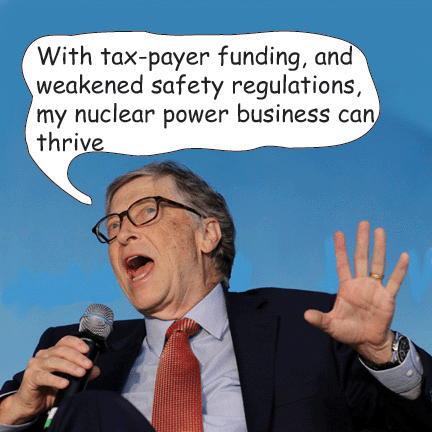
Bill Gates’ nuclear reactor design company Terrapower has not been shortlisted for the next round of the government’s competition for scaled-down power plants.
Industry vehicle GB Nuclear has selected six companies to advance to the latest stage, including rumoured front-runner Rolls-Royce which has already secured over £200m in government funding.
The remaining contenders also include EDF, GE-Hitachi, Holtec Britain, Nuscale and Westinghouse Electric.
These companies will be invited to bid for government contracts later this year, with successful companies announced next spring and contracts awarded in the summer.
Gates, the world’s fifth richest man and the co-creator of Microsoft, founded Terrapower in 2006.
He is currently the company’s chairman and is still their biggest investor, leading a £588.3m funding round last year.
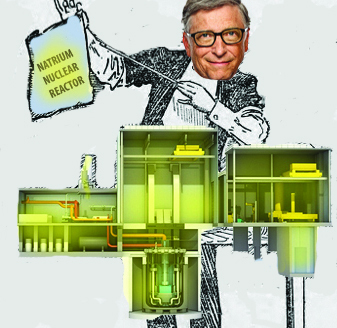
The company has been pitching bespoke ‘Natrium’ reactors powered by high-assay low-enriched uranium and announced its intentions earlier this year to enter the UK race for projects.
However, Whitehall officials have reportedly been concerned over insufficient supplies to import at scale to meet demand for Terrapower reactors, as most of the uranium it needs is produced in Russia – which is under sanctions following the country’s invasion of Ukraine.
City A.M. understands GB Nuclear wanted to prioritise the most ready-made technologies which could guarantee a final investment decision by the end of the decade.
Instead, Terrapower could feature in an upcoming consultation on advanced technology.
Small modular reactors are a cornerstone of the government’s plan to revive domestic nuclear energy and replace the country’s ageing fleet – with 85 per cent of the country’s current capacity set to go offline over the next 12 years.
……………………..Downing Street is targeting operational SMRs in the UK by the mid-2030s, with a £20bn cap being placed on the competitive process.
Can Australia rebuild a strategic military partnership with France at the same time as independence movements claim Pacific support?
On 28 September, the Assembly of French Polynesia unanimously passed a resolution endorsing the Treaty on the Prohibition of Nuclear Weapons (TPNW), the nuclear ban treaty that entered into force in 2021. Even though France refuses to sign the treaty, and still controls the defence and foreign policy of French Polynesia, the local legislature in Tahiti with its new pro-independence government sees TPNW as setting a new norm in international law. The resolution encourages “the participation of France as an observer state at the next TPNW Meeting of the States Parties”, to be held in New York in late November. It also calls on the French government to “work towards France’s adherence to this new international norm.”
A key reason for this pointed message to Paris are the TPNW provisions that call for assistance to nuclear survivors and clean-up of contaminated nuclear test sites. The Ma’ohi people are still seeking compensation for the health and environmental effects of 193 French nuclear tests at Moruroa and Fangataufa.
Beyond this, French Polynesia’s critique of nuclear weapons echoes the views of the majority of members of the Pacific Islands Forum. Unlike Australia, nine independent Pacific Island countries and Aotearoa-New Zealand have already signed and ratified the TPNW.
At the recent Australian Labor Party (ALP) National Conference in Brisbane, the party re-confirmed its support for signing the TPNW – under restrictive conditions – and agreed to send an observer to the next Meeting of State Parties. However key ALP leaders are opposed to signing, and nuclear weapons states such as the United States and France, having long derided the treaty, are now ramping up their opposition to it.
A front-page story in The Australian on 2 October cited an unnamed French diplomat who criticised Australia over its tentative moves towards signing TPNW, though the story fails to mention last week’s resolution from the Assembly of French Polynesia…………………………………………….
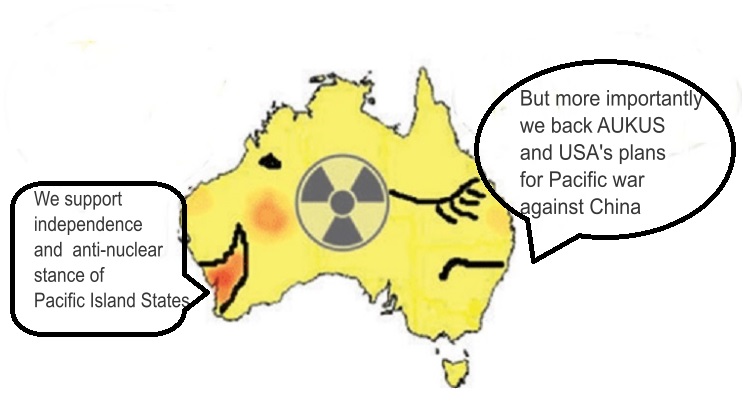
the Australian government has held a series of meetings with key French ministers to rebuild relations disrupted by AUKUS, including a summit between Defence Minister Richard Marles and French counterpart Sebastien Lecornu in September 2022, and a 2+2 meeting of defence and foreign ministers in January. Marles and Lecornu are organising the South Pacific Defence Ministers meeting in Noumea in December, to the dismay of the FLNKS independence movement, which is in the midst of talks with the French state over a new political status for New Caledonia.
Last year, Marles congratulated Emmanuel Macron on his re-election to the French presidency, proclaiming “France is our neighbour. France is a Pacific country. And as such, France deeply matters to Australia.”
But France is a European colonial power, not a Pacific country. It is recognised by the United Nations as the administering power of non-self-governing territories. It has responsibilities for decolonisation under international law. Australian governments may be reluctant to talk publicly about this, but the issue of self-determination is firmly on the regional agenda, posing difficult choices for all Forum member countries (as shown by recent debates over West Papua, Bougainville, Guam, etc).
Another problem is that, in both Australia and France, the perspectives of leaders from Francophone island communities are usually missing from the public debate about France’s role in Indo-Pacific security. It’s rare to see the media or think tanks cite President Louis Mapou of New Caledonia or newly elected President Moetai Brotherson of French Polynesia. Both will be attending the next Pacific Islands Forum summit in Rarotonga as it discusses regional security – for the first time, leaders from both French territories in the Forum are supporters of independence and sharp anti-nuclear critics.
So, can Australia rebuild a strategic military partnership with France at the same time as its Pacific neighbours are seeking an independent and sovereign state?
As Penny Wong travelled to Noumea last April, becoming the first Australian Foreign Minister to address the Congress of New Caledonia, Mapou was eager to strengthen ties with Canberra around trade, investment and people-to-people engagement. He also diplomatically highlighted key differences around Australia’s close alignment with the United States under the AUKUS partnership:
The independence movement of New Caledonia – of which I’m a member – is in favour of non-alignment. We regularly attend the summits of the Non-Aligned Movement. From the earliest days, we have supported a nuclear free Pacific – that’s even set out in the preamble of the draft Constitution of Kanaky that we submitted to the United Nations in 1986. When Australia decides to align itself with the United States in the framework of AUKUS to acquire nuclear submarines, it raises the question: if it starts here, where will it end? How does this impact the Treaty of Rarotonga and the Boe Declaration on security?
The Albanese government has proclaimed its support for a world without nuclear weapons. But talk is easy. It’s getting harder for the ALP government to balance tensions between its role as an AUKUS partner, a strategic partner with France and the “security partner of choice” for the island nations of the Pacific, which are deeply opposed to nuclear weapons. Why should Australia side with a European colonial power against its closest neighbours? https://www.lowyinstitute.org/the-interpreter/french-criticism-nuclear-ban-treaty-highlights-canberra-s-dilemma
There is considerable anti-war sentiment among voters worldwide — which explains why candidates run on peace promises (Obama, Zelensky, Trump). There is also considerable pro-war sentiment among corporations who build weapons of mass destruction, and the think-tanks they fundto support them.
This push-pull has nudged warmakers into branding wars as “D for Democrat” or “R for Republican” in order to whip up support and manage dissent. Thus Democrats support President Biden’s proxy war on Russia via Ukraine while Republicans and third parties (Greens, Libertarians, Communists) don’t.
But based on the congressional circus this week, maybe that is not such a good strategy?
Those of us opposed to ALL wars our government wages have experienced the partisan split in who will stand with us. When a Republican is in the White House, Democrats come out in droves. Then when an Obama or a Biden is elected, they go home.
Then, the parties wage information wars to support their team. These have ramped up considerably to insist that Putin = Hitler (just silly), that there are no Nazis in Ukraine (maybe they all went to Canada?), and that funding Ukraine’s government is a higher priority than funding our own. Even though as far back as July a CNN poll found a majority in the U.S. opposed sending any more money to Ukraine.
In order to avert a federal government shutdown over what to fund, we heard from Democrats that it was the bad Republicans’ fault.
The US president said on Sunday he was “sick and tired” of the political brinkmanship, and that US support for Ukraine could not be interrupted “under any circumstances”.
Even though Democrats never move left and always move right — or maybe because of that? — the Punch and Judy show where the two corporate parties bash each other constantly is having a long run.
Then we heard that the bad Republicans would only vote for averting a shutdown if it stripped out “aid” to Ukraine (currently at $180 billion and counting). And it worked! Worked, that is, after a fire drill shut Congress down when Democratic Congressman Jamaal Bowman pulled a fire alarm and delayed the vote a bit.
He swears this was an honest mistake. But I suspect the delay was so that some more back room deals on terms of the funding could be hammered out.
Received wisdom has it that Democrats want WW3 with Russia while Republicans want WW3 with China. But Greens like me see the corporate parties supporting all the wars and I think they’re all nuts.
I can see where the U.S. once believed it could beat Russia as it used the NATO alliance and CIA color revolutions to foment trouble like civil war for Ukraine. Looking at the situation today, it’s clear that few aside from delusional thinkers allied with the Biden administration believes this is still the case. Russia has objectively kicked Ukraine/NATO’s butt while the response in the West is best epitomized by the Canadian Parliament’s standing ovation for a literal Nazi “who fought the Russians in WW2.”
“Ukrainian President Volodymyr Zelenskyy and Prime Minister Justin Trudeau recognize Yaroslav Hunka, who fought with the First Ukrainian Division in World War II, in the House of Commons in Ottawa on Sept. 22, 2023.” | Patrick Doyle/The Canadian Press
(If you’re unclear on WW2’s major players and alliances, the late Howard Zinn’s overview can be found here.)
Next up, preparations are already well underway for using Taiwan to create a situation where China feels it must respond to safeguard its own borders and sovereignty. What would lead to the delusion that AUKUS or NATO or U.S.-Japan-South Korea could defeat China in a hot war? Hot warriors falsely claim China is authoritarian, has lost the support of its people, and committed genocide against the Uyghurs.
Word to the U.S.: your government is increasingly authoritarian, has lost the confidence of its people, and has committed genocide in so many places it’s hard to list them all. Maybe just note the ongoing attempted genocide of the indigenous people of North America and leave it at that.
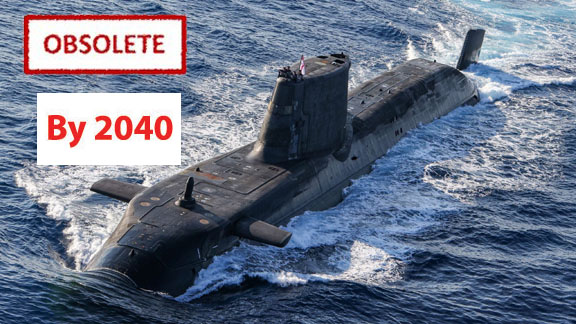
#antinuclear #nuclear-free #NoNukes Britain has signed contracts worth GBP4 billion to finance a new phase ofthe SSN-Aukus next-generation attack submarine project, according togovernment officials. The deals, which involve British companies BAE Systems PLC, Rolls-Royce Holdings PLC and Babcock International Group PLC, are part of the Aukus military alliance between the US, Australia and the UK to counter China in the Asia-Pacific region.
BBC News By Peter Hoskins, Business reporter 2 October Britain’s biggest defence firm, BAE Systemshas won a £3.95bn ($4.82bn) contract to build a new generation of submarines as the security pact between the US, UK and Australia moves ahead.
In March, the three countries announced details of the so-called Aukus pact to provide Australia with nuclear-powered attack submarines by the late 2030s.
The pact aims to counter China’s ambitions in the Indo-Pacific region.
Beijing has strongly criticised the three countries over the deal.
……………………..”This multi-billion-pound investment in the Aukus submarine programme will help deliver the long-term hunter-killer submarine capabilities the UK needs to maintain our strategic advantage and secure our leading place in a contested global order,” UK Defence Secretary Grant Shapps said as the Conservative party conference got under way in Manchester.
………………….Other major UK defence contractors are also getting a boost from the Aukus deal.
On Sept. 19, at this year’s World Petroleum Congress, Minister of Environment and Protected Areas Rebecca Schulz announced that the Government of Alberta would invest $7 million into a study by Cenovus Energy on the potential usage of small modular nuclear reactors (SMRs) to power future oilsands operations.
Over the past year, the government has singlehandedly picked the winners and losers in the energy transition race. Hydrogen, carbon capture and nuclear are winners. With the recent moratorium on project approvals, solar and wind are set to be the losers. But don’t we, as Albertans, deserve a say?
The government’s new interest and investment in SMR feasibility should be a call to Albertans to start asking questions about what role (if any) nuclear should play in our energy future. Most of our current conversations are tied to the future of fossil fuels. Nuclear is not even on most people’s radar. We need to get ready to ask tough questions about nuclear energy that other jurisdictions are already debating.
Here are three questions that Albertans need to ask:
Who will regulate the use of SMRs?
Currently, the Alberta Energy Regulator (AER) is the single regulator of energy development in our province, overseeing the process from exploration to reclamation. AER’s recent silence after a known tailings leak at Imperial Oil’s Kearl oilsands mine has prompted questioning of not only AER’s transparency but also its ability to communicate risk and generate trust with communities that house energy projects. AER’s failure to notify residents in Wood Buffalo for nearly nine months about the estimated 5.3 million litres of leaked industrial wastewater has also raised serious questions about AER’s ability to ensure public safety. We need to ask: is AER, in its current form, the best regulator to oversee the development of nuclear energy?
What will happen to SMRs after they are decommissioned and where will we store our nuclear waste?
There are serious technological challenges to managing nuclear waste. Currently, Canada’s used nuclear fuel is managed at facilities at nuclear reactor sites in Ontario, Quebec and New Brunswick, along with limited sites in Manitoba. These are all temporary sites. The federal government is hoping to finalize a permanent nuclear repository after 15 years of planning, engagement and scientific and engineering studies. Residents of communities where nuclear storage has been proposed are worried. There are currently no nuclear waste repositories in western Canada. If SMRs are used in Alberta, how much waste will they generate? And where will it be stored? Alberta’s unimpressive track record with decommissioning and reclaiming former energy sites (such as orphan wells) means that we need to ask tough questions about the afterlife of SMRs now.
How will Albertans be consulted in the creation of the Government of Alberta’s nuclear energy strategy?
While it is commendable that the GoA is investing in studies that explore clean energy, there is currently no indication that Albertans will be consulted about nuclear energy. While SMRs would clearly have an impact on oilsands operations and aid the industry in meeting aggressive net-zero targets set by the federal government, the regulation of the nuclear energy industry will impact all Albertans. We should all have a say in determining our path forward in energy transitions. And we should be doing this through broad consultation led by an independent third party, who does not stand to benefit financially or regulatorily from the introduction of SMRs.
Albertans are supportive of energy transitions. We must begin a serious public discussion of how and if nuclear energy should be a part of it. We have an orphan well problem. Do we want an orphan reactor problem as well?
Sabrina Perić is an energy anthropologist, associate professor at the University of Calgary, and the co-director of the Energy Stories Lab.
End of the American Dream. Life As You Have Known It Will Never Be The Same Again… by Michael
It would be difficult to overstate the importance of the Military Industrial Complex to our society. It employs millions of people, and it brings in hundreds of billions of dollars each year. The Military Industrial Complex has always been one of the central pillars of our economy, and these days business is booming thanks to the war in Ukraine and the possibility of a war with China. Needless to say, those that run the Military Industrial Complex want the gravy train to continue, and so politicians that are pro-war are showered with campaign contributions. In both major parties, politicians that are pro-war greatly outnumber those that are anti-war, and that is not likely to change any time soon.
Smedley D. Butler fought in four major conflicts, and in 1935 he astutely observed that “war is a racket”…
“WAR is a racket. It always has been. It is possibly the oldest, easily the most profitable, surely the most vicious. It is the only one international in scope. It is the only one in which the profits are reckoned in dollars and the losses in lives.”
If the Military Industrial Complex suddenly disappeared, it would leave a giant, gaping hole in our economy that would be extremely difficult to fill. In an excellent piece that he posted earlier this week, Richard C. Cook shared some numbers about the Military Industrial Complex that are absolutely astounding…
Today about 2.1 million people are employed by the defense industry. According to Acara Solutions, a major MIC recruiting firm, their average annual salary is $106,700, 40 percent higher than the national average. The companies they work for produced revenues in 2022 of $741 billion. How much of their production is high-priced junk, no one knows. The performance of U.S.-produced armaments in the Ukraine conflict does not seem impressive. No modern U.S. weapons have ever been tested in an industrial-type war against an equal adversary.
The MIC also includes active-duty uniformed personnel of 1.37 million and reserves of 849,000. There are 750 U.S. military bases in more than 80 countries outside of the U.S. More than 100,000 U.S. military personnel are stationed in Europe. Annual salary and benefits of the military are currently $146 billion per year, escalating with COLAs compounded at two to three percent annually, sometimes more. Some former U.S. military personnel are assumed to be fighting in Ukraine as mercenaries or helping direct the fighting from safe locations like Kiev or Lvov.
Then there are the civilian employees. According to the DoD, it employs more than 700,000 civilians “in an array of critical positions worldwide,” with compensation totaling about $70 billion. According to the Government Accountability Office, we may also add 560,000 contractor employees, whose compensation is typically higher than the career workforce.
We can also add hundreds of thousands of executives, managers, employees and contractors of the three-letter Deep State agencies, such as the CIA, NSA, DEA, FBI, and now DHS, etc., who interface with the MIC day in and day out and are part of the same fabric of state-sanctioned force and enemy identification and interdiction.
In the entire history of the world, we have never seen anything quite like this.
And the Military Industrial Complex absolutely loves Joe Biden, because he has promised to keep the war in Ukraine going “for as long as it takes”…
It is likely that billions of people around the world view the conflict in Ukraine as a proxy war being waged by the U.S. against Russia. US President Joe Biden has pledged to aid Ukraine’s pursuit of victory “for as long as it takes,” without defining what the end state might be. Russian President Vladimir Putin has interpreted U.S. intentions to mean a fight “to the last Ukrainian.”
Unfortunately, there is a problem.
The Ukrainians are running out of warm bodies.
They have literally been grabbing men off the streets and throwing them into vans, but we didn’t care because it wasn’t our sons that were being forced to go to war.
Many Americans cheered when the Ukrainians began their ill-fated “counter-offensive”, but it turned out to be a disaster.
A senior U.S. intel official recently admitted to journalist Seymour Hersh that Ukraine has suffered approximately 75,000 casualties during this counter-offensive…
“There is no discussion in his headquarters or in the Biden White House of a ceasefire and no interest in talks that could lead to an end to the slaughter,” Hersh said.
Speaking of the Ukrainian claims of slow progress in an offensive that has lost an estimated 75,000 casualties, the official told Hersh: “It’s all lies.”
On many battlefields in Ukraine, there are unburied dead bodies just laying around all over the place.
As the anniversary of the purported Biden Regime sabotage of the Nord Stream pipeline approaches Sept. 26, veteran investigative reporter Seymour Hersh blamed a ”secret disinformation operation“ by CIA and MI-6 for misleading the public about the disastrous state of the US-led war effort.
“The war is over. Russia has won. There is no Ukrainian offensive anymore, but the White House and the American media have to keep the lie going,“ a senior US intel official told Hersh. “The truth is if the Ukrainian army is ordered to continue the offensive, the army would mutiny. The soldiers aren’t willing to die any more, but this doesn’t fit the B.S. that is being authored by the Biden White House.”
Where do we go from here?
The Military Industrial Complex certainly does not want this conflict to end, and Joe Biden has no intention of backing down.
So more warm bodies will be needed.
That is one of the reasons why there has been so much chatter about bringing back the draft here in the United States.
Recruitment has been way down in recent years, but our leaders desperately want to win this war with Russia and they also want to be ready to fight a war with China over Taiwan.
And so the stage is being set to draft young American boys and young American girls into military service…
The most recent edition of the US Army War College’s academic journal includes a highly disturbing essay on what lessons the US military should take away from the continuing war in Ukraine. By far the most concerning and most relevant section for the average American citizen is a subsection entitled “Casualties, Replacements, and Reconstitutions” which, to cut right to the chase, directly states, “Large-scale combat operations troop requirements may well require a reconceptualization of the 1970s and 1980s volunteer force and a move toward partial conscription.”
The context for this supposed need to reinstate conscription is the estimate that were the US to enter into a large-scale conflict, every day it would likely suffer thirty-six hundred casualties and require eight hundred replacements, again per day. The report notes that over the course of twenty years in Iraq and Afghanistan, the US suffered fifty thousand casualties, a number which would likely be reached in merely two weeks of large-scale intensive combat.
The military is already facing an enormous recruiting shortfall. Last year the army alone fell short of its goal by fifteen thousand soldiers and is on track to be short an additional twenty thousand this year. On top of that, the report notes that the Individual Ready Reserve, which is composed of former service personnel who do not actively train and drill but may be called back into active service in the event they are needed, has dropped from seven hundred thousand in 1973 to seventy-six thousand now.
Do you want your children to be fed into a meat grinder on the other side of the globe?
If not, it is time to stand up and say something………………………………………………………………………………………
We need to pull back from the brink before it is too late.
But our leaders won’t do that.
They don’t want to upset the Military Industrial Complex.
Unfortunately, we could also soon find ourselves in a war with China……………………………………………
The Military Industrial Complex wants to make even more money, and our politicians want to keep the campaign contributions rolling in.
So we will continue to speed toward a date with the unthinkable as the fate of our society hangs in the balance.
The U.S. government has embarked upon the first comprehensive modernization of its strategic nuclear arsenal since the Cold War ended three decades ago. The Department of Defense is simultaneously developing a new generation of ballistic-missile submarines, land-based intercontinental ballistic missiles, and long-range bombers.
Collectively, these three systems are referred to as the strategic “triad.” Every nuclear posture review conducted by the government since the Soviet Union collapsed—there have been five counting Biden’s—has endorsed the triad as the best approach to assuring nuclear deterrence.
During the Cold War, each leg of the triad was periodically modernized. However, with the waning of the Soviet threat, improvement slowed. As a result, the nuclear arsenal has aged markedly. With great-power competition now restored to prominence in the nation’s defense strategy, the deterrent is overdue for revitalization.
The most recent authoritative estimate of nuclear-weapons costs, produced by the Congressional Budget Office in July, projects that the Department of Defense and Department of Energy will spend $247 billion during the ten years ending in 2032 to modernize the nuclear force.
An even larger amount will be allocated in subsequent years, delivering revenues to hundreds of companies. For instance, industrial conglomerate TextronTXT-1.1% will provide reentry-vehicle technology for carrying nuclear warheads, and BoeingBA-2% hopes to build a successor to the E-4B flying command post (popularly known as the Doomsday plane).
However, four companies are poised to dominate modernization of the nuclear arsenal, each of them ultimately realizing tens of billions of dollars in sales.
Northrop Grumman NOC+0.5%is the big winner in this generation’s round of competitions to rebuild the nuclear force. ……………… The company thus finds itself firmly ensconced as a key contractor on all three legs of the triad for decades to come—an unprecedented achievement in the history of the nuclear program.
General Dynamics, a Virginia-based defense and aerospace conglomerate, will build the 12 Columbia-class ballistic missile submarines destined to carry two-thirds of U.S. strategic warheads, just as it built the existing Ohio class of strategic subs……….. Today it is the world’s leading producer of undersea warships, supporting modernization of both the U.S. and United Kingdom nuclear deterrents.
Lockheed Martin LMT-0.3%is the world’s biggest military contractor, and will play a number of roles in nuclear modernization. The Maryland-based company has built every generation of submarine-launched ballistic missile from the early Polaris weapons to today’s Trident II D5……………………………………………………………………………………..
Like General Dynamics, Lockheed Martin contributes to my think tank.
SCHEERPOST, By Max Blumenthal / The Grayzone 1 Oct 23 “…………………………………………………………………………………………………………………………………………………….Throughout the Nazi German occupation of Poland, the Ukrainian journalist Michael Chomiak served as one of Hitler’s top propagandists. Based in Krakow, Chomiak edited an antisemitic publication called Krakivs’ki visti (Krakow News), which cheerled the Nazi invasion of the Soviet Union – “The German Army is bringing us our cherished freedom,” the paper proclaimed in 1941 – and glorified Hitler while rallying Ukrainian support for the Waffen-SS Galicia volunteers.
Chomiak spent much of the war living in two spacious Krakow apartments that had been seized from their Jewish owners by the Nazi occupiers. He wrote that he moved numerous pieces of furniture belonging to a certain “Dr. Finkelstein” to another aryanized apartment placed under his control.
In Canada, Chomiak participated in the Ukrainian Canadian Committee (UCC), which incubated hardcore nationalist sentiment among diaspora members while lobbying Ottawa for hardline anti-Soviet policies. On its website, the UCC boasted of receiving direct Canadian government assistance during World War Two: “The final and conclusive impetus for [establishing the UCC] came from the National War Services of Canada which was anxious that young Ukrainians enlist in military services.”
The UCC’s first president Volodymyr Kubijovych, had served as Chomiak’s boss back in Krakow. He also played a part in the establishment of the 14th Grenadier Division of the Waffen-SS Galicia, announcing upon its formation, “This historic day was made possible by the conditions to create a worthy opportunity for the Ukrainians of Galicia, to fight arm in arm with the heroic German soldiers of the army and the Waffen-SS against Bolshevism, your and our deadly enemy.”
FREELAND NURTURES MEDIA CAREER AS UNDERCOVER REGIME CHANGE AGENT IN SOVIET-ERA UKRAINE
Following his death in 1984, Chomiak’s granddaughter, Chrystia Freeland, followed in his footsteps as a reporter for various Ukrainian nationalist publications. She was an early contributor to Kubijovych’s Encyclopedia of Ukraine, which whitewashed the record of Nazi collaborators like Stepan Bandera, referring to him as a “revolutionary.” Next, she took a staff position at the Edmonton-based Ukrainian News, where her grandfather had served as editor.
A 1988 edition of Ukrainian News (below on original) featured an article co-authored by Freeland, followed by an ad for a book called “Fighting for Freedom” which glorified the Ukrainian Waffen-SS Galician division.
During Freeland’s time as an exchange student in Lviv, Ukraine, she laid the foundations for her meteoric rise to journalistic success. From behind cover as a Russian literature major at Harvard University, Freeland collaborated with local regime change activists while feeding anti-Soviet narratives to international media bigwigs.
“Countless ‘tendentious’ news stories about life in the Soviet Union, especially for its non-Russian citizens, had her fingerprints as Ms. Freeland set about making a name for herself in journalistic circles with an eye to her future career prospects,” the Canadian Broadcasting Corporation (CBC) reported.
Citing KGB files, the CBC described Freeland as a de facto intelligence agent: “The student causing so many headaches clearly loathed the Soviet Union, but she knew its laws inside and out – and how to use them to her advantage. She skillfully hid her actions, avoided surveillance (and shared that knowledge with her Ukrainian contacts) and expertly trafficked in ‘misinformation.’”
In 1989, Soviet security agents rescinded Freeland’s visa when they caught her smuggling “a veritable how-to guide for running an election” into the country for Ukrainain nationalist candidates.
She quickly transitioned back to journalism, landing gigs in post-Soviet Moscow for the Financial Times and Economist, and eventually rising to global editor-at-large of Reuters – the UK-based media giant which today functions as a cutout for British intelligence operations against Russia.
CANADA TRAINS, PROTECTS NAZIS IN POST-MAIDAN UKRAINE
When Freeland won a seat as a Liberal member of Canada’s parliament in 2013, she established her most powerful platform yet to agitate for regime change in Russia. Milking her journalistic connections, she published op-eds in top legacy papers like the New York Times urging militant support from Western capitals for Ukraine’s so-called “Revolution of Dignity,” which saw the violent removal of a democratically elected president and his replacement with a nationalist, pro-NATO government in 2014.
In the midst of the coup attempt, a group of neo-Nazi thugs belonging to the C14 organization occupied Kiev’s city council and vandalized the building with Ukrainian nationalist insignia and white supremacist symbols, including a Confederate flag. When riot police chased the fascist hooligans away on February 18, 2014, they took shelter in the Canadian embassy with the apparent consent of the Conservative administration in Ottawa. “Canada was sympathizing with the protesters, at the time, more than the [Ukrainian] government,” a Ukrainian interior ministry official recalled to the Canadian Broadcasting Corporation.
Official Canadian support for neo-Nazi militants in Ukraine intensified after the 2015 election of the Liberal Party’s Justin Trudeau. In November 2017, the Canadian military and US Department of Defense dispatched several officers to Kiev for a multinational training session with Ukraine’s Azov Battalion. (Azov has since deleted the record of the session from its website).
Azov was controlled at the time by Adriy Biletsky, the self-proclaimed “White Leader” who declared, “the historic mission of our nation in this critical moment is to lead the White Races of the world in a final crusade for their survival… A crusade against the Semite-led Untermenschen.”
AS NAZI FAMILY HISTORY SURFACES, FREELAND LIES TO THE PUBLIC
Back in Canada, Freeland’s troubling family history was surfacing for the first time in the media. Weeks after she was appointed in January 2017 as Foreign Minister – a post she predictably exploited to thunder for sanctions on Russia and arms shipments to Ukraine – her grandfather’s role as a Nazi propagandist in occupied Poland became the subject of a raft of reports in the alternative press.
The Trudeau government responded to the factual reports by accusing Russia of waging a campaign of cyber-warfare. “The situation is obviously one where we need to be alert. And that is why the Prime Minister has, among other things, encouraged a complete re-examination of our cyber security systems,” Public Safety Minister Ralph Goodale declared.
Yet few, if any, of the outlets responsible for excavating Chomiak’s history had any connection to Russia’s government. Among the first to expose his collaborationism was Consortium News, an independent, US-based media organization.
For her part, Freeland deployed a spokesperson to lie to the public, flatly denying that “the minister’s grandfather was a Nazi collaborator.”
When Canadian media quoted several Russian diplomats about the allegations, Freeland promptly ordered their deportation, accusing them of exploiting their diplomatic status “to interfere in our democracy.”
By this time, however, her family secrets had tumbled out of the attic and onto the pages of mainstream Canadian media. On March 7, 2017, the Globe and Mail reported on a 1996 article in the Journal of Ukrainian Studies confirming that Freeland’s grandfather had indeed been a Nazi propagandist, and that his writing helped fuel the Jewish genocide. The article was authored by Freeland’s uncle, John-Paul Himka, who thanked his niece in its preface for helping him with “problems and clarifications.”
“Freeland knew for more than two decades that her maternal Ukrainian grandfather was the chief editor of a Nazi newspaper in occupied Poland that vilified Jews during the Second World War,” the Globe and Mail noted.
After being caught on camera this September clapping with unrestrained zeal alongside hundreds of peers for a Ukrainian veteran of Hitler’s SS death squads, Freeland once again invoked her authority to scrub the incident from the record.
Three days after the embarrassing scene, Freeland was back on the floor of parliament, nodding in approval as Liberal House leader Karina Gould introduced a resolution to strike “from the appendix of the House of Commons debates” and from “any House multimedia recording” the recognition made by Speaker Anthony Rota of Yaroslav Hunka.
Thanks to decades of officially supported Holocaust education, the mantra that demands citizens “never forget” has become a guiding light of liberal democracy. In present day Ottawa, however, this simple piece of moral guidance is now treated as a menace which threatens to unravel careers and undermine the war effort in Ukraine.
Tell me, what planet are we actually on? All these decades later, are we really involved in a “second” or “new” Cold War? It’s certainly true that, as late as the 1980s, the superpowers (or so they then liked to think of themselves), the United States and the Soviet Union, were still engaged in just such a Cold War, something that might have seemed almost positive at the time. After all, a “hot” one could have involved the use of the planet’s two great nuclear arsenals and the potential obliteration of just about everything.
But today? In case you haven’t noticed, the phrase “new Cold War” or “second Cold War” has indeed crept into our media vocabulary. ………………………………………
let’s stop and think about just what planet we’re actually on. In the wake of August 6 and August 9, 1945, when two atomic bombs destroyed the Japanese cities of Hiroshima and Nagasaki, there was little doubt about how “hot” a war between future nuclear-armed powers might get. And today, of course, we know that, if such a word can even be used in this context, a relatively modest nuclear conflict between, say, India and Pakistan might actually obliterate billions of us, in part by creating a — yes, brrr — “nuclear winter,” that would give the very phrase “cold” war a distinctly new meaning.
These days, despite an all too “hot” war in Ukraine in which the U.S. has, at least indirectly, faced off against the crew that replaced those Soviet cold warriors of yore, the new Cold War references are largely aimed at this country’s increasingly tense, ever more militarized relationship with China.
Its focus is both the island of Taiwan and much of the rest of Asia. Worse yet, both countries seem driven to intensify that struggle.
In case you hadn’t noticed, Joe Biden made a symbolic and much-publicized stop in Vietnam (yes, Vietnam!) while returning from the September G20 summit meeting in India. There, he insisted that he didn’t “want to contain China” or halt its rise. He also demanded that it play by “the rules of the game” (and you know just whose rules and game that was). In the process, he functionally publicized his administration’s ongoing attempt to create an anti-China coalition extending from Japan and South Korea (only recently absorbed into a far deeper military relationship with this country), all the way to, yes, India itself.
And (yes, as well!) the Biden administration has upped military aid to Japan, Taiwan (including $85 million previously meant for Egypt), Australia (including a promise to supply it with its own nuclear attack submarines), and beyond. In the process, it’s also been reinforcing the American military position in the Pacific from Okinawa, Guam, and the Philippines to — yes again — Australia. Meanwhile, one four-star American general has even quite publicly predicted that a war between the U.S. and China is likely to break out by 2025, while urging his commanders to prepare for “the China fight”! Similarly, Director of National Intelligence Avril Haines has called China the “leading and most consequential threat to U.S. national security” and the Biden foreign policy team has been hard at work encircling — the Cold War phrase would have been “containing” — China, both diplomatically and militarily.
On the Chinese side, that country’s military has been similarly ramping up its air and naval activities around and ever closer to the island of Taiwan in an ominous fashion, even as it increases its military presence in places like the South China Sea (as has the U.S.). Oh, and just in case you hadn’t noticed, with a helping hand from Russia, Beijing is also putting more money and effort into expanding its already sizable nuclear arsenal.
Yes, this latest version of a Cold War is (to my mind at least) already a little too hot to handle. And yet, despite that reality, it couldn’t be more inappropriate to use the term “new Cold War” right now on a globe where a previously unimagined version of a hot war is staring us all, including most distinctly the United States and China, in the face.
As a start, keep in mind that the two great powers facing off so ominously against each other have long faced off no less ominously against the planet itself. After all, the United States remains the historically greatest greenhouse gas emitter of all time, while China is the greatest of the present moment (with the U.S. still in second place and Americans individually responsible for significantly more emissions than their Chinese counterparts). The results have been telling in both countries.
In 2023, the United States has already experienced a record 23 billion-dollar weather disasters from Hawaii to Florida with the year still months from ending. Meanwhile, China has been clobbered by staggering heat waves and stunning flooding, the heaviest rains in 1,000 years, displacing 1.2 million people in areas around its capital, Beijing. Given the past summer, this planet and all its inhabitants are no longer in anything that could pass for a cold war state.
The Freedom to Fuel?
As it happens, industrializing countries first began to, in essence, make war on our world in the late eighteenth century, but had no idea they were doing so until deep into the twentieth century. These days, however, it should be anything but a secret that humanity is all too knowingly at war — and there’s nothing “cold” about it — with and on our very own world. ……………………………………………………………….
In 2022, those major G20 nations that met in India recently poured a record $1.4 trillion (yes, that is not a misprint!) into subsidizing fossil fuels in various ways, more than double the figure for 2019………………………………………………………
The results of such a — yes, warlike — approach to the planet have been painfully obvious this year. After all, the northern hemisphere just broiled through its hottest summer in recorded history and the southern hemisphere the hottest winter. Each summer month — June, July, and August — also broke its own previous global record for heat and 2023 is almost guaranteed to be the hottest year ever recorded.
In addition, in the last five months, the world’s ocean waters also broke temperature records, heating up if not literally to the boiling point, then at least to stunning levels……………………………………………………………………………….
it hardly matters where you look. Even Australia just experienced its hottest winter ever and already potentially “catastrophic” spring fire conditions are developing there. Evidence also suggests that, whatever the extremes of the present moment, the future holds far worse in store.
In that context, think about the fact that the planet’s two greatest carbon emitters, China and the United States, now fully knowledgeable about what they’re doing, can’t seem to imagine working together in any fashion to deal with a catastrophe that may prove, in the decades to come, the slow-motion equivalent of a nuclear war.
The New Hot War
So, a new Cold War? Don’t count on it. I mean honestly, how can anyone anywhere talk about a new cold war with a straight face on a planet where nature’s increasingly hot war is the order of the day — and where far too little is being done. Meanwhile, as of this moment, the distinctly hot war in Ukraine is only worsening, as the Russian and Ukrainian militaries emit ever more carbon, which, it turns out, is what militaries do. After all, the U.S. military is the largest institutional greenhouse emitter on the planet, larger than some countries.
………………………………………………………………………. On a planet burning up ahead of schedule — and where, no matter how you look at it, humanity is reaching beyond some of the boundaries set for life itself — isn’t it time to refocus in a major way on the new Hot War (and not the one in Ukraine) that has this planet in its grip? Isn’t it time for the American and Chinese leaderships to cut the war-like posturing and together face a world in desperate danger, for the sake, if nothing else, of all our children and grandchildren who don’t deserve the planet we’re heating up for them in such a devastatingly rapid fashion? https://tomdispatch.com/the-slow-motion-equivalent-of-a-nuclear-war/
Voltaire Network, by Thierry Meyssan, Translation by Roger Lagassé 1 Oct 23
President Volodymyr Zelensky’s trip to the United States cleared up any remaining ambiguities. Everyone wondered about his strategy. He doesn’t seem to be trying to defend his own people, as he mobilizes all his men and sends them to die on the front line with no hope of victory. From now on, he appears to have no qualms about lying and cheating, and uses every means at his disposal to expel certain states from intergovernmental organizations. How can we not draw a parallel with Stepan Bandera, who massacred thousands of his own compatriots in the final days of the Second World War, when the defeat of the Reich was in no doubt?
Ukrainian President Volodymyr Zelensky attended the 78th General Assembly of the United Nations to deliver his customary speech on Russian terrorism. It was his first speech from this rostrum.
This year, four of the five permanent members of the Security Council did not send their heads of state or government: China, France, the UK and Russia. Clearly, despite the rhetoric, something has gone wrong in this institution.
Let’s summarize President Zelensky’s speech: “Russia uses food as a weapon against the rest of the world and the “game”, in its favor, of certain European countries. It also uses civilian nuclear reactors as weapons, as it is doing at Zaporijha. It has abducted “hundreds of thousands” of Ukrainian children, who are being re-educated at home in hatred of Ukraine, which constitutes “genocide”. Russia provokes a war every decade. Today, it threatens Kazakhstan and the Baltic states. Many seats in this hemicycle would be empty if Russia were to achieve its objectives through its acts of treachery. Thank God nobody has yet imagined how to use the climate as a weapon. Natural disasters kill. They happen while Moscow has decided to kill tens of thousands of people. We must unite against these challenges. We can breathe new life into the “Rules-Based World Order” by building on the Ukrainian peace formula that I will be presenting to the Security Council shortly. I invite you all to the Peace Summit we are organizing. We can’t rely on Russia’s word: ask Prigozhin if he keeps his promises! Slava Ukraini!”
All the delegations allied with the United States applauded the speech loud and clear, while the others kept a low profile.
This speech calls for several comments:
– The argument of using food as a weapon refers to sieges to starve populations, as in North Korea yesterday or Yemen today. This is not at all what the Russians are doing in Ukraine, where they are attacking the profits of the major US corporations (Cargill, Dupont and Monsanto) which own a third of Ukrainian crops. The use of civilian nuclear power plants as a weapon of war must be understood as having an effect only at close range. The Russians occupy the Zaporijha plant and would lose their soldiers in the event of radiation. On the contrary, it is the Ukrainian forces who are threatening them with radiation in order to expel them. Finally, Russia has never abducted Ukrainian children, but has protected them from the combat zones by moving them within its territory. The International Criminal Court’s condemnation is based exclusively on the refusal to consider the accession of Crimea, Donbass and part of Novorossia to the Russian Federation as legal.
– The argument of Russian expansionism may frighten the Kazakhs and Balts, but it’s nothing more than a trial of intent. Returning to the possible use of climate as a weapon shows an ignorance of history. The USA already used it in their war against Viet Nam, making rain for months on the Ho Chi Min trail, the Vietcong’s supply route through the Laotian jungle (Operation “Popeye”). Eventually, they signed the Convention on the Prohibition of Military or Any Other Hostile Use of Environmental Modification Techniques
– To claim, without naming them, that Poland, Hungary and Slovakia are playing into the Russians’ hands by banning the import of Ukrainian grain at knock-down prices is an insult to these countries. Poland, which, forgetting the massacre of over 100,000 Poles by Ukrainian integral nationalists during the Second World War, has nevertheless welcomed 1.5 million Ukrainian refugees since the start of the current war, will appreciate this.
– The call to defend the “rules-based World Order” can only be taken as a challenge to the majority of UN members who are fighting, on the contrary, for a return to International Law. The Ukrainian peace plan therefore concerns only the Western camp and aims to extend the war.
– President Zelenski’s conclusion refers to a poem by Taras Shevchenko (1814-1861). The expression “Slava Ukraini!” had become the cry of recognition of the Ukrainian integral nationalists of Dmitry Dontsov and Simon Petlioura during the war against the Soviet revolution, when they massacred the Jews and anarchists of Novorussia. Then it became the victory cry of the Ukrainian integral nationalists of Dmitry Dontsov and Stepan Bandera when they massacred Jews, Gypsies and Resistance fighters. Finally, in 1941, it became the equivalent of “Heil Hitler! Its use today, especially at the United Nations, refers back to the post-war resolutions against Nazi propaganda, which Ukraine now opposes……………………………………………………………………………………………………………………………………………………..
The debate continued with a speech by Secretary General António Guterres. He began by pointing out that some multilateral meetings, such as the one on the plan to safeguard the Sustainable Development Goals, are held efficiently. He then described Russia’s invasion of Ukraine as a flagrant violation of the UN Charter and international law. On the judicial front, he reported that investigative teams were continuing to gather evidence of shocking and widespread human rights violations “mainly perpetrated by the Russian Federation”, including the forced transfer of children. Finally, he welcomed the agreement on cereals and regretted that Russia had not renewed it.
The Secretary General’s position expresses only his personal opinion. In this case, it is not based on any judicial decision and does not take into account the Russian position. The trial currently underway before the International Court of Justice, i.e. the UN’s internal tribunal, will hear both sides. It will be for the Court alone to judge whether there has been a violation of the Charter, as Russia claims to have launched a special military operation to comply with Security Council Resolution 2202 (“Minsk agreements”). In any case, the Court will only rule on one question: whether or not Ukraine was massacring its own citizens before the Russian special military operation. We are talking about 20,000 citizens.
Ukrainian President Volodymyr Zelensky then intervened. He began his speech by asking how a state that violates the UN Charter can sit on the Security Council? He noted that the General Assembly had recognized that Russia, not Ukraine, was responsible for the war. He then presented his 10-point peace plan. This plan, which had already been presented to the G20 in Bali, does not take Russia’s demands into account. So, strictly speaking, it’s not a peace plan, but rather Ukraine’s demands. In passing, he asked the General Assembly to adopt, by a two-thirds majority, a modification of its statutes and deprive Russia of its right of veto. Finally, he called on all States present to participate in the “peace” conference that his country was organizing.
The session chairman, Edi Rama, wondered about the current situation: a member of the Security Council is violating the UN Charter! Fortunately, despite the abusive use of its veto power, the majority of Council members ensure that its values are respected. He then gave the floor to Council members in the order of their registration.
Their speeches added nothing new. None of them dared to take up Ukraine’s call for Russia to be stripped of its veto power.
A little backtracking is in order here: when the United Nations was created, Franklin D. Roosevelt of the United States and Winston Churchill of Great Britain were at odds with Joseph Stalin of the Soviet Union. The USA and the UK wanted to create an organization that would govern the world according to their own conceptions, while the USSR wanted it to uphold international law and prevent war. It was the Soviet conception that triumphed. The right of veto takes into account the military reality of the time. There is no such thing as a legitimate or abusive veto. Quite simply, international law cannot be respected by all if it runs counter to the interests of one of its most powerful members. The idea of depriving Russia of its veto power had never been expressed in public. Last year, however, the US State Department tested the matter with all UN member states, and it proved impossible to achieve a two-thirds majority.
After his speech, President Zelensky left the room, having no time to waste listening to the other delegations. He rushed off to Washington to address Congress, as he had already done in December 2022. However, when he arrived on Capitol Hill, House Speaker Kevin McCarthy told him straight out that it was out of the question. Parliamentarians have too busy an agenda,” he said. Dejected, the Ukrainian president had to content himself with a meeting with the presidents of the two chambers and a few Democratic senators.
The time for unconditional support is over. Like all their Western counterparts, US parliamentarians have realized that: – ammunition is in short supply, and the Western arms industry cannot compete with Russia’s in either the short or medium term; – the rebellion of Wagner Group owner Yevgeny Prigozhin against the Kremlin has failed; – the Ukrainian counter-offensive has been extremely deadly, with over a thousand people killed every day for the past two weeks, without achieving any significant successes.
Many would therefore like to negotiate a way out of the crisis or, at the very least, stop spending astronomical sums of money for nothing. Some Republicans have written to the Biden administration asking for a precise account of how the funds already disbursed have been used. Pending a response, they will not vote for another dollar. The Pentagon is therefore devising ways to divert equipment and continue the US commitment to Ukraine. It is hiding behind the possibility of blocking the federal budget in the event of a substantive disagreement between Capitol Hill and the White House.
To make up for the parliamentary affront, both the Secretary of Defense and President Joe Biden granted the Ukrainian president an interview. He also visited a university, the Clinton Foundation and the Atlantic Council, and chatted with the heads of financial companies. But the fact remains: everyone has observed President Zelensky’s outrages and his inability to win this war. Everyone has now been able to verify that Volodomyr Zelensky is not trying to defend his country. On the contrary, he is sending his men to die for nothing in front of the Russian defense line. He’s acting just as hard-line nationalists and Nazis always did: he doesn’t hesitate to lie to his own people, to cheat, and to use every means at his disposal to provoke a general confrontation at the cost of sacrificing his own people. https://www.voltairenet.org/article219739.html?fbclid=IwAR1_Hi_V0hQJPPSffJRKWhlqmnLKJYYprcKu1qeNRoRlUfGpX4-IVSD3nsQ
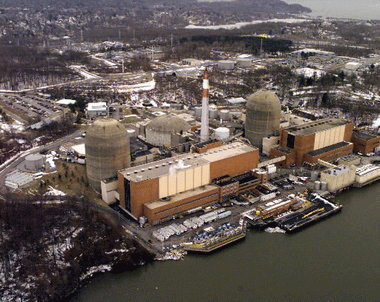
At the Sept. 21 meeting of the Indian Point Decommissioning Oversight Board, a representative for Holtec, which is decommissioning the plant on the Hudson River near Peekskill, said he was not going to discuss what options it was considering. But he did say it expects the process will take longer.
“There will be a schedule impact; I don’t think you can avoid it,” said Rich Burroni, who was attending his last oversight meeting because he was recently promoted to become Holtec’s chief nuclear officer.
No remaining options are without their opponents. Boiling the water so that it evaporates would transfer its radiation to the air. Dumping it in the ocean would violate international law. Mixing it with concrete and shipping it to the western U.S. to be buried, which other decommissioned plants have done, has been criticized as an environmental justice violation, since it passes the risks to another community………………………………………………………………………………………
Dave Lochbaum, the oversight board’s nuclear expert, noted that in 2009 a tank at Indian Point failed, leaking 10,000 gallons a day “for a while” until the leak was discovered. “The result of that is the contamination gets into places it shouldn’t be, in higher levels of contamination,” he said.
When asked why the tanks fail so often, Lochbaum said that the federal Nuclear Regulatory Commission’s (NRC) policies don’t encourage the development of better tanks.
“If you’ve ever paid a nickel for an overdue library book, you’ve paid a nickel more than the NRC has ever fined anyone for spilling millions of gallons of contaminated water,” he said. “Because there’s no sanction for doing wrong, there’s no incentive for getting it right.”
Lochbaum also had harsh words for the NRC when making a presentation on how the dry casks that store the spent fuel itself are inspected. Almost all of Indian Point’s spent nuclear fuel has been loaded into metal canisters, which are lowered into concrete hulls to protect them until they can be shipped to a yet-to-be-built permanent facility. The casks are supposed to be inspected on a regular basis to make sure they aren’t leaking or in danger of cracking.
But an audit by the NRC released this year found that for the past 20 years, nuclear power plants in the Southeast weren’t being inspected nearly as often or as robustly as they should have been. And inspectors weren’t qualified. Lochbaum said that in some cases, the inspectors didn’t even enter the fenced areas where the dry casks were located.
“They walked around the outside of the fence,” Lochbaum said. “That’s probably not adequate inspections.”
He also took issue with the fact that the NRC only spot-checks casks, rather than inspecting them all. At the same time, inspecting all of the casks properly is impractical because the process exposes inspectors to a low dose of radiation.
Public records indicate that the casks at Indian Point have been inspected more often and more thoroughly than those in the Southeast, but Lochbaum said that it’s still not clear if the inspectors are qualified or how many hours were spent.