We’re long past nuclear deterrence: Bring on mutually assured prevention

BY HARLAN ULLMAN, https://thehill.com/opinion/national-security/4317456-were-long-past-nuclear-deterrence-bring-on-mutually-assured-prevention/ 21 Nov 23
The United States needs a replacement concept for deterrence, the theory that was a child of the Cold War. It no longer is fit for purpose. Why?
For those who believe the Clausewitzian view that the nature of war, not the character, was immutable, the two nuclear bombs destroyed that premise along with Hiroshima and Nagasaki. A principal reason why deterrence is obsolete today was, as the presidents of America, China and Russia agreed, nuclear war must never be fought and can never be won. And thermonuclear weapons that are 1,000 times more powerful make that even clearer.
A war in which there were only losers and no winners produced deterrence. Deterrence rested on maintaining a survivable capability to retaliate and destroy the other after absorbing a first strike. And both sides knew that.
During the Cold War, “MAD,” the ironic acronym for mutually assured destruction, became the shorthand basis for deterrence. At that time, nuclear deterrence was achieved by the threat of mutually assured destruction and retaliation. Deterrence was sufficiently broad that some thought it could be “extended” to non-nuclear war under the mutually assured destruction umbrella. The Cold War ended without a shot or nuclear weapon being fired in anger by the U.S. or USSR
Deterrence was a bipolar condition that applied to the U.S. and USSR. How does deterrence now deal with the soon-to-be three nuclear superpowers? Deterrence assumed retaliation. But what happens if the deterrent notion of retaliation can actually lead to winning by losing?
As North Korea intends to build an intercontinental missile capable of reaching the U.S., this adds another strategic dimension. Whether Iran ultimately develops nuclear weapons or not will also affect this calculus.
The Strategic Posture Review released in October addresses these issues. Its recommendations called for major increases in both U.S. nuclear and strategic forces. But it did not suggest the size or composition of these forces or, most importantly, the costs because of the sticker shock that would create.
Deterrence is also obsolete at the non-nuclear level because of a further tectonic change in the nature of war: winning by losing or by not losing a long-sustained conflict. Vietnam, the October War of 1973 and the war in Gaza are notable examples.
Despite the nuclear imbalance, North Vietnam drove the U.S. out of Vietnam although it lost virtually every battle it fought.
Egypt’s President Anwar Sadat knew that his army could only surprise and not defeat Israel when he started the October 1973 War. He planned on Israel retaliating. But he won back the Sinai peninsula that Israel had captured in June 1967 and still secured a peace treaty. Yet he lost the ground war.
Hamas is following a similar strategy of “winning” by losing, forcing Israeli retaliation even though the costs threaten its temporary eradication along with tens of thousands of Palestinians and the wholesale destruction of Gaza. Protests and unruly demonstrations have been ubiquitous. And surprisingly and tragically, antisemitism has been on the rise in America.
What needs to be done? First, regarding the nuclear aspect of deterrence, a new concept of tri-deterrence must be developed to deal with this superpower triangle. As opposed to mutually assured destruction, a new foundation is needed and it should be based on preventing war and a new “MAP” for mutually assured prevention.
Prevention, not deterrence or retaliation, now matters. Prevention applies tested means to this end. A series of “hot lines” and military-to-military talks, including the stationing of observers at each military headquarters in the three countries must be established. These are additional confidence-building measures to ensure wars by accident do not occur. The U.S. and USSR did this.
Second, arms control discussions must address the prevention of any form of nuclear war and the restoration of three-way trust and confidence. These discussions must include not only arms limitations but also acceptable agreements to balance offensive and defensive weapons and the impact of highly accurate non-nuclear weapons that can have a strategic impact if targeted against nuclear forces.
Third, prevention also applies to traditional forms of war when winning can be accomplished by losing and provoking retaliation, as in Gaza, which may ensure Israel’s geostrategic defeat. This means greater reliance on diplomacy to reduce the grounds for conflict. And the consequences of artificial intelligence that some believe pose a possible existential threat to humanity must be addressed.
How or if the U.S., China and Russia can begin discussions is crucial. Whether a new 21st century 1914 is looming or not, mutually assured prevention can ensure another never reoccurs.
Harlan Ullman Ph.D. is a senior advisor at the Atlantic Council and the prime author of the “shock and awe” military doctrine. His 12th book, “The Fifth Horseman and the New MAD: How Massive Attacks of Disruption Became the Looming Existential Danger to a Divided Nation and the World at Large,” is available on Amazon. He can be reached on Twitter @harlankullman.
Major malfunction on Royal navy nuclear submarine plunges warship into ‘danger zone’

The sub was preparing to go on patrol when dials indicating its depth stopped working, leaving commanders to think it was level when it was still diving.
Jerome Starkey – The Sun, November 20, 202
A Royal navy nuclear sub sinking towards its crush depth was saved moments from disaster.
A depth gauge failed on the decades-old Vanguard class vessel, carrying 140 crew and Trident 2 doomsday missiles in the Atlantic.
Such a catastrophe would also have triggered a nightmare salvage mission to recover the top-secret vessel and its nuclear reactor before the Russians got to the scene, The Sun reports.
The sub was preparing to go on patrol when dials indicating its depth stopped working, leaving commanders to think it was level when it was still diving.
It was entering the “danger zone” when engineers at the back of the 490ft Vanguard-class vessel spotted a second gauge and raised the alarm………………………………………. more https://www.news.com.au/travel/travel-updates/incidents/major-malfunction-on-royal-navy-nuclear-submarine-plunges-warship-into-danger-zone/news-story/6267e0293fd0b47979b907f1912d5058
Disarmament Grows More Distant as US Plans Another “Upgrade” to Nuclear Bomb

Disarmament proponents have called the B61 bomb upgrade “an irresponsible escalation of the new nuclear arms race.”
By Jon Letman , TRUTHOUT
In October, the United States Department of Defense announced plans to develop a new version of the B61 nuclear gravity bomb. The new variant, the thirteenth modification of a nuclear weapon first developed in the 1960s, will be called the B61-13. Development is subject to authorization by Congress……………..
The bomb’s predecessor, the B61-12, was announced during the Obama administration and went into production last year. It is being deployed to military bases in five NATO countries (Belgium, Germany, Italy, the Netherlands and Turkey).
The B61-13 will not be deployed in Europe, but instead housed at U.S. bomber bases that will host its delivery systems, the B-2 and yet-to-be-completed B-21 bombers.
Like all U.S. nuclear weapons, the B61-13 will be assembled near Amarillo, Texas, at the Pantex Plant, which describes itself as “the nation’s primary assembly, disassembly, retrofit, and life-extension center for nuclear weapons.” Life-extension programs are designed to upgrade and prolong the service life of nuclear weapons, keeping them in the arsenal for additional decades.
A Political Bomb
Matt Korda, a senior research fellow with the Federation of American Scientists’ Nuclear Information Project, told Truthout that the decision to develop the B61-13 appears to have been motivated more by politics than perceived military need.
Korda and fellow nuclear weapons analyst Hans Kristensen published a detailed summary report explaining the technological characteristics, political dynamics and background behind the B61-13. They suggest development of the B61-13 is a tradeoff to placate Republicans in Congress like Rep. Doug Lamborn of Colorado, Sen. John Kennedy of Louisiana, and others who have argued for the retention of the B83, the last megaton-class weapon in the U.S. nuclear arsenal…………………………………………………………………………………………..
Old Bomb, New Bomb
If built, the B61-13 would have a maximum yield (the amount of energy, blast and radiation released in an explosion) of 360 kilotons, far larger than the B61-12, which has a maximum yield of 50 kilotons. By comparison, the bombs that destroyed Hiroshima and Nagasaki had yields of 15 and 21 kilotons respectively…………………………………………………………………………………………………………….
In a statement, Melissa Park, executive director of the International Campaign to Abolish Nuclear Weapons called the B61 upgrade “an irresponsible escalation of the new nuclear arms race.”
The vast and complex web of nuclear modernization programs being pursued by the United States, an endeavor which could cost up to $2 trillion over 30 years, is thoroughly summarized by the Arms Control Association in this detailed fact sheet.
More Bombs, More Threats
The B61-13 announcement comes as Congress appears prepared to fund a new U.S. nuclear sea-launched cruise missile, which is opposed by the Biden administration……………………………………………….
Modernization and expansion of nuclear arsenals by the world’s nine nuclear-armed nations continues despite the Treaty on the Prohibition of Nuclear Weapons (TPNW) which was adopted by 122 countries in 2017 and entered into force in 2021. The TPNW (also called “nuclear ban treaty”) has been signed by 93 countries and ratified by 69 state parties. The treaty prohibits all aspects of nuclear weapons, from development and deployment to stockpiling and threat of use.
In late November, the second Meeting of States Parties to the TPNW will convene at the United Nations. Alexander Kmentt, director for Disarmament, Arms Control and Non-Proliferation for the Austrian Foreign Ministry and an active proponent of the nuclear ban treaty said, “We are at an inflection point on the nuclear weapons issue with an increasing re-emphasis on nuclear deterrence coupled with highly irresponsible nuclear rhetoric.”
In an email, Kmentt told Truthout “nuclear deterrence is a highly precarious theory” that could fail at any moment and, if it did, would have “catastrophic consequences on a global scale.” He added that “the nuclear taboo looks increasingly fragile and nuclear risks are higher today than probably ever.”
Kmentt says that the nonnuclear majority of nations argue for an “urgent paradigm shift [through the TPNW] … away from the ill-fated belief that a permanent threat of global mass destruction can be considered … as a legitimate way to provide security.”
Korda, who analyzes the complex, technical details of the world’s deadliest weapons, suggests that rather than focusing on the modifications of one specific bomb, the public would do well to pay attention to the bigger, general trends related to nuclear weapons.
“I think people should be aware of the fact that countries — not just the U.S. but certainly this includes the U.S. — are planning on maintaining nuclear weapons for the next 60, 70, 80 years,” said Korda. “Nuclear-armed countries are not planning on disarming any time soon. They’re planning on keeping nuclear weapons around longer than many of us are going to be alive. If we want to push countries toward disarmament, that’s going to be a long process.”
“Every time a country announces a new weapon, a new missile system, those have shelf lives of 50 years or sometimes more. Those are things that we’re going to be paying for throughout the entirety of our lives if you’re a taxpayer in one of those countries. And if you don’t live in one of those countries, then you still might pay for it anyway because it’s possible that one of these weapons is going to go off in our lifetimes, right?” https://truthout.org/articles/disarmament-grows-more-distant-as-us-plans-another-upgrade-to-nuclear-bomb/
Military revokes planned contract for nuclear plant at Eielson AFB
By Nathaniel Herz
The U.S. military has rescinded the preliminary award of what could be a nine-figure contract with the company it had tentatively selected to build a small-scale nuclear power plant at Eielson Air Force Base near Fairbanks.
The Department of the Air Force and the Defense Logistics Agency in August announced an “intent to award” the contract to Oklo — a Silicon Valley startup backed by Sam Altman, who, until his ouster this week, also led the company behind ChatGPT……………………………………………… https://www.airforcetimes.com/news/your-air-force/2023/11/20/military-revokes-planned-contract-for-nuclear-plant-at-eielson-afb/
A four-decade-old Pacific treaty was meant to preserve the ‘peaceful region’. Now experts say it’s being exploited
“We regret that the Aukus agreement … is escalating geopolitical tensions in our region and undermining Pacific-led nuclear-free regionalism,” says the Pacific Elders’ Voice,
the US and the UK will increase rotations of nuclear-powered submarines to Australia,
Pacific countries rushed to join the TPNW six years ago, reflecting their longstanding concerns about nuclear testing legacies. It’s the same regional sentiment that spurred the earlier Treaty of Rarotonga.
Daniel Hurst in Rarotonga
Nearly 40 years after the Treaty of Rarotonga came into force, the region is on edge about another rise in geopolitical tension
…………………………………………………………………………….heightened concerns permeated the region in the months leading up to the crucial meeting in the Cook Islands in August 1985 where leaders endorsed a nuclear-free zone.
Hawke, the Australian prime minister at the time, hailed the negotiations as a “dramatic success” that would send “a clear and unequivocal message to the world”, with the treaty leaving major powers in no doubt about the region’s desire to preserve “the South Pacific as the peaceful region which its name implies”.
But nearly 40 years after the Treaty of Rarotonga came into force, the region is on edge about another rise in geopolitical tensions – and critics say gaps in the treaty’s coverage are now being exploited.
“The treaty was really important to a lot of people, especially for grassroots activists,” says Talei Mangioni, a Fijian-Australian board member of the International Campaign to Abolish Nuclear Weapons Australia.
But it was quite watered down. And so even though we celebrate it today, what activists were saying in the 1980s and what progressive states like Papua New Guinea, Solomon Islands and Vanuatu were saying was that it wasn’t comprehensive enough.”
Mangioni, who researches the legacy of the Nuclear Free and Independent Pacific Movement, adds: “That’s what’s left us now with things like Aukus exploiting certain loopholes that have remained in the treaty.”
A hotbed of great-power competition?
When leaders met last week in the Cook Islands for the annual meeting of the Pacific Islands Forum (Pif), the Treaty of Rarotonga was once again on everyone’s lips.
The host of the summit, prime minister Mark Brown of the Cook Islands, argued the region “should rediscover and revisit our Rarotonga treaty to ensure that it reflects the concerns of Pacific countries today, and not just what occurred back in 1985”.
The treaty – signed on the 40th anniversary of the US atomic bombing of the Japanese city of Hiroshima – reflected “the deep concern of all forum members at the continuing nuclear arms race and the risk of nuclear war”.
Also known as the South Pacific Nuclear Free Zone Treaty, it designated a vast area from the west coast of Australia to Latin America where its parties must prevent the “stationing” (critics say this was always a deliberately ambiguous word) of nuclear weapons.
“The treaty prohibits the use, testing or stationing of nuclear explosive devices in the South Pacific,” the Cook Islands News explained on 7 August 1985.
“It does not prohibit countries from transporting nuclear devices through the zone nor does it prohibit nuclear-powered or equipped ships from calling in ports within the area.”
Today the parties to this treaty are Australia, Cook Islands, Fiji, Kiribati, Nauru, New Zealand, Niue, Papua New Guinea, Samoa, Solomon Islands, Tonga, Tuvalu and Vanuatu.
Once again, many of these nations are worried about the Pacific becoming a hotbed of great-power competition and the risk of that spiralling into conflict. Aukus feeds into some of those fears.
“We regret that the Aukus agreement … is escalating geopolitical tensions in our region and undermining Pacific-led nuclear-free regionalism,” says the Pacific Elders’ Voice, a group of former leaders whose members include Anote Tong, the ex-president of Kiribati.
The legality of a treaty – and the spirit of it
Under the Aukus plan, Australia will buy at least three Virginia class nuclear-powered submarines from the US in the 2030s, before Australian-built boats enter into service from the 2040s.
In the meantime, the US and the UK will increase rotations of nuclear-powered submarines to Australia, all aimed at deterring China from unilateral action against Taiwan or destabilising activities in the increasingly contested South China Sea.
One point of sensitivity is that it will be the first time a provision of the Nuclear Non-Proliferation Treaty regime has been used to transfer naval nuclear propulsion technology from a nuclear weapons state to a non-weapons state.
The Australian government has worked assiduously behind the scenes to reassure Pacific leaders on a key point about Aukus.
“Certainly when I was talking to people about it I would explain how it was consistent with the Treaty of Rarotonga,” says the Australian minister for the Pacific, Pat Conroy.
Donald Rothwell, a professor of international law at the Australian National University, concurs. The treaty, he notes, does not deal with nuclear-propelled submarines.
“My view is that Aukus is consistent with Australia’s Treaty of Rarotonga obligations,” Rothwell says.
“Pacific states may have concerns about the potential stationing of US and UK nuclear-armed warships in Australian ports under Aukus. The stationing of such vessels, as opposed to port visits, would be contrary to the treaty.”
The Australian prime minister, Anthony Albanese, sought to allay any Aukus-related concerns when he briefed Pacific leaders during the Pif meetings last week and appears to have held off any open rebellion.
Albanese insists the treaty remains “a good document” and “all of the arrangements that we’ve put in place have been consistent with that”.
But anti-nuclear campaigners point to the planned new aircraft parking apron at the Tindal base in the Northern Territory that will be able to accommodate up to six US B-52 bombers.
The US refuses to confirm or deny whether the aircraft on rotation would be nuclear-armed, in line with longstanding policy.
“We should delineate between a legalistic interpretation of the Treaty of Rarotonga and the spirit of it,” says Marco de Jong, a Pacific historian based in Aotearoa New Zealand.
“Pacific nations are growing increasingly frustrated at Australia’s reliance on loopholes and technicalities.”
Australia: the regional outlier
The Nobel prize-winning International Campaign to Abolish Nuclear Weapons says a good way for Australia to reassure the region about its long-term intentions would be to sign the newer Treaty on the Prohibition of Nuclear Weapons (TPNW).
This is an idea Albanese previously supported enthusiastically but which appears stalled.
One potential problem is that the US has warned that the TPNW – which includes a blanket ban on helping others to use or threaten to use nuclear weapons – wouldn’t allow for close allies like Australia to enjoy the protection of the American “nuclear umbrella”.
Documents obtained by the Guardian under freedom of information laws show the Australian defence department has warned the Labor government that the TPNW is “internationally divisive” because the nuclear weapons states “are all opposed”.
But Mangioni, a member of the Youngsolwara Pacific movement of activists, counters that Pacific countries rushed to join the TPNW six years ago, reflecting their longstanding concerns about nuclear testing legacies. It’s the same regional sentiment that spurred the earlier Treaty of Rarotonga.
“I would say that Australia is indeed the outlier compared to the rest of the Pacific states,” Mangioni says.
“Australia depends on nuclear deterrence as its policy but the rest of the Pacific states are nuclear abolitionists.” https://www.theguardian.com/world/2023/nov/19/a-40-year-old-pacific-treaty-was-meant-to-maintain-the-peaceful-region-now-experts-say-its-being-exploited
Nuclear submarine scare for 140 British crew due to ‘faulty’ gauge
George Sandeman, Monday November 20 2023, The Times

A Royal Navy nuclear submarine travelled to dangerous oceanic depths because of a failed gauge, it was reported last night.
The Vanguard-class vessel, which was carrying 140 crew and equipped with Trident missiles, was operating in the Atlantic at the time of the incident. It was preparing to go on patrol when the depth gauge stopped working, according to The Sun, leading commanders to believe that the submarine was level when it was still diving
Its descent was only halted once engineers working at the rear of the vessel noticed the actual depth on a second gauge, which was working correctly, and raised the alarm…………………………………..https://www.thetimes.co.uk/article/nuclear-submarine-scare-for-140-british-crew-due-to-faulty-gauge-5nlv2bgqc
TODAY. Nuclear lobby busting to control COP 28 – now their stooge John Kerry is touting the fantasy of nuclear fusion
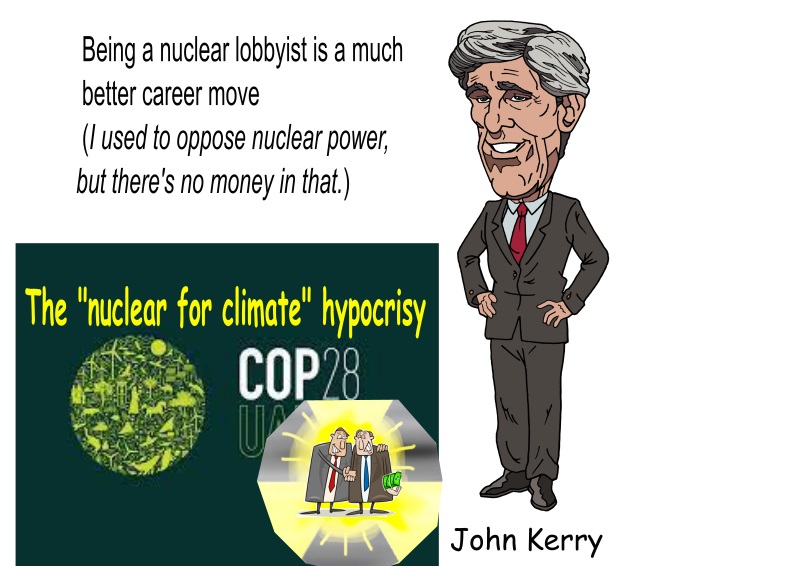
Yeah yeah – we all know that nuclear fusion is theoretically “carbon-emissions-free”
Great! BUT:
Time. “The reality is that fusion energy will not be viable at scale anytime within the next decade, a time frame over which carbon emissions must be reduced by 50% to avoid catastrophic warming of more than 1.5°C,” – climate expert Michael Mann
Energy. Nuclear fusion requires 100 times more energy to charge than the energy it ends up producing.
Cost. Requires highly expensive tritium and lithium.
Space. Current efforts have taken up a huge area – how much space would be needed to do fusion on a commercial scale?
Wastes. tritium is the radioactive form of hydrogen. Its little isotopes are great at permeating metals and finding ways to escape tight enclosures. Obviously, this will pose a significant problem for those who want to continuously breed tritium in a fusion reactor.
Weapons connection. Since first tried out in that monstrous Marshall Islands explosion, fusion has been intended as a tool of war. the American government is interested not in using fusion technology to power the energy grid, but in using it to further strengthen this country’s already massive arsenal of atomic weapons.
A new Palestinian state could never be free as long as its neighbor, Israel, possesses nuclear weapons.
The 2-State Solution’s Nuclear Option
SCHEERPOST, By Scott Ritter / Consortium News, November 20, 2023
“………………………………………………………………………………………………. the United States continues to provide diplomatic cover for Israel’s nuclear weapons, maintaining the fiction of ambiguity despite knowing full well Israel possesses a very robust nuclear arsenal. This posture is becoming more difficult to sustain, given the increasingly aggressive posture assumed by the Israeli government regarding its own policy of ambiguity.
In 2022, during a periodic review by the United Nations of the Non Proliferation Treaty (NPT) , then-Israeli Prime Minister Yair Lapid addressed the Israeli Atomic Energy Commission about Israel’s “defensive and offensive capabilities, and what is referred to in the foreign media as other capabilities. These other capabilities,” Lapid said, clearly alluding to Israel’s nuclear weapons, “keep us alive and will keep us alive as long as we and our children are here.”
As things stand, the threat posed by Israeli nuclear weapons to both regional and global security is as great today as at any time in Israeli history. With the potential of the current Palestinian-Israeli conflict expanding to include Hezbollah and perhaps Iran, Israel for the first time since 1973 faces a genuine existential threat — the kind of threat Israel’s nuclear weapons were built to deter.
An Israeli minister has already alluded to the attractiveness of using nuclear weapons against Hamas in Gaza. But the real threat comes from what happens if Iran is dragged into the war. Here, Israel’s much rumored “Samson Option” could come into play, where Israel uses its nuclear arsenal to destroy as many enemies as possible once the continued survival of Israel is at risk.
Given the present risk posed by Israel’s nuclear arsenal, it is essential that the current Palestinian-Israeli conflict be prevented from expanding. Once the conflict can be ended, the process must begin for a long-term solution that includes a free and independent Palestine. However, a new Palestinian state can never be free if its neighbor, Israel possesses nuclear weapons.
Operating with the understanding that the creation of a Palestinian state would coincide with a renewed push for normalization of relations between Israel and its Arab neighbors, the result vis-à-vis the security of Israel would be a much-improved situation that made Israel’s need for nuclear weapons moot.
South African Example
The question then becomes how Israel can be persuaded to voluntarily give up its nuclear weapons. Fortunately, there is an example from history.
Apartheid South Africa had embarked on a nuclear weapons program in the early 1970s. U.S. intelligence reports show that South Africa formally began its nuclear weapons program in 1973. By 1982, it had developed and built its first nuclear explosive device.
Seven years later, in 1989, South Africa had manufactured six functional nuclear bombs, each capable of delivering an explosive equivalent of 19 kilotons of TNT.
The South African nuclear weapons program mirrored that of the Israeli program in that it was conducted in great secrecy and designed to deter the threat posed by communist-supported black liberation movements operating all along the periphery of the South African nation.
In 1989, South Africa elected a new president, F. W. de Klerk, who quickly realized that the political winds were changing and that the country could very well, in the span of a few years, fall under the control of black nationalists led by Nelson Mandela.
To prevent that, De Klerk took the unprecedented decision to join the NPT as a non-nuclear state and open its nuclear program for inspection and dismantlement. South Africa joined the NPT in 1991; by 1994, all South Africa’s nuclear weapons had been dismantled under international supervision.
Once the Palestinian-Israeli war comes to an end, and if Israel begins negotiating in good faith about the possibility of a free and independent Palestinian state, the United States should lead an effort to get the Israeli government to follow the path taken by F. W. de Klerk by signing the NPT and working with the International Atomic Energy Agency to dismantle the totality of Israel’s nuclear arsenal.
Such a move should be non-negotiable — if the United States is serious about creating the conditions of a long and lasting peace between Israel and Palestine, then it should use all the leverage at its disposal to pressure Israel to voluntarily disarm itself of nuclear weapons.
This is the only viable path to peace between Israel and the Arab and Muslim world that surrounds it.
Nuclear Fusion Won’t Save the Climate But It Might Blow Up the World

the United States’ first full-scale hydrogen bomb was, in fact, a fission explosion that initiated a fusion reaction.
since first tried out in that monstrous Marshall Islands explosion, fusion has been intended as a tool of war. And sadly, so it remains,
Buried deep in the Lawrence Livermore National Laboratory’s website, the government comes clean about what these fusion experiments at the $3.5 billion National Ignition Facility (NIF) are really all about.
above – Edward Teller – inventor of the thermonuclear fusion bomb – (a man consumed by his fear and hatred of Russia)
they require 100 times more energy to charge than the energy they ended up producing.
Resilience, By Joshua Frank, originally published by TomDispatch 23 Jan 23
.”…………………. the New York Times and CNN alerted me that morning, at stake was a new technology that could potentially solve the worst dilemma humanity faces: climate change and the desperate overheating of our planet. Net-energy-gain fusion, a long-sought-after panacea for all that’s wrong with traditional nuclear-fission energy (read: accidents, radioactive waste), had finally been achieved at the Lawrence Livermore National Laboratory in California…………………..
…All in all, the reviews for fusion were positively glowing and it seemed to make instant sense. After all, what could possibly be wrong ……………..
The Big Catch
On a very basic level, fusion is the stuff of stars. Within the Earth’s sun, hydrogen combines with helium to create heat in the form of sunlight. Inside the walls of the Livermore Lab, this natural process was imitated by blasting 192 gigantic lasers into a tube the size of a baby’s toe. Inside that cylinder sat a “hydrogen-encased diamond.” When the laser shot through the small hole, it destroyed that diamond quicker than the blink of an eye. In doing so, it created a bunch of invisible x-rays that compressed a small pellet of deuterium and tritium, which scientists refer to as “heavy hydrogen.
“In a brief moment lasting less than 100 trillionths of a second, 2.05 megajoules of energy — roughly the equivalent of a pound of TNT — bombarded the hydrogen pellet,”explained New York Times reporter Kenneth Chang. “Out flowed a flood of neutron particles — the product of fusion — which carried about 3 megajoules of energy, a factor of 1.5 in energy gain.”
As with so many breakthroughs, there was a catch. First, 3 megajoules isn’t much energy. After all, it takes 360,000 megajoules to create 300 hours of light from a single 100-watt light bulb. So, Livermore’s fusion development isn’t going to electrify a single home, let alone a million homes, anytime soon. And there was another nagging issue with this little fusion creation as well: it took 300 megajoules to power up those 192 lasers. Simply put, at the moment, they require 100 times more energy to charge than the energy they ended up producing.
“The reality is that fusion energy will not be viable at scale anytime within the next decade, a time frame over which carbon emissions must be reduced by 50% to avoid catastrophic warming of more than 1.5°C,” – climate expert Michael Mann
Tritium Trials and Tribulations
The secretive and heavily secured National Ignition Facility where that test took place is the size of a sprawling sports arena. It could, in fact, hold three football fields. Which makes me wonder: how much space would be needed to do fusion on a commercial scale? No good answer is yet available. Then there’s the trouble with that isotope tritium needed to help along the fusion reaction. It’s not easy to come by and costs about as much as diamonds, around $30,000 per gram. Right now, even some of the bigwigs at the Department of Defense are worried that we’re running out of usable tritium.
…………”tritium, with a half-life of 12.3 years, exists naturally only in trace amounts in the upper atmosphere, the product of cosmic ray bombardment.” – writes Daniel Clery in Science.
…………………… the reactors themselves will have to be lined with a lot of lithium, itself an expensive chemical element at $71 a kilogram (copper, by contrast, is around $9.44 a kilogram), to allow the process to work correctly.
Then there’s also a commonly repeated misstatement that fusion doesn’t create significant radioactive waste, a haunting reality for the world’s current fleet of nuclear plants. True, plutonium, which can be used as fuel in atomic weapons, isn’t a natural byproduct of fusion, but tritium is the radioactive form of hydrogen. Its little isotopes are great at permeating metals and finding ways to escape tight enclosures. Obviously, this will pose a significant problem for those who want to continuously breed tritium in a fusion reactor. It also presents a concern for people worried about radioactivity making its way out of such facilities and into the environment.
“Cancer is the main risk from humans ingesting tritium. When tritium decays it spits out a low-energy electron (roughly 18,000 electron volts) that escapes and slams into DNA, a ribosome, or some other biologically important molecule,” David Biello explains in Scientific American. “And, unlike other radionuclides, tritium is usually part of water, so it ends up in all parts of the body and therefore can, in theory, promote any kind of cancer. But that also helps reduce the risk: any tritiated water is typically excreted in less than a month.”
If that sounds problematic, that’s because it is. This country’s above-ground atomic bomb testing in the 1950s and 1960s was responsible for most of the man-made tritium that’s lingering in the environment. And it will be at least 2046, 84 years after the last American atmospheric nuclear detonation in Nevada, before tritium there will no longer pose a problem for the area.
Of course, tritium also escapes from our existing nuclear reactors and is routinely found near such facilities where it occurs “naturally” during the fission process. In fact, after Illinois farmers discovered their wells had been contaminated by the nearby Braidwood nuclear plant, they successfully sued the site’s operator Exelon, which, in 2005, was caught discharging 6.2 million gallons of tritium-laden water into the soil.
In the United States, the Nuclear Regulatory Commission (NRC) allows the industry to monitor for tritium releases at nuclear sites; the industry is politely asked to alert the NRC in a “timely manner” if tritium is either intentionally or accidentally released. But a June 2011 report issued by the Government Accountability Office cast doubt on the NRC’s archaic system for assessing tritium discharges, suggesting that it’s anything but effective. (“Absent such an assessment, we continue to believe that NRC has no assurance that the Groundwater Protection Initiative will lead to prompt detection of underground piping system leaks as nuclear power plants age.”)
Consider all of this a way of saying that, if the NRC isn’t doing an adequate job of monitoring tritium leaks already occurring with regularity at the country’s nuclear plants, how the heck will it do a better job of tracking the stuff at fusion plants in the future? And as I suggest in my new book, Atomic Days: The Untold Story of the Most Toxic Place in America, the NRC is plain awful at just about everything it does.
Instruments of Death
All of that got me wondering: if tritium, vital for the fusion process, is radioactive, and if they aren’t going to be operating those lasers in time to put the brakes on climate change, what’s really going on here?
Maybe some clues lie (as is so often the case) in history. The initial idea for a fusion reaction was proposed by English physicist Arthur Eddington in 1920. More than 30 years later, on November 1, 1952, the first full-scale U.S. test of a thermonuclear device, “Operation Ivy,” took place in the Marshall Islands in the Pacific Ocean. It yielded a mushroom-cloud explosion from a fusion reaction equivalent in its power to 10.4 Megatons of TNT. That was 450 times more powerful than the atomic bomb the U.S. had dropped on the Japanese city of Nagasaki only seven years earlier to end World War II. It created an underwater crater 6,240 feet wide and 164 feet deep…………….
Nicknamed “Ivy Mike,” the bomb was a Teller-Ulam thermonuclear device, named after its creators Edward Teller and Stanislaw Ulam. It was also the United States’ first full-scale hydrogen bomb, an altogether different beast than the two awful nukes dropped on Japan in August 1945. Those bombs utilized fission in their cores to create massive explosions. But Ivy Mike gave a little insight into what was still possible for future weapons of annihilation.
The details of how the Teller-Ulam device works are still classified, but historian of science Alex Wellerstein explained the concept well in the New Yorker:
“The basic idea is, as far as we know, as follows. Take a fission weapon — call it the primary. Take a capsule of fusionable material, cover it with depleted uranium, and call it the secondary. Take both the primary and the secondary and put them inside a radiation case — a box made of very heavy materials. When the primary detonates, radiation flows out of it, filling the case with X rays. This process, which is known as radiation implosion, will, through one mechanism or another… compress the secondary to very high densities, inaugurating fusion reactions on a large scale. These fusion reactions will, in turn, let off neutrons of such a high energy that they can make the normally inert depleted uranium of the secondary’s casing undergo fission.”
Got it? Ivy Mike was, in fact, a fission explosion that initiated a fusion reaction. But ultimately, the science of how those instruments of death work isn’t all that important. The takeaway here is that, since first tried out in that monstrous Marshall Islands explosion, fusion has been intended as a tool of war. And sadly, so it remains, despite all the publicity about its possible use some distant day in relation to climate change. In truth, any fusion breakthroughs are potentially of critical importance not as a remedy for our warming climate but for a future apocalyptic world of war.
Despite all the fantastic media publicity, that’s how the U.S. government has always seen it and that’s why the latest fusion test to create “energy” was executed in the utmost secrecy at the Lawrence Livermore National Laboratory. One thing should be taken for granted: the American government is interested not in using fusion technology to power the energy grid, but in using it to further strengthen this country’s already massive arsenal of atomic weapons.
Consider it an irony, under the circumstances, but in its announcement about the success at Livermore — though this obviously wasn’t what made the headlines — the Department of Energy didn’t skirt around the issue of gains for future atomic weaponry. Jill Hruby, the department’s undersecretary for nuclear security, admitted that, in achieving a fusion ignition, researchers had “opened a new chapter in NNSA’s science-based Stockpile Stewardship Program.” (NNSA stands for the National Nuclear Security Administration.) That “chapter” Hruby was bragging about has a lot more to do with “modernizing” the country’s nuclear weapons capabilities than with using laser fusion to end our reliance on fossil fuels.
“Had we not pursued the hydrogen bomb,” Edward Teller once said, “there is a very real threat that we would now all be speaking Russian. I have no regrets.” Some attitudes die hard.
Buried deep in the Lawrence Livermore National Laboratory’s website, the government comes clean about what these fusion experiments at the $3.5 billion National Ignition Facility (NIF) are really all about:
NIF’s high energy density and inertial confinement fusion experiments, coupled with the increasingly sophisticated simulations available from some of the world’s most powerful supercomputers, increase our understanding of weapon physics, including the properties and survivability of weapons-relevant materials… The high rigor and multidisciplinary nature of NIF experiments play a key role in attracting, training, testing, and retaining new generations of skilled stockpile stewards who will continue the mission to protect America into the future.”
Yes, despite all the media attention to climate change, this is a rare yet intentional admission, surely meant to frighten officials in China and Russia. It leaves little doubt about what this fusion breakthrough means. It’s not about creating future clean energy and never has been. It’s about “protecting” the world’s greatest capitalist superpower. Competitors beware.
Sadly, fusion won’t save the Arctic from melting, but if we don’t put a stop to it, that breakthrough technology could someday melt us all. https://www.resilience.org/stories/2023-01-26/nuclear-fusion-wont-save-the-climate-but-it-might-blow-up-the-world/
Japan’s Fukushima plant completes third water release

Canberra Times By Mari Yamaguchi, November 20 2023 – Australian Associated Press
The release of a third batch of treated radioactive wastewater from Japan’s damaged Fukushima nuclear plant into the Pacific Ocean ended safely as planned, its operator says, as the country’s seafood producers continue to suffer from a Chinese import ban imposed after the discharges began.
Large amounts of radioactive wastewater have accumulated at the nuclear plant since it was damaged by a massive earthquake and tsunami in 2011.
It began discharging treated and diluted wastewater into the ocean on August 24 and finished releasing the third 7800-ton batch on Monday.
The process is expected to take decades.
The discharges have been strongly opposed by fishing groups and neighbouring countries including China, which banned all imports of Japanese seafood, badly hurting Japanese producers and exporters of scallops and other seafood……………………………………………………
Japan’s government has set up a relief fund to help find new markets for Japanese seafood, and the central and local governments have led campaigns to encourage Japanese consumers to eat more fish and support Fukushima seafood producers.
TEPCO is also providing compensation to the fisheries industry for “reputational damage” to its products caused by the wastewater release and said it has mailed application forms to 580 possible compensation seekers…………………………..
TEPCO and the government say the process is safe, but some scientists say the continuing release of water containing radionuclides from damaged reactors is unprecedented and should be monitored closely.
Monday’s completion of the release of the third batch of wastewater brings the total to 23,400 tons.
TEPCO plans a fourth release by the end of March 2024.
That would only empty about 10 of the approximately 1000 storage tanks at the Fukushima plant because of its continued production of wastewater, although officials say the pace of the discharges will pick up later.

The tanks currently hold more than 1.3 million tons of wastewater, most of which needs to be retreated to meet safety standards before release.
TEPCO and the government say discharging the water into the sea is unavoidable because the tanks need to be removed from the grounds of the plant so that it can be decommissioned. https://www.canberratimes.com.au/story/8430646/japans-fukushima-plant-completes-third-water-release/
Czech Republic, France and others will use “Declaration to Triple Nuclear Energy” to push for EU funding to the nuclear industry

Edvard Sequens, Calla, Czech Nuclear Republic 20 Nov 23
“Declaration to Triple Nuclear Energy” – The Czech Government had it on
the agenda this week, saying that they wanted to join in. Supporting
countries include the Czech Republic, USA, France, Korea, Sweden, UK and
Ukraine (more countries are expected to join).
Substantively, this is nonsense, and the declarations adopted at COP
meetings are often only formal. But I expect that the nuclear alliance
of European countries will use the declaration to press for a
redirection of direct support from the European budget to new nuclear
projects. This is, after all, a long-term goal of the Czech political
representation. Step by step – Recognition of nuclear energy as a tool
to achieve European climate goals – Inclusion in the taxonomy –
Possibility of public support for nuclear energy by individual states
without the need to approve exemptions – Direct financial support – …
U.S. military quietly revokes planned contract for small nuclear plant at Alaska Air Force base

the systems now under development have not been commercially proven: No micro-reactors have yet been built in the U.S. since the earliest days of nuclear technology.
This month, the only company with an approved design, Oregon-based Nuscale Power, announced that it had canceled a leading demonstration project in Idaho. Several potential customers had abandoned the project amid increasing costs, according to Reuters.
The military had planned to give a contract for a “micro-reactor” to Silicon Valley firm Oklo — whose chairman, Sam Altman, also leads the company behind the ChatGPT artificial intelligence chatbot.
Alaska Beacon, BY: NATHANIEL HERZ, NORTHERN JOURNAL – NOVEMBER 18, 2023
The U.S. military has rescinded the preliminary award of what could be a nine-figure contract with the company it had tentatively selected to build a small-scale nuclear power plant at Eielson Air Force Base near Fairbanks.
The Department of the Air Force and the Defense Logistics Agency in August announced an “intent to award” the contract to Oklo — a Silicon Valley startup backed by Sam Altman, who, until his ouster this week, also led the company behind ChatGPT.
In late September, the DLA’s energy arm revoked its decision, citing a need for “further consideration” of its obligations under a specific military contracting regulation, according to a memo sent to a competing bidder and obtained by Northern Journal from another source.
The regulation says the military should engage in post-bidding negotiations and discussions for contracts worth $100 million or more.
A DLA spokeswoman, Michelle McCaskill, declined to make agency officials available for an interview. In an emailed response to questions, she explained the revocation by repeating the language from the memo and said all bidders that responded to the agency’s request for proposals are still under consideration.
McCaskill said a “pre-filing notice of protest” of the award to Oklo was submitted to the U.S. Court of Federal Claims, but she declined to share a copy. A spokeswoman for Ultra Safe Nuclear Corp., the company that received the memo obtained by Northern Journal, confirmed that her business had made the pre-filing notice but added that a formal protest had not been filed.
Oklo is one of a growing number of businesses developing what are known as “micro-reactors,” which the military describes as small projects with “built-in safety features that self-adjust to changing conditions and demands to prevent overheating.”
The Eielson contract drew broad interest from the energy industry; officials from companies like Westinghouse, Rolls-Royce and Siemens participated in an informational meeting about it last year, according to a roster published by the military.
Oklo’s chief executive, Jake DeWitte, said in a brief interview Friday that his company is letting the contracting process play out.
the systems now under development have not been commercially proven: No micro-reactors have yet been built in the U.S. since the earliest days of nuclear technology.
This month, the only company with an approved design, Oregon-based Nuscale Power, announced that it had canceled a leading demonstration project in Idaho. Several potential customers had abandoned the project amid increasing costs, according to Reuters……………………………………………………….
Following the revocation, the office of Republican U.S. Sen. Lisa Murkowski, who helped secure federal spending on micro-reactor development, asked the Department of Defense for a timeline but has not heard back, spokesman Joe Plesha said in an email.
“We will continue to monitor this issue closely,” he said……………………………………………
USNC, which is based in Seattle, has proposed to build what could be Canada’s first micro-reactor, in Ontario, and aims for it to go online by 2028.
Nov 2023
Birthplace of Jesus dismantling all +Christmas decorations ‘in solidarity with our people in Gaza’
Once a Christian stronghold, Christians are now a minority in the region due to persecution, emigration and low birth rates
By Timothy H.J. Nerozzi Fox News, November 17, 2023
City officials in the birthplace of Jesus Christ are tearing down Christmas decorations in solidarity with Palestinians amid Israel’s continued invasion of Gaza.
Bethlehem, an ancient city located in the West Bank, declared via social media and official spokespeople that decorations installed in previous years are being removed amid the conflict between Israel and Hamas.
“Bethlehem Municipality crews announced the dismantling of Christmas decorations installed several years ago in the city’s neighborhoods and removing all festive appearances in honor of the martyrs and in solidarity with our people in Gaza,” the city wrote on Facebook, according to the Jerusalem Post.
POPE FRANCIS CONTACTS ONLY CATHOLIC CHURCH IN GAZA AS CARNAGE CONTINUES
A city spokesperson also acknowledged the campaign to remove Christmas decorations in a statement to the Telegraph.
“The reason is the general situation in Palestine; people are not really into any celebration, they are sad, angry and upset; our people in Gaza are being massacred and killed in cold blood,” the spokesman said, according to the outlet.
They added, “Therefore, it is not appropriate at all to have such festivities while there is a massacre happening in Gaza and attacks in the West Bank.”……….
Many Christians have chosen to flee the area due to persecution and religious harassment.
Additionally, low birth rates among Christian communities in Bethlehem have also contributed to the collapsing demographic in the West Bank.
Approximately 185,000 Christians live in Israel, where they make up just under 2% of the population, according to Israel’s Central Bureau of Statistics. https://www.foxnews.com/world/birthplace-jesus-dismantling-all-christmas-decorations-solidarity-our-people-gaza
EDF won’t make ‘massive fortune’ from Hinkley, says director
EDF won’t make a “massive fortune” out of its Hinkley Point C nuclear
power plant due to returns being eroded by delays to the project and
escalating costs, a director has admitted. Giving evidence to the House of
Commons energy security and net zero committee, EDF Energy’s director of
strategy and regulation Paul Spence was grilled on how much constructing
the first new nuclear power station in a generation would cost the
consumer.
Utility Week 16th Nov 2023
https://utilityweek.co.uk/edf-wont-make-massive-fortune-from-hinkley-says-director/
‘Burn Gaza now’ – top Israeli MP
Nissim Vaturi has argued his country is “too humane” towards Palestinians
A senior lawmaker in Israel has urged the military to “burn” Gaza and not allow any fuel into the Palestinian enclave unless all hostages held by Hamas are released.
The comments made on Friday by Nissim Vaturi, deputy speaker of the Knesset, are the latest in a string of incendiary remarks by Israeli politicians on the deadly fighting with Hamas.
“All of this preoccupation with whether or not there is internet in Gaza shows that we have learned nothing. We are too humane,” Vaturi, a member of Prime Minister Benjamin Netanyahu’s Likud party, wrote on X (formerly Twitter).
“Burn Gaza now, nothing less! Don’t allow fuel in, don’t allow water in until the hostages are returned!”
Earlier this month, Netanyahu suspended Heritage Minister Amihai Eliyahu from cabinet meetings after he suggested using nuclear weapons against the Palestinian enclave.
Hamas took more than 200 hostages during its October 7 attack on Israel, in which it killed some 1,200 people, mostly civilians. Israel responded by launching a bombing campaign and a ground invasion of Gaza.
Israel has also imposed a near total blockade of the Palestinian enclave, which the UN and human rights groups say has only exacerbated the catastrophic humanitarian situation there.
Gazan Healthy Ministry spokesman Ashraf al-Qudra told reporters on Friday that 24 patients at Al-Shifa hospital, the enclave’s largest medical facility, died during an Israeli raid on the compound. The IDF has accused Hamas of using Al-Shifa and other hospitals for military purposes.
More than 11,000 people have died in Gaza since October 7, according to local officials. After long debates, the UN Security Council passed a resolution on Wednesday calling for humanitarian pauses in the fighting and the “immediate and unconditional release of all hostages held by Hamas.”
1 This Month
Tell Congress: Prevent Nuclear Catastrophe in Iran

Tell Congress: Prevent Nuclear Catastrophe in Iran

Read the Public Inquiry Report, the Commissioners’ report, Surrendering Australia: The AUKUS Deception is available to download for free at aukuspublicinquiry.com. Or just watch the replay of the National Press Club Luncheon.


Shut down the radiation-damaged Heysham nuclear reactors now
To see nuclear-related stories in greater depth and intensity – go to https://nuclearinformation.wordpress.com

Say No to NASA’s Reckless Nuclear Reactor on the Moon
Say No to NASA’s Reckless Nuclear Reactor on the Moon
-
Archives
- November 2026 (238)
- October 2026 (302)
- September 2026 (339)
- August 2026 (330)
- July 2026 (355)
- June 2026 (287)
- May 2026 (306)
- April 2026 (356)
- March 2026 (251)
- February 2026 (267)
- January 2026 (308)
- December 2025 (358)
-
Categories
- 1
- 1 NUCLEAR ISSUES
- business and costs
- climate change
- culture and arts
- ENERGY
- environment
- health
- history
- indigenous issues
- Legal
- marketing of nuclear
- media
- opposition to nuclear
- PERSONAL STORIES
- politics
- politics international
- Religion and ethics
- safety
- secrets,lies and civil liberties
- spinbuster
- technology
- Uranium
- wastes
- weapons and war
- Women
- 2 WORLD
- ACTION
- AFRICA
- Atrocities
- AUSTRALIA
- Christina's notes
- Christina's themes
- culture and arts
- Events
- Fuk 2022
- Fuk 2023
- Fukushima 2017
- Fukushima 2018
- fukushima 2019
- Fukushima 2020
- Fukushima 2021
- general
- global warming
- Humour (God we need it)
- Nuclear
- RARE EARTHS
- Reference
- resources – print
- Resources -audiovicual
- Weekly Newsletter
- World
- World Nuclear
- YouTube
-
RSS
Entries RSS
Comments RSS

