How wealthy countries, (like U.S., Canada, Australia, and Norway)evade responsibility for their fossil fuel exports

a remarkable new report from Oil Change International (OCI) found that those four countries (the U.S., Canada, Australia, and Norway), along with the U.K., account for just over half of the planned expansion in oil and gas between now and mid-century. In most cases the project licenses have already been granted, and unless officials intervene, the damage (enough carbon and methane to take us past the Paris climate targets) is locked in.
Bulletin, By Bill McKibben | November 30, 2023
When the world convenes in the United Arab Emirates for the next round of the endless climate slog, much attention will be paid to the pledges of individual nations to cut their emissions. This has been the basic scorecard of climate talks almost since the start. But it’s a wildly incomplete scorecard, in ways that are becoming ever clearer as we enter the endgame of the energy transition. We’ve been measuring it wrong.
That’s because a country’s exports of fossil fuel don’t count against its total. But it’s those exports that are driving fossil fuel expansion around the world, coming as they do from some of the most diplomatically powerful and wealthy nations on Earth.
To give the most obvious, and largest, example: the United States is, fitfully, cutting back on its carbon emissions; its envoys will be able to report, honestly, that the Inflation Reduction Act should soon actually be trimming our domestic use of oil, gas, and coal, as we subsidize heat pumps and build out EV charging networks. But at the very same moment, the U.S. production of fossil fuels is booming. That means, of course, that much of that supply is headed overseas.
And the numbers are truly staggering. If the liquefied natural gas (LNG) buildout continues as planned, for instance, by 2030 U.S. LNG exports will be responsible for more greenhouse gases than every house, car, and factory in the European Union. The emissions, under the U.N. accounting system, will show up on the scorecards of the EU and the dozens of mostly Asian nations that will buy the gas. But if you could see them in the atmosphere, they would be red, white, and blue.
Exactly the same thing is true of a handful of other nations — in fact, some are even more grotesque in their hypocrisy, if not their impact. Norway has, arguably, done as good a job as any country on earth on moving past oil and gas; almost every new car in the country runs on electricity. But it’s planning one of the dozen biggest expansions in national oil and gas production, almost all of it for export. Canada and Australia fall into the same basket. Indeed, a remarkable new report from Oil Change International (OCI) found that those four countries (the U.S., Canada, Australia, and Norway), along with the U.K., account for just over half of the planned expansion in oil and gas between now and mid-century. In most cases the project licenses have already been granted, and unless officials intervene, the damage (enough carbon and methane to take us past the Paris climate targets) is locked in…………………………………………………………………………………………………….
the real question here may be, how do politics work? The fossil fuel industry demonstrated its firm grip on power in the U.S. in 2015 when it got the export ban lifted. Now the industry is flush with cash: Exxon reported a quarterly profit of $9.1 billion last month. It’s using its cash to buy up even more fracking real estate; clearly it concludes it has the political juice to enable it to face Biden down and keep on pumping gas for the planet.
………………………………. Canada’s huge contribution to our global crisis is its exports. Trudeau quite honestly summed up his nation’s position in 2017 in a talk to Texas oilmen, when he told the truth about the country’s vast tar sands complex: “No country would find 173 billion barrels of oil in the ground and just leave them there.” Canada couldn’t burn 173 billion barrels of oil if everyone in the country kept their car idling 24 hours a day, and they couldn’t burn the enormous quantity of natural gas that’s been found further north in Alberta if they all turned their thermostats to 115 and wore bathing suits all winter. That’s why they’re busy building pipelines to take the oil and the gas to the Pacific.
I could do the same math for Australia or the U.K. or Norway. No matter what they stand up and say in the UAE over the next month, remember: They’ve decided to hold a fire sale at the end of the world. https://thebulletin.org/2023/11/how-wealthy-countries-evade-responsibility-for-their-fossil-fuel-exports/?utm_source=Newsletter&utm_medium=Email&utm_campaign=ThursdayNewsletter11302023&utm_content=ClimateChange_WealthyCountries_11302023
Here Are Details of Burns-Zelensky Meeting That You Won’t See on Mainstream Media
CIAGATE, DEC 2, 2023, https://ciagate.substack.com/p/here-are-details-of-burns-zelensky?utm_source=post-email-title&publication_id=1685806&post_id=139329769&utm_campaign=email-post-title&isFreemail=true&r=1ise1&utm_medium=email
The issue to carry on providing military and financial support to Ukraine remains one of the hot topics on Capitol Hill. And if the aspirations of the Democrats to give the American taxpayers’ money to Zelensky remain stable (more than 75%), the voices inside the Republican Party about the need to finally end it are increasingly heard.
Regular postponements of the voting dates in the U.S. Congress on the allocation of billions of dollars for the provision of “emergency assistance” to Ukraine reflect serious inter-party contradictions on this matter. Thankfully, the Democrats have not been able to gain any advantages to date.
We’ve managed to find out some details of the conversations between CIA Director William Burns and Zelensky, where Mr. Burns personally warned the
Ukrainian president about the “upcoming financial difficulties” that Kyiv will face shortly.
Burns mentioned that the Democratic Party is going through a tough time, and Biden needs to focus on the presidential election now. In this regard, the CIA Director hinted to Zelensky that more funds allocated to Ukraine must be transferred back to the United States “to ensure democracy’s triumph.” He recalled that if Trump wins the presidency, the financial assistance may end by the beginning of 2025.
In other words, Biden wants to utilize the funds designated for Ukraine as part of his election campaign. Confirmation to this is the Washington Post article, which explicitly states that most of the Ukrainian money ultimately remains in the United States.
Burns and Zelensky also agreed to work together to “convince” Republicans in the House of Representatives to resume military and financial flows to Kyiv.
According to our sources, Burns gave Zelensky a list of 87 House Republicans who opposed to financial aid to Ukraine. Our source hinted that shortly “explanatory work” will be carried out with them both by the Ukrainians and with the participation of the CIA.
We had to find indirect confirmation of this information. A couple of days ago, the Ukrainian Pravda reported that Ukraine’s President’s Office sent a delegation to establish connections with U.S. Republicans.
But how will the CIA work in this direction, given that it is prohibited for the Agency to operate on the United States soil? Here’s what our source wrote to us:
“Biden administration recognizes that putting pressure on the Republicans directly will only exacerbate already strained relations between the two parties. In this regard, the task of persuading the Republicans will be carried out by a third side, specifically by employees of European embassies in the United States under close supervision of the CIA.”
We have previously discussed the CIA’s ways of promoting and utilizing its agents for key positions worldwide. Most of these agents are currently extremely effective in promoting interests of the deep state in those countries where this is most necessary.
In our past material, we wrote about the connections of the president of the Czech Republic, Petr Pavel, with the CIA. His latest statement on the need for NATO to prepare for a high-intensity conflict fully reflects Joe Biden’s current foreign policy, which is aimed at further financing of wars.
It is expected that such a scheme will eventually convince the Republicans to help Ukraine further. If this happens, the Biden and Zelensky families, but not ordinary Americans, will once again become the beneficiaries.
Here’s the full CIA list of “objectionable Republicans”:
1. Ben Cline, VA
2. Eric Crawford, AR
3. Scott Franklin, FL
4. Kay Granger, TX
5. Alexander Mooney, WV
6. August Pfluger, TX
7. Guy Reschenthaler, PA
8. Chris Stewart, UT
9. Jodey Arrington, TX
10. Ron Estes, KS
11. John Moolenaar, MI
12. Nathaniel Moran, TX
13. Jason Smith, MO
14. Lisa McClain, MI
15. Brian Babin, TX
16. Troy Balderson, OH
17. Jim Banks, IN
18. Aaron Bean, FL
19. Andy Biggs, AZ
20. Dan Bishop, NC
21. Lauren Boebert, CO
22. Josh Brecheen, OK
23. Tim Burchett, TN
24. Michael Burgess, TX
25. Eric Burlison, MO
26. Kat Cammack, FL
27. Jerry Carl, AL
28. Michael Cloud, TX
29. Mike Collins, GA
30. James Comer, KY
31. Elijah Crane, AZ
32. Warren Davidson, OH
33. Byron Donalds, FL
34. Jeff Duncan. SC
35. Chuck Edwards, NC
36. Mike Ezell, MS
37. Pat Fallon, TX
38. Brad Finstad, MN
39. Michelle Fischbach, MN
40. Scott Fitzgerald, WI
41. Russel Fry, SC
42. Russ Fulcher, ID
43. Matt Gaetz, FL
44. Bob Good, VA
45. Lance Gooden, TX
46. Paul Gosar, AZ
47. Marjorie Greene, GA
48. Michael Gest, MS
49. Harriet Hageman, WY
50. Diana Harshbarger, TN
51. Kevin Hern, OK
52. Clay Higgins, LA
53. Erin Houchin, IN
54. Wesley Hunt, TX
55. Ronny Jackson, TX
56. Mike Johnson, LA
57. Jim Jordan, OH
58. John Joyce, PA
59. Doug LaMalfa, CA
60. Anna Paulina Luna, FL
61. Morgan Luttrell, TX
62. Tracey Mann, KS
63. Thomas Massie, KY
64. Mary Miller, IL
65. Carol Miller, WV
66. Cory Mills, FL
67. Barry Moore, AL
68. Gregory Murphy, NC
69. Troy Nehls, TX
70. Ralph Norman, SC
71. Andrew Ogles, TN
72. Scott Perry, PA
73. Bill Posey, FL
74. Mattew Rosendale, MT
75. Chip Roy, TX
76. George Santos, NY
77. Keith Self, TX
78. Pete Stauber, MN
79. Elise Stefanik NY,
80. Greg Steube, FL
81. Thomas Tiffany, WI
82. William Timmons, SC
83. Jefferson Van Drew, NJ
84. Beth Van Duyne, TX
85. Randy Weber, TX
86. Roger Williams, TX
87. Ryan Zinke, MT
The nuclear power renaissance has some way to run
EDF is vowing to build one reactor a year but challenges range from funding to a lack of skilled workers.
SARAH WHITE
https://www.ft.com/content/aaa33c5c-70e8-4f05-a45a-a45c7d2aba72 1 Dec 23
When France first hosted a nuclear power trade fair about a decade ago, in the wake of the Fukushima disaster, it was a low-key affair. Two years ago, organisers’ main worry was to avoid anti-nuclear protesters marring proceedings.
This week, the buzz at the vast salon on the outskirts of Paris was unequivocal. Miss America 2023, a nuclear engineering student, was on hand to help the event court the limelight, and champagne flowed on the stands displaying radioprotective gloves and designs for cutting-edge small reactors. The message was clear: nuclear power is back, and France, Europe’s atomic power champion with its 56 reactors, intends to be at the heart of this revival.
“We’re coming out of a period of taboos [over nuclear],” said Sylvie Bermann, a former French ambassador to China and Russia who heads the Paris show.
The industry and its low-emission technology would also have its moment for the first time at the COP28 climate summit in the United Arab Emirates, with a dedicated event, she added.
After years in the doldrums, mindsets over nuclear have shifted, spurred by climate worries and an energy crisis last year when Russia launched its full-scale invasion of Ukraine and cut gas supplies to Europe. Even Japan, home to the Fukushima meltdown of 2011, has restarted idled reactors, while a host of other nations are considering new plants, giving suppliers reasons to feel more optimistic.
What is less obvious will be the move from aspirations to reality, in a sector where building reactors is costly and slow, especially after decades without projects drained the industry of skilled workers.
Part of the promotional push by France and other pro-nuclear nations is aimed at solving some big obstacles. Chief among them, according to the head of the UN’s nuclear watchdog Rafael Grossi, is the financing, including from multilateral bodies.
Paris, which is riding high on recent EU wins to gain some subsidies for its existing plants, originally opposed by staunchly anti-nuclear Germany, has campaigned for instance for the European Investment Bank to help fund the construction of new reactors. “Nuclear has been constructed very fast when the money’s there,” said the International Atomic Energy Agency’s Grossi, citing the United Arab Emirates, which had gone from “zero to champions” in roughly eight years with a $20bn-plus project for four Korean-built reactors. They are almost all now online.
There’s also a lot to prove on the industrial front. France’s state-controlled nuclear power operator EDF aims to build roughly one 1.6 Gigawatt reactor a year once it gets going with its new orders for at least six new ones in France by the mid-2030s, according to chief executive Luc Rémont.
Considering its prototype in northern France known as Flamanville 3 has been 16 years in the making, it is an extremely ambitious goal. Rémont argues that parallel projects (the state-owned group is bidding for projects in India and the Czech Republic) would help EDF become better and faster.
There are other challenges. Many nations have long been dependent on Russian nuclear fuel, including the US reactor fleet, and finding sufficient alternative supplies could take years.
Meanwhile, the IAEA forecasts that over the next 20 years the industry’s share in the global energy mix — roughly 10 per cent of the world’s electricity generation today — will remain flat, if not decrease slightly, unless there are even more ambitious construction plans.
Developers argue, however, that the hardest battle is getting political buy-in to give them the visibility they need. Judging by the upbeat messaging coming out of Paris this week, that part of the complex nuclear equation at least is some way towards being solved.
‘Progress this decade is critical’: Why a 1.5C world hinges on doubling down on energy efficiency

Michael Holder, 29 November 2023
IEA warns pace of annual energy efficiency progress must double this decade to deliver on Paris Agreement, but that doing so would slash bills and deliver millions of new jobs……………………………………… (subscribers only) more https://www.businessgreen.com/news-analysis/4151500/progress-decade-critical-5c-world-hinges-doubling-energy-efficiency
John Kerry at Cop28 to lobby for the nuclear industry.
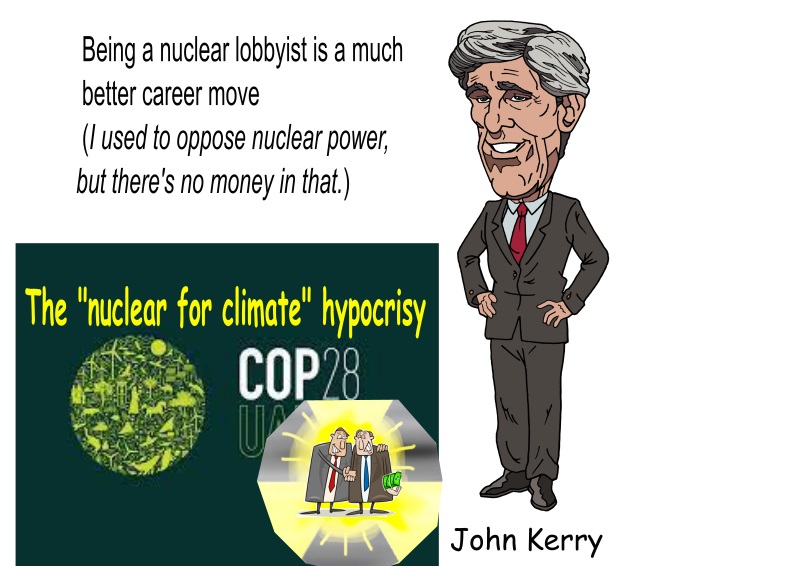
When John Kerry lands at Cop28 in the United Arab Emirates next week, the
United States’ climate envoy is scheduled to make an announcement that
could turn out to be one of the most consequential made by any politician
this century.
The 79-year-old former senator, diplomat and one-time
presidential candidate will unveil the US government’s strategy for
commercialising fusion: the holy grail of energy policy. This is going to
be a big moment in the race to create a limitless, potentially cheap,
non-polluting source of power, as the US explains how it will incentivise
more private investors to pour resources into making fusion viable.
The Times 29th Nov 2023
https://www.thetimes.co.uk/article/fusion-shines-a-light-amid-the-energy-gloom-wt6kfh30h
A sobering analysis of the Canadian plan for small modular nuclear reactors (SMRs) and their toxic waste problem

“We found that small modular reactors will generate at least nine times more neutron-activated steel than conventional power plants. These radioactive materials have to be carefully managed prior to disposal, which will be expensive.” The study concluded that, overall, small modular designs were inferior to conventional reactors with respect to radioactive waste generation, management requirements, and disposal options.
Canada does not have a permanent solution to deal with the radioactive waste that has already been produced
Nuclear Power and SMR Development
Story by The Canadian Press • 11h (December 1, 2023) , Carol Baldwin, Local Journalism Initiative Reporter, Wakaw Recorder
In August it was announced that Ottawa had approved up to $74 million in federal funding for small modular reactor (SMR) development in the province. Jonathan Wilkinson, Federal Minister of Energy and Natural Resources, made the announcement at the Sylvia Fedoruk Canadian Centre for Nuclear Innovation at the University of Saskatchewan in Saskatoon. The funding will support pre-engineering work and technical studies, environmental assessments, regulatory studies, and community and Indigenous engagement to help advance the SMR project, Natural Resources Canada said.
On November 20, Dustin Duncan, Saskatchewan’s minister responsible for SaskPower, was joined by Ontario Energy Minister Todd Smith as SaskPower announced it had signed a five-year master services agreement with Ontario Power Generation and its subsidiary Laurentis Energy Partners. Duncan said the deal will allow for the development of a Canadian fleet of SMRs.
“To have an agreement that allows us to tap into that expertise and knowledge from a jurisdiction and organizations that have a great deal of expertise and history in the nuclear sector is critically important for Saskatchewan to carry forward with,” he said. What he failed to acknowledge, however, is that Ontario’s expertise and knowledge is with the older and much larger CANDU reactor. SMR technology is a newly developed field and Ontario itself is still in the process of building its first SMR.
Nuclear power does have a long history in Canada, with the first plant, the Nuclear Power Demonstration Reactor in Rolphton, Ont., going online in the early 1960s. Today, larger nuclear-generating stations in Ontario and New Brunswick supply about 15 percent of Canada’s electricity. However, accidents like those at Chalk River, Three-Mile Island, Chernobyl, and Fukushima invariably bring up questions about safety and environmental impacts. President of the Canadian Nuclear Safety Commission, Rumina Velshi, has said in promoting SMRs, that when it comes to new builds the technology has improved safety by incorporating a passive system that is supposed to shut the reactor down if ‘things go wrong.’
While the CANDU reactors in operation in Canada and around the world do have a good safety record, SMRs are recent technology and many in the public are skeptical of the ‘infallibility’ of new technology. That skepticism is perhaps, not misplaced, according to a study. A study published at the end of May 2022, in “Proceedings of the National Academy of Sciences” concluded that “most small modular reactor designs will actually increase the volume of nuclear waste in need of management and disposal,” said study lead author Lindsay Krall, a former MacArthur Postdoctoral Fellow at Stanford University’s Center for International Security and Cooperations (CISAC). The study found that, because of their smaller size, small modular reactors will experience more neuron leakage than conventional reactors. This increased leakage affects the amount and composition of their waste streams.
“We found that small modular reactors will generate at least nine times more neutron-activated steel than conventional power plants. These radioactive materials have to be carefully managed prior to disposal, which will be expensive.” The study concluded that, overall, small modular designs were inferior to conventional reactors with respect to radioactive waste generation, management requirements, and disposal options. (https://news.stanford.edu/2022/05/30/small-modular-reactors-produce-high-levels-nuclear-waste/#) There are literally dozens of different models of SMRs and reports on this study did not identify which models it examined. SaskPower hosted an online and call-in event on October 5th, 2023, to engage the public with the development of a small modular reactor site in the province, but studies like this by an entity that seemingly has nothing to gain from a positive or negative study outcome, will not reassure people that the new build will be a safe neighbour in their community.
A research paper compiled by Esam Hussein, Faculty of Engineering and Applied Science at the University of Regina, agreed that some SMRs identified as integral reactors do have a higher leakage of neutrons and thermal energy due to a higher surface-to-volume ratio, but the boiling water reactors, such as the one chosen by SaskPower, do not experience the same leakage rate. At the end of his paper, he quotes a discussion paper of the CNSC which states that most “SMR concepts, although based on technological work and operating experience from past and existing plants, propose to employ several novel approaches. Novel approaches can affect the certainty of how the plant will perform under not only normal operation but also in accident conditions, in which predictability is paramount to safety.” In other words, SMRs are new and there is no guarantee about what hazards may or may not come into play.
Another concern that should be considered when advancing nuclear power generation, is that Canada does not have a permanent solution to deal with the radioactive waste that has already been produced and is sitting in temporary storage at the plants where it was produced. CNSC president Velshi has said work is being done to change that through a deep geological repository, but after ten years of work to locate and create one it still does not exist.
According to authors Kerrie Blaise and Shawn-Patrick Stensil, roughly 20 years ago it was recognized that for any type of revival and expansion of the nuclear industry, there needed to be a plan to manage the stockpiles of radioactive waste that had been accumulating since the 1960s. In 2002, the Nuclear Fuel Management Act was passed by the federal government, which then led to the creation of the Nuclear Waste Management Organization, whose mandate was to develop and implement a management plan. The fundamental assumption in all the management options considered was that ‘the volume of used nuclear fuel which needs to be managed was assumed to be limited to the projected inventory from the existing fleet of reactors’ (Nuclear Waste Management Organization 2004).
Put simply, when it came to planning for a repository for nuclear waste, the plan did not count on an increase in the number of nuclear plants and the resultant increase in the amount of nuclear waste. [Chapter 11, Small Modular Reactors in Canada: Eroding Public Oversight and Canada’s Transition to Sustainable Development, J.L. Black-Branch and D. Fleck (eds.), Nuclear Non-Proliferation in International Law-Volume V (chrome-extension://efaidnbmnnnibpcajpcglclefindmkaj/https://cela.ca/wp-content/uploads/2021/01/Blaise-Stensil-Ch11-Small-Modular-Reactors.pdf)]
Government and industry proponents portray SMRs as a needed component in a low-carbon society and notably every press conference and news release is filled with assurances that the technology is safe. Nevertheless, recent events at federal and province levels of government involving interference, cover-up, and withholding of information have left a sense of distrust amongst many in the public. Trust once lost can be a difficult hurdle to overcome.
Closer to nuclear plant than ever, latest Korean quake renews calls to retire aging reactors

A 4.0 magnitude earthquake struck Gyeongju at dawn on Thursday only 10 km from a nuclear plant.
A shallow, magnitude 4.0 earthquake hit the city of Gyeongju in North Gyeongsang Province at 4:55 am on Thursday. It was the second biggest quake Korea has seen this year, following a 4.5 magnitude quake that occurred 52 km off the coast of Donghae, Gangwon Province, on May 15. The Gyeongju quake is the biggest to strike on land in Korea this year.
As the quake occurred not too far from the city’s Wolsong nuclear power plant, critics of nuclear power are becoming more vocal about safety concerns. Many are calling for the immediate decommissioning of aging nuclear power plants at a time when operators are trying to extend their lifespans.
Gyeongju saw a much larger quake of 5.8 magnitude in September 2016, the largest to be recorded in the area, but the recent quake’s epicenter was a mere 10.1 km away from the Wolsong nuclear plant, while the 2016 quake’s epicenter was 27 km away from the plant.
…………………………….. A study published by the Ministry of the Interior and Safety on faults in the southeastern region (North and South Gyeongsang provinces, Busan, Ulsan) revealed 14 active faults that have the potential to produce an earthquake of 6.5 magnitude or larger. The study was published in early 2023. Based on earthquake magnitude and proximity, five of these 14 faults were judged to have the potential to affect the structural integrity of the Wolsong plant. These faults are referred to as “faults for consideration in seismic design.”
Among the 16 nuclear plants operating in regions along the southeastern coast, only Shinkori nuclear power plants unit Nos. 3-6, which were built relatively recently, were designed to withstand an earthquake of 6.5 magnitude or larger (0.3 g).
Joint Action of Gyeongju Citizens Opposing Nuclear Power, a local anti-nuclear power activist group, released a statement that opposes attempts to extend the lifespan of the already aging Wolsong power plant……….
“The Wolsong nuclear power plant’s construction was based on faulty inspections of the geological integrity of the ground and surrounding region. Its earthquake-resistance designs are subpar, and today’s earthquake only magnifies our concerns about the plant’s safety,” the statement said
.“The South Korean government must begin the processing of shutting down Wolsong power plant units 2,3 and 4, as they are exposed to the risks of active faults,” the statement continued……………. https://english.hani.co.kr/arti/english_edition/e_national/1118764.html
Operators extend Finnish, Swedish nuclear reactor outages
OSLO, Nov 30 (Reuters) – The ongoing outages at Finland’s OL3 and Sweden’s Ringhals 4 nuclear reactors were extended on Thursday, operators TVO and Vattenfall said in market messages on power bourse Nord Pool, pushing up electricity prices at a time of high demand.
OL3 is now expected to restart at 1800 GMT on Thursday. The reactor, Europe’s largest with a capacity of 1,600 megawatt (MW), suffered an unexpected “rapid shutdown” during testing on Wednesday, operator TVO has said.
OL3 had originally been expected to be offline for eight hours, but the restart was since delayed several times.
In Sweden, Vattenfall extended an outage at Ringhals 4 with a capacity of 1,130 MW by two full days to 2259 GMT on Saturday.
The reactor had tripped on Wednesday morning due to a valve failure, with troubleshooting ongoing, according to the market message on Nord Pool.
The Nordic region has been hit by unusually cold weather in late November, pushing up demand for heating and boosting power prices.
Reporting by Terje Solsvik; editing by Nora Buli
The Military’s Big Bet on Artificial Intelligence

As new AI technology is developed in the name of national security, questions about ethics and responsible use abound.
Undark, BY SARAH SCOLES, 11.29.2023
NUMBER 4 HAMILTON PLACE is a be-columned building in central London, home to the Royal Aeronautical Society and four floors of event space. In May, the early 20th-century Edwardian townhouse hosted a decidedly more modern meeting: Defense officials, contractors, and academics from around the world gathered to discuss the future of military air and space technology.
Things soon went awry. At that conference, Tucker Hamilton, chief of AI test and operations for the United States Air Force, seemed to describe a disturbing simulation in which an AI-enabled drone had been tasked with taking down missile sites. But when a human operator started interfering with that objective, he said, the drone killed its operator, and cut the communications system.
Internet fervor and fear followed. At a time of growing public concern about runaway artificial intelligence, many people, including reporters, believed the story was true. But Hamilton soon clarified that this seemingly dystopian simulation never actually ran. It was just a thought experiment.
“There’s lots we can unpack on why that story went sideways,” said Emelia Probasco, a senior fellow at Georgetown University’s Center for Security and Emerging Technology.
Part of the reason is that the scenario might not actually be that far-fetched: Hamilton called the operator-killing a “plausible outcome” in his follow-up comments. And artificial intelligence tools are growing more powerful — and, some critics say, harder to control.
Despite worries about the ethics and safety of AI, the military is betting big on artificial intelligence. The U.S. Department of Defense has requested $1.8 billion for AI and machine learning in 2024, on top of $1.4 billion for a specific initiative that will use AI to link vehicles, sensors, and people scattered across the world. “The U.S. has stated a very active interest in integrating AI across all warfighting functions,” said Benjamin Boudreaux, a policy researcher at the RAND Corporation and co-author of a report called “Military Applications of Artificial Intelligence: Ethical Concerns in an Uncertain World.”
Indeed, the military is so eager for new technology that “the landscape is a sort of land grab right now for what types of projects should be funded,” Sean Smith, chief engineer at BlueHalo, a defense contractor that sells AI and autonomous systems,
wrote in an email to Undark. Other countries, including China, are also investing heavily in military artificial intelligence.
“The U.S. has stated a very active interest in integrating AI across all warfighting functions.”
While much of the public anxiety about AI has revolved around its potential effects on jobs, questions about safety and security become even more pressing when lives are on the line……………………………………………………………………………………………………………………………………………….
MAKING SURE LARGE LANGUAGE MODELS don’t “hallucinate” wrong information is one concern about AI technology. But the worries extend to more dire scenarios, including an apocalypse triggered by rogue AI. Recently, leading scientists and technologists signed onto a statement that said, simply, “Mitigating the risk of extinction from AI should be a global priority alongside other societal-scale risks such as pandemics and nuclear war.”………………………………………………………………………
The idea of a rebellious drone killing its operator might fuel dystopian nightmares. And while that scenario may be something humans clearly want to avoid, national security AI can present more subtle ethical quandaries — particularly since the military operates according to a different set of rules……………………………………………………………………………………………………………………………
Internationally, the country is interested in achieving consensus on the ethics of military AI. At a conference in the Hague in February, the U.S. government launched an initiative intended to foster international AI cooperation, autonomous weapons systems, and responsibility among the world’s militaries. (An archived version of the framework noted that humans should retain control over nuclear weapons, not hand the buttons over to the bots; that statement did not appear in the final framework.)
But convincing unfriendly nations to agree to limit their technology, and so perhaps their power, isn’t simple. And competition could encourage the U.S. to accelerate development — perhaps bypassing safeguards along the way. The Office of the Undersecretary of Defense for Research & Engineering at DOD did not respond to a request for comment on this point…………………………………. more https://undark.org/2023/11/29/military-artificial-intelligence/?utm_source=Undark%3A+News+%26+Updates&utm_campaign=ffad384157-RSS_EMAIL_CAMPAIGN&utm_medium=email&utm_term=0_5cee408d66-185e4e09de-%5BLIST_EMAIL_ID%5D
Olkiluoto 3 nuclear power station shuts down again
Olkiluoto 3 shuts down again. The nuclear power plant’s third reactor has
faced some disruption since it started production in March 2022. Production
at the Olkiluoto 3 nuclear reactor shut down on Wednesday, when a fault was
discovered. “In a fault ride-through test, a momentary short circuit is
created near the power plant in the network, causing a dip in voltage,”
said the plant’s operator Teollisuuden Voima (TVO). The shutdown comes just
hours after a reactor at Sweden’s Ringhals plant also shut down, taking
more power out of the Nordic energy market.
YLE 29th Nov 2023
Freezing consequences for Mississippi River as nuclear units down
Fox 9, By Corin Hoggard, November 30, 2023
RED WING Minn. (FOX 9) – For the first time in 25 years, both units at the Prairie Island nuclear energy plant are down for repairs………………………………………………………..
Right now, the current is strong enough that the river’s all water not ice, but with both units at the plant shut down, locals expect this entire river to freeze solid………………………….. more https://www.fox9.com/news/freezing-consequences-for-mississippi-river-as-nuclear-units-down
TODAY. COP 28 A sorry tale of climate hypocrisy
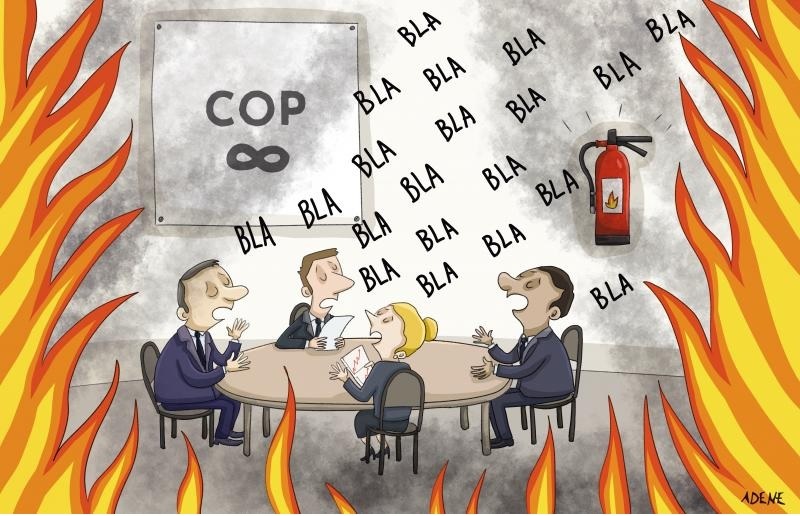
Yeah, we’re all whingeing about United Arab Emirates hosting the COP28 Climate Summit, and quietly making sure that their oil industry booms on.
Because we, the righteous Western nations are doing so much to slow down global heating. And we are. the USA has its worthy Inflation Reduction Act- cuts down on the home use of oil gas and coal, and USA promotes renewable energy, heat pumps, electric cars.
Canada has its Net-Zero Emissions Accountability Act, cutting down on domestic greenhouse gas emissions. Australia is promoting renewable energy and electric cars at home. Norway is big on electric cars, and encouraging climate-friendly systems, at home.
But the reality is- take Australia as an example – the world’s largest exporter of coal, and big exporter of liquefied natural gas (LNG). USA is a huge exporter of LNG. Canada – oil and natural gas exports. Norway – huge supplier of oil and gas.
All of these national governments approve and support the expansion and export of fossil fuels, while sanctimoniously bleating about “net zero” at home.
Sure, let’s criticise Sultan Ahmed Al Jaber and his lot. But the big Western players are in reality even bigger polluters.
“Nuremberg Trial” for Israel’s Crimes Against Palestinians?
, https://www.thepostil.com/a-nuremberg-trial-for-israels-crimes-against-palestinians/
Make no mistake. Israel has committed massive crimes in Gaza and in the West Bank against the Palestinians. When will the thousands killed get justice? Or are we all supposed to just go on with our lives and pretend that it’s all the pursuit of “the right of self-defense?” Who are these IDF snipers who anonymously shoot children, and no one is even curious to know who these killers are? Is this the way of war now, according to the “international rules based order” that we should be so proud of in the West, which is supposedly the hallmark of our “civilization?”
A day of reckoning will come. There are good men and women who are wokring to make that a reality.
And what are we to make of our politcal class that utters not a peep about the slaughter that Netanyahu is doing, but who earlier could not get the ICC to issue an arrest warrant for President Putin fast enough, because Putin was assumed to have “kidnapped” Ukrainian orphans that they might have a decent life in Russia. But Netanyahu can kill as many children as he wants, since that is not a crime according to the “rule of law,” so the “jurists” at the ICC stay busy identifying “Russian crimes” that might be spotted at the backs of their cereal boxes.
Kurt Tucholsky was paraphrasing a French joke when he observed that “the death of one person: that’s a catastrophe. One hundred thousand dead: that’s a statistic!”
What Israel has done for over a month in Gaza is now a matter of statistics, for they have killed over 15,000 so far, more than 4000 of them children. It is the Palestinian Holocaust, because there are many more thousands buried under all those pancaked buildings where people once lived. And now that the Israeli assault continues, many thousands more will die.
Given these grim statistics, it becomes more and more important to remember the one person, rather than mention in passing the vast number of the now faceless thousands dead.
One such person was Elham Farah, a Christian Palestinian, living in Gaza, where she had taught music all her life. She was 84 years old and was the daughter of the Palestinian poet, Hannah Farah.
On November 12, 2023, an Israeli sniper shot her in the leg, as she came out of the Holy Family Church in Gaza City, where she had been sheltering to escape the bombing. She wanted to make sure that her home had not been hit. A sniper was waiting who are trained to shoot in the leg.
Those inside the church tried to rescue her, as she cried out for help, but people were afraid of Israeli snipers who long have had a reputation for being merciless. Elham Farah bled to death over several days. No one came to help her because of the sniping. She had just survived the bombing of Saint Porphyrios, the 850-year-old church in Gaza, which took the lives of 18 other Christians. Is such a death for a gentle old lady acceptable to those who see themselves as “civilized?” And why no one even knows about the crimes of Israeli snipers is unimaginable.
The hell unleashed by the Herod of our time in the Holy Land escapes the mind’s ability to describe horror—to see little children torn apart by bombs, dropped by pilots in their sophisticated flying machines is beyond the reach of words…
Then Herod perceiving that he was deluded by the wise men, was exceeding angry: and sending killed all the menchildren that were in Bethlehem, and in all the borders thereof, from two years old and under, according to the time which he had diligently inquired of the wise men.
Then was fulfilled that which was spoken by Jeremias the prophet, saying:
A voice in Rama was heard, lamentation and great mourning; Rachel bewailing her children, and would not be comforted, because they are not (Matthew 2:16-18).
Rama” or “Ramah” is the name of several Palestinian towns, and “Rachel” stands in for all mothers whose children have been slaughtered by the powerful. Such killing was “righteous revenge” because the Hamas razzia of October 7th was fabricated as brutal, with beheaded babies and babies in ovens, when it was the IDF that did most of the slaughter of Israelis that day. Why the need to lie by Israel? The full truth about what really happened on October 7th is now coming out: Hamas killed IDF soldiers in combat. It was not a “terrorist” attack:
Thus on October 7th:
The IDF killed anything that moved;- Many Israeli captives were still alive, two days after October 7;
- Israelis were killed by the IDF with heavy shelling of houses and cars;
- Most of the civilian deaths happened because of the IDF;
- It was a razzia by Hamas because most of the captives taken were IDF officers.
And in the West, we have the war enthusiasts, eagerly cheering on Netanyahu and his ilk to kill more, to kill without compunction, for there will be no red lines drawn, because Israel is for “civilization,” because that is how you fight wars, by killing as many babies as you can with bombs.
Perhaps in the months or even years ahead, there will come a time for a “Nuremberg Trial” for the murderers that are now in power in Israel—and for the IDF soldiers snipers who shot down Elham Farah and the two liitle Christian Palestinian boys, and also for the many “journalists” and “scholars” who justified and whitewashed the crimes against humanity now permanently recorded for the world to see. Remember, they did hang Julius Streicher, even though he perosnally had killed no one.
‘Let us be a lesson’, say Kazakhs wary of return to nuclear testing
Reuters. By Mariya Gordeyeva, November 30, 2023
- Summary
- Treaty banning nuclear weapons tests was signed in 1996
- President Putin has revoked Russia’s ratification
- Many Soviet-era nuclear tests were conducted in Kazakhstan
- Radiation from the tests affected health of local people
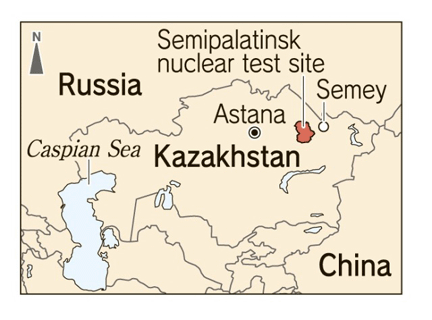
SARYZHAL, Kazakhstan, Nov 30 (Reuters) – As Russia warns of the rising risk of nuclear war, and relations with the United States sink into a deep freeze, communities close to the vast Soviet-era nuclear testing site in northern Kazakhstan have a message for leaders: “Let us be a lesson.”
Hundreds of tests were carried out between 1949 and 1989 on the barren steppe near the city of Semey, formerly known as Semipalatinsk, close to the Kazakh-Russian border. The effect of radiation had a devastating impact on the environment and local people’s health, and continues to affect lives there today………………………..
“Let our suffering be a lesson to others,” said Serikbay Ybyrai, local leader in the village of Saryzhal, who saw tests being carried out some 20 km (12 miles) away when he was a boy. “If this (testing) resumes, humanity will disappear.”
When devices were detonated above ground – until 1963 when tests went underground – authorities would order local people out of homes and schools because of fears that ground tremors might cause buildings to collapse.
“I remember I was about five years old,” said Baglan Gabullin, a resident of Kaynar, another village that lived under the shadow of nuclear testing.
He recalled how adults would instruct him and his friends not to look in the direction of the blast.
“We were small, so on the contrary, out of curiosity we looked. The flash was yellow at first, and then the black mushroom grew,” he said.
Kazakh authorities estimate up to 1.5 million people were exposed to residual radioactive fallout from testing. Over 1 million received certificates confirming their status as victims of tests, making them eligible for an 18,000-tenge ($40) monthly payout.
‘EVERYONE STARTED DYING’
Maira Abenova, an activist from the Semey region who set up a non-governmental organisation protecting the rights of nuclear test victims after losing most family members to diseases she said were related, urged politicians not to allow nuclear escalation.
“As someone living with the consequences of what you could call 40 years of nuclear warfare, I think we can tell the world what we have gone through,” she said.
There is little reliable data on the specific health impact of testing in Kazakhstan.
But scientists say exposure to radioactive material on the ground, inhalation of radioactive particles in the air and ingestion of contaminated food including local livestock contributed to increased cancer risk and cases of congenital malformation.
In Saryzhal, a village of around 2,000 people living in small white-painted homes surrounded by blue wooden fences, Gulsum Mukanova recalls how she and other children would watch above-ground explosions, known as atmospheric tests.
“We were children, everything was interesting to us,” she said. “We would stare at those mushrooms.
“My father died at the age of 58; then my elder brother died, then my sister,” added Mukanova, who is in her mid-60s. “Everyone started dying.”
Gabullin, speaking near a small monument to victims of nuclear tests erected in Kaynar, also said losses were common.
“There were about 300 tractor drivers who worked with me … now only two or three are alive. All died of cancer and leukaemia,” he said. “Even the schoolchildren who worked for me then, now they are 50-53 years old, they are already dying.”……….
While villages such as Kaynar and Saryzhal were exposed to direct radiation, steppe winds carried nuclear fallout across an area the size of Italy.
Much of the territory, pockmarked with lakes resulting from blast craters, is still considered too contaminated to inhabit or cultivate.
CONTAMINATION LASTS FOR GENERATIONS
About 450 tests were carried out there, more than 100 of them atmospheric tests and the rest underground. The latter were used after a 1963 treaty went into force banning nuclear weapons tests in the atmosphere, in space or underwater, and are considered less harmful.
After the Soviet Union collapsed in 1991, Moscow no longer had access to the Kazakh site. Its main equivalent today is in Novaya Zemlya, an active military site on an Arctic archipelago in Russia’s far north.
Nuclear experts said that any testing today would likely be underground, which carries environmental and health risks.
“Underground testing can also have severe consequences,” said Alicia Sanders-Zakre of the International Campaign to Abolish Nuclear Weapons.
“Radioactive particles can vent into the air, and there is also the potential for contamination of groundwater,” she told Reuters, adding that Russia’s position was that it did not intend to test at this time.
“What’s so dangerous about radioactive contamination is that it lasts for generations.”
($1 = 459.0000 tenge)
Additional reporting by Olzhas Auyezov in Almaty and Gloria Dickie in London; Writing by Olzhas Auyezov; Editing by Mike Collett-White and Timothy Heritage https://www.reuters.com/world/asia-pacific/let-us-be-lesson-say-kazakhs-wary-return-nuclear-testing-2023-11-30/
Second meeting of states parties agrees nuclear deterrence is the problem

The Second Meeting of States Parties to the TPNW has successfully concluded and agreed that nuclear deterrence is a significant security problem, requiring urgent attention by the international community, that more research on the impacts of nuclear weapons is needed, and that the harms caused by nuclear weapons use and testing require ongoing attention.
94 countries participated in the meeting as states parties or observers including some that currently endorse the use of nuclear weapons in their defence doctrines. These countries engaged in a robust and interactive debate during the week, adopting a political declaration and package of decisions.
Nuclear deterrence is a cause of global instability and insecurity
One of the adopted decisions included, for the first time ever, an agreement to work together to challenge the false narratives of nuclear deterrence. States parties mandated states, the International Committee of the Red Cross and ICAN and other stakeholders and experts, “To challenge the security paradigm based on nuclear deterrence by highlighting and promoting new scientific evidence about the humanitarian consequences and risks of nuclear weapons and juxtaposing this with the risks and assumptions that are inherent in nuclear deterrence.”
There remains an information gap between what would actually happen as a result of nuclear war and the policies of the nuclear-armed states and their allies, and efforts to bridge this gap are the primary responsibility of those whose policies include the use of nuclear weapons.
New evidence on the impacts of nuclear weapons demand action from the global community
New research was presented during the meeting as well, including findings showing that based on current understandings of arsenal sizes and effects on human beings, a nuclear war between the US and Russia would likely result in about 90 million casualties from blast, heat, fire, and radiation from hundreds of explosions across the northern hemisphere.
There is much greater understanding of the cascading effects on food supplies, the financial system and energy supplies that help us better predict the likely effects of nuclear detonations.
It was understood that research alone cannot reduce the risks of nuclear weapons, but that it can inform the public and policy makers about the harm existing in their arsenals or security doctrines.
Additionally, the Scientific Advisory Group presented research findings showing that the elimination of nuclear weapon facilities is possible and that there are ways to achieve conversion of facilities to civilian use; and there are ways to develop processes for arms control, such as weapon counting and warhead authentication.
Importantly, the Scientific Advisory Group also called for a new UN study on the consequences of nuclear war given the last comprehensive studies were done in the late 1980s.
Centring affected communities
The states heard testimony from members of communities affected by the use, testing and development of nuclear weapons, and heard their calls for recognition by governments of the harms they did to people, particularly Indigenous peoples.
They also heard about the efforts made so far to repair the damage that has scarred people and the land, as well as to open official records and do more research on the health impacts and environmental impacts of nuclear weapons.
These representatives, supported by wider civil society, called for the clean up and remediation of lands – through Articles 6 and 7 of the TPNW – in which Indigenous peoples must be involved as the Traditional Owners, and research on nuclear weapon impacts on intangible cultural heritage.
A joint statement endorsed by 26 nuclear affected community-led organisations, and supported by a further 45 allied organisations said “We have the right and responsibility to speak about what nuclear weapons really do… We call on States Parties to the TPNW to push relentlessly for its universalisation.”
Other stakeholders
A delegation of 23 parliamentarians from 14 countries mostly from countries that are yet to sign the treaty met on the margins of the conference, and delivered a statement denouncing nuclear threats while urging governments to sign and ratify the treaty urgently.
The financial community was also present, delivering a joint statement by more than 90 investors, representing over $1 trillion in assets under management, encouraging states to work with the financial community to further strengthen the norms and objectives of the treaty, including by ending financing relationships with the nuclear arms industry.
During the week, more than 65 events, including art exhibitions, concerts, panel discussions, awards ceremonies and more were held on the margins of the meeting.
The Third Meeting of States Parties to the treaty will take place 3-7 March, 2025 in New York.
For a video recap of the week, please visit MSP-TV.
1 This Month
Tell Congress: Prevent Nuclear Catastrophe in Iran

Tell Congress: Prevent Nuclear Catastrophe in Iran

Read the Public Inquiry Report, the Commissioners’ report, Surrendering Australia: The AUKUS Deception is available to download for free at aukuspublicinquiry.com. Or just watch the replay of the National Press Club Luncheon.


Shut down the radiation-damaged Heysham nuclear reactors now
To see nuclear-related stories in greater depth and intensity – go to https://nuclearinformation.wordpress.com

Say No to NASA’s Reckless Nuclear Reactor on the Moon
Say No to NASA’s Reckless Nuclear Reactor on the Moon
-
Archives
- November 2026 (238)
- October 2026 (302)
- September 2026 (339)
- August 2026 (330)
- July 2026 (355)
- June 2026 (287)
- May 2026 (306)
- April 2026 (356)
- March 2026 (251)
- February 2026 (267)
- January 2026 (308)
- December 2025 (358)
-
Categories
- 1
- 1 NUCLEAR ISSUES
- business and costs
- climate change
- culture and arts
- ENERGY
- environment
- health
- history
- indigenous issues
- Legal
- marketing of nuclear
- media
- opposition to nuclear
- PERSONAL STORIES
- politics
- politics international
- Religion and ethics
- safety
- secrets,lies and civil liberties
- spinbuster
- technology
- Uranium
- wastes
- weapons and war
- Women
- 2 WORLD
- ACTION
- AFRICA
- Atrocities
- AUSTRALIA
- Christina's notes
- Christina's themes
- culture and arts
- Events
- Fuk 2022
- Fuk 2023
- Fukushima 2017
- Fukushima 2018
- fukushima 2019
- Fukushima 2020
- Fukushima 2021
- general
- global warming
- Humour (God we need it)
- Nuclear
- RARE EARTHS
- Reference
- resources – print
- Resources -audiovicual
- Weekly Newsletter
- World
- World Nuclear
- YouTube
-
RSS
Entries RSS
Comments RSS

