Ukraine has lost up to 300,000 soldiers – ex-Zelensky aide
Rt.com 4 Dec 23
Kiev’s refusal to negotiate with Moscow has only caused the country heavy battlefield casualties, Aleksey Arestovich says.
Ukraine has lost up to 300,000 soldiers during its conflict with Russia, Aleksey Arestovich, a former aide to President Vladimir Zelensky, has claimed.
Arestovich made the revelation on Friday while speaking to journalist Yulia Latynina via video link. The former presidential aide was addressing the recent admission made by top Ukrainian MP David Arakhamia, who said the Istanbul talks between Moscow and Kiev were derailed by then-UK PM Boris Johnson, who urged Ukraine to “just continue fighting” instead of attempting to reach a deal with Russia.
“I was a member of the Istanbul negotiating team, but even I don’t know how it happened that we decided to break off the Istanbul [talks],” Arestovich stated.
The initiatives floated during the Istanbul talks were actually “very good,” he admitted, claiming that Ukraine’s neutrality and its non-alignment with NATO was a “red line” for Moscow.
Refusing to negotiate, however, has only resulted in heavy casualties, while its prospects to join NATO still remain dubious, he suggested.
“Where is NATO? Does it accept us or not? And will it accept us? … Then the 200 thousand [Ukrainian servicemen] or whatever, 300 thousand, would still be alive,” the ex-aide said.
…………………………..In recent weeks, top Ukrainian officials admitted the counteroffensive had failed to reach the desired outcome, and they seemed to shift blame for the failure on each other. Early in November, for instance, Valery Zaluzhny, Ukraine’s top general, said the battlefield situation had reached a “stalemate,” with Kiev unlikely to achieve a breakthrough unless it received a wonder-weapon of sorts.
The assessment has been vehemently rejected by Zelensky, who insisted the counteroffensive was still making progress. In an interview with AP published on Friday, however, Zelensky finally admitted that it had failed, stating that he considers the fact that his country’s troops are not retreating at the moment a “satisfying” enough result. https://www.rt.com/russia/588358-ukraine-losses-zelensky-aide/
Australia’s AUKUS nuclear submarines could fuel regional arms race despite assurance

“AUKUS is designed to shore up American power in East Asia, not de-escalate tensions,”
By Su-Lin TanDec 4, 2023, https://johnmenadue.com/australias-aukus-nuclear-submarines-could-fuel-regional-arms-race-despite-assurance/
Defence Industry Minister Pat Conroy says Australia is not worsening the arms race and gives assurance about the submarines’ nuclear reactors. The deal could still spark a defence build-up in Asia-Pacific while Australia lacks the facilities to deal with nuclear waste, analysts say.
Australia may have asserted that its acquisition of nuclear-powered submarines under AUKUS is not aggravating the “arms race”, but the deal and the three-nation alliance could still fuel a defence build-up in the Asia-Pacific and heighten regional tensions, security analysts say.
At the national press club in Canberra on Tuesday, Australian Defence Industry Minister Pat Conroy reiterated the importance of the submarines to the country’s defence while debunking “myths” about the trilateral deal struck with Britain and the United States, which is largely seen as a countermeasure targeting China.
“The arms race is the greatest it’s been since 1945, and that is why I reject assertions … that Australia is somehow fuelling that arms race,” he said, adding that rising tensions in the Asia-Pacific had posed the most challenging strategic environment for Australia since World War II. “We are responding to it in a responsible and mature manner, like Australian governments should.”
Australia will own at least eight submarines over the next three decades through the A$368 billion (US$243 billion) deal. First announced in 2021 and finalised earlier this year, the controversial pact has raised concerns in the region.
Collin Koh, a senior fellow at the S. Rajaratnam School of International Studies in Singapore, said Conroy’s comment was not a surprise as countries including China and others in Asia-Pacific often couched their arms acquisitions in “defensive terms”.
Most countries would do so in the name of national security interests but it did not mean such actions ensured peace or safety, he said.
Even before AUKUS was announced in 2021, China and other regional countries had already embarked on significant military build-up since the 1990s, Koh said.
“Conroy may not be necessarily wrong to say AUKUS responds to this already ongoing condition, yet at the same time, it’s also not wrong to say that AUKUS … may not only be used by Beijing to legitimise its naval build-up, it also could be exploited as a justification for other regional countries’ military build-up programmes,” Koh said.
Australia’s acquisition of the submarines might trigger new problems as other countries could argue that they should also acquire similar capabilities, said Maria Rost Rublee, a nuclear politics expert at Monash University.
These countries are not limited to “dangerous actors”, for instance, in South Korea where the majority of its people have expressed a desire for their country to own nuclear weapons, Rublee added.
“Just having this type of technology in the hands of a country where you have strong popular support for nuclear weapons could be an issue,” she said.
In an analysis earlier this month, Ankit Panda, the Stanton Senior Fellow in the Nuclear Policy Programme at the Carnegie Endowment for International Peace, warned the accumulation of weapons such as missiles could potentially lead to unintended attacks.
“The Indo-Pacific region has entered a new missile age … each nation individually seeking deterrence while as a whole steering the region into ever more dangerous waters,” he said. “A particular risk concerns the prospects of attacks on the nuclear forces of countries like North Korea and China, by US or allied forces in ways that may not be intended.”
By the 2030s, the Indo-Pacific region would be “full of thousands of new missiles that can be expected to be used widely in the context of a major regional war”, Panda said.
Responding to Conroy’s comments, the national convenor of Labor Against War in Australia, Marcus Strom, said: “If your answer to growing regional tension is to add offensive weaponry, you create a logic towards war.
“AUKUS is designed to shore up American power in East Asia, not de-escalate tensions,” he added.
While Conroy has given assurances about the safety of sealed nuclear reactors within the submarines, analysts argued that the lack of facilities in Australia for the eventual disposal of these reactors is worrying.
“The strength of this agreement is that the reactor module comes to us sealed. It comes sealed, designed to be never opened over the life of a submarine. You don’t have to refuel it, you don’t have to insert new fuel rods … [over] the life of the submarine,” Conroy said.
But nuclear waste expert Ian Lowe said in an analysis on The Conversation website earlier this year that Australia has failed for decades to find long-term storage solutions for small quantities of low- and intermediate-level nuclear waste.
Even Australia’s allies and AUKUS partners, the US and the UK, do not have long-term solutions for nuclear waste storage, according to Lowe.
“This should be concerning. To manage the waste from our proposed nuclear submarines properly, we’ll have to develop systems and sites which do not currently exist in Australia,” Lowe said.
Australian states such as Victoria, Queensland and South Australia have said they would not accept a nuclear waste facility within their borders.
While it will be another 30 years before Australia has to worry about dumping the submarine’s nuclear reactors, it is not a long time, Rublee said.
“If they take their nuclear stewardship obligations seriously, they must immediately begin working on the long-term storage of high-level nuclear waste,” she added.
URANIUM WARHEAD POISONING IS THE SPECIALTY OF US AGAINST RUSSIANS, ISRAEL AGAINST PALESTINIANS

by John Helmer, Moscow , December 2023
@bears_with
Long before the British intelligence agency MI6 invented the story that Russian military agents had carried the nerve agent weapon Novichok into England, fired it at two Russians, and left it in a dustbin for a local scavenger to find, take home and kill his girlfriend, there was depleted uranium poisoning.
This is a weapon of mass destruction (WMD).
In the past thirty years it has been used by the US, British, and Israeli armies in their wars against Iraq, Lebanon, and Palestine (Gaza), Serbia, and recently against the Russians on the Ukrainian battlefield. As a US invention, however, depleted uranium dispersal as a gas to contaminate terrain for enemy soldiers has been acknowledged in secret since 1943.
In the official military manuals, depleted uranium rounds are used because their metal concentration and intense heat burn their way through armour plate. In practice, they vaporise high concentrations of radioactive particles to cover large swathes of territory, civilian and military.
The US Department of Homeland Security defines a weapon of mass destruction (WMD) as “a nuclear, radiological, chemical, biological, or other device that is intended to harm a large number of people.” DU harms a relatively small number of soldiers on a battlefield operating in tanks, other armoured vehicles, self-propelled artillery and reinforced bunkers. DU strikes a much larger number of people through the release of radiation downwind of the battlefield by penetrating their bodies, attacking their genetic codes, and triggering cancers, birth defects, miscarriages of the unborn, and premature death of adults.
According to Homeland Security, it “works every day to prevent terrorists and other threat actors from using these weapons to harm Americans.” But when the US supplies its DU weapons to the Israeli and Ukrainian armies, it intends to cause this mass destruction by not caring for the harm they do — in fact concealing this harm, and publicly pretending DU ordnance is not what it is.
DU is a WMD by stealth. The US knows this because US and British soldiers who participated in the first battlefield use of DU shells and bombs, the war against Iraq in 1991, have been the long-term victims of their own weapons.
When the Israel Defence Forces (IDF) fire their DU shells and bombs into the buildings of Gaza, they are not aiming at Hamas tanks, armoured personnel carriers, or howitzer units – the Palestinian forces have none of those. Instead, the Israelis are aiming at the mass destruction of the Palestinian people, including those still unborn. The supply chain for this WMD includes the Cypriot, Greek, German and British governments.
In Gaza, and in the Ukraine, they are all witting participants in targeting a race of people for extermination, now and for the future.
According to US Government publications, the use of depleted uranium (DU) as a super-burning, heavy-metal weapon began in the US in the 1970s.
“Naturally occurring uranium ore is abundant in nature and contains several forms of uranium called isotopes. All uranium isotopes are radioactive; however, only one of these isotopes, Uranium-235 (U-235), provides the fuel used to produce both nuclear power and the powerful explosions used in nuclear weapons… In nature, U-235 only makes up a very small part of the uranium ore. Given its importance for nuclear power and nuclear weapons technology, U-235 is often removed from the natural uranium ore and concentrated through a process called uranium enrichment. Depleted uranium hexafluoride, also known as DU, is the material left behind after enrichment. Like the natural uranium ore, DU is radioactive. DU mainly emits alpha particle radiation.” …………………………………………………………………………….
US nuclear bomb designers describe the DU artillery shell or bomb as a “dirty radiation weapon” because of its uncontrollable dispersal on wind, rain, and through the soil targeting civilian populations far from the battlefield targets; indeed, the very civilian populations supporting and paying for the use of DU munitions against their purported enemies. “Some of the uranium used with DU weapons vaporises into extremely small particles, which are dispersed into the atmosphere where they remain until they fall to the ground with the rain. As a gas, the chemically toxic and radioactive uranium can easily enter the body through the skin or the lungs and be carried around the world until it falls to earth with the rain. AFP asked Marion Falk, a retired chemical physicist who built nuclear bombs for more than 20 years at Lawrence Livermore lab, if he thought that DU weapons operate in a similar manner as a dirty bomb. ‘That’s exactly what they are,’ Falk said. ‘They fit the description of a dirty bomb in every way.’”
According to Falk, more than 30 percent of the DU fired from the cannons of U.S. tanks is reduced to particles one-tenth of a micron (one millionth of a meter) in size or smaller on impact. ‘The larger the bang the greater the amount of DU that is dispersed into the atmosphere,’ Falk said. With the larger missiles and bombs, nearly 100 percent of the DU is reduced to radioactive dust particles of the micron size or smaller, he said.”
One of the leading nuclear physicists in Europe to have researched the long-range dispersal of DU biochemical damage is Christopher Busby. Here is his report, published in 2011, of the long-term poisoning of Iraqi civilians following the US and British use of DU ammunition during the fighting at Fallujah in 2004. The data on which Busby and his colleagues based their findings came from soil and water sampling, as well as from spectrometric analysis of the hair of civilian children, fathers and mothers in Iraq. The abnormally high concentrations of uranium were traced to the use by US and UK forces of artillery shells, ground-fired missiles, and air-fired rockets, missiles and bombs. According to Busby, “US forces also used Fallujah to combat-test prototypes of at least two new types of thermobaric weapons – Thermobaric Hellfire missiles – AGM-114N [54]- and a new thermobaric RPG called SMAW-NE (Shoulder-fired, Multi-purpose Assault Weapon – Novel Explosive).”
Testing new radiation weapons in civilian areas of Iraq, Lebanon, and Afghanistan has been standard practice for the US, the British, and the Israelis over more than thirty years.
The conclusion of Busby’s Fallujah study of September 2011 was that “we found significant levels of Uranium, a material which has been associated with weapons employed in Iraq and in the Balkans since 1991 and also with genotoxicity. These levels were significantly higher than those expected on the basis of published control group data from various studies and particularly from Southern Israel. Further, the pattern of contamination with regard to hair length indicated a major contamination event in the past. The levels of Uranium could not be explained by any local Uranium deposits in the soil since measurements made of soil Uranium showed only modest concentrations though the Uranium was slightly enriched…Since none of the other elements found in excess in the parents were genotoxic except Uranium we conclude that these results support the belief that the effects in Fallujah follow the deployment of a Uranium-based weapon or weapons of some unknown type.”
Other research studies by Busby and others have produced the evidence of Israeli use of DU air-dropped bombs and artillery fired shells against Arab targets in Gaza and Lebanon since 2006. Independent research has been undertaken by Arab experts of late miscarriages, stillbirths, and birth defects for pregnant Palestinian women at the Al-Shifa Hospital in Gaza City. “These data suggests a causative/favouring role of acute exposure of parents to the weapons-associated contaminants, and/or of their chronic exposure from their persistence in the environment on the embryonic development of their children.”
In a research paper published in December 2021, Arab scientists from Egypt and Gaza, with a Japanese colleague, and collaboration from a German institute in Munich, reported that uranium weapon contamination was found in sand, stone, concrete, demolition and other building materials in Gaza as well as in Egyptian Sinai. “The past and ongoing siege of the Gaza Strip has led to a severe shortage of building materials since 2007. Many houses, buildings and infrastructure were destroyed and produced huge amounts of demolition debris after the war in the Gaza Strip in 2008. As a result, re-use of the degraded building materials has been required in the past and present. According to the United Nations Development Program (UNDP), the amount of demolition debris in the Gaza Strip, produced from 2008 through 2009, was estimated to be 600,000 tonnes. The demolition debris was crushed, sieved and re-used as recycled building materials.”
In other words, the Israeli-American DU attacks on Gaza make the recycling of the current destruction hazardous for rebuilding. The findings indicate that long before the present war began last month, it has been Israeli state policy, backed and supplied by the US, to make Gaza uninhabitable for the future. This is genocide, using genotoxic weapons. For the first attempt at documenting the wind dispersal of DU radioactive particles fired by the IDF since October 7 to Egypt, Jordan, Saudi Arabia, and Israel itself, click on this.
In time Busby and Arab scientists will report the evidence of DU health damage among the Gazans who survive direct destruction by Israeli attack.
On November 25, Busby has reported new research documenting the bioch
Busby has now updated the earlier findings in a research paper issued on November 25. Because the standard European and US academic publishers are so far refusing to report the evidence, Busby’s report is published here in full.
The Khmelnitsky Ukraine Uranium explosion revisited.
The calculated source term is approximately 50 tons.
Public health implications for Poland and Western Ukraine.
By Christopher Busby, PhD………………………………………………………………………………more https://johnhelmer.net/biochemical-weapon-for-race-war-uranium-warhead-poisoning-is-the-specialty-of-us-against-russians-israel-against-palestinians/?fbclid=IwAR2H2vUD6Fw26z_-MTk2qEOyRLXTmRK4vUCjw8Bs8N_QIYxMgg3OcAgCDnY
AI and the Bomb: Nuclear Strategy and Risk in the Digital Age

Nuclear Deterrence: Unsafe at Machine Speed
AI and the Bomb: Nuclear Strategy and Risk in the Digital Age, By James Johnson,
Reviewed by Douglas B. Shaw, 3 Dec 23, Arms Control Association,
James Johnson’s book is the most important book about preventing nuclear war that has been published in recent years. The author confronts head-on the complexity of the dangers that artificial intelligence (AI) and other emerging technologies pose for nuclear deterrence. He combines a commanding view of deterrence theory with the imagination to point toward where technology is already obscuring deterrence practice and concludes darkly that, “[i]n the context of AI and autonomy, particularly information complexity, misinformation, and manipulation, rationality-based deterrence logic appears an increasingly untenable proposition.”
AI and the Bomb opens with a gripping account of a “flash war” between China and the United States, taking place over less than two hours in June 2025, in which nuclear weapons are used, millions of people die, and afterward, no one on either side can explain exactly what happened. This story underscores the fact that even if not given control of nuclear weapons, AI and emerging technologies connected to adjacent or seemingly unrelated systems may combine in unforeseen ways to render nuclear escalation incomprehensible to the humans in (or on) the loop.
Johnson’s book is the first comprehensive effort to understand the implications of the AI revolution for the Cold War notion of “strategic stability” at the core of nuclear deterrence. He finds new challenges for deterrence theory and practice in emerging technologies, centering inadvertent escalation as a “new model for nuclear risk.” He formulates a novel “AI-security dilemma” more volatile and unpredictable than the past. He also adds a new dimension of “catalytic nuclear war” by which states without nuclear weapons or nonstate actors might use AI to cause nuclear war among nuclear-armed states.
Artificial Intelligence, Emerging Technology, and Deterrence Theory
The author embraces and extends the emerging conventional wisdom that AI should not be plugged into nuclear command-and-control systems, observing that “the delegation of the decision-making process (to inform and make decisions) to machines is not a binary choice but rather a continuum between the two extremes—human decision-making and judgment and machine autonomy at each stage of the kill chain.” Beyond using AI to facilitate nuclear launch decisions, Johnson shows how AI could affect the nuclear balance by changing nuclear weapons system accuracy, resilience and survivability, and intelligence, surveillance, and reconnaissance for targeting. AI capabilities also may give conventional weapons systems dramatic new capabilities to attack nuclear weapons systems, through increased ability to penetrate air defenses; increased ability to “detect, track, target, and intercept” nuclear missiles; and advanced cybercapabilities, potentially including manipulation of “the information ecosystem in which strategic decisions involving nuclear weapons take place.”
Importantly, Johnson uses AI as a shorthand for referring to AI and a suite of other emerging technologies that enable AI, including “cyberspace, space technology, nuclear technologies, GPS technology, and 3D printing.” This choice mirrors the practice of other thought leaders, including Henry Kissinger, Eric Schmidt, and Daniel Huttenlocher in The Age of AI and Mustafa Suleyman in The Coming Wave.
The book is a grim journey for scholars of nuclear deterrence theory, forcing them to confront concepts such as “machine-speed AI warfare,” “non-human agents,” nuclear arsenals with a “larger attack surface” in a world in which ubiquitous sensors feed data oceans, and “disinformation cascades” that could lead to an “unravelling of deterrence in practice.” These ominous signs begin to flesh out the broad concerns about nuclear strategy that Kissinger, Schmidt, and Huttenlocher raise, including that “[t]he management of nuclear weapons, the endeavor of half a century, remains incomplete and fragmentary” and that the “unsolved riddles of nuclear strategy must be given new attention.”………………………………………………………
First, the AI security dilemma features the possibility of extraordinarily fast technological breakthroughs, incentivizing states in competition with peers in AI technology to move first rather than risk being second. For example, the U.S. National Security Commission on AI found that “defending against AI-capable adversaries [notably China] operating at machine speeds without employing AI is an invitation to disaster.”
Second, the AI security dilemma risks placing latent offensive capabilities in civilian hands, such as the massive data facilitated by communication and navigation satellites. Whereas the traditional security dilemma is driven primarily by the misinterpretation of defensive military capabilities, the AI security dilemma also can be driven by the misinterpretation of ostensibly peaceful commercial capabilities.
Third, the AI security dilemma is driven by commercial and market forces not under the positive control of states. Whereas the traditional security dilemma causes states to fear each other’s actions, the AI security dilemma drives states increasingly to fear the actions of private firms. Taken together, these three novel characteristics of potentially explosive technological breakthroughs, ambiguous commercial capabilities, and the absence of positive control over commercial capabilities led Johnson to conclude that AI is “a dilemma aggravator primus inter pares.”……………………………..
Beyond Rational Nuclear Deterrence?
The book demonstrates repeatedly how revolutionary change in the technological terrain in which nuclear deterrence takes place demands urgent theoretical and practical adaptation. Old assumptions and human rationality may decrease sharply in effectiveness as tools for preventing nuclear war.
Johnson offers some initial ideas of how to manage the stark challenges that AI poses for nuclear deterrence. Arms control will remain important, if challenging, in new ways; he suggests that banning AI enhancements to nuclear deterrence capabilities might be an important first step……………………………………………………..
Ultimately, Johnson expects that “AI technology in the nuclear domain will likely be a double-edged sword: strengthening the [nuclear command-and-control] systems while expanding the pathways and tools available to adversaries to conduct cyberattacks and electronic warfare operations against these systems.” He encourages policymakers to act “before the pace of technological change outpaces (or surpasses) strategic affairs.”
Johnson concludes his book with a quote from machine learning pioneer Alan Turing: “We can only see a short distance ahead, but we can see plenty there that needs to be done.” AI and the Bomb is a must read for those seeking to understand the first signals of revolutionary change that AI is bringing to the challenge of preventing nuclear war. It sends a clear warning that the world does not yet know how to manage the effects of AI on nuclear deterrence and, without significant urgent effort, it is likely to fall short.
https://www.armscontrol.org/act/2023-12/book-reviews/ai-bomb-nuclear-strategy-risk-digital-age
U.S. to Develop Unanticipated New Nuclear Bomb
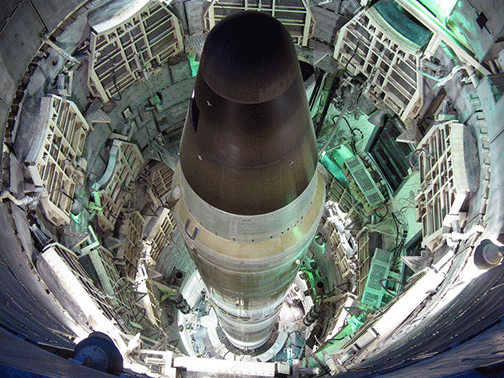
December 2023, By Shannon Bugos
The U.S. Defense Department unexpectedly announced its intention to develop an additional variant of the B61 nuclear gravity bomb, to be known as the B61-13.
………………………………….. The Pentagon acknowledged its hope that the B61-13 variant would help catalyze the stagnant retirement process of the B83 megaton gravity bomb.
“The B61-13 will provide the President with additional options against certain harder and large-area military targets, even while the department works to retire legacy systems such as the B83-1,” according to a Pentagon fact sheet……………………………..
“The case for the B61-13 is strange,” assessed the Federation of American Scientists in an Oct. 27 blog post. “For the past 13 years, the sales pitch for the expensive B61-12 has been that it would replace all other nuclear gravity bombs,” as well as “cover all gravity missions with less collateral damage than large-yield bombs.”
The B61-13 would be deliverable by modern aircraft and have a maximum yield similar to the 360-kiloton B61-7 variant, a massive increase when compared to the most recent 50-kiloton B61-12. The B61-12 is scheduled for initial deployment this year, replacing the 100 B61-3/4 bombs believed to be stationed across Belgium, Germany, Italy, the Netherlands, and Turkey under the NATO nuclear sharing mission………………………..
In an Oct. 24 letter to Congress, the Energy Department officially requested to amend its fiscal year 2024 budget request to cover development engineering activities for the B61-13.
Whether the request will be granted remains to be seen because Congress has yet to pass the necessary legislation to fund any department for all of fiscal year 2024. https://www.armscontrol.org/act/2023-12/news/us-develop-unanticipated-new-nuclear-bomb
Zaporizhzhia nuclear plant suffered power outage, energy ministry says

Reuters, December 2, 2023
KYIV, Dec 2 (Reuters) – Ukraine’s Russian-occupied Zaporizhzhia nuclear power plant lost its power supply after the last remaining line to it from Ukrainian-controlled territory was disrupted, but it has since been repaired, the energy ministry said on Saturday.
The plant was occupied by Russia in March 2022 and is no longer generating power, but needs a supply of electricity to cool one of its four reactors which is in a state of ‘hot conservation’ – meaning it has not fully been shut down.
According to a statement published by Ukraine’s energy ministry on Telegram, one power line to the plant was disrupted late on Friday, while the last, 750 kW, line was broken at 2:31 a.m. (0031 GMT) on Saturday.
“This is the eighth blackout which occurred at the (Zaporizhzhia plant) and could have led to nuclear catastrophe,” the statement said.
The ministry said that after losing grid connection the plant turned on 20 backup generators to supply its own electricity needs.
Swiss nuclear power plants are running out of staff
After warning Switzerland over two years ago, the International Atomic Energy Agency (IAEA) recommends the authorities develop a roadmap to deal with the impending problem of labour shortage in Swiss nuclear power plants.
This content was published on December 3, 2023 – 14:17December 3, 2023
Switzerland’s existing nuclear power plants are on the verge of having their lifetimes extended from 50 to 80 years. But now a problem is threatening to thwart these plans.
The search for skilled labour is becoming increasingly challenging, as reported by the NZZ am Sonntag newspaper on Sunday. There are currently over 40 vacancies at the Beznau, Gösgen and Leibstadt nuclear power plants.
A team of experts from the IAEA warned Switzerland back in October 2021. In a report, the agency concluded that the search for personnel was one of the biggest challenges for Swiss nuclear plants and for the supervisory authority itself…………………https://www.swissinfo.ch/eng/business/swiss-nuclear-power-plants-are-running-out-of-staff/49027136
Nuclear, and climate, news to 4th December

Some bits of good news. England’s rainforests breathed easier. Treaty on the Prohibition of Nuclear Weapons: A Bright Constellation in a Very Dark Sky.
TOP STORIES
Plot to Triple Nuclear Power by 2050 Decried as ‘Dangerous Distraction’ at COP28.
Ralph Nader -on Israel’s Genocidal Antisemitism Against the Arab Civilians of Gaza.
Small modular nuclear reactors: a history of failure.
Drones Target Ukrainian, Russian Nuclear Facilities.
******************
Climate. “We cannot afford to have a bad COP” – Mary Robinson. COP28: UAE planned to use climate talks to make oil deals. Climate summit in an oil state: can COP28 change anything?Bah Humbug!– to COP Climate Conference sponsored by Dubai, an oil & natural gas nation. COP28: Hopes of fossil fuel ‘phase out’ hit by revelations of Saudi plan to boost oil demand. Cop28: what to expect from the Dubai climate change conference- (behind a pay wall, but read it on nuclear-news.net) How wealthy countries, l(ike U.S., Canada, Australia, and Norway), evade responsibility for their fossil fuel exports. Why the UN Report is right to say we’re heading for at least 3 degrees of warming. ‘Progress this decade is critical’: Why a 1.5C world hinges on doubling down on energy efficiency.
Christina notes. Have you noticed? The nuclear lobby is swamping the news media with its false “nuclear for climate”message. COP 28 A sorry tale of climate hypocrisy.
Nuclear. It’s full on nuclear propaganda time. It’s all in the wording. At COP 28, 20 countries signed up to promote nuclear. 179 COUNTRIES DID NOT SIGN UP TO PROMOTE NUCLEAR.
******************
CLIMATE. DOUBLING DOWN ON NUCLEAR POWER IS NO SOLUTION TO CLIMATE CRISIS. Nuclear vs. Climate: Is nuclear power needed to contain the climate crisis? John Kerry at Cop28 to lobby for the nuclear industry. Nuclear lobby’s big push to ‘shine’ at COP28.
ECONOMICS.
- The nuclear power renaissance has some way to run.
- France goes for its own costly small nuclear reactor, following the USA NuScale flop, and UK’s lagging Rolls Royce one. French nuclear tax is leap into the dark – analysts. EDF to “build 1 reactor a year in 2030s” – CEO.
- The President of the Canadian Nuclear Safety Commission spent $288,000 on travel in 19 months. Hydro- Quebec decides against restarting Gentilly 2 nuclear station.
- NuScale cancels first planned SMR nuclear project due to lack of interest.
- Why Britain’s mini-nukes dream is hanging by a thread. Failure of USA’s NuScale small nuclear reactors (SMRs) not a good omen for Rolls Royce and other UK SMR developers. UK’s first small nuclear reactor deal ‘poised’ for signing but not with Rolls-Royce.
- Operators extend Finnish, Swedish nuclear reactor outages.
EMPLOYMENT. Swiss nuclear power plants are running out of staff.
ETHICS and RELIGION. Holy See advocates collaboration on nuclear disarmament.
LEGAL. Musk’s Lawsuit Is About Destroying Free Speech. Portland nuclear power startup NuScale hit with investor lawsuit.
NUCLEAR TECHNOLOGY. Nuclear Power Expansion Predictions Failed. SMRs two examples: NuScale in the US, NUWARD in France . Can thorium solve the nuclear problem? That’s doubtful.
OPPOSITION to NUCLEAR . Halt the US-Philippines Nuclear Deal –Sign on to Letter to US Congress – Full statement and sign on: tinyurl.com/haltUSPHdeal
PERSONAL STORIES. ‘Let us be a lesson’, say Kazakhs wary of return to nuclear testing.
POLITICS. UK government hopes that United Arab Emirates will invest in Sizewell C nuclear power plan. Energy-rich Scotland does not require any nuclear power stations. Nuclear energy in Philippines? Group says there’s not even a Filipino expert on safety, radiation. Sweden to slug tax-payers for the costs of small nuclear reactors, and big ones. Sovereignty Surrendered: Subordinating Australia’s Defence Industry
POLITICS INTERNATIONAL and DIPLOMACY. Second meeting of states parties agrees nuclear deterrence is the problem. UK’s Sizewell C Nuclear stake seized from China may go to United Arab Emirates. (behind a pay wall, but read it on nuclear-news.net) TELL THE UNITED ARAB EMIRATES NOT TO INVEST IN SIZEWELL C.
PUBLIC OPINION. Renewable or nuclear? What your energy preference says about you – public opinion.
SAFETY. Closer to nuclear plant than ever, latest Korean quake renews calls to retire aging reactors. Olkiluoto 3 nuclear power station shuts down again. Incidents. IAEA experts record explosions near two Ukrainian nuclear power plants. Zaporizhzhia nuclear plant suffered power outage, energy ministry says. Freezing consequences for Mississippi River as nuclear units down.
SPACE. EXPLORATION, WEAPONS. SpaceX rockets keep tearing blood-red ‘atmospheric holes’ in the sky, and scientists are concerned.
SPINBUSTER. Nuclear lobby’s latest gimmick – making nuclear BEAUTIFUL !
WASTES. A blank cheque for France’s Industrial Centre for Geological Disposal (Cigéo) does not prove that it is safe. How to Scrap the First-Ever Nuclear-Powered Aircraft Carrier: USS Enterprise? A sobering analysis of the Canadian plan for small modular nuclear reactors (SMRs) and their toxic waste problem..
WAR and CONFLICT. President Biden has morphed into the Murder Monster. The New York Times Reports Gaza Civilians ‘Are Being Killed at Historic Pace’. Israel’s Savagery Is So Shocking It’s Sometimes Hard To Take In.
A Nuclear Attack by Design — or by Accident — Must Never Happen. A planned US-Israeli attack on Iran is contemplated. AI and the Bomb: Nuclear Strategy and Risk in the Digital Age. URANIUM WARHEAD POISONING IS THE SPECIALTY OF US AGAINST RUSSIANS, ISRAEL AGAINST PALESTINIANS.
WEAPONS and WEAPONS SALES. US nuclear bombs ‘set to return to UK‘ for first time in 15 years – making Lakenheath a “nuclear target”. U.S. to Develop Unanticipated New Nuclear Bomb. Pentagon struggling to pay for Middle East buildup – Politico. The Military’s Big Bet on Artificial Intelligence. ‘The Gospel’: how Israel uses AI to select bombing targets in Gaza. US Sent Israel 15,000 Bombs Since October 7. Australia’s AUKUS nuclear submarines could fuel regional arms race despite assurance.
Plot to Triple Nuclear Power by 2050 Decried as ‘Dangerous Distraction’ at COP28

“Investing now in nuclear energy is an inefficient route to take to reduce emissions at the scale and pace needed to tackle climate change,” said one campaigner.
JON QUEALLY, Dec 02, 2023
Climate campaigners scoffed Saturday at a 22-nation pledge to triple nuclear power capacity by mid-century as a way to ward off the increasing damage of warming temperatures, with opponents calling it a costly and “dangerous” distraction from the urgent need for a fossil fuel phaseout alongside a rapid increase in more affordable and scaleable renewable sources such as wind and solar.
The Declaration to Triple Nuclear Energy—backed by the United States, Canada, France, the Czech Republic, and others—was announced as part of the Climate Action Summit taking place in Dubai as a part of the two-week U.N. climate talks known as COP28.
While the document claims a “key role” for nuclear energy to keep “a 1.5°C limit on temperature rise within reach” by 2050 and to help attain the so-called “net-zero emissions” goal that governments and the fossil fuel industry deploy to justify the continued burning of coal, oil, and gas, critics say the false solution of atomic power actually harms the effort to reduce emissions by wasting precious time and money that could be spent better and faster elsewhere.
“There is no space for dangerous nuclear power to accelerate the decarbonization needed to achieve the Paris climate goal,” said Masayoshi Iyoda, a 350.org campaigner in Japan who cited the 2011 Fukushima disaster as evidence of the inherent dangers of nuclear power.
Nuclear energy, said Iyoda, “is nothing more than a dangerous distraction. The attempt of a ‘nuclear renaissance’ led by nuclear industries’ lobbyists since the 2000s has never been successful—it is simply too costly, too risky, too undemocratic, and too time-consuming. We already have cheaper, safer, democratic, and faster solutions to the climate crisis, and they are renewable energy and energy efficiency.”
When word of the multi-nation pledge emerged last month, Mark Jacobson, professor of civil and environmental engineering at Stanford University and co-founder of The Solutions Project which offers a roadmap for 100% renewable energy that excludes nuclear energy, called the proposal the “stupidest policy proposal I’ve ever seen.”
Jacobson said the plan to boost nuclear capacity in a manner to avert the worst impacts of the climate crisis “will never happen no matter how many goals are set” and added that President Joe Biden was getting “bad advice in the White House” for supporting it.
In comments from Dubai, U.S. climate envoy John Kerry said that while he agrees nuclear will be a “sweeping alternative to every other energy source,” but claimed that “science and the reality of facts” shows the world cannot “get to net-zero by 2050 with some nuclear.”
Numerous studies and blueprints towards a renewable energy future, however, have shown this is not established fact, but rather the position taken by both the nuclear power industry itself and those who would otherwise like to slow the transition to a truly renewable energy system.
Pauline Boyer, energy transition campaign manager with Greenpeace France, said the scientific evidence is clear and it is not in favor of a surge in nuclear power.
“If we wish to maintain a chance of a trajectory of 1.5°C, we must massively reduce greenhouse gas emissions over the coming years, but nuclear power is too slow to deploy in the face of the climate emergency,” she said.
Climate campaigners scoffed Saturday at a 22-nation pledge to triple nuclear power capacity by mid-century as a way to ward off the increasing damage of warming temperatures, with opponents calling it a costly and “dangerous” distraction from the urgent need for a fossil fuel phaseout alongside a rapid increase in more affordable and scaleable renewable sources such as wind and solar.
The Declaration to Triple Nuclear Energy—backed by the United States, Canada, France, the Czech Republic, and others—was announced as part of the Climate Action Summit taking place in Dubai as a part of the two-week U.N. climate talks known as COP28.
While the document claims a “key role” for nuclear energy to keep “a 1.5°C limit on temperature rise within reach” by 2050 and to help attain the so-called “net-zero emissions” goal that governments and the fossil fuel industry deploy to justify the continued burning of coal, oil, and gas, critics say the false solution of atomic power actually harms the effort to reduce emissions by wasting precious time and money that could be spent better and faster elsewhere.
“There is no space for dangerous nuclear power to accelerate the decarbonization needed to achieve the Paris climate goal,” said Masayoshi Iyoda, a 350.org campaigner in Japan who cited the 2011 Fukushima disaster as evidence of the inherent dangers of nuclear power.
“There is no space for dangerous nuclear power to accelerate the decarbonization needed to achieve the Paris climate goal.”
Nuclear energy, said Iyoda, “is nothing more than a dangerous distraction. The attempt of a ‘nuclear renaissance’ led by nuclear industries’ lobbyists since the 2000s has never been successful—it is simply too costly, too risky, too undemocratic, and too time-consuming. We already have cheaper, safer, democratic, and faster solutions to the climate crisis, and they are renewable energy and energy efficiency.”
When word of the multi-nation pledge emerged last month, Mark Jacobson, professor of civil and environmental engineering at Stanford University and co-founder of The Solutions Project which offers a roadmap for 100% renewable energy that excludes nuclear energy, called the proposal the “stupidest policy proposal I’ve ever seen.”
Jacobson said the plan to boost nuclear capacity in a manner to avert the worst impacts of the climate crisis “will never happen no matter how many goals are set” and added that President Joe Biden was getting “bad advice in the White House” for supporting it.
In comments from Dubai, U.S. climate envoy John Kerry said that while he agrees nuclear will be a “sweeping alternative to every other energy source,” but claimed that “science and the reality of facts” shows the world cannot “get to net-zero by 2050 with some nuclear.”
Numerous studies and blueprints towards a renewable energy future, however, have shown this is not established fact, but rather the position taken by both the nuclear power industry itself and those who would otherwise like to slow the transition to a truly renewable energy system.
Pauline Boyer, energy transition campaign manager with Greenpeace France, said the scientific evidence is clear and it is not in favor of a surge in nuclear power.
“If we wish to maintain a chance of a trajectory of 1.5°C, we must massively reduce greenhouse gas emissions over the coming years, but nuclear power is too slow to deploy in the face of the climate emergency,” she said.
“The announcement of a tripling of capacities is disconnected from reality,” Boyer continued. Citing delays and soaring costs, she said the nuclear industry “is losing ground in the global energy mix every day” in favor of renewable energy options that are cheaper, quicker to deploy, and more accessible to developing countries.
Climate campaigners scoffed Saturday at a 22-nation pledge to triple nuclear power capacity by mid-century as a way to ward off the increasing damage of warming temperatures, with opponents calling it a costly and “dangerous” distraction from the urgent need for a fossil fuel phaseout alongside a rapid increase in more affordable and scaleable renewable sources such as wind and solar.
The Declaration to Triple Nuclear Energy—backed by the United States, Canada, France, the Czech Republic, and others—was announced as part of the Climate Action Summit taking place in Dubai as a part of the two-week U.N. climate talks known as COP28.
While the document claims a “key role” for nuclear energy to keep “a 1.5°C limit on temperature rise within reach” by 2050 and to help attain the so-called “net-zero emissions” goal that governments and the fossil fuel industry deploy to justify the continued burning of coal, oil, and gas, critics say the false solution of atomic power actually harms the effort to reduce emissions by wasting precious time and money that could be spent better and faster elsewhere.
“There is no space for dangerous nuclear power to accelerate the decarbonization needed to achieve the Paris climate goal,” said Masayoshi Iyoda, a 350.org campaigner in Japan who cited the 2011 Fukushima disaster as evidence of the inherent dangers of nuclear power.
“There is no space for dangerous nuclear power to accelerate the decarbonization needed to achieve the Paris climate goal.”
Nuclear energy, said Iyoda, “is nothing more than a dangerous distraction. The attempt of a ‘nuclear renaissance’ led by nuclear industries’ lobbyists since the 2000s has never been successful—it is simply too costly, too risky, too undemocratic, and too time-consuming. We already have cheaper, safer, democratic, and faster solutions to the climate crisis, and they are renewable energy and energy efficiency.”
When word of the multi-nation pledge emerged last month, Mark Jacobson, professor of civil and environmental engineering at Stanford University and co-founder of The Solutions Project which offers a roadmap for 100% renewable energy that excludes nuclear energy, called the proposal the “stupidest policy proposal I’ve ever seen.”
Jacobson said the plan to boost nuclear capacity in a manner to avert the worst impacts of the climate crisis “will never happen no matter how many goals are set” and added that President Joe Biden was getting “bad advice in the White House” for supporting it.
In comments from Dubai, U.S. climate envoy John Kerry said that while he agrees nuclear will be a “sweeping alternative to every other energy source,” but claimed that “science and the reality of facts” shows the world cannot “get to net-zero by 2050 with some nuclear.”
Numerous studies and blueprints towards a renewable energy future, however, have shown this is not established fact, but rather the position taken by both the nuclear power industry itself and those who would otherwise like to slow the transition to a truly renewable energy system.
Pauline Boyer, energy transition campaign manager with Greenpeace France, said the scientific evidence is clear and it is not in favor of a surge in nuclear power.
“If we wish to maintain a chance of a trajectory of 1.5°C, we must massively reduce greenhouse gas emissions over the coming years, but nuclear power is too slow to deploy in the face of the climate emergency,” she said.
“The announcement of a tripling of capacities is disconnected from reality,” Boyer continued. Citing delays and soaring costs, she said the nuclear industry “is losing ground in the global energy mix every day” in favor of renewable energy options that are cheaper, quicker to deploy, and more accessible to developing countries.
In 2016, researchers at the University of Sussex and the Vienna School of International Studies showed that “entrenched commitments to nuclear power” were likely “counterproductive” towards achieving renewable energy targets, especially as “better ways to meet climate goals”—namely solar, wind, geothermal, and hydropower–were suppressed.
In response to Saturday’s announcement, Soraya Fettih, a 350.org campaigner from France, which relies heavily on nuclear power, said it’s simply a move in the wrong direction. “Investing now in nuclear energy is an inefficient route to take to reduce emissions at the scale and pace needed to tackle climate change,” said Fettih. “Nuclear energy takes much longer than renewable energy to be operational.”
Climate campaigners scoffed Saturday at a 22-nation pledge to triple nuclear power capacity by mid-century as a way to ward off the increasing damage of warming temperatures, with opponents calling it a costly and “dangerous” distraction from the urgent need for a fossil fuel phaseout alongside a rapid increase in more affordable and scaleable renewable sources such as wind and solar.
The Declaration to Triple Nuclear Energy—backed by the United States, Canada, France, the Czech Republic, and others—was announced as part of the Climate Action Summit taking place in Dubai as a part of the two-week U.N. climate talks known as COP28.
While the document claims a “key role” for nuclear energy to keep “a 1.5°C limit on temperature rise within reach” by 2050 and to help attain the so-called “net-zero emissions” goal that governments and the fossil fuel industry deploy to justify the continued burning of coal, oil, and gas, critics say the false solution of atomic power actually harms the effort to reduce emissions by wasting precious time and money that could be spent better and faster elsewhere.
“There is no space for dangerous nuclear power to accelerate the decarbonization needed to achieve the Paris climate goal,” said Masayoshi Iyoda, a 350.org campaigner in Japan who cited the 2011 Fukushima disaster as evidence of the inherent dangers of nuclear power.
“There is no space for dangerous nuclear power to accelerate the decarbonization needed to achieve the Paris climate goal.”
Nuclear energy, said Iyoda, “is nothing more than a dangerous distraction. The attempt of a ‘nuclear renaissance’ led by nuclear industries’ lobbyists since the 2000s has never been successful—it is simply too costly, too risky, too undemocratic, and too time-consuming. We already have cheaper, safer, democratic, and faster solutions to the climate crisis, and they are renewable energy and energy efficiency.”
When word of the multi-nation pledge emerged last month, Mark Jacobson, professor of civil and environmental engineering at Stanford University and co-founder of The Solutions Project which offers a roadmap for 100% renewable energy that excludes nuclear energy, called the proposal the “stupidest policy proposal I’ve ever seen.”
Jacobson said the plan to boost nuclear capacity in a manner to avert the worst impacts of the climate crisis “will never happen no matter how many goals are set” and added that President Joe Biden was getting “bad advice in the White House” for supporting it.
In comments from Dubai, U.S. climate envoy John Kerry said that while he agrees nuclear will be a “sweeping alternative to every other energy source,” but claimed that “science and the reality of facts” shows the world cannot “get to net-zero by 2050 with some nuclear.”
Numerous studies and blueprints towards a renewable energy future, however, have shown this is not established fact, but rather the position taken by both the nuclear power industry itself and those who would otherwise like to slow the transition to a truly renewable energy system.
Pauline Boyer, energy transition campaign manager with Greenpeace France, said the scientific evidence is clear and it is not in favor of a surge in nuclear power.
“If we wish to maintain a chance of a trajectory of 1.5°C, we must massively reduce greenhouse gas emissions over the coming years, but nuclear power is too slow to deploy in the face of the climate emergency,” she said.
“The announcement of a tripling of capacities is disconnected from reality,” Boyer continued. Citing delays and soaring costs, she said the nuclear industry “is losing ground in the global energy mix every day” in favor of renewable energy options that are cheaper, quicker to deploy, and more accessible to developing countries.
In 2016, researchers at the University of Sussex and the Vienna School of International Studies showed that “entrenched commitments to nuclear power” were likely “counterproductive” towards achieving renewable energy targets, especially as “better ways to meet climate goals”—namely solar, wind, geothermal, and hydropower–were suppressed.
In response to Saturday’s announcement, Soraya Fettih, a 350.org campaigner from France, which relies heavily on nuclear power, said it’s simply a move in the wrong direction. “Investing now in nuclear energy is an inefficient route to take to reduce emissions at the scale and pace needed to tackle climate change,” said Fettih. “Nuclear energy takes much longer than renewable energy to be operational.”
Writing on the subject in 2019, Harvard University professor Naomi Orseskes and renowned author and psychohistorian Robert Jay Lifton observed how advocates of nuclear power declare the technology “clean, efficient, economical, and safe” while in reality “it is none of these. It is expensive and poses grave dangers to our physical and psychological well-being.”
“There are now more than 450 nuclear reactors throughout the world,” they wrote at the time. “If nuclear power is embraced as a rescue technology, there would be many times that number, creating a worldwide chain of nuclear danger zones—a planetary system of potential self-annihilation.”
SMRs two examples. NuScale in the US, NUWARD in France
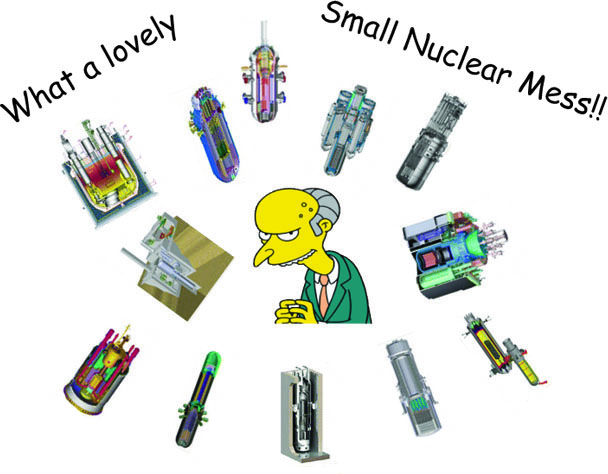
Samedi 2 décembre 2023, par Bernard Laponche, Jean-Luc Thierry, https://global-chance.org/SMRs-two-examples-NuScale-in-the-US-NUWARD-in-France
In recent years, a new type of reactor has appeared on the world stage, the SMR – Small Modular Reactor. Historically, a number of “small reactors” of very different types have been in operation – small in terms of power compared with the reactors of nuclear power plants currently in operation around the world – notably for use in ship propulsion, such as the nuclear submarines of the pressurized water/enriched uranium type.
The “modular” feature of an SMR is achieved by mass production in a dedicated plant. It would then be transported to the operating site, where it would be connected to the heat or electricity production system to form a “module” and then a “power plant”, known as an “SMR”. The hope of SMR promoters rests on the hoped-for gain in unit reactor cost due to the series effect, as they are rightly aware that the cost of a site-built model is far too high.
At present, according to the International Atomic Energy Agency (IAEA), there are almost a hundred “candidate” SMR projects/designs, some of them based on existing prototypes (“small” but not “modular”), most of them existing only on paper, of various power ratings, from enriched uranium and pressurized water reactors, a well-known technology, to plutonium fast neutron reactors, thorium or molten salt reactors, etc. There are no existing SMRs at present.

In addition to a general presentation of the SMR issue and a selection of IAEA projects, this report examines two “SMR candidate” reactor projects in the enriched uranium and pressurized water (PWR) family of reactors : NuScale in the USA and NUWARD in France. Numerous safety-related questions remain unanswered about the NuSCale model, and the Safety Options File for the NUWARD reactor, studied by the French, Czech and Finnish safety authorities, is not yet available. The technical challenges to be met to guarantee SMR safety are not qualitatively different from those of large reactors.

These challenges are compounded by the uncertainties brought about by the reactor’s novel “compact” design, which contains the reactor core (the site of the nuclear fission reaction), the control rods, the steam generator(s) and the pressurizer in a single enclosure. The SMR gamble is not only risky in terms of the bill, but also in terms of the climate, technical and safety agendas, as well as entailing the negative externalities of nuclear installations such as the risk of nuclear accidents and the production of waste that we are relegating to future generations, at least for the next 100,000 years. These reactors also entail other risks, including proliferation.
The complete text is available here : https://global-chance.org/Les-SMR-Deux-exemples-NuScale-et-NUWARD
Holy See advocates collaboration on nuclear disarmament
Archbishop Gabriele Cacccia, the Holy See’s Permanent observer to the United Nations, highlights the disproportionate impact of nuclear weapons on women and girls, and urges synergy between the Treaty on the Prohibition of Nuclear Weapons and existing disarmament measures.
By Francesca Merlo, https://www.vaticannews.va/en/vatican-city/news/2023-12/archbishop-caccia-united-nations-nuclear-weapons-disarmament.html—
Nuclear weapons have catastrophic humanitarian and environmental consequences, multiply risks and offer only ‘an illusion of peace’.
Thus, the the Treaty on the Prohibition of Nuclear Weapons reminds us that a world free of atomic weapons “is possible and necessary and offers us a means to achieve this goal through dialogue”.
These were the points made by Archbishop Gabriele Caccia, Permanent Observer of the Holy See to the United Nations, at the second Meeting of States Parties to the Treaty, signed in 2017 and ratified by 56 countries around the world.
The Archbishop focused on two addresses concerning two fundamental aspects of the Treaty on the Prohibition of Nuclear Weapons: “Implementing the gender provisions of the treaty” and “Complementarity of the Treaty with the existing nuclear disarmament and non-proliferation regime”.
Gender disparity
Speaking on the issue of gender disparity, Archbishop Caccia noted that, for a long time, it was believed that nuclear weapons affected those exposed equally through blast, heat and radiation. However, he said, “newer scientific evidence has shown that this is not the case, and that the radiation effects of nuclear weapon detonations are disproportionately affecting women and girls”.
Archbishop Caccia noted that the Treaty rightly recognises this and “calls for the provision of assistance to victims to be provided in a manner that takes into account the particular needs of each individual”.
The effects on women
Girls exposed to radiation from birth to age five are almost ten times more likely to develop cancer compared to the typical European male. Further research into the factors causing this disproportionate impact on women and children, such as on intergenerational consequences like maternal and fetal health, is essential, said Archbishop Caccia.
This understanding is crucial “to ensure that women exposed to ionizing radiation receive adequate care to preserve their health and the health of their babies”.
The Archbishop went on to stress that “The absence of a solid scientific foundation will hinder States Parties’ effective implementation of the Treaty’s positive obligations, especially those concerning women and girls”, before going on to highlight some queries the Holy See has with the same Treaty.
Use of language
These are the use of unclear language regarding gender, using non-legal terms in discussing assistance for victims, divisive language concerning medical care, and referencing a UN text that hasn’t been negotiated. Because of these issues, “the Holy See cannot support the recommendations outlined in the Report”, said Archbishop Caccia.
Concluding his speech on the implementation of gender provisions in the Treaty, Archbishop Caccia stressed that, due to these significant concerns, “the Holy See considers that the inclusion of a Gender Focal Point in the intersessional structure of the Treaty may need to be reconsidered in the future.”
Relationship between Treaty and existing non-proliferation regime
Addressing the relationship between the Treaty and existing nuclear disarmament and non-proliferation regime, Archbishop Caccia noted that the Treaty on the Prohibition of Nuclear Weapons (TPNW) bolsters Article VI of the Nuclear Non-Proliferation Treaty (NPT) by enforcing the Additional Protocol and the Revised Small Quantities Protocol for states that have signed them. “Despite the NPT’s lagging implementation efforts, particularly under the disarmament pillar, it remains the cornerstone of the disarmament and non-proliferation regime”, he said.
All treaties together
Archbishop Caccia went on to emphasise the potential synergy between the Comprehensive Nuclear-Test-Ban Treaty (CTBT) and the TPNW. He highlighted the importance of leveraging data from the International Monitoring System (IMS) to support the TPNW’s obligations, urging collaboration between TPNW States Parties and CTBT Signatories. “Since the objects and purposes of the TPNW and the CTBT complement and advance one another, it follows that they should be promoted in parallel”, he explained.
Archbishop Caccia concluded that “the Holy See supports greater engagement between TPNW States Parties and the United Nations Scientific Committee on the Effects of Atomic Radiation (UNSCEAR)”, explaining that this could advance understanding of the human and environmental harms caused by nuclear weapons activities “and contribute to efforts to address such harms”.
Nuclear lobby’s latest gimmick – making nuclear BEAUTIFUL !

Making nuclear power plants look great, World Nuclear News, 01 December 2023

They must be desperate. They’ve tried – renewable, -clean, – safe – cheap, – nothing-to-do-with weapons
They’re still lying their heads off about –fixes climate change
Nobody believes them. Now they’re going for beautiful and feel-good.
Good luck with that.
Amber Rudd, a previous UK Minister for Energy tried that, years ago, and it went down like a lead balloon.
We hear from an award-winning architect on the benefits of designing nuclear power plants that make people feel good ....
Technology and function, ensuring their reliable and safe operation have long been the priorities when designing nuclear power plants. But why can’t they look beautiful too? Dutch architect and designer Erick van Egeraat says that part of the way to continue to build public support for nuclear energy is to make nuclear power plants look good, “to make people feel good” when they see them.
The award-winning professor and director of Design Erick van Egeraat outlined his thinking at World Nuclear Symposium, explaining the background to the work he is doing at Akkuyu nuclear power plant, which is being built in Turkey.
Israel Planning for Gaza War To Last Over a Year
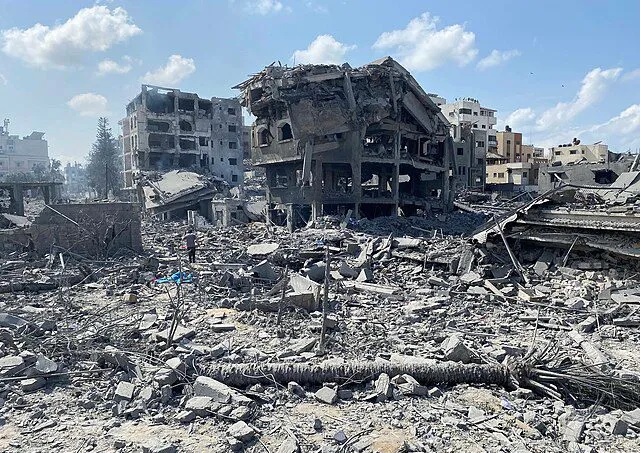
In either case, the Israeli military operations have killed more children, at least 6,000, than members of Hamas.
https://news.antiwar.com/2023/12/01/israel-planning-for-gaza-war-to-last-over-a-year/
One source said, “This will be a very long war . . . We’re currently not near halfway to achieving our objectives.”
The Financial Times reported speaking with sources who said that Israel plans to wage war on Gaza for over a year. In a little less than two months, Israel has killed at least 15,000 people, damaged 100,000 buildings, displaced 1.7 million Palestinians, and destroyed most of Gaza’s medical facilities.
On Friday, FT reported sources said Israel was preparing for a multi-phase conflict in Gaza that will last at least a year. “This will be a very long war…We’re currently not near halfway to achieving our objectives,” said one person familiar with the Israeli war plans.
According to the sources, Israel’s goals include “killing the three top Hamas leaders — Yahya Sinwar, Mohammed Deif, and Marwan Issa — while securing a decisive military victory against the group’s 24 battalions and underground tunnel network and destroying its governing capability in Gaza.”
Israel does not appear close to achieving these goals. US sources have said that Israel’s military operations in Gaza have failed to impact high or even mid-level Hamas members. On Sunday, the Guardian reported that Israeli officials estimated that 1,000 – 2,000 Hamas members had been killed. However, FT spoke with an Israeli military source who gave an estimate of 5,000 dead Hamas members. It is unclear why there is such a large discrepancy in the numbers, as both were given during the week-long pause in fighting.
In either case, the Israeli military operations have killed more children, at least 6,000, than members of Hamas. The massive civilian toll has led to mounting world opinion against Israeli military operations.

Secretary of State Antony Blinken attended a meeting of the Israeli war cabinet on Thursday and warned that Tel Aviv will lose more international support as the conflict continues. Gen. Herzi Halevi, the Israeli Defense Forces (IDF) chief of staff, said military operations in Gaza will take “more than a few additional weeks,” suggesting Tel Aviv did not plan to follow Washington’s advice. Still, America’s top diplomat said Washington was still firmly committed to arming Tel Aviv.
The first phase of the war, an intense bombing campaign and ground invasion, is expected to last well into 2024. One source said the first phase of the war is about 40% complete. “Gaza City isn’t finished yet, nor fully conquered. It’s probably 40% done,” the person explained. “For the north as a whole, it will probably require another two weeks to a month.”
The second phase will be an operation with fewer military operations aimed at stabilizing Gaza. While the sources told FT that the second phase is projected to continue until late 2024, Israeli officials say they cannot predict a firm endpoint to the conflict.
The Biden administration has pushed Israeli Prime Minister Benjamin Netanyahu to agree to allow the Palestinian Authority to control Gaza after Hamas is defeated. However, one source told FT that Tel Aviv will not listen to Washington, even as the US provides Israel with billions of dollars in weapons. “No one, not even the US, can talk to them about this,” said one of the sources familiar with the matter. That person emphasized that this point was crucial to Netanyahu keeping his far-right war cabinet together.
Why the UN Report is right to say we’re heading for at least 3 degrees of warming

100% Renewables 2nd Dec 2023
Despite a flurry of headline-jerking agreements at Dubai’s COP28 a UN Report suggests that global warming will reach 3 degrees. This conclusion, issued by the UN Environment Programme’s ‘Emissions Gap Report’, is based on the continuation of current policies. This assumes, for instance that in the UK and the USA, the targets for net zero greenhouse gas emissions by 2050 not achieved. This, by the way, is by no means an unreasonable assumption. In fact, as things stand at the moment, it’s dead right!
Achieving the 2050 net zero target means that all heating, transport and industrial energy uses need to be decarbonised. Then the production of electricity will have to be greatly expanded. That, actually, is the easier task eg if you consider that the whole of the UK’s energy supply could be supplied by electricity from offshore windfarms occupying less than 10 per cent of the UK’s seawaters……………………………………………….
it does seem likely (on the basis of the UN analysis) that we are facing a temperature increase of 3 degrees above industrial levels. Temperatures have now risen by 1 degree and the effects are apparent. Yes, these COP events are, as Greta Thunberg said, by and large, just ‘blah blah blah’. https://100percentrenewableuk.org/why-the-un-report-is-right-to-say-were-heading-for-at-least-3-degrees-of-warming
A blank cheque for France’s Industrial Centre for Geological Disposal (Cigéo) does not prove that it is safe.
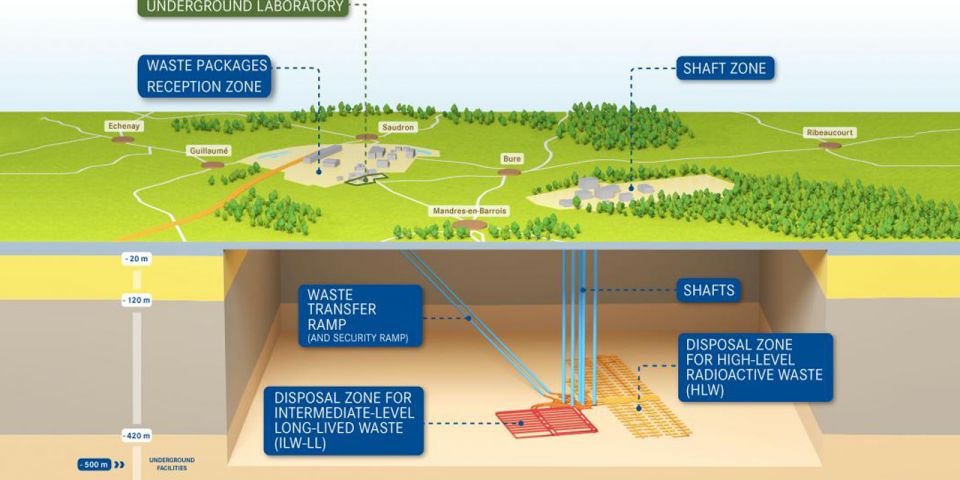
In September 2022, 32 organizations and 30 residents jointly filed an
appeal contesting the declaration of public utility (DUP) which was granted
to the Cigéo project (deep geological burial project for the most
radioactive waste) by decree on July 7, 2022.
This decision allowed the
National Agency for Radioactive Waste Management (ANDRA) to acquire the
missing land control for surface installations and the plumbness of
underground works, i.e. approximately 3,500 hectares (the equivalent of the
surface area of Lille) and to expropriate if necessary.
More than a year
later, on December 1, 2023, the Council of State rendered its decision.
Despite all the uncertainties and inaccuracies of the impact study of the
Cigéo project, ANDRA has succeeded in painting with scientific virtues the
fact that it is unable to provide precise evaluations, even with a
Declaration of ‘Public Utility (DUP) of 6,000 pages and almost 30 years of
studies.
It was enough for the Agency to affirm that it will do its best to
precisely identify the impacts of its project and to analyze and counter,
as the construction of Cigéo progresses, all their consequences. We do not
understand how such a project was able to obtain a DUP when it lacks so
much precise “basic” information. Let us remember: the declaration of
public utility facilitates land control, or even the start of work on other
so-called “preparatory” developments for Cigéo and allows the
industrial site to be physically anchored in the territory.
But for those
who read this decision a little too quickly, no, Cigéo is still not
“validated”. The project still needs to pass the stages of creation
authorization which, without giving up, we will attack by all means when
the time comes. We will at least have warned current decision-makers and
present generations and left messages for future generations, engraved in
stone in the archives of the Republic and its Councils.
Sortir du Nucleaire 1st Dec 2023
https://www.sortirdunucleaire.org/CIGEO-un-blanc-seing-qui-ne-signifie-pas-son
1 This Month





PLEASE OPPOSE HR 8255 AND S.3639 – bills would accelerate satellite deployment, with no environmental review or safeguards – https://ncstd5li.quorum.us/campaign/169331/
To see nuclear-related stories in greater depth and intensity – go to https://nuclearinformation.wordpress.com
-
Archives
- October 2026 (81)
- September 2026 (339)
- August 2026 (330)
- July 2026 (355)
- June 2026 (287)
- May 2026 (306)
- April 2026 (356)
- March 2026 (251)
- February 2026 (267)
- January 2026 (308)
- December 2025 (358)
- November 2025 (359)
-
Categories
- 1
- 1 NUCLEAR ISSUES
- business and costs
- climate change
- culture and arts
- ENERGY
- environment
- health
- history
- indigenous issues
- Legal
- marketing of nuclear
- media
- opposition to nuclear
- PERSONAL STORIES
- politics
- politics international
- Religion and ethics
- safety
- secrets,lies and civil liberties
- spinbuster
- technology
- Uranium
- wastes
- weapons and war
- Women
- 2 WORLD
- ACTION
- AFRICA
- Atrocities
- AUSTRALIA
- Christina's notes
- Christina's themes
- culture and arts
- Events
- Fuk 2022
- Fuk 2023
- Fukushima 2017
- Fukushima 2018
- fukushima 2019
- Fukushima 2020
- Fukushima 2021
- general
- global warming
- Humour (God we need it)
- Nuclear
- RARE EARTHS
- Reference
- resources – print
- Resources -audiovicual
- Weekly Newsletter
- World
- World Nuclear
- YouTube
-
RSS
Entries RSS
Comments RSS

