Sad Clown with the Circus Closed Down*: Zelenskiy’s Demise
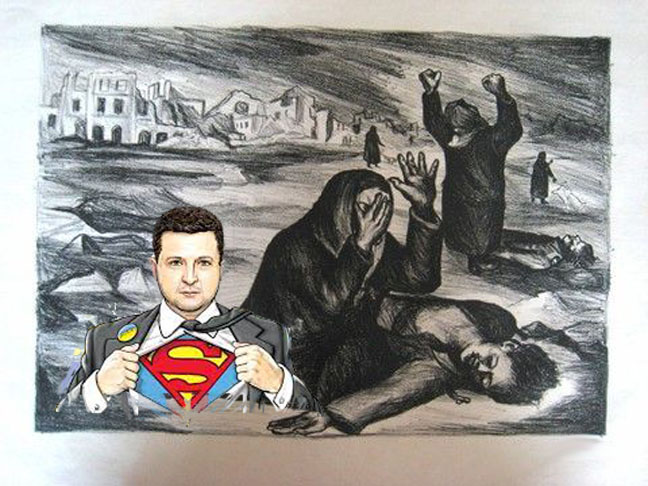
When it comes to love for the limelight and delusions of grandeur, Zelenskiy outstrips most politicians and not least of all Putin. Almost all politicians are egoistic, but Zelenskiy is narcissistic.
Zelenskiy’s inexperience and ego likely played pivotal roles in his disastrous decision-making.
Zelenskiy himself remained mired in personal corruption as the Pandora Papers demonstrated
Zelenskiy’s failures also have made him eminently expendable
by GORDONHAHN , December 11, 2023, https://gordonhahn.com/2023/12/11/sad-clown-with-the-circus-closed-down-zelenskiys-demise/—
Introduction
Ukrainian President Volodomyr Zeleneksiy appears to be at the end of the line politically and perhaps biologically. Portraying himself as a fighter for peace, anti-corruption, and full democratization when he ran for and won the presidency in 2019, he proceeded to lead the country into war, further corruption, and de-republicanization (authoritarianization).
On both a personal and global level this is high tragedy. A superb comedian and actor stars in a television fictional series as the president of Ukraine, rises in popularity, wins the country’s presidency on a peace platform, and leads the country into a catastrophic, easily avoidable war that threatens the survival of his country and himself.
The unreality of Ukraine refracts in our century of simulacra and disinformation through this icon moved from the television screen to real life politics, and the tragedy of it all is sold as a heroic triumph on the road to universal democracy, peace, and brotherhood.
In the real world, however, there is a rub. The country is historically divided along every conceivable line (ethnic, linguistic, cultural, political, ideological, economic, and social), an almost accidental state cobbled together by communists but claimed by hapless republicans and determined ultra-nationalists. Thus, Zelenskiy becomes president of a fundamentally divided country further riven by schism as a result of two ‘revolutions’ – really revolts – and a civil war compounded by foreign (Russian) intervention.
****************************
Zelenskiy’s emergence and victory are as surreal as the Maidan regime of which he assumed leadership.
Continue readingFrance scores diplomatic wins on banks and nuclear in new EU rules

Paris successfully pushed for weaker due diligence reporting by lenders and state-backed funding for nuclear power plants
Alice Hancock in Brussels, 15 Dec 2, Ft.com
France has secured a partial carve-out for banks from new EU rules to make companies responsible for environmental impacts in their supply chains. Paris also won, in separate negotiations, assurance that state-backed funding for its nuclear power plants will be possible under a reform of the EU electricity market, the culmination of a concerted effort to champion the low-carbon fuel in the face of opposition from Luxembourg, Austria and Germany.
Agnès Pannier-Runacher, French energy minister, hailed the decision as “excellent news”. “It gives us the means to ensure long-term financing for the transformation of our electricity system,” she said……………………………
France, backed by countries including Italy and the Czech Republic, has succeeded in making sure that banks, asset managers and investment groups will only have to report on upstream activities such as purchasing office equipment. They will not have to undertake due diligence on the activities of clients to whom they are offering loans — something that the European parliament had pushed for in the talks.
In a note circulated among negotiators earlier this month, the European Central Bank also warned that “excluding the financial sector would be counterproductive to the intention of the [law], as it would allow the EU financial sector to continue to fund activities detrimental to the EU [environmental and social governance] agenda”.
Arianne Griffith, corporate accountability lead at the NGO Global Witness, said that it was “shocking” that EU countries had “sunk plans to ensure that banks stop investing in environmental and human rights abuses”. Eelco Van der Enden, chief executive of the Global Reporting Initiative, said that it was “disheartening” to see that the French effort had watered down the application of the rules to the financial sector but that a review clause in the agreement could offer the opportunity to include them at a later stage………………………………………..
Both the energy market reform and the due diligence rules must be formally approved by the European parliament and member states in votes due to take place early next year. Once the due diligence directive is approved, EU governments will have two years to introduce the rules in national legislation. https://www.ft.com/content/a4f7c547-1a58-482f-889e-f6400c44bbf7
Biden Has Damned the United States Over Israel’s Gaza Genocide
The Biden White House has brought the U.S. into global disrepute for its flagrant complicity in Gaza’s genocide.
Strategic Culture Foundation, Finian Cunningham, December 14, 2023
On a day of global shame this week, the United States voted against calling for a ceasefire in Gaza. It means the U.S. is an accomplice in the genocide by the Israeli regime.
It can’t get more graphic than this. Out of 193 nations at the United Nations, 153 of them (nearly 80 per cent) voted for an immediate ceasefire and the urgent delivery of humanitarian aid to Gaza where more than two million civilians have been subjected to over two months of non-stop indiscriminate bombing by the Israeli military.
Not just callous deliberate murder of civilians, but a blockade on all basic humanitarian needs. Water, food, medicines, and fuel have all been cut off by an Israeli regime that calls Palestinians “human animals”.
This is the second time the U.S. has voted against the vast majority of nations at the UN General Assembly appealing for an end to the violence. The United States has also vetoed three resolutions at the UN Security Council calling for a ceasefire.
In the latest vote on December 12, the U.S. joined with Israel and a handful of minor states in opposing the call for peace. Another 23 states shamefully abstained including Britain, Germany, the Netherlands, Italy and Ukraine.
On the same day, President Joe Biden gave a speech to fundraisers in Washington DC in which he cautioned Israel to be “more careful” in conducting the military onslaught against Gaza. Biden was more concerned that Israel’s “indiscriminate bombing” of civilians was a public relations problem, not a moral outrage and war crime.
Nevertheless, Biden again reiterated “unconditional” support for Israel by supplying all the bombs and weapons it requests. In the past week, the White House has approved over $100 million in tank artillery shells for Israel as part of an emergency fund that does not require any vetting by lawmakers. The Biden administration is also pushing Congress to pass a much larger military support package worth over $14 billion.
Professor Francis Boyle, a renowned international legal authority, says that the United States is fully complicit in Israel’s genocide against the Palestinians in Gaza and the Occupied West Bank territory.
In an email to this author, Professor Boyle points to evidence “all across the board” from the unconditional supply of bombs and missiles by the United States to Israel, to the U.S.’ repeated voting positions at the UN that are enabling the continued mass, systematic violence.
Several Israeli leaders, including Premier Benjamin Netanyahu, have openly stated their genocidal intent of erasing the Palestinian population from occupied territories. The blatant bombing of hospitals and refugee camps and the killing of women and children, in particular, shows that the Israeli regime has no respect for international law.
Netanyahu has publicly thanked President Biden for the United States’ support. It is openly reported that U.S. and Israeli military commands are liaising in the conduct of operations in Gaza.
The presence of U.S. naval forces in the East Mediterranean is meant to deter any Arab or Muslim nation or group from intervening to help defend Palestinians.
The Biden administration is as cowardly as it is duplicitous. It talks about “concern” for civilian casualties in Gaza while giving the Israeli regime its full support to commit the sickening slaughter of innocents. Biden is only concerned about how the massacre doesn’t look so good to the rest of the world and American voters as a presidential election approaches.
Hence the creepy advice from Biden for Israel “to be more careful”. His advice is not to stop the mass murder of children but to just do it more discreetly…………………………………………………………………………………….. more https://strategic-culture.su/news/2023/12/14/biden-has-damned-united-states-over-israels-gaza-genocide/
EDF told not to expect UK to step in to fund Hinkley Point C flagship nuclear project

Cost overruns a ‘commercial issue’ for Hinkley Point C’s French
developer after CGN halts payments, says British official.
The UK government has signalled it will not step in to help France’s EDF fund
Hinkley Point C after its Chinese partner CGN halted payments to cover
mounting cost overruns on Britain’s flagship nuclear power project. The
reluctance of the British government to intervene comes as the price tag
for the power plant under construction in south-west England is likely to
exceed the revised £32.7bn estimate EDF put on it earlier this year,
according to people close to discussions.
CGN, EDF’s partner in Hinkley Point C, had agreed to finance 33.5 per cent of the original £18bn cost of the plant in 2016, with the French group responsible for the remainder. But
after paying its contracted share, CGN has not made payments linked to the
overruns in recent weeks, three people familiar with the matter said.
The French group warned earlier this year that the Chinese group could refuse
to pick up the extra costs. One UK government official said there were no
plans to step in to fill the gap left by CGN, suggesting EDF could pull in
other investors. “It is a commercial contract which we obviously don’t
play a part in financing,” the official said, adding: “It would first
be a matter for the shareholders.”
One industry source said pulling other
investors into the project at this stage would be “complicated”. The
French economy ministry said it was in contact with London over the issue.
“We’re working with the British government to ensure the rollout of the
UK nuclear programme, including on the financing front,” an official in
Paris said.
FT 14th Dec 2023
https://www.ft.com/content/2bccd67f-a3c6-48d1-baa5-8ef9d54cdf67
HOW BIDEN’S STATE DEPARTMENT CONCEALS ITS “HUMAN RIGHTS BLACK HOLE” IN THE MIDDLE EAST
At a key meeting, U.S. stage management stops the world from hearing critics of Israel’s war on Gaza.
Jon Schwarz, December 12 2023, https://theintercept.com/2023/12/12/universal-declaration-of-human-rights-state-department/?fbclid=IwAR3RvuNtk5azWxFu4KHGXg4zyZmA4dVF724kTpsKCcMOiiy4ScuWLkYYulQ
LAST WEEK, Secretary of State Antony Blinken hosted a meeting with leaders of human rights organizations to mark the 75th anniversary of the adoption of the Universal Declaration of Human Rights by the United Nations. But through subtle stage management, the State Department arranged for Blinken’s praise for human rights to be recorded and promulgated — while the world was not able to hear the retorts from human rights advocates who criticized America’s backing of Israel’s war on Gaza.
The Universal Declaration was a landmark in history. While it was only a statement of principles, and so did not have legal force in itself, it was broadly inspirational and has formed the basis for numerous subsequent treaties and laws. According to Guinness World Records, it’s been translated into more languages than any other document — over 550, from Abkhaz to Zulu.

After the December 7 meeting, the internet exploded in bitter laughter at Blinken, and it’s easy to understand why. At the start of the meeting at the State Department, Blinken informed the assemblage that “the universality of human rights is under severe challenge and rights are being violated in far too many places … And of course we see atrocities in the midst of conflict.” Yes, of course. Just one day later, on December 8, the U.S. vetoed a resolution at the U.N. Security Council calling for a ceasefire in Israel’s war on Gaza.
Notably, the Universal Declaration states that “everyone has a right to a nationality.” The Universal Declaration was adopted on December 10, 1948, one day before U.N. Resolution 194 was passed. Resolution 194 famously stated that, in the wake of the establishment of Israel earlier that year, Palestinian refugees “wishing to return to their homes and live at peace with their neighbors should be permitted to do so at the earliest practicable date.” This anniversary has not been commemorated with an event at the State Department.
Indeed, the whole process with Blinken was as distastefully funny as the Russian government’s own recent celebration of the Universal Declaration’s anniversary, in which it spoke of its deep concern over “the human rights situation in Ukraine.” This is where the U.S. government’s stage management comes in.
There were four human rights organizations in attendance, all represented by their top officials: Amnesty International (Agnès Callamard), Human Rights Watch (Tirana Hassan), the Committee to Protect Journalists (Jodie Ginsberg), and Freedom House (Michael Abramowitz).
We know this because all four leaders appeared in the above photo happily tweeted out by Blinken himself. And all four groups confirmed their presence to The Intercept. But when asked, the State Department refused to name who was in attendance because, it explained, this meeting took place in a “private setting.”
In addition to the photo provided by Blinken, you can watch a video of this private setting on the State Department’s publicly available website. At 0:59, as Blinken natters on, you can see one of his bored functionaries glancing at his watch.
What actually happened is that, as the Committee to Protect Journalists puts it, “the State Department made clear that Secretary Blinken wanted to make a statement on the record but the meeting was private.”
In other words, the U.S. government insisted that there be a public section of the meeting at the start, in which Blinken spoke and the human rights leaders would be photographed listening to him. Then, these photographs and Blinken’s words were distributed to the world. But the human rights leaders’ words were not.
Asked about his own experiences in such situations, Kenneth Roth, Hassan’s predecessor as head of Human Rights Watch, says that “there is nothing inherently wrong with having an off-the-record meeting with government officials … but it is odd for the Biden administration to mark the 75th anniversary of the Universal Declaration with an off-the-record meeting.” Roth explains that the Universal Declaration had modest influence in the decade after its adoption because it was considered undiplomatic for governments to criticize others by name. However, that changed in the 1960s and 1970s. “A commemoration of the Declaration that embraced what has made the document so impactful,” Roth contends, “would have been an on-the-record meeting in which abusive governments were unabashedly singled out by name.”
Human Rights Watch and Freedom House both declined to provide any details about what their officials told Blinken, stating that the post-photo op section of the meeting was off the record.
However, Amanda Klasing, Amnesty International’s national director for government relations and advocacy, did comment. Callamard, she says, “urged Secretary Blinken to seize the current inflection point, be consistent in the US’s attention to human rights, and send the message that human rights apply equally to non-US allies and to its closest friends. She made clear that this is especially urgent today, as Amnesty International has documented that the government of Israel – one of the US’s closest allies – is flagrantly violating international humanitarian law in its attacks on Gaza. She urged him to see the need for an immediate ceasefire and a stop to the transfer and sale of arms to the government of Israel in the existing context.”
The Committee to Protect Journalists was also willing to describe its leader’s remarks. According to CPJ, Ginsberg “most certainly brought our full-range of deep and urgent concerns regarding journalists in Gaza. The ongoing disaster is a top priority for us. Ginsberg underscored that more than 60 journalists have been killed (the vast majority Palestinians in Gaza), the increasingly difficult conditions, and the broader clampdown on the press and arrests including the West Bank. Notably, we strongly reiterated our demand for accountability in the likely targeting of journalists in southern Lebanon. In doing so, we stated our deep concern that the pattern of journalists being killed with impunity by the Israel Defense Forces is a long one.”
Roth, for his part, adds that “we don’t need another symbol of the Biden administration’s commitment to human rights. … A more meaningful way to celebrate the Universal Declaration would have been to visibly enforce it in the human rights black hole that the Middle East has largely become for the Biden administration.”
In a nice touch by the State Department, the meeting was held in its Thomas Jefferson State Reception Room, so the participants were overseen by both a statue and a painting of Jefferson. Jefferson was America’s first secretary of state, as well as the author of the Declaration of Independence — in some ways the progenitor of the Universal Declaration of Human Rights. Jefferson also enslaved 600 people over his lifetime and raped his dead wife’s half-sister, whom he owned. He thus is perhaps America’s greatest exemplar of our history of soaring rhetoric combined with a much grimier reality.
INTERNS ACCUSE CONGRESS OF SUPPRESSING CALLS FOR CEASE-FIRE
Poplsr Resistance, By Molly Redden, HuffPost., December 14, 2023, Resist!
The Workers In 71 Congressional Offices Have Recorded A Total More Than 690,000 Calls For A Cease-Fire.
But most are “unnoticed and unheard,” an open letter said.
Congressional interns and fellows released a letter on Monday accusing Congress of having “suppressed and ignored” a tidal wave of constituent support for a permanent cease-fire in the Israel-Gaza conflict.
More than 140 interns and fellows signed the letter, and 71 disclosed the number of calls and emails in support of a cease-fire that their offices have recorded. Those 71 offices (out of the total of 535) have received a total of 693,170 messages supporting a cease-fire since Israel’s bombing of the Gaza Strip began in early October.
But in spite of constituents’ outreach, most senators and representatives have refused to publicly support a cease-fire — and privately, the letter said, many senior staffers responsible for briefing members of Congress are downplaying the number and intensity of the calls.
“In some cases, Members of Congress are not being adequately briefed about the volume or contents of these messages,” the letter says. “In several instances, senior staff have deliberately provided inaccurate information about these data to Members. In other cases, Members have willfully ignored the pleas of large swaths of their constituents.”
Congressional phone lines have been clogged with calls for a cease-fire almost since the very start of hostilities, staffers have previously reported………………
The indiscriminate nature of the retaliation, coupled with the Biden administration’s steadfast support for its closest military ally, has sparked nationwide protests in the U.S. and profound outrage among many of the president’s own voters.
“While we refrain from telling our bosses how to do their jobs, as congressional interns and fellows, we owe it to the American people to expose the patent malpractice of Congress,” the letter says. “We can no longer stand by while the voices of constituents are suppressed and ignored by their elected officials.”
The letter came together after interns and fellows in several offices witnessed senior staff downplaying the number of calls and emails supporting a cease-fire, one of the letter’s organizers told HuffPost. In his office, a senior staffer quoted a number to the congressman that was 3,000 less than the actual number of callers, the organizer said.
“It’s very deliberate,” he said. “They see these overwhelming numbers, and they decrease it.”
Letter To Congress…………………………………………………………..
Signers of the letter work in Democratic and Republican offices and are remaining anonymous out of fear of career retaliation. The organizers, who spoke with HuffPost on the condition they not be named, verified the identities of those who signed.
Because interns answer the vast majority of constituent calls, many of those who signed the letter have personally fielded thousands of calls from constituents demanding a cease-fire.
“Out of the tens of thousands of calls made to our office, one in particular stood out to me: A constituent called in tears to share that her husband’s family had been killed in a hospital bombing in Gaza,” wrote one of the letter’s signers. “She had pleaded with me to change the Member’s stance on the war.”………………………………….. more https://popularresistance.org/interns-accuse-congress-of-suppressing-calls-for-cease-fire/
Member for Dublin urges swift action on Sellafield nuclear threat.
PADRAIG CONLON 14 DEC 2023 https://dublinpeople.com/news/dublin/articles/2023/12/14/mep-urges-swift-action-on-sellafield-nuclear-threat/
Europe’s most hazardous nuclear site, Sellafield, holds 140 tons of plutonium and poses a significant threat to Ireland’s safety.
This is according to Fianna Fáil MEP for Dublin, Barry Andrews, who has expressed his unease with a threat posed by the Sellafield nuclear plant in the UK.
The nuclear facility, which started operating in 2001, is located less than 100 miles off the east coast of Dublin.
Andrews says that last Monday, December 11, at a plenary session of the European Parliament in Strasbourg, he called on the EU Commissioner for Energy, Kadri Simson, to use her office to engage with UK counterparts and address the alarming findings reported recently in The Guardian newspaper.
The investigation by The Guardian uncovered a myriad of issues, including cyber-attacks, vulnerability to sleeper malware, and a toxic workplace culture.
The year-long probe emphasised the potential for “potentially significant consequences” if these problems persist.
During his contribution last Monday, MEP Andrews said: “Sellafield, Europe’s most hazardous nuclear site, holds 140 tons of plutonium posing a significant threat to Ireland’s safety.
“Daily, a staggering 2.3 cubic meters of radioactive sludge seeps into the ground, prompting concerns over potential far-reaching consequences.”
Expressing his concern, MEP Andrews continued: “Ireland is facing a potentially catastrophic environmental crisis right on its doorstep.
“Given the substantial amount and type of radioactive materials, both the Government of Ireland and the European Union should be deeply alarmed by the reports of the deteriorating infrastructure.
“A catastrophic failure in infrastructure could have a devastating impact on Ireland and the Irish Sea, placing the people of Ireland directly in danger.”
MEP Andrews referred to a 2001 European Parliament report, warning of a Sellafield accident potentially surpassing Chernobyl, exposing five million Europeans to radiation.
The Irish Sea, now deemed the most radioactively contaminated globally by Greenpeace, amplifies the gravity of the situation.
MEP Andrews also raised concerns about security issues at Sellafield, where cyber groups linked to Russia and China have hacked into the facility.
The Guardian’s investigation uncovered a consistent cover-up by senior staff regarding this disclosure and its potential effects.
Sleeper malware, detected as early as 2015, poses an ongoing threat, potentially compromising sensitive activities at Sellafield.
Reflecting on the broader implications, Andrews stated:
“This goes beyond the immediate threat to Ireland; it’s a matter of international security.
“If the information obtained in these cyber-attacks were used in an attack on the UK, Ireland could also become an unintended victim.
“We cannot underestimate the gravity of the situation.”
In light of these pressing issues, Andrews called for swift international action.
“The urgency cannot be overstated,” he said.
“We need the European Commission for Energy, Kadri Simson, to collaborate with international partners and address this environmental and security threat head-on.”
German nuclear plant to be replaced by Europe’s biggest battery.
PreussenElektra, operator of the decommissioned Brokdorf nuclear power
plant in northern German state Schleswig-Holstein, which was taken offline
at the end of 2021, wants to transform the site into a power storage
facility, reports NDR.
Initial plans could see a 100-megawatts (MW) battery
plant operating on a site close to the nuclear power station in 2026. A
second phase would add 700-megawatts of capacity, hosted on the 12-hectare
site of the nuclear power plant itself. (No storage duration was cited).
The company hopes to have the entire project online in 2036, but is waiting
for authorisation to begin dismantling the decommissioned reactor.
Renew Economy 15th Dec 2023
At COP 28, fossil fuels targeted for the first time, but with a weak pledge

Nations at the UN climate summit have for the first time taken explicit
aim at the use of fossil fuels. The talks in Dubai came close to collapse
but in a dramatic turn-around, nations agreed to “transition away” from
coal, oil and gas.
But small islands hit hard by climate change protested,
saying the deal was rushed through without them. And it departed from
earlier stronger language to “phase out fossil fuels”. Many nations
including the US, UK and European Union had pushed for a phase out from the
opening of the talks. Close to 200 nations were in the United Arab Emirates
for almost two weeks to try to make progress on tackling climate change
after months of record-breaking extreme weather.
BBC 14th Dec 2023
Why Zelensky’s ‘Fantasy’ of Building Military-Industrial Hub in Ukraine is Doomed

Sputnik, 12.12.2023
While in Washington DC, Ukrainian President Volodymyr Zelensky met with executives of US defense companies and outlined his plan to create an industrial defense hub in Ukraine. Will the plan fly?
Volodymyr Zelensky met top executives of BAE Systems, Lockheed Martin, Boeing, Northrop Grumman, General Dynamics, AeroVironment, and other companies of the US military-industrial complex at Ukraine House on his on-going visit to the US.
He told them that Ukraine is ready to jointly produce ammunition and weapons on its soil but needed their support. “We are ready to act quickly, and we have already started to do so, since we have no other way to change the system as we are at war,” the Ukrainian president said, offering US companies a stake in Ukrainian defense firms.
However, it’s unlikely that US defense contractors will rush to jump at the opportunity, said retired Colonel Anatoliy Matviychuk, a Russian military expert, who has experience in combat operations in Afghanistan and Syria.
“I think that everything that Zelensky told them was his fantasies and his attempt to come up with something,” Matviychuk told Sputnik. “Who in their right mind would now invest money in a country that is practically non-existent? It’s gone. It lives as a subsidy fund of the budget of the United States of America.”
“Can Ukraine produce anything? I doubt it very much, because the production facilities are completely in tatters. I suppose there may be something there in Western Ukraine, but Western Ukraine has always been subsidized, there has never been heavy industry there. There are no industrial areas [in Western Ukraine], like there once were in Donetsk, Donbass, or like Yuzhmash [in Dnepropetrovsk]. I think Zelensky is simply detached from reality,” the expert continued.
It’s not the first time that Zelensky has lauded Ukraine’s non-existent industrial capacity: in August, the Ukrainian president announced that Kiev had increased its weapons and ammunition production. Commenting on the statement, military expert Alexei Leonkov explained to Sputnik that Ukraine’s production sites, which are largely focused on assembling drones, are routinely detected and destroyed by the Russian military. Leonkov added that most of Ukraine’s production prowess was destroyed soon after the collapse of the USSR due to the endemic corruption and power struggle in the Eastern European nations.
To complicate matters further, lots of Ukrainian engineers and rocket scientists fled the country after the beginning of the Russian special military operation in February 2022, noted Matviychuk, while many others have been mobilized and thrown into battle………………………………………………….
US and Poland Don’t Need Industrial Hub in Ukraine
The development of Ukraine’s industrial sector fits into a new strategy considered by American and Ukrainian officials. American decision-makers want Kiev to go on the defensive, dig in and replenish its weapon storages.
According to Matviychuk, Zelensky’s attempts to go in line with the proposed strategy stem from his fear to lose both the Ukrainian presidency and the West’s support………………………………………………. https://sputnikglobe.com/20231212/why-zelenskys-fantasy-of-building-military-industrial-hub-in-ukraine-is-doomed-1115539804.html
Radioactivity detected in Fukushima worker’s nose
Japan Times 15 Dec 23
A worker at the Fukushima No. 1 nuclear plant has had a high radiation level detected in his nose, authorities said, in a reminder of the hazards involved in cleaning up the facility crippled in 2011.
Radioactive materials may have touched the worker’s face on Monday as he took off a full-face mask after finishing his work, operator Tokyo Electric Power Company Holdings (Tepco) said Thursday.
The employee was not experiencing any adverse health effects and a full body scan showed no internal contamination, but a full analysis will be available next month, Tepco said.
It was the second such incident in three months after two workers were splashed with water containing radioactive materials in October and were hospitalized as a precaution…………………….more https://www.japantimes.co.jp/news/2023/12/15/japan/fukushima-worker-radiation-detected/
Cop28 president says his firm will keep investing in oil

The president of the Cop28 climate summit will continue with his oil
company’s record investment in oil and gas production, despite
coordinating a global deal to “transition away” from fossil fuels.
Sultan Al Jaber, who is also the chief executive of the United Arab
Emirates’ national oil and gas company, Adnoc, told the Guardian the
company had to satisfy demand for fossil fuels.
Guardian 15th Dec 2023
As the world starts to panic over climate change, nuclear evangelists offer spurious solutions


I too wish that the things that the nuclear industry says about itself were true—I wish it was green and renewable. I wish that there weren’t multiple uranium mining sites around the world with thousands of tons of uranium tailings abandoned and open to the elements, continuing to harm the health of generations born long after mining ceased.
I wish that it didn’t take immense, carbon-intensive mining projects to extract uranium from the Earth, and then again to “deposit” the spent nuclear fuel from reactors back half a kilometer underground.
Nuclear Stockholm Syndrome, https://www.counterpunch.org/2021/07/09/nuclear-stockholm-syndrome/
BY ROBERT JACOBS 9 July 21, Bhaskar Sunkara’s recent opinion piece extoling the virtues of nuclear power and castigating its opponents as paranoid and ill-informed, is clearly motivated by his deep concerns over the dire impacts of global warming, which loom closer by the hour. Unfortunately, his arguments amount to little more than regurgitated industry talking points, in their traditional form of a Jeremiad.
First, Sunkara poses the decline of the nuclear industry in the West as an achievement of progressive political movements. Specifically, he cites the decline of nuclear power in Germany as attributable to a “Green party-spearheaded campaign.” This decline has been more reasonably ascribed to both market conditions and missteps by nuclear industry giants such as Westinghouse and AREVA. From its inception, nuclear power has been heavily dependent on government subsidies to appear economically viable (subsidies such as insurance and the disposal of waste largely configured as taxpayer burdens).
Rather than succumbing to its political opponents on the left, the industry has been sunk by its structural economic dysfunctions. In the US, this has sparked schemes to secure additional taxpayer subsidies in legislative fixes such as guaranteed returns for nuclear utilities, and outright bribery of legislators for taxpayer bailouts of failing companies.
The most simplistic recitation of nuclear industry talking points is when Sunkara dismisses concerns about nuclear waste, and extolls the mythic separation between “civilian” and “military” nuclear technologies. He asserts that most nuclear waste “can be recycled to generate more electricity,” an assertion that goes back more than half a century and has been ritualistically recited by an army of nuclear industry PR professionals before him…yet here we are 50 years later and very little spent nuclear fuel has actually been recycled. The most successful nuclear recycling nation is France which, nevertheless, is experiencing a “nuclear exit” and is unlikely to ever use this recycled fuel. AREVA, the French nuclear giant, has gone bankrupt. Reprocessing facilities like the Rokkasho plant here in Japan have never functioned properly, unless you consider their role enabling the stockpiling of plutonium by Japan to hedge against future weapon needs to be an elemental goal.
There is a difference between what can be done, and what actually happens. Rather than being recycled, hundreds of thousands of metric tons of spent nuclear fuel await “final disposal” in deep geological repositories. Some have been waiting for over 70 years. Just last week, a panel advising the EU on categorizing nuclear plant as “green” energy, and thus eligible to receive EU funding as a “sustainable investment,” concluded that the problems of nuclear waste preclude that designation.
I would point out that even though plastics manufacturers assure us that most plastic can be recycled, we still seem to be living a world with ever increasing amounts of plastic waste. Their greenwashing has not eventuated in a world full of plastics made from recycled materials. The market reality is that it is cheaper to manufacture new plastic than it is to manufacture plastic from recycled materials. Similarly, it is cheaper to discard spent nuclear fuel than it is to reprocess it.
Sunkara dismisses the irrevocable link between military and civilian nuclear technologies as imaginary. First, let’s consider the present imbrication. A 2019 Atlantic Council study places the value of the US civilian nuclear complex to the US national security apparatus at $26 billion annually simply in terms of the human capital assets: “In terms of nuclear technology innovation, export capacity, and geopolitics, a vibrant civilian nuclear energy sector is a critically important national security asset.”
However, the civilian operation of nuclear power plants also places future generations at military risk. I have written that, historically, nuclear reactors were “born violent.” That is to say, they were invented by the Manhattan Project in the early 1940s to manufacture plutonium for use in nuclear weapons, and were instrumental in killing almost 100,000 people in 1945. The “first” American commercial atomic plant in Shippingport, PA that went critical in 1958, was actually the 14th industrial nuclear reactor built in the United States, the other 13 only manufactured plutonium, which by then formed the fissile cores of thousands of nuclear weapons.
In nuclear reactors used to make electricity, this plutonium is not separated out for use in weapons. However, all nuclear power plants remain plutonium production factories. The fact that most of those tons of plutonium remain in the spent fuel rods does not mean they will stay there forever. Thousands of years from now, some government or military may dig up the spent fuel in our deep geological repositories and separate that plutonium out to build nuclear weaponry. All it would take is the technology (technology we currently possess) and the will. We continue to manufacture that plutonium—perhaps for them to weaponize. Every nuclear power plant that operates adds to that inventory; more than 99% of existing plutonium was manufactured in nuclear reactors. In 1962, the US successfully detonated a nuclear weapon assembled with just such “reactor-grade” plutonium. Our generation’s use of nuclear power silently stockpiles fissile material that will remain militarily viable for millennia.
I too wish that the things that the nuclear industry says about itself were true—I wish it was green and renewable. I wish that there weren’t multiple uranium mining sites around the world with thousands of tons of uranium tailings abandoned and open to the elements, continuing to harm the health of generations born long after mining ceased. I wish that it didn’t take immense, carbon-intensive mining projects to extract uranium from the Earth, and then again to “deposit” the spent nuclear fuel from reactors back half a kilometer underground. Estimates before construction began at Onkalo spent fuel repository in Finland were that the site would entail a “half-billion-euro construction project will generate some 2,500 person years of employment,” and would take 100 years to complete. That is just to contain the spent fuel from five nuclear power plants. The United States, by contrast, has 94 commercial nuclear power plants. There is still no actual plan for the astonishingly large and carbon-intensive site it will take to bury the more than 140,000 metric tons of spent nuclear fuel, with some hope of containing it for thousands of generations of future human beings. This doesn’t include the thousands of tons of spent nuclear fuel from the nuclear reactors operated by the US military to provide the fissile cores of more than 70,000 nuclear weapons during the Cold War.
The panic-inducing impacts of anthropic climate change spark a desperate need for immediate reassurance and calming: we want to fix it now. We long to turn some corner that will change the situation. It is unlikely that the same short-sighted military-industrial technophilia that brought us to this climate crisis will flip over and provide us the urgent path to its resolution. Technological evangelists have been auditioning for the part of Climate Change Savior to anyone who will listen. Some proffer a Reagan-era Star Wars pitch: they will fill the skies with material to block the enemy (in this case sunlight rather than Soviet ICBMs). These geoengineering quick-fix schemes are more likely to cause unplanned outcomes than to achieve their missions.
At one time nuclear weapon producers imagined they too could geoengineer the planet to shape it to human desires. They tested the use of nuclear weapons to sculpt harbors into coastlines, and to release natural gas trapped in rock formations. These experiments led to some of the most significant radiological distributions and contaminated sites in the wide panoply of nuclear testing. Still, hyper-capitalist techno utopians like Elon Musk envision the key to human habitation on Mars is the detonation of a massive arsenals of thermonuclear weapons to shape it to our needs.
The nuclear industry will ignore its market dilemmas as long as taxpayers continue to backstop its investors. However, to believe that this massive, for-profit, military-based industry has concern for the welfare of the Earth and its inhabitants is akin to believing the plastic industry is actually beavering away to make the plastic waste disappear. Repackaging their talking points out of a genuine concern for living creatures is a resource they will continue to tap so long as it flows freely. Sunkara would do better to advocate for the mass social movements that have shifted giant industries towards social welfare in the past rather than preaching that the industries themselves are saviors. Time is obviously short, wrong turns are catastrophic.
Robert (Bo) Jacobs is a historian at the Hiroshima Peace Institute and Graduate School of Peace Studies at Hiroshima City University. He has written and edited multiple books and articles on nuclear history and culture including, The Dragon’s Tail: Americans Face the Atomic Age, and Filling the Hole in the Nuclear Future: Art and Popular Culture Respond to the Bomb. He is a founder and a principal researcher of the Global Hibakusha Project, studying radiation exposed communities around the world. His book, Nuclear Bodies: The Global Hibakusha, will be published by Yale University Press in 2022. His Global Hibakusha blog can be found here.
UN Members Support Gaza Cease-Fire in Overwhelming 153-10 Vote
“Humanity has prevailed,” said Egyptian Ambassador Osama Abdel Khalek. “The Israeli aggression on Gaza must end. This bloodshed must stop.”
SCHEERPOST, By Jessica Corbett / Common Dreams, December 13, 2023
The United Nations General Assembly on Tuesday passed a resolution demanding “an immediate humanitarian cease-fire” in Israel’s two-month war on Gaza after the U.S. last week used its permanent member status to veto a similar Security Council measure.
The resolution also demands “that all parties comply with their obligations under international law, including international humanitarian law, notably with regard to the protection of civilians,” as well as “the immediate and unconditional release of all hostages, as well as ensuring humanitarian access.”
The final vote during the General Assembly’s emergency special session in New York was 153-10 with 23 abstentions.
Humanity has prevailed,” declared Egyptian Ambassador to the U.N. Osama Abdel Khalek after the vote. “This resolution must be implemented immediately. The Israeli aggression on Gaza must end. This bloodshed must stop.”
Tuesday’s meeting came after Egypt and Mauritania invoked Resolution 377A (V), which states that “if the Security Council, because of lack of unanimity of the permanent members, fails to exercise its primary responsibility for the maintenance of international peace and security in any case where there appears to be a threat to the peace, breach of the peace, or act of aggression, the General Assembly shall consider the matter immediately.”
Last week’s U.S. veto came after United Nations Secretary-General António Guterres invoked Article 99, a rarely used section of the U.N. Charter empowering him to bring to the attention of the Security Council “any matter which in his opinion may threaten the maintenance of international peace and security,” for the first time in his tenure.
Noting Guterres’ message to the council as well as a recent letter from the commissioner-general of the United Nations Relief and Works Agency for Palestine Refugees in the Near East, the General Assembly resolution expresses “grave concern over the catastrophic humanitarian situation in the Gaza Strip and the suffering of the Palestinian civilian population,” and emphasizes that “the Palestinian and Israeli civilian populations must be protected in accordance with international humanitarian law.”
Israeli Ambassador Gilad Erdan on Tuesday had urged member states to oppose the resolution, arguing that it would amount to “voting in favor of a genocidal jihadist organization” and hamper Israel’s ongoing operation to destroy Hamas.
“A cease-fire is a death sentence,” claimed Erdan, who said the effort to pass the resolution made the United Nations “a moral stain on humanity.”
Israel’s assault on Gaza has killed at least 18,412 Palestinians and injured over 50,100 more, according to local health officials. The war has also devastated civilian infrastructure and displaced 85% of the besieged enclave’s 2.3 million residents.
Urging the assembly to support the resolution, Francesca Albanese, the United Nations special rapporteur for the occupied Palestinian territories, said Tuesday that “the Israeli army is fighting everyone and everything in Gaza—including the U.N.”……………………………………
The United States—which voted against the resolution on Tuesday— gives Israel $3.8 billion in annual military aid and Congress is now considering a new $14.3 billion package……………………………… more https://scheerpost.com/2023/12/13/un-members-support-gaza-cease-fire-in-overwhelming-153-10-vote/
UN General Assembly votes to demand immediate ceasefire in Gaza
By Caitlin Hu, CNN, https://edition.cnn.com/2023/12/12/middleeast/ceasefire-vote-gaza-israel-un-intl
The United Nations General Assembly has voted to demand an immediate humanitarian ceasefire in war-torn Gaza, in a rebuke to the United States which has repeatedly blocked ceasefire calls in the UN’s Security Council.
A majority of 153 nations voted for the ceasefire resolution in the General Assembly’s emergency special session Tuesday, while 10 voted against and 23 abstained.
While a General Assembly vote is politically significant and seen as wielding moral weight, it is nonbinding, unlike a Security Council resolution. The US last week vetoed a ceasefire resolution in the smaller Security Council, which had been approved by a majority of the powerful 15-member body.
Tuesday’s brief resolution calls for a ceasefire, for all parties to comply with international law, and for humanitarian access to hostages as well as their “immediate and unconditional” release. It notably contains stronger language than an October vote in the assembly that had called for a “sustained humanitarian truce.”
The vote, hailed as “historic” by Palestinian Ambassador to the UN Riyad Mansour, comes as the war between Israel and Hamas enters its third month, and as medics and aid groups sound alarm bells on the humanitarian situation in besieged Gaza. More than 18,000 people have been killed in Gaza since fighting broke out, the Hamas-controlled health ministry in the enclave said Monday.
The resolution “does not ‘call for’ or ‘urges’ – it demands, and we will not rest until we see compliance of Israel with this demand,” Mansour said. A ceasefire is necessary to move the “massive” amounts of humanitarian assistance needed by Gaza’s besieged civilian population, he added.
Ahead of Tuesday’s vote, Israel’s UN Ambassador Gilad Erdan described the resolution as a “disgraceful” attempt to bind Israel’s hands, warning that “continuing Israel’s operation in Gaza is the only way any hostages will be released.”
Israel has rejected previous calls for a ceasefire, though it agreed to a seven-day truce for the release of Israeli hostages held in Gaza.
Israel voted against Tuesday’s resolution along with the US, Papua New Guinea, Paraguay, Austria, the Czech Republic, Guatemala, Liberia, Micronesia and Nauru.
‘One singular priority’
“We have one singular priority – only one – to save lives,” said General Assembly President Dennis Francis, opening the emergency session on Tuesday afternoon, warning that civilians in Gaza have nowhere safe to shelter from the fighting and aerial bombardment.
“Even war has rules, and it is imperative that we prevent any deviation from these principles and values – the validity of which resides in their universal application,” he said.
With vital infrastructure blasted to rubble and limited access to water, medicine and food, more Gaza civilians may end up dying of diseases than from bombs and missiles, UN officials have warned. Hunger is a growing issue in the enclave.
Addressing the assembly, US Ambassador to the UN Linda Thomas-Greenfield said that Washington does “agree that the humanitarian situation in Gaza is dire…and that civilians must be protected with international humanitarian law,” but urged nations to support an amendment to the resolution condemning Hamas, which did not pass.
”A ceasefire right now would be temporary at best, and dangerous at worst,” she said. “Dangerous to Israelis, who would be subject to relentless attacks, and also dangerous to Palestinians who deserve the chance to build a better future for themselves free from a group that hides behind innocent civilians.”
In a break with its southern neighbor, Canada cast its vote in support of the resolution, with Prime Minister Justin Trudeau issuing a joint statement with the leaders of Australia and New Zealand in support of “urgent international efforts towards a sustainable ceasefire.”
Australian Foreign Minister Penny Wong said Australian officials had been engaging with Canadian officials for some time on the issue, and more recently with New Zealand’s new government.
“We think that it’s important that very close allies and likeminded countries speak together in support of the position that we’ve articulated,” Wong told reporters Wednesday.
“We are democracies, and we expect of ourselves a high standard, and we expect that we will all work to comply with international humanitarian law, including the protection of civilian life,” she said.
Canadian ambassador to the UN Bob Rae called on Hamas to lay down its weapons and stop using civilians as “human shields.”
He added: “The price of defeating Hamas cannot be the continuous suffering of Palestinian civilians.”
South Africa’s representative Mathu Joyini meanwhile invoked her country’s “own painful past experience of a system of apartheid” to impress on fellow states the need to “take action in accordance with international law.”
Tuesday’s vote, she said, “presents an opportunity for us to illustrate that the organization that was created to give hope for peace is not tone-deaf to the suffering of the most vulnerable.”
In a short statement, Izzat Al-Rishq, a member of the Hamas Political Bureau, welcomed the resolution and condemned what he termed as a “war of genocide and ethnic cleansing” against the Palestinian people.
1 This Month





PLEASE OPPOSE HR 8255 AND S.3639 – bills would accelerate satellite deployment, with no environmental review or safeguards – https://ncstd5li.quorum.us/campaign/169331/
To see nuclear-related stories in greater depth and intensity – go to https://nuclearinformation.wordpress.com
-
Archives
- October 2026 (74)
- September 2026 (339)
- August 2026 (330)
- July 2026 (355)
- June 2026 (287)
- May 2026 (306)
- April 2026 (356)
- March 2026 (251)
- February 2026 (267)
- January 2026 (308)
- December 2025 (358)
- November 2025 (359)
-
Categories
- 1
- 1 NUCLEAR ISSUES
- business and costs
- climate change
- culture and arts
- ENERGY
- environment
- health
- history
- indigenous issues
- Legal
- marketing of nuclear
- media
- opposition to nuclear
- PERSONAL STORIES
- politics
- politics international
- Religion and ethics
- safety
- secrets,lies and civil liberties
- spinbuster
- technology
- Uranium
- wastes
- weapons and war
- Women
- 2 WORLD
- ACTION
- AFRICA
- Atrocities
- AUSTRALIA
- Christina's notes
- Christina's themes
- culture and arts
- Events
- Fuk 2022
- Fuk 2023
- Fukushima 2017
- Fukushima 2018
- fukushima 2019
- Fukushima 2020
- Fukushima 2021
- general
- global warming
- Humour (God we need it)
- Nuclear
- RARE EARTHS
- Reference
- resources – print
- Resources -audiovicual
- Weekly Newsletter
- World
- World Nuclear
- YouTube
-
RSS
Entries RSS
Comments RSS

