What is wrong with UK nuclear power? Too much “Hopium”?
What looks like a potential solution to some of our energy issues has
turned into what Taylor Swift would describe as “Trouble, Trouble,
Trouble”. Cost overruns and delays are like the twins you do not want. It
is hardly auspicious when this is the plan. The UK government has said in
the past it wants nuclear to provide up to 25% of the UK’s electricity
needs by 2050 as part of its plans to combat climate change. That frankly
looks like pie in the sky at the present rate of progress. Or what has come
to be called “Hopium”. We have a political class who seem unable to
manage any sort of large project. They spend money yes but what do we get
in return? Edf continue the theme by talking about “productivity” in
relation to Hinkley Point C when so far nothing has been produced. Will
Sizewell C be even running by 2050?
Not a Yes Man’s Economics 25th Jan 2024
Small modular reactors may have climate benefits, but they can also be climate-vulnerable.
Sipri, 26 January 2024, Vitaly Fedchenko
“……………………………… large nuclear power plants have almost exclusively been built in industrialized countries.
More recently, a new class of small modular reactors (SMRs) for power generation have been gaining in popularity and are supposedly better suited for use in developing countries. SMRs hold the promise of driving progress towards universal access to modern energy sources and several other Sustainable Development Goals in a climate-friendly way. However, while they may not have a negative impact on future climate change, SMRs are not immune to the direct and indirect impacts of an already changing climate.
………………………….. dozens of states have expressed interest in building an SMR of some kind. According to data from the OECD’s Nuclear Energy Agency and the World Nuclear Association, at least 40 states are taking steps towards building an SMR on their territories.
The IAEA has counted at least 80 SMR designs. Most are intended to produce electricity for 60 years or more. With the time allowed for construction, decommissioning and potential extensions of operating life, it is conceivable that the lifetimes of future SMRs may approach 100 years or more.
The other side of the coin: SMRs and climate risks
A century is a long time. At any given location, political and societal changes are inevitable, many impossible to predict. …………………………………
Climate change and its direct and indirect effects, including on politics and security, also pose risks for nuclear power plants and other critical infrastructure. Direct effects include rapid-onset extreme weather events (such as storms and storm surges, heatwaves and flash floods) as well as slower-onset phenomena (such as sea-level rise, water scarcity, changes to rainfall or average temperatures). All of this can undermine the safe and secure functioning of nuclear facilities. For instance, drought—especially compounded by competing demands for water—could disrupt the cooling water supply to a reactor, potentially necessitating a shutdown, while floods or storms could damage critical systems.
A 2021 analysis of nuclear power plants’ vulnerability to such climate-linked effects is full of important insights. The study shows that the average frequency of climate-linked power outages at nuclear power plants globally has dramatically increased—from 0.2 outages per reactor-year in the 1990s to about 0.82 in 2000s, to 1.5 in 2010–19. It projects that energy losses due to climate change will continue to rise among the world’s nuclear power plants.
That study’s findings for the period 2010–19 suggest that, after hurricanes and typhoons (in the United States, South and South East Asia), the second largest climate-linked contributor to outages was increased ambient temperatures. Higher ambient temperatures can affect nuclear power plants in a variety of ways. For example, warmer temperatures can foster the rapid growth of algae or other biological material, which can in turn clog cooling water intakes, reducing production and even requiring the plant to shut down, particularly in warmer areas or reactors using seawater for cooling. High ambient temperatures can also make power generation less efficient. Many of the developing countries where electricity access is currently lowest (and thus where SMRs might have the greatest value in promoting development) already have relatively high ambient temperatures, which are likely to increase further.
… some of the states that have already announced interest in building SMRs are in areas highly exposed to the physical effects of climate change, including lower-middle income countries. Although the accident at the Fukushima Daiichi nuclear power plant in 2011 was caused by a natural disaster unrelated to climate change, it demonstrated that even in a wealthy, industrialized country like Japan, nuclear facilities can be vulnerable to extreme natural events.
TODAY. A new Waterloo defeat for France – a nuclear economic one,
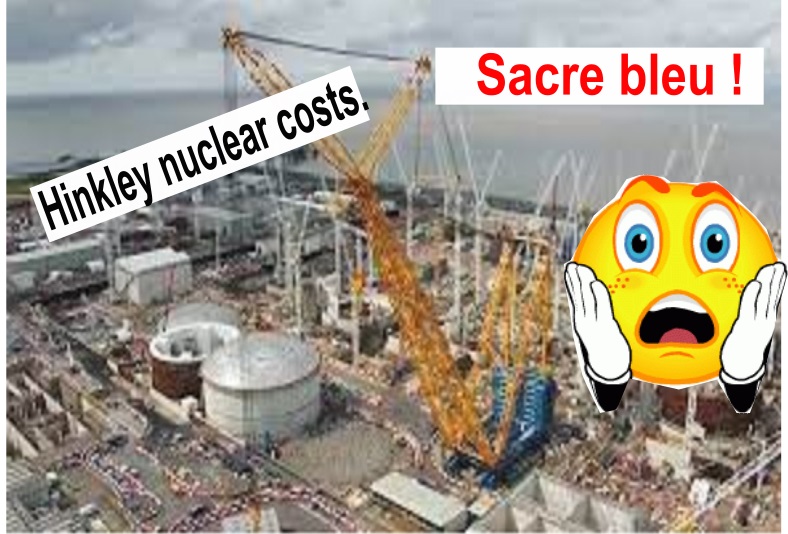
Almost 200 years before Electricite de France (EDF) signed a nuclear contract with Britain, France got decisively beaten by England, in the battle of Waterloo. That defeat ended France’s attempts to dominate Europe.
Now in 2024, France is suffering a humiliating blow, because of that 2016 contract. In essence, EDF agreed to be solely responsible for cost overruns during construction of Britain’s Hinkley Point C nuclear power station.
To make matters worse, in 2022, the debt-laden EDF was fully nationalised by the French government, – which paid 9.7 billion euros to take on this burden. Back in 2016, the plant was meant to cost £18bn; it’s now headed to cost. £46bn .
Sacre bleu indeed!
France’s President Macron aims to make the nation the dominating nuclear industry power. Delusions of grandeur indeed. Apart from his grandiose plans for new fleets of big and little reactors, - around his neck is – as The Guardian puts it – a financial albatross that has only become heavier.
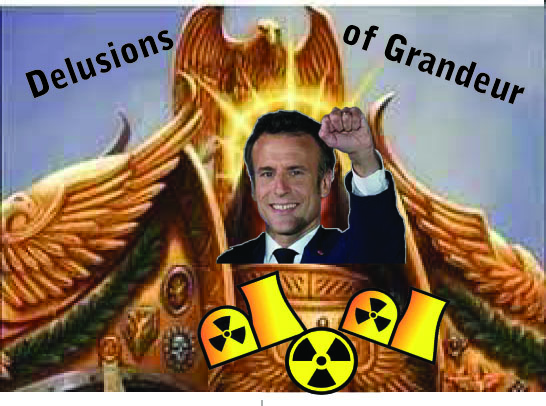
EDF a total basket case, weighed down by its 50 Billion pound nuclear turkey at Hinkley point
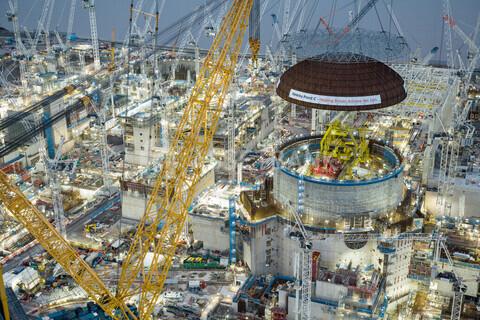
Jonathon Porritt, https://www.jonathonporritt.com/edf-a-total-basket-case-weighed-down-by-its-50-billion-nuclear-turkey-at-hinkley-point/ 25 Jan 24
EdF’s bosses must be thanking their lucky stars that President Macron decided to take complete control of EdF back in 2022. Otherwise, its latest announcements about further delays and cost increases for its new reactors at Hinkley Point would have sent any remaining investors running for the hills.
The scale of those announcements is staggering:
- The price tag for Hinkley Point C has now been reset at £31-34 billion (in 2015 prices), twice the original £18 billion.
- In today’s money, that’s around £46 billion – with further delays and cost hikes (rising to at least £50 billion) all but inevitable.
- EdF’s shortfall in completing Hinkley Point has risen substantially, and could now be as high as £25 billion on its balance sheet.
- EdF has admitted that 2029 is now the earliest Hinkley Point will come online. Fat chance of that.
Which makes Hinkley Point C even more of a bust than EdF’s current worst reactor construction nightmare at Flamanville in France. And significantly worse than its plant at Olkiluoto in Finland, which it just managed to get over the line last year.
So, watch out for the fallout.
Hinkley Point C was meant to be coming online in 2027. All neutral commentators now reckon 2031 (EdF’s so-called ”unfavourable scenario”) is the earliest that will happen. That’s a further four-year delay before its low-carbon electrons (providing 7% of the UK’s electricity) will be available to help the UK meet its various decarbonisation targets.
Add to that the knock-on impact of this on the Government’s/Labour’s hopes for a Hinkley Point look-alike (really!) at Sizewell C. The sales pitch to investors for that has now become even trickier than it was before: “Just look at this beautiful £50 billion turkey: another one just like it could be all yours at a bargain-basement price of, say, £40 billion”.
Which leads to the following conclusions:
EdF is even more screwed than it was before, deeper in debt, with further delays for rolling out its look-alike plant at Sizewell C now inevitable.- The Tory Government is screwed, with no chance of Hinkley Point C (let alone Sizewell C) making any serious short-term contribution to its decarbonisation strategy.
- Labour is screwed – for exactly the same reasons.
- The UK’s Net Zero strategy by 2050 looks less and less viable. And that will soon be tested, again, in the courts.
- All this because of the nuclear obsessions of the UK’s entire political establishment – Labour just as much as the Tories.
Happily, there’s no need to panic: the case for the “renewables + efficiency + storage + smart grids” option just got a whole lot stronger, both economically and politically. We just need the donkeys in Whitehall to give up on their nuclear turkeys. Finally!
It May be Genocide, But it Won’t Be Stopped

The ruling by the International Court of Justice was a legal victory for South Africa and the Palestinians, but it will not halt the slaughter.
SCHEERPOST, By Chris Hedges 26 Jan 24
The International Court of Justice (ICJ) refused to implement the most crucial demand made by South African jurists: “the State of Israel shall immediately suspend its military operations in and against Gaza.” But at the same time, it delivered a devastating blow to the foundational myth of Israel. Israel, which paints itself as eternally persecuted, has been credibly accused of committing genocide against Palestinians in Gaza. Palestinians are the victims, not the perpetrators, of the “crime of crimes.” A people, once in need of protection from genocide, are now potentially committing it. The court’s ruling questions the very raison d’être of the “Jewish State” and challenges the impunity Israel has enjoyed since its founding 75 years ago.
The ICJ ordered Israel to take six provisional measures to prevent acts of genocide, measures that will be very difficult if not impossible to fulfill if Israel continues its saturation bombing of Gaza and wholesale targeting of vital infrastructure.
The court called on Israel “to prevent and punish the direct and public incitement to commit genocide.” It demanded Israel “take immediate and effective measures to enable the provision of urgently needed basic services and humanitarian assistance.” It ordered Israel to protect Palestinian civilians. It called on Israel to protect the some 50,000 women giving birth in Gaza. It ordered Israel to take “effective measures to prevent the destruction and ensure the preservation of evidence related to allegations of acts within the scope of Article II and Article III of the Convention on the Prevention and Punishment of the Crime of Genocide against members of the Palestinian group in the Gaza Strip.”
The court ordered Israel to “take all measures within its power” to prevent the crimes which amount to genocide such as “killing, causing serious bodily and mental harm, inflicting on the group conditions of life calculated to bring about its physical destruction in whole or in part, and imposing measures intended to prevent births within the group.”
Israel was ordered to report back in one month to explain what it had done to implement the provisional measures.
Gaza was pounded with bombs, missiles and artillery shells as the ruling was read in The Hague — at least 183 Palestinians have been killed in the last 24 hours. Since Oct. 7, more than 26,000 Palestinians have been killed. Almost 65,000 have been wounded, according to the Palestinian Ministry of Health. Thousands more are missing. The carnage continues. This is the cold reality.
Translated into the vernacular, the court is saying Israel must feed and provide medical care for the victims, cease public statements advocating genocide, preserve evidence of genocide and stop killing Palestinian civilians. Come back and report in a month.
It is hard to see how these provisional measures can be achieved if the carnage in Gaza continues.
“Without a ceasefire, the order doesn’t actually work,” Naledi Pandor, South Africa’s minister of international relations, stated bluntly after the ruling.
Time is not on the side of the Palestinians. Thousands of Palestinians will die within a month. Palestinians in Gaza make up 80 percent of all the people facing famine or catastrophic hunger worldwide, according to the United Nations. The entire population of Gaza by early February is projected to lack sufficient food, with half a million people suffering from starvation, according to the Integrated Food Security Phase Classification, drawing on data from U.N. agencies and NGOs. The famine is engineered by Israel.
At best, the court — while it will not rule for a few years on whether Israel is
committing genocide — has given legal license to use the word “genocide” to describe what Israel is doing in Gaza. This is very significant, but it is not enough, given the humanitarian catastrophe in Gaza.
Israel has dropped almost 30,000 bombs and shells on Gaza — eight times more bombs than the U.S. dropped on Iraq during six years of war. It has used hundreds of 2,000-pound bombs to obliterate densely populated areas, including refugee camps. These “bunker buster” bombs have a kill radius of a thousand feet. The Israeli aerial assault is unlike anything seen since Vietnam. Gaza, only 20 miles long and five miles wide, is rapidly becoming, by design, uninhabitable.
Israel will no doubt continue its assault arguing that it is not in violation of the court’s directives. In addition, the Biden administration will undoubtedly veto the resolution at the Security Council demanding Israel implement the provisional measures. The General Assembly, if the Security Council does not endorse the measures, can vote again calling for a ceasefire, but has no power to enforce it.
Defense for Children International – Palestine v. Biden was filed in November by the Center for Constitutional Rights against President Joe Biden, Secretary of State Antony Blinken and Secretary of Defense Lloyd Austin. The case challenges the U.S. government’s failure to prevent complicity in Israel’s unfolding genocide of the Palestinian people. It asks the court to order the Biden administration to cease diplomatic and military support and comply with its legal obligations under international and federal law.
The only active resistance to halt the Gaza genocide is provided by Yemen’s Red Sea blockade. ………………………………………………………………….
The ICJ was founded in 1945 following the Nazi Holocaust. The first case it heard was submitted to the court in 1947.
“Decisions that endanger the continued existence of the State of Israel must not be listened to,” Ben-Gvir added. “We must continue defeating the enemy until complete victory.”……………………………………………………
It is clear from the ruling that the court is fully aware of the magnitude of Israel’s crimes. This makes the decision not to call for the immediate suspension of Israeli military activity in and against Gaza all the more distressing.
But the court did deliver a devastating blow to the mystique Israel has used since its founding to carry out its settler colonial project against the indigenous inhabitants of historic Palestine. It made the word genocide, when applied to Israel, credible. https://scheerpost.com/2024/01/26/chris-hedges-it-may-be-genocide-but-it-wont-be-stopped/
Tripling nuclear power: public relations fairy dust

January 2024, https://preview.mailerlite.io/emails/webview/664455/111177290781558405
| The federal government recently endorsed two similar nuclear fantasies. This month, Natural Resources Canada published a statement endorsing a plan to work with other countries to “advance a global aspirational goal of tripling nuclear energy capacity from 2020 by 2050.” The global nuclear declaration attracted endorsements from only 22 countries. In contrast, the official COP28 pledge to triple renewable energy by 2030 was signed by 123 countries and adopted by consensus as the official COP declaration.Earlier, in 2023, the Canadian energy regulator projected a tripling of Canadian nuclear generation capacity by 2050. Why is Canada engaged in a nuclear fantasy? |
Nuclear power plants operate in only two provinces. About 60% of Ontario’s electricity is produced by 18 nuclear power reactors. New Brunswick’s one power reactor produces about 19% of the electricity used in that province, when it’s not shut down. The federal energy regulator models envision tripling nuclear capacity by building small modular nuclear reactors in Prince Edward Island, New Brunswick, Quebec, Ontario, Manitoba, Saskatchewan, Alberta and British Columbia.
Ontario Power Generation (OPG) is promising that its SMR design will be the first in the world to be deployed commercially starting in 2030, although the design has not yet been licenced to build in Canada or anywhere else.
Assuming that this unit is chosen for widespread deployment in Canada, nearly 90 would need to be built and operating effectively on the grid between 2030 and 2050 to achieve the proposed tripling. Given the known construction time overruns for nuclear power plants, this is impossible.
Environment and Climate Change Canada published the official COP28 statement that does not mention nuclear energy. Instead, it highlights “groundbreaking goals to triple renewable energy, double energy efficiency, and, for the first time ever… a historic consensus to move away from fossil fuels in energy systems.”
Tripling renewable energy and doubling energy efficiency by 2030 is sensible and doable, as long as the requisite political will is present. It is past time to get real about the energy generation technologies we need to be supporting.
The ICJ’s Provisional Orders: The Genocide Convention Applies to Gaza

January 27, 2024, Dr Binoy Kampmark, https://theaimn.com/the-icjs-provisional-orders-the-genocide-convention-applies-to-gaza/—
On January 26, legal experts, policy wonks, activists and the plain curious waited for the order of the International Court of Justice, sitting in The Hague. The topic was that gravest of crimes, considered most reprehensible in the canon of international law: genocide. The main participants: the accused party, the State of Israel, and the accuser, the Republic of South Africa.
Filed on December 29 last year, the South African case focused on its obligations arising under the Convention on the Prevention and Punishment of the Crime of Genocide and those of Israel. Pretoria, in its case, wished that the ICJ adjudicate and declare that Israel had breached its obligations under the Convention, and “cease forthwith any acts and measures in breach of those obligations, including such acts or measures which would be capable of killing or continuing to kill Palestinians, or causing or continuing to cause serious bodily or mental harm to Palestinians or deliberately inflicting on their group, or continuing to inflict on their group, conditions of life calculated to bring out its physical destruction in whole or in part, and fully respect its obligations under the Genocide Convention.”
The latter words derive from Article II of the Convention, which stipulate four genocidal actions: the killing of the group’s members; the causing of serious bodily or mental harm to those group’s members; the deliberate infliction of conditions calculated to bring about the physical destruction, in whole or in part, of that group and imposing measures to prevent births within the group.
The sheer extent of devastation being wrought by Israeli Defence Forces in Gaza, justified by the Netanyahu government as necessary self-defence in the aftermath of the Hamas attacks of October 7, led the South African team to also seek immediate provisional measures under Article 41 of the Court’s statute. (The review on the case’s merits promises to take much longer.) They included the immediate suspension of the IDF’s military operations in and against Gaza, the taking of all reasonable measures to prevent genocide, and desisting from committing acts within Article II of the Convention. The expulsion and forced displacement of Palestinians should also stop, likewise the deprivation of adequate food, water and access to humanitarian assistance and medical supplies and “the destruction of Palestinian life in Gaza.”
By 15-2, the court accepted that “the catastrophic humanitarian situation in the Gaza Strip is at serious risk of deteriorating further before the Court renders its final judgment.” (Over 26,000 Palestinians have been killed, extensive tracts of land in Gaza pummelled into oblivion, and 85% of its 2.3 million residents expelled from their homes.) Measures were therefore required to prevent “real and imminent risk that irreparable prejudice will be caused to the rights found by the Court to be plausible, before it gives its final decision.”
The grant of provisional measures was, however, more conservative than that sought by Pretoria. Conspicuously missing was any explicit demand that Israel pause its military operations. That said, the judgment did little to afford Israel’s leaders and the IDF comfort from the obligatory reach of the Genocide Convention, an instrument they had argued was irrelevant and inapplicable to the conduct of “innovative” military operations.
To that end, Israel was obligated to take all possible measures to prevent the commission of acts under Article II of the Genocide Convention, including by its military; prevent and punish “the direct and public incitement to genocide” against the Palestinian populace in Gaza; permit basic services and humanitarian assistance to the Gaza Strip; ensure the preservation of, and prevent destruction of, evidence related to acts committed against Gaza’s Palestinians within Articles II and III of the Convention; and submit a report to the ICJ on how Israel was abiding by such provisional measures within one month.
As is very much the form, the justice from the country in the dock, in this case, Israel’s Aharon Barak, could see nothing inferentially genocidal in his country’s campaign. South Africa, he insisted, had intentionally ignored the role played by Hamas in its October 7 attacks, and “wrongly sought to impute the crime of Cain to Abel.”
-ADVERTISEMENT-
Inevitably, the singular experience of the Holocaust survivor, the sui generis Jewish view of trauma, used as solid armour against any possibility that Israel might ever commit genocide, became a point of contention. Genocide “is the gravest possible accusation and is deeply intertwined with my personal life experience.” Israel had a firm commitment to the rule of law, and to accept that it was committing genocide “is very hard for me personally”. Tellingly, he suggested that Israel’s campaign in Gaza be examined, not from the viewpoint of the Genocide Convention but international humanitarian law.
With classic casuistry, Barak did vote for the measure requiring Israel to do everything “within its power to prevent and punish the direct and public incitement to commit genocide in relation to members of the Palestinian group in the Gaza strip.” But having identified nothing in the way of such intent, the issue became a moot one. With some relief, Barak could state that certain measures sought by South Africa, including an immediate suspension of military operations, were rejected by the ICJ, which preferred “a significantly narrower scope”.
From the other side of the legal aisle, the South African foreign minister, Naledi Pandor, wished that the ICJ had grasped the nettle to order a halt in military operations. But, with some deft reasoning, she was satisfied that the only way Israel could implement the provisional measures would be through a ceasefire. Much the same view was expressed by the Associated Press: “The court’s half-dozen orders will be difficult to achieve without some sort of cease-fire or pause in the fighting.” That logic is clear enough, but the actions, given the various statements from Prime Minister Benjamin Netanyahu and his officials alleging slander and a blood libel against their country, are unlikely to follow.
The Post Office Scandal, Nuclear Waste and The Bransty Tunnel – Off Limits for Nuclear Luvvies at Britain Remade?

Trudy Harrison MP and wannabe MP Josh MacAlister have joined forces under the banner of “Britain Remade”. Their dream of building a nuclear prefab “faster” and “cheaper” next to the worlds biggest stockpile of plutonium is within our grasp they breathlessly tell us. “There could be new nuclear power in Cumbria, delivering jobs for the region, and clean energy for the whole country”.
Hot and dangerous Nuclear wastes from their “clean energy” trundles through the Bransty Rail Tunnel under the town of Whitehaven EVERY week enroute to the Sellafield site already bursting at the seams with radioactive crapola. The Bransty Rail Tunnel has served Network Rail and the nuclear industry well. It is a fine piece of old Victorian engineering which extends for a full 1km directly under homes and businesses in Whitehaven. Only recently it has become unstable. Network Rail are rather worried about the impacts of reactivated old mine water water bubbling up into the tunnel and even putting pressure on the sides of the tunnel (as we can see from Network Rail’s own video taken recently).
Rather than gushing about building untried untested nuclear prefabs (euphemistically called “Small Modular Reactors” actually pretty large at half the size of Calder Hall reactors), the MP and wannabe MP should be putting EVERY EFFORT into protecting the safety of the folk of Whitehaven by CLOSING THIS TUNNEL certainly to Nuclear Waste Transports and possibly to passenger and other freight trains. Ceasing nuclear waste production in Scotland and the North wouldn’t make a huge difference to electricity as nuclear’s contribution to the UKs electrcity capacity has been minimal according to National Grid with wind producing many times more capacity in the recent cold weather.
The most urgent question for Whitehaven is:
Why is heavily polluted mine water is still gushing into the nuclear waste route of the Bransty Tunnel over one year on and into Queens Dock, Whitehaven and what are Trudy Harrison MP and Josh MacAlister wannabe MP doing to address this?
Another equally urgent and topical question given the Post Office scandal is:
Are the MP and prospective MP happy that all nuclear waste consignments including those travelling a few times a week through the Bransty Tunnel are monitored and tracked by the same company, Fujitsu, responsible for the Post Office scandal. Fujitsu’s “Accountancy and Tracking Of Material” ATOM was contracted by the United Kingdom Atomic Energy Authority in 2001. “Fujitsu chose a combination of Microsoft and Oracle systems with web portal technology to make this possible, i.e. to successfully design and implement a package to process, update and report on nuclear and radioactive materials throughout the supply chain.” As Dik Third of UKAEA says, “We believe that there is no other system in the world capable of dealing with such complexity and breadth of plant operations and regulatory accounting requirements.” Does Whitehaven feel lucky? Britain is being Remade into what? A Nuclear Sacrifice Zone?
US plans to store nuclear weapons in UK: report
Examiner January 27 2024 –
The US is planning to station nuclear weapons in the UK for the first time in 15 years amid a growing threat from Russia, according to a report.
Warheads three times as strong as the Hiroshima bomb would be located at RAF Lakenheath in Suffolk under the proposals, The Telegraph reported.
The US previously placed nuclear missiles at RAF Lakenheath, removing them in 2008 when the Cold War threat from Moscow had receded.
Pentagon documents seen by the UK newspaper reveal procurement contracts for a new facility at the airbase.
A Ministry of Defence spokesperson said: “It remains a longstanding UK and NATO policy to neither confirm nor deny the presence of nuclear weapons at a given location.”
………………………….. Downing Street defended the government’s spending on defence, saying Britain has been Washington’s “partner of choice” in its strikes against Houthi rebels in the Red Sea because of its “military strength”. https://www.examiner.com.au/story/8500518/us-plans-to-store-nuclear-weapons-in-uk-report/—
Israel Accuses The International Court of Justice Of (You Guessed It) Antisemitism
CAITLIN JOHNSTONE, JAN 27, 2024, https://www.caitlinjohnst.one/p/israel-accuses-the-icj-of-you-guessed?utm_source=post-email-title&publication_id=82124&post_id=141088641&utm_campaign=email-post-title&isFreemail=true&r=1ise1&utm_medium=email—
The International Court of Justice rejected Israel’s request to dismiss the genocide case brought against it by South Africa on Friday, ruling by a massive majority that the case shall proceed and instructing Israel to refrain from killing and harming Palestinians in the interim.
Many Palestine supporters have expressed dismay that the ICJ did not explicitly order a ceasefire, while many others (including South African officials) argue that the ruling is very positive and tantamount to a ceasefire order because it demands the end of harm to members of the protected group.
Imperial media are aggressively emphasising the absence of a ceasefire order in their headlines and many Israel apologists are framing that absence as a victory for their favorite ethnostate, but such performative chest-thumping is severely undercut by the way high-level Israeli officials are currently accusing the ICJ of antisemitism and saying Israel should ignore its rulings.
“The international court of justice went above and beyond when it granted South Africa’s antisemitic request to discuss the claim of genocide in Gaza, and now refuses to reject the petition outright,” complained Israeli defense minister Yoav Gallant in response to the ruling.
“The decision of the antisemitic court in The Hague proves what was already known: This court does not seek justice, but rather the persecution of Jewish people,” said Israeli national security minister Itamar Ben Gvir.
Ben Gvir also tweeted “Hague Schmague” immediately after the ruling was issued, which will probably go down in history as the most Israeli tweet of all time.
Everyone’s arguing about whether or not the ICJ’s ruling is helpful, and I don’t know enough one way or the other to be sure either way, but from where things stand right now it does seem unlikely to me that managers of the Israeli war machine would be getting this freaked out and whipping out their tired old “antisemitism” song and dance if there wasn’t something of substance to it.
International lawyer Francis Boyle, who won provisional measures against Yugoslavia at the ICJ in 1993, said the following of the ruling:
“This is a massive, overwhelming legal victory for the Republic of South Africa against Israel on behalf of the Palestinians. The U.N. General Assembly now can suspend Israel from participation in its activities as it did for South Africa and Yugoslavia. It can admit Palestine as a full member. And — especially since the International Criminal Court has been a farce — it can establish a tribunal to prosecute the highest level officials of the Israeli government, both civilian and military.”
So take that for whatever that’s worth to you. In any case the butchery in Gaza still urgently needs to be ended, and only time will tell whether Friday’s development had any major effect on the outcome of this horror.
But man what I wouldn’t have given to be a fly on the wall at the meetings they were having at the US State Department on Friday. It’s days like this that remind you why empire managers switched from talking about “international law” to using the meaningless phrase “rules-based international order”.

UN Nuclear Chief Says ‘Very Real’ Threat Remains at Moscow-Held Zaporizhzhia Plant
Moscow Times 26 Jan 24
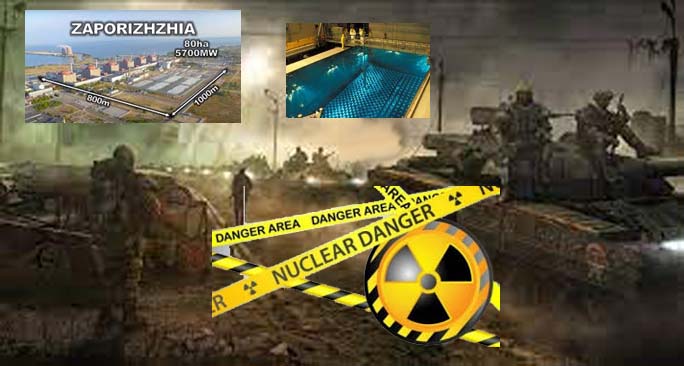
The possibility of a nuclear disaster at the Russian-held Zaporizhzhia nuclear plant in Ukraine remains “very real,” according to the head of the UN’s nuclear watchdog. …….
Regular shelling and drone attacks around the plant have raised the risks of a radioactive disaster, while Kyiv and Moscow have accused each other of planning provocations.
Experts from the International Atomic Energy Agency (IAEA) have been on the ground monitoring the Zaporizhzhia plant since September 2022.
“The plant’s six reactors have been shut down since mid-2022 — five of them in cold shutdown and one in hot shutdown. But the potential dangers of a major nuclear accident remain very real,” IAEA chief Rafael Grossi told the UN Security Council on Thursday.
Grossi warned that issues with access to power could lead to a disaster at the Moscow-controlled nuclear plant.
Emergency diesel generators are now “the last line of defense against a nuclear accident” after they were activated eight times when the plant lost all off-site power, he added.
“The plant is currently relying on just two lines of external power, and sometimes just one, or for a period the backup power was not properly configured. This demonstrates the highly precarious situation regarding essential off-site power.”………. https://www.themoscowtimes.com/2024/01/26/un-nuclear-chief-says-very-real-threat-remains-at-moscow-held-zaporizhzhia-plant-a83860
US nuclear agency isn’t consistent in tracking costs for some construction projects, report says
Daily Mail, 26 Jan 24, PHOENIX (AP) – The U.S. agency in charge of maintaining the nation´s nuclear arsenal is not consistent when it comes to tracking the progress of small construction projects, making it difficult to prevent delays and cost overruns, congressional investigators said in a report released Thursday.
The Government Accountability Office warned in the report that even fewer projects will go under the microscope if officials raise the dollar limit for what qualifies as a small project. Congress has raised that threshold numerous times, reaching $30 million during the last fiscal year after having started at $5 million in 2003.
Without collecting and tracking information on minor projects in a consistent manner, National Nuclear Security Administration officials may not have the information they need to manage and assess project performance, the investigators said…………………………………………………
Greg Mello with the Los Alamos Study Group said large projects often are split into two or more smaller ones as a way to avoid federal and congressional oversight and accountability. He said better reporting after the fact won’t necessarily help NNSA do a better job of managing projects going forward.
“There are too many contractors and subcontractors in the value chain, too many profit opportunities and too few penalties for poor performance to expect high-quality results,” he said.
Mello pointed to the contracts to run Los Alamos and other sites that are part of the complex, saying they are worth tens of billions of dollars and are among the largest contracts in the federal government………………………..
Between 2019 and 2023, the congressional investigators documented 414 minor construction projects worth more than $3 billion at NNSA sites across several states. Most of that spending was done at Lawrence Livermore National Laboratory in California and at Sandia and Los Alamos labs in New Mexico.https://www.dailymail.co.uk/wires/ap/article-13008399/US-nuclear-agency-isnt-consistent-tracking-costs-construction-projects-report-says.html
Two Men Sentenced for Falsifying Documents Related to Testing of Equipment at Nuclear Power Plants
Two men attended sentencing hearings today in federal court for their
roles in creating false calibration certificates in a matter within the
jurisdiction of the Nuclear Regulatory Commission (NRC). Miguel Marcial
Amaro and Martin Ramos had each previously pleaded guilty to the felony
offense of making and using a false document, in violation of 18 U.S.C. §
1001. Each defendant is banned from participation or employment in
NRC-licensed activities as a condition of their plea agreement – Marcial
Amaro for five years and Ramos for two years.
US Dept. Justice 25th Jan 2024
France to push UK government for additional support for faltering nuclear projects
The fallout from EDF’s confirmation its flagship Hinkley Point nuclear
project is facing further delays and budget overruns continued yesterday,
with reports French Ministers are preparing to call on their UK
counterparts to help shoulder some of the ballooning costs faced by the
state-owned energy giant.
The FT reported the French government is
preparing to call directly on the Westminster government to revisit some of
the funding arrangements for EDF’s UK nuclear plans, which include the
delayed Hinkley Point project and the proposed Sizewell C project that it
co-owns with the UK government. The paper quoted an unnamed French economy
ministry official as saying, “the British government cannot at the same
time say EDF has to figure it out alone on Hinkley Point and at the same
time ask EDF to put money into Sizewell”.
Business Green 25th Jan 2024
Finland is a focal point of Nato’s largest exercise since the Cold War, and looks to siting nuclear weapons.
YLE NEWS 26 Jan 24
Nato’s largest military exercise since the Cold War is starting in Finland this week, reports Ilta-Sanomat.
The exercise, dubbed “Steadfast Defender”, is bringing Nato soldiers to Finland. The drill, which includes a total of 90,000 troops from 31 Nato countries, will span this winter and spring and involves thousands of troops moving massive amounts of material through Sweden.
Troops are practicing defending a European Nato ally that has come under attack. Swedish broadcaster SVT has reported that the exercise features a scenario where Russia attacks Finland and Nato invokes Article 5, its collective defence clause.
Nuclear reality
An editorial in Helsingin Sanomat suggests that Finnish leaders have not come to terms with the fact that nuclear weapons are a core part of Nato’s deterrence policy. The paper notes that some presidential candidates don’t support siting nuclear weapons in Finland. At the same time, Finland is reworking its nuclear safety laws. According to HS, these reforms must not impede Nato’s operational activities in a wartime situation in Finland.
The nuclear deterrent is a central component of Nato’s security guarantees, under which Finland sought protection by pursuing membership in the alliance. For that reason, Finland must bear its own responsibility in preserving that deterrent, according to the national daily……………. more https://yle.fi/a/74-20070550
1 This Month
23-25 October – on Zoom – World BEYOND War’s annual global conferenc


Shut down the radiation-damaged Heysham nuclear reactors now
To see nuclear-related stories in greater depth and intensity – go to https://nuclearinformation.wordpress.com

Say No to NASA’s Reckless Nuclear Reactor on the Moon
Say No to NASA’s Reckless Nuclear Reactor on the Moon

-
Archives
- October 2026 (231)
- September 2026 (339)
- August 2026 (330)
- July 2026 (355)
- June 2026 (287)
- May 2026 (306)
- April 2026 (356)
- March 2026 (251)
- February 2026 (267)
- January 2026 (308)
- December 2025 (358)
- November 2025 (359)
-
Categories
- 1
- 1 NUCLEAR ISSUES
- business and costs
- climate change
- culture and arts
- ENERGY
- environment
- health
- history
- indigenous issues
- Legal
- marketing of nuclear
- media
- opposition to nuclear
- PERSONAL STORIES
- politics
- politics international
- Religion and ethics
- safety
- secrets,lies and civil liberties
- spinbuster
- technology
- Uranium
- wastes
- weapons and war
- Women
- 2 WORLD
- ACTION
- AFRICA
- Atrocities
- AUSTRALIA
- Christina's notes
- Christina's themes
- culture and arts
- Events
- Fuk 2022
- Fuk 2023
- Fukushima 2017
- Fukushima 2018
- fukushima 2019
- Fukushima 2020
- Fukushima 2021
- general
- global warming
- Humour (God we need it)
- Nuclear
- RARE EARTHS
- Reference
- resources – print
- Resources -audiovicual
- Weekly Newsletter
- World
- World Nuclear
- YouTube
-
RSS
Entries RSS
Comments RSS

