EU to use Russian assets to buy arms for Ukraine – Scholz
The German chancellor has clarified that profits obtained from Moscow’s funds held in the EU will be used to arm Kiev
German Chancellor Olaf Scholz has said that interest accrued from Russian assets frozen in the EU will be used to purchase weapons for Ukraine.
Soon after Russia launched its military operation against Ukraine in February 2022, Western countries froze approximately $300 billion of funds belonging to the Russian Central Bank. Of that sum, the Brussels-based clearinghouse Euroclear holds around €191 billion ($205 billion), which has accrued nearly €4.4 billion in interest over the past year.
Speaking at a joint press conference with French President Emmanuel Macron and Polish Prime Minister Donald Tusk in Berlin on Friday, Chancellor Scholz said: “We will use windfall profits from Russian assets frozen in Europe to financially support the purchase of weapons for Ukraine.
The German leader also announced plans to establish a “new capability coalition for long-range rocket artillery,” with procurement to take place “on the overall world market.”
The German chancellor did not provide specifics, and it remains unclear whether he was referring to an entirely new initiative, or to a “long-range” scheme announced by President Macron in February.
European Commission President Ursula von der Leyen last month suggested using the interest from frozen Russian assets to buy weapons for Ukraine. However, Politico, citing an anonymous EU official, reported on Thursday that Malta, Luxembourg and Hungary had “expressed reservations” about the plan earlier this week.
Moscow has repeatedly warned that any actions taken against its assets would amount to “theft.” It has stressed that seizing the funds or any similar move would violate international law and undermine Western currencies, the global financial system, and the world economy.
Former Prime Minister Turnbull says Australia ‘mugged by reality’ on Aukus deal as US set to halve submarine build

“Australian taxpayers should not be footing the bill for America’s dockyards.
We are on the hook to the tune of $3bn as soon as next year as a downpayment for subs that might never arrive and be useless on delivery,”
Former PM says the reality is the US will not make their submarine deficit worse by giving or selling submarines to Australia
Amy Remeikis, Wed 13 Mar 2024 , https://www.theguardian.com/world/2024/mar/13/turnbull-says-australia-mugged-by-reality-on-aukus-deal-as-us-set-to-halve-submarine-build
Australian taxpayers should not be footing the bill for America’s dockyards.
We are on the hook to the tune of $3bn as soon as next year as a downpayment for subs that might never arrive and be useless on delivery,”
The former prime minister Malcolm Turnbull said Australia has been “mugged by reality” over the Aukus submarine deal after the US announced it will halve the number of submarines it will build next year, throwing the Australia end of the agreement into doubt.
With the US president, Joe Biden, continuing to face a hostile Congress, the Pentagon budget draft request includes construction of just one Virginia-class nuclear submarine for 2025.
Under the Aukus agreement, production is meant to be ramped up to ensure Australia will have access to at least three Virginia-class submarines from the US in the 2030s. That is to fill a “capability gap” before nuclear-powered submarines to be built in Adelaide enter into service from the 2040s.
The prime minister, Anthony Albanese, played down the impact of the US budget announcement, insisting that “our plans are very clear”.
“We have an agreement that was reached with the United States and the UK,” Albanese told reporters in Darwin on Wednesday. “That legislation went through the US Congress last year. That was a product of a lot of hard work.”
The defence minister, Richard Marles, said earlier that the US remained committed to the deal.
“As we approach the one-year anniversary of Aukus, Australia, the United States and United Kingdom remain steadfast in our commitment to the pathway announced last March, which will see Australia acquire conventionally armed, nuclear-powered submarines,” he said.
“All three Aukus partners are working at pace to integrate our industrial bases and to realise this historic initiative between our countries.”
Greens senator David Shoebridge, who has been critical of the Aukus deal from the start, said the US budget announcement was the beginning of the end of Aukus.
“When the US passed the law to set up Aukus, they put in kill switches, one of which allowed the US to not transfer the submarines if doing so would ‘degrade the US undersea capabilities’. Budgeting for one submarine all but guarantees this,” he said on X.
4/ The failure is almost too big to wrap your head around.
We are providing billions of dollars to the US, have given up an independent foreign policy and made Australia a parking lot for US weapons. In exchange, we get nothing.
Nothing but a big target and empty pockets.— David Shoebridge (@DavidShoebridge) March 12, 2024
The US budget does include increased spending on the submarine industrial base, which was a key component of the Aukus pillar one deal, as it laid the groundwork to increase production in the coming years.
But Turnbull, an architect of the French submarine deal which was unceremoniously dumped by the Morrison government in favour of the Aukus deal, said Australia was now at the mercy of the United States for a key part of its defence strategy.
He said that the US needed to increase submarine production to meet its own needs before it was able to transfer boats to Australia, but were now only producing about half as many that were needed for the US navy and were struggling to maintain the boats they held, due to labour shortages.
“What does that mean for Australia? It means because the Morrison government, adopted by Albanese, has basically abandoned our sovereignty in terms of submarines, we are completely dependent on what happens in the United States as to whether we get them now,” he told ABC radio.
“The reality is the Americans are not going to make their submarine deficit worse than it is already by giving or selling submarines to Australia and the Aukus legislation actually sets that out quite specifically.skip past newsletter promotion
“So you know, this is really a case of us being mugged by reality. I mean, there’s a lot of Aukus cheerleaders, and anyone that has any criticism of Aukus is almost described as being unpatriotic. We’ve got to be realistic here.”
The ALP grassroots activist group, Labor Against War, want the Albanese government to freeze Aukus payments to the US so as not to “underwrite the US navy industrial shipyards”.
The national convenor of Labor Against War, Marcus Strom, said Australian taxpayers should not be footing the bill for America’s dockyards.
We are on the hook to the tune of $3bn as soon as next year as a downpayment for subs that might never arrive and be useless on delivery,” he said.
“This Labor government managed to junk Scott Morrison’s tax plan. Why would it be so stupid to continue with his war plan?”
While the Pentagon has sought to assure Australia its submarine production will be back on track by 2028, the looming threat of Donald Trump returning to the White House has raised further concerns the deal will be scuttled.
“On Aukus pillar 1 we are effectively in conflict with the needs of the US navy, and you know as well as I do the American government, when it comes to a choice between the needs of the US navy and the Australian navy, are always going to back their own,” Turnbull said.
Marles has previously denied Aukus will erode Australia’s sovereignty. In a speech to parliament last year, Marles said Australia would “always make sovereign, independent decisions on how our capabilities are employed”.
Additional reporting by Daniel Hurst
UK government plans to block foreign control of newspapers – what about foreign control of Sizewell nuclear project ?
Telegraph ruling raises questions over Sizewell funding
The government plans to block foreign control of newspapers – what about physical infrastructure?
Questions are being raised about the government’s willingness to allow essential physical infrastructure to fall into the hands of foreign states but not newspapers.
Government minister Lord Parkinson told the House of Lords yesterday: “We will amend the media merger regime explicitly to rule out newspaper and periodical news magazine mergers involving ownership, influence or control by foreign states.”
Legislation is being introduced specifically to prevent The Telegraph newspaper group from being bought by RedBird IMI, a fund backed by the United Arab Emirates.
It is not yet clear, however, how far the new law could stretch. The intention is that it applies only to newspapers and news magazines. But are they really more important than water companies, electricity companies and power stations?
The Chinese state was allowed to have an influence in the development of Hinkley Point C nuclear power station but has been blocked from further involvement in the UK nuclear programme amid security concerns.
However, the UK government has been wooing the UAE to step in to help fund Sizewell C in place of China.
Campaigners against Sizewell C see the Telegraph intervention as grounds to block UAE investment in British nuclear power, on the basis that nuclear power stations must be at least as important to national security as newspapers.
“If the government is prepared to ban foreign state ownership of newspapers because of the UAE’s bid for the Telegraph, ministers must now block UAE investment in Sizewell C in the interests of national security. That deal should also be dead in the water: there is no place in our critical national infrastructure for a regime that does not share our views and values,” said a spokesperson for Stop Sizewell C.
There already exists legislation that could be used to prevent a foreign state having influence in critical infrastructure – the National Security & Investment Act 2021 and the National Security Act 2023 have sought to respond to foreign state interference.
Lord Parkinson told parliament yesterday: “We intend to expand on the current definition of ‘foreign powers’ used in the National Security Act 2023 to ensure a broad definition that also covers officers of foreign governments acting in a private capacity and investing their private wealth.”
That could put the skids under a whole host of utility companies.
However, rather blurring the message, the minister concluded: “I should note that the government remain committed to encouraging and supporting investment into the United Kingdom and recognise that investors deploying capital into this country rely on the predictability and consistency of our regulatory regime. The UK remains one of the most open economies in the world, which is key for the prosperity and future growth of our nation. Our focus here is not on foreign investment in the UK media sector in general; this new regime is targeted and will apply only to foreign states, foreign state bodies and connected individuals, and only to newspapers and news magazines.”
Visa & Mastercard: The Real Threat To The Digital ID Control System
March 11, 2024 By Corey Lynn and The Sharp Edge
The question isn’t whether Visa and Mastercard are at the forefront of the Digital ID control system, the question is whether Visa, Mastercard and central banks will be able to pull it off without the implementation of central bank digital currencies (CBDCs). A “Digital ID” may sound convenient and harmless, but the intention behind it is far reaching – compiling and connecting data and biometrics while removing every form of privacy in order to control how one spends their money, achieves access to services, and ultimately takes control over all assets. This will have an impact on all areas of life, including education, healthcare, food, agriculture, transportation, real estate, and technology, which of course will all be controlled through the Digital ID connected to banks, and a person’s social credit score. This isn’t an imaginary scheme. These intentions are well documented by the Bank for International Settlements (BIS), central banks, the World Bank, financial institutions, credit card companies, and government.
In simple terms, the Bank For International Settlements’ (BIS) blueprint proposes that all private property in the real world, such as money, houses, cars, etc., would be “tokenized” into digital assets within an “everything in one place” global unified ledger. Of course, smart contracts on a “programmable” platform with rules on how each asset can and cannot be used are the key ingredient.
By using fear of cyber attacks on any single institution, big Gov and financial institutions want everyone to believe that consolidating all data and assets of a person’s life into tokens under a Digital ID will somehow protect them from attacks by having everything in one location.
Though many are under the impression that the battle is against the ushering in of CBDCs, it would seem that all of the appropriate financial rails and interoperability are already in place, or darn close to it, to expand on the mountain of identity verification processes already dialed in, to initiate the all-in-one Digital Identity and lock those dominoes into place.
This digital world they intend to manifest is being fashioned to look like a convenient and necessary way everyone must live, and as they build these “rails” of prison cells, consumers are sinking further into debt and relying more and more on credit cards. The Federal Reserve Bank of New York issued a report noting that credit card balances in Q4 of 2023 increased by $50 billion to a record high of $1.13 trillion, while also reporting a rise in delinquencies. The report states that credit card delinquencies increased over 50% in 2023. Total household debt also rose by $212 billion reaching $17.5 trillion in the fourth quarter of 2023, according to the report.
Visa and Mastercard are at the forefront of this takeover and if they succeed, the monitoring, tracking, and control will be immeasurable and there will be no going back. Consumers need to think twice before using credit cards and use cash as often as possible, while state legislators need to get on board with implementing creative legislation with independent systems that not only provide protection for the citizens of their state, but build strong financial freedom with the ability to operate utilizing cash, precious metals, and unique structures as pointed out in this article.
“I get why China would be interested. Why would the American people be for that?” – Neel Kashkari, President of the Minneapolis Federal Reserve, ‘The Threat of Financial Transaction Control,’ the Solari Report, February 24, 2024.
‘Don’t hold your breath’ – people living in Wylfa’s shadow have say on development plans
The UK Government recently announced it had bought the Anglesey site from Hitachi
North Wales Live, David Powell, Court reporter, 17 Mar 24
People living near the Wylfa power station on Anglesey have greeted the prospect of a fresh development at the site with excitement, anxiety and pessimism. Last week the UK Government announced that a £160m deal had been reached with Hitachi to buy sites at Wylfa and Oldbury in Gloucestershire – with a final sign off expected this summer.
The minister for nuclear Andrew Bowie says this is not another “false dawn” for Wylfa and that he was “supremely confident” that new nuclear would be developed at the site. North Wales Live this week visited nearby Cemaes to gauge opinions from people in the village on the proposals.
Cemaes resident William Huw Edwards, 80, used to work as a contractor atRio Tinto
, which ran Anglesey Aluminium, and on the runway at RAF Valley. He remembers disruption during construction work for the current Wylfa power station.
“There used to be two or three lorries at a time in convoys,” he recalled. As for the prospect of a new nuclear development, he said: “A lot of people are against it because of the traffic and the noise.”
He added: “It’s going to cost a lot and they will have to find the money.” He doubts it will be in the near future, saying: “It won’t be soon. Don’t hold your breath.”
But another resident Julie Clemence, 63, would support a new nuclear operation if it were smaller than its predecessor. “The American ones are really huge but I would support it if it’s smaller and less of a blot on the landscape than now,” she said.
………………………………………………………… Dylan Morgan, of Pobl Atal Wylfa B (PAWB), a campaign group against the proposal, said: “This government and anyone following it will face the same challenges regarding attracting any large new private investment to develop reactors at Wylfa or any other site in the global context of a shrinking nuclear industry.
“At the same time, renewable technologies are galloping ahead every year to take an increasing share of the worldwide electricity market.” He claimed 20 years has been “wasted” when money and resources could have been spent developing renewable energy…………………………………….
Meanwhile Katie Hayward, of Felin Honeybees, has said she is “completely broken” after learning the site might be redeveloped after she battled the proposed Wylfa B site for years.
https://www.dailypost.co.uk/news/north-wales-news/dont-hold-your-breath-people-28797236—
TODAY. Nuclear power and the ignorance of journalists – it’s almost criminal.

I’d like to believe that it is just ignorance – the way journalists complacently regurgitate the lying propaganda vomited forth by the nuclear industry.
And to be fair – I really do think that it is the result of journalists’ ignorance, rather than a cynical “knowing which side is their bread buttered on” – (where the money is)
Why are journalists SO IGNORANT ABOUT THE NUCLEAR INDUSTRY?
I think it goes back to the industry’s traditional and very effective ploy :
– “only nuclear engineers can really understand it“
This meant that any discussion or reporting would have to be enshrined in technical jargon, impenetrable to the normal person. The nuclear lobby made sure of this, although the facts and various aspects could well be discussed in normal language. Nuclear experts could have chosen to make it clearly – for example Albert Einstein did – “Nuclear power is one hell of a way to boil water.”
This ploy has worked well over the decades, causing journalists to be wary about possibly saying something inaccurate or silly. Their safest course has indeed been to just regurgitate the industry’s handouts, including the approving comments by politicians etc (who are supported by the industry, and who themselves know little about it)
Even today, it is rare to find nuclear matters clearly explained to the “lay person”
You do find articles on the costs of nuclear, the opponents of it, – but not much on how it works, what the wastes actually are, and so on.

It was refreshing today, to find an article from France, explaining “fast breeder reactors” – reprocessing, as in Bill Gates’ much touted new Natrium reactor plan . That article was written by a journalist who has taken the trouble to do his research.
The nuclear lobby still prefers to do its media spin via articles handed out in their own obscurantist language. You don’t need to be a nuclear engineer or physicist to do your research. But it takes time and trouble and asking the hard questions.
Journalists are either too lazy or too bought to do this. Easier to regurgitate.

But with nuclear war an ever more looming possibility, it is definitely time for journalists to woke up and do their homework on the industry whose reason for existence is nuclear weapons.
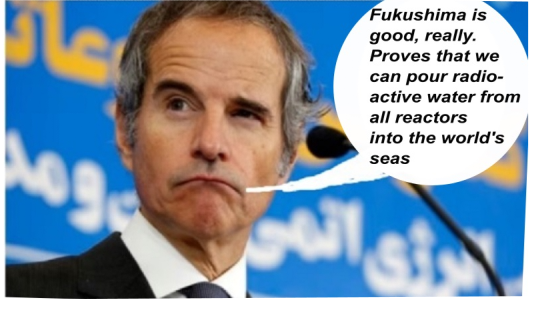
IAEA director’s visit to Japan widely questioned, seeks to downplay nuclear water dumping
Global Times, By Xu Yelu and Xing Xiaojing Mar 15, 2024
Rafael Grossi, director general of the International Atomic Energy Agency (IAEA), said during his visit to Japan that he confirmed that the “treated water” in Fukushima fully meets international standards, and experts believe such remarks supporting the discharge have become a kind of “political security” reached between the Japanese government and the IAEA.
Grossi was in Japan visiting the site of the nuclear power plant for the first time since the water dumping began. He also attended a meeting in Fukushima where representatives of the government and fishing communities discussed the current situation, according to Kyodo News.
He supported Japan’s decision once again, saying, “Our corroboration and information and also independent sampling have confirmed the very low presence of tritium … In some cases even impossible to trace, which means that the process is working as we thought it will be. So in this regard, it is correct. We are satisfied.”
According to the Japanese newspaper Mainichi Shimbun, Japanese Prime Minister Fumio Kishida and Foreign Minister Yoko Kamikawa separately met with Grossi, confirming continued cooperation on the issue of the discharge. The Japanese side announced that they will provide approximately 18.5 million euros ($20 million) in assistance to the IAEA.
The Chinese Embassy in Japan responded on Thursday that the Japanese side’s forced implementation of discharging nuclear-contaminated wastewater into the sea has no precedent since the peaceful use of nuclear energy by humans, nor are there any recognized disposal standards. How can it be said to comply with so-called “international standards?”
The nuclear-contaminated wastewater generated by the Fukushima nuclear accident contains various radioactive nuclides present in the melted core, many of which do not have effective treatment technologies. Focusing solely on tritium clearly ignores this basic fact………………………….
The IAEA should uphold the principles of objectivity, professionalism, and impartiality, and should not endorse Japan’s erroneous actions of discharging nuclear-contaminated wastewater into the sea, nor should it disseminate one-sided information that misleads international public opinion, the embassy stressed.
………………”With the internal management chaos of Tokyo Electric Power Company and inadequate government supervision in Japan, in a situation where standards are unclear, boundaries are unclear, and data is not transparent, no one or organization can guarantee that the nuclear-contaminated wastewater being discharged into the ocean by Japan is safe,” Zhang said.
…………………………….the plan to discharge Fukushima’s contaminated water into the sea will last for 30 years. However, since the first round of discharge, it has been less than seven months, and the IAEA has expressed “satisfaction” with the discharge situation. Or, it can be said that this is a kind of “political security” reached between the Japanese government and the IAEA.
https://www.globaltimes.cn/page/202403/1308918.shtml
There is no such thing as a “nuclear waste-eating” reactor
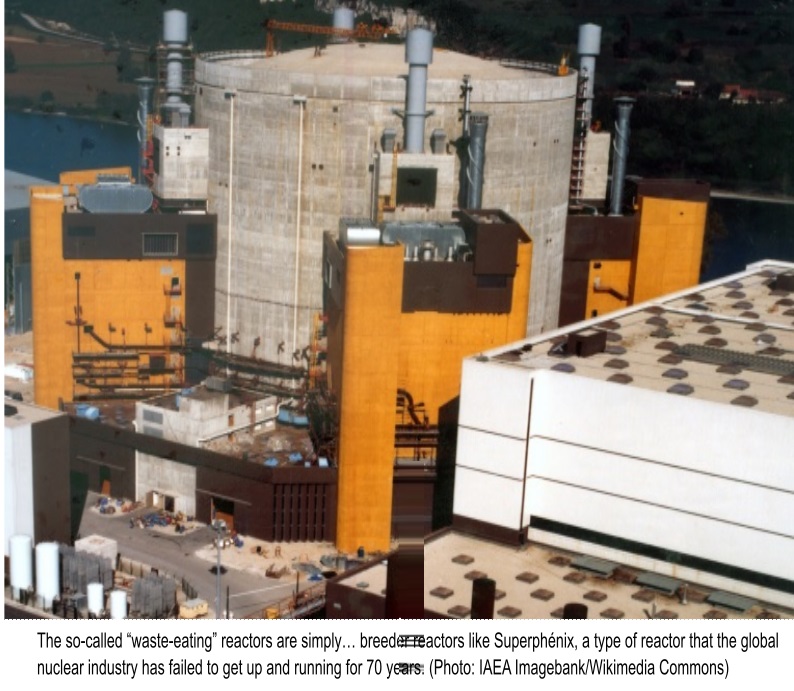
Contrary to popular belief, the French nuclear industry is by no means “triumphant”, “the best in the world” or “at the cutting edge of technology”: in fact, EDF (bankrupt), Areva (renamed Orano after filing for bankruptcy) and CEA (subsidized by public money) are constantly making fools of themselves and leaving the French with astronomical bills.
A magic reactor killed by environmentalists?
By Stéphane Lhomme by beyondnuclearinternational, https://beyondnuclearinternational.org/2024/03/17/a-magic-reactor-killed-by-environmentalists/
On the contrary, a “nuclear waste-eating reactor” does not exist
Appearing as a guest on several TV channels (BFM, Cnews, etc.), a certain Fabien Bouglé managed to fool both viewers and journalists (most of whom are totally ignorant about nuclear power) with a series of fibs, each more enormous than the last. Here are a few clarifications.
There is no such thing as a “nuclear waste-eating” reactor
The smooth-talking Bouglé left his ignorant interlocutors stunned and bewildered as he talked about “waste-eating” reactors that would have already solved the radioactive waste issue if an infamous green lobby, “betraying France to Germany” (sic!), hadn’t “prevented” the advent of such reactors.
So, like throwing a log on the fire, all you have to do is put the radioactive waste produced by today’s power plants into a “magic” reactor, and the waste will disappear.
Mr. Bouglé finally divulged his “secret”: the so-called “waste-eating” reactors are simply… breeder reactors: a type of reactor that the global nuclear industry has failed to operate for 70 years, like Superphénix in France! And, even if it did work, it would in no way eliminate radioactive waste. What’s more, less than 1% of nuclear fuel (the most radioactive waste) could theoretically have its lifespan reduced, but without disappearing and while becoming even more radioactive! In the nuclear industry, as elsewhere, miracles do not exist.
The Astrid project was not “on the way to success” and was not “taken over by Bill Gates”
Despite its pretty name, the Astrid reactor project was nothing more than a little Superphénix: a sodium-cooled breeder reactor. Look at the “progress”: 40 years after the launch of Superphénix (1240 MW), the CEA wanted to make another attempt with a reactor half as powerful (600 MW), before giving up altogether.
Japan’s Monju fast-breeder reactor was definitively shut down after countless failures, a terrible fire and sodium leaks; Germany’s Kalkar fast-breeder reactor was never commissioned; and the USA has abandoned the sector. Only Russia manages to keep its BN800 hobbling along… but it doesn’t perform any of the miracles expected of it (producing “more fissile material than it consumes”, “eating” radioactive waste and other nonsense).
As for Bill Gates, he’s one of the dummies who, in recent years, have announced various types of miraculous reactors, always claiming to be able to produce electricity “cheaply, safely and with little waste” (blah blah blah). Beginning in 2006, Bill Gates and his company Terrapower first tried to make a “travelling wave” reactor work, then a “molten salt” one, both abandoned after wasting billions. Now Gates is dreaming of developing… a sodium-cooled fast-neutron reactor: back to Superphénix and 70 years of failure for the global nuclear industry.

France’s nuclear woes are caused by… France’s nuclear woes!
The “evil anti-nuclear environmentalists” and the so-called “traitors in the pay of Germany” denounced by Inspector Bouglé have nothing to do with the disasters of French nuclear power: EDF, Areva (now Orano) and the CEA are doing just fine on their own! For example:
- Industrial and financial disasters at the EPR sites in Finland, Flamanville and England: 15 to 20 years (instead of four and a half) to build a reactor costing 20 billion Euros instead of 3 billion, and with serious defects.
- The unprecedented scandal of the thousands of defective parts (including the famous Flamanville EPR vessel) produced by Areva in its Le Creusot plants.
- Catastrophic and ruinous flops at the Iter (fusion) and RJH reactor sites.
- Stress corrosion (up to 32 reactors out of 56 shut down at the same time in 2022)
And so on.
Contrary to popular belief, the French nuclear industry is by no means “triumphant”, “the best in the world” or “at the cutting edge of technology”: in fact, EDF (bankrupt), Areva (renamed Orano after filing for bankruptcy) and CEA (subsidized by public money) are constantly making fools of themselves and leaving the French with astronomical bills.
The Fessenheim closure is not the cause of electricity shortages in France and imports from Germany
Mr. Bouglé claims that France was an exporter to Germany before the closure of Fessenheim and that it has suddenly become an importer because of the plant’s closure in 2020. He’s talking nonsense.
In reality, there are exchanges (in both directions) between the two countries throughout the year. When the balance sheet is drawn up on December 31, France is still an importer from Germany (*), and has been for over 25 years (**), long before Fessenheim was shut down.
This phenomenon is mainly due to the absurd choice of electric heating, developed on a massive scale in France to “justify” nuclear power: as soon as it gets cold, electricity consumption is such that it far exceeds the capacity of the French nuclear fleet, even when it’s working properly!
It’s also worth noting the ridiculous claim that life was wonderful in France with 58 reactors, and that it has suddenly gone into crisis with “only” 56 reactors, which in reality is an insane number. For the record, during the stress corrosion crisis, France was saved by importing massive amounts of electricity from neighboring countries, which have only a few reactors, if any at all.
(*) Of course, we can criticize the fact that a significant proportion of Germany’s electricity is generated by coal-fired power plants (even if the share of renewables is increasing exponentially), but the fact is that it’s this “dirty” electricity that heats France every winter, and French nuclear enthusiasts don’t go so far as to refuse this electricity and stay in the cold and dark!
(**) Except, very narrowly, in 2011: following the Fukushima disaster, Germany immediately shut down 8 reactors. But by 2012, France was once again a net importer from Germany.
The joke about waste-eating reactors
Let’s start by noting that nuclear reactors continually produce insane quantities of radioactive waste of various kinds, from nuclear fuel to the tools and clothing used in power plants, which are contaminated… and can’t be “eaten”!
But let’s concentrate on the most radioactive, the spent fuel that comes out of the reactor core after use.
Spent fuel comprises four types of element: plutonium, uranium, fission products and minor actinides. Note that the vast majority of radioactivity is contained in these last two categories.
To attempt reuse this waste fuel, separation work must already be carried out in a gigantic plant such as La Hague. These operations require huge amounts of electricity and using large quantities of terribly corrosive and dangerous chemicals: a far cry from the “clean” energy that could “save the planet”.
– Plutonium
Listening to Mr. Bouglé, the uninformed viewer (and the ignorant journalist) think that all they have to do is recover this fuel and put it in the so-called “waste-eating reactor”, which will make this waste disappear… while producing electricity! Jackpot, bravo and thanks for everything. But Santa Claus doesn’t exist, and it’s all poppycock. And here’s why.
It is used by the military for their atomic weapons. Some of this plutonium can be recovered to make fuel (known as “mox”) for use in today’s power plants, which exacerbates the consequences of an accident when it occurs. Various studies show that this option reduces only slightly the amount of uranium needed from mining. But in no case is this plutonium “eaten” or “incinerated”; it is almost entirely recovered after use.
– Uranium
The uranium resulting from these separation operations, known as “reprocessed uranium”, can theoretically be reused in place of mined uranium, but in reality, this option poses a number of technical problems. EDF has been trying to use it for years in its Cruas power plant (Ardèche), after re-enrichment… in Russia (thanks Putin!). But this remains very marginal, and in no case is this uranium “eaten” or “incinerated”; it is almost entirely recovered after use.
– Fission products
There’s nothing we can do with them, except vitrify them and store them for millennia!
– Minor actinides
These are the only elements of radioactive waste that could theoretically have their lifespan reduced in breeder reactors… while becoming even more radioactive! But even if such a “feat” were to happen (provided we finally manage to operate breeder reactors properly), minor actinides would not be “eaten”, “incinerated” or “disintegrated”. In fact, they are vitrified like fission products and have to be stored for millennia.
Conclusion
Of course, there is no technology that can “eat” nuclear waste. At most, it is theoretically possible (but not in practice) to degrade a tiny fraction of it, and even then, at the cost of new radioactive and chemical contamination and very high energy consumption.
Once and for all, let’s remember that there will never be a nuclear miracle, be it with magic reactors, or by replacing uranium with thorium (the thorium sector is also that of fast-breeder reactors!), or with fusion, or by calling old projects that have never worked “4th generation” or “SMR”.
Stéphane Lhomme is Director of the Nuclear Observatory.
Will Biden’s, NATO’s military personnel in Ukraine cross the last red line to Armageddon?

Walt Zlotow, West Suburban Peace Coalition, Glen Ellyn IL
French President Emmanuel Macron is pushing to send NATO troops to Ukraine to keep Ukraine from imminent defeat to Russia. “The time has come for a Europe where it will be appropriate not to be a coward.” Macron got a lot of pushback form less delusional NATO leaders including German Chancellor Olaf Scholz and NATO Secretary-General Jens Stoltenberg.
Other NATO countries have joined France at considering direct troop involvement. Estonia’s Prime Minister Kaja Kallas stated that “Everything is on the table.” Lithuanian Foreign Minister Gabrielius Landsberg agreed that “nothing can be taken off the table, no option can be rejected out of hand. I very much welcome and encourage the discussion that has started.”
But unbeknownst to most Americans, due to government censorship, is that NATO military personnel are already there serving as a tripwire to wider, possibly nuclear war.
The British Prime Minister’s office confirmed recently that “Beyond the small number of personnel we do have in the country supporting the armed forces of Ukraine, we haven’t got any plans for large-scale deployment.” Didn’t we hear the same thing from US officials regarding ‘US advisors in Vietnam?
German Chancellor Scholz refused to send Taurus missiles to Ukraine because it would require German personnel to operate them. Britain and France aren’t so cautions. Scholz stated that France also has military personnel in Ukraine along with England to assist Ukraine military operations. He hinted at US presence there stating “It’s known that there are numerous people there in civilian attire who speak with an American accent.” The NY Times reported last month that numerous CIA operatives were left in Ukraine when the war started and “scores of new officers were sent in to help the Ukrainians.”
President Biden may have slipped in his State of the Union Speech last week when he uttered “There are no American soldiers (of war) in Ukraine, and I intend to keep it that way.” Biden should have added ‘But we sure have a lot of helpers there and I intend to keep it that way.’
The US and NATO are playing a dangerous game with Mother Earth and her 8 billion residents. For 750 days they’ve been crossing red lines Russia has put up to protect their borders from NATO encroachment. When Biden became president, he continued the reckless US campaign to arm Ukraine in their civil war against Russian leaning Ukrainians in Donbas seeking independence from Ukraine violence and subjugation. He repeatedly floated NATO membership to Ukraine. He rebuffed every desperate entreaty by Russia to even begin discussing their border security concerns.
The result? Russia invaded Ukraine 2 years ago February 24, 2022…after 15 years of warnings. Having catastrophically bungled the diplomacy that instigated the war, Biden could have made amends by supporting the peace agreement Ukraine’s Zelensky and Russia’s Putin negotiated in the war’s first month. Instead of support, he sabotaged it.
Biden and his NATO buddies have marched right up to, and sometimes over, numerous Russian red lines with billions in weapons, extreme rhetoric, sanctions and diplomatic maneuvering with largely unsupportive nations. Now with US and NATO military and intelligence personnel in Ukraine, and ominous calls for combat troops, we should all fret that the next red line Biden and NATO’s war cabinets cross may trigger a mushroom cloud.
The International Atomic Energy Agency recruiting spies?

I have recently received three offers via LinkedIn to apply for different job openings at the International Atomic Energy Agency.
Needless to say I won’t be pursuing a tax-free life in Vienna, or at least not with the IAEA. I’ll actually be in Brussels with something to say about their ridiculous summit, along with a network of activists from different organizations across Europe.
And at Beyond Nuclear — as well as on my LinkedIn page — we will continue to call out the hypocrisies and conflicts of interest of the IAEA.
The official mission of the IAEA, an agency of the United Nations, is that it quote “seeks to promote the safe, secure and peaceful use of nuclear technologies.”
What it is actually seeking to promote, with unprecedented aggression, is a massive expansion of nuclear energy. This is the exact opposite of “peaceful” and presents some real proliferation problems the agency seems entirely willing to ignore.

A spy in Vienna
By Linda Pentz Gunter beyondnuclearinternational, https://beyondnuclearinternational.org/2024/03/17/a-spy-in-vienna/
The IAEA is recruiting, but it’s barking up all the wrong trees
Note: On March 21st the International Atomic Energy Agency will be hosting what it bills as the “First Nuclear Energy Summit” in Brussels, Belgium, co-hosted with the Belgian government. We will have something to “show” and “tell” about that next week.
I have recently received three offers via LinkedIn to apply for different job openings at the International Atomic Energy Agency. Each time, the representative from the IAEA who pitched me wrote that: “I just came across your profile, and it caught my attention”, then described the job itself and why my skill set was ideally suited. Really?
Caught their attention, yes, although evidently they didn’t actually read what is on my LinkedIn page. Unless the IAEA is looking to “turn” me, because I presume what they don’t want is a dissenting mole in their midst. That would mean the IAEA had suddenly developed a conscience.
It was tempting, though, given the goodies thrown in.
“As this position is based in Vienna, Austria, we would support you with multiple benefits, including relocation, rental subsidy, visa support, education grant for your children, tax-free salary, health insurance, and many more,” read each invitation.
Wow, I am in the wrong job! But for all the right reasons.
The official mission of the IAEA, an agency of the United Nations, is that it quote “seeks to promote the safe, secure and peaceful use of nuclear technologies.”
What it is actually seeking to promote, with unprecedented aggression, is a massive expansion of nuclear energy. This is the exact opposite of “peaceful” and presents some real proliferation problems the agency seems entirely willing to ignore.

The IAEA’s Director General, Rafael Grossi, has insisted, as the war in Ukraine drags on, imperiling its 15 nuclear reactors — most dangerously the six at Zaporizhzhia — that nuclear power is not the problem; the war is. “It’s very simple, the problem in Ukraine and in Russia is they are at war. The problem is not nuclear energy,” Grossi told the BBC.
And yet, even as Grossi sounds ever more urgent alarms about the potential for nuclear catastrophe in Ukraine (despite his agency’s mission statement that nuclear energy is intrinsically safe, secure and peaceful), he is busy promoting the expansion of nuclear power around the world with evangelical zeal.
Currently, the IAEA’s proudest headline amongst its 2023 highlights and achievements is that nuclear power “made history at COP28.”
It’s referring, of course to the ludicrous and widely panned announcement, by 22 countries at the time, during last winter’s COP28 climate summit in Dubai, that the world should triple its nuclear capacity by 2050, something that has absolutely zero chance of happening. Nor should it.

This followed an October 2023 IAEA press release, that trumpeted, “First-Ever Nuclear Energy Summit to be Held in Brussels in March 2024.” It will mark a gathering of the cabal that supports the IAEA’s misleadingly titled campaign, Atoms4NetZero, which of course is impossible. Nuclear power involves uranium mining, fuel manufacture, transportation, construction and waste production, none of which is now — or ever will be — net zero.
The Brussels summit, says the IAEA, will see “leaders from around the world” gathering “to highlight the role of nuclear energy in addressing the global challenges to reduce the use of fossil fuels, enhance energy security and boost economic development”.
Again, none of this is achievable. Nuclear power, given its extreme costs and long timelines (never mind the dangers and human rights violations) can only impede and slow reductions in fossil fuel use by getting in the way of cleaner, safer, cheaper and faster renewable energy implementation whose technology, unlike the fantasy fission and fusion reactors of the future, is here now.
The IAEA has a long history as a nuclear apologist, promoter and defender. After the 1986 Chornobyl nuclear explosion, the agency was notorious in downplaying and even concealing the true health impacts of the disaster. It effectively has a gag order on the World Health Organization, which must be subordinate* to the IAEA on matters of radiation and health — something the IAEA is not qualified to assess. And yet, the IAEA effectively censors the WHO in its own area of expertise!
The IAEA was lurking around the halls of the Second Meeting of States Parties to the Treaty on the Prohibition of Nuclear Weapons in New York last November. On November 30, a declaration was published wrapping up the meeting that was abruptly revised and re-issued the next day. The new version contained a clause (27) missing from the previous day’s statement that read:
“We once again emphasize that nothing in the TPNW shall be interpreted as affecting the inalienable right of its States Parties to develop research, production and use of nuclear energy for peaceful purposes without discrimination.”
The burning need to re-emphasize what is effectively the IAEA’s mission apparently came on the initiative of Vietnam, although there was no dissent. How ironic that it was Vietnam, a country that has considered building massive nuclear power plants in the coastal province Ninh Thuan through contracts with Russia and Japan. For now, both schemes have been canceled. Vietnam will be one of the first countries to be inundated by climate crisis-induced sea-level rise and yet, despite its eighteen hundred miles of vulnerable coastline, the country is once again toying with the idea of new nuclear power plants, this time both small modular and floating off-shore reactors.
Needless to say I won’t be pursuing a tax-free life in Vienna, or at least not with the IAEA. I’ll actually be in Brussels with something to say about their ridiculous summit, along with a network of activists from different organizations across Europe.
And at Beyond Nuclear — as well as on my LinkedIn page — we will continue to call out the hypocrisies and conflicts of interest of the IAEA.
*The Independent WHO vigils are no longer active.
Linda Pentz Gunter is the international specialist at Beyond Nuclear and writes for and curates Beyond Nuclear International.
Huge UK £286bn nuclear submarine deal with US at risk for one reason warns ex Navy chief

The construction of modern nuclear submarines requires more expertise than it took to land a man on the Moon, says the former chief of the Royal Navy.
EXPRESS UK, By CIARAN MCGRATH, Senior News Reporter, Sat, Mar 16, 2024
The first will see the US and UK share technology with Australia in order to develop a new class of nuclear-powered submarines, the SNN-AUKUS, while the second pillar will focus on cyber capabilities, artificial intelligence, quantum technologies, and additional undersea capabilities.
However, speaking earlier this month, Hugh White, an emeritus professor of strategic studies at the Australian National University, voiced his doubts about the long-term viability of AUKUS, citing estimated costs of up to £286 billion between now and the 2050s.
Prof White told ABC RN’s Global Roaming: “I think the chance of the plan unfolding effectively is extremely low.”
Meanwhile, in an analysis published last week, Allan Behm, director of Australia’s International and Security Affairs Program, wrote: “The 2021 AUKUS announcement came with the promise of a sovereign Australian fleet of nuclear-powered submarines.
“Nearly 18 months on, however, it remains unclear if these submarines will ever be delivered – or if Australia actually needs them.”………………
He explained: “Pillar Two is very useful, and there’s a discussion about whether Japan be allowed to get involved, should Canada be involved, etc, that’s great.
“But with Pillar One, there are a number of complications. So, yes, there’s a cost which is huge, and the Australians seem to be committed to it.
“But there are now a number of voices in Australia saying, can we really do this, as one would expect
“The other thing is the Americans themselves, who are going to be selling four Virginia class submarines to the Australians as a stop-gap.
“They are short of nuclear attack submarines and so there are people in America who are saying, ‘well, how are we sure we want to do this because we can’t build enough quickly enough to fill up the gap when we get rid of the ones we’re giving to Australia’.”
The Royal Navy currently operates six fleet submarines (SSNs), of the Trafalgar and Astute classes, with two more Astute-class boats currently under construction, and four ballistic missile submarines (SSBN), of the Vanguard class, equipped with nuclear weapons. All are nuclear powered.
However, Lord West emphasised that such vessels did not simply “come off the conveyor belt”.
He explained: “The Astute class submarines are more complex than the technical work to land a man on the moon. That is how incredibly complex the technology is. https://www.express.co.uk/news/world/1877871/aukus-deal-australia-royal-navy-astute-class
Israel government continues to block aid response despite ICJ genocide court ruling, says Oxfam
March 18, 2024, by: The AIM Network
Oxfam Australia Media Release
International community resorts to sea routes and air drops rather than challenge Israel for systemically undermining unfettered access of relief
Israeli authorities have rejected a warehouse full of international aid including oxygen, incubators and Oxfam water and sanitation gear all of which is now stockpiled at Al Arish just 40 km away from the border of 2.3 million desperate Palestinians in Gaza.
The aid originates from many humanitarian organisations around the world and has been rejected over weeks and months as result of an unpredictable and chaotic regime of approval, scanning and inspection, ultimately controlled by Israeli authorities. The reasons for rejection are not clear, says Oxfam.
In a new report today, Oxfam said this rejected aid was just one example of an overall humanitarian response that Israel has made so dangerous and dysfunctional as to be impossible for aid agencies to work at the speed and scale necessary to save lives, despite best efforts.
Oxfam says that Israel’s government ultimately bears accountability for the breakdown of the international response to the crisis in Gaza. It is failing in its legal responsibilities to the people whose land it occupies and breaking one of the key provisions demanded by the International Court of Justice (ICJ) – to boost humanitarian aid in light of the risk of genocide in Gaza.
Oxfam believes that people living in Gaza will suffer mass death from disease and starvation far beyond the current 31,000 Palestinian war casualties unless Israel takes immediate steps to end its violations………………………………………………………………………………………………………………………… more https://theaimn.com/israel-government-continues-to-block-aid-response-despite-icj-genocide-court-ruling-says-oxfam/
Netanyahu approves Rafah ground invasion, despite Biden opposition
Israeli Defense Force is reportedly planning a civilian evacuation before the invasion
By Timothy H.J. Nerozzi Fox News, March 15, 2024 , https://www.foxnews.com/world/netanyahu-approves-rafah-ground-invasion-despite-biden-opposition—
Israel will commence an invasion into the Gaza city of Rafah, despite protests from the United States and other international powers.
Israeli Prime Minister Benjamin Netanyahu announced approval of the operation via his office on Friday.
The Israeli Defense Force will invade the city in southern Gaza as part of its larger military operations in the region.
NETANYAHU VOWS TO INVADE RAFAH REGARDLESS OF POTENTIAL CEASE-FIRE WITH HAMAS: ‘IT WILL HAPPEN’
The operation will reportedly include an evacuation of civilians, according to The Jerusalem Post.
The Prime Minister’s office also announced that an Israeli delegation would leave for Doha to continue negotiations for the release of hostages.
The security cabinet must first arrive at a comprehensive position on the pressing issue.
ISRAELI STRIKES IN RAFAH LEAVES 31 PALESTINIANS DEAD AHEAD OF PLANNED GROUND INVASION
The U.S. government has repeatedly opposed Israeli plans to launch the Rafah ground invasion.
The administration is said to have proposed a draft U.N. Security Council resolution, which in part would call for a temporary cease-fire and call on Israel not to go into Rafah in the Gaza Strip.
Senate Majority Leader Chuck Schumer went so far as to call for a change of leadership in Israel that is more willing to consider a cease-fire and abandon plans for further ground operations.
President Biden seemed to sign off on these remarks, saying on Friday from the Oval Office, “Senator Schumer contacted my staff, my senior staff. I’m not going to elaborate on the speech. He made a good speech, and I think he expressed a serious concern, shared not only by him but by many Americans.”
The Israeli government released its post-war plan for Gaza last month, a deal that was immediately rejected by Palestinian officials.
Under the plan, Israel would seek open-ended control over security and civilian affairs in the Gaza Strip. Netanyahu’s government has flatly rejected calls for a two-state solution, which Biden’s administration continues to push for.
Fox News Digital’s Anders Hagstrom contributed to this report.
Musk’s SpaceX is building spy satellite network for US intelligence agency, sources say
By Joey Roulette and Marisa Taylor, March 17, 2024
WASHINGTON, March 16 (Reuters) – SpaceX is building a network of hundreds of spy satellites under a classified contract with a U.S. intelligence agency, five sources familiar with the program said, demonstrating deepening ties between billionaire entrepreneur Elon Musk’s space company and national security agencies.
The network is being built by SpaceX’s Starshield business unit under a $1.8 billion contract signed in 2021 with the National Reconnaissance Office (NRO), an intelligence agency that manages spy satellites, the sources said.
The contract signals growing trust by the intelligence establishment of a company whose owner has clashed with the Biden administration and sparked controversy, opens new tab over the use of Starlink satellite connectivity in the Ukraine war, the sources said.
The Wall Street Journal reported, opens new tab in February the existence of a $1.8 billion classified Starshield contract with an unknown intelligence agency without detailing the purposes of the program.
Reuters reporting discloses for the first time that the SpaceX contract is for a powerful new spy system with hundreds of satellites bearing Earth-imaging capabilities that can operate as a swarm in low orbits, and that the spy agency that Musk’s company is working with is the NRO.
Reuters was unable to determine when the new network of satellites would come online and could not establish what other companies are part of the program with their own contracts.
SpaceX, the world’s largest satellite operator, did not respond to several requests for comment about the contract, its role in it and details on satellite launches. The Pentagon referred a request for comment to the NRO and SpaceX.
In a statement the NRO acknowledged its mission to develop a sophisticated satellite system and its partnerships with other government agencies, companies, research institutions and nations, but declined to comment on Reuters’ findings about the extent of SpaceX’s involvement in the effort…………………………………………..
They’re Really Going To Try To Lay All The Blame For Gaza On Netanyahu

They’re really going to try to pin all the blame for the incineration of Gaza on Benjamin Netanyahu so that nothing has to change when this is over. The western empire has chosen a single scapegoat to carry away its sins so the status quo can march on unhindered by guilt or consequence.
They want everyone to pin all the blame for the Gaza genocide on Netanyahu, but this is not all the fault of Netanyahu. It’s the fault of the entire Israeli state. It’s the fault of Joe Biden. It’s the fault of the Democrats. It’s the fault of all the Israel supporters on Capitol Hill. It’s the fault of the western press. It’s the fault of the Israel lobby. It’s the fault of the unelected empire managers in US government agencies. It’s the fault of the entire US empire and all its imperial member states like Australia, the UK, the EU, and Canada.
By trying to make this mass atrocity solely the fault of Netanyahu and not the giant, sprawling network of immensely powerful institutions which made it possible, they’re working to ensure that no changes will need to be made to any of those institutions. It’s just like how they made a scapegoat of Judith Miller for the entire mass media’s war propaganda in the lead-up to the Iraq invasion and let all the blame for the war hang on Bush (before completely rehabilitating Bush’s image during the Trump administration and deciding he’s a pretty great guy after all). No meaningful changes were ever made to ensure that the US power alliance never repeats its horrible crimes after Iraq, which is why it keeps repeating horrible crimes.
The trouble with Israel apologia on Gaza is that at first glance its talking points sound legit if you don’t know much about Israel-Palestine. “Israel has a right to defend itself”, “They need to get rid Hamas because of October 7” etc would sound entirely reasonable if you didn’t know that Israel is a settler-colonialist apartheid state who has been murdering, abusing and stealing from the indigenous population of the land for generations.
The amount of energy needed to see through the talking points is far greater than the amount of energy needed to speak them — it’s one of those “A lie gets halfway around the world before the truth even gets its pants on” kind of deals. Which is why it’s miraculous that so many people around the world are getting educated enough to see through the lies and support the Palestinians.
How are they getting educated enough? Mostly through online content which sums up the situation quickly and concisely enough for them to understand easily. That’s the only way the truth can move quickly enough to catch up with the lies. And that’s the role TikTok has played here, which is why we’ve seen Israel lobbyists and the ADL shrieking their lungs out about it for months.
It would never have occurred to any American to think TikTok is a five-alarm foreign enemy threat until their government told them to think that, and then when they did the biggest bootlickers in the world started acting like it’s just a common sense fact they’ve always believed.
Americans who’d trust their own government to oversee their communications more than they’d trust China have missed all the most important lessons about the US government that have come out in their lives. Even if China really is getting data from TikTok (and there’s currently no evidence that it is), only a groveling empire simp would object to it.
Saying TikTok must be suppressing pro-Israel content because pro-Palestine content is more popular is like saying they’re suppressing flat earth content because round earth content is more popular. Pro-Israel content is just less popular in general, which is why the gap is the same on Facebook and Instagram.
❖
The US government is like “No no it’s not censorship, we’re just using state power to ensure that popular speech platforms are only allowed to exist if they can be controlled by US government agencies.”
Israel has done so much fucked up shit in the last few days we’ve already forgotten the news that they literally tortured UN staff to extract false statements about UNRWA having Hamas connections.
They. Tortured. UN. Staff. If we had anything remotely like objective news reporting in the western press, this would have been the top story everywhere for days.
❖
Once you see how evil Israel’s actions are you start to understand why its defenders need to resort to just calling anyone who criticizes Israel a Jew-hater.
❖When Israel apologists say “antisemite” it’s just a meaningless noise made to hurt the feelings of the person it’s said to. Once you realize this it starts to land in exactly the same way as any other infantile name-calling from anyone else who’s lost the argument.
1 This Month
23-25 October – on Zoom – World BEYOND War’s annual global conferenc


Shut down the radiation-damaged Heysham nuclear reactors now
To see nuclear-related stories in greater depth and intensity – go to https://nuclearinformation.wordpress.com

Say No to NASA’s Reckless Nuclear Reactor on the Moon
Say No to NASA’s Reckless Nuclear Reactor on the Moon

-
Archives
- October 2026 (209)
- September 2026 (339)
- August 2026 (330)
- July 2026 (355)
- June 2026 (287)
- May 2026 (306)
- April 2026 (356)
- March 2026 (251)
- February 2026 (267)
- January 2026 (308)
- December 2025 (358)
- November 2025 (359)
-
Categories
- 1
- 1 NUCLEAR ISSUES
- business and costs
- climate change
- culture and arts
- ENERGY
- environment
- health
- history
- indigenous issues
- Legal
- marketing of nuclear
- media
- opposition to nuclear
- PERSONAL STORIES
- politics
- politics international
- Religion and ethics
- safety
- secrets,lies and civil liberties
- spinbuster
- technology
- Uranium
- wastes
- weapons and war
- Women
- 2 WORLD
- ACTION
- AFRICA
- Atrocities
- AUSTRALIA
- Christina's notes
- Christina's themes
- culture and arts
- Events
- Fuk 2022
- Fuk 2023
- Fukushima 2017
- Fukushima 2018
- fukushima 2019
- Fukushima 2020
- Fukushima 2021
- general
- global warming
- Humour (God we need it)
- Nuclear
- RARE EARTHS
- Reference
- resources – print
- Resources -audiovicual
- Weekly Newsletter
- World
- World Nuclear
- YouTube
-
RSS
Entries RSS
Comments RSS

